It often isn’t easy to determine whether information falls into the “miss-” (unintentional) category or the “dis-” (intentional) category.
For instance, Fox News has promulgated faulty information of the “dis-” sort, while your addled neighbor usually mouths “mis-“.
I have the infinite ability to create U.S. dollars just by pressing computer keys, but I want you to give me more dollars and keep fewer for yourself. Crazy, huh?
The following article comes from the Associated Press, so I would put it in the misinformation category.
National debt: Trump’s big challengePaying down $36T could limit his tax cuts, other policiesBy Josh Boak and Fatima Hussein Associated PressWASHINGTON — President-elect Donald Trump has big plans for the economy — and a big debt problem that will be a hurdle to delivering on them.Trump has bold ideas on tax cuts, tariffs and other programs, but high interest rates and the price of repaying the federal government’s debt could limit what he’s able to do.
High interest rates and debt do not prevent anything. The government has infinite money available to fund anything.
And heaven forbid we ever begin to “repay” the federal debt (which isn’t federal and isn’t debt).
The federal debt is the total of deposits in Treasury Security accounts, all wholly owned by the depositors, not the federal government.
These accounts can be “repaid” simply by returning the dollars currently in the accounts to the depositors. This would not burden the government, taxpayers, or anyone else.
The article’s authors believe that federal so-called “debt” should be reduced, which requires increased taxes and/or reduced deficits. This is what reducing federal debt causes:
Every U.S. depression has come on the heels of a federal “debt” reduction.
1804-1812: U. S. Federal Debt reduced 48%. Depression began 1807.
1817-1821: U. S. Federal Debt reduced 29%. Depression began 1819.
1823-1836: U. S. Federal Debt reduced 99%. Depression began 1837.
1852-1857: U. S. Federal Debt reduced 59%. Depression began 1857.
1867-1873: U. S. Federal Debt reduced 27%. Depression began 1873.
1880-1893: U. S. Federal Debt reduced 57%. Depression began 1893.
1920-1930: U. S. Federal Debt reduced 36%. Depression began 1929.
1997-2001: U. S. Federal Debt reduced 15%. Recession began 2001.
The reason is simple. Federal debt reduction removes dollars from the economy, which causes the economy to shrink. By definition, a shrinking economy is a depression.
There is no magic here. To grow, an economy must have a growing supply of spending money. The formula is:
GDP = Federal and Non-federal Spending + Net Exports
There is no way to avoid a recession or depression when the money supply shrinks. Basic mathematics.
Not only is the federal debt at roughly $36 trillion, but the spike in inflation after the coronavirus pandemic and Russia’s invasion of Ukraine have pushed up the government’s borrowing costs such that debt servicenext year will easily exceed spending on national debt.
Again, the AP writers demonstrate monumental ignorance about federalfinancing, which is quite different from the businessfinancing Donald Trump and Elon Musk know.
First, the federal government is Monetarily Sovereign and has the infinite ability to create U.S. dollars. So it has no need to borrow dollars and, indeed, doesn’t.
Statement from the St. Louis Fed: “As the sole manufacturer of dollars, whose debt is denominated in dollars, the U.S. government can never become insolvent, i.e., unable to pay its bills. In this sense, the government is not dependent on credit markets to remain operational.”
“Not dependent on credit markets” is Fed-speak for “doesn’t borrow.”
Those T-bills, T-notes, and T-bonds mistakenly are called “borrowing,” though they are depositsinto accounts similar to safe deposit boxes.
The government never owns those dollars, so it does not owe them. Instead, it merely holds them in a secure place and returns them to their owners to repay the so-called borrowing.
Second, “debt service” means interest payments, which the federal government can do endlessly without collecting a penny in taxes.
The higher cost of servicing the debt gives Trump less room to maneuverwith the federal budget as he seeks income tax cuts.
Unlike state and local governments, the federal government has infinite “room to maneuver.” Even if the misnamed “debt” were double or triple its current size, the federal government could cut taxes to $0 and still pay all its bills simply by pressing computer keys.
It’s also a political challenge because higher interest rates have made it costlier for many Americans to buy a home or new automobile. And the issue of high costs helped Trump reclaim the presidency in November’s election.
The Fed raises interest rates to fight inflation. However, contrary to popular wisdom, those higher rates actually cause inflation.
Almost every business must add interest to its cost of goods and services. Raising rates increases the cost of goods and services, which exacerbates inflation.
“It’s clear the current amount of debt is putting upward pressure on interest rates, including mortgage rates for instance,” said Shai Akabas, executive director of the economic policy program at the Bipartisan Policy Center. “The cost of housing and groceries is going to be increasingly felt by households in a way that are going to adversely affect our economic prospects.”
“Federal debt” (which isn’t federal and isn’t debt) does not put pressure on anything. Interest rates are set arbitrarily by the Fed and are not forced by anything.
The so-called “debt” isn’t federal, because the dollars always remain the depositor’s property. It isn’t debt because the government never owned or owed the dollars; it merely held them for depositors in safe storage.
The government doesn’t need to accept T-security deposits. T-securities’ purpose is not to provide the government with spending money but rather to provide a safe place for dollar holders to store unused dollars.
China, for instance, would much prefer to store its unused dollars in Treasury Security accounts than in any bank.
This safety stabilizes the dollar, making it attractive as the world’s primary money choice.
Akabas stressed that the debt service is already starting to crowd out government spendingon basic needs, such as infrastructure and education. About 1 in 5 dollars spent by the government are repaying investors for borrowed money, instead of enabling investments in future economic growth.
Because the federal government has infinite dollars, it does not borrow. So-called “debt service” is interest on T-security deposits.These payments do not “crowd out” spending. On the contrary, federal payments add growth dollars to the economy.
Bessent: I never knew that federal finances are different from business finances. Maybe that’s why President Trump chose me to be Treasury Secretary.It’s an issue on Trump’s radar. In his statement on choosing billionaire investor Scott Bessent to be his Treasury secretary, the Republican president-elect said Bessent would “help curb the unsustainable path of Federal Debt.”
The debt service costs along with the higher total debt complicate Trump’s efforts to renew his 2017 tax cuts, much of which are set to expire after next year. The higher debt from those tax cuts could push interest rates higher, making debt service even costlier and minimizing any benefits the tax cuts could produce for growth.
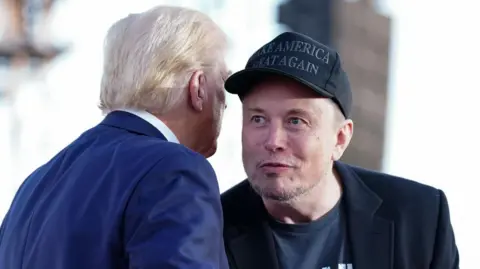
DT: Don’t tell anyone, but someone said federal finance is Monetarily Sovereign, while business finance is monetarily non-sovereign. I don’t know the difference, do you? EM: Never heard of it.
Utter nonsense. Tax collections could be cut to $0, and the government could continue to spend, forever.
Nothing “pushes” interest rates higher. They are set arbitrarily by the Fed.
“Clearly, it’s irresponsible to run back the same tax cuts after the deficit has tripled,” said Brian Riedl, a senior fellow at the Manhattan Institute and a former Republican congressional aide. “Even congressional Republicans behind the scenes are looking for ways to scale down the president’s ambitions.”
This is another classic example of ignorance about federal finance.
They don’t understand the difference between Monetarily Sovereign (federal government) and monetary non-sovereignty (state and local governments).
Democrats and many economists say Trump’s income tax cuts disproportionately benefit the wealthy, which deprives the government of revenues needed for programs for the middle class and poor.
The tax cuts disproportionately benefit the wealthy but do not deprive the government of revenues. It has infinite revenues. The ignorance is appalling.
“The president-elect’s tax policy ideas will increase the deficit because they will decrease taxes for those with the highest ability to pay, such as the corporations whose tax rate he’s proposed reducing even further to 15%,” said Jessica Fulton, vice president of policy at the Joint Center for Political and Economic Studies, a Washington-based think tank that deals with issues facing communities of color.
Increasing the deficit adds growth dollars to the economy. Cutting corporate taxes helps the economy grow. The federal deficit is not a burden on the government or on taxpayers.
Seemingly, the Joint Center for Political and Economic Studies doesn’t understand basic economics.
Trump’s team insists he can make the math work.“The American people reelected President Trump … to implement the promises he made on the campaign trail, including lowering prices. He will deliver,” said Karoline Leavitt, the Trump transition spokeswoman.
He won’t deliver if he increases import duties as he promises. American consumers pay those duties.
When Trump was last in the White House, the federal government was spending $345 billion annually to service the national debt. It was possible to run up the national debt with tax cuts and pandemic aid because the average interest rate was low, making repayment costs manageable even as debt levels climbed.
The federal government doesn’t pay for debt; it merely returns depositors’ money. In any event, the federal government has the infinite ability to pay for anything without collecting taxes.
The sole purposes of taxes are to:
Control the economy by taxing what the government wishes to discourage and by giving tax breaks to what the government wishes to reward and
To assure demand for the U.S. dollar by requiring taxes be paid in dollars.
Federal taxes do not provide the federal government with spending money.
Congressional Budget Office projections indicate that debt service costs next year could exceed $1 trillion. What fueled the increased cost of servicing the debt? Higher interest rates.
Translation: The federal government will pump more than 1 trillion growth dollars into the economy at no cost to anyone.
A political leader not knowing the differences between Monetary Sovereignty and monetary non-sovereignty is like a baker not knowing the differences between salt and sugar.In April 2020, when the government was borrowing trillions of dollars to address the pandemic, the yield on 10-year Treasury notes fell as low as 0.6%. They’re now 4.4%, having increased since September as investors expect Trump to add several trillions of dollars onto projected deficits with his income tax cuts.
The federal government never borrows dollars. It has the infinite ability to create dollars.
Treasury securities do not represent borrowing. They are deposits, easily returned simply by sending them back to their owners.
The Fed arbitrarily determines interest rates, which could be 0% if it chooses to.
Democratic President Joe Biden can point to strong economic growth and successfully avoiding a recessionas the Federal Reserve sought to bring down inflation. Still, deficits ran at unusually high levels during his term. That’s due in part to his initiatives to boost manufacturing and address climate change, and to the legacy of Trump’s previous tax cuts.
Federal deficits are income for the economy. Without federal deficits, the economy would not grow, and the greater the deficits, the greater the growth.
People in Trump’s orbit, as well as Republican lawmakers, are already scouting out ways to reduce spending to minimize the debt and bring down interest rates.
The Fed could bring down interest rates simply by lowering the base rate. Reducing federal debt causes depression.
Elon Musk and Vivek Ramaswamy, the wealthy businessmen leading Trump’s efforts to cut government costs, have proposed simply refusing to spend some of the money approved by Congress. It’s an idea that Trump has also backed, but it would likely provoke challenges in court as undermining congressional authority.
Musk and Ramaswamy are showing pure ignorance. They seemingly don’t understand that our Monetarily Sovereign government has the infinite ability to create dollars.
The so-called “debt” does not burden the government or taxpayers.
Refusing to spend money is refusing to insert growth dollars into the economy.
Russell Vought, the White House budget director during Trump’s first term and Trump’s choice to lead it again, put out an alternative proposed budget for 2023 with more than $11 trillion in spending cuts over 10 years to potentially generate a surplus.
Translation: Russell Vought proposed costing the economy $11 trillion.
Trump has also talked up tariffs on imports to generate revenues and reduce deficits, while some GOP lawmakers have discussed adding work requirements to trim Medicaid expenses.
Tariffs on imports are identical to taxes. Thus, Trump wants to increase taxes and reduce economic income.
SUMMARY
Our leaders’ ignorance of the difference between federal and business finance is like a baker’s ignorance of the difference between salt and sugar.
Decisions based on ignorance cause massive damage. Try baking a cake using salt instead of sugar.
The facts are:
The U.S. federal government is uniquely Monetarily Sovereign. It creates dollars simply by pressing computer keys. It never can run short of dollars.
The U.S. economy is monetarily non-sovereign. During recessions and depressions, it can and often does run short of dollars.
Being Monetarily Sovereign, the federal government never borrows dollars. Treasury bonds are fundamentally different from corporate bonds. Treasury bonds are a safe storage device, while corporate bonds are used to obtain spending dollars. The same word, “bonds,” describes two completely different functions.
While state government taxes provide states with spending money, federal taxes have a different purpose — to control the economy and assure demand for the U.S. dollar.
In short, confusion arises when words like “bond,” “note,” “debt,” “owe,” and even “tax” have different purposes and functions when applied to federal finances vs. personal finances.
It’s one thing for the public not to understand the differences. It’s far worse when our political leaders don’t.
Rodger Malcolm Mitchell
Monetary SovereigntyTwitter: @rodgermitchellSearch #monetarysovereigntyFacebook: Rodger Malcolm Mitchell;MUCK RACK: https://muckrack.com/rodger-malcolm-mitchell; https://www.academia.edu/
……………………………………………………………………..
The Sole Purpose of Government Is to Improve and Protect the Lives of the People.
THE WEEK publishes short, timely articles using an unusual format. Each article begins with a setup, followed by short sections presenting two or more sides of an argument and ending with a summary and opinion.
It is one of my favorite magazines. So, it grieves me to read the following assemblage of outright misinformation and nuttery in a magazine I read every week.
The national debt threatThe federal government is spending ever more money servicing an ever-larger debt pile. Are we headed for a crisis?
What does the U.S. owe?
The national debt stands at nearly $35 trillion, or more than $100,000 per person.
And there it is, concise and misleading. The U.S. does not owe $35 trillion, nor do you owe the $100,000 referenced.
The so-called “national debt” is based on the total of all federal deficits (spending minus taxes). The government doesn’t owe the deficits; they all have been paid.
The “national debt” also includes deposits (not borrowing) into Treasury Security accounts (T-bills, T-notes, T-bonds). These accounts resemble bank safe deposit boxes in that the contents are owned and touched only by the depositors, not by the federal government.
The purpose of T-security accounts is not to lendspending money to the government. The government never touches those dollars. They remain the property of the depositors.
Periodically, the government adds interest dollars to the T-security accounts. These are not tax dollars (which are destroyed upon receipt.) They are created ad hoc, from thin air, at the touch of computer keys.
Former Federal Reserve Chairman Ben Bernanke:“The U.S. government has a technology, called a printing press (or, today, its electronic equivalent), that allows it to produce as many U.S. dollars as it wishes at essentially no cost. It’s not tax money… We simply use the computer to mark up the size of the account.”
The purposes of T-security accounts is to:
Provide as safe storage place for unused dollars and,
To help the Federal Reserve control interest rates by setting the rates for the T-securities
Upon maturity, depositors receive their deposits + interest. The government merely returns the dollars that exist in each depositor’s T-security account.
No tax dollars are used. No taxpayers are obligated. You don’t owe the dollars. They already exist in the accounts, and are returned. No “debt” is involved.
The debt has climbed sharply over the past two decades — we owed $5.7 trillion in 2000 —with both Democratic and Republican administrations running budget deficits, meaning they spent more than they took in.
“We” (the federal government or you) don’t owe anything.
It is true that the government has spent more than it took from taxpayers. This is the only way the economy can grow.It is 100% necessary for the federal government to run deficits, i.e. to create dollars and add them to the economy.
When the federal government instead runs surpluses instead of deficits, this is what happens:
U.S. depressions come from federal surpluses.
1804-1812: U. S. Federal Debt reduced 48%. Depression began 1807.
1817-1821: U. S. Federal Debt reduced 29%. Depression began 1819.
1823-1836: U. S. Federal Debt reduced 99%. Depression began 1837.
1852-1857: U. S. Federal Debt reduced 59%. Depression began 1857.
1867-1873: U. S. Federal Debt reduced 27%. Depression began 1873.
1880-1893: U. S. Federal Debt reduced 57%. Depression began 1893.
1920-1930: U. S. Federal Debt reduced 36%. Depression began 1929.
1997-2001: U. S. Federal Debt reduced 15%. Recession began 2001.
By definition, a growing economy requires a growing supply of money. But federal surpluses remove money from the economy, which always causes depressions and recessions.
In fact, deficits are so vital to economic growth that even insufficient federal deficits can lead to recessions.
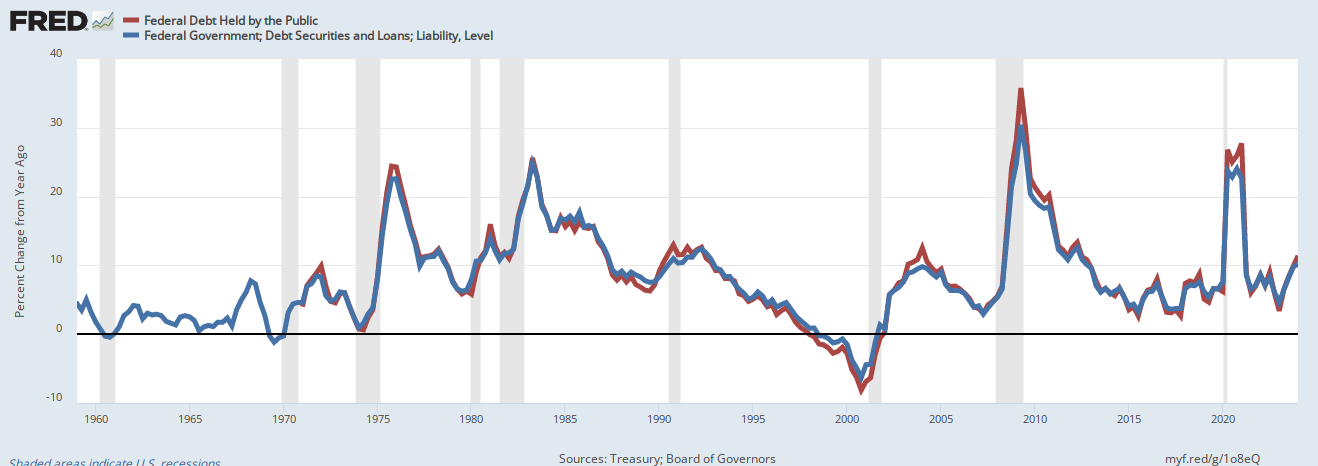
Two measures of federal “debt” show the same thing. Recessions (vertical gray bars) occur when deficit spending is reduced, and recessions are cured by increases in federal deficit spending.
This year, the deficit is on track to hit $1.5 trillion, about 5 percent of gross domestic product.
The oft-quoted ratios of federal Debt or Deficit to gross Domestic Product are meaningless. They are a comparison of oranges versus orange crayons.
The sole connection between the two measures is that federal deficit spending grows Gross Domestic Product (GDP). In fact, it’s part of the formula: GDP = Federal Spending + Nonfederal Spending + Net Exports.
Federal Spending – Federal Taxes = Federal Deficit Spending, and taxes reduce Nonfederal Spending.
On wonders where THE WEEK writers think the economy’s dollars would come from if there were no federal deficit spending.
Because interest rates were low and expected to stay low, many officials and experts thought the cost of servicing that debt would remain manageable.
The federal government has the infinite ability to “manage” (pay for) anylevel of debt. It has the infinite ability to create dollars. It never can run short of dollars to pay its bills.
Former Federal Reserve Chairman Alan Greenspan:“A government cannot become insolvent with respect to obligations in its own currency. There is nothing to prevent the federal government from creating as much money as it wants and paying it to somebody. The United States can pay any debt it has because we can always print the money to do that.”
But the pandemic and the return of high inflation changed that thinking. To curb inflation, the Federal Reserve hiked interest rates from close to zero in 2020 to above 5 percent.
This was a grave error. Interest is a business cost, and increasing interest rates increases business costs. To be profitable, businesses must raise prices above higher costs.
Thus, the Fed, amazingly, increases business costs and pricing to reduce inflation. It boggles.
Partly as a result, the government is for the first time expected to spend more this year on interest payments on the debt (about $870 billion) than on defense ($850 billion).
A meaningless statistic. Interest rates and defense have different purposes. It’s another orange/orange crayons comparison designed solely to shock you. It’s like telling you the cost of oranges is greater than the cost of orange crayons.
If rates remain high, interest payments could reach $2 trillion a year by the end of the decade, consuming 30 percent of federal tax revenue.
That means the federal government would pump $2 trillion in growth dollars a year into the economy. The more interest the government pays into the economy, the stronger the growth.
Interest payments do not consume federal tax revenue.
Federal taxes are destroyed upon receipt. The purpose of federal taxes is not to provide the government with spending money. Taxes have two purposes:
To control the economy by taxing what the government wishes to discourage and by giving tax breaks to what the government wishes to reward, and
To assure demand for the U.S. dollar by requiring taxes to be paid in dollars.
Interest payments, like all other federal spending, are made ad hoc with dollars created by pressing computer keys.
Payments on the debt would be the second-largest federal program, behind only Social Security. “We are in a spiral now — it’s a slow spiral, but it’s still a spiral — of rising debt and rising payments on the debt,” said Phillip Swagel, director of the Congressional Budget Office (CBO). “The situation is unsustainable.”
Utter nonsense. Here are some of the people who have been claiming since 1940 (!) that the federal debt is unsustainable. They called the debt a “ticking time bomb.” For 84 years, it has been “ticking.” Still no explosion.
Being wrong for 84 years doesn’t seem to embarrass them.
The term “unsustainable” often is used by debt worriers, but what does it mean? Does Mr. Swagel really believe the Monetarily Sovereign U.S. government, the government that invented the U.S. dollar and created the first dollar from thin air, really believe the federal government can now run out of the dollars?
Let’s replay Chairman Alan Greenspan’s words: “A government cannot become insolvent with respect to obligations in its own currency.”
Cities, counties, states, businesses, euro nations, you and I can run short of money. The U.S. government cannot. One is Monetarily Sovereign, while the others are monetarily non-sovereign.
Apparently, Mr. Swagel doesn’t understand the difference.
How did we get here?
It’s mostly because the government doesn’t collect enough tax revenue to cover the cost of federal programs—a problem exacerbated by multiple rounds of tax cuts.
Unlike state and local taxes, which do pay for state and local payments, federal taxes pay for nothing.
The federal tax cuts added growth dollars to the economy, which would have grown more slowly or sunk into recessions or depressions without them.
According to the Center for American Progress, the cuts signed into law by President George W. Bush in 2001 and 2003 have added more than $8 trillion to the debt, while the tax cuts passed under President Donald Trump in 2017 have added another $1.7 trillion.
Nearly $5 trillion in emergency pandemic outlays under Trump and President Biden further added to the debt pile.
Translation: The Bush and Trump tax cuts added more than $14.7 trillion in growth dollarsto the economy, and Biden added $5 trillion more. That is why U.S. economic growth has been so robust.
“The pandemic created enormous economic losses, and we used borrowing not so much to make the losses vanish into thin air but to spread them out over time,” said former CBO chief economist Wendy Edelberg.
No, Ms. Edelberg. The U.S. government, being the original creator of dollars, never borrows dollars; it creates them at will by pressing computer keys.
And your “vanish . . . spread” comment makes no economic sense. Think about it.
Meanwhile, the costs of Social Security and Medicare — the top two government outlays — will rise as millions more Baby Boomers retire over the coming years.
Why is this a problem?
The bigger the deficit, the more bonds the Treasury must issue to cover otherwise unfunded spending — unfunded spending that now includes repayments for those bonds.
All federal spending is funded by sovereign money creation. No federal spending is funded by tax collection.
Federal bonds do not pay for anything. They are deposits into safekeeping accounts. The words “bonds,” “notes,” and “bills” are misleading. They do not represent federal borrowing; they are terms used when monetarily non-sovereign entities borrow.
There’s a risk that investors could demand higher yields to buy the flood of government bonds, which in turn could push up borrowing costs on mortgages, credit cards, and business loans.
There is no such risk:
The federal government does not need to offer bonds in order to pay its bills. It can create all the dollars it needs simply by pressing computer keys
Investors have no leverage over the Federal Reserve’s setting of interest rates.
The Fed arbitrarily sets rates with inflation in mind, not to sell bonds. Even during the decade beginning in 2010, when federal debt growth was as high as 30% and averaged well over 8% a year, interest rates held near 0%. Were investors asleep, then?
The following graph demonstrates no relationship between federal debt growth and interest rates.This graph demonstrates that the Fed does not raise interest rates when “investors demand higher rates,” asdebt rises. Investors have no leverage over the rates set by the Fed.
Consumer spending and corporate investment would dip, slowing the economy and causing tax revenues to drop — requiring the government to borrow even more to make up the shortfall. New debt isn’t the only problem.
It is true that raising interest rates is recessionary, but since the U.S. federal government never borrows U.S. dollars, federal debt does not lead to federal borrowing or increased interest rates.
What does lead to higher interest rates? The Fed’s misguided attempts to combat inflation.
Over the next three years, more than half of the government’s publicly held debt will mature and need to be refinanced at higher rates.
Unlike with private debt, the Fed does not raise rates in response to maturing T-securities. The magazine author seems to have no concept of the fundamental differences between federal Treasury securities and private sector bonds.
If inflation drops next year, the Fed will drop interest rates, regardless of how much deficit spending the government does.
And the more tax money that goes to debt servicing, the less there is for government programs that might boost growth, whether that’s investment in infrastructure, health care, or anti-poverty measures.
“We are paying for the past, not the future,” said Tim Penny and David Minge of the nonpartisan Committee for a Responsible Federal Budget (CRFB).
The above two sentences could not be more misleading. Federal tax dollars (unlike local tax dollars) do not service debt. Federal tax dollars service nothing; the federal government pays all its debts by creating new dollars, ad hoc.
Federal “debt servicing” does not reduce the amount available for “infrastructure, health care, or anti-poverty measures.” The government has the infinite ability to fund those programs.
The CRFB is a notorious shill for the rich, always urging federal tax increases that impact the middle classes while the rich get tax breaks.
How could we shrink the deficit?
Through a combination of tax hikes and spending cuts. “The middle class is going to have to contribute on the tax side or on the spending side,” said Marc Goldwein of the CRFB.
“There really is no path if they’re not part of it.”
Yep, there it is—the CRFB’s never-ending effort to widen the income/wealth/power Gap between the rich and the rest.
What do “tax hikes” and “spending cuts” have in common? They take dollars from the private sector, especially the middle classes, and widen the Gap between the rich and the rest while slowing or stopping economic growth.
In his most recent budget proposal, Biden said he’d let Trump’s tax cuts expire next year, but that only individuals making more than $400,000 would see a tax hike.
He also called for the minimum corporate tax rate to be hiked from 21 percent to 28 percent and for a 25 percent tax on individuals with more than $100 million in assets.
Would that plan make a difference?
Yes, it would make several differences:
It would take billions or trillions of growth dollars out of the economy, assuring much slower economic growth, or, more likely, recessions
It would do nothing to hurt the rich, who would find other tax dodges of the sort that allowed billionaire Donald Trump to pay far fewer dollars in taxes than you did in the past ten years.
It would directly hurt the economy by taking research and development dollars from American businesses.
It would shrink the deficit by nearly $3 trillion over the next decade, according to the White House.
But many of Biden’s proposals would struggle to pass even a Democratic-controlled Congress; with Republicans in control of the House, they’re going nowhere.
Thank goodness it won’t happen. The last thing the private sector needs to have $3 trillion pulled out, for no good purpose.
Should Trump return to the White House, he has vowed to extend his 2017 tax cuts —which the CBO says would add nearly $4 trillion to the deficit over the next decade —and to push for more cuts.
Trump’s promise to extend tax cuts almost (but not quite) makes me consider voting for him. Naw.
Both candidates oppose making cuts to the big sources of federal spending: Social Security, Medicare, and defense. “Neither party is remotely serious about either spending cuts or tax increases,” said Brian Riedl, of the conservative Manhattan Institute.
Yet, I often read false claims that the Medicare and Social Security fake trust funds are going bankrupt without tax increases or benefit reductions.
This is a lie based on the rich’s desire to widen the income/wealth/power Gap between them and the rest of us.
What happens if Congress does nothing?
Under current policy and in the best-case scenario, the U.S. has 20 years to take corrective action before the federal debt reaches an unsustainable level, according to the University of Pennsylvania’s Penn Wharton Budget Model.
Sadly, I’m too old to be alive 20 years from now when none of the above nonsense is scheduled to happen, and this foolish prediction has been forgotten.
After that point, the analysts note, “no amount of future tax increases or spending cuts could avoid the government defaulting on its debt.”
Such a default would be disastrous for the U.S. and global economies.
A reckoning could be delayed if interest rates fall back to recent lows, or if U.S. economic growth outpaces interest rates. But most experts agree that the country will eventually have to tackle its surging debt and deficits.
The problem is that “nobody really knows what ‘eventually’ means,” said Louise Sheiner, of the Brookings Institute. “The longer you wait, the more you are shifting costs onto the future generation.”
I’m sorry, but this simply is wrong. The federal government cannot unintentionally default on its debts. It has the infinite ability to create dollars.
If you sent the government a legitimate invoice for a trillion dollars, or a hundred trillion, or a thousand trillion, it could pay it instantly simply by tapping a few computer keys.
“The analysts” do not understand the fundamental differences between a Monetarily Sovereign entity, like the U.S. government, and a monetarily non-sovereign entity, like a local government, a business, or a euro nation.
And, uh oh, here it comes, as usual:
Saving Social SecurityA demographic time bomb could blow a hole in Social Security.
The program taxes current workers to support older Americans.
Those FICA taxes, like all other federal taxes, support nothing. Even Franklin D. Roosevelt, who initiated Social Security, knew the taxes were useless.
Why did he create them when there were no special taxes to “fund” Congress, the Supreme Court, the White House, the Military, etc.?
When told the programs could be funded the same way all other federal spending was funded, he said the taxes created “a legal, moral, and political right to collect their pensions and their unemployment benefits. With those [payroll] taxes in there, no damn politician can ever scrap my social security program.”
FICA was a political decision, not a financial one.
But as the population gets grayer and lives longer, the worker-to-retiree ratio is dipping lower and lower.
As a result, Social Security’s trust fund is projected to run dry by 2035, triggering an immediate 17 percent cut in benefits.
A number of proposals have been floated to stave off insolvency, including raising the age at which full benefits can be claimed from 67 to 70; hiking payroll taxes; and raising the limit on annual earnings subject to Social Security taxes, now about $168,600.
Yet despite nearly a decade of warnings about the program’s financial health, Congress has yet to approve any meaningful reform. “Nobody’s acting as if that’s something they’ve got to take seriously,” said Andrew Biggs, senior fellow at the American Enterprise Institute.
“So, I’ll just be honest and say I’m worried about how this thing plays out.”
The federal government can’t afford to help you unless you’re rich.
Is it ignorance or intentional rubbish? Probably both.
“Insolvency.” “Tax hikes.” “Benefit cuts.” All lies.
The American people have been fed so many lies about federal affordability that not one in a million understands the differences between Monetary Sovereignty and monetary non-sovereignty.
There are lies about the so-called “debt,” lies about the purposes of federal taxes, lies about the so-called “trust funds,” and “ticking time bomb” lies.
The liars mislead about virtually everything regarding federal financing, so who can blame the American people for believing that federal spending is “socialism” and that federal surpluses are better than federal deficits.
It’s all they hear. The lies are even taught in economics classes and books.
Sadly, the fear of federal deficits has prevented people from receiving health care insurance, adequate retirement benefits, unemployment compensation, education, cures for poverty, hunger, homelessness, and so many other benefits the federal government could and should provide.
But there is a penalty for ignorance. The Gap widens.
In summary:
1. The federal government does not owe the “federal debt.
2. The federal government does not borrow dollars
3. Social Security and Medicare Trust Funds cannot become insolvent
4. FICA does not fund Social Security or Medicare
5. Federal taxes do not fund anything.
6. T-bonds are not debt
7. Interest rates are not determined by investor demand
8. Taxpayers do not owe the federal debt
9. Federal deficits are necessary for economic growth
10. Federal surpluses cause depressions.
11. The federal debt/GDP ratio is meaningless.
12. Federal taxes are destroyed upon receipt.
Rodger Malcolm Mitchell
Monetary SovereigntyTwitter: @rodgermitchellSearch #monetarysovereigntyFacebook: Rodger Malcolm Mitchell
……………………………………………………………………..
The Sole Purpose of Government Is to Improve and Protect the Lives of the People.





 #Monetary Sovereignty - Mitchell