Why YOU don’t have free medical care (but the rich do).

Imagine you being the richest person in the world—the first trillionaire—when your adult daughter comes to you and says, “I have cancer, and my insurance won’t cover the treatments I need to survive. I can’t afford to pay the medical bills.”

” What would you do?

Would you say, “I’m trillionaire; I’ll pay for the cost of your treatment”?

Or would You say, “I don’t care whether you go broke or die. You’ll have to pay because, even though I’m a trillionaire, I don’t want to help you.”

The federal government, being Monetarily Sovereign. Has more money than even a trillionaire. It effectively has infinite money.

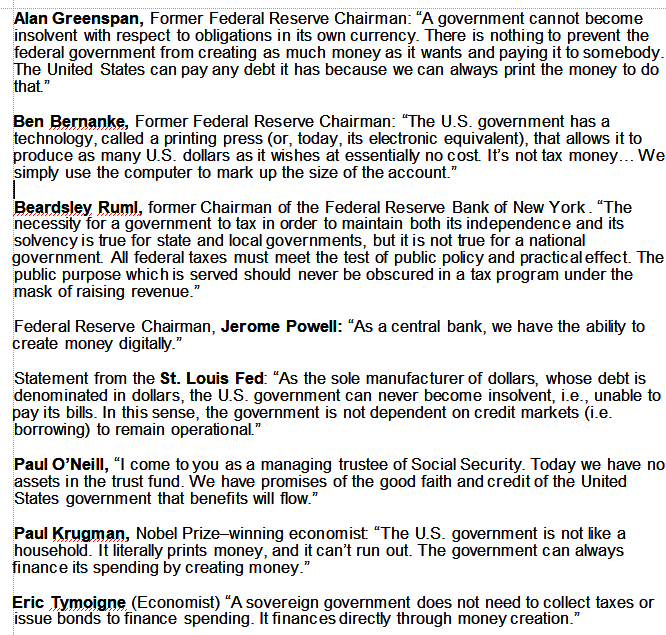
Who says so? These experts, listed at the right, and many others.

If four Federal Reserve Chairmen, and many others of similar note, say the government has the infinite ability to pay for anything, without collecting taxes or borrowing, why won’t the government simply pay for a comprehensive, no deductible Medicare for everyone, regardless of age or illness?

This recent article tells the story.

Republicans see high-risk plans as the future of health insurance Story by Kelly Hooper • 20h • 8 min read

The High Deductible Plan

Hundreds of thousands of Americans have switched to health insurance that covers a lot less of their care this year. Republicans hope a lot more will follow them.

The shift since January was driven by GOP lawmakers’ decision at the end of December to reduce the help the government provides to people who don’t get insurance through work, but instead buy it in the Obamacare marketplace. The reduction in those subsidies sent Obamacare customers searching for plans that cost less.

There’s a catch: The cheaper plans don’t cover the first several thousand dollars in sick visits, drugs and surgeries a patient needs. Nearly 4 in 10 Obamacare enrollees are in these “high-deductible” plans now, compared to 3 in 10 a year ago.

In short, Republicans want to move the financial burden from the government, which can afford it, to lower-income people, who can’t.

The reason is that it widens the income, wealth, and power gap between the rich and everyone else. This gap is what makes the rich wealthy—the wider it gets, the richer they become.

Since Republicans are seen as the “party of the rich,” their goal often seems to be helping the rich get richer while the poor get poorer.

President Donald Trump and GOP senators want to encourage more to go that route by shifting remaining Obamacare subsidies, which are now used to reduce monthly premiums, into tax-advantaged savings accounts that come with the high-deductible plans.

That would be very good for some — affluent people in good health who use the savings accounts to accrue wealth — but not so much for others: sicker and poorer people who incur medical bills they can’t afford.

The “Overuse” False Excuse

For many Republicans, that’s a worthwhile trade-off, considering the plans also reduce overuse of the health care system and put downward pressure on prices.

“The president clearly has said we need to send money to patients rather than insurers in the system, and building out policies that are consistent with that is important,” said Brian Blase, president of the right-leaning Paragon Health Institute and an adviser to Trump in his first term.

Republicans believe that poor Americans tend to “overuse” the healthcare system, whether by visiting the doctor too frequently or undergoing unnecessary surgeries.

It’s likely that very few people see a doctor too often or undergo unnecessary surgeries. Regular checkups are encouraged as a cost-seaving and preventive measure, and while some cosmetic procedures might be unnecessary, most of us would rather eat spiders than have surgery we don’t need.

Many high-deductible customers are “chasing after that lower premium, but they actually do need to use care on an ongoing basis, and then they end up with a lot of debt or being terrified to use their insurance or seek care and ignoring symptoms,” said Katherine Hempstead, senior policy adviser at the Robert Wood Johnson Foundation, a progressive health care-focused philanthropy.

The president touted his “Great Health Care Plan” at a Turning Point USA event two weeks ago, promising “to get it done one way or the other.”

The “Save Money” False Excuse

Among Republicans on Capitol Hill, both Trump allies, like Sen. Rick Scott of Florida, and adversaries, such as Sen. Bill Cassidy of Louisiana, are trying to help.

Cassidy told POLITICO he thought most people would come out ahead given the lower premiums and tax savings. “Your total cost of being insured is less,” he said.

The phrase “being insured” feels like mealy-mouthed double talk. Sure, the overall cost might be lower, but having no insurance at all would be even cheaper. Is that the idea?

Cassidy ignores the fact that deductibles shift costs from the infinitely rich government onto poor sick individuals.

The “Greater Control” False Excuse

For Scott, it’s about giving patients greater control. The change would “radically re-empower the American people and let them dictate more of where their money goes,” he said.

It’s hard to see how deductibles give more “control,” especially when a relatively small federal payment is unlikely to cover the costs of serious illnesses.

One easily could ask, If the Republican proposal offers, better, cheaper insurance, would Senators be willing to use their  own proposed plan?

A mass shift to high-deductible plans could leave millions of Americans who recently lost access to Obamacare subsidies vulnerable to unexpectedly high costs, health policy experts said. 

“You’re going to have parallel-marketed plans — next to comprehensive ACA plans — that are loosely regulated, that may look attractive at first because they they appear to have lower premiums, but then you come to find out when you actually need to use the plan you’re stuck with much higher out-of-pocket costs and fewer consumer protections,” said Michelle Long, a senior policy manager for the Program on Patient and Consumer Protections at KFF, a health policy research organization.

The “Most People” Doubletalk

Sen. Bill Cassidy (R-La.) thinks most people would come out ahead under his plan to direct Obamacare subsidies into individuals’ HSA accounts when they enroll in low-premium, high-deductible plans.

In fact, most people would be better off financially if they didn’t buy any insurance at all. That’s what makes insurance companies profitable. If most people came out ahead by purchasing insurance, there wouldn’t be any private insurers.

You can be certain that Cassidy knows this.

Cassidy, the Health Committee chair, is leading a bill with the Finance chair, Mike Crapo (R-Idaho), that would direct federal funds used for Obamacare subsidies instead to individuals’ HSA accounts when they enroll in low-premium, high-deductible plans.

If the government were to put $2,000 into enrollees’ health savings accounts, Cassidy said, that would cover the annual medical expenses of the average American.

Scott said his proposal would do more to lower costs by allowing people to save in new Trump Health Freedom Accounts in any type of insurance plan. Currently, only people in high-deductible plans can open HSAs.

Scott’s plan would also let states waive certain ACA requirements, including coverage of essential health benefits, to lower premiums. That could leave enrollees who get sick on the hook for unexpected bills.

The plan is consistent with Trump’s efforts to offer more choices for Obamacare enrollees outside traditional ACA plans, including expanding short-term health plans, which Democrats have derided as “junk insurance.”

No matter how many twists, turns, and fake options the Republicans add to  confuse the public, the goal remains the same: Have the government spend less and the people spend more.

The Trump administration has also proposed a marketplace rule that would crack down on fraudulent ACA enrollments and expand several alternative plan options, including catastrophic plans — lower-premium plans that cover Obamacare’s essential health benefits but come with a more than $10,000 deductible for an individual in 2026. Trump also proposes allowing the sale of so-called non-network plans on the ACA marketplace, which typically come with high deductibles but have no networks of doctors or providers, an option some employers currently offer.

If all these options leave you feeling confused, that’s exactly the point: toss in dozens of variations to make you believe you’re paying less, when the real goal is to have you pay more while thinking you’re getting a deal.

If insurers take a financial hit as a result of the policies, they might hike premiums across the market, raising costs for large swaths of Obamacare enrollees regardless of what plans they’re in. And the plans might not provide much protection for an unexpected medical event.

What politicians don’t mention is that while federal spending doesn’t cost taxpayers directly, it actually helps grow the economy. They complain about hospitals, doctors, and pharmaceutical companies charging “too much,” but overlook the fact that this money circulates through the economy and ends up in everyone’s pockets.

Insurers and providers argue the plans would leave consumers vulnerable to high out-of-pocket costs. vers just because they’re armed with pricing data.

“What you might see instead is somebody who gets duped into thinking it’d be better to have a lower-tier plan and $2,000. That could be a really terrible trade-off for them, because that $2,000 won’t last long if something really happens, and they’re just going to have a way more exposure to debt.” 

THE REAL SOLUTION

The government exists to protect and enhance the well-being of its people, and in return, we provide it with money and grant it authority over certain aspects of our lives.

Since the U.S. federal government has unlimited funds, it can cover services that would be expensive for individuals, such as military defense, legal protections, and healthcare.

The federal government can afford to fund — without collecting a penny in taxes — a comprehensive, no-deductible Medicare plan for everyone in America, regardless of age or health.

This would not only include all services from doctors, nurses, and hospitals, but also educational programs to train more doctors and nurses, along with funding for pharmaceutical R&D and equipment manufacturers.

A holistic approach to funding America’s health could not only cost taxpayers nothing and boost healthy longevity but also generate billions in economic growth. Cost no longer would be an issue, because the dollars would circulate through the economy and benefit everyone, both economically and physically.

If we ever can educate America on the huge possible benefits of Monetary Sovereignty, we’ll finally become the great nation we’ve always aspired to be.

Rodger Malcolm Mitchell

Monetary Sovereignty

Twitter: @rodgermitchell

Search #monetarysovereignty

Facebook: Rodger Malcolm Mitchell;

MUCK RACK: https://muckrack.com/rodger-malcolm-mitchell;

https://www.academia.edu/

……………………………………………………………………..

A Government’s Sole Purpose is to Improve and Protect The People’s Lives.

MONETARY SOVEREIGNTY

Is saving healthcare money a good idea?

Is saving healthcare money a good idea? Before you jump to an answer, I’ll give you the answer: It depends on whose money is being saved.

Think about it as you read the following article:

In Medicare payments fight, hospital lobby shows strength
Phil Galewitz and Colleen DeGuzman,
KFF Health News

Phil Galewitz, KFF Health News
Phil Galewitz

Hospitals are deploying their political power to protect their bottom lines in the battle to control healthcare costs.

The point of contention: For decades, Medicare has paid hospitals — including hospital-owned physician practices that may not be physically located in a hospital building — about double the rates it pays other doctors and facilities for the same services, such as mammograms, colonoscopies, and blood tests.

The rationale has been that hospitals have higher fixed costs, such as 24/7 emergency rooms and uncompensated care for uninsured people.

I can understand why federally funded Medicare would pay more to organizations with higher fixed costs, but why would they pay less to organizations with lower fixed costs?

I know. That sounds like double talk. If you pay more to one group, you pay less to another. But there is a point to be made.

Colleen DeGuzman

Medicare is an agency of the Monetarily Sovereign federal government. Contrary to popular wisdom, Medicare is not funded by FICA taxes.

All federal tax dollars, including FICA, are destroyed upon receipt by the U.S. Treasury.

The dollars begin in the M2 money supply measure, but when they reach the Treasury, they cease to be part of any money supply measure.

Effectively, they are destroyed. There cannot be a money supply measure for an entity with the limitless ability to create dollars by clicking computer keys.

Alan Greenspan: “A government cannot become insolvent with respect to obligations in its own currency. There is nothing to prevent the federal government from creating as much money as it wants and paying it to somebody. The United States can pay any debt it has because we can always print the money to do that.”

All federal agencies — Congress, the White House, SCOTUS, the military, etc. are funded the same way: By federal new money creation. That includes Medicare and Social Security.

Since the federal government can create dollars, why should it try to save dollars? It shouldn’t.

When there is a question about how much the federal government should pay for anything, the wise course is to err on the side of paying more. That would add growth dollars to the economy at no cost to anyone.

Suppose the goal is to pay hospitals the same rate as other doctors and facilities for the same services. In that case, the federal government shouldn’t cut hospital pay but rather increase the pay to other doctors and facilities.

Insurers, doctors, and consumer advocates have long complained it’s an unequal and unfair arrangement that results in higher costs for patients and taxpayers.

It may or may not be “unfair,” but why would hospital pay be considered too high? No one has demonstrated that hospitals should receive less money. So why is reducing hospital pay the cure for “unfairness”?

It’s also a profit incentive for hospitals to buy up physician practices, which health economists say can lead to hospital consolidation and higher prices.

It would seem that the real profit incentive is not with the hospitals to buy physician practices. Instead, there would be an incentive for doctors to sell their practices, depending on how Medicare dollars are split between doctors and hospitals.

In December, the House passed a bill that included a provision requiring Medicare to pay the same rates for medical infusions, like chemotherapy and many treatments for autoimmune conditions, regardless of whether they’re done in a doctor’s office or clinic owned by a hospital or by a different entity.

The policy, known as site-neutral payment, has sparked a ferocious lobbying battle in the Senate, not the first of its kind, with hospitals determined to kill such legislation.

There would be no need for “ferocious lobbying” if doctors’ pay were increased rather than hospitals’ pay decreased.

According to the Congressional Budget Office, the House legislation would save Medicare an estimated $3.7 billion over a decade.

To put this in perspective, the program is projected to pay hospitals upward of $2 trillion during that same period. But hospitals have long argued that adopting site-neutral payments would force them to cut jobs or services or close facilities altogether — particularly in rural areas. And senators are listening.

“Saving Medicare $3.7 billion is identical to saying, “cost the economy 3.7 billion it otherwise would have received.”

“The Senate is very much attuned to rural concerns,” Sen. Ron Wyden (D-Ore.), who chairs the Finance Committee, told KFF Health News. His panel has jurisdiction over Medicare, the health program for seniors and people with disabilities.

“I have heard many questions about how these proposals would affect rural communities and rural facilities,” he said. “So we’re taking a look at it.”

Outpatient departments at rural hospitals can have outsize importance to their communities. Taking any funding away from stand-alone rural hospitals is seen as risky. Scores have closed in the past decade due to financial problems.

With fewer patients, rural hospitals often struggle to attract doctors and update technology amid rising costs.

Taking money from rural hospitals impoverishes them while doing nothing for doctors or for the federal government, which has infinite money. This is how economics ignorance hurts everyone.

Sen. Bill Cassidy, R-La., a physician serving on the Finance Committee, indicated he was apprehensive about the legislation.

“In some cases,” he said, higher Medicare hospital payments are “justified.”

“In some cases, it doesn’t seem to be,” he said. He told KFF Health News he was planning to introduce legislation on the issue but didn’t provide details, and his office didn’t respond to inquiries.

As the two senators show, the issue doesn’t break cleanly along partisan lines. In December, the House quickly passed the Lower Costs, More Transparency Act, the broader bill that included this Medicare payment change, with 166 Republicans and 154 Democrats voting.

Whenever Congress votes for “lower costs for the federal government,” it means “Fewer growth dollars for the economy, i.e., the private sector.” Lower costs for the federal government means taking money from you.

In short, you pay for all federal savings.

“It’s more about how close different members are to the hospital industry,” said Matthew Fiedler, a former White House health economist under President Obama and now a senior fellow at the Brookings Institution.

Barack Obama was notoriously ignorant about federal finances. He famously claimed the federal government had to “live within its means.”

The federal government always lives with its means because its “means” are infinite. It never can run short of dollars.

Obama also signed the Budget Control Act to cut annual government spending by about $1 trillion over the next 10 years. Additionally, the act charged the Joint Select Committee on Deficit Reduction with finding an additional $1.5 trillion in savings.

Translation: The Budget Control Act aimed to reduce the economy’s supply of growth dollars by $1 trillion and charged the Joint Select Committee on Economic Growth Reduction with taking another $1.5 trillion from the American people.

The American Hospital Association described the site-neutral policy as a “cut” to hospital Medicare payments.

It said in a statement to a House subcommittee that it “disregards important differences in patient safety and quality standards required in these facilities.”

Rather than cutting payments to hospitals, Medicare could accomplish equality by increasing payments to healthcare suppliers, not in hospitals. This would satisfy rural hospitals, grow the economy, and improve the nation’s healthcare.

Chip Kahn, president and CEO of the Federation of American Hospitals, representing for-profit hospitals, offered a similar characterization of the House-passed legislation.

“This is no time for so-called ‘site-neutral’ Medicare cuts that could harm beneficiaries,” he said in a statement.

Right. There has never been a time to make cuts to save the federal government money.

“This is not a hospital cut. It is rolling back an unethical price increase,” said Mark Miller, a former MedPAC executive director now an executive vice president at Arnold Ventures, a philanthropy founded by John and Laura Arnold.

No, it’s a hospital cut. All the mealy-mouth rationalizations don’t change that fact. It is an unnecessary cut with zero benefit to America and much pain to the economy and our hospitals.

Large hospital systems with the money to buy physician practices, Miller said, have exploited the disparity between Medicare payments to physician offices and hospitals to increase their revenue and consolidate.

Miller said he’s hopeful the site-neutral provision of the House bill will be part of a larger government spending bill that must be passed next month to keep the government open.

If lawmakers need to offset the bill’s costs, “then it is more likely to get in the funding package,” he said.

But, lawmakers do not need to offset the bill’s costs. The reluctance to spend and keep the government open is total bullshit. Yes, there is no better way to state it: Total bullshit that has been fed to the American public.

The purpose of the bullshit is simple: To make the middle- and lower-income groups stop asking for federal benefits. When the people are told (falsely) that Medicare and Social Security “can’t afford” more benefits or even existing benefits, they meekly accept their impoverishment.

And that makes the rich, who run America, richer.

Sorry, folks, but your representatives are cheating you by keeping you ignorant of federal finances. Ignorance is costly.

The House-passed legislation is viewed as an “incremental” change, said Fiedler, but it faces a rough path forward.

Evening out Medicare payment for physician-administered drugs, hospitals fear, could lead to similar moves for other outpatient services.

“Hospitals have a lot of money at stake and will fight this hard,” he said. “Hospitals feel if they lose here, there will be more substantial steps down the road.”

Yes, the rich will fight like hell to widen the Gap between the rich and the rest — if we let them get away with the Big Lie — the bullshit that the federal government can run short of dollars.

President Kennedy was wrong when he said, “My fellow Americans: ask not what your country can do for you — ask what you can do for your country.”

He should have said, “Ask not how much you can pay your federal government — ask how much your federal government will pay you.”

Rodger Malcolm Mitchell

Monetary Sovereignty

Twitter: @rodgermitchell

Search #monetarysovereignty

Facebook: Rodger Malcolm Mitchell

……………………………………………………………………..

THE SOLE PURPOSE OF GOVERNMENT IS TO IMPROVE AND PROTECT THE LIVES OF THE PEOPLE.