The efforts of the rich to become even richer never end.
The rich incessantly promulgate lies about our economy. More importantly, they bribe the primary influencers — the politicians, the media, and the economists — to spread the Big Lie that federal spending is funded by federal taxes.
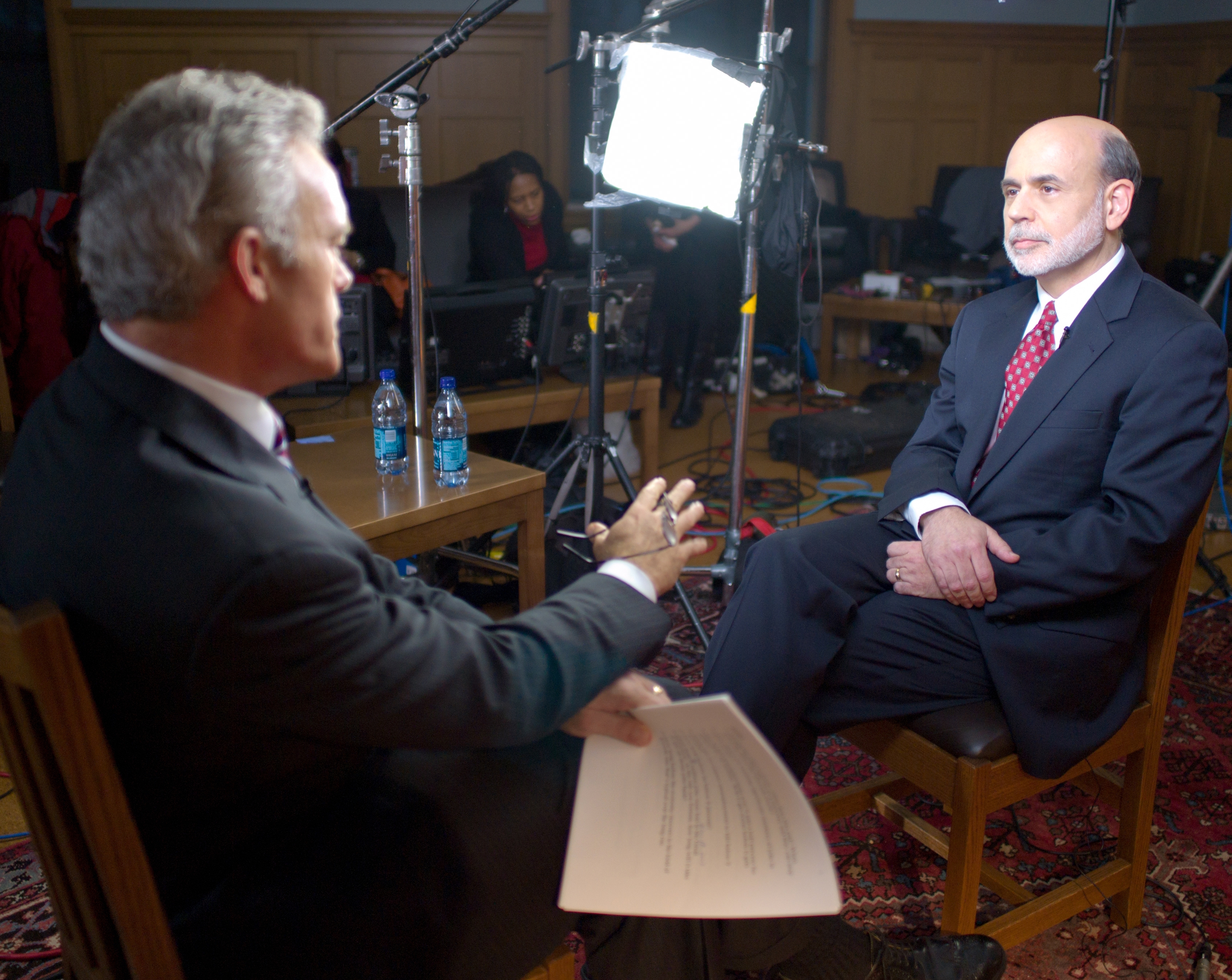
Bernanke: “It’s not tax money… We simply use the computer to mark up the size of the account.”
In reality, federal spending is funded by ad hoc federal money creation, not taxes.
The tax dollars no longer exist in the economy (the private sector), and since the federal government has infinite dollars, the tax dollars no longer exist anywhere.
The Big Lie convinces the populace that the federal government’s ability to provide benefits is financially limited by tax receipts.
(Politicians are bribed via campaign contributions and promises of lucrative jobs. The media are bribed via advertising dollars and actual ownership. Economists are bribed via gifts to universities and lucrative positions on “think tanks.”)
Whenever you hear about a federal benefit, and someone asks, “Who will pay for it?” you should know you are about to listen to the Big Lie. The answer is: “The federal government will pay for it by creating dollars.”
Quote from former Fed Chairman Ben Bernanke when he was on 60 Minutes: Scott Pelley: Is that tax money that the Fed is spending? Bernanke: It’s not tax money… We simply use the computer to mark up the size of the account.
“Social Security and Medicare are about to become insolvent” is an example of the Big Lie, the purpose of which is to distance the rich from the rest of us.
“Rich” is a comparative, not an absolute. If you have a million dollars, you are rich if most others have less than a million. But you are not wealthy if everyone else has ten million.
That leaves you two ways to become richer: Get more for yourself or make the others have less. The rich in America have chosen both courses.
They try to grab more for themselves; their efforts to force you to have less are not as obvious.
The rich receive most of their income from sources other than salaries. Consider FICA. Congress has deemed FICA should be collected only from salaries, not from other forms of income.
Further, Congress has decided FICA is to be collected on salaries less than $142,800. Anything above that is not taxed.
The FICA limit is just one of the thousands of tax breaks the rich have “encouraged” Congress to give them. The purpose: To widen the Gap between them and you. Widening the Gap makes them richer.
U.S. federal finances are unlike state & local government finances, business finances, and euro nation finances.
Former Fed Chairman Alan Greenspan: “A government cannot become insolvent with respect to obligations in its own currency.”
The U.S. government is Monetarily Sovereign. It has the unlimited ability to create its own sovereign currency.
It never unintentionally can run short of dollars.
Yet we see organizations funded by the rich claiming that federal spending, which goes to the middle- and lower-income people, is detrimental to the middle- and lower-income people.
They want you to believe you should receive lower benefits and pay more taxes.
If they can cement that belief in your minds, you’ll vote for the very people who take money from your pocket.
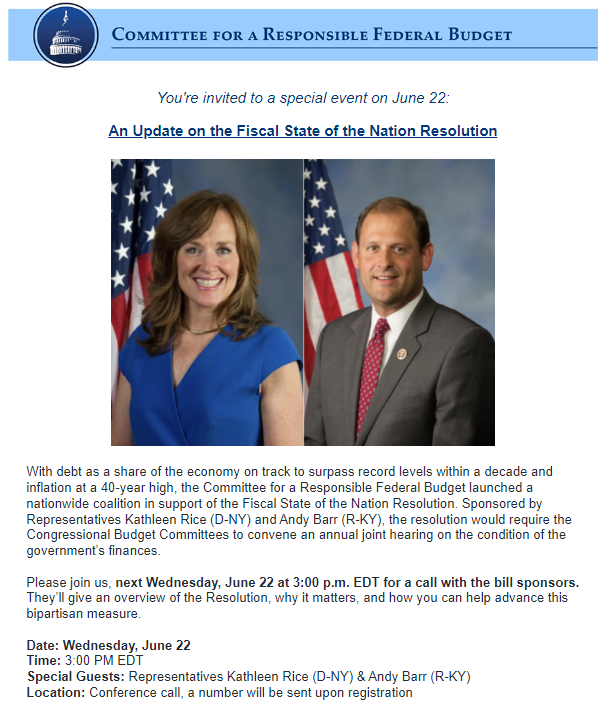
Here is the entirety of a page posted by the Committee For A Responsible Budget, one of the organizations that continually tries to foist on you the false idea that you should have less.
Every single sentence, including the headline, is false and/or an outright lie:
FALSE. High and rising National (i.e., federal) Debt is not a problem. It is not even Debt. It is the total of deposits into Treasury security accounts at the Federal Reserve.
These accounts resemble safe-deposit boxes. When you buy a T-bill, T-note, or T-bond, you open an account at the Federal Reserve and deposit your dollars into it.
The federal government never touches those dollars. It has no need to.
The government can pay off the so-called “debt” merely by returning to you the dollars in your account.
This is no burden on the government, taxpayers, or the economy. There is no “Problem.”
High and rising national Debt will threaten economic growth and the standard of living for all Americans. High Debt will slow the growth of the economy and wages.
FALSE. Federal “debt,” i.e., the total of deposits in T-securities, is set by law to equal the cumulative total of federal deficits.
Bernanke: “The U.S. government has a technology, called a printing press (or, today, its electronic equivalent), that allows it to produce as many U.S. dollars as it wishes at essentially no cost.”
Deficits are the difference between the amount of money the government takes out of the economy vs. the amount it puts in (with some going to foreign nations).
Rising national “debt” occurs when the federal government puts more dollars into the economy than it takes out.
There is no mechanism by which adding money to the economy can “slow the growth of the economy and wages.”
On the contrary, when economic growth slows, the government adds more stimulus dollars (increases the “debt”) to prevent or cure a recession.
The “debt” has no direct effect on wages, which are a function of business profits (stimulated by federal deficit spending) and labor supply.
As Debt rises, higher interest payments will crowd outimportant investments in areas like education, infrastructure, and research that can help grow the economy.
FALSE. Federal Debt does not force higher interest rates. Interest rates are set arbitrarily by the Federal Reserve to control inflation.
The peaks and valleys of changes for Federal deficits (blue) neither correspond to changes in Interest rates (red) nor are they a leading indicator. Note the 12 years 2008 – 2020, when federal deficit spending grew massively while interest rates neared zero.
Federal interest payments do not “crowd out” other federal payments for “education, infrastructure, and research. The federal government has infinite money with which to pay for anything.
During periods of high deficit spending, interest rates have been low.
Getting the Debt under control once the crisis is over will be very beneficial for generations to come, from higher wages to increased investment to lower borrowing costs for families and businesses.
FALSE. This paragraph is just a restatement of the previous section. There is no mechanism by which fewer dollars coming into the economy can cause “higher wages, increased investment, and lower borrowing costs.
The last decade shows the opposite: Higher deficits along with higher wages, increased investment, and low borrowing costs.
The Congressional Budget Office predicts that the economy will grow faster with Debt on a declining path as opposed to a rising one.
FALSE: History shows that declining Debt leads to depressions and recessions.
1804-1812: U. S. Federal Debt reduced 48%. Depression began 1807. 1817-1821: U. S. Federal Debt reduced 29%. Depression began 1819. 1823-1836: U. S. Federal Debt reduced 99%. Depression began 1837. 1852-1857: U. S. Federal Debt reduced 59%. Depression began 1857. 1867-1873: U. S. Federal Debt reduced 27%. Depression began 1873. 1880-1893: U. S. Federal Debt reduced 57%. Depression began 1893. 1920-1930: U. S. Federal Debt reduced 36%. Depression began 1929. 1997-2001: U. S. Federal Debt reduced 15%. Recession began 2001.
The reason is quite simple. Reducing federal Debt requires taking dollars out of the economy.
Just as adding stimulus dollars to the economy prevents and cures recessions and depressions, taking dollars out of the economy causes recessions and depressions.
The rich do not fear recessions and depressions. They are less harmed than the rest of us. They have more cushion to weather the hard times.
During recessions and depressions, workers become more desperate for jobs, giving the rich the opportunity to cut wages and increase their own relative incomes.
In addition to publishing the completely non-sensical paragraphs just discussed, The rich-run CRFB runs “hearings” on the condition of the government’s finances.”
These hearings contain nothing more than recitations of the Big Lie — false propaganda we have just discussed. The purpose will be to give Congress excuses to:
Cut Social Security benefits
Cut Medicare benefits
Eliminated Obamacare
Increase FICA taxes
Cut other benefits for the poor and middle-classes
Widen the income/wealth/power Gaps between the rich and the rest
The drumming of lies and misstatements from the rich and toadies for the rich is relentless. So long as it works to indoctrinate the public, it never will end.
The attempts at indoctrination end only when you, the public, demonstrate your understanding of the lies and your willingness to punish the liars.
Fool you once; shame on them. Fool you thousands of times, over and over and over; shame on you.
[No rational person would take dollars from the economy and give them to a federal government that has the infinite ability to create dollars.]
Gap Psychology describes the common desire to distance oneself from those “below” in any socio-economic ranking, and to come nearer those “above.” The socio-economic distance is referred to as “The Gap.”
Wide Gaps negatively affect poverty, health and longevity, education, housing, law and crime, war, leadership, ownership, bigotry, supply and demand, taxation, GDP, international relations, scientific advancement, the environment, human motivation and well-being, and virtually every other issue in economics.Implementation of Monetary Sovereignty and The Ten Steps To Prosperity can grow the economy and narrow the Gaps: Ten Steps To Prosperity:
Our federal government and the European Central Bank are Monetarily Sovereign. The implications are:
Former Fed Chairman Alan Greenspan: “A government cannot become insolvent with respect to obligations in its own currency.”
Former Fed Chairman Ben Bernanke: “The U.S. government has a technology, called a printing press (or, today, its electronic equivalent), that allows it to produce as many U.S. dollars as it wishes at essentially no cost.”
Ben Bernanke when, as Fed chief, he was on 60 Minutes:
Scott Pelley: Is that tax money that the Fed is spending?
Ben Bernanke: It’s not tax money… We simply use the computer to mark up the size of the account.
Statement from the St. Louis Fed:
“As the sole manufacturer of dollars, whose debt is denominated in dollars, the U.S. government can never become insolvent, i.e., unable to pay its bills. In this sense, the government is not dependent on credit markets to remain operational.”
Press Conference: Mario Draghi, President of the ECB, 9 January 2014
Question: I am wondering: can the ECB ever run out of money?
Mario Draghi: Technically, no. We cannot run out of money.
[Why would any sane person take dollars from the economy and give them to a federal government that has the infinite ability to create dollars?]
————————————————————————————————————–
Step #4 of the Ten Steps to Prosperity (below) is:Free education for everyone
That post begins with the following facts:
Educating our young people is important to the future of America.
For that reason, free elementary education has been provided by every state and every town in America.
Since WWII, America’s need for college-educated young people has grown, in a more sophisticated, more competitive world. College-educated students no longer are a luxury for America; they are a necessity.
Many of America’s bright students are unable to afford a college education, especially not in better colleges.
The U.S. federal government is Monetarily Sovereign, meaning it creates dollars at will. It never can run short of dollars. The federal government has the unlimited ability to pay for anything priced in dollars.
The federal government’s responsibility is to advance the interests of the United States and its people.
Putting America’s young people into debt, a debt so suffocating it cannot even be discharged in bankruptcy, does not advance the interests of the United States and its people.
A literate nation is a better nation in every aspect of human life, emotionally, socially, and economically. Our founders knew it, which is why free education was offered to settler’s children, and today is offered everywhere in America. The famous “one-room schoolhouse” was ubiquous in the new America.
It would be utter folly for our government, or any government, not to expend every effort to educate its young people, especially true in our more advanced world, where a high school education no longer is the gold standard.
Yet, here we are:
After a White House official confirmed this week that President Joe Biden is considering further extending a pandemic-related pause on student loan payments, lawmakers and activists renewed calls for debt cancellation.
“We have reached a student debt crisis of epic proportions.”
While payments are due to resume on May 1, White House Chief of Staff Ronald Klain suggested on a popular podcast that the president may extend the pause and is still sorting out whether he will take further action on the student debt crisis.
“This is a GOOD idea!” the group Bold Progressives tweeted with a video of Klain on “Pod Save America.”
Senate Majority Leader Chuck Schumer (D-N.Y.), a key advocate of student debt cancellation in Congress, agreed, also tweeting Klain’s comments.
In response to HuffPost‘s reporting on Klain’s remarks, Congresswoman Marie Newman (D-Ill.) said Saturday that “pausing student loan payments during Covid has allowed Americans to get by.”
“We need immediate student debt relief, and deferring payments again is a great step, but we need to do more,” she added.
Noting that “education is a pathway to greater opportunity and economic security, yet many Americans simply can’t afford it or become crushed by student loans,” Rep. Ilhan Omar (D-Minn.) told Biden on Saturday that “we must cancel student debt.”
Rep. Jesús “Chuy” García (D-Ill.) and Rep. Ayanna Pressley (D-Mass.) also pressured the president to take action on the issue Saturday:
Pressley and Sen. Elizabeth Warren (D-Mass.), who have been leading the fight in Congress with Schumer, participated in a Friday roundtable about how student loan debt impacts Black communities, particularly business owners, entrepreneurs, and other professionals.
Advocates of debt cancellation often argue that it is necessary to help address the racial wealth gap in the United States.
Eliminating student debt would help narrow every income/wealth/power Gap in America. There is not a single benefit to our nation that emanates from charging American students to attend college.
Given all you know, you might think student debt cancellation is an obvious solution to many problems facing all of America, not just those students who already are in debt.
But America has two parties. The more aggressive and united GOP party is “The Party of the Rich.” It wants to widen, not narrow, the Gaps between the “haves” and the “have-nots.” It believes in harsh punishments for misdeeds by those below, and rewards only for those above. The wider the Gap, the richer are the rich, and that is what the GOP wants.
The more timid and disunited Democratic party advocates narrowing the Gaps, with rewards for those below and punishments for those above, but it is riven with strife among partisans, whose blinders restrict each view to specific needs at the exclusion of all others.
Not being able to present a united front, the Dems’ messages become muddled, so the general public rightfully views it and its programs as weak and ineffectual.
Also on Friday, the Debt Collective announced a nationally coordinated refusal to make payments if Biden refuses to step in before they resume in May.
“If President Biden resumes illegitimate student debt payments in May, we will facilitate as many student debtors as possible to safely pay $0 a month to the Department of Education,” declared Debt Collective co-founder Astra Taylor.
“Whether it’s filing a borrower defense or enrolling in an income-driven repayment plan, we are politicizing our refusal to pay as part of our escalation on President Biden,” Taylor said. “He has the authority to cancel all federal student debt with the flick of a pen. He can end this manufactured crisis today.”
Debt Collective spokesperson Braxton Brewington emphasized that “we want to be clear—a student debt strike is not intentionally defaulting on your loans but politicizing and collectivizing your refusal to pay by using the tools the Department of Education already provides to student borrowers.”
America does not need an “income-driven repayment plan.” America needs a no-repayment plan. More than that, America needs a no payment (i.e. no payment for college) plan.The U.S. government neither needs nor uses any dollars sent to it. In fact, every dollar sent to the U.S. federal government is destroyed upon receipt by the Treasury
(When you pay taxes, for instance, those dollars in your checking account are part of the M1 money supply measure. When they hit the Treasury, they instantly disappear from any money supply measure. They effectively are destroyed. The federal government creates new dollars ad hoc each time it pays creditors.)
And for those students who received dollars from private sources, the federal government has the unlimited ability to pay off those loans, and no cost to taxpayers.
“The federal government doesn’t need our student debt payments to function, and the last two years have proved that,” Brewington added, “but they do need our cooperation—and they certainly won’t have that.”
The federal government not only doesn’t need student debt payments, it doesn’t need any payments of any kind.
Congresswoman Rashida Tlaib (D-Mich.) expressed support for the planned strike, noting that “the road to student debt cancellation is long and hard, and a key aspect is building solidarity amongst students and graduates with debt.”
It’s only “long and hard,” because the “haves” don’t want it (Widening Gap makes the rich richer), and the “have-nots” don’t understand it (They erroneously believe, because they repeatedly have been told, federal deficits should be reduced.)
“The Debt Collective’s Student Debt Strike is an important campaign to help build the mass movement we need to resist and abolish student debt, and there are so many ways to support it without putting yourself in financial jeopardy,” she said. “I stand with Student Debt Strikers and encourage everyone—whether you have debt or not—to join us.”
As Common Dreams reported last month, polling shows student debt cancellation is popular with the American public, even among people who don’t have higher education loans to repay.
Student debt cancellation may be popular with the public as a whole, but there may be some who find it less appetizing. The rich, of course, want to keep the rest of us down, because that makes them richer.
Those who already have paid for college by scrimping, saving, and borrowing, may feel it’s “unfair” for others to have the benefits without the suffering.
Those who don’t want college educations may feel it’s unfair or even unnecessary, for others to receive free college.
Even those who recognize the massive benefits to America of universal, free college may object to student debt reduction or elimination.
And there is another problem:
Let us say that the Dems suddenly and miraculously acquire courage and cohesion, and they manage to pass a bill eliminating all student debt, what happens tomorrow? Who pays for tomorrow’s college?
Do we begin the same process anew, with future students building future debt, and future arguments about paying it? How will colleges and teachers be supported?
We already have a model for that. It is called “Medicare” and it answers the question, “How can hospitals and doctors be supported?”
Just as America needs a Medicare available to everyone, (aka “Medicare for All,”) not just for the elderly, America needs a “Collecare” plan that funds grades 13+, not just grades K-12.
The first 13 years of education in America are funded by local, monetarily non-sovereign governments, using taxpayer dollars. Why, in heaven’s name, are college years not funded by our Monetarily Sovereign government, that does not use taxpayer dollars, but instead can create infinite dollars from thin air?
Just as Medicare does not treat patients — it merely funds private sector treatment — Collecare would not educate students — it merely would fund private sector education.
And just as Medicare doesn’t pay the “better” hospitals more, Collecare would not pay the “better” universities more. Harvard would receive no more than would Podunk U.
Today, Virtually all colleges and universities provide scholarships to students based on wealth, income, athleticism, skin color, religion, country of origin, and a long, often secret list of student attributes.
With Collecare, that expense no longer would be necessary for any college. Your tuition payments no longer would be used to pay for other students’ educations.
And, there yet is another problem: Those whose income is so low that even free college is unaffordable: They need their young people to work full time just to support themselves and their families. (For this latter group, we recommend (Ten Steps to Prosperity: Step 5: Salary for attending school, and Salary for attending school, III and Salary for attending school: 2nd paper.)
Just as healthcare insurance should cover rehab costs, Collecare would be incomplete without a supplement that pays students’ living expenses.
And then, there is one final problem. In general, the education in America’s K-12 schools is not worthy of this wealthy nation. We have good teachers in bad schools; we have bad teachers in good schools; and commonly, we have bad teachers in bad schools.
Much of what is “bad” can be attributed to income.
Low income begets crime, illness, and hopelessness, which beget bad K-12 schools, which in turn beget more crime, illness, and hopelessness. We cannot solve America’s income, education, and health problems separately without solving them together.America needs Medicare for All. America needs College for All. America needs Social Security for All.
The U.S. government should do everything it can to support America’s people. That is the fundamental purpose of government — not to run people’s lives but to support people’s lives.
The sainted President John Kennedy famously said, “Ask not what your country can do for you; ask what you can do for your country.” If by “your country” he had meant the federal government, it would have been among the most stupid, misleading statements of all time.
I suspect however, that it was a general call to do right for everyone, not just yourself — a sort of golden rule appeal. It means, in part, when voting, vote for what is best for America, not just what is best for you.
The rich hate federal funding for the have-nots. They will try to talk you out of it, with phony claims that inflation is caused by federal spending on your benefits.
Quoting the voice of the rich, the Committee for a Responsible Federal Budget:
Full debt cancellation would cost the federal government roughly $1.6 trillion, while improving household balance sheets by a similar amount.
Consistent with our prior analysis, we estimate this would translate to an $80 billion reduction in repayments in the first year, which would in turn increase household consumption by $70 to $95 billion once the effect of higher wealth is considered.
For the rich, “cost federal government” is bad only if the money goes to you, not to the rich. The rich hate “improving household balance sheets,” and “higher wealth” for you and me.
Don’t listen to them. The government, being Monetarily Sovereign, can bring to bear unlimited funding,without taxpayer support.
It should devote that funding to making our lives healthier, safer, and better.
Rodger Malcolm Mitchell
Monetary SovereigntyTwitter: @rodgermitchellSearch #monetarysovereigntyFacebook: Rodger Malcolm Mitchell
……………………………………………………………………..
THE SOLE PURPOSE OF GOVERNMENT IS TO IMPROVE AND PROTECT THE LIVES OF THE PEOPLE.
Gap Psychology describes the common desire to distance oneself from those “below” in any socio-economic ranking, and to come nearer those “above.” The socio-economic distance is referred to as “The Gap.”
Wide Gaps negatively affect poverty, health and longevity, education, housing, law and crime, war, leadership, ownership, bigotry, supply and demand, taxation, GDP, international relations, scientific advancement, the environment, human motivation and well-being, and virtually every other issue in economics.Implementation of Monetary Sovereignty and The Ten Steps To Prosperity can grow the economy and narrow the Gaps:
Ten Steps To Prosperity:
Being Monetarily Sovereign, the U.S. government owns infinite dollars.
You reasonably might expect that, of all the newspapers in the world, the Wall Street Journal surely would print articles by only writers who understand federal finances.
Ah, would that it were so.
Unfortunately, some writers published by WSJ either are as ignorant as the general populace or as intentionally ignorant as the bribed-by-the-rich politicians and university economists.
Here is an example saw in a recent WSJ edition (OK, the article printed in several papers, but I read in WSJ, which should know better):
U.S. National Debt Tops $30 Trillion as Borrowing Surged Amid PandemicThe record red ink, fueled by spending to combat the coronavirus, comes as interest rates are expected to rise, which could add to America’s costs.After a protracted standoff last year, Congress agreed in December to raise the nation’s borrowing cap to $31.4 trillion.By Alan Rappeport, Feb. 1, 2022
We can’t even get past the headline and subheads without being subjected to WSJ ignorance.
Federal “debt” is deposits into accounts similar to safe deposit boxes. The federal government never touches those deposits except to return them to the owners.
The so-called “national debt” neither is “red ink,” nor is it debt. It is the total of deposits into Treasury Security accounts.
When you invest in a T-bill, T-note, or T-bond, you do not lend the federal government money. You merely deposit your dollars into your T-security account. It’s an account similar to an interest-paying, safe-deposit box.
As with a safe deposit box, the federal government does not touch your dollars. It merely stores them for you, and allows you to accumulate interest.
Upon the maturity of your account, the government “pays it off” simply by returning to you, the dollars in your account. Since the dollars already exist in your account, and remain yours, this payoff is no burden on you, on the government, or on taxpayers. It’s merely a transfer of your dollars.
If the national “debt” were a real governemnt debt, it would go something like this:
The government needs dollars to pay its bills. Federal taxes are insufficient to pay all the creditors, so the government must borrow dollars, and in return it gives the lenders its IOUs in the form of T-securities (T-bills, T-notes, T-bonds).
Later, to obtain the dollars to pay off the T-securities, the government levies more taxes. This means we taxpayers ultimately are liable for the government’s debts.
You have just read what the Wall Street Journal and the vast majority of Americans believe about the federal debt.
And it is 100% wrong.
Back in the late 1770s, the federal government created the U.S. dollar from thin air. The government simply passed laws (from thin air) that created as many dollars as it wished, and gave those dollars whatever value it wished.
The first U.S. silver dollars were coined on Oct 15,1794. On that day, 1,758 of them were produced, but no more the rest of the year.
In 1794, a new coin called the Draped Bust Dollar, featuring a matronly Liberty of considerable endowment wearing a draped blouse. Over 40,000 Draped Bust dollars were minted in 1795.
Why 1,158 and 40,000? Because the government arbitrarily based its coin on silver. Each coin contained 0.7737 oz of silver. Why 0.7737? Because the government arbitrarily made its dollar similar in weight to the Spanish dollar.
Note the word “arbitrarily.” The government could have produced any numberof dollars, and could have made them equivalent to anything it wished. The base could have been gold, lead, tin, or nothing at all.
Because we were a new country, we tried to create demand for the dollar by making it equivalent to an existing coin. But it was all arbitrary.
The federal government arbitrarily has changedthe metal content of all U.S. coins many, many times over the years.
Today, the vast majority of dollars are nothing more than numbers on spreadsheets, and have no physical existence.
The federal government retains the infinite ability to create laws from thin air, and those laws have the infinite ability to create dollars from thin air.
Alan Greenspan: “A government cannot become insolvent with respect to obligations in its own currency.”
Ben Bernanke: “The U.S. government has a technology, called a printing press (or, today, its electronic equivalent), that allows it to produce as many U.S. dollars as it wishes at essentially no cost.”
Quote from Ben Bernanke when, as Fed chief, he was on 60 Minutes:
Scott Pelley: Is that tax money that the Fed is spending?
Ben Bernanke: It’s not tax money… We simply use the computer to mark up the size of the account.
Statement from the St. Louis Fed:
“As the sole manufacturer of dollars, whose debt is denominated in dollars, the U.S. government can never become insolvent, i.e., unable to pay its bills. In this sense, the government is not dependent on credit markets to remain operational.”
Read the above quotes carefully, then ask, what is Alan Rappeport talking about when he refers to the federal “debt” (i.e. deposits) as “red ink?” How can accepting deposits into T-security accounts be considered “borrowing,” when, as Greenspan, Bernanke, and the St. Louis Fed say the federal government has the infinite ability to create dollars? Why would the government ever need to borrow?It wouldn’t and it doesn’t.
WASHINGTON — America’s gross national debt topped $30 trillion for the first time on Tuesday, an ominous fiscal milestone that underscores the fragile nature of the country’s long-term economic health as it grapples with soaring prices and the prospect of higher interest rates.
It’s not “ominous.” On the contrary, it’s a sign of a growing economy. It would be “ominous” if the misnamed national “debt” were declining. That would demonstrate we are in a recession or depression.
In fact, the so-called”debt” isn’t even debt or borrowing. It’s the total of investments in T-securities (T-bills, T-notes, T-bonds).
The government never touches the dollars invested in these securities, and the government pays them off every day, simply by returning the balances in the accounts. No tax dollars are involved. This is not a burden on the government or on taxpayers.
The sole purpose of T-securities is not to provide the federal government with its own dollars, but rather to provide a safe “parking place” for unused dollars. This stabilizes the dollar. It is not borrowing in any sense of the term.
The breach of that threshold, which was revealed in new Treasury Department figures, arrived years earlier than previously projected as a result of trillions in federal spending that the United States has deployed to combat the pandemic. That $5 trillion, which funded expanded jobless benefits, financial support for small businesses and stimulus payments, was financed with borrowed money.
No, no, no. It was NOT financed with borrowed money. Every penny the government pays for anything is created, ad hoc, with the press of a computer key. The federal government never borrows the currency it has the infinite ability to create from thin air. Here is how:
To pay a creditor, the federal government creates instructions. These instructions tell the creditor’s bank to increase the balance in the creditor’s checking account.
At the instant the instructions are obeyed, new dollars are created and added to the money supply measure called “M1.”
That is how the federal government creates money: By using its infinite ability to create instructions telling banks to increase checking account balances.
Why would the federal government borrow, when as Chairman Ben Bernanke said, it can “produce as many U.S. dollars as it wishes at essentially no cost.”
The borrowing binge, which many economists viewed as necessary to help the United States recover from the pandemic, has left the nation with a debt burden so large that the government would need to spend an amount larger than America’s entire annual economy in order to pay it off.
Utter nonsense. The so-called “debt” (that isn’t a debt) is not a debt “burden.” The government pays off all T-securities simply by returning the dollars in T-security accounts. It does this every day.
And the phrase, “entire annual economy” is a non-sequitur based on ignorance. The size of the U.S. economy (i.e. the Gross Domestic Product) does not pay for any part of the “debt.”
That comparison of the so-called “debt” vs. the US. economy — known as the “debt/GDP ratio — often is quoted as a way to shock the reader, though it is a meaningless comparison.
.
.
.
.
.
.
.
.
.
.
Do you see any relationship between the Debt/GDP ratio and the economic strength of the nation? Of course not, because there is no such relationship.
The Debt/GDP relationship is meaningless. So why does Rappeport refer to it? Either he doesn’t understand federal finance or he is trying to scare you.
(The Wall Street Journal is designed for the rich, and the rich want to convince the populace that the government cannot afford to give benefits to the not-rich.)
Some economists contend that the nation’s large debt load is not unhealthy given that the economy is growing, interest rates are low and investors are still willing to buy U.S. Treasury securities, which gives them safe assets to help manage their financial risk. Those securities allow the government to borrow money relatively cheaply and use it to invest in the economy.
More nonsense. The so-called “debt load” is not unhealthy, and low interest rates are not a factor. The federal government, having the unlimited ability to create dollars, has no difficulty paying any amount of interest.Totally painless.
And the federal government doesn’t need investors to buy Treasury securities. These are offered as a benefit to investors, not to the government. And in any event, any unsold T-securities are purchased by the Federal Reserve.
For years, presidents have promised to limit federal borrowingand bring down the nation’s budget deficit, which is the gap between what the nation spends and what it takes in. Under President Bill Clinton, the United States actually ran a budget surplus between 1998 and 2001.
Yes, Presidents have made this promise, and every time they actually kept the promise, we had depression or a recession. Mr. Rappeport fails to mention that Clinton’s surplus led to the recession of 2001.
1804-1812: U. S. Federal Debt reduced 48%. Depression began 1807.
1817-1821: U. S. Federal Debt reduced 29%. Depression began 1819.
1823-1836: U. S. Federal Debt reduced 99%. Depression began 1837.
1852-1857: U. S. Federal Debt reduced 59%. Depression began 1857.
1867-1873: U. S. Federal Debt reduced 27%. Depression began 1873.
1880-1893: U. S. Federal Debt reduced 57%. Depression began 1893.
1920-1930: U. S. Federal Debt reduced 36%. Depression began 1929.
1997-2001: U. S. Federal Debt reduced 15%. Recession began 2001.
But taming deficitshad fallen out of fashion in recent years, including during the Trump administration, when lawmakers blew through budget caps and borrowed money to fund tax cuts and other federal spending.
Deficits don’t need to be “tamed.” Remember what Greenspan, Bernanke, and the St. Louis Fed said about the government’s infinite ability to pay its bills.
Further, the federal government does not borrow its own sovereign dollars, the dollars it has the unlimited ability to create from thin air.
And all federal spending is funded, not by taxes, but by ad hoc creation of new dollars.
Why does the federal government levy taxes? To control the economy. It taxes what it wishes to discourage, and it gives tax breaks to what it wishes to encourage.
Further, taxes give the impression that federal benefits must be limited. The rich, who control Congress and the President, want the Gap between the rich and not-rich to widen. The wider the Gap, the richer are the rich.
It’s called “Gap Psychology“, the human desire to widen the Gap below and to narrow the Gap above.
“Hitting the $30 trillion mark is clearly an important milestone in our dangerous fiscal trajectory,” said Michael A. Peterson, the chief executive officer of the Peter G. Peterson Foundation, which promotes deficit reduction. “For many years before Covid, America had an unsustainable structural fiscal path because the programs we’ve designed are not sufficiently funded by the revenue we take in.”
The Peter G. Peterson Foundation is notorious for crying “wolf” about the deficit and predicting calamity that never happens — until we actually do reduce the deficit, at which time we have the aforementioned depressions or recessions.
Until then, it’s all warnings and hand wringing about the “ticking time bomb of debt.” It’s a “time bomb” that has been ticking since 1940 and still no explosion.
The gross national debt represents debt held by the public, such as individuals, businesses and pension funds, as well as liabilities that one part of the federal government owes to another part.
Right, the so-called debt (T-bills et al) are assets of the private sector. When you own a T-bill, that is one of your assets.
Alan Rappeport doesn’t want you to have that asset. He wants the government, which has infinite assets, to take that asset from you. Smart?
While Republican lawmakers helped run up the nation’s debt load, they have since blamed Mr. Biden for putting the nation on a rocky fiscal path by funding his agenda. After a protracted standoff in which Republicans refused to raise America’s borrowing cap, threatening a first-ever federal default, Congress finally agreed in December to raise the nation’s debt limit to about $31.4 trillion.
It was all political theater — cynical politicians trying to convince the innocent public that they are fiscally prudent. But if they really were prudent, they would spend more on global warming, poverty, healthcare, education, transportation, infrastructure, science, ecology, etc. — not debating about how to spend less.
In January 2020, before the pandemic spread across the United States, the Congressional Budget Office projected that the gross national debt would reach $30 trillion by around the end of 2025. The total debt held by the public outpaced the size of the American economy last year, a decade faster than forecasters projected.
Yes, as usual, the economic forecasters were wrong about the meaningless Debt/GDP ratio. So?
The nonpartisan office warned last year that rising interest costs and growing health spending as the population aged would increase the risk of a “fiscal crisis” and higher inflation, a situation that could undermine confidence in the U.S. dollar.
By “fiscal crisis,” we assume Rappeport means the federal government would be unable to pay its debts — which as we know is impossible for our Monetarily Sovereign government. (It can happen to state/local government, which are monetarily non-sovereign.)
And inflation always is caused by shortages, never by federal deficit spending.
In fact, federal deficit spending is one of the best methods for curing inflation, if the spending is for curing the shortages.
Todays inflation is caused by shortages of oil, food, computer chips, labor, and other needs. The federal government could stop inflation by spending more to support oil drilling, efficient farming, and chip manufacture, and by eliminating FICA (FICA lowers the net income of workers and makes them less willing to accept jobs).
Trillions in federal spending has left the United States approaching levels of red ink not seen since World War II.
Actually, the so-called “debt” is much higher than it was during WWII. And when spending for WWII ended, we had recessions.
The Biden administration has said the $1.9 trillion pandemic relief package the Democrats passed last year was a necessary measure to protect the economy from further damage. Treasury Secretary Janet L. Yellen has argued that such large federal investments are affordable because interest costs as a share of gross domestic product are at historically low levels thanks to persistently low interest rates.
Yes, the $1.9 Trillion in deficit spending did protect the economy, just as cuts to federal spending will injure the economy. So why cut?
Interest costs as a share of GDP are irrelevant, as are low interest rates. In fact, higher interest rates have one advantage: They force the federal government to pump more stimulus dollars into the economy.
What is inflation? Inflation is a loss of purchasing power over time, meaning your dollar will not go as far tomorrow as it did today. It is typically expressed as the annual change in prices for everyday goods and services such as food, furniture, apparel, transportation and toys.What causes inflation? It can be the result of rising consumer demand. But inflation can also rise and fall based on developments that have little to do with economic conditions, such as limited oil production and supply chain problems.
Inflation always is caused by shortages and always is cured by curing the shortages, which the federal government can do by federal deficit spending.
Esther L. George, the president of the Federal Reserve Bank of Kansas City, suggested during a speech this week that the Fed’s big bond holdings might be lowering longer-term interest rates by as much as 1.5 percentage points — nearly cutting the interest rate on 10-year government debt in half. As rates rise, so does the amount that the United States owes to investors who buy its debt. The Congressional Budget Office estimates that if interest rates rise in line with their own forecasts, net interest costs will reach 8.6 percent of gross domestic product in 2051. That would amount to about $60 trillion in total interest payments over three decades.
That’s 60 trillion stimulus dollarspumped into the economy — dollars the federal government easily can create with the touch of a computer key, and dollars the economy uses for growth.
“A larger amount of debt makes the United States’ fiscal position more vulnerable to an increase in interest rates,” the C.B.O. said in its long-term budget outlook.
What does he mean by “vulnerable”? Is he saying that our Monetarily Sovereign government, which has the infinite ability to create dollars, will not be able to pay interest? Nonsensical.
Biden administration officials insist that they view fiscal responsibility as a priority. They have pledged that their economic agenda will be fully paid for through tax increaseson wealthy Americans and corporations and by more rigorous enforcement of the tax code.
Biden wants you to believe that federal taxes fund federal spending. It is a lie. Federal taxes are destroyed upon receipt by the Treasury.
Taxes come out of checking accounts that are part of the M1 money-supply measure. When they reach the Treasury, they cease to be part of any money-supply measure. They effectively disappear.
There is no money supply measure that includes the federal government, because the government has infinite money. No one can answer the question, “How much money does the federal government have?” The only answer is, “Infinite.”
In recent months, the budget deficit has started to shrink as a stronger economy has boosted tax receipts and as government payments of pandemic relief money have slowed.
And this means economic growth will slow. If federal deficits fall enough, we will have a recession or depression.
And some economists argue that a more recent economic phenomenon — inflation — may have a silver lining in that it could chip away at the nation’s debt burden.
The federal “debt” is not a burden on the federal government or on taxpayers or on anyone else. It’s not debt, and even if it were, the federal government has the unlimited ability to pay.
Kenneth Rogoff, a Harvard University economist, said “You would rather have no debt, of course, but compared to other issues at the moment that’s not the principal problem.”
He’s a Harvard economist and he thinks that having no debt (which would require removing $30 trillion from the economy) is something we “would rather have”?? Is this the nonsense they teach at Harvard?
In summary:
A federal deficit is necessary for economic growth. The federal Debt/GDP ratio is meaningless as a measure of economic health.
The federal government creates dollars, ad hoc, by paying creditors, which it can do endlessly.
Unlike state/local governments, the federal government is Monetarily Sovereign. It has the unlimited ability to create its sovereign currency, the U.S. dollar, and instantly can pay any obligation based on dollars.
The government never unintentionally can run short of dollars.
Federal taxes are destroyed upon receipt and do not fund federal spending.
The federal debt is nothing more than the total of deposits in T-security accounts, which are “paid off” by returning the dollars in them. This is not a burden on the federal government or taxpayers.
Federal deficit spending does not cause inflation; shortages cause inflation. A prime way to combat inflation is with federal deficit spending to cure shortages.
Gap Psychology describes the common desire to distance oneself from those “below” in any socio-economic ranking, and to come nearer those “above.” The socio-economic distance is referred to as “The Gap.”
Wide Gaps negatively affect poverty, health and longevity, education, housing, law and crime, war, leadership, ownership, bigotry, supply and demand, taxation, GDP, international relations, scientific advancement, the environment, human motivation and well-being, and virtually every other issue in economics.Implementation of Monetary Sovereignty and The Ten Steps To Prosperity can grow the economy and narrow the Gaps:
Ten Steps To Prosperity:
I continually am puzzled by the misunderstanding (“disunderstanding”?) of Monetary Sovereignty. It is both simple and obvious, yet many (most?) people have trouble comprehending it.
MS is based on just four simple facts:
In the 1780s, the U.S. federal government created the laws that created the U.S. dollar from thin air — as many dollars as it wished – and gave them the value it wished.
The government’s own laws give it the power to continue creating dollars, infinitely
The government’s own laws give it the power to continue changingthe valueof the dollar — a power it has used many times.
The government can change its laws at will.
Really, what could be simpler, more obvious, and less controversial?
Derived from these simple, obvious facts comes the following:
The U.S. federal government never unintentionally can run short of U.S. dollars.
No agency of the government can run short of dollars unless the government wishes it.
Federal taxes are not used or needed to fund federal spending.
By changing the value of the dollar, the government has absolute control over inflation
And that’s it. Monetary Sovereignty.
Intuition is powerful. Many of us prefer to believe our intuition than believe facts.
Interestingly, where fiction parallels facts, you might not believe the facts about the fiction, while still believing fiction about the facts.
That is, you might read a historical novel of fiction, and not believe the background facts presented. Yet, you might be fooled by a conspiracy theory website presenting fiction as fact.
So here is the explanation that may appeal to intuition as well as to facts.
You probably have played the hugely popular board game, Monopolytm. As a game, it’s fiction, but you believe and understand the facts (i.e. “rules.’)
Here are some of the facts.
The game is played with multiple players plus a Bank. The Bank pays Monopoly dollars to the players for various benefits.The Bank collects taxes, fines, loans and interest from the players.The Bank “never goes broke.” If the Bank needs money, it may issue as many dollars as needed by printing on scraps of paper or simply by creating a bookkeeping tally.
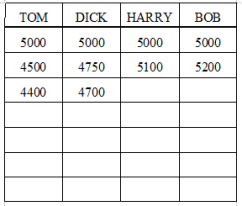
Example of a Monopoly running tally
A sample tally is demonstrated by the illustration at the right.
It reveals three things:
I. Monopoly money is not physical. Those printed $500, $100, $50, $20 $10 $5, and $1 bills aren’t dollars in of themselves.They merely representdollars, just as the numbers on a tally represent dollars.II. The Bank can createan infinite supply of Monopoly dollars.
If needed, the Bank instantly could pay Tom, Dick, Harry, or Bob $1, or $100, or $1,000,000,000 in Monopoly dollars.
In the tally, there is no need to create a column for the Monopoly Bank.
This lack of a column demonstrates the Bank’s ownership of infinite dollars.
It also demonstrates that all dollars sent to the Monopoly Bank are destroyed upon receipt.
If Tom, for instance, sent $100 to the Bank, his $4,400 would be reduced to $4,300. So, what happened to the $100 Tom paid? They simply disappeared. They no longer exist.
Although the Bank can create infinite dollars this creation process does not create Monopoly Bank “debt.” The Monopoly Bank does not borrow dollars nor does it owe any dollars.
Thus, taxes are not levied to “pay off” any Monopoly Bank debt.
By rule, the Monopoly Bank simply creates all the dollars it needs. Although the Bank is not precluded from keeping track of the dollars it receives from players, that record would not indicate how many dollars the Monopoly Bank “owes” or has.
There is no ongoing debt owed by the Monopoly Bank.
All of the above is easily understood by you and by virtually anyone else who has played the game.
Now, in the above paragraphs, substitute the words, “U.S. federal government” for the word “Bank.” And substitute “members of the public” for “players.”
The facts remain essentially the same.
There are multiple members of the public plus the federal government.
The federal government pays dollars to the public for various benefits.
The federal government collects taxes, fines, loans, and interest from the public.
The federal government “never goes broke.” If the federal government needs money, the government may issue as much as needed by printing on paper or simply by creating a bookkeeping tally.
[Former Fed Chairman, Alan Greenspan: “A government cannot become insolvent with respect to obligations in its own currency.”]
Continue reading and substituting until you come to the part that some people have difficulty understanding:
The federal government does not borrow dollars nor does it owe any dollars. Taxes are not levied to “pay off” any federal government debt.
[Quote from Ben Bernanke when, as Fed chief, he was on 60 Minutes:
Scott Pelley: Is that tax money that the Fed is spending?
Former Fed Chair, Ben Bernanke: It’s not tax money… We simply use the computer to mark up the size of the account.]
The Monopoly Bank and the U.S. federal government both are Monetarily Sovereign. They both are issuers of their dollars. Neither of them can run short of dollars.
Both the Monopoly Bank and the U.S federal government have infinite dollars.
[Former Fed Chair, Ben Bernanke: “The U.S. government has a technology, called a printing press (or, today, its electronic equivalent), that allows it to produce as many U.S. dollars as it wishes at essentially no cost.”]
Neither the Monopoly Bank nor the federal government borrows or taxes in order to pay their financial obligations. Spending by the Monopoly Bank or the U.S. federal government does not create future taxpayer obligations.
For that reason, Social Security, an agency of the federal government, cannot run short of dollars, unless that is what the government wants. Even if there were no FICA tax (which contrary to popular myth, does not fund Social Security), that agency need not run short of dollars.
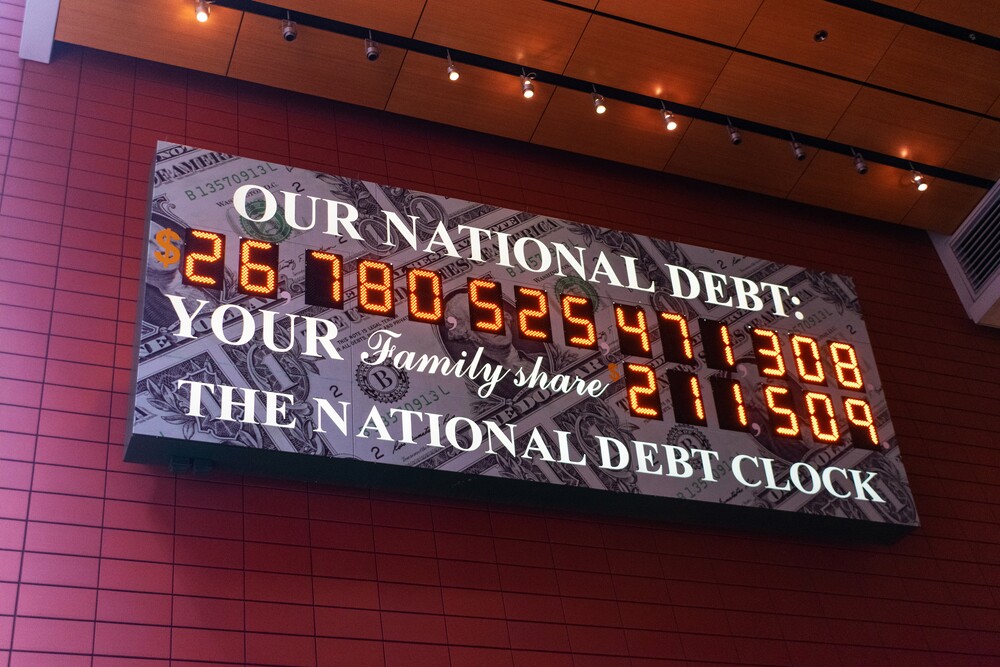
The “debt clock.” You have no share.
Medicare for All, college for all, upgraded infrastructure, good housing for all — every imaginable federal benefit — all are easily affordable. The so-called federal debt is not a burden on future taxpayers or on the government.
The famous “debt clock” implies the lie that somehow the federal “debt” is a danger to you, your children, and the federal government.
It is not a debt, and it is not a danger, to you or anyone.
It is just simple deposits by the public into accounts.
The parallels between the Monopoly game and federal financing are stunning.
Yet, though people tend to understand the rules of Monopoly, too many become hopelessly confused by the same set of facts when applied to real life.
Yes, one is fiction and the other is fact, but that difference is not the source of the confusion.
The confusion is caused by the longtime, ongoing, relentless dissemination of false information about the federal government’s finances and by the misnaming of T-securities as “borrowing” and “debt.” They are neither.
The misinformation is promulgated by agents for the rich, who want to prevent you from asking for the benefits the rich already receive: Retirement benefits, medical care, good housing, safe neighborhoods, college education, spending money for a good life.
Neither the government nor you owes the deposits that sit in T-security accounts. These accounts resemble bank safe deposit boxes, which the bank “pays off” simply by returning the contents. No “debt” or tax liability there.
The Monopoly board game is a good analog for the federal finance system. If you understand one, you should understand the other.
Rodger Malcolm Mitchell
Monetary SovereigntyTwitter: @rodgermitchellSearch #monetarysovereigntyFacebook: Rodger Malcolm Mitchell
……………………………………………………………………..
THE SOLE PURPOSE OF GOVERNMENT IS TO IMPROVE AND PROTECT THE LIVES OF THE PEOPLE.
Gap Psychology describes the common desire to distance oneself from those “below” in any socio-economic ranking, and to come nearer those “above.” The socio-economic distance is referred to as “The Gap.”
Wide Gaps negatively affect poverty, health and longevity, education, housing, law and crime, war, leadership, ownership, bigotry, supply and demand, taxation, GDP, international relations, scientific advancement, the environment, human motivation and well-being, and virtually every other issue in economics.Implementation of Monetary Sovereignty and The Ten Steps To Prosperity can grow the economy and narrow the Gaps:
Ten Steps To Prosperity:






 Here are some of the facts.
 #Monetary Sovereignty - Mitchell