The U.S. federal government is unlike state and local governments. It uniquely is Monetarily Sovereign. That means it has the infinite ability to create dollars simply by passing laws and pressing computer keys.
While state and local government can run short of dollars, the federal government cannot unintentionally run short.Not now. Not ever.
Federal Reserve Chairman Alan Greenspan: “A government cannot become insolvent with respect to obligations in its own currency. There is nothing to prevent the federal government from creating as much money as it wants and paying it to somebody. The United States can pay any debt it has because we can always print the money to do that.”
Federal Reserve Chairman Ben Bernanke: “The U.S. government has a technology, called a printing press (or, today, its electronic equivalent), that allows it to produce as many U.S. dollars as it wishes at essentially no cost. It’s not tax money… We simply use the computer to mark up the size of the account.”
Federal Reserve Chairman Jerome Powell stated, “As a central bank, we have the ability to create money digitally.”
Statement from the St. Louis Fed: “As the sole manufacturer of dollars, whose debt is denominated in dollars, the U.S. government can never become insolvent, i.e., unable to pay its bills. In this sense, the government is not dependent on credit markets to remain operational.”
Social Security is a federal agency. Like all federal agencies, including Congress, the Supreme Court, theWhite House, the military, et al, Social Security cannot run short of dollars unless Congress and the President will it.
Congress has the infinite power to create laws, and some of these laws create dollars from thin air. So long as Congress can create laws, the U.S. always will have enough dollars for any expenditure.
In June, 2001, Paul O’Neill, Secretary of the Treasury said, “I come to you as a managing trustee of Social Security. Today we have no assets in the trust fund. We have promises of the good faith and credit of the United States government that benefits will flow.”
The so-called Social Security “trust fund” (which is not a real trust fund) never has assets other than “promises of the good faith and credit of the United States government.”
Those promises are what we call “dollars.”< /br>< /br>
Look at a dollar “bill.” At the very top it says, “FEDERAL RESERVE NOTE.” Bills and notes are promises of payment.
All dollars are promises by the federal government that it will accept dollars as payment, and so will everyone else in America. In fact, that is stated on the dollar bill: “This note is legal tender for all debts, public and private.”
The federal government has the infinite ability to create legal tender to pay all debts.
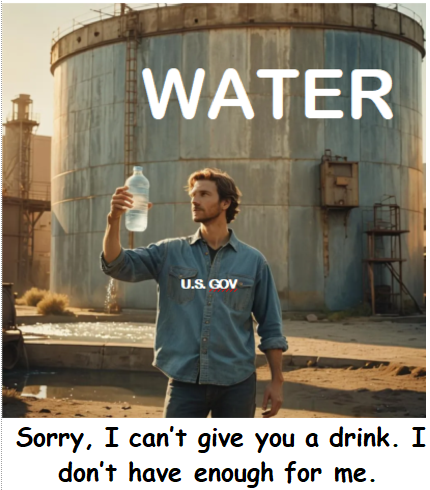
If I were the federal government, some people would tell you I could run short of oranges. Those are the people who tell you Social Security, Medicare, and Medicaid can run short of dollars.
Because the federal government cannot unintentionally run short of dollars, how can we explain the following article from MSN?
As Social Security teeters on the brink of insolvency, the government is exploring various proposals to ensure its sustainability.
While the program is not expected to disappear, the amount future retirees will receive is uncertain.
Have you ever heard that the White House, Congress, or the Supreme Court are “teetering on the brink of insolvency“?
No?
For the fiscal year 2024, the United States Supreme Court had a discretionary budget request of $161.3 million. Where did it get the money? There is nothing like a FICA tax to supposedly support this federal agency.
For the fiscal year 2025, the U.S. Congress has an approximately $5.9 billion budget. This budget covers the operational expenses of the House of Representatives and the Senate, including salaries, office expenses, and other administrative costs. Where did it get the money? There is nothing like a FICA tax to supposedly support this federal agency.
The White House’s annual operating budget is part of the overall budget of the Executive Office of the President (EOP). For the fiscal year 2025, the EOP has a budget request of approximately $714 million. Where did it get the money? There is nothing like a FICA tax to supposedly support this federal agency.
The answer to the questions: All federal agencies get their spending money the same way. Congress votes; the President approves; and magically, the dollars are created from thin air.
Social Security is a federal agency. Like all other federal agencies, Social Security gets its money from Congress’s votes and the President’s approval.
Contrary to popular wisdom, Social Security does not get its spending money from the FICA tax or any other source. Those FICA dollars ripped from your paycheck are destroyed the moment they reach the U.S. Treasury.
The dollars originate in checking accounts as part of the “M2 money supply measure.” When they reach the Treasury, they instantly cease to be part of any money supply measure. Effectively, they are destroyed.
Among the proposed changes, some have sparked significant controversy and resistance among the American public. A survey by the National Academy of Social Insurance (NASI) highlights six proposals that have met with strong opposition.
One of the most debated proposals involves the taxable earnings cap. This cap determines the portion of a person’s income subject to Social Security payroll taxes.
In 2025, the cap is set at $176,100. Most Americans earn below this threshold, paying taxes on their entire income, while wealthier individuals do not.
Many advocate for raising or eliminating this cap to increase contributions from the wealthiest, though this alone won’t resolve the funding crisis. The NASI survey indicates that maintaining the current cap, with only minor inflation adjustments, is unpopular.
The taxable earnings cap is an invention of the rich, to widen the income/wealth/power Gap between the rich and the rest.
Another contentious proposal is gradually raising the full retirement age (FRA) to 69. The FRA, which determines eligibility for full benefits, was previously increased from 65 to 67.
Raising it further would effectively reduce benefits for younger workers by increasing penalties for early claims and decreasing delayed retirement credits. This change is seen as a benefit cut, particularly affecting those who claim benefits in their early-to-mid-60s.
This is the “work-’til-you-die” provision that Republicans love. It penalizes those who are not rich, because they are the ones who rely on SS to survive.
Reducing cost-of-living adjustments (COLAs) is also on the table. COLAs are annual adjustments to help benefits keep pace with inflation but also increase program costs. Many seniors oppose reducing COLAs, as Social Security’s buying power has already declined.
The Senior Citizens League reports a 20% loss in buying power since 2010. There’s a push to calculate COLAs based on the Consumer Price Index for the Elderly (CPI-E), which would likely result in higher adjustments but also increase expenses.
If you are hoping to receive SS, and are not rich, but you voted for Trump, you’re getting what you voted for: Delayed SS benefits.
Increasing benefits by $250 per month for all new beneficiaries is another proposal that hasn’t gained much support. This increase wouldn’t benefit current recipients or address the issue of COLAs not keeping up with inflation.
The NASI survey found this proposal less popular than others, such as raising COLAs.
It’s not clear how this would address the phony Social Security Trust Funds so-called “insolvency.” But handing out money is a good idea.
Raising the taxable earnings cap to $ 350,000, while paying wealthier beneficiaries more, is another controversial idea. Although many support raising the cap, they oppose larger checks for high earners.
The current benefit formula replaces a smaller portion of pre-retirement income for high earners. Altering the formula to prevent larger checks for those paying more into the program would require congressional action.
The real problem is with the words, “taxable earnings.” Currently, FICA is calculated against salaries but not other taxable earnings, such as capital gains. Most of the rich do not receive significant salaries. They are too smart for that. Their income is from capital gains, stock swaps, etc. — stuff you middle-class workers seldom enjoy.
Lastly, a bridge benefit for retired workers with declining health has been proposed. Thiswould reduce early claiming penalties for those in physically demanding jobs.
While there’s demand for this change, details on its implementation and criteria are lacking.
Ultimately, the solution to Social Security’s challengesmay involve some or none of these proposals, as Congress decides the best course of action.
The solutions to “Social Security’s challenges” are:
Learn the facts about federal finance and acknowledge the federal government’s infinite ability to create dollars and to determine their value (i.e. control inflation).
Eliminate FICA. Fund Social Security by Congressional vote, like nearly all federal agencies are funded. Get rid of the fake Social Security “trust fund.” It’s not a source of dollars but rather a limit on dollars and an excuse for cutting benefits to those who are not wealthy. It’s as illogical as the current debt-limit laws.
Pay everyone of all ages a Social Security benefit, regardless of income. Elon Musk would receive the same benefits as the poorest, homeless adult. It would mean nothing to Musk but be a life saver to the poor person. (My current suggestion is about $3,000 per month for each adult and $1,500 per month for each child, with subsequent additions for inflation.)
While Trump’s and the Republican ascendency in power may be a disaster for American democracy, such as it is, a few tiny glimmers of financial sunlight peek through the darkness.
For the purposes of this post, we’ll ignore the astounding parallels between Trump and Hitler while focusing on the few near-term benefits.
Here are a few excerpts from an article in USA TODAY:
Stocks soared on news of Trump’s election. Bonds sank. Here’s why. Story by Daniel de Visé, As Donald Trump emerged victorious in the presidential election Wednesday, stock prices soared. As the stock market rose, the bond market fell. Stocks roared to record highs Wednesday in the wake of news of Trump’s triumph, signaling an end to the uncertainty of the election cycle and, perhaps, a vote of confidence in his plans for the national economy, some economists said. On the same day, the yield on 10-year Treasury bonds rose to 4.479%, a four-month high. A higher bond yield means a declining bond market: Bond prices fall as yields rise. While stock traders rejoiced, bond traders voiced unease with Trump’s fiscal plans. Trump campaigned on a promise to keep taxes low.
It will be great news for the economy if he keeps that promise. Federal taxes are recessive. They remove dollars from the private sector and transfer them to the federal government, where they are destroyed.
Taxes are paid with dollars from the M2 money supply measure. When they reach the Treasury, they cease to be part of any money supply measure. Effectively, they are destroyed. Destroying M2 dollars is recessive.
Because the federal government can infinitely create dollars at the touch of a computer key, a money supply measure of federal dollars would make no sense.
No matter how many tax dollars you send to the federal government, the federal money supply measure will always be the same: infinite. That is because the U.S. government, unlike state and local governments, is Monetarily Sovereign.
It is 100% impossible for the federal government to unintentionally run short of its own sovereign currency, the dollars it created from thin air in the early 1800s.
Former Fed Chairman Alan Greenspan: “A government cannot become insolvent with respect to obligations in its own currency. There is nothing to prevent the federal government from creating as much money as it wants and paying it to somebody. The United States can pay any debt it has because we can always print the money to do that.”
He also proposed sweeping tariffs on imported goods.
This will be bad news for the economy. Import tariffs are federal taxes. Like all other federal taxes, they are paid with M2 dollars that are destroyed when they reach the Treasury. Destroying dollars is recessive.
Economic growth is measured by Gross Domestic Product (GDP). GDP=Federal Spending + Non-Federal Spending – Net Imports. GDP growth requires money supply growth.
Worse, tariffs increase consumer prices, which means they add to inflation.
Even worse, tariffs invite retaliatory tariffs. They also reduce exports, which are part of the Gross Domestic Product.
Economists predict a widening deficit in Trump presidency Economists warn that Trump’s plans to preserve and extend tax cuts will widen the federal budget deficit,which stands at $1.8 trillion.
Contrary to popular wisdom, widening the federal budget deficit is good news for the economy. It means the government is pouring more growth dollars into the economy than it is taking out.
Deficits are the net amount of growth dollars the federal government adds to the economy. The federal debt is the net total of all previous deficits, i.e. the net total of all growth dollars the federal government has added to the economy.
Tariffs, meanwhile, could reignite inflation, which the Federal Reserve has battled to cool.
To summarize, import tariffs have two bad outcomes: They increase inflation and remove growth dollars from the economy.
Their ostensible purpose is to protect U.S. industry. A far wiser approach would be to cut federal taxes on businesses and support designated businesses with federal cash and favorable laws.
One example is federal farm subsidies, which boost farm profits without increasing consumer costs.
For bond investors, those worries translate to rising yields. The yield is the interest rate, the amount investors expect to receive in exchange for lending money: in this case, to the federal government.
Technical point: Because the federal government has the infinite ability to create dollars, it never borrows dollars. Though corporate bonds do represent corporate borrowing, federal bonds do not represent federal borrowing. The same word has two different meanings.
These bonds represent dollars deposited into T-bond accounts for safekeeping. The government never touches the money; it remains the property of the depositor. The purpose is to provide a save place for money holders to keep unused dollars.
The Chinese, for example, would be loath to store their billions of unused dollars in private banks.
In the current economic cycle, bond investors “might perceive there to be more risk of holding U.S. debt if there’s not an eye on a plan for reducing spending.
False. There is no spending-related risk for storing dollars in T-security accounts. The dollars always are 100% safe. This is diametrically the opposite with private sector bonds, which do suffer repayment risk.
The 10-year Treasury bond is considered a benchmark in the bond market. The yield on those bonds “began to climb weeks ago, as investors anticipated a Trump win,” The New York Times reported, “and on Wednesday, the yield on 10-year Treasury notes jumped as much 0.2 percentage points, a huge move in that market.”
This all was mere speculation, having nothing to do with real risk. Bond traders anticipated that other bond traders would think there was more risk, so they acted accordingly. It was a lemming-like approach to trading — trying to do what everyone else was going to do, before they did it.
When deficit growth decreases, we have recessions (vertical gray bars) which are cured by deficit growth increases. The reason: A growing economy requires a growing supply of money.Long-term bond yields are rising because “many investors expect that the federal government under Trump will maintain high deficit spending,” according to Bankrate, the personal finance site.
The federal government could double or triple its spending without accepting one additional dollar in deposits. Federal spending is not contingent on non-existent federal “borrowing.”
In a broader sense, bond investors worry that “we’re living beyond our means in the United States, and we have been for a very long time,” said Todd Jablonski, global head of multi-asset investing for Principal Asset Management.
This is utter nonsense. The U.S. federal government has infinite “means.” It cannot run short of dollars.
Former Fed Chairman Ben Bernanke: “The U.S. government has a technology, called a printing press (or, today, its electronic equivalent), that allows it to produce as many U.S. dollars as it wishes at essentially no cost. It’s not tax money… We simply use the computer to mark up the size of the account.”
Over the long term, Jablonski said, investors “fear that the United States’s creditworthiness is not as impeccable as it was once considered to be.” As the federal deficit grows, investors take on greater risk, and they expect to be paid a higher interest rate for loaning money to the government.
That is absolutely untrue. In 1940, when the federal debt (deposits) totaled only $400 Billion, pundits called it a “ticking time bomb.”
Exactly the same language has been used every year since. Today, after 84 years of hand-wringing, the pundits still make the same claim about our $30 Trillion debt, and we are no closer to insolvency than we were then.
This is part of the Big Lie in economics, where even respected economists continue to make the same “Earth-is-flat.” statements.
Perhaps it is taught in high schools or discussed over drinks. I can’t say, but it seldom is questioned. Strange.
If you would like to watch economists stutter, ask them:
“If federal deficits are bad, why do we run deficits to cure recessions?”
Neither Trump nor Democratic presidential candidate Kamala Harris offered a convincing plan to reduce the deficit on the campaign trail, economists said.
Politicians don’t reduce the deficit because it involves two steps—both economically bad: tax increases and/or spending reduction. Both are recessionary.
Harris promised to raise taxes on the wealthiest Americans and corporations as a source of new revenue.
Raising taxes on the wealthiest Americans has some value, but not for revenue generation. The beneficial purpose would be to narrow the income/wealth/power Gap between the rich and the rest.
Trump, by contrast, pledged to extend and even deepen his previous tax cuts. Trump has made a case that economic growth and job creation would naturally boost revenue.
Trump is correct on both counts. Deepening tax cuts benefits the economy, though he probably would again deepen them for the rich, thereby widening the income/wealth/power Gap, a terrible outcome.
Depending on the details, revenue might be boosted, but that would be bad for the economy.
The bond market may not be convinced. “If there’s a Republican sweep of House, Senate and the presidency, I expect the bond market to be wobbly,” said Jeremy Siegel, finance professor at the Wharton School of the University of Pennsylvania, speaking to CNBC on Election Day.
Yes, the bond market might be “wobbly” (whatever that means), not for functional reasons, ut rather because the Jeremy Siegels of the world predict wobbliness.
In Summary:
The federal government is uniquely Monetarily Sovereign over the U.S. dollar. It cannot unintentionally run short of dollars.
The federal government does not borrow dollars or owe so-called “debt.” The dollars deposited in T-security accounts are wholly owned by depositors, whom the government pays merely by returning their dollars.
The purpose of federal bonds is not to provide the government with spending money. The purpose is to provide a safe place for dollar holders to store unused dollars. This stabilized the value of the dollar.
Federal deficit spending and “debt” are not a burden on the government or taxpayers, nor are they a risk to depositors.
Economic growth requires federal deficit spending, which adds growth dollars. When deficits are too low, we have recessions, which are cured by increased deficits.
The Wall Street Journal is owned by Rupert Murdoch, who supports 32 times convicted felon Donald Trump. Murdoch also owns extreme right-wing Fox News, which paid an $800 million fine for lying.
Need I say more?
Here are excerpts from an article that appeared in the WSJ. Comments are noted.
Federal Debt Is Soaring. Here’s Why Trump and Harris Aren’t Talking About It. Story by Richard Rubin, richard.rubin@wsj.com
The U.S. isn’t fighting a war, a crisis or a recession. Yet the federal government is borrowing as if it were.
The U.S. federal government is Monetarily Sovereign. It has the unlimited ability to create U.S. dollars:
Alan Greenspan:“There is nothing to prevent the federal government from creating as much money as it wants and paying it to somebody.”
If you owned a money-printing machine and had the unlimited, legal ability to create as many $100 bills as you wanted — at no cost to you — would you ever borrow dollars? Think about it.
The government has that “money-printing machine” and the legal right to create dollars. Why on earth would the government ever borrow dollars? Answer: The U.S. government never borrows dollars. Not ever.
Ben Bernanke: “The U.S. government has a technology, called a printing press (or, today, its electronic equivalent), that allows it to produce as many U.S. dollars as it wishes at essentially no cost.”
The confusion is semantic. In the private sector, the words “bills,” “notes,” and “bonds” denote debt. “Bills” are what you owe in your daily life. Corporate “notes” and “bonds” are evidence of corporate debt.
By contrast, Treasury bills, notes, and bonds have nothing to do with government borrowing. They are deposits into Treasury Security accounts. Depositors, like China, the UK, and private citizens like you, own the money in these accounts; the federal government doesn’t.
The federal government never accesses those dollars for federal spending. It creates new dollars to pay all its bills.
To pay a creditor, the federal government creates instructions in the form of checks or wires. The instructions tell the creditor’s bank to increase the balance in the creditor’s checking account by a certain amount.
At the moment the bank obeys those instructions, new dollars are created and added to the M2 money supply measure.
To pay off the so-called “debt,” the federal government merely returns the depositors’ dollars that already reside in their T-security accounts. (Think of a safe deposit box in which depositors place valuables. The bank doesn’t use those valuables and returns them upon request by the depositors.)
Returning existing dollars is not a financial burden on the government or on federal taxpayers.
The confusion is not only semantic but also arises from the fact that the total of deposits equals the total of federal deficits. This is an anachronism from when the federal government was not wholly sovereign over the dollar and tied itself to silver and gold.
In short, federal “debt” is nothing like personal debt. The federal government is not “in debt.” It pays all its bills timely and in full, and can continue doing so.
Since dollars are a creation of laws, so long as the federal government has the ability to pass laws, it has the ability create dollars.
This year’s budget deficit is on track to top $1.9 trillion, or more than 6% of economic output, a threshold reached only around World War II, the 2008 financial crisis and the Covid-19 pandemic.
Publicly held federal debt—the sum of all deficits—just passed $28 trillion or almost 100% of GDP.
The “debt”/GDP ratio is meaningless. It says nothing about the federal government’s ability to pay. Debt nuts often quote this number to scare you, but it has absolutely no relevance to the federal government’s ability to pay its bills.
If Congress does nothing, the total debt will climb by another $22 trillion through 2034. Interest costs alone are poised to exceed annual defense spending.
These are big numbers but completely meaningless concerning the federal government’s solvency. The misnamed “debt” could be ten times or a hundred times as large, and the federal government easily could continue to pay all its bills.
Even if the government didn’t collect a single penny in taxes and the “debt” was a hundred times larger, it still could continue to pay its bills in full and in a timely manner.
Federal taxes are different from state and local taxes. State and local governments are monetarily non-sovereign. They do not have the unlimited ability to create dollars. They use tax receipts and borrowing to pay their financial obligations.
By contrast, the U.S. federal government does not use tax dollars or borrowing to pay its bills. The purposes of federal taxes are:
To control the economy by taxing what the government wishes to discourage and by giving tax breaks to what the government wishes to reward.
To assure demand for the U.S. dollar by required taxes to be paid in dollars.
Economists and policymakers already worry that the growing debt pile could put upward pressure on interest rates, restraining economic growth, crowding out other priorities and potentially impairing Washington’s ability to borrow in case of a war or another crisis.
In one sentence, the author, Mr. Rubin, has articulated the four common lies about the so-called federal debt (that neither is federal nor debt).
The U.S. Federal Reserve sets interest rates at its whim in an effort to control inflation. This has nothing to do with the size of the federal “debt” as shown by the following graph:
There is no relationship between changes in federal “debt” (bleu) and interest rates (red).
There have been scattered warning signs already, including downgrades to the U.S. credit rating and lackluster demand for Treasury debt at some auctions.
Interest rates also are set to attract depositors, an exercise that became obsolete in 1971, when the government no longer required itself to match income with outflow.
2. Credit agencies set ratings based on the debtor’s ability and likelihood of paying promptly and in full. The federal government always pays timely and in full, so why would the rating ever go down?
Answer: This is not because of the size of the “debt” but because of Congress’s political gamesmanship. The party out of power limits the party in power’s ability to pay. It uses one of the more ridiculous laws, the so-called “debt limit” (which doesn’t limit the non-existent “debt.” It limits the government’s ability to pay its daily bills).
While the federal “debt” has grown from $400 billion to $33 trillion in just 80 years, “debt” downgrades have been few and sporadic, and related only to the fear that the debt nuts will prevent the government from paying, not to the size of the “debt.”
3. Federal deficits are necessary to grow the economy. It is mathematically impossible for the U.S. economy to grow unless the federal government pumps more money into the private sector (aka, the economy) than it takes out.
4. Federal deficit spending does not “crowd out” anything. It adds lending dollars to the economy.
With more dollars on deposit, the banks can lend more easily, and when the economy has more money, it is more likely to expand by borrowing. Nothing impairs Washington’s ability to borrow; the federal government never borrows.
5. “Lackluster demand” for T-securities is not a problem for the federal government. Selling T-securities doesn’t benefit the federal government. T-securities benefit buyers looking for a safe place to store unused dollars. That is why China buys them.T-securities are more secure than any bank China could find.
T-securities have two purposes, neither of which is to provide spending funds to the U.S. government:
— To help stabilize the dollar by providing safe storage for unused dollars
— To help the Fed control interest rates.
Both Harris and Trump have promised to protect the biggest drivers of rising spending—Social Security and Medicare. And both want to extend trillions of dollars in tax cuts set to lapse at the end of 2025, amid bipartisan agreement that federal income taxes shouldn’t rise for at least 97% of households.
Those are good political promises that would benefit the economy. Of course, the reality is that debt nuts will prevail because of voter ignorance. Thus, you can expect the same strong support for cutting benefits to the middle- and lower-income groups as we have seen in the past. The eligibility age for Social Security will continue to go up, and benefits will be taxed further.
Trump has promised to exempt tips from taxation, end income taxes on Social Security benefits, eliminate taxes on overtime pay, lower tax rates for companies that manufacture in the U.S., and create a new deduction for new parents’ expenses, offering more than $2 trillion in tax cuts atop $4 trillion to extend his first-term tax cuts.
These are good ideas, but as has been typical of Trump’s promises, they’re all verbal tooth-fairy stuff. It’ll happen only in your dreams.
Harris matched Trump’s tips idea and called for an expanded child care tax credit, including $6,000 for parents of newborns.
If the Republican House allows an expanded child care tax credit and $6,000 for newborns — which it won’t.
How did the U.S. fiscal path simultaneously become economically more alarming yet politically less relevant? Federal debt and deficits have blown past various imagined red lines and feared consequences have not materialized.
Keep that phrase in mind: “Feared consequences have not materialized.” The reason: The feared consequences were based on lies. There are no adverse consequences for federal deficits.The consequences are for not running deficits or even for deficits that are too low.
Interest rates, at least until 2022, stayed low. The dollar remains the world’s reserve currency, giving the U.S. far more running room than other major countries. The U.S. of 2024 is not Greece of 2007. There is risk, but there is no fiscal crisis.
There has been no financial crisis simply because federal “debt” is not a financial crisis. The whole thing is a giant lie spun by the rich to prevent the rest of us from receiving benefits.
The tax on Social Security benefits is ludicrous. Why would any sane government tax the benefits it provides?
The fact that the U.S. dollar is the world’s most common reserve currency does not give the U.S. “more running room” (whatever that is). It merely means that the world’s banks carry more U.S. dollars in reserve to facilitate international trade.
It does not protect us from financial difficulties; Monetary Sovereignty protects us from financial difficulties.
And yes, the U.S. is not Greece (or France, Germany, or Spain), none of which is Monetarily Sovereign. Those nations are more like Illinois, New York, and Wisconsin. They cannot create the money they use. The European Union (EU) is like the U.S. federal government in that itis Monetarily Sovereign and has the unlimited ability to create euros.
“We’ve learned we borrowed more than we realized we could,” said Jason Furman, a Harvard economist who was a top aide to President Barack Obama. “And we’ve actually borrowed more than we expected.”
Actually, Mr. Harvard economist, we haven’t borrowed at all. You’re surprised because the economy has grown due to increased federal deficit spending.
You simply can’t figure out why deficit spending seems to grow the economy while insufficient deficit spending leads to recessions (which are cured by more deficit spending).
Why it’s a mystery to you is the real mystery.
When deficit growth declines, we have recessions (vertical gray bars), which are cured by deficit increases.
Sadly, this simple graph shows that declines in deficit growth repeatedly lead to recessions, which are cured by increasesin deficit growth.
Yet economically ignorant pundits continue to rail against deficit growth.
If anything, borrowing kept the economy afloat during the 2007-09 financial crisisand pandemic, and lawmakers were rewarded for it. Polls show the public is concerned about the deficit, but they also prefer politicians who dangle tax cuts, stimulus checks and money for the military.
If you believe borrowing “kept the economy afloat,” why do you oppose it?
At any rate, there was no borrowing. There was money creation, which the federal government can do in any amount, at will. The financial crisis was caused by excessive private-sector borrowing, not by non-existent federal borrowing.
The author demonstrates a failure to understand the difference between private sector and federal finances.
“No president in history, Republican or Democrat, gets a gold star or a Nobel Prize for reining in spending, the deficits and our debt,” said Rep. Jodey Arrington (R., Texas), chairman of the House Budget Committee. “Nobody gets the golden meat cleaver award.”
Thank heaven for that, because the “golden meat cleaver” cuts the legs off economic growth. (See: Ignorance is hard to conquer if the ignorant want to remain that way.)
Whoever wins in November will soon face two big fiscal tests. One is the need to raise the federal debt limit, likely in mid-2025.
No, the test will be to eliminate, not raise, the ridiculous “debt limit,” a law based on the rich’s desire to widen the income/wealth/power Gapbetween them and the rest. It is the Gap that makes them rich. Without the Gap, no one would be rich; we all would be the same. And the wider the Gap, the richer they are.
The two ways for the rich to become richer are: Gain more for themselves and/or make sure those below them have less. That is why cutting your benefits makes the rich richer.
In both 2011 and 2023, the threat of default without a debt-limit increase led to compromises that reduced red ink.
Any default would be caused by the idiotic, unnecessary “debt ceiling.” Compromises are political theatre based on lies.
The other trigger is the looming expiration of much of the 2017 tax law.
That is the tax law Trump passed to help the rich widen the income/wealth/power Gap between the rich and the rest.
It was a tax law that If Congress doesn’t act by the end of 2025, taxes would rise on most households, a path to deficit reduction that both parties say they don’t want.
Imagine that. Congress wants to keep taxes low, but not increase the deficit. Anyone have a magic wand to make that happen?
In the early 1990s, when deficits were much smaller, deficit hawks were powerful enough in both parties to produce bipartisan deals that raised taxes and lowered spending. Those agreements helped drive the budget into balance in the late 1990s. Federal debt fell to about one-third of GDP.
And that budget balancing is what led to the recession of 2001, which was cured by federal deficits.
As deficit growth fell, we had a recession, which was cured when deficit growth resumed. This has happened repeatedly in U.S. history, yet debt nuts still call for deficit reduction.
When he first ran for president in 2016, Donald Trump said he would pay off the national debt within eight years. He went in the opposite direction: Debt rose from less than $15 trillion to more than $21 trillion by the time he left office.
What?? Donald Trump lied? Hard to believe. But good thing he did. The rise in “debt” fueled economic growth.
Trump made two major decisions that broke with Republicans in Congress and drove up federal borrowing.
Republicans had long advocated making Social Security and Medicare less generousand more fiscally sustainable. To appeal to middle-class voters, Trump embraced what had long been a Democratic position and shut down discussion of broad benefit cuts.
As always, Republicans wanted to cut benefits for those who are not rich. Trump saw that the voters would not buy into the lie, so he wisely increased the “debt.”
And to call Social Security and Medicare “generous” is laughable. No one can live on Social Security benefits, and Medicare covers, at best, only 80% of costs. Still, the right-wing can hardly wait to cut, cut, cut.
Then in 2017, when House Republicans sought to cut tax rates, Trump resisted their attempts to offset the full cost. The Tax Cuts and Jobs Act Trump eventually signed into law was projected then to increase deficits by $1.5 trillion over a decade.
And it helped make the rich richer.
Once the pandemic started, Trump joined the broad economic consensus that the U.S. needed to pour money into the economy, eventually adding more than $3 trillion to the debt to provide stimulus checks, enhanced jobless benefits and other relief.
O.K., debt nuts, why does pouring money into the economy grow the economy, but only is a good thing when the economy is in trouble? It makes no sense.
President Biden and Harris expanded on Trump’s pandemic spending with the $1.9 trillion American Rescue Plan, which included another round of stimulus checks and aid to state and local governments.
The stimulus checks were a toe-in-the-water introduction of Social Security for All, which America should have. It worked as desired, which is why Congress didn’t repeat them.
Biden, with Harris’s strong backing, canceled student debt in a series of executive orders that could cost the government more than $1 trillion, according to the Committee for a Responsible Federal Budget. The plan is now stuck in litigation as (right-wing) courts have curtailed Biden’s authority to cancel debt.
“I don’t think we’ve seen a president spend nearly as much without Congress as Biden,” said Marc Goldwein, the CRFB’s senior vice president.
Biden took over where the Republican Congress played politics with the economy. Putting students into debt is as stupid as it gets for a nation that claims it needs an educated population to compete on the world stage.
What happens if Trump wins depends on Congress. If Republicans also control the House and Senate, his next term could look a lot like his first—occasional talk about debt and deficits paired with tax cuts that expand both.
“Paired with tax cuts” for the rich along with deportations of much of our workforce (which would destroy the economy), the promised firing of millions of government workers (which would destroy our government), and the hiring of Trump’s incompetent friends and relatives (which would make Trump a dictator).
In his acceptance speech at the Republican National Convention, Trump said, “We’ll start paying off debt and start lowering taxes even further.”
Nonpartisan experts say there’s virtually no chance of that. Paying off debt would require the U.S. to shift from massive deficits to surpluses.
Tax cuts would work in the opposite direction. Low tax rates can encourage growth and generate some revenue, but not enough to offset the loss of revenue, economists in both parties acknowledge.
Federal surpluses take dollars out of the economy. How this is supposed to cause economic growth is a mystery never explained by the debt nuts.
Every federal surplus in history has caused a depression, but one, the 1997 recession “only” caused a recession.
1804-1812: U. S. Federal Debt reduced 48%. Depression began 1807.
1817-1821: U. S. Federal Debt reduced 29%. Depression began 1819.
1823-1836: U. S. Federal Debt reduced 99%. Depression began 1837.
1852-1857: U. S. Federal Debt reduced 59%. Depression began 1857.
1867-1873: U. S. Federal Debt reduced 27%. Depression began 1873.
1880-1893: U. S. Federal Debt reduced 57%. Depression began 1893.
1920-1930: U. S. Federal Debt reduced 36%. Depression began 1929.
1997-2001: U. S. Federal Debt reduced 15%. Recession began 2001.
The reason for the above is no mystery. GDP = Federal Spending + Nonfederal Spending + Net Exports. Reduce federal deficits, and you will reduce both federal spending and nonfederal spending. Simple algebra.
Trump has indicated that he wants to extend the pieces of his 2017 tax law that expire after 2025 and lower the 21% corporate tax rate to 20%, and 15% for some companies. His recent proposals—eliminating taxes on workers’ tips, overtime pay and retirees’ Social Security benefits—dig a deeper hole.
He’s also made other proposals that would entail significant new spending, including a mass deportation program and a domestic missile-defense system.
These are good proposals except for his deportation crime. This would destroy lives, destroy the economy of America and the world, and destroy America ‘s reputation. We would forever be stamped as a vicious, mean-spirited banana-republic dictatorship.
Trump has touted several ideas that could reduce deficits. One is impoundment, in which the president refuses to spend money Congress has appropriated. That’s legally and constitutionally dubious.
And economically suicidal.
The other is tariffs. Trump wants to impose a tariff of 10% to 20% on all imported goods and even higher on Chinese products. That could raise about $2.8 trillion over a decade, according to the Tax Policy Center.
That $2,8 trillion would come from the pockets of American consumersand the economy. It’s incredibly ignorant, which is why debt nuts will love it.
House Republicans have proposed capping federal spending growth at a level lower than inflation, though the party is split and some want significant increases in the defense budget.
Capping spending will cause a recession or depression, as it always has. Sadly, the American voter is ignorant about federal finances, so will vote for a damaging and unnecessary cap.
Arrington, who is helping cobble together Republicans’ agenda if they have full control of Congress, said they need to tackle spending and entitlement programs and hopes Trump, despite his statements to the contrary, could be open to that.
“We have an opportunity to live up to what we claim we believe when we campaign and why almost every Republican member was sent here to Congress by their constituents,” he said.
Arrington claims Republican constituents want Congress to cut Social Security and Medicare. That’s what his voters want? Really?
First, while the budget would raise taxes on the rich and corporations, the revenue isn’t enough to deliver the claimed deficit reduction, pay for Harris’ child tax credit and home-buyer subsidy proposals, and cover the Biden-Harris proposals to extend expiring cuts to prevent tax increases on households earning less than $400,000.
Second, the chances Congress would agree to such a plan are slim, even in the unlikely event Democrats control both the House and Senate. Biden couldn’t get centrist Democratic senators to pass his tax increases in 2022. Harris could face similar opposition and already dialed back Biden’s proposed capital-gains tax increase.
All of the above nonsense is due to one thing: The Big Lie that federal taxes fund federal spending. Let’s clarify this as simply as possible.
Federal taxes do not fund anything.
Even if the government collected $0, it could continue spending forever.
The government pays for everything by creating new dollars ad hoc.
Biden officials see next year’s tax debate as a crucial pivot point, and the White House has said any extension of expiring tax cuts should be paired with tax increases.
Ridiculous. Federal taxes pay for nothing. They are a useless drain on the economy.
Biden has proposed some Medicare savings through prescription drug pricing and has called for shoring up Social Security, which is paying out more in benefits than it collects in taxes.
Federal payment of more benefits than it collects in taxes grows the economy (aka the private sector).
But the parties are at odds over whether Social Security taxes and benefits should increase, and that gridlock means the program likely won’t be addressed for about a decade, when its trust fund is projected to be exhausted, triggering benefit cuts.
The federal government should simply pay for Social Security and Medicare to “shore up” them.
Not including interest, the U.S. government will spend $1.21 for every $1.00 it collects in revenue this year. Add interest and that climbs to $1.39.
Mathematically, that $.21 (or $.39) difference will grow the economy. Growing the economy is impossible if the federal government runs a surplus.
Voters often support balanced budgets in theory, but they also like the low taxes and higher spending of the past few decades.
Wanting federal balance budgets merely indicates that the public, having been fed the Big Lie so often, has become ignorant about federal finances.
“It’s really the combination of high deficits, high debt level, high interest burden,” said Richard Francis, the lead U.S. analyst for Fitch Ratings, one of those companies. “And we didn’t see any willingness to tackle the big issues.”
Total BS. Since 1940, the U.S. government has had high deficits, a high “debt level,” and often high interest rates, but it has never been downgraded. Why? Because Congressional infighting has become so fierce that the rating agencies were afraid the government would refuse to pay its bills out of spite toward the other side.
At some point, maybe, the U.S. will find it difficult to borrow.
The U.S. government never borrows.
At some point, interest costs may constrain policymakers.
The U.S. government has the infinite ability to pay interest.
At some point, bond investors may look at the U.S. political system and decide there’s a real risk they won’t get paid back—then begin demanding higher interest rates.
That only could happen if we continue with the astoundingly stupid, totally unnecessary, absolutely harmful “debt ceiling.”
“It’s going to be a 2029, 2030 exercise,” said Schneider of Piper Sandler.
Write to Richard Rubin at richard.rubin@wsj.com
It will be worse if publications like the Wall Street Journal continue printing lies, politicians continue speaking lies, and economists continue teaching lies to fool the public.
This post is dedicated to those who believe the U.S. government can run short of its sovereign currency, the dollar.
The Continental Congress met in New York in 1785, and on 6 July, the dollar was established as the official currency of the new United States of America.
Congress decided on a decimal system, i.e., 100 cents to a dollar. However, disagreements among the members of Congress meant that a mint wasn’t established in America until 1792.
It was another 70 years—1862, in the middle of the Civil War—before the US Treasury was able to print dollar bills—black on the front, green on the back, so colored because of the chemicals used to prevent counterfeiting.
And so the dollar (or greenback) as we know it today came into being.
Keep in mind that all of this was accomplished simply by passing laws, which are created from thin air. So long as the U.S. government has the infinite power to pass laws, it has the endless power to create U.S. dollars.
Former Federal Reserve Chairman Alan Greenspan: “A government cannot become insolvent with respect to obligations in its own currency. There is nothing to prevent the federal government from creating as much money as it wants and paying it to somebody. The United States can pay any debt it has because we can always print the money to do that.”
Former Federal Reserve Chairman Ben Bernanke: “The U.S. government has a technology, called a printing press (or, today, its electronic equivalent), that allows it to produce as many U.S. dollars as it wishes at essentially no cost. It’s not tax money… We simply use the computer to mark up the size of the account.”
Fed Chairman Jerome Powell: “As a central bank, we have the ability to create money digitally.”
Statement from the St. Louis Federal Reserve Bank: “As the sole manufacturer of dollars, whose debt is denominated in dollars, the U.S. government can never become insolvent, i.e., unable to pay its bills. In this sense, the government is not dependent on credit markets to remain operational.”
All of the above statements rely on the fact that the U.S. government is Monetarily Sovereign; it is sovereign over the U.S. dollar.
The statements are true for all Monetary Sovereigns. For example, the European Union is sovereign over the euro. So long as the EU can pass laws, it can create euros.
Mario Draghi, President of the European Central Bank: “We cannot run out of money.”
As you read this post, keep in mind the U.S. government’s infinite ability to create dollars out of thin air.
The subhead was: “Medicare and Social Security are projected to run out of money by 2036. Mike Townsend discusses possible solutions to the shortfalls and the likelihood of each.”
The clock is ticking on two pillars of retirement planning.
Barring major overhauls, projections indicate that Medicare’s Hospital Insurance trust fund, which covers hospital benefits, will be unable to pay full benefits after 2036, and the Social Security trust fund, which covers retirees and their survivors, will be unable to pay full benefits after 2033.
We’ll pause here to remind you that Medicare’s Hospital Insurance trust fund and the Social Security trust fund are not real trust funds.
They are just bookkeeping line items 100% controlled by Congress and the President.
If Congress and the President decide to add a trillion dollars to each of the so-called “trust funds,” they will vote, and each “trust fund” line item instantly will be a trillion higher.
Strangely, Mike Townsend, the managing director of legislative and regulatory affairs at Schwab, doesn’t seem to understand Monetary Sovereignty and the federal government’s unique and infinite ability to create U.S. dollars.
Seemingly, Townsend equates the federal government with monetarily non-sovereign state and local governments, which do not have this infinite power.
We talked with Mike Townsend about the most likely solutions, whom they’ll affect, and when.
Q: Let’s start with Social Security. What potential fixes are on the table?
Mike: There’s a universe of possibilities, including extending the full retirement age, raising the payroll tax rate, and increasing the amount of income subject to the payroll tax.
But no one in elected office is enthusiastic about promoting any solutions that might prove politically unpopular.
Townsend doesn’t mention the real solution: Eliminate the fake trust funds and simply pay for Social Security and Medicare the same way we pay for Congress, the White House, the Supreme Court, all the branches of the military, and almost every other federal agency and federal project: by creating dollars ad hoc.
Q: What might raising the full retirement age look like?
Mike: During the last major Social Security overhaul, in 1983, the age at which you could collect full benefits was gradually increased, from 65 to 67. (You can collect reduced benefits as early as age 62.)
We’re seeing similar proposals now, with one pushing for a full retirement age of 70 for those born after 1977—the rationale being that people are generally living longer and therefore also working longer.
This is at or near the top of the list of proposals, and it’s likely that the full retirement age will go up at some point—though I expect it will include a long and slow phase-in when it does happen.
This solution, called the “work ’til you drop” idea, and other “solutions” Townsend mentions, involve taking dollars from the poor and middle classes, the very people for whom Social Security and Medicare were invented.
The rich receive most of their income from sources not subject to the FICA tax.
It truly is a disgrace the people who are paid to know better pretend the federal government needs to take dollars from those who rely on them most.
Q: Have there also been proposals to change the payroll tax that funds Social Security?
Mike: Currently, the payroll tax that funds retiree benefits is 12.4% of workers’ earnings, split evenly between employer and employee. There are many proposals to increase that amount, such as by a fraction of a percentage point annually over several years to lessen the impact on the average worker.
Townsend fails to tell you that in reality, all of the money comes from salaried employees.
Every business treats the payroll tax as a cost associated with employees’ pay. This cost is one of the considerations when determining how much to pay salaried employees.
That is why so many businesses prefer to classify workers as independent contractors rather than as employees. FICA is in reality, a head tax on businesses, paid for by salaried employees.
Q: How else could the payroll tax structure change to increase revenue?
Mike: For 2024, only the first $168,600 of income is subject to the Social Security payroll tax. One proposal suggests starting to collect the tax again for income over $400,000, while another suggests collecting above $250,000.
On the political left, that’s probably the most popular proposal, because it impacts higher earners; but on the right, it’s among the least popular proposals because conservatives generally oppose tax increases of any kind.
Q: Any other ideas floating around?
Mike: There’s a bipartisan group in the Senate trying to come up with alternatives. For example, Social Security funds are now 100% invested in U.S. Treasury bonds, which are very safe but offer a relatively low rate of return.
One idea is to put some portion of Social Security taxes into a newly created sovereign wealth fund that would invest in stocks and have the potential to earn a higher rate of return.
The above is an example of the federal government pretending it isn’t Monetarily Sovereign and is helpless to increase the balance in the “trust funds” or, better yet, to do away with them and simply pay for the costs.
Q: Let’s turn to Medicare. What can be done to sustain the Hospital Insurance trust fund?
Mike: The Medicare payroll tax of 2.9%, which is split equally between employers and workers, finances this fund. For wages above $200,000, there’s an additional Medicare tax of 0.9%. Raising the tax is one way to help shore up Medicare, so it’s definitely in the mix. But again, in a divided Congress the more conservative members are unlikely to vote for a tax increase.
Q: How does the Net Investment Income Tax factor into the equation?
Mike: Currently that tax is 3.8% on investment income for those making a total of more than $200,000 ($250,000 for married couples filing jointly).
Right now, that money goes into the general coffers rather than Medicare.
However, President Biden has proposed not only an expansion of the tax—to 5% above $400,000 in income ($450,000 for couples filing jointly)—but also to apply the money to the Hospital Insurance trust fund. That proposal is also going nowhere in a divided Congress, but it’s nevertheless on the table.
It’s all ridiculous hocus-pocus. There are no “general coffers.” The federal government creates all its payment funds ad hoc. It sends instructions to each creditor’s bank, instructing the bank to increase the balance in the creditor’s checking account.
What the bank does as instructed, new dollars are created and added to the M2 money supply measure.
Further, a tax increase is entirely useless. The federal government neither needs nor uses tax dollars. When you pay your taxes, you take M2 dollars from your bank account and send them to the U.S. Treasury.
When your dollars reach the Treasury, they cease to be part of any money supply measure because the Treasury has access to infinite dollars.
Mike: The closer the government gets to the insolvency deadlines, the less time it has to raise the necessary funds.
Congress can continue to kick the can down the road, but the math is only going to get more difficult. That said, there continues to be a lack of urgency on Capitol Hill, and it may be a few years before momentum for action builds.
The Monetarily Sovereign federal government doesn’t “raise” funds. It creates all the funds it needs and destroys all dollars coming in.
Congress can continue to kick the can down the road, but the math is only going to get more difficult. That said, there continues to be a lack of urgency on Capitol Hill, and it may be a few years before momentum for action builds.
From a beneficiary’s perspective, any proposed solution likely would be phased in over many years—and people approaching or already in retirement would almost certainly be exempt.
After all, many Americans have been planning their retirement with certain assumptions around Social Security in mind, and it would be unfair to upend those assumptions without adequate time to adjust.
Townsend does not seem to understand the fundamental differences between Monetary Sovereignty (i.e., the U.S. government) and monetary non-sovereignty (i.e., you, me, state/local governments, and businesses).
The astounding lack of factual information promulgated by one of America’s largest brokerages truly is sad.



 #Monetary Sovereignty - Mitchell