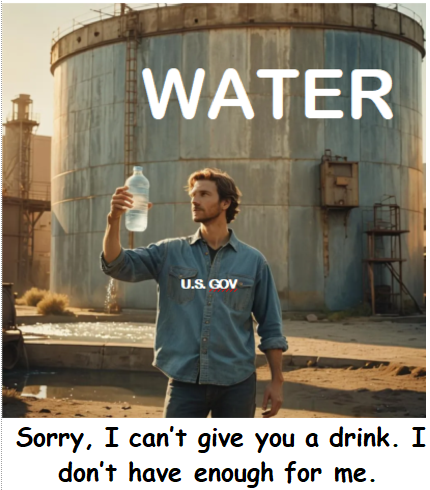
Help the rich or help the poor?

Here is a puzzle for you: Given the unlimited ability to spend money to aid rich farmers or poor consumers, guess who the Republicans and the Democrats in Congress will help? Think about your answer as you read the following excerpts and comments
Lawmakers are at odds over whether to boost the price floor for certain food commodities or to spend the same money approving more generous food aid for needy families. By Jacob Bogage, July 12, 2024 at 6:00 a.m. EDT
A price floor is a price set above the “equilibrium” price. The equilibrium price is the price when supply equals demand. Normally, when supply exceeds demand, the price goes down, which tends to increase demand or decrease supply, until equilibrium is reached. When demand exceeds supply, the price goes up until again, equilibrium is reached. But markets aren’t perfect and they are unpredictable. The equilibrium price is a safety net. The price floor guarantees farmers a minimum price if prices fall due to oversupply. It’s price insurance.
In the latest draft of a $1.5 trillion measure known as the farm bill, Republicans in Congress have plans to spend $50 billion over the next decade to raise price floors for major agricultural products such as corn, wheat, soybeans, cotton and peanuts.
But to pay for those new prices, the House version of the bill would scrap a 2018 change in the law that allowed presidents to increase benefits in the Supplemental Nutrition Assistance Program, formerly known as food stamps, which subsidizes groceries for nearly 42 million Americans each month.
To pay for those new prices, Congress merely needs to vote for the funds. (Former Fed Chairman Alan Greenspan: “There is nothing to prevent the federal government from creating as much money as it wants and paying it to somebody.”)
Now Congress is locked in negotiations over whether to send money to food producers or food consumers, as the current farm bill is set to expire Sept 30.
This should not be a choice. No “either,” “or.” The government should help those who need help.
“It’s really that farm safety net that’s been left behind,” said Joe Gilson, director of governmental affairs for the American Farm Bureau Federation. “Farmers are just asking for an increase for the reference price, a modest increase, that can address some of the concerns that they’ve seen in their production over the past five or six years.” A bill from House Agriculture Committee Chairman Glenn Thompson (R-Pa.) would raise price guarantees for 14 commodity crops. The proposal raises “reference prices,” the federally guaranteed minimum price, for those products by up to 20 percent. It also includes a 15 percent crop insurance subsidy for new farmers, up from the current 10 percent; those policies can protect specialty crops and livestock that lack commodity price protections. “It’s risk management. It protects against market volatility. Crop insurance protects against weather,” Thompson said. “What we put together is really what the American farmer is asking for.” To balance that spending, Republican proposals would prevent the White House from flexing power to increase future food assistance.
Heaven forbid that the GOP should vote to do anything for the poor.
Lawmakers also plan to cut funds the Agriculture Department has traditionally used to help small farmers survive market shocks. The GOP proposals, advanced by Thompson and Sen. John Boozman (Ark.), would not cut SNAP benefits, which would continue to receive annual automatic cost-of-living adjustments to keep up with inflation. But the bill would prevent the president from recalculating benefits outside of budgetary limits.
Not only will the GOP not help the poor, but it won’t help small farmers.
Using SNAP funds to pay for higher price floors is “a trade-off that none of us Democrats are willing to make,” Sen. Cory Booker (D-N.J.) told The Washington Post. Booker said Congress should address SNAP and reference prices as independent issues. The standoff could force lawmakers to extend the current farm bill again, either to consider legislation after November’s elections or after a new Congress takes office in January. Without a farm bill, U.S. commodity and dairy markets could face massive upheaval.
A totally unnecessary trade-off, because Congress has infinite funds. (Former Fed Chairman Ben Bernanke: “The U.S. government has a technology, called a printing press (or, today, its electronic equivalent), that allows it to produce as many U.S. dollars as it wishes at essentially no cost.)
Reference prices are the main method policymakers use to keep agricultural commodity prices stable and help withstand global shocks. U.S. growers compete with international producers in an industry that experiences more price fluctuation than many other goods-producing industries, economists say. Favorable soybean growing conditions in Brazil, for example, could tank the price U.S. growers can demand for their product. But by the same token, a drought in India could boost American rice export prices. If the market price falls below the reference, taxpayer dollars pay agricultural producers a subsidy to make up the difference. That smooths over some of the price volatility, agro-economists say, and can help keep farmers afloat after a rough growing season. Those floors have not increased since 2014, and inflation has increased dramatically since then, essentially leaving producers with a lower price guarantee. But price guarantees only kick in for a subset of commodity farmers. Producers are eligible for the guarantees if they farm on “base acres,” land set aside in 1985 for crop-specific farming. Congress has gradually added acres to the allotment, but the designation only covered 244 million acres of the United States’ 879 million acres of farmland in 2023. So reference prices tend to mainly help larger industrial farm operations, which over time have consolidated ownership of much of those acres. “It’s a lot of money going to a very small number of farmers, representing a very small number of counties in the U.S., who already are receiving significant payments anyway from this program,” said Joelle Johnson, deputy director at the Center for Science in the Public Interest.
Examples are:
  1. Cargill: As one of the largest privately held corporations globally, Cargill is a major agricultural player. They operate farms across various states, producing corn, soybeans, and wheat crops.
  2. ADM (Archer Daniels Midland): ADM is another giant in the agricultural industry. They manage extensive farmland, process crops, and handle commodities like grains, oilseeds, and sweeteners.
  3. Bunge: Bunge is involved in grain trading, oilseed processing, and fertilizer production. Their farm operations contribute significantly to their overall business.
  4. Tyson Foods: While primarily known for poultry and meat processing, Tyson also owns and operates farms that supply feed for their livestock.
  5. Smithfield Foods:
The advocacy organization Environmental Working Group, for instance, found in 2021 that the largest 10 percent of farms received 81 percent of reference price payouts.The largest 20 percent received 91 percent of the subsidies.
The GOP wants to help the largest 10 percent of the farmers while punishing the poorest consumers. Surprised?
Congress has also relaxed rules about which crops farmers must grow to claim subsidies. Legislation in 1996 divorced crop requirements from price support, encouraging growers to “farm the market” instead of “farming the reference price.” Producers no longer have to match the crop they grow on a base acre to the subsidy they receive. For example, a farm can grow more price-stable soybeans on land set aside for long-grain rice, which regularly receives government support. That farm would get subsidies based on the rice market, even though it’s growing soy. To nutrition advocates, a new investment in commodity producers feels like it comes at the expense of families in financial straits, said Johnson from the Center for Science in the Public Interest.  “We all accept that SNAP benefits should be adjusted for inflation,” he said. “And we have to be equally accepting of the fact that nutritional guidance, societal norms around food, the availability of food products, the way in which we prepare food are also things which should be accounted for to ensure that SNAP recipients are not losing ground.”
Rodger Malcolm Mitchell Monetary Sovereignty Twitter: @rodgermitchell Search #monetarysovereignty Facebook: Rodger Malcolm Mitchell; MUCK RACK: https://muckrack.com/rodger-malcolm-mitchell; https://www.academia.edu/

……………………………………………………………………..

The Sole Purpose of Government Is to Improve and Protect the Lives of the People.

MONETARY SOVEREIGNTY

Uninformed debate on “national government debt” and one informed voice.

Former Fed chairman Alan Greenspan on the risk of recession
Alan Greenspan
The UK government, like the US government, is Monetarily Sovereign. It has the infinite ability to create its own sovereign currency.

Former Federal Reserve Chairman Alan Greenspan: “A government cannot become insolvent with respect to obligations in its own currency.

“There is nothing to prevent the federal government from creating as much money as it wants and paying it to somebody.

“The United States can pay any debt it has because we can always print the money to do that.”

Other governments have this ability — the UK, Canada, Japan, Australia, the EU (though not its euro-using nations), China, etc. Not only can they create infinite amounts of their sovereign currency, but they are large enough to assure acceptance of, and demand for, their currencies. The currencies of the above-named nations are backed by the full faith and credit of those nations, so there always is demand.

(By contrast, if you decided to create and distribute “mybucks” as your sovereign currency, you, too, would be Monetarily Sovereign, but few, if any, people would want it because your full faith and credit do not support a widely used currency.)

Sadly, the leaders of those nations have been paid by the rich to pretend they are not Monetarily Sovereign and that their “debt” is not “sustainable.” The purpose of the bribe: To widen the Gap between the rich and the rest. In many posts on this blog, I have discussed the facts that:
  1. U.S. “federal debt” is not federal, nor is it debt. It is deposits wholly owned by the depositors.
  2. The U.S. federal government is infinitely able to pay any obligations denominated in dollars, and the federal “debt” is infinitely sustainable.
  3. Creating dollars does not cause inflation. All inflations are caused by scarcities of critical goods and services, most often oil, food, and labor.
  4. Federal deficits are necessary to grow the economy, necessary to prevent recessions and depressions, and necessary to cure recessions.
Lest you believe the U.S. is the only Monetarily Sovereign government that pretends it isn’t Monetarily Sovereign, I give you the following demonstration of economic ignorance from the UK:

Background UK public sector net debt, often referred to as ‘national debt’, currently stands at just under 100 per cent of GDP.

The UK’s growth outlook remains weak; quantitative easing has significantly increased the sensitivity of the UK’s debt to changes in short-term interest rates; and it is unclear whether the Government’s fiscal rule, as it relates to the national debt, is fit for purpose.

The committee’s inquiry will investigate whether the UK’s national debt is on a sustainable path; if not, what steps are required; and whether the Government’s fiscal rule regarding the national debt is meaningful.

There it is, the “sustainable” lie. Like the Monetarily Sovereign U.S. “debt,” the UK debt is infinitely sustainable.

Call for evidence The committee is seeking answers to the following questions:

1. What is meant by a “sustainable” national debt? Does the metric of debt as a percentage of GDP adequately capture sustainability?

Answer: No. The “debt”/GDP has no meaning with regard to a Monetarily Sovereign government’s ability to “sustain” its so-called “debt.”

2. The Government’s target is for public sector net debt (excluding the Bank of England) to be falling, as a percentage of GDP, by the fifth year of the OBR’s forecast. How meaningful is this target; and how does it inform an evaluation of the sustainability of our national debt?

Answer: The only way to decrease the “debt”/GDP ratio is to reduce deficit spending, a reduction that has repeatedly caused recessions.

3. How robust are the assumptions used by the Office for Budget Responsibility when forecasting our national debt?

Answer: Since the forecasts are meaningless, the “robustness” question also is meaningless.

4. What implications does the structure of the UK’s national debt have for its short and longer-term funding?

Answer: The debt is the net total of deficit spending, which already has been funded by money creation.

5. What are the market risks created by high levels of public debt; and what factors will influence the market’s appetite for this debt?

Answer: National government deficit spending adds growth dollars to the economy. The real market risks — i.e., recession and depression — come from insufficient deficit spending. The government does not need to sell deposits into so-called “debt.” So, there is no government need for “market appetite.” The UK government can spend endlessly without selling even one pound of debt securities.

6. If we are to ensure our national debt is sustainable, what might this mean for fiscal policy?

Answer: There is no need to “ensure’ the national debt is sustainable. It is infinitely sustainable. For that reason, paying higher interest on the “debt” is not a burden on the government Higher rates often can benefit the economy by adding dollars to the private sector, thus increasing GDP.

7. Should the definition of the national debt differentiate between debt incurred for investments (which generate revenue for the Government), and other areas of spending?

Answer: The so-called “national debt” is nothing like private (monetarily non-sovereign) debt. The more “national debt” there is, the healthier the economy. The UK government has no need for revenue. Even if it didn’t collect a pound in income or taxes, it could continue spending forever. And then there is this bit of nonsense:
Matthew Lynn
Matthew Lynn

Britain is teetering on the brink of bankruptcy. No one dares admit it Story by Matthew Lynn

Rishi Sunak came under fire for some Treasury forecasts of tax rises.

The Labour Party droned on about “change” while endlessly repeating some imaginary numbers about “investing” in the NHS and creating “green jobs”. 

Over the course of the election campaign, the main parties have argued furiously about trivialities.

Yet there is an ugly truth lurking behind this election: Britain is far closer to bankruptcy than our political elites are willing to admit. 

This is absolutely false scaremongering. The UK cannot go bankrupt because it cannot run short of money. Period.

Taxes are already at a 70-year high, and yet we are nowhere close to balancing the books.

Every pound of taxes reduces GDP growth. National taxes absolutely should be cut. They do not fund (monetary sovereign) national government spending. (Taxes do fund local — monetarily non-sovereign –government spending.) If the UK stops running deficits, it will have a depression that will make the Great Depression look like a picnic — a depression that only will be cured by massive deficit spending.

Over the course of this year, we will add another £87 billion, or around 3 per cent of GDP, to the national debt, according to the Office for Budget Responsibility (OBR).

And this is happening at a time when the economy is recovering, and the Government has pushed through a series of punishing tax rises.

Did it occur to the authors that GDP = National + local government spending + Net Exports? An economy recovers because of deficit spending, not in spite of it.

We should be paying back debt at this point in the cycle, not racking up even more.

“Paying back requires either more taxes or less spending, both of which will reduce GDP. It’s simple algebra.

Our debt to GDP ratio is close to 100 per cent, and tripled in the 16 years to 2023, according to the Resolution Foundation, the largest ever increase in peacetime.

We are very near to the 112 per cent level that has just led to the humiliating downgrade of France’s credit rating twice over the past six months.

The UK is Monetarily Sovereign. France is monetarily non-sovereign. Sadly, the authors don’t understand the difference, yet they write about economics. Shameful.

It doesn’t stop there. We are still racking up huge off-balance sheet debts. Such as? There is already £200 billion of outstanding student debt, and that is forecast to rise to over £400 billion by the 2040s.

Again, students are monetarily non-sovereign. The authors confuse the burden of private debt with the economic necessity of national debt, demonstrating unforgivable ignorance by national leaders. The government should increase its deficits by helping fund students’ debt.

Few believe that graduates will earn enough to pay back their loans in full, especially as our zero-growth economy is hardly creating any new professional jobs to absorb them all.

Government deficit spending could grow the economy and create jobs.

We are on the hook for some £2.6 trillion in “unfunded” public sector pension entitlements.

There are zero “unfunded” public sector pension entitlements. They all are funded by government money creation. The claim is an attempt to widen the income/wealth/power Gaps between the rich and the rest. The claim is funded by the rich to make themselves richer. The wider the Gaps, the richer are the wealthy.

As the state employs more and more people – we added another 135,000 to the government payroll in the year to September 2023 – that figure will carry on getting larger and larger.

That means 135,000 people receive money that is added to GDP.

We are legally mandated to hit a net zero target which the OBR has calculated could add at least another £300 billion to the government’s costs over three decades.

If a “net zero” target means zero deficits, the UK is headed for a depression. That target is beyond stupid. It is criminal.

In Wales, a staggering 28 per cent of working age people are now on benefits, depending on the state to support them, and the figures are little better in the rest of the country.

If “the state” is the national government, those payments add to GDP and do not cost anyone anything. And at last, we come to one Britisher who understands Monetary Sovereignty. Delight in reading one informed man’s comments:
Jon Camden | Materials Science and Engineering | University of Notre Dame
Jon Camden

JON CAMDEN – WRITTEN EVIDENCE SND0005 – SUSTAINABILITY OF THE UK’S NATIONAL DEBT INQUIRY

The UK’s national debt is always sustainable.

I’m frankly amazed you have to ask this question. Firstly, a brief explanation as to what the National Debt actually is. The debt is nothing more than a record of all government expenditure into the economy less taxes removed from the economy.

The issuance of Gilts to match the difference between spending and tax is not borrowing and does not provision government. The sale/purchase of Gilts is an Open Market Operation with the purpose of managing interest rates, it is a hangover from the gold standard days.

Gilt sales serve no real purpose other than to provide a safe way for pension funds and other financial institutions to make money.

They also help control interest rates, but the point is correct. They do not provide the government with spending funds.

Not a bad thing in itself but let’s not pretend that our government, that is the monopoly issuer of the pound, needs to borrow pounds that it has already issued.

And what is the mechanism behind this simple fact? Reserves accounts of commercial financial institutions held at the Bank of England solely consist of pounds issued/spent by the government or loaned by the government.

The pounds in the reserve accounts of commercial institutions put there by our government are then used by commercial institutions to purchase Gilts issued by our government! In effect the pounds in the reserve account are transferred to a Gilts account which pays interest.

That’s it. There is no way that in any sense of the word could this be considered as the UK government borrowing.

Next, although we’ve just seen that the National Debt is a mirage and better described as savings, we still insist that we have to pay interest (often described as nothing more than corporate welfare) on the pounds we have issued.

And that is a lot of interest. How sustainable are these interest payments? The answer is infinitely sustainable.

As I’ve already stated the irrefutable fact that the UK government is the monopoly issuer of the pound. The UK government can never involuntarily become bankrupt.

It can never run out of pounds. It can therefore always service its ‘debt’ as long as the debt is in pounds (which of course it is).

You only have to look at the example of Japan to realise that debt to GDP ratios are totally meaningless.

Last time I looked, end of 2023, Japan had a debt to GDP of 263% with low inflation, low interest rates, high levels of employment and excellent public services.

Any debt to GDP target is completely arbitrary and designed to hold down the spending of public money for public purpose, in other words it is politically motivated rather than having any economic basis.

Last, just want to reiterate that the idea that the UK government is dependent on the private sector or market to finance its ‘debt’ is total nonsense.

As I’ve already stated the pounds used by private financial institutions to buy Gilts were already issued by the government but we still have to go through the theatre of pretence by selling Gilts on the primary market.

BoE just used to buy them directly until it was forbidden, but that is entirely self-impose constraint. Now, if the market loses its appetite for debt the BoE just steps in and buys on the secondary market.

It’s about time the law-makers of our country understood that the UK government is monetarily sovereign. UK government finances are not like a household’s.

The UK government can never go broke, can never run out of money, and can always sustain its debt.

That, however, is not to say there are no limits to government expenditure. UK government expenditure is constrained by the real resources that are available to buy priced in pounds.

Asking how we are going deploy our government’s infinite financial resources to invest to sustain the real economy, mobilise our workforce and the finite resources of our country and, at the same time, sustain the environment are the real questions we should be asking.

Not worrying about an imaginary problem about how to sustain an imaginary ‘debt’, caused by imaginary ‘borrowing’. 23 January 2024

Thank you, Professor Camden. We can now assure everyone that there is at least one informed, though lonesome, person in England. Is there another? Oh, wait. I think Camden is an American and a chemist. If that is the case, perhaps it shows that chemists rely on proofs and facts, while economists rely on intuition and hearsay. So, thank you again, Professor Jon Camden, for your excellent article. Rodger Malcolm Mitchell Monetary Sovereignty Twitter: @rodgermitchell Search #monetarysovereignty Facebook: Rodger Malcolm Mitchell; MUCK RACK: https://muckrack.com/rodger-malcolm-mitchell

……………………………………………………………………..

The Sole Purpose of Government Is to Improve and Protect the Lives of the People.

MONETARY SOVEREIGNTY

The “unsustainable,” “ticking time bomb” federal debt isn’t an unsustainable ticking time bomb at all

If you are a regular reader of this blog you may be familiar with this post: Historical claims the Federal Debt is a “ticking time bomb.” It describes the ongoing, relentless claims that the federal debt is “unsustainable and a “ticking time bomb.

The first entry was in 1940, when the so-called “federal debt” was about $40 Billion. Today, it is about $30 Trillion, a monstrous 74,900% increase.

You read that right. The so-called “federal debt” has increased nearly seventy five thousand percent since Robert M. Hanes, president of the American Bankers Association, claimed, the federal budget was a ticking time-bomb which can eventually destroy the American system,”

Now, here we are, 84 years and $30 Trillion dollars later. And still we survive. Not much of a time bomb.

I was reminded yet again, about the absurdity of the debt worries, when I read the following article, Here are some excerpts:

Record-high national debt is fiscal time bomb for US. Congress must defuse it. Founding Father’s fear has come true: Federal debt burden now is the greatest threat to the U.S. economy, national security and social stability. David M. Walker and Mark J. Higgins Opinion contributors

Apparently the “time bomb” still is ticking in the minds of the debt fear mongers.

In the late 1780s, the finances of the United States were in disarray. Revolutionary War debts incurred by the Continental Congress and former colonies were defaulting, and the democratic experiment in the New World was on the brink of failure.

But the nation caught a break when President George Washington appointed Alexander Hamilton as the first secretary of the Treasury.

In 1790 and 1791, Hamilton persuaded a reluctant Congress to establish the nation’s first central bank and consolidate all outstanding state and federal debt.

The federal debt burden after this action was just 30% of gross domestic product. A few years later, President Washington reinforced in his farewell address the need to avoid excessive debt.

We repeatedly have shown that the Debt/GDP ratio signifies nothing. It predicts nothing. It says nothing about a nation’s ability to pay its financial debts. It has no meaning whatsoever.

Yet it is quoted, again and again, by pundits who use it as evidence of . . . whatever they are trying to prove.

What next, Annual Rainfall/Number of Children named “Tom”? Here is the nonsense being peddled by Investopedia:

The debt-to-GDP ratio is the metric comparing a country’s public debt to its gross domestic product (GDP).
By comparing what a country owes with what it produces, the debt-to-GDP ratio reliably indicates that particular country’s ability to pay back its debts.
Often expressed as a percentage, this ratio can also be interpreted as the number of years needed to pay back debt if GDP is dedicated entirely to debt repayment.

Oh, really? The ratio “reliably indicates”?

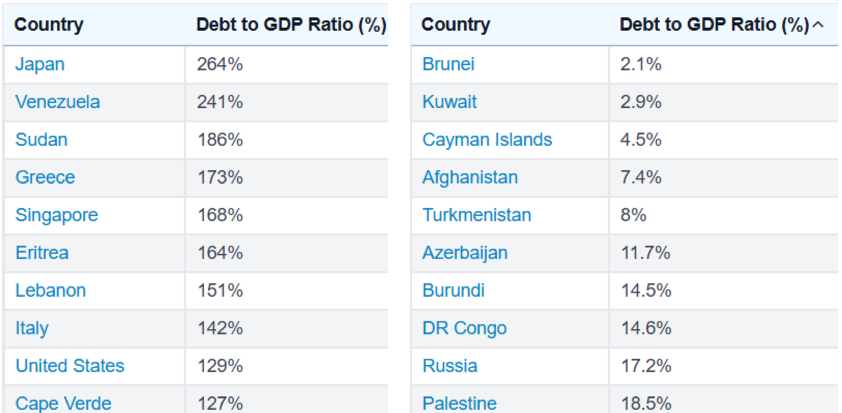
Here are some sample ratios. The nations with the ten highest ratios are shown to the left. The nations with the ten lowest ratios are shown to the right. According to the debt fear-mongers, the most financially secure nations are listed in the right-hand column:

According to the infamous Debt/GDP formula, the U.S. government has less ability to pay its debts than Cape Verde, and every one of the nations in the right-hand column.

And Japan supposedly has less ability to pay its debts than any other nation in the world. Does anyone really believe this nonsense?

But wait. Buried deep in the Investopedia article is this little paragraph:

Economists who adhere to modern monetary theory (MMT) argue that sovereign nations capable of printing their own money cannot ever go bankrupt, because they can simply produce more fiat currency to service debts; however, this rule does not apply to countries that do not control their monetary policies, such as European Union (EU) nations, who must rely on the European Central Bank (ECB) to issue euros.

Thus, the Debt/GDP “rule” does not apply to the United States, Canada, Mexico, China, Australia, the UK, Switzerland, Sweden, Norway, India, South Africa and others. The “rule” doesn’t apply to most of the world’s largest, most significant economies.

Yet, pundits in America insist on using the useless — no harmful — Debt/GDP ratio as a cudgel to ram debt reduction into financial planning.

Never mind that debt reduction causes depressions and recessions:

1804-1812: U. S. Federal Debt reduced 48%. Depression began 1807.
1817-1821: U. S. Federal Debt reduced 29%. Depression began 1819.
1823-1836: U. S. Federal Debt reduced 99%. Depression began 1837.
1852-1857: U. S. Federal Debt reduced 59%. Depression began 1857.
1867-1873: U. S. Federal Debt reduced 27%. Depression began 1873.
1880-1893: U. S. Federal Debt reduced 57%. Depression began 1893.
1920-1930: U. S. Federal Debt reduced 36%. Depression began 1929.
1997-2001: U. S. Federal Debt reduced 15%. Recession began 2001.

Why does that happen? Simple algebra. The formula for Gross Domestic Product is:

GDP = Federal Spending + Nonfederal Spending + Net Exports.

To reduce the so-called federal debt, one must decrease Federal Spending and/or increase federal taxes, which decreases Nonfederal Spending.

To increase real (inflation-adjusted) economic growth, a nation must do the opposite: Increase Federal Spending and/or decrease federal taxes, both of which add to the so-called “federal debt.”

Mathematically, there is no way to grow real GDP without growing “federal debt” enough to overcome inflation. So, if inflation is say, 2% (the Fed’s goal), the debt increase must overcome an annual 2% inflation handicap for GDP just to stay even.

Add to that, the need to overcome a net export figure (which America almost always has) and large annual deficits become vital.

When we have deficits that are too small, we have recessions, which the following graph demonstrates:

When federal debt declines, we experience recessions (vertical gray bars), which are cured by federal debt increases.

Strangely, the “science” of economics, which seems to love mathematical formulas and graphs, ignores the obvious. Growing an economy requires a growing supply of money.

Federal deficits add money to the economy. Federal taxes take money from the economy.

Continuing with the ticking time bomb article:

Over the next 175 years, politicians across the political spectrum largely adhered to Hamiltonian principles to preserve the integrity of the public credit.

The most important principle was that debt should be issued primarily to address emergencies – especially those involving foreign wars – and that debt burdens should be reduced during times of peace.

This changed completely in the 1970’s when President Nixon mandated the end of the dollar “backing” (actually the convertibility) to gold, and made the federal government Monetarily Sovereign in full.

Until then, the federal government’s ability to create dollars was limited by its inventory of gold. When the inventory did not keep up with GDP growth needs, recessions resulted.

Now, with gold no longer a factor, the government’s ability to grow the nation’s money supply also gave the government the ability to grow GDP.

This discipline enabled America to establish and maintain its excellent credit record, which provided ample lending capacity during periodic crises.

As Hamilton predicted, the ability of the nation to borrow proved critical during the War of 1812, the Civil War, World War I and World War II.

The nation now has no need to borrow, a far superior situation. It can create, at will, the growth dollars it needs.

 After World War II, fiscal discipline was temporarily restored, and debt/GDP was reduced by growing the economy much faster than the debt even though the federal government continued to run budget deficits during most years.

Again, there is no magic. GDP still = Federal Spending + Nonfederal Spending + Net Exports.

If the Federal debt is reduced, the growth dollars must come from somewhere. In this case, growth came from Net Exports.

Subsequently, our wealthy economy began buying, buying, buying, which is a good thing. We were exchanging dollars that cost us nothing (We created them by pressing computer keys) for valuable goods and services.

Because the American government has access to infinite dollars, importing goods and services makes economic sense.

The U.S. is the world’s most massive consumer economy. Our Net Exports fell while GDP grew only because of massive federal deficit spending.

The one exception was in 1998-2001, when the federal government ran budget surpluses and even paid down debt in two of these years.

That exception proves the debt reduction is an economic disaster. Here is what happened when we paid down debt: 1997-2001: U. S. Federal Debt reduced 15%. Recession began 2001.

Reduced deficit spending morphed into a surplus in 1998. The result: A recession in 2001, which was cured by increased federal deficit spending.

Since then, the Hamiltonian principle has been decisively abandoned, and the federal government now routinely runs large deficits, resulting in ever-increasing debt burdens. This behavior is projected to worsen in the future.

Translation: The federal government now routinely runs large deficits, which pump growth dollars into the economy, thus growing GDP.

Mounting federal debt burdens now represent the greatest threat to the U.S. economy, national security and social stability.

The federal debt/GDP ratio is 123%. The nonpartisan Congressional Budget Office projects that, under current law, it will increase to 192% by 2053.

The federal government has the infinite ability to create dollars. The major threat to the U.S. economy (i.e. to GDP) is a reduction in federal money creation.

Clearly this is irresponsible, unsustainable and in sharp contrast to Hamilton’s founding principle.

There it is, the word “unsustainable,” to describe what we have been sustaining since 1940. Hamilton did not anticipate the post-1973, Monetarily Sovereign America.

National debt has topped $34 trillion.Does anyone actually have the guts to fix it?

The fastest way to “fix” the national debt would be to stop accepting deposits into T-security accounts (T-bills, T-notes, and T-bonds).

The government doesn’t use those dollars. They remain the property of the depositors. The problem is that those deposits do have two functions (neither of which is to supply the government with dollars):

  1. To provide a safer place to store dollars than bank savings accounts
  2. To help the Fed control interest rates by providing a floor for rates.

Why does the United States continue to behave so irresponsibly? One reason is that U.S. politicians routinely avoid spending cuts and tax increases because they may threaten their reelection prospects.

Voters rightfully don’t want tax increases and they don’t want federal benefit reductions, both of  which take money out of voters’ pockets and lead to recessions.

Another is that, as the issuer of the world’s dominant reserve currency, the United States can run fiscal deficits so long as surplus countries, such as China and Saudi Arabia, continue to purchase U.S. Treasuries.

The U.S. does not need anyone to purchase U.S. Treasuries. The federal government creates all the dollars it needs simply by pressing computer keys. The government does not use the dollars in T-security accounts. They are the property of the depositors.

In fact, proponents of the flawed and failed Modern Monetary Theory implicitly argue that the dollar’s reserve currency status is permanent, which allows deficit spending to continue indefinitely.

The dollar is the world’s leading reserve currency, which is a currency banks keep on reserve to facilitate international commerce. But, other currencies — the British pound, the euro, the Chinese renminbi — also are reserve currencies.

Being a reserve currency has nothing to do with the federal government’s ability to spend indefinitely.

Congress must defuse America’s fiscal time bomb.

Yikes, there it is again, the silly “time bomb” analogy. It’s the time bomb that never explodes.

A debt crisis is not imminent in 2024, but one will occur in the future if the nation’s addiction to deficits and debt persists.

Translation: A debt crisis is not imminent in 2024. We have no idea when if ever it will occur, but it makes us sound smart to threaten it.

The greatest risk is the one that Alexander Hamilton feared most: One day, the United States could face a threat to its very existence – perhaps in the form of a foreign war – and Americans will lack the debt capacity to fund an adequate response.

Lessons from the switch to Bernanke from Greenspan - MarketWatch
Obviously, the government never can run short of dollars. I wonder why they don’t understand that.

Lack the capacity to fund? Utter nonsense. Here are the facts:

Former Fed Chairman, Alan Greenspan: “A government cannot become insolvent with respect to obligations in its own currency. There is nothing to prevent the federal government from creating as much money as it wants and paying it to somebody. The United States can pay any debt it has because we can always print the money to do that.”

Former Fed Chairman, Ben Bernanke: “The U.S. government has a technology, called a printing press (or, today, its electronic equivalent), that allows it to produce as many U.S. dollars as it wishes at essentially no cost. It’s not tax money… We simply use the computer to mark up the size of the account.

Statement from the St. Louis Fed: “As the sole manufacturer of dollars, whose debt is denominated in dollars, the U.S. government can never become insolvent, i.e., unable to pay its bills. In this sense, the government is not dependent on credit markets to remain operational.”

That’s the real capacity.

Fortunately, the future is far from hopeless. America sits on a huge reservoir of natural resources and remains the world’s technological innovation engine.

It also possesses sufficient time to enact fiscal reforms and reestablish fiscal discipline.

Because the authors, David M. Walker and Mark J. Higgins, don’t understand Monetary Sovereignty, they think federal government fiscal discipline is the same a personal fiscal discipline. 

Federal finance is so unlike personal finance that not understanding the difference is like not understanding the difference between butter and a butterfly.

The challenge for Americans today is that the longer we wait to reinstate this principle, the more pain that will be incurred. It is our belief that the solution is in the hands of “We the People.”

The math doesn’t lie.Republicans and Democrats own every missing dollar of our growing national debt crisis.

Politicians have powerful incentives to respond to short-term demands, and if Americans collectively demand that short-term desires must be satisfied at the expense of the nation’s long-term prosperity and solvency, that is what politicians will deliver.

Heaven forbid that Americans demand increases in taxes and cuts to federal spending. The result would be a depression.

On the other hand, if Americans place equal value on the longevity of their country and the prosperity of their children and grandchildren, they will demand that politicians take steps to defuse America’s fiscal “time bomb.”

Oops, more time bomb that never explodes.

Ever notice that the debt worriers never come up with evidence? They say “debt is bad,” but they don’t say,”Here is a graph of what has happened to the economy when federal debt increased and decreased.

Here is one such graph:

As federal debt (red) has grown, the economy (GDP, blue) has grown.

As you can see, there is no sign of a “debt crisis.”

History suggests that Americans will eventually pursue the correct course of action. Our hope is that they embrace it quickly to ensure that America’s future is brighter than its past.

David M. Walker, a former U.S. comptroller general, is also a recipient of the Alexander Hamilton Award for economic and fiscal policy leadership from the Center for the Study of the Presidency and the Congress.

Mark J. Higgins is author of “Investing in U.S. Financial History: Understanding the Past to Forecast the Future,” coming Feb. 27. Connect with Mark on LinkedIn. 

It is frightening that a former U.S. comptroller general and recipient of an award for policy leadership, and the author of a book about U.S. finances can be so clueless about U.S. federal finances. No wonder the public is so ill-informed.


Rodger Malcolm Mitchell
Monetary Sovereignty

Twitter: @rodgermitchell Search #monetarysovereignty
Facebook: Rodger Malcolm Mitchell

……………………………………………………………………..

The Sole Purpose of Government Is to Improve and Protect the Lives of the People.

MONETARY SOVEREIGNTY
When will the U.S. government run out of U.S. dollars?

Seems like a simple question — “When will the U.S. government run out of U.S. dollars?” Sadly, the media writers, economists, and politicians don’t seem to know. Some claim “soon.” Some claim “eventually.” A few say “never.”
Scott Horsley 2010
Scott Horsley
For instance, Scott Horsley:
Scott Horsley is NPR’s Chief Economics Correspondent. He reports on ups and downs in the national economy as well as fault lines between booming and busting communities. Horsley spent a decade on the White House beat, covering both the Trump and Obama administrations. Before that, he was a San Diego-based business reporter for NPR, covering fast food, gasoline prices, and the California electricity crunch of 2000. He also reported from the Pentagon during the early phases of the wars in Iraq and Afghanistan. Horsley earned a bachelor’s degree from Harvard University and an MBA from San Diego State University. 
Mr. Horsley seems to believe the government will run out of money in 2033 or maybe in 2036. I say that because of the article he wrote:

The clock is ticking to fix Social Security as retirees face automatic cut in 9 years MAY 6, 2027:06 PM ET, Scott Horsley

Congress has less than a decade to fix Social Security before the popular program runs short of cash, threatening a sharp cut in benefits for nearly 60 million retirees and family members, according to a government report released Monday.

Social Security (SS) is an agency of the U.S. government. The only two ways SS can run out of dollars are:
  1. If Congress and the President want it to run out, or
  2. If the U.S. government runs out.
Can the government run out of its sovereign currency, which it created from scratch in the 18th century? For millions of years, there was no U.S., no U.S. laws, and no U.S. dollars. Then suddenly, in the late 1780s, a group of men created a government from thin air. This government passed laws, also from thin air. Some of the laws created the U.S. dollar, again from thin air. That government created as many laws as it wished, and those laws created as many dollars as the law-writers wished. It all was arbitrary. So, returning to the question, “When will the U.S. government run out of U.S. dollars?”

The report from Social Security trustees predicts the retirement program’s trust fund will be exhausted in November of 2033.

Despit what you repeatedly have been told, it isn’t a trust fund. It’s just a line item in a balance sheet. (See: “The phony trust fund controversy.“) The government can change those numbers to whatever it chooses at any time it chooses. Congress votes; the President approves; someone presses a computer key; and a one billion dollar “trust fund” instantly becomes a fifty billion dollar “trust fund.”

At that point, benefits would automatically be cut by 21%, unless lawmakers adopt changes before then.

Among the laws the government created were the laws creating Social Security. As an agency of the government, Social Security is funded the same way as every other agency: Congress votes, and the President approves.  Congress and the President have unlimited freedom to decide how much any agency will receive:
  • Mandatory spending – funding for Social Security, Medicare, veterans benefits, and other spending required by law. This typically uses over half of all funding. (Congress and the President make the law)
  • Discretionary spending – federal agency funding. Congress sets funding levels for these each year. This usually accounts for around a third of all funding. (Congress and the President set the levels)
  • Interest on the debt – this usually uses less than 10 percent of all funding. Congress and the President decide how much interest to pay and tax).
In short, every penny of federal spending ultimately is decided by Congress and the President. It all returns to the fundamental question, “When will the U.S. government run out of U.S. dollars?” By now, I’m sure you know the answer: The U.S. government cannot unintentionally run short of U.S. dollars.
Lessons from the switch to Bernanke from Greenspan - MarketWatch
People don’t realize that FICA doesn’t fund Social Security and Medicare and that those trust funds are fictions.
Even if the government had to pay someone a billion, a trillion, or a billion trillion dollars today, it could do so simply by passing a law and pressing a computer key.

Former Federal Reserve Chairman Alan Greenspan: “A government cannot become insolvent with respect to obligations in its own currency. There is nothing to prevent the federal government from creating as much money as it wants and paying it to somebody. The United States can pay any debt it has because we can always print the money to do that.”

Former Federal Reserve Chairman Ben Bernanke: “The U.S. government has a technology, called a printing press (or, today, its electronic equivalent), that allows it to produce as many U.S. dollars as it wishes at essentially no cost. It’s not tax money… We simply use the computer to mark up the size of the account.”

Statement from the St. Louis Fed: “As the sole manufacturer of dollars, whose debt is denominated in dollars, the U.S. government can never become insolvent, i.e., unable to pay its bills. In this sense, the government is not dependent on credit markets to remain operational.”

The answer to the question, “When will the U.S. government run out of U.S. dollars?” is a resounding, NEVER, unless Congress and the President make that arbitrary decision. You and I are limited in our money supply. Your state, county, and city governments are limited. All businesses are limited. Banks are limited. Even euro nations are limited. All are monetarily non-sovereign. They were not the original creators of the U.S. dollar. By contrast, the U.S. government is Monetarily Sovereign. It was the creator of the dollar. It cannot unintentionally run short — not now, not in 2033, not in 2036, not ever. So why do writers like Scott Horsley think SS and Medicare, agencies of the federal government, will run short?

There’s some good news in the new forecast. Thanks to higher-than-expected worker productivity and a decline in expected disabilities, Social Security isn’t burning through cash as fast as trustees predicted a year ago.

Still, the long-term demographic challenges haven’t gone away.

A growing number of baby boomers are collecting benefits, while there are fewer people in the workforce paying taxes for each retiree.

Given today’s low birthrates, that mismatch is not expected to change for decades, although a surge in immigration helps.

Remember what Ben Bernanke said, “It’s not tax money… We simply use the computer to mark up the size of the account.” The federal government does not use your tax dollars to fund its spending. You (and Mr. Horsley) may be shocked to learn that every dollar you send to the U.S. Treasury is destroyed upon receipt. When you pay taxes, the dollars come out of your bank account, where they were part of the “M2 money supply measure.” When the dollars reach the Treasury, they instantly disappear from M2 and are not found in any money supply measure.  They join the Treasury’s infinite money supply. Adding dollars to infinite dollars still yields infinite dollars. These dollars, which are not part of any money supply, no longer can be found. They have been destroyed. Why does the federal government collect taxes if not to fund spending?
  1. To control the economy by taxing what it wishes to discourage and by giving tax breaks to what it wishes to reward.
  2. To assure demand for the U.S. dollar by requiring taxes to be paid in dollars.
  3. To make you believe dollars are limited by taxes, so you will not request benefits. (This doesn’t discourage the rich from requesting and getting tax benefits unavailable to you.)

Proposed Fixes Congress could fix the problem by raising taxes that support Social Security, reducing retirement benefits, or some combination of the two. But a politically palatable solution has been elusive.

Mr. Horsley can think of only two fixes: Raise taxes or cut benefits. Both fixes predictably would impact the middle and lower income groups, thereby widening the income/wealth/power Gap between the rich and the rest. This is exactly what the rich want because the wider the Gap, the richer they are. Increasing your taxes and lowering your benefits makes the rich richer.  And that is precisely what the rich bribe the media, the economists, and the politicians to do. It’s not that Mr. Horsley himself has been bribed. He may simply be following the “party line” created by others who have been bribed — just going with the flow, and not thinking about the reality that the federal government can’t unintentionally run short of dollars.

“When you see the two major candidates running for president tripping over themselves to promise what they won’t do to fix the problem, you have to worry because those kinds of reforms really start at the top,” says Maya Macguineas, president of the Committee for a Responsible Federal Budget.

Ah, yes, the famous Maya Macguineas, who repeatedly implies that the federal government is running out of dollars — now there is a “reliable” source.

The Biden administration has pledged not to touch Social Security benefits.

“Seniors spent a lifetime working to earn the benefits they receive,” Treasury Secretary Janet Yellen, who leads the trustees, said in a statement.

“We are committed to steps that would protect and strengthen these programs that Americans rely on for a secure retirement.”

Yes, yes, blah, blah, blah. “Committed to steps,” “Protect and strengthen.” And more blah, blah, blah. But what exactly are those steps?

Congressional Democrats have proposed higher taxes on the wealthy to support Social Security.

Congressional Republicans have balked at that, instead calling for reducing the benefit formula and raising the retirement age for younger workers.

The classic Democrat/Republican false choices. The Dems want to soak the rich. The GOP wants to soak the rest of us.

“Those who want to cut Social Security couch it in affordability,” says Nancy Altman, who heads the advocacy group Social Security Works.

But of course, there’s no question we can afford it. It’s really a question of values. And as polarized as we are, we’re not polarized over this.”

Altman is confident that lawmakers will find a solution before automatic cuts take effect.

“If they didn’t act, not only would they all be voted out of office,” she says. “They couldn’t even remain in Washington. They’d be chased down the street.”

Why aren’t they already being chased? Because the public has been fed so many lies by so many “reliable sources,” the people don’t realize they are being lied to. On first reading of this post, most people will think, “That can’t be true.” But it’s true. The federal government could fund a comprehensive, no-deductible Medicare for every man, woman, and child in America and a generous Social Security program for everyone, all without collecting a single penny in taxes. Yes, there’s no question we can afford it. So? So? AFFORD IT!

But the clock is ticking, and delay has already been costly.

“Every year the trustees warn us we have to make changes and the sooner we make them, the better and easier it will be,” says Macguineas. “And every year we fail to make those changes.”

Medicare and disability solvency While Social Security’s retirement program is in danger of running short of cash, a separate program that supports disabled people appears to be solvent for the long term, trustees said.

Medicare’s finances have also improved somewhat in the last year, thanks to a strong economy and lower-than-expected spending. Still, the program which provides health care for nearly 67 million people, is expected to face its own cash crunch in 2036.

You have been fed lie after lie after lie. Your information sources wring their hands in mock horror that one day soon, the federal government will run short of dollars, perhaps right after the universe runs short of stars and politicians become honest. Even the densest among us can see the solution: The federal government should pay for Social Security and Medicare, period. Eliminate FICA. It doesn’t fund SS or Medicare. It doesn’t fund anything. Those FICA dollars are destroyed upon receipt. FICA serves only as a convenient excuse (convenient for the rich) to limit and cut your SS and Medicare benefits, thus widening the income/wealth/power Gap and making the rich richer and you poorer. In technical terms, that pisses me off, and it should piss you off, too. What are you going to do about it? Rodger Malcolm Mitchell Monetary Sovereignty Twitter: @rodgermitchell Search #monetarysovereignty Facebook: Rodger Malcolm Mitchell

……………………………………………………………………..

The Sole Purpose of Government Is to Improve and Protect the Lives of the People.

MONETARY SOVEREIGNTY