The “unsustainable,” “ticking time bomb” federal debt isn’t an unsustainable ticking time bomb at all

If you are a regular reader of this blog you may be familiar with this post: Historical claims the Federal Debt is a “ticking time bomb.” It describes the ongoing, relentless claims that the federal debt is “unsustainable and a “ticking time bomb.

The first entry was in 1940, when the so-called “federal debt” was about $40 Billion. Today, it is about $30 Trillion, a monstrous 74,900% increase.

You read that right. The so-called “federal debt” has increased nearly seventy five thousand percent since Robert M. Hanes, president of the American Bankers Association, claimed, the federal budget was a ticking time-bomb which can eventually destroy the American system,”

Now, here we are, 84 years and $30 Trillion dollars later. And still we survive. Not much of a time bomb.

I was reminded yet again, about the absurdity of the debt worries, when I read the following article, Here are some excerpts:

Record-high national debt is fiscal time bomb for US. Congress must defuse it. Founding Father’s fear has come true: Federal debt burden now is the greatest threat to the U.S. economy, national security and social stability. David M. Walker and Mark J. Higgins Opinion contributors

Apparently the “time bomb” still is ticking in the minds of the debt fear mongers.

In the late 1780s, the finances of the United States were in disarray. Revolutionary War debts incurred by the Continental Congress and former colonies were defaulting, and the democratic experiment in the New World was on the brink of failure.

But the nation caught a break when President George Washington appointed Alexander Hamilton as the first secretary of the Treasury.

In 1790 and 1791, Hamilton persuaded a reluctant Congress to establish the nation’s first central bank and consolidate all outstanding state and federal debt.

The federal debt burden after this action was just 30% of gross domestic product. A few years later, President Washington reinforced in his farewell address the need to avoid excessive debt.

We repeatedly have shown that the Debt/GDP ratio signifies nothing. It predicts nothing. It says nothing about a nation’s ability to pay its financial debts. It has no meaning whatsoever.

Yet it is quoted, again and again, by pundits who use it as evidence of . . . whatever they are trying to prove.

What next, Annual Rainfall/Number of Children named “Tom”? Here is the nonsense being peddled by Investopedia:

The debt-to-GDP ratio is the metric comparing a country’s public debt to its gross domestic product (GDP).
By comparing what a country owes with what it produces, the debt-to-GDP ratio reliably indicates that particular country’s ability to pay back its debts.
Often expressed as a percentage, this ratio can also be interpreted as the number of years needed to pay back debt if GDP is dedicated entirely to debt repayment.

Oh, really? The ratio “reliably indicates”?

Here are some sample ratios. The nations with the ten highest ratios are shown to the left. The nations with the ten lowest ratios are shown to the right. According to the debt fear-mongers, the most financially secure nations are listed in the right-hand column:
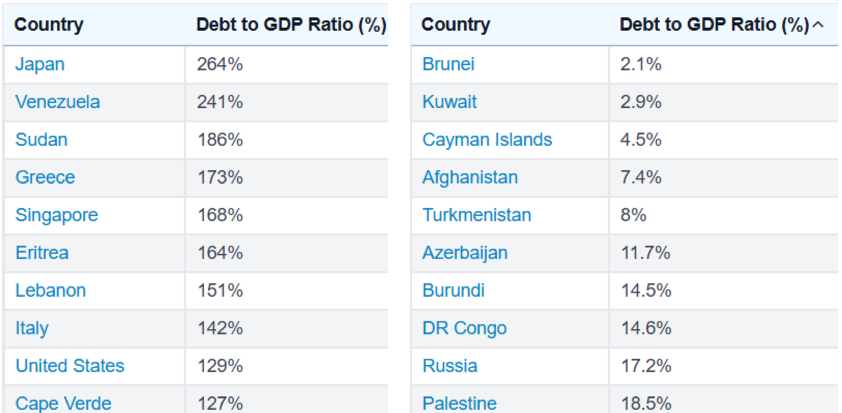
According to the infamous Debt/GDP formula, the U.S. government has less ability to pay its debts than Cape Verde, and every one of the nations in the right-hand column.

And Japan supposedly has less ability to pay its debts than any other nation in the world. Does anyone really believe this nonsense?

But wait. Buried deep in the Investopedia article is this little paragraph:

Economists who adhere to modern monetary theory (MMT) argue that sovereign nations capable of printing their own money cannot ever go bankrupt, because they can simply produce more fiat currency to service debts; however, this rule does not apply to countries that do not control their monetary policies, such as European Union (EU) nations, who must rely on the European Central Bank (ECB) to issue euros.

Thus, the Debt/GDP “rule” does not apply to the United States, Canada, Mexico, China, Australia, the UK, Switzerland, Sweden, Norway, India, South Africa and others. The “rule” doesn’t apply to most of the world’s largest, most significant economies.

Yet, pundits in America insist on using the useless — no harmful — Debt/GDP ratio as a cudgel to ram debt reduction into financial planning.

Never mind that debt reduction causes depressions and recessions:

1804-1812: U. S. Federal Debt reduced 48%. Depression began 1807.
1817-1821: U. S. Federal Debt reduced 29%. Depression began 1819.
1823-1836: U. S. Federal Debt reduced 99%. Depression began 1837.
1852-1857: U. S. Federal Debt reduced 59%. Depression began 1857.
1867-1873: U. S. Federal Debt reduced 27%. Depression began 1873.
1880-1893: U. S. Federal Debt reduced 57%. Depression began 1893.
1920-1930: U. S. Federal Debt reduced 36%. Depression began 1929.
1997-2001: U. S. Federal Debt reduced 15%. Recession began 2001.

Why does that happen? Simple algebra. The formula for Gross Domestic Product is:

GDP = Federal Spending + Nonfederal Spending + Net Exports.

To reduce the so-called federal debt, one must decrease Federal Spending and/or increase federal taxes, which decreases Nonfederal Spending.

To increase real (inflation-adjusted) economic growth, a nation must do the opposite: Increase Federal Spending and/or decrease federal taxes, both of which add to the so-called “federal debt.”

Mathematically, there is no way to grow real GDP without growing “federal debt” enough to overcome inflation. So, if inflation is say, 2% (the Fed’s goal), the debt increase must overcome an annual 2% inflation handicap for GDP just to stay even.

Add to that, the need to overcome a net export figure (which America almost always has) and large annual deficits become vital.

When we have deficits that are too small, we have recessions, which the following graph demonstrates:

When federal debt declines, we experience recessions (vertical gray bars), which are cured by federal debt increases.

Strangely, the “science” of economics, which seems to love mathematical formulas and graphs, ignores the obvious. Growing an economy requires a growing supply of money.

Federal deficits add money to the economy. Federal taxes take money from the economy.

Continuing with the ticking time bomb article:

Over the next 175 years, politicians across the political spectrum largely adhered to Hamiltonian principles to preserve the integrity of the public credit.

The most important principle was that debt should be issued primarily to address emergencies – especially those involving foreign wars – and that debt burdens should be reduced during times of peace.

This changed completely in the 1970’s when President Nixon mandated the end of the dollar “backing” (actually the convertibility) to gold, and made the federal government Monetarily Sovereign in full.

Until then, the federal government’s ability to create dollars was limited by its inventory of gold. When the inventory did not keep up with GDP growth needs, recessions resulted.

Now, with gold no longer a factor, the government’s ability to grow the nation’s money supply also gave the government the ability to grow GDP.

This discipline enabled America to establish and maintain its excellent credit record, which provided ample lending capacity during periodic crises.

As Hamilton predicted, the ability of the nation to borrow proved critical during the War of 1812, the Civil War, World War I and World War II.

The nation now has no need to borrow, a far superior situation. It can create, at will, the growth dollars it needs.

 After World War II, fiscal discipline was temporarily restored, and debt/GDP was reduced by growing the economy much faster than the debt even though the federal government continued to run budget deficits during most years.

Again, there is no magic. GDP still = Federal Spending + Nonfederal Spending + Net Exports.

If the Federal debt is reduced, the growth dollars must come from somewhere. In this case, growth came from Net Exports.

Subsequently, our wealthy economy began buying, buying, buying, which is a good thing. We were exchanging dollars that cost us nothing (We created them by pressing computer keys) for valuable goods and services.

Because the American government has access to infinite dollars, importing goods and services makes economic sense.

The U.S. is the world’s most massive consumer economy. Our Net Exports fell while GDP grew only because of massive federal deficit spending.

The one exception was in 1998-2001, when the federal government ran budget surpluses and even paid down debt in two of these years.

That exception proves the debt reduction is an economic disaster. Here is what happened when we paid down debt: 1997-2001: U. S. Federal Debt reduced 15%. Recession began 2001.

Reduced deficit spending morphed into a surplus in 1998. The result: A recession in 2001, which was cured by increased federal deficit spending.

Since then, the Hamiltonian principle has been decisively abandoned, and the federal government now routinely runs large deficits, resulting in ever-increasing debt burdens. This behavior is projected to worsen in the future.

Translation: The federal government now routinely runs large deficits, which pump growth dollars into the economy, thus growing GDP.

Mounting federal debt burdens now represent the greatest threat to the U.S. economy, national security and social stability.

The federal debt/GDP ratio is 123%. The nonpartisan Congressional Budget Office projects that, under current law, it will increase to 192% by 2053.

The federal government has the infinite ability to create dollars. The major threat to the U.S. economy (i.e. to GDP) is a reduction in federal money creation.

Clearly this is irresponsible, unsustainable and in sharp contrast to Hamilton’s founding principle.

There it is, the word “unsustainable,” to describe what we have been sustaining since 1940. Hamilton did not anticipate the post-1973, Monetarily Sovereign America.

National debt has topped $34 trillion.Does anyone actually have the guts to fix it?

The fastest way to “fix” the national debt would be to stop accepting deposits into T-security accounts (T-bills, T-notes, and T-bonds).

The government doesn’t use those dollars. They remain the property of the depositors. The problem is that those deposits do have two functions (neither of which is to supply the government with dollars):

  1. To provide a safer place to store dollars than bank savings accounts
  2. To help the Fed control interest rates by providing a floor for rates.

Why does the United States continue to behave so irresponsibly? One reason is that U.S. politicians routinely avoid spending cuts and tax increases because they may threaten their reelection prospects.

Voters rightfully don’t want tax increases and they don’t want federal benefit reductions, both of  which take money out of voters’ pockets and lead to recessions.

Another is that, as the issuer of the world’s dominant reserve currency, the United States can run fiscal deficits so long as surplus countries, such as China and Saudi Arabia, continue to purchase U.S. Treasuries.

The U.S. does not need anyone to purchase U.S. Treasuries. The federal government creates all the dollars it needs simply by pressing computer keys. The government does not use the dollars in T-security accounts. They are the property of the depositors.

In fact, proponents of the flawed and failed Modern Monetary Theory implicitly argue that the dollar’s reserve currency status is permanent, which allows deficit spending to continue indefinitely.

The dollar is the world’s leading reserve currency, which is a currency banks keep on reserve to facilitate international commerce. But, other currencies — the British pound, the euro, the Chinese renminbi — also are reserve currencies.

Being a reserve currency has nothing to do with the federal government’s ability to spend indefinitely.

Congress must defuse America’s fiscal time bomb.

Yikes, there it is again, the silly “time bomb” analogy. It’s the time bomb that never explodes.

A debt crisis is not imminent in 2024, but one will occur in the future if the nation’s addiction to deficits and debt persists.

Translation: A debt crisis is not imminent in 2024. We have no idea when if ever it will occur, but it makes us sound smart to threaten it.

The greatest risk is the one that Alexander Hamilton feared most: One day, the United States could face a threat to its very existence – perhaps in the form of a foreign war – and Americans will lack the debt capacity to fund an adequate response.

Lessons from the switch to Bernanke from Greenspan - MarketWatch
Obviously, the government never can run short of dollars. I wonder why they don’t understand that.

Lack the capacity to fund? Utter nonsense. Here are the facts:

Former Fed Chairman, Alan Greenspan: “A government cannot become insolvent with respect to obligations in its own currency. There is nothing to prevent the federal government from creating as much money as it wants and paying it to somebody. The United States can pay any debt it has because we can always print the money to do that.”

Former Fed Chairman, Ben Bernanke: “The U.S. government has a technology, called a printing press (or, today, its electronic equivalent), that allows it to produce as many U.S. dollars as it wishes at essentially no cost. It’s not tax money… We simply use the computer to mark up the size of the account.

Statement from the St. Louis Fed: “As the sole manufacturer of dollars, whose debt is denominated in dollars, the U.S. government can never become insolvent, i.e., unable to pay its bills. In this sense, the government is not dependent on credit markets to remain operational.”

That’s the real capacity.

Fortunately, the future is far from hopeless. America sits on a huge reservoir of natural resources and remains the world’s technological innovation engine.

It also possesses sufficient time to enact fiscal reforms and reestablish fiscal discipline.

Because the authors, David M. Walker and Mark J. Higgins, don’t understand Monetary Sovereignty, they think federal government fiscal discipline is the same a personal fiscal discipline. 

Federal finance is so unlike personal finance that not understanding the difference is like not understanding the difference between butter and a butterfly.

The challenge for Americans today is that the longer we wait to reinstate this principle, the more pain that will be incurred. It is our belief that the solution is in the hands of “We the People.”

The math doesn’t lie.Republicans and Democrats own every missing dollar of our growing national debt crisis.

Politicians have powerful incentives to respond to short-term demands, and if Americans collectively demand that short-term desires must be satisfied at the expense of the nation’s long-term prosperity and solvency, that is what politicians will deliver.

Heaven forbid that Americans demand increases in taxes and cuts to federal spending. The result would be a depression.

On the other hand, if Americans place equal value on the longevity of their country and the prosperity of their children and grandchildren, they will demand that politicians take steps to defuse America’s fiscal “time bomb.”

Oops, more time bomb that never explodes.

Ever notice that the debt worriers never come up with evidence? They say “debt is bad,” but they don’t say,”Here is a graph of what has happened to the economy when federal debt increased and decreased.

Here is one such graph:

As federal debt (red) has grown, the economy (GDP, blue) has grown.

As you can see, there is no sign of a “debt crisis.”

History suggests that Americans will eventually pursue the correct course of action. Our hope is that they embrace it quickly to ensure that America’s future is brighter than its past.

David M. Walker, a former U.S. comptroller general, is also a recipient of the Alexander Hamilton Award for economic and fiscal policy leadership from the Center for the Study of the Presidency and the Congress.

Mark J. Higgins is author of “Investing in U.S. Financial History: Understanding the Past to Forecast the Future,” coming Feb. 27. Connect with Mark on LinkedIn. 

It is frightening that a former U.S. comptroller general and recipient of an award for policy leadership, and the author of a book about U.S. finances can be so clueless about U.S. federal finances. No wonder the public is so ill-informed.


Rodger Malcolm Mitchell
Monetary Sovereignty

Twitter: @rodgermitchell Search #monetarysovereignty
Facebook: Rodger Malcolm Mitchell

……………………………………………………………………..

The Sole Purpose of Government Is to Improve and Protect the Lives of the People.

MONETARY SOVEREIGNTY

If you owned a legal money-printing press, would you borrow money?

If you owned a legal, money-printing press, would you borrow money? Think about it. The U.S. government has the infinite ability to create (aka “print”) U.S. dollars. So why would it ever borrow dollars? It doesn’t.
Treeing - Wikipedia
The same “bark”?
Despite what “learned” pundits tell you, the U.S. government never, never, ever borrows U.S. dollars. The government issues U.S. Treasury bonds, which are totally unlike the private sector bonds that corporations issue. The fact that the same words — “bills,” “notes,” and “bonds” — are used to describe completely different things, has confused people who should know better — politicians, economists, and the media — for decades. It’s as though a professional botanist told you dogs are like trees because they both have “bark.” In the same vein, the so-called federal “debt” is not debt. It’s not even federal. Here are Warren Buffett’s comments.  He gets it about 95% right.

Warren Buffett explains the simple reason why the US will never default on its debt Ethan Wolff-Mann·Senior Editor, Updated Tue, May 5, 20204 

Warren Buffett | Bill & Melinda Gates Foundation
Warren Buffett

The U.S. Treasury is borrowing $3 trillion in three months to pay for the pandemic response, a record sum that dwarfs the $1.8 trillion borrowed in 2009 during the financial crisis.

The debt will be sold in bonds to a variety of foreign and domestic investors.

Sorry, Mr. Wolff-Mann, but because the federal government is Monetarily Sovereign, the U.S. Treasury has the infinite ability to create dollars (at the behest of Congress). If Congress voted for the Treasury to create $3 trillion, or $300 trillion, or $3,000 trillion, the Treasury could do it at the touch of a computer key. Clearly, it has no reason to borrow dollars. So it doesn’t. The so-called, misnamed “debt” is two separate things that have been merged for obsolete reasons:

1. The “debt” is the net total of all deficits through history. Deficits are the difference between taxes received and financial obligations (aka “bills”) paid.

The government doesn’t owe deficits. They already have been paid for. That is what makes them “deficits.”

2. The “debt” also is the total of deposits into Treasury Security accounts, those T-bills, T-notes, and T-bonds that are nothing whatsoever like private sector bills, notes, and bonds.

The government accepts deposits into Treasury Security accounts to provide a safe storage place for unused dollars. This stabilizes the dollar and is partly responsible for the U.S. dollar being the most popular currency in the world.

Rather than putting unused dollars into risky private bank accounts, foreign governments and private investors prefer the safety of U.S. Treasury accounts.

The accounts resemble safe deposit boxes in that the money in these accounts is wholly owned by the depositors, not by the U.S. government, which never touches those dollars.

To pay off these accounts, the government simply returns the contents of the accounts to the owners, i.e. the depositors.

At the 2020 Berkshire Hathaway Annual Shareholders Meeting on Saturday, billionaire investor Warren Buffett carefully explained in simple terms why the U.S. will never default on its debt.

When a concerned shareholder asked him whether there was a risk, he didn’t prevaricate, but started with a “no.”

“If you print bonds in your own currency, what happens to the currency will be the question,” said Buffett. “But you don’t default. The U.S. has been smart to issue its debt in its own currency.”

A U.S. dollar bill actually is a zero-interest, Treasury bond. It is evidence that the bearer owns a U.S. dollar.

Other countries don’t do this, Buffett pointed out.

“Argentina is now having a problem because the debt isn’t in their own currency, and lots of countries have had that problem,” he said.

“And lots of competent countries will have that problem in the future.”

Similarly, U.S. state and local government and euro nation debt isn’t in their own currency. State and local governments use the dollar. Euro nations use the euro, which is the currency of the European Union (EU). France, Germany, Italy et al have problems with their debt (which is real debt) because they do not issue the euro. The EU does.

Over the years, many have worried about the growing national debt as tax cuts and spending have created an ever-widening gap between revenue and outflows.

But in his explanation, Buffett highlighted the distinctions that make the U.S. Treasury much different than your personal checkbook.

Mainly, the government owns the printing press to pay the money to the holders of its debt.

Close, but that’s not precisely what happens.  The money already exists in the accounts. The depositors put it there.  Paying off the “debt” merely involves returning the depositors’ dollars. The only function of the metaphorical “printing press” is to add interest dollars to the accounts.

“It is very painful to owe money in somebody else’s currency,” said Buffett. “If I could issue a currency Buffett bucks, and I had a printing press and I could borrow money, I would never default.”

If he could print Buffet bucks, that would be widely accepted, he never would borrow money, just as the U.S. federal government never borrows dollars.

This is a common refrain of Modern Monetary Theory as well as longtime Fed Chair Alan Greenspan, who once said something similar: “The United States can pay any debt it has because we can always print money to do that. So there is zero probability of default.”

The chief worry about just printing money to pay obligations is inflation.

That is another widespread, false belief. Creating (aka “printing”) dollars doesn’t cause inflation. Shortages of critical goods and services — mostly oil and food — cause inflation. (See: Inflation: Why the Fed is confused)

“What you end up getting in terms of purchasing power can be in doubt,” Buffett said.

But whether the U.S. can pay the dollars that it owes is not in doubt. The Oracle of Omaha noted back to when Standard & Poor’s downgraded the U.S.’s credit rating in 2011.

The U.S. government does not “owe” any dollars. It already has paid for what it has purchased. That is the “deficit.” And the dollars in Treasury Security accounts — the T-bills, notes, and bonds — are owned by the depositors. The government doesn’t owe them just as your bank doesn’t owe you the contents of your safe deposit box.

“To me that did not make sense,” he said. “How you can regard any corporation as stronger than a person who can print the money to pay you, I just don’t understand. So don’t worry about the government defaulting.”

Buffett then addressed the frequent government shut-downs that happen over partisan arguments about raising the debt ceiling.

“I think it’s kind of crazy incidentally…to have these limits on the debt,” he said. “And then [the] stopped government, arguing about whether it’s going to increase the limits. We’re going to increase the limits on the debt.”

Buffett pointed out that the debt “isn’t going to be paid, it’s going to be refunded,” and referenced the period in the 1990s when the debt came down and the country simply created more.

“When the debts come down a little bit, the country’s going to print more debt. The country is going to grow in terms of its debt-paying capacity,” he said. “But the trick is to keep borrowing in your own currency.”

Ethan Wolff-Mann is a writer at Yahoo Finance focusing on consumer issues, personal finance, retail, airlines, and more. Follow him on Twitter @ewolffmann.

Paul Krugman on How to Fix the Economy - and Why It's Easier Than You Think
Paul Krugman
That was Warren Buffett. Now, here is Paul Krugman, winner of the economics version of the Nobel Prize. He too gets it about 95% right.

Here’s why the US doesn’t have to pay off its $31 trillion mountain of debt, according to Paul Krugman, Franck Robichon/Reuters

Though individual borrowers are expected to pay off debts, the same isn’t true for governments, Krugman argued in a column for the New York Times on Friday.

That’s because unlike people, governments don’t die, and they gain more revenue with each passing generation.

Not quite right. State and local governments are expected to pay off debts. Euro governments are expected to pay off debts. But the Monetarily Sovereign U.S. federal government always pays what it owes to vendors, on time. It does not accumulate debt. The reason is not that “governments don’t die and gain more revenue.” Monetarily nonsovereign governments do borrow and must pay off loans, and may not gain enough revenue to pay off those loans. Our Monetarily Sovereign government is a different animal, altogether. It does not borrow, it does not have loans to pay off, and its tax revenue does not pay for anything. Its tax revenue is destroyed upon receipt. (See: “Does the U.S. Treasury Really Destroy Your Tax Dollars?”)

“Governments, then, must service their debts – pay interest and repay principal when bonds come due – but they don’t necessarily have to pay them off; they can issue new bonds to pay principal on old bonds and even borrow to pay interest as long as overall debt doesn’t rise too much faster than revenue,” he added.

Treasury bonds don’t supply the federal government with spending money. The government never touches those dollars. The government doesn’t use bond deposits to pay anything. Treasury securities provide two main functions:
  1. They help the Federal Reserve control interest rates by providing a “base” rate.
  2. They help stabilize the dollar by providing a safe haven for unused dollars.
They do not help the federal government fund any thing.

Though the debt-to-GDP ratio hovered around 97% last year, interest payments on that debt is only around $395 billion, according to the Office of Management and Budget, or around 1% of last year’s GDP (Gross Domestic Product).

The debt-to-GDP ratio is oft-quoted, but completely meaningless. The federal government can pay all its financial obligations whether the ratio was 10%, 100%, or 1,000%. (See: Enough Already, With The Debt/GDP ratio) Federal purchases are part of GDP, but are not paid for with GDP. All federal financial obligations are funded by newly created ad hoc dollars.
Historically, it’s also unusual for governments to pay off large debts, Krugman said. Such was the case for Great Britain, which has largely held onto the debt it incurred as far back as the Napoleonic wars.
It’s more irrelevance from the Nobel winner. Deadbeat governments may not pay creditors, but the Great Britain “debt” is not owed to creditors. It’s an accounting myth for describing the total of deficit spending, which is funded by money creation.
Krugman’s argument comes amid growing contention over the US debt level, with policymakers still sparring over the conditions they want to raise the country’s borrowing limit.
House Speaker Kevin McCarthy has said he would reject a short-term debt ceiling increase unless spending cuts are negotiated, having proposed a bill that would slash around $4.5 trillion on spending.
This is purely a political ploy, having absolutely nothing to do with the realities of federal funding. The formula for GDP is:
GDP = Federal Spending + Nonfederal Spending + Net Exports
Slashing $4.5 trillion for federal spending would, by formula, slash at least $4.5 trillion from GDP (Probably more, because federal spending begets private sector, nonfederal spending.)
In short, Republican McCarthy wanted to trash the economy, because a Democrat was President.

Congress now has less than two weeks to raise the borrowing limit before the government could potentially run out of cash, US Treasury Secretary Janet Yellen warned.

Sadly, Yellen is too cowardly (or ignorant?) to tell the truth. The so-called “borrowing limit” is the ultimate fraud. It’s not a borrowing limit, because the U.S. doesn’t borrow. It’s a limit on deposits into T-security accounts, which do nothing to change the federal government’s ability to fund its spending.

A default on the country’s obligations could result in catastrophe for financial markets, experts have warned.

Krugman has called for the debt ceiling to be abolished, as the risk of a financial crisis offers Republicans a “choke point” on fiscal policy.

Krugman is correct. The debt ceiling is a fraud being committed on naive American voters. It’s a bit of meaningless, though harmful, political chicanery, designed to pretend financial frugality. All those who think the debt ceiling is a good idea either are liars or ignorant. There is no alternative. Period. Rodger Malcolm Mitchell Monetary Sovereignty Twitter: @rodgermitchell Search #monetarysovereignty Facebook: Rodger Malcolm Mitchell

……………………………………………………………………..

The Sole Purpose of Government Is to Improve and Protect the Lives of the People.

MONETARY SOVEREIGNTY

Note to readers

The system for approving your comments before publication has changed. If recently you submitted a comment that didn’t show up, try once again. Sorry, it’s a technology thing.

A common misunderstanding about taxes, inflation and Donald Trump.

I am no fan of Donald Trump. That is putting it mildly. He is a proven psychopath and is closer to Hitler than any former American President. It will be a sad day, indeed, should America not have learned from history and re-elect this vicious dictator wannabe. That said, he did one good — make that, partially good– thing. He cut taxes on corporations, which improved Gross Domestic Product growth and added to corporate profitability. Sadly, his cuts favored the rich, widening the Gap between them and the rest of us. Well-meaning people do not understand why economic growth benefits the nation. They seem to consider business to be the enemy of the economy rather than the engine that makes it run. The enemy is the ever-widening income/wealth/power Gap between the rich and the rest of us.
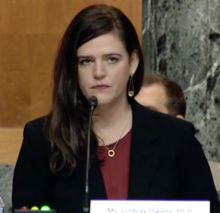
Screenshot of Lindsay Owens testimony during a Hearing of the Committee on the Budget, April 5, 2022
Lindsay Owens
Here are excerpts from an article you should file in the “Save us from our friends” category:

TRUMP’S CORPORATE TAX CUTS PAVED THE WAY FOR INFLATION The former president made it more profitable for companies to gouge us. When those cuts expire next year, we’ll have an opportunity to get our money back. By Lindsay Owens | May 15, 2024

Remember those words, “get our money back,” because they demonstrate profound ignorance about how our economy operates.

Next year, when key provisions of President Trump’s 2017 tax breaks to the wealthy and corporations expire, we have an opportunity to get our money back.

I’m not just talking about all the foregone tax revenue we’ve lost because the rich have paid so little since 2017 — though we should get that back, too.

Mr. Owens seems to believe that we Americans receive federal tax revenue and that federal tax cuts take that revenue from us. Nothing could be further from the truth. Contrary to popular, innocent belief, paying federal taxes does absolutely nothing for the Monetarily Sovereign federal government. Unlike monetarily non-sovereign state and local governments, the federal government creates new dollars to pay all its bills. Every dollar you pay in federal taxes is destroyed upon receipt and lost to the economy. Why does the federal government collect taxes? Not to pay its bills. There are only two purposes for federal tax collection;
  1. To control the economy by taxing what the government wishes to discourage and by giving tax breaks to whom the government wishes to reward.
  2. To assure demand for the U.S. dollar by requiring that taxes be paid in dollars.
This is in contrast to the monetarily non-sovereign state, county, and city governments, which do use tax dollars to pay their bills. Mr. Owens does not seem to understand the differences between Monetarily Sovereign entities and those that are monetarily non-sovereign.

I’m talking about the money families have lost to corporate price gouging. Let me explain.

In 2017, Republicans slashed the corporate tax rate from 35 percent to 21 percent, giving massive corporations their biggest tax windfall since Ronald Reagan was president.

Translation: In 2017, Republicans slashed the corporate tax rate from 35 percent to 21 percent, giving the private sector (aka the economy) an infusion of growth dollars.  The result: Unemployment fell, and GDP rose.
After Trump’s tax cuts, unemployment (blue) fell, and Gross Domestic Product (green) rose.

A few years later, as Americans emerged from a global pandemic, these same corporations drove up prices for families.

The price increases (aka inflation) following the global pandemic were not related to the reduced corporate tax rate. They were caused by shortages of oil, food, computer chips, steel, wood, shipping, labor, and other scarcities.

While inflation hamstrung workers and families, it didn’t make a dent in corporate profits. In fact, as many CEOs boasted themselves, it’s been a boon.

Companies simply passed rising costs along to consumers — and then some, bringing in record profits as a result.

Again, the tax cuts had nothing to do with corporate greed. The companies raise prices to whatever the buyers will bear.

All told, corporate profit margins skyrocketed to 70 year-highs. And by the end of 2023, when Americans were beyond fed up, after-tax corporate profits hit an all-time record high of $2.8 trillion.

Dollars circulate. Profits circulate. The primary problem is that the income/wealth/power Gap between the rich and the rest, widened. This could have, and should have, been controlled by the federal government via increased benefits to the middle- and lower-income groups. To narrow the Gap, Medicare and Social Security benefits should be increased. College tuition should be free. Poverty should erased. Housing should be subsidized. Renewable energy should be subsidized. The federal government has the power to control inflation and to narrow the Gap. Smart economists don’t blame corporations for making “too much” money.

My organization, Groundwork Collaborative, recently found that corporate profits drove over 50 percent of inflation in the second and third quarters of last year.

Utter nonsense. Inflation was driven, as it always is, by shortages of key goods and services, not by corporate profits.

But why would a change in the corporate tax rate unleash the kind of rampant corporate profiteering we saw in the aftermath of the pandemic?

Simple: It’s a lot more fun to gouge customers when you get to keep more of what you pull in.

“A lot more fun?” A childish non sequitur . Low tax rates don’t encourage “gouging” customers. If a company wished to “gouge” customers, it will do so, regardless of tax rates.

Look at Procter & Gamble, which has raised the price of everything from toothpaste to diapers. Last year, the company pulled in more than $39 billion in profit.

If they had to pay the 35 percent statutory tax rate, they would have sent nearly $14 billion to Uncle Sam. Instead, they paid a 21 percent rate and, using loopholes, got to keep an extra $10 billion — which helped with their combined $16.4 billion worth of dividends and stock buybacks for shareholders.

All dollars sent to the federal government are destroyed upon receipt. If Proctor and Gamble sent $24 billion to Uncle Sam, that would have removed $24 billion from the economy, benefiting no one.

Corporations did well from Trump’s corporate tax cuts, with executives getting big raises and shareholders receiving big buybacks.

But the real bonus came when inflation hit. Corporations used the cover of supply chain issues and broader inflation to hike prices more than their higher input costs justified — and they didn’t have to worry about their tax bill.

Whether tax rates are high or low, corporations “worry about their tax bill.” They always try to minimize taxes. Corporations paying federal taxes serve no public purpose. The dollars come out of the economy. The only negative in the entire scenario is that the money flows to the rich more than to the middle—and lower-income people and businesses. The income/wealth/power Gap is the issue.

Our tax code is exacerbating some of the worst corporate excesses, effectively “subsidizing corporate price gouging,” as Sen. Elizabeth Warren (D-MA) described it recently.

But it’s not only that low tax rates incentivize companies to overcharge.

Rock-bottom tax rates also make collusion more profitable, as we saw with Pioneer Oil.

There is no mechanism by which low tax rates increase pricing. A much stronger case could be made for high tax rates increasing costs that lead to price increases.

Recently, the Federal Trade Commission barred former Pioneer Oil CEO Scott Sheffield from joining the board of ExxonMobil following their merger, because Sheffield allegedly colluded with OPEC to raise oil prices.

As families struggled with higher energy costs, the oil and gas industry banded together to keep prices high, which according to one analyst accounted for 27 percent of inflation in 2021.

Reduced taxes did not cause Sheffield to collude with OPEC to raise oil prices. But yes, oil shortages and oil pricing were the primary causes of inflation.
Oil prices (red), which are determined by oil supplies and shortages, parallel inflation (blue).

When the reward is higher with lower corporate taxes, executives like Sheffield are more willing to take the risk.

Higher corporate taxes are both crucial for accountability and for ensuring that there’s far less incentive for executives to squeeze as much as they can from their customers.

Utter nonsense. One just as easily could make the case that high taxes, which raise costs and squeeze profits, incentivize businesses to raise prices.

Wall Street tycoons and CEOs didn’t take the heat of inflation — they fanned its flames and families got burned. It’s no wonder people overwhelmingly favor a tax code that’s no longer rigged for corporations, especially as they struggle with high prices.

That much is true. The tax code is rigged for the rich. The federal government should use tax law and its unlimited spending ability to narrow the Gap.

Congress raising the corporate tax rate in 2025 is an opportunity to recoup some of the truly obscene profits corporate America raked in during this period of economic upheaval for American families.

It’s time Americans got their money back.

American families would not see one penny of increased taxes taken from corporations. Not one penny. Those dollars are destroyed upon receipt.

Lindsay Owens is the executive director of Groundwork Collaborative. This op-ed was distributed by OtherWords.org.  Lindsay Alexandra Owens is an American economic sociologist and academic who serves as the executive director of the Groundwork Collaborative, a Washington, D.C.-based non-profit public policy think tank. Owens is best known for her academic research of economic recessions in the United States and outspoken public commentary on the role that corporate profiteering plays in inflation

Rodger Malcolm Mitchell Monetary Sovereignty Twitter: @rodgermitchell Search #monetarysovereignty Facebook: Rodger Malcolm Mitchell

……………………………………………………………………..

The Sole Purpose of Government Is to Improve and Protect the Lives of the People.

MONETARY SOVEREIGNTY