Economics is filled with myths that might make one think it is taught at Hogwarts School of Witchcraft and Wizardry. A discipline that loves to use statistics often seems to disregard them in favor of intuition and confused semantics.
The majority of economics revolves around two key concepts: Monetary Sovereignty and Gap Psychology.
Monetary Sovereignty is the historical truth that the federal government created the first dollars from thin air through legislation. The government retains the unlimited authority to continue passing laws and those laws can produce as many dollars as the government desires for any purpose it chooses.
Gap Psychology suggests that the terms “rich” and “poor” are relative. To become richer, one must widen the gap in income, wealth, and power below, while narrowing the gap above. This can be achieved either by increasing one’s own earnings or by reducing others’ earnings.
Currently, the federal government creates dollars by this process:
- Congress votes to fund something.
- The President approves
- Computer keys are pressed
- The money is credited to the appropriate accounts.
This means the federal government, being Monetarily Sovereign:
- Cannot run short of dollars.
- Cannot become insolvent or go bankrupt
- Does not need to, and indeed does not, borrow dollars.
- Neither needs nor uses tax dollars to pay its obligations
Due to the monetary non-sovereignty of state and city governments, businesses, and individuals, there are many misunderstandings and myths about federal finances.
Federal “debt.” It isn’t what most people know as “debt.” The federal government is not “in debt.” It does not borrow. It does not owe. It merely accepts deposits into U.S. Treasury savings accounts.
Those deposits are owned by the depositor, not by the government. To pay off the “debt,” the government returns the deposits plus interest. Federal taxes and taxpayers are not involved in any way.
The purpose of those accounts is not to provide the government with funds for spending. Instead, those accounts:
- Assist the Federal Reserve in managing interest rates by establishing a “base” rate.
- Provide a secure location for unused dollars to stabilize and enhance their value.
Here are the most common myths about T-securities deposits (aka “debt”).
1. “The debt is a burden on future generations.” Future generations are not responsible for repaying past federal debt. When Treasury securities are bought, the purchaser deposits dollars into their T-security account. Upon maturity of those securities, the buyer is paid with the dollars in that account. Future tax dollars are not involved in this process.
Future generations will benefit from the government’s interest payments.
2. “The federal government could become insolvent.” Many people believe federal finances resemble a family budget. This comparison is intuitively appealing and for some, politically advantageous.
A monetarily sovereign government creates all the currency it owes. It cannot run out of dollars any more than a scorekeeper runs out of points. It can generate the dollars required to fulfill any obligation.
3. “China ‘owns’ us and can demand repayment.” China holds U.S. Treasuries because it seeks a secure way to save in dollars. It does not have the power to make demands regarding these securities. Repayment occurs only at maturity and involves an electronic transfer from China’s T-security account at the Federal Reserve to other Chinese accounts at the same
4. “Interest will crowd out federal programs.” Paying interest simply credits bank accounts. It doesn’t deplete federal funds; the government creates the funds it pays out. Additionally, paying interest generates dollars for economic growth. Even if the government paid trillions of dollars in interest, it would not affect the government’s ability to fund its programs — not by one penny.
5. “High debt causes inflation.” Federal debt differs from personal debt. It is created when dollars are accepted into Treasury accounts, which are settled at maturity simply by returning those dollars. Inflation is related to resource shortages, not to federal debt.

6. “High debt raises interest rates.” The Federal Reserve sets interest rates arbitrarily. Since the federal government does not have a financial need to accept T-security deposits, the demand for these investments does not influence interest rates.

7. “Our grandchildren will be saddled with the debt.” Every dollar of debt corresponds to a dollar of someone’s savings. Future generations will own both the Treasuries and the interest dollars used to service them. There is no intergenerational burden. The “debt” is not a taxpayer liability.
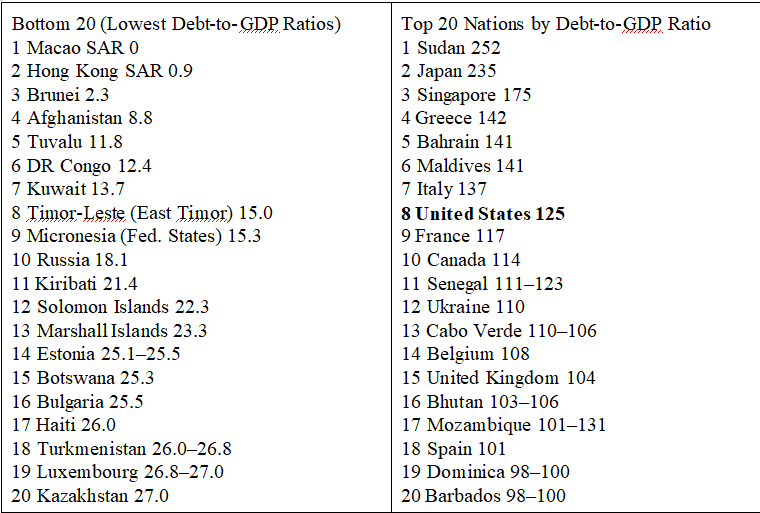
8. “The level of debt is too high compared to the GDP.” Japan is at 260% and has had almost no inflation and near-zero interest rates for decades. The Debt/GDP ratio tells nothing about the government’s credit or ability to pay its obligations. It is an often quoted, but useless ratio.
Here are the lowest and highest ratios. By analyzing these ratios, could you determine which nations you would prefer to lend to? Which nations are strongest financially? Which nations are least likely to default?
You can’t, because the Debt/GDP ratio is meaningless.
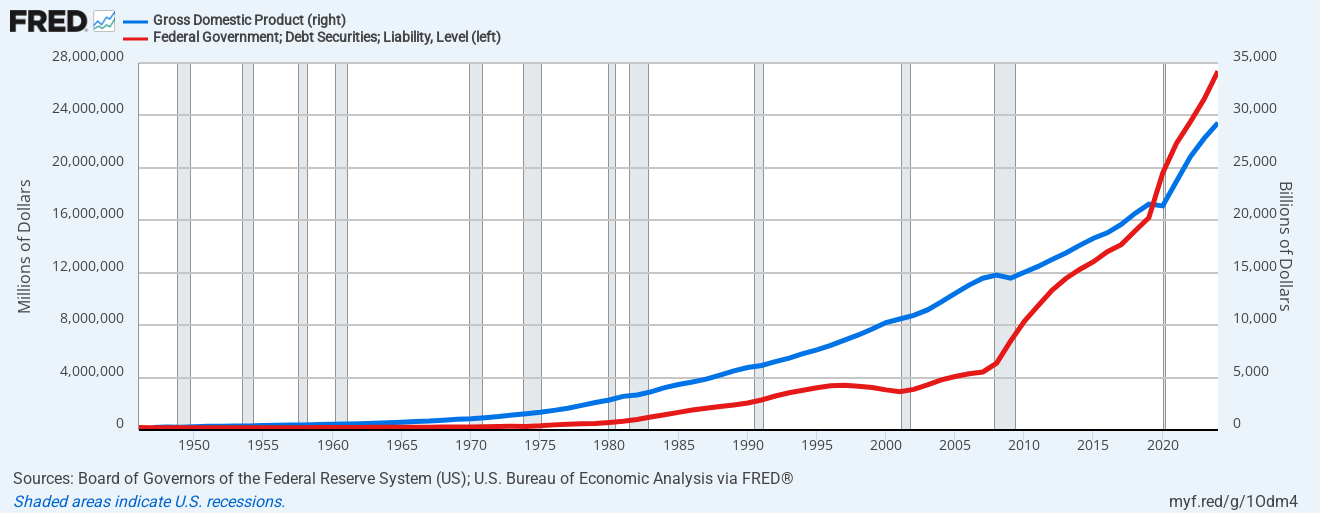
9. “Large debt hurts economic growth.” Higher government debt correlates with stronger GDP growth because federal deficits and interest payments add growth dollars to the economy.
The following graph illustrates the parallel paths of Gross Domestic Product and Federal Debt. This parallelism is not coincidental. The most crucial equation in economics is GDP = Federal Spending + Nonfederal Spending + Net Exports. Federal spending adds dollars to the private sector and is necessary for economic growth.
10. “We must reduce debt so interest payments don’t explode.” Interest payments act as a fiscal stimulus by adding growth funds to the private sector. When interest payments increase, private income also rises.
Our government, as a monetarily sovereign entity, easily manages any level of interest payments.

Interest rates (yellow, dashed line) and GDP (blue) rise and fall together.
11. “It’s irresponsible to let debt grow forever.” The federal debt is the difference between federal spending and revenue. Thus, debt adds growth capital to the economy, allowing for continuous economic growth, which is beneficial.
The federal debt has grown for 85 years, belying the repeated false claims that it is a “ticking time bomb.”
12. “Eventually, no one will buy our debt.” The Federal Reserve and primary dealers are obligated to purchase Treasury securities; however, the federal government has no financial need for anyone to buy its debt.
The purpose of federal debt is not to provide spending funds to the government. T-securities provide dollar users with a safe place to store unused dollars. The dollar-using world wants the insurance that T-securities provide.
13. “High deficits mean higher taxes later.” Federal taxes do not pay for the federal debt. Instead, the Treasury creates new dollars to cover the interest, and each debt account is settled at maturity by returning the dollars in that account.

14. “We should have a balanced budget.” This means the federal government would not provide additional funds to the economy, which would result in a depression.
Even President Barack Obama, who should have known better, said in 2011, “We have to reduce our deficit, and we have to get back on a path that will allow us to pay down our debt.”
Paying down the debt requires running surpluses, which historically have led to depressions. Throughout U.S. history, every depression has been preceded by federal surpluses.
1804-1812: U. S. Federal Debt reduced 48%. Depression began in 1807.
1817-1821: U. S. Federal Debt reduced 29%. Depression began in 1819.
1823-1836: U. S. Federal Debt reduced 99%. Depression began in 1837.
1852-1857: U. S. Federal Debt reduced 59%. Depression began in 1857.
1867-1873: U. S. Federal Debt reduced 27%. Depression began in 1873.
1880-1893: U. S. Federal Debt reduced 57%. Depression began in 1893.
1920-1930: U. S. Federal Debt reduced 36%. Depression began in 1929.
1997-2001: U. S. Federal Debt reduced 15%. The recession began in 2001.
When federal deficit spending decreases, recessions tend to occur, which are resolved by increasing federal deficit spending. See the following graph:

15. “The federal debt is not sustainable.” This is a non-specific false claim encompassing all of the other false claims about federal debt. The term “sustainable” frequently is used by individuals opposed to debt and leaning toward Libertarian views.
However, they seldom clarify why a Monetarily Sovereign nation cannot “sustain” any level of debt, especially when the situation in question isn’t even a debt. (It’s deposits.)
And all the false claims boil down to the one underlying false claim:
16. The government and taxpayers cannot afford Medicare for All, Social Security for all, housing assistance, food assistance, or any other benefits for the middle class and the poor. The federal government, being Monetarily Sovereign, can afford anything without needing taxpayer funds.
Despite the fact that tax loopholes for the wealthy cost the government money, Congress and the President rarely oppose them. The reason: wealthy people are major campaign contributors.
Given this situation, why is Washington hesitant to provide those benefits? Why do we have “debt ceilings” and government shutdown battles over spending?
The answer: Gap Psychology.
The very wealthy still want to become wealthier. It is human nature. To become wealthier, one must widen the income/wealth/power Gap below and narrow it above.
To do that, one must increase one’s own income or decrease the income of others. The rich do both by bribing the most important information sources:
- They bribe politicians via campaign contributions and lucrative jobs in “think tanks.”
- They bribe economists via university endowments and promises of lucrative jobs and assignments
- They bribe the media via advertising dollars and outright ownership
All are expected to promulgate the myths about federal debt so as to reduce or eliminate entirely spending for social services.
That is why it is said that the Social Security and Medicare trust funds are running out of money, when in reality, there are no actual trust funds, and the necessary funds would be available if Congress simply voted for them.
It is why Congress forces the states to fund social programs, knowing that the states are monetarily non-sovereign and often unable to fund programs properly.
SUMMARY
The federal “debt” is not real debt in the traditional sense. It refers to deposits that are essentially repaid by returning them. This process does not impact taxpayers.
The federal government, as a monetarily sovereign entity, does not borrow dollars. Instead, the purpose of this so-called debt (or deposits) is to help the Federal Reserve manage interest rates and provide a safe option for unused dollars, thereby protecting dollar users.
In summary, the federal debt does not threaten the federal government’s solvency nor hinder economic growth. In fact, it serves the opposite purpose.
Rodger Malcolm Mitchell
Twitter: @rodgermitchell
Search #monetarysovereignty
Facebook: Rodger Malcolm Mitchell;
MUCK RACK: https://muckrack.com/rodger-malcolm-mitchell;
……………………………………………………………………..
A Government’s Sole Purpose is to Improve and Protect The People’s Lives.
MONETARY SOVEREIGNTY






/grad_c.gif)
 #Monetary Sovereignty - Mitchell