Historical BULLSHIT Claims the Federal Debt Is a “Ticking Time Bomb”: From Sept. 26, 1940 to April 20, 2026

This is an update of the many, many previous posts showing the seemingly never-ending warnings about “federal debt” (that isn’t federal and isn’t debt).

The purpose has been to demonstrate how, year after year, so-called experts claim the U.S. is about to enter a catastrophe because federal debt is “too high,” while the experts are proven wrong year after year. The economy continues to grow and is healthier than ever.

I’ve been doing this for over 20 years; the experts have been wrong for over 86 years, and they never seem to learn. While I find it frustrating, I used to try to remain civil and merely recite the facts. But, as I pass my 91sth year, and the road ahead is short, I’ve grown impatient with civility, and I’ve decided to call it like it is: BULLSHIT.

What set me off last year was a BULLSHIT tweet (or whatever “X” calls them), from the richest man in the world, who, despite his great wealth, seems to know nothing about federal finance:

No, Elon, the U.S. federal government, being Monetarily Sovereign, cannot go bankrupt. Even if tax collections fell to $0, and spending tripled, the federal government could continue to pay all its bills forever.

Now, a year later, a long, long article titled, “America’s debt crisis: $39 trillion and rising—a ticking time bomb!” got me going, again.

The Big Lie in economics is: “Federal taxes fund federal spending.” Wrong. Wrong. Wrong. The truth is that federal taxes fund nothing. They are destroyed upon receipt by the Treasury.

The purposes of federal taxes are to:

  1. Control the economy by taxing what the government wishes to discourage and by giving tax breaks to those the government wishes to reward (mainly the wealthy).
  2. Assure demand for the U.S. dollar by requiring taxes to be paid in dollars.

That’s it. Taxes do not fund federal spending. Period. The federal government does not spend “taxpayers’ money. The government spends dollars that it creates by voting and then pressing computer keys.

Further, you do not owe the federal “debt.” No one does. It isn’t even debt. It merely is the arithmetic difference between federal spending and the taxes it receives. The U.S. federal government pays all its debts on time.

The U.S. federal government is not like state/local governments, not like euro governments, not like businesses, and not like you and me.

It is uniquely Monetarily Sovereign. It cannot, unwillingly, run short of its own sovereign currency, the U.S. dollar. As real experts have said:

Former Federal Reserve Chairman Alan Greenspan: “A government cannot become insolvent with respect to obligations in its own currency. There is nothing to prevent the federal government from creating as much money as it wants and paying it to somebody. The United States can pay any debt it has because we can always print the money to do that.

Former Fed Chairman Ben Bernanke: “The U.S. government has a technology, called a printing press (or, today, its electronic equivalent), that allows it to produce as many U.S. dollars as it wishes at essentially no cost. It’s not tax money… We simply use the computer to mark up the size of the account.”

Statement from the St. Louis Fed: “As the sole manufacturer of dollars, whose debt is denominated in dollars, the U.S. government can never become insolvent, i.e., unable to pay its bills. In this sense, the government is not dependent on credit markets to remain operational.

Press Conference: Mario Draghi, President of the Monetarily Sovereign ECB, January 9, 2014. Question: Can the ECB ever run out of money? Mario Draghi: Technically, no. We cannot run out of money.

Fed Chairman Jerome Powell stated, “As a central bank, we have the ability to create money digitally.”

Paul Krugman (Nobel Prize–winning economist): “The U.S. government is not like a household. It literally prints money, and it can’t run out.” — Numerous op-eds/blog posts

Hyman Minsky (Economist, key influence on MMT)
“The government can always finance its spending by creating money.”

Eric Tymoigne (Economist) “A sovereign government does not need to collect taxes or issue bonds to finance spending. It finances directly through money creation.”

Those are real experts, not the phonies who shout about ticking time bombs.

Because the U.S. federal government has the infinite ability to create its sovereign currency, the U.S. dollar, it never borrows dollars.

Contrary to popular wisdom, T-bills, T-notes, and T-bonds do not represent borrowing. They are deposits, the purpose of which is to provide a safe place to store unused dollars and to help the Fed control interest rates.

The government never touches those dollars, which remain the property of the depositors. Not only can our Monetarily Sovereign government not run short of dollars, but federal deficits are necessary to grow the economy, as evidenced by the formula: Gross Domestic Product = Federal Spending + Nonfederal Spending + Net Exports.

The formula shows that economic growth requires federal deficit spending growth.

The record highs of federal debt (red) parallel those of Gross Domestic Product (blue).

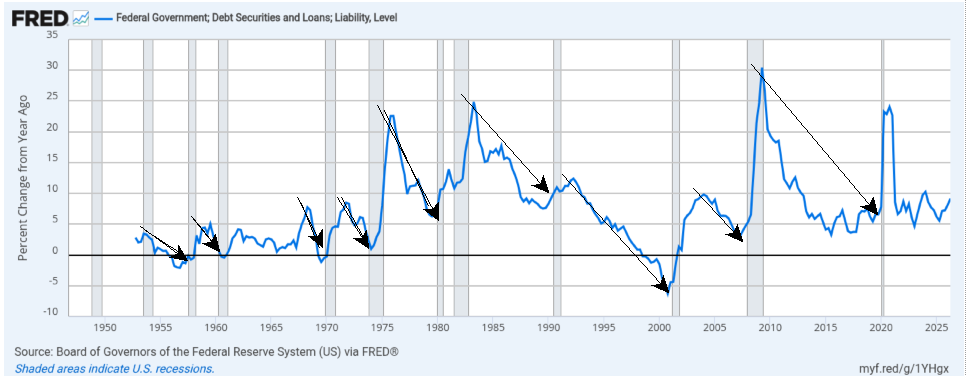
The next graph shows that reduced deficit growth (red) is associated with recessions (vertical gray bars), and increased deficit growth cures recessions. 

When we don’t have sufficient federal deficits, we have depressions and recessions:

U.S. depressions tend to come on the heels of federal surpluses.

        1. 1804-1812: U. S. Federal Debt reduced 48%. Depression began 1807.
        2. 1817-1821: U. S. Federal Debt reduced 29%. Depression began 1819.
        3. 1823-1836: U. S. Federal Debt reduced 99%. Depression began 1837.
        4. 1852-1857: U. S. Federal Debt reduced 59%. Depression began 1857.
        5. 1867-1873: U. S. Federal Debt reduced 27%. Depression began 1873.
        6. 1880-1893: U. S. Federal Debt reduced 57%. Depression began 1893.
        7. 1920-1930: U. S. Federal Debt reduced 36%. Depression began 1929.
        8. 1997-2001: U. S. Federal Debt reduced 15%. Recession began 2001.

Periodically, we publish yet another shrieking claim that the U.S. federal debt is “unsustainable” and a “ticking time bomb.”

This lie has been told to you every year (really, almost every day) since 1940, and that bomb has never exploded, nor will it.

Rather than repeat the entire list of the thousands of lies to which you have been subject, I will list samples here as a reference and add periodically, at the end, new “federal debt is a ticking time bomb BULLSHIT claims as I encounter them.

Read these and see that even respected economists replace facts with BULLSHIT:

————————//—————————

September 26, 1940, New York Times: The federal budget was a “ticking time-bomb which can eventually destroy the American system,” said Robert M. Hanes, president of the American Bankers Association. BULLSHIT

(Yes, the record of bad predictions goes all the way back to 1940. It probably goes back longer, but I don’t have the examples.)

September 26, 1940, New York Times: The federal budget was a “ticking time-bomb which can eventually destroy the American system,” said Robert M. Hanes, president of the American Bankers Association.

By 1960, the debt was “threatening the country’s fiscal future,” said Secretary of Commerce Frederick H. Mueller. (“The enormous cost of various Federal programs is a time-bomb threatening the country’s fiscal future, Secretary of Commerce Frederick H. Mueller warned here yesterday.”)BULLSHIT

By 1983: “The debt probably will explode in the third quarter of 1984,” said Fred Napolitano, former National Association of Home Builders president.BULLSHIT

In 1984: AFL-CIO President Lane Kirkland said. “It’s a time bomb ticking away.”BULLSHIT

In 1985: “The federal deficit is a ticking time bomb, and it’s about to blow up,” U.S. Sen. Mitch McConnell. (Remember him?)BULLSHIT

Later in 1985: Los Angeles Times: “We labeled the deficit a ‘ticking time bomb that threatens to permanently undermine the strength and vitality of the American economy.”BULLSHIT

In 1987: Richmond Times-Dispatch – Richmond, VA: “100TH CONGRESS FACING U.S. DEFICIT’ TIME BOMB‘”BULLSHIT

Later in 1987: The Dallas Morning News: “A fiscal time bomb is slowly ticking that, if not defused, could explode into a financial crisis within the next few years for the federal government.”BULLSHIT

In 1989: FORTUNE Magazine: “A TIME BOMB FOR U.S. TAXPAYERSBULLSHIT

In 1992: The Pantagraph – Bloomington, Illinois: “I have seen where politicians in Washington have expressed little or no concern about this ticking time bomb they have helped to create, that being the enormous federal budget deficit, approaching $4 trillion.BULLSHIT

Later in 1992, Ross Perot said, “Our great nation is sitting right on top of a ticking time bomb. We have a national debt of $4 trillion.”BULLSHIT

In 1995: Kansas City Star: “Concerned citizens. . . regard the national debt as a ticking time bomb poised to explode with devastating consequences at some future date.”BULLSHIT

In 2003: Porter Stansberry, for the Daily Reckoning: “Generation debt is a ticking time bomb . . . with about ten years left on the clock.”BULLSHIT

In 2004: Bradenton Herald: “A NATION AT RISK: TWIN DEFICIT A TICKING TIME BOMBBULLSHIT

In 2005: Providence Journal: “Some lawmakers see the Medicare drug benefit for what it is: a ticking time bomb.” BULLSHIT

In 2006: NewsMax.com, “We have to worry about the deficit . . . when we combine it with the trade deficit, we have a real ticking time bomb in our economy,” said Mrs. Clinton. BULLSHIT

In 2007: USA Today: “Like a ticking time bomb, the national debt is an explosion waiting to happen.BULLSHIT

In 2010: Heritage Foundation: “Why the National Debt is a Ticking Time Bomb. Interest rates on government bonds are virtually guaranteed to jump over the next few years. BULLSHIT

In 2010: Reason Alert: “. . . the time bomb that’s ticking under the federal budget like a Guy Fawkes’ powder keg.” BULLSHITBullshit Meter - Funny Sticker – Stickerheads Stickers

In 2011: Washington Post, Lori Montgomery:”. . . defuse the biggest budgetary time bombs that are set to explode.” BULLSHIT

June 19, 2013: Chamber of Commerce: Safety net spending is a ‘time bomb’, by Jim Tankersley: The U.S. Chamber of Commerce is worried that not enough Americans are worried about social safety net spending. The nation’s largest business lobbying group launched a renewed effort Wednesday to reduce projected federal spending on safety-net programs, labeling them a “ticking time bomb” that, left unchanged, “will bankrupt this nation.” BULLSHIT

On June 15, 2014: CBN News: “The United States of Debt: A Ticking Time BombBULLSHIT

On June 18, 2015: The ticking economic time bomb that presidential candidates are ignoring: Fortune Magazine, Shawn Tully, BULLSHIT

On February 10, 2016, The Daily Bell: “Obama’s $4.1 Trillion Budget Is Latest Sign of America’s Looming Collapse” BULLSHIT

On January 23, 2017: Trump’s ‘Debt Bomb‘: Deficit May Grow, Defense Budget May Not, By Sydney J. Freedberg, Jr. BULLSHIT

On January 27, 2017: America’s “debt bomb is going to explode.” That’s according to financial strategist Peter Schiff. Schiff said that while low interest rates had helped keep a lid on U.S. debt, it couldn’t be contained for much longer. Interest rates and inflation are rising, creditors will demand higher premiums, and the country is headed “off the edge of a cliff.” BULLSHIT

On April 28, 2017: Debt in the U.S. Fuel for Growth or Ticking Time Bomb?, American Institute for Economic Research, by Max Gulker, PhD – Senior Research Fellow, Theodore Cangeros BULLSHIT

February 16, 2018 America’s Debt Bomb By Andrew Soergel, Senior Reporter: Conservatives and deficit hawks are hurling criticism at Washington for deepening America’s debt hole. BULLSHIT

April 18, 2018 By Alan Greenspan and John R. Kasich: “Time is running short, and America’s debt time bomb continues to tick.” BULLSHIT

January 10, 2019, Unfunded Govt. Liabilities — Our Ticking Time Bomb. By Myra Adams, Tick, tick, tick goes the time bomb of national doom. BULLSHIT

January 18, 2019; 2019 Is Gold’s Year To Shine (And The Ticking U.S. Debt Time-Bomb) By Gavin Wendt BULLSHIT

April 10, 2019, The National Debt: America’s Ticking Time Bomb. TIL Journal. Entire nations can go bankrupt. One prominent example was the *nation of Greece which was threatened with insolvency a decade ago. Greece survived the economic crisis because the European Union and the IMF bailed the nation out. BULLSHIT

July 11, 2019: National debt is a ‘ticking time bomb: Sen. Mike Lee BULLSHIT

SEP 12, 2019, Our national ticking time bomb, By BILL YEARGIN SPECIAL TO THE SUN SENTINEL | At some point, investors will become concerned about lending to a debt-riddled U.S., which will result in having to offer higher interest rates to attract the money. Even with rates low today, interest expense is the federal government’s third-highest expenditure, following the elderly and military. The U.S. already borrows all the money it uses to pay its interest expense, sort of like a Ponzi scheme. Lack of investor confidence will only make this problem worse. BULLSHIT

JANUARY 06, 2020, National debt is a time bomb, BY MARK MANSPERGER, Tri City Herald | The increase in the U.S. deficit last year was about $1.1 trillion, bringing our total national debt to more than $23 trillion! This fiscal year, the deficit is forecasted to be even higher, and when the economy eventually slows down, our annual deficits could be pushing $2 trillion a year! This is financial madness. There’s not going to be a drastic cut in federal expenditures — that is, until we go broke — nor are we going to “grow our way” out of this predicament. Therefore, to gain control of this looming debt, we’re going to have to raise taxes. BULLSHIT

February 14, 2020, OMG! It’s February 14, 2020, and the national debt is still a ticking time bomb! The national debt: A ticking time bomb? America is “headed toward a crisis,” said Tiana Lowe in Washington Examiner.com. The Treasury Department reported last week that the federal deficit swelled to more than $1 trillion in 2019 for the first time since 2012. Even more alarming was the report from the bipartisan Congressional Budget Office (CBO) predicting that $1 trillion deficits will continue for the next 10 years, eventually reaching $1.7 trillion in 2030 BULLSHIT

April 26, 2020, ‘Catastrophic’: Why government debt is a ticking time bomb, Stephen Koukoulas, Yahoo Finance [Re. Monetarily Sovereign Australia’s debt.] BULLSHIT

August 29, 2020, LOS ANGELES, California: America’s mountain of debt is a ticking time bomb. The United States not only looks ill, but also dead broke. To offset the pandemic-induced “Great Cessation,” the U.S. Federal Reserve and Congress have marshalled staggering sums of stimulus spending out of fear that the economy would otherwise plunge to 1930s soup kitchen levels. Assuming that America eventually defeats COVID-19 and does not devolve into a Terminator-like dystopia, how will it avoid the approaching fiscal cliff and national bankruptcy? BULLSHIT

April 16, 2021, NATIONAL POLICY: ECONOMY AND TAXES / MARK ALEXANDER / The National Debt Clock: A Ticking Time Bomb: At the moment, our national debt exceeds $28 TRILLION — about 80% held as public debt and the rest as intragovernmental debt. That is $225,000 per taxpayer. Federal annual spending this year is almost $8 trillion, and more than half of that is deficit spending — piling on the national debt. BULLSHIT

June 17, 2022, Time Bomb On National Debt Is Counting Down Faster Thanks To Fed’s Rate Hike, Tim Brown /We are now staring down the barrel of the end of the U.S. economy based on fiat money, printed out of thin air but charged back to the people at ridiculous interest rates. BULLSHIT

Now, the national debt is approaching $31 trillion, which is $12 trillion more than when Donald Trump took office in 2017, and more than half of that debt was tacked on in his final year. Then we’ve had the disastrous year and a half of Joe Biden. Now, the Fed is hiking its rates, and that spells even more trouble for the national debt and the economy at large. BULLSHIT

December 4, 2022 America’s ticking time bomb: $66 trillion in debt that could crash the economy By Stephen Moore, The national debt is $31 trillion when including Social Security’s and Medicare’s unfunded liabilities. Wake up, America. BULLSHIT

That ticking sound you’re hearing is the American debt time bomb that, with each passing day, is getting precariously close to detonating and crashing the US economy. BULLSHIT

January 13, 2023. A ticking time bomb in the U.S. economy is running perilously close to detonation. Long considered a harbinger of bad luck, Friday, January 13 came with a warning for Congress that the country could default on its debt as soon as June. BULLSHIT

February 5, 2023, ‘The world’s largest Ponzi scheme’: Peter Schiff just blasted the US debt ceiling drama. Here are 3 assets he trusts amid major market uncertainty. Story by Bethan Moorcraft, A ticking time bomb in the U.S. economy is running perilously close to detonation. With the U.S. reaching its debt limit of $31.4 trillion on Jan. 19, Treasury Secretary Janet Yellen urged lawmakers to increase or suspend the debt ceiling. BULLSHIT

April 22, 2023 The Debt Ceiling Debate Is About More Than Debt, Jim Tankersley, WASHINGTON — Speaker Kevin McCarthy of California has repeatedly said that he and his fellow House Republicans are refusing to raise the nation’s borrowing limit, and risking economic catastrophe, to force a reckoning on America’s $31 trillion national debt. “Without exaggeration, America’s debt is a ticking time bomb that will detonate unless we take serious, responsible action,” he said this week. BULLSHIT

November 3, 2023 The Fuse on America’s Debt Bomb Just Got Shorter, J Antoni Heritage Organization. The Treasury is now on track to borrow almost as much in just six months as it did in the previous 12 months. That’s nearly a doubling of the deficit. Because the federal debt is $33.7 trillion, just a 1 percent increase in yields adds $337 billion to the annual cost of servicing the debt over time. Absent spending reform, eventually no one will be willing to hold the bomb anymore, and the yields on U.S. debt will begin to resemble those in Argentina. BULLSHIT

February 2, 2024 How Florida can help defuse the nation’s debt bomb By professor emeritus of economics at the University of Colorado Boulder and former comptroller general of the United States. Washington’s out-of-control spending, combined with fiscal and monetary policies have resulted in trillion-dollar-plus annual deficits, over $34 trillion in federal debt, over $125 trillion in total federal liabilities and unfunded obligations, and excess inflation. Excessive spending and loose monetary policy increase inflation in the short term, and mounting debt burdens serve to reduce future economic growth and shift the economic burden and consequences of mounting debt burdens to future generations. BULLSHIT

February 8, 2024 Legendary investor Paul Tudor Jones says a ‘debt bomb’ is about to go off in the U.S.: ‘We’re fast-pouring consumption like crazy’. The U.S. economy may seem like it’s firing on all cylinders, but underneath the surface, a “debt bomb” could be on the verge of exploding, according to billionaire hedge fund manager Paul Tudor Jones. The esteemed investor said in an interview with CNBC that he couldn’t deny the economy was strong, but that it was actually “on steroids” due to massive government spending and borrowing. BULLSHIT

Jones is not the only one to call attention to the growing deficit issue in the U.S. On Sunday, Federal Reserve Chairman Jerome Powell took a rare dive into politics, telling CBS’s 60 Minutes that the national debt was “growing faster than the economy,” and calling for lawmakers to get the federal government “back on a sustainable fiscal path.” Meanwhile, U.S. Treasury Secretary Janet Yellen has said she is not yet worried about the increasing national debt as long as the government keeps in check the net payments it makes on its debt relative to GDP. BULLSHIT

Those payments are projected to rise from 2.5% last year to 2.9% next year, according to the Office of Management and Budget, below their level in the early 1990s. Jones told CNBC that the strong economy could postpone the effects of the government’s deficit spending, but only for a little while. “The only question is … when does that manifest itself in markets?” he added. BULLSHIT

“It could be this year, it could be next year. Productivity may mask, and it might be three or four years from now. But clearly, clearly we’re on an unsustainable path.” BULLSHIT

June 21, 2024 My Weekly Column: Our debt crisis is a ticking time bomb by Randy Feenstra: On June 18, the nonpartisan Congressional Budget Office (CBO) – the government agency tasked with monitoring our nation’s fiscal health – confirmed my serious concerns with President Biden’s reckless spending agenda. BULLSHIT

His administration’s fiscal policies have not only caused cumulative inflation to skyrocket by over 20% since he took office, but they have also accelerated our accumulation of debt to levels that are beyond unsustainable. Instead of changing course, he recently released his budget for Fiscal Year 2025, which has a $ 7.3 trillion price tag and looks to raise taxes on our families, farmers, and businesses to the tune of $5.5 trillion. BULLSHIT

The CBO estimates that his debt “cancellation” policies will cost taxpayers nearly $400 billion over the next ten years. I strongly oppose these bailouts. Iowans who never attended college, entered the workforce early, or helped put their kids through school should not be forced to pick up the tab for President Biden’s costly and unfair executive orders. BULLSHIT

July 22, 2024 Federal debt is the ticking bomb in your wallet By E.J. Antoni a public finance economist and the Richard F. Aster fellow at the Heritage Foundation, and a senior fellow at Unleash. The federal government is already running $2 trillion annual deficits, driving up interest on the debt exponentially. The time bomb of federal finance has already started ticking down. BULLSHIT

October 10, 2024, U.S. Debt Bomb is ticking louder by Nick Beams, World Socialist Website. The immediate economic question is: when will the rise in US government debt give rise to a crisis for the US dollar, a major meltdown in the market for debt, the Treasury bond market, or some other area of the financial system? Government debt is now heading towards $36 trillion and increasing at a pace that is regarded as “unsustainable” by Federal Reserve chair Jerome Powell, along with many others. BULLSHIT

May 30, 2025 DEFICIT DANGER. BOJ governor warns US debt time bomb outweighs trade war risks. By Dashan Hendricks. BANK of Jamaica (BOJ) governor Richard Byles has issued a stark warning that America’s spiralling budget deficits now present a more severe danger to the global economy than ongoing trade conflicts, as the world’s largest economy grapples with its third credit rating downgrade since 2011. His comments follow Moody’s recent decision to cut the US government’s credit rating from its top-tier Aaa to Aa1, citing concerns over its US$36-trillion debt burden, which now exceeds the nation’s US$30 trillion GDP. BULLSHIT

August 12, 2025 Rep. Nancy Mace (R-S.C.) Nancy Mace’s Debt Alarm Tweet was hit with a fact-check after warning on social media that the U.S. national debt had reached $37 trillion, calling it “a bill our kids can’t afford to pay.” The post, shared on Twitter, received over 2 million views and framed the soaring debt as a dire generational crisis. 

(No kids will pay the national debt.) It’s not debt, and it’s paid by returning the dollars already in storage, not by federal taxes.) Yes, Nancy, it’s all: BULLSHIT

March 2026, Project Nightfall America’s debt crisis: $39 trillion and rising—a ticking time bomb! “Look at this number. Stare at it. Let it sink in. $39,000,000,000,000. Thirty-nine trillion dollars. That is the staggering, incomprehensible sum the United States now owes. In March 2026, a line was crossed. The total US national debt officially surpassed the $39 trillion mark for the very first time in recorded history.

Just five short months ago, this colossal debt stood at $38 trillion. A terrifying figure in itself, but one that already feels like a distant memory. Two months before that, it was $37 trillion. Do you see the pattern emerging? A relentless, accelerating surge that defies all conventional understanding.”

And it’s all  BULLSHIT

———————–//———————–

The above articles contain the same old BULLSHIT (“unsustainable,” “cost taxpayers,” “our kids will pay”) that they’ve been telling us since 1940. To buttress their lies, they make false comparisons to family finances or the finances of other monetarily non-sovereign entities like businesses or euro nations.

They have been wrong, repeatedly wrong, for all those years. If we wait long enough, perhaps something might happen to prove them right, perhaps in a thousand years? Today, this makes “only” 85 years of the debt nuts’ BULLSHIT.

The federal deficit yields economic growth year after year. When deficits are insufficient, we have had recessions, which were cured by increased deficits.

If respected economists keep predicting something terrible is imminent year after year, yet exactly the opposite happens, at what point do they reexamine their beliefs?

At what point does the public say, “Fool me once; shame on you. Fool me repeatedly for 86+ years; shame on me. This is just a steaming pile of BULLSHIT“?

Whew, I feel a little better, now — but just a little.

Rodger Malcolm Mitchell

Monetary Sovereignty Twitter: @rodgermitchell Search #monetarysovereignty Facebook: Rodger Malcolm Mitchell; MUCK RACK: https://muckrack.com/rodger-malcolm-mitchell; https://www.academia.edu/

……………………………………………………………………..

The Sole Purpose of Government Is to Improve and Protect the Lives of the People.

MONETARY SOVEREIGNTY


Is Canada’s national fund based on ignorance? You decide.

The following article ran in the April 28th Florida Sun Sentinel:

Canada to launch national fund for investing with $18B
TORONTO — Canada is developing a government-owned investment fund, Prime Minister Mark Carney announced Monday.

Carney said the fund will invest in major Canadian industrial projects in areas such as energy, infrastructure, mining, agriculture and technology. It will begin at 25 billion Canadian dollars, approximately $18 billion.

The prime minister said the federal government will put up funds alongside private investors for projects his government is focused on building as Canada seeks to diversify away from the United States.

The funds invest in assets such as stocks, bonds and real estate and are typically funded by a country’s budgetary surplus, which Canada currently does not have.

The announcement comes a day before the Carney government announces its spring economic update. — Associated Pres

First, a Monetarily Sovereign government like Canada’s, does not fund anything via a budgetary surplus. It simply creates the dollars via fiat. If Canada truly runs a surplus to “fund” this investment, that surplus will drain private sector balances in order to justify public investment — in short, it will create a recession.

Canada’s proposed government investment fund is largely financial theater.

A currency-issuing government like Canada’s does not need to “raise,” “earn,” or “recycle” money in order to support industry. It already has the capacity to fund any project that uses available labor, materials, and technology.

Structuring policy as an “investment fund” that seeks returns borrows the language and logic of the private sector, implying a constraint that doesn’t exist. It frames public action as if it must behave like a profit-seeking investor, which is conceptually wrong.

That doesn’t make the idea useless—but it changes what its real purpose must be. The only legitimate justification for such a fund is not financial return, but resource direction.

If the fund helps channel labor, materials, and organization into areas Canada actually needs—energy, infrastructure, supply chains, housing inputs—then it has value. But if it simply co-invests where private capital already wants to go, it becomes a subsidy mechanism: public participation without public purpose, and no meaningful increase in real capacity.

Worse, structuring the fund around dividends, capital gains, or “returns” introduces a deeper conceptual error. A Monetarily Sovereign government does not need income to spend.

When it collects income—whether through taxes or profits—it reduces private sector financial balances, even though its own ability to spend remains unchanged. Like taxation, collection income from the private sector is recessionary.

Designing policy to extract returns therefore risks doing the opposite of what public investment should do: instead of supporting private sector balance sheets, it can become an unnecessary drain, all while reinforcing the false belief that a Monetarily Sovereign government must fund itself like a business.

The deeper issue is that Canada appears to be choosing a roundabout method to do what it could do directly.

Instead of clearly stating, “We will fund and build what the country needs,” it creates an intermediary structure that mimics market behavior and obscures accountability. The public is left evaluating performance in terms of “returns” rather than results—confusing financial metrics with real-world outcomes.

If something is truly vital to the economy, the correct approach is straightforward: define the required outcomes, set the rules, and provide the support necessary to meet them.

Ownership and investment structures are secondary tools, not primary solutions. Canada’s fund will be judged not by its balance sheet, but by whether it actually increases the nation’s productive capacity and improves the lives of its people.

If it does not, then it isn’t just unnecessary and misleading—it actively reinforces the mistaken belief that a Monetarily Sovereign government must behave like a private investor to accomplish its goals.

If anyone has any friends in Canada, please show them this post.

Rodger Malcolm Mitchell

Monetary Sovereignty

Twitter: @rodgermitchell

Search #monetarysovereignty

Facebook: Rodger Malcolm Mitchell;

MUCK RACK: https://muckrack.com/rodger-malcolm-mitchell;

https://www.academia.edu/

……………………………………………………………………..

A Government’s Sole Purpose is to Improve and Protect The People’s Lives.

MONETARY SOVEREIGNTY

An open letter to public radio station WLRN via WAMU

Perhaps you could do three things at once:

  1. Help get the facts out and reduce the amount of false information being disseminated to the American public
  2. Help reduce the damaging belief that federal taxes are necessary to fund federal spending
  3. Help force the government to support programs that will improve the lives and health of the American people

You can help by contacting your local public radio station with the following letter — a letter that I just Emailed to 1a@WAMU.org, one of the content providers to public radio, including my local station WLRN.

If enough of us contacts these stations, that just might begin the end of the false narratives that have hurt America.

Your listeners are being given false information. Today was not the first time, and unless you provide the facts, it won’t be the last.

Today is April 27, 2026. This morning, at about 10:30, Eastern time, station WLRN, on program, “1a,” interviewed “experts” who falsely claimed:

  1. The purpose of federal taxes is to fund federal spending.
  2. The federal deficit is too high
  3. Therefore, federal taxes must be increased, or federal spending must be decreased.

The facts are:

  1. Unlike state and local governments, the federal government is uniquely monetarily sovereign, with the unlimited ability to create U.S. dollars. Even without collecting any taxes, it could keep spending indefinitely by simply creating more dollars.

The sole purposes of federal taxes, rather than funding federal spending, are:

–To control the economy by taxing what it wishes to discourage and by giving tax breaks to what it wishes to reward, and
–To assure demand for the U.S. dollar by requiring that taxes be paid in dollars.

  1. The federal deficit is a measure of the growth dollars the government adds to the economy. When the government fails to add growth dollars, we have recessions (if we are lucky) and depressions (if we are not lucky.)

Every depression in U.S. history began with federal surpluses, and every recession was cured by federal deficit spending.

1804-1812: U. S. Federal Debt reduced 48%. Depression began 1807.
1817-1821: U. S. Federal Debt reduced 29%. Depression began 1819.
1823-1836: U. S. Federal Debt reduced 99%. Depression began 1837.
1852-1857: U. S. Federal Debt reduced 59%. Depression began 1857.
1867-1873: U. S. Federal Debt reduced 27%. Depression began 1873.
1880-1893: U. S. Federal Debt reduced 57%. Depression began 1893.
1920-1930: U. S. Federal Debt reduced 36%. Depression began 1929.
1997-2001: U. S. Federal Debt reduced 15%. Recession began 2001.

This graph demonstrates the essentially parallel paths of federal deficit spending and economic growth. Recessions, which begin with reduced deficits, are vertical gray bars.
  1. Increasing federal taxes and/or decreasing federal spending reduces the number of growth dollars in the private sector, which by formula, shrinks the economy, i.e. is recessive.

Gross Domestic Product = Federal Spending + Non-federal Spending + Net Exports

Who agrees with all of the above? For starters, how about:

Alan Greenspan, Former Federal Reserve Chairman: “A government cannot become insolvent with respect to obligations in its own currency. There is nothing to prevent the federal government from creating as much money as it wants and paying it to somebody. Alan Greenspan: “The United States can pay any debt it has because we can always print the money to do that.”

Ben Bernanke, Former Federal Reserve Chairman: “The U.S. government has a technology, called a printing press (or, today, its electronic equivalent), that allows it to produce as many U.S. dollars as it wishes at essentially no cost. It’s not tax money… We simply use the computer to mark up the size of the account.”

Beardsley Ruml, former Chairman of the Federal Reserve Bank of New York . “The necessity for a government to tax in order to maintain both its independence and its solvency is true for state and local governments, but it is not true for a national government. All federal taxes must meet the test of public policy and practical effect. The public purpose which is served should never be obscured in a tax program under the mask of raising revenue.”

Federal Reserve Chairman, Jerome Powell: “As a central bank, we have the ability to create money digitally.”

Statement from the St. Louis Fed: “As the sole manufacturer of dollars, whose debt is denominated in dollars, the U.S. government can never become insolvent, i.e., unable to pay its bills. In this sense, the government is not dependent on credit markets to remain operational.”

Paul O’Neill, “I come to you as a managing trustee of Social Security. Today we have no assets in the trust fund. We have promises of the good faith and credit of the United States government that benefits will flow.”

Paul Krugman, Nobel Prize–winning economist: “The U.S. government is not like a household. It literally prints money, and it can’t run out.” “The government can always finance its spending by creating money.”

Eric Tymoigne (Economist) “A sovereign government does not need to collect taxes or issue bonds to finance spending. It finances directly through money creation.”

If we all simply Email 1a@WAMU.org, and/or our local public radio stations, we just might be able to make a difference in this world.


Rodger Malcolm Mitchell

Monetary Sovereignty

Twitter: @rodgermitchell

Search #monetarysovereignty

Facebook: Rodger Malcolm Mitchell;

MUCK RACK: https://muckrack.com/rodger-malcolm-mitchell;

https://www.academia.edu/

……………………………………………………………………..

A Government’s Sole Purpose is to Improve and Protect The People’s Lives.

MONETARY SOVEREIGNTY

Responsiveness: A Unified View of Thought, and Decision

A newborn comes into the world unable to see clearly, move with intent, or make sense of its surroundings. But over time, it grows into an adult who can handle the incredible complexity of life.

The difference isn’t the arrival of some mysterious “conscious decider,” but the gradual development of a vast, interconnected system of responsiveness.

The Fundamental Principle

Living systems aren’t just about complexity—they’re all about constant, multi-layered responsiveness to change. Every part of the body is sensing, reacting, and adapting, not in a central or step-by-step way, but everywhere, all at once.

The Architecture of Responsiveness

  1. Cells. Each cell receives signals, changes state, sends signals. There is neither awareness nor intent. It is just input + state —> output
  2. Tissues and organs. Groups of cells coordinate responses, regulate local conditions, and repair damage.
Woman sitting with cast on her foot
My body quietly is making millions of decisions every second, to help me heal.

My wife once broke a bone in her foot while on vacation. It hurt immediately but eased within an hour. By the next day it had swollen and it hurt.

She thought it was a sprain. The third day it only hurt if she tried to walk on it.

When sitting, it didn’t hurt. Finally, we went to the doctor, who told her it was broken.

He set it, and it while in the cast it no longer hurt.

Parts of her “knew” it was broken well before her brain told her. At various times, various parts of her were treating the injury.

Millions of “decisions” were being made each second, by millions of cells based on signals they all were receiving.

The inflammation, swelling, and sensitivity all began before any diagnosis. Her body responded before her brain “knew.”

What actually happened in her foot was:

Immediate phase (minutes–hours)

Mechanical damage. Local cells release signals (ATP, prostaglandins, etc.) Nociceptors fire which causes the sensation of  pain. Then shortly thereafter there was: Adaptation + central dampening can make pain ease after the initial spike

This was not “recognition,” but local signaling + system-level gain control

The next day (inflammation)

Her immune response ramped up. Increased fluid led to swelling. Cytokines caused increased sensitivity. Tissues became easier to trigger (hyperalgesia)

The system shifted the odds toward protection

Day three (use-dependent pain)

Loading the bone activation stressed her tissue, causing pain. While at rest, there were fewer triggers, thus little or no pain

The same injury yielded, different conditions and different outputs

After casting

Immobilization reduced mechanical stress, and stabilization lowered nociceptor firing. Her brain and spinal circuits downshifted the signal gain

The reduced input altered the signal gain, resulting in less pain

Local tissues generated signals consistent with damage, and the system responded to those signals before any explicit label (‘broken’) was formed. The label “broken” is a brain-level categorization. The response (inflammation, protection) is distributed at a lower level, but still it affects brain-level response.

That is, it changes the brain’s ability to think. 

We all recognize that decisions made while in pain differ from decisions made in comfort. Decisions made under stress are different from those made in calm. Rushed decisions differ from contemplated decisions.

Every shift in state—happiness, sadness, pain, comfort, curiosity, fear, desire, urgency—alters the system making the response. Change the state, and you change the outcome, and we have scant knowledge or control over these states and emotions,

Every organ in the body is continuously changing the system’s state. And every change in state changes the outcome. For example: 

Kidneys secretly regulate fluid balance, electrolytes (sodium, potassium), and blood pressure. Imbalances can cause fatigue, confusion, and irritability each of which can affect thinking, belief and action. Change the chemistry and you change the response.

The Liver secretly controls glucose levels, detoxification, and metabolic balance. Low glucose alone can produce poor judgment, impulsivity, mood shifts, all of which affect decision-making and desire.

The Thyroid regulates metabolic rate. Too much or too little causes anxiety or sluggishness, restlessness or depression. The same person in a different thyroid state will show different personalities.

The Skin is not just a barrier. It measures and regulates temperature, touch, pain, pleasure, and irritation. It directs attention, and tolerance, all of which alter behavior.

The Immune System releases cytokines which affect fatigue/energy and motivation. Not “feeling well” changes your mind about future actions.

Gut & Distributed Receptors produces signaling molecules that communicate via nerves and blood. This influences mood and motivation. Receptors throughout the body detect internal conditions and feed continuous updates into the system.

The nervous system provides fast, precise, body-wide signaling. The endocrine system (blood) provides slow, body-wide modulation. The immune system (lymph) provides body-wide adaptive regulation. And all affect your thinking, belief and action without your overt knowledge.

The brain does not originate behavior. It integrates signals, models patterns, biases outcomes, and gates actions. It is not the source of decision. It is the highest-level integrator of distributed responsiveness.

Consider something so simple as our “Taste buds” (more precisely, taste receptors), which have been found in several places around the body, outside the mouth, including:

In the Gut (stomach and intestines) where they detect sugars, amino acids, bitter compounds. They trigger hormone release (like insulin-related signals), digestion changes, and appetite regulation

In your Airways where they detect bitter compounds (often toxins or bacteria), and trigger coughing, changes in breathing, and immune responses

In your Pancreas where these sugar-sensing receptors influence insulin release and direct metabolic regulation

In your Brain where they seem to be involved in chemical signaling and some form of internal regulation

In the Testes, where they likely are  involved in cell signaling and developmental processes

The so-called “taste buds are general-purpose chemical detectors reused throughout the body, silently affecting your actions and beliefs.

The key point is that none of these organs think, decide, believe, or choose, but all of them continuously shift the conditions under which outcomes emerge. 

How then can we claim to control our decision-making?  If every “decision” depends on internal chemistry, physical condition, prior experience, and current environment, the vast majority happening “behind the scenes,” so to speak, then what, exactly, is making the decisions we mistakenly call “free will”?

Answer: There is no fixed chooser. There only is only a body-wide changing system, producing different results under different conditions. There is no “free will” in the brain. It is an illusion.

What is the Purpose of the “Free Will” Illusion?

What we call free will can be seen as an internal model telling us, “this action comes from me.” It’s not some mysterious, metaphysical force, but rather a label we place on top of the underlying processes.

Why have that model at all? Not for truth—for function. The belief in free will, a belief that may be shared by many animals, has certain survival advantages:

1) Action coordination. To act quickly, the system needs a simple handle: “I can do this.” Without that, hesitation increases; competing signals don’t resolve efficiently. So, the system uses a shortcut. Ownership produces faster commitment

2) Learning and credit assignment. To learn, the system must link action to an outcome. That requires something like, “I did that.” Otherwise, there would be no reinforcement or adjustment. The “I did” is a bookkeeping tool.

3) Social interaction. In social species, Ownership creates responsibility, prediction of others, and coordination, all of which rely on agents who appear to choose (even if, underneath, it’s all distributed processes).

4) Compression. The underlying system is insanely complex, with thousands of decisions being made each second. Instead, the illusion of “free will” compresses the system into a single narrative: “I decided.”

(It’s similar to the reason that vision compresses wavelengths into shades of “red,” and compresses a series of movie frames into “movement”)

Even the lowly housefly acts as if it “wants to” move its wings, when the true act of flying is far more complex than a fly’s tiny brain could accomplish

In short, the compelling illusion of “free will” serves a purpose. It acts as a functional model that streamlines scattered processes into a single focus point, making action, learning, and social coordination possible.

We don’t have free will. We have a system that works better by believing it does.

IN SUMMARY

You are your history. You are the collection of all the internal and external stimuli you’ve ever experienced, along with every atom that makes up what you are.

There’s no separate “self” apart from your body and experiences that’s running the show. Your brain takes in signals, weaves them together, and builds a story. It tags events with labels like “pain,” “injury,” or “decision,” making it feel like there’s a central observer. But in reality, it’s just the system reporting on itself.

We do not think with our brains alone. We respond with our entire bodies. The brain does not command, decide, or know. It participates in the process.

Living systems are made up of interconnected units that respond and adapt across many levels. What we think of as thinking or decision-making emerges from these complex networks, shaped by the constant interplay between cells, organs, and signaling systems.

We don’t think first and then act; we react, and we label that reaction as “thinking.” What we call “consciousness” and “free will” is really just Stimulus —> Response —> Response —> …, and so on.

Rodger Malcolm Mitchell

Monetary Sovereignty

Twitter: @rodgermitchell

Search #monetarysovereignty

Facebook: Rodger Malcolm Mitchell;

MUCK RACK: https://muckrack.com/rodger-malcolm-mitchell;

https://www.academia.edu/

……………………………………………………………………..

A Government’s Sole Purpose is to Improve and Protect The People’s Lives.

MONETARY SOVEREIGNTY