I want more $ for the military; less $ for you: Leon Panetta

Image result for make america ignorant again

.

It takes only two things to keep people in chains:
The ignorance of the oppressed
and the treachery of their leaders.

——————————————————————————————————————————————————————————————————————————————————————————–

The Committee for a Responsible Federal Budget published an article containing a letter written by (or for) Leon Panetta, co-chair of the CRFB.

The title is: Leon Panetta and Other Former Defense Secretaries: Debt-Increasing Tax Bill Threatens National Security

Here are some excerpts, together with my comments:

November 15, 2017

Dear Leader McConnell, Leader Schumer, Speaker Ryan, Leader Pelosi, Chairman McCain, Ranking Member Reed, Chairman Thornberry, and Ranking Member Smith:

As former Secretaries of Defense, we have witnessed the negative impact of arbitrary budget cuts in defense, diplomacy and intelligence since the passage of the Budget Control Act of 2011.

In particular, we have seen military readiness erode as a result of deep sequester cuts in funding for training, maintenance, force structure, flight missions, procurement and other key programs.

The result is the growing danger of a “hollowed out” military force that lacks the ability to sustain the intensive deployment requirements of our global defense mission.

The Navy’s recent report on the causes of the two destroyer collisions with civilian cargo ships that took the lives of 17 seamen confirms the lack of adequate training.

Panetta makes the strange claim that the ships crashed because there wasn’t enough money to train their sailors.

Yesterday, a Navy aircrew left an obscene (penis) condensed air trail in the sky. We wonder whether Panetta will claim that too was due to limited budgets

Contributing to this crisis is a broken budget process in Congress that relies heavily on temporary, short-term continuing resolutions on spending.

The consequence is increasing deficits and a mounting national debt that threatens the resources needed for our national security.

At this stage, you properly might wonder how “increasing deficits and mounting national debt” — which imply increased national spending — could “threaten resources” and  “hollow out” the military.

It can’t. The opposite is true.

Panetta apparently hopes you won’t think about it too closely. He also hopes you will not try to figure out what “hollowed out” means for the largest military budget in the world.

I should warn you that nowhere in Panetta’s letter will you find any data showing how much has been, is being, or will be spent by the military.

All you will be told is that it isn’t enough, whatever it is.

So, for your interest, here is what Panetta is complaining about:

The U.S. 2017 military budget is larger than the military budgets of the next 8 nations, combined.

Here is another view:

See the big blue area at the bottom?  That’s the U.S. spending. All the other colored areas are the rest of the world. The U.S. spends on defense about 2/3 of what the entire rest of the world spends.

Is this is why our military is “hollowed out”??? Is this is why two of our ships crashed and why navy airmen drew a penis in the sky?

It is difficult, if not impossible, to properly plan for future budget contingencies when there is a lack of certainty as to what budget resources will be provided for defense and other national security requirements in the next year.

This much is true, not only for the military but for all groups that rely on federal money. The annual (daily?) budget revisions make long-term planning impossible.

Many military applications require years of planning and execution. Many efforts have had to be abandoned midstream, resulting in mountains of wasted time and effort left behind.

But none of the above will be cured by transferring dollars from Medicaid to the military.

Now added to all of this uncertainty is a tax bill under consideration by Congress that is estimated to add anywhere from $1.5 to $2 trillion dollars to the national deficit over the next decade.

In the absence of a comprehensive budget that provides essential fiscal discipline on entitlement spending, and enforces a tough “pay-go” requirement that pays for both additional spending and tax relief, the burden of increased future debt will fall – as it always does – on the discretionary accounts of the federal budget, with the largest being defense and national security.

Let’s summarize what Panetta (aka the CRFB) is saying

  1. The debt and deficit are too high
  2. Taxes should be cut
  3. We need to spend more on the military

Now think about that. If the debt and deficit are too high, and taxes should be cut, the only way to reduce the debt and deficit would be to cut spending.

But the CRFB says we need to spend more on the military. So if we cut spending, from where will the additional military money come?

Panetta wants more spending for the military, but there should be “fiscal discipline on entitlement spending.” No “fiscal discipline” for the military, of course

We recognize the importance of providing tax relief to the American people. Our intent is not to criticize tax relief itself, but to raise the concern that tax relief without fiscal discipline will inevitably add to the national debt.

“Tax relief” = higher deficits.  “Fiscal discipline” = less spending. But Panetta says he wants lower deficits and more spending. 

That increase in the debt will, in the absence of a comprehensive budget that addresses both entitlements and revenues, force even deeper reductions in our national security capabilities.

Panetta wants to “address entitlements and revenues.” But tax cuts reduce revenues, so again, from where will the money come? And again, from “Entitlements.”

And what are “Entitlements”? Depending on various definitions, they may or may not include your Social Security, Medicare, Medicaid, aids to education, anti-poverty, housing aids, aids to education, and all the other things the government of “the greatest nation on earth” should do for its citizens.

In short, the CRFB, America’s leading debt Henny Pennys, tell you our sky is falling, and that the only way to save us is to spend more on the military and less on Americans.

And to top it all off, Panetta finishes with phony patriotism. While you read the next two paragraphs, be sure to play the Star Spangled Banner on your iPad:

We are proud of the men and women in uniform who bravely serve our nation and recognize the sacrifices that so many others have made for their country.

Our goal is to make sure that those who volunteer to serve in our military will never have to experience the consequences of a “hollowed out” national defense system.

No, Leon, your goal is to cut spending for the poor and middle-income people and to give the money to the voracious,  never-satisfied (but supposedly “hollowed out”) military, the largest military the world has ever known — and we aren’t even in a war.  

Imagine Panetta’s demands if the U.S. were in an actual shooting war.

For these reasons, we respectfully ask Congress to adopt a tax bill that will be paid for and will not further contribute to the uncertainty of future budgets.

Sincerely,

Secretary Leon Panetta, Secretary Ash Carter, Secretary Chuck Hagel

But it isn’t only the CRFB that wants to spend more on the military and less on social programs. It’s the party-of-the-rich, the GOP:

Here’s What’s In The House Republican Budget

The House budget plan would slash spending by $5.4 trillion over 10 years, including more than $4 trillion in cuts to mandatory spending like Medicaid and Medicare, while ramping up defense spending.

The House budget would bump up defense spending by around $929 billion over the next decade and save on non-defense discretionary spending by $1.3 trillion.

It slashes safety net programs. The House budget would slash Medicaid — it says that via Medicaid cuts plus changes to Obamacare, it would save $1.5 trillion.

And the House budget would also impose work requirements on Temporary Assistance for Needy Families (known as welfare) and the Supplemental Nutrition Assistance Program (known as food stamps).

It also cuts Medicare. The House bill would cut Medicare by $487 billion over 10 years, while the president’s budget, as proposed, barely touched it.

In the face of inflation, all social programs need to be increased, not cut. But then, those programs “only” benefit the middle and the poor, so they are not considered necessary by the GOP.

What does the GOP say is necessary? Tax cuts for the rich. They are the ones who will benefit from the GOP’s budgets.

If you doubt it, ask yourself why our billionaire President (who refuses to disclose his tax returns) and the billionaires he has appointed to his cabinet, and all the billionaires supporting him, so ardently vote Republican and favor the GOP pro-rich budgets.

In summary:

The GOP rightly claims that federal tax cuts will stimulate economic growth. The reason: Tax cuts leave more dollars in the private sector. The GOP also rightly claims that federal spending increases will stimulate economic growth. Spending increases also put more dollars into the private sector.

The commonality is dollars in the private sector.

Gross Domestic Product growth parallels the growth of dollars in the private sector.

Federal deficit spending adds dollars to the private sector. But the GOP claims that tax plans should be “revenue neutral,” meaning the GOP strives for plans that will add no dollars to the private sector.

Considering inflation, a revenue-neutral (no deficit) tax plan will reduce economic growth by reducing real dollars in the economy.

Thus, we see the impossibility of tax reductions that “pay for themselves” without increasing the federal deficit and debt.

  1. If a tax rate reduction results in less total tax being collected, it will grow the economy, while generating higher federal deficits and debt.
  2. If a tax rate reduction results in more total tax being collected, it cannot add dollars to the private sector, and so cannot grow the economy.

The self-imposed limitations on the federal deficit and debt are what limit economic growth.

There is no evidence that increased federal deficits and federal debt have any adverse effect on economic growth. It mathematically is impossible to grow the economy while the money supply declines.

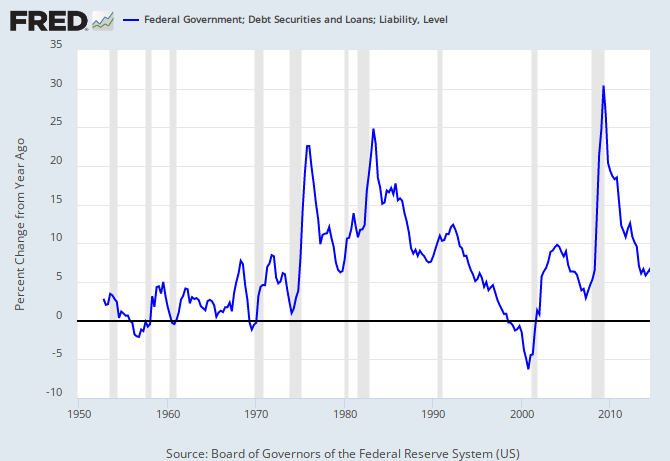
Reductions in federal deficits and debt lead to recessions, which are cured by increases in federal deficits and debt.


[Vertical gray bars are recessions.]

We can, and should, have tax cuts for the lower- and middle-income groups. We can, and should, increase spending for entitlements, to make life better for the 99% of Americans who will depend on entitlements — Social Security, Medicare, Medicaid, etc.

We even can spend more on the military, though the priority, when we aren’t in a real war, is questionable.

We can have all those things if we simply realize that the federal debt is no problem at all, and the federal deficit is too low.

The federal government is not like you and me. Its finances are not like ours. Unlike you and me, the federal government never can run short of its own sovereign currency, the dollar. The government creates dollars, ad hoc, by spending dollars.

The government is what is known as “Monetarily Sovereign.” It has the ability to spend an unlimited number of dollars, which it creates by pressing computer keys.

The only limit to federal spending is an inflation that cannot be controlled by raising interest rates. The U.S. never has had such an inflation.

The GOP’s tax plans are hideous giveaways to the rich. Panetta’s comments about the budgets are designed to impoverish the 99% under the guise of making us safer.

And it’s all based on the private sector’s ignorance of Monetary Sovereignty.

Rodger Malcolm Mitchell
Monetary Sovereignty
Twitter: @rodgermitchell; Search #monetarysovereignty
Facebook: Rodger Malcolm Mitchell

………………………………………………………………………………………………………………………………………………………………………………………………………………………………………………………………………………………………………………………………………..
THOUGHTS

•Those, who do not understand the differences between Monetary Sovereignty and monetary non-sovereignty, do not understand economics.

•The more federal budgets are cut and taxes increased, the weaker an economy becomes..

•No nation can tax itself into prosperity, nor grow without money growth.

•Cutting federal deficits to grow the economy is like applying leeches to cure anemia.

•A growing economy requires a growing supply of money (GDP = Federal Spending + Non-federal Spending + Net Exports)

•The limit to federal deficit spending is an inflation that cannot be cured with interest rate control. The limit to non-federal deficit spending is the ability to borrow.

•Until the 99% understand the need for federal deficits, the upper 1% will rule.

•Progressives think the purpose of government is to protect the poor and powerless from the rich and powerful. Conservatives think the purpose of government is to protect the rich and powerful from the poor and powerless.

•The single most important problem in economics is the Gap between the rich and the rest.

•Austerity is the government’s method for widening the Gap between the rich and the rest.

•Everything in economics devolves to motive, and the motive is the Gap between the rich and the rest..

MONETARY SOVEREIGNTY

It’s a “chump-or-brains” decision. Which are you?


It takes only two things to keep people in chains:
The ignorance of the oppressed
and the treachery of their leaders.

——————————————————————————————————————————————————————————————————————————————————————————–

Let’s begin with an absolute truth: Unless you own at least $20 million — and this is a ridiculously bare minimum — you are a chump if you vote for the GOP, aka “The Party of the Rich.”

Yes, yes, I know. The Dems are “libtards,” and Hillary is “crooked,”, and Bernie is a clown, and Bill is a womanizer, etc., etc. , but the fact remains that the GOP uniquely does everything in its power to take dollars from you and give those dollars to the very rich.

First, the GOP tells you the rich are “makers” and the poor are “takers” — a bold-faced lie — to make you believe you should be grateful for what the rich do to you. In fact, as you will see, it is the rich who are the real “takers” in America, and it is the lower income groups who do all the actual “making.”

Look at any major corporation. The top executives live high, while you peons are sweating.  Nothing is done for you. Instead, you do for them.

Any jobs the rich make are incidental to their primary purpose: Self-enrichment. Any money that floats down to you not only is inadvertent, but is resented by the rich. (That’s why they call you “takers.”)

The minimal benefits you receive are just designed to be barely enough to get your vote; nothing more.

Then the GOP tells you the federal government can’t afford deficits and debt — another lie — which requires that your meager social benefits like Medicare, Medicaid, Social Security, housing aids, food aids, education aids must be limited or eliminated.

But, the U.S federal government never can run short of its sovereign currency, the dollar. All the dire warnings about “unsustainable” deficits and your grandchildren paying for the debt, are 100% false, lies designed to make you accept short rations, while the rich sop up all the gravy.Image result for pickpocket

By no coincidence, the social benefits despised by the GOP were provided by the Democrats.

Now, the GOP offers tax “reform” that cuts taxes on the rich and raises taxes on the middle classes, while cutting ACA and other benefits to the middle-class.

This will be one of the largest pickpocket, money-transfer schemes in history.

You can read about the scam at:

The Trump tax cuts fall far short of Ronald Reagan’s reforms
The Gipper is an inspiration to Republicans, but they are not following his example

As Republicans embark on yet another sweeping rewrite of the tax code, many point to the 1986 effort as a model to emulate. It was “really something special”, Donald Trump said in August.

However, admirers of America’s last comprehensive revision of its tax code should be disappointed with the GOP’s current attempts.

The authors of the last reform relied heavily on advice from professional economists. In contrast, Mr Trump’s Treasury department is yet to find a credible study supporting its claim that tax cuts will deliver enough economic growth to pay for themselves.

It also removed from its website a paper arguing that the benefits of corporate tax cuts flow primarily to investors, rather than to workers.

Also, the 1986 tax code law:

” . . . included full committee hearings, markups and deliberations. That legislative process bears little resemblance to the Republican Party’s current approach to tax reform.

Republicans are using the restrictive procedure of budget reconciliation to try to push the legislation through on a party-line vote.

And unlike the exhaustive review that occurred from 1984 to 1986, Mr Trump has promised to sign a bill by Christmas, just two months after the first legislative text was introduced.

. . . According to figures from the Joint Committee on Taxation, most of the benefits will go to the rich. Reagan’s 1986 reform did the opposite.

Despite these shortfalls, the House is expected to vote on its tax proposal today.

That may have less to do with enthusiasm for the bill itself than with Republicans’ belief that they need to approve some form of major legislation to avoid a wipe-out in next year’s midterm elections.

Do you see anything the GOP is doing for you? No, you don’t, because the GOP doesn’t care about you.

It cares only about fooling you long enough to get your vote so it can continue transferring dollars from your pockets to the never-satisfied rich.

The GOP assumes that by repeating “Hillary, Bill, Obama, and Democrats” often enough, your dislike for the left will prompt you to vote against your own self-interest, and instead vote for the interests of the billionaires.

In short, the GOP expects you to vote like a chump.

Speaking of billionaires, here are a few who think you poor chumps receive too much, and so you should give more to them:

The Paradise Papers
Bloomberg News

Earlier this week, the International Consortium of Investigative Journalists released over 13 million heretofore confidential records documenting the offshore financial interests held by wealthy individuals and corporations who may have wanted to shield their involvement in offshore tax havens from public scrutiny.

[You’ll see several references to “Appleby,” self described as “. . . an offshore law firm. We advise global public and private companies, financial institutions, and high net worth individuals, working with them and their advisers to achieve practical solutions.” The two word description of what Appleby does best is “tax havens.”]

Known as the Paradise Papers, the documents originate primarily from Appleby, a Bermuda-based law firm, says the ICIJ. The firm specializes in catering to UHNW clients and blue chip companies

  • Reveals offshore interests and activities of more than 120 politicians and world leaders, including Queen Elizabeth II, and 13 advisers, major donors and members of U.S. President Donald J. Trump’s administration
  • Exposes the tax engineering of more than 100 multinational corporations, including Apple, Nike and Botox-maker Allergan
  • Reveals tax haven shopping sprees by multinational companies in Africa and Asia that use shell companies in Mauritius and Singapore to reduce taxes
  • Shines a light on secretive deals and hidden companies connected to Glencore, the world’s largest commodity trader, and provides detailed accounts of the company’s negotiations in the Democratic Republic of the Congo for valuable mineral resources
  • Provides details of how owners of jets and yachts, including royalty and sports stars, used Isle of Man tax-avoidance structures

While your employer dutifully deducts payroll taxes and income taxes from your paycheck, the rich rake in billions of untaxed dollars — and still complain the federal deficit is too high.

Donald Trump told voters he would put “America First.” But surrounding him are associates who have used tax havens to conduct business.

Go to Explore The Influencers: Donald Trump’s allies in the Paradise Papers and you’ll see some of the people who cry about the federal debt and what meager “freebies” you receive, while they gorge at the tax-free trough.

You’ll see such names as:

Stephen Schwarzman, co-founder and CEO of the Blackstone Group, a global private equity firm, has been one of President Donald Trump’s closest allies on Wall Street. Shortly after his election victory, Trump named Schwarzman chairman of the White House’s business advisory council. An outspoken opponent of raising taxes on the rich, Schwarzman once compared an Obama administration plan to raise taxes on hedge fund managers to Hitler’s invasion of Poland.

Billionaire industrialists Charles and David Koch are among the most influential political donors in modern U.S. history. After declining to back Donald Trump during the 2016 election, the two brothers appear to have warmed to the new president.

In July, it was reported that they had launched a multimillion-dollar campaign in support of President Trump’s tax plan.

Real estate investor Thomas J. Barrack Jr., a close friend of and adviser to Donald Trump, was a fundraiser for Trump, donor to his campaign and chairman of the inaugural committee. During the campaign, Barrack said he raised $32 million for a super PAC backing Trump’s candidacy. CNN has called Barrack “perhaps the single
person closest to [Trump] outside of his immediate family.”

Barrack’s firm, Colony Capital, now known as Colony NorthStar, owns a vast web of offshore holdings that operate in tax havens around the globe. Among them are a pair of Cayman Islands shell companies in the law firm Appleby’s files that list Barrack as a director.

As vice chairman for supervision at the Federal Reserve, Randal Quarles is the central bank’s watchdog over the U.S. banking industry. Appleby files identify Quarles as an officer of two tax-exempt entities registered in the Cayman Islands and associated with the Carlyle Group.

Casino magnate Sheldon G. Adelson was the Republican Party’s leading donor in 2016, contributing more than $82 million to GOP candidates and causes. He provided an additional $5 million to Trump’s inaugural festivities, the largest-ever contribution to an inauguration.

Adelson’s Las Vegas Sands paid tens of millions of dollars to Adelson’s Interface Bermuda between 2010 and 2016, SEC filings show – effectively shifting Adelson’s money from the United States to a tax-free jurisdiction.

Rex Tillerson is the U.S. secretary of state. Before his nomination by President Donald Trump, he served for more than a decade as CEO of the oil giant ExxonMobil.

Robert Mercer is the CEO of Renaissance Technologies, a highly profitable
hedge fund that relies on secret trading algorithms. Mercer was a prominent financial backer of Donald Trump’s candidacy and is credited with influencing
key decisions by Trump, including the hiring of Stephen Bannon as White House
chief strategist, a position Bannon held for seven months.

An Appleby spreadsheet created on September 2015, lists Mercer as a director of eight Renaissance Technologies subsidiaries, all registered in Bermuda.

Another billionaire Las Vegas casino magnate Steve Wynn, is the founder of Wynn Resorts. A friend of Donald Trump, Wynn donated $729,000 in “entertainers and production work” to the incoming president’s inaugural fund, a Wynn spokesman told the Associated Press. In February, the Republican National Committee named Wynn its finance chairman.

Wynn’s casino company, Wynn Resorts, controls several offshore shell companies
associated with its move into the Chinese gambling hotspot of Macau in 2006. Although Wynn had no resorts or casinos on the Isle of Man, two of the offshore
entities relating to his Macau venture were incorporated in the small
island tax haven in the Irish Sea.

Wilbur Ross is the U.S. secretary of commerce. Before his appointment by President Donald Trump, Ross was a billionaire Wall Street investor best known for buying struggling companies to turn around and sell for a profit.

Ross’ private equity firm W.L. Ross & Co, LLC, was one of Appleby’s biggest clients. Appleby administered more than 50 W.L. Ross companies and partnerships, most in the Cayman Islands.

Paul Elliott Singer is the founder of Elliott Management, a hedge fund that purchases distressed assets and has been accused of acting as a vulture fund. A top donor to Republican candidates, Singer contributed $1 million to Donald Trump’s inaugural fund. As president, Trump has called Singer a “very strong ally.”

Among Elliott Management’s holdings in tax havens across the world has been a firm called Kensington International Ltd., registered in the Cayman Islands.

Gary Cohn is President Donald Trump’s chief economic adviser and the director of the National Economic Council. Before joining the administration, Cohn was the president and chief operating officer of the investment bank Goldman Sachs.

Cohn was the president of 20 Bermuda incorporated companies affiliated
with a fund managed by Goldman Sachs.

Real estate developer Geoffrey Palmer contributed $5 million to a super PAC that
supported Donald Trump’s presidential campaign and has donated to dozens of other Republican candidates and causes.

His company G.H. Palmer Associates owns more than 10,000 apartment units in Southern California, and he has been a strong opponent of affordable housing requirements for real estate developments.

Palmer is the principal of a Bermuda-based company called Malibu Consulting Ltd. In 2009, a lawyer for a Deutsche Bank affiliate contacted Appleby to
request the assistance of a “Bermuda aircraft attorney” in connection with the affiliate providing a loan to Palmer’s company.

These are but a few of the GOP Billionaires, who have avoided taxes.

While the chumps pay and pay and pay, the billionaires complain that the government spends too much on benefits for yes, the chumps.

Keep all this in mind as you read more details of the GOP tax plan.

Then decide whether, in the coming election, you will vote for your interests or for the billionaires’ interests.

It’s a “chump-or-brains” decision.

Rodger Malcolm Mitchell
Monetary Sovereignty
Twitter: @rodgermitchell; Search #monetarysovereignty
Facebook: Rodger Malcolm Mitchell

………………………………………………………………………………………………………………………………………………………………………………………………………………………………………………………………………………………………………………………………………..

The most important problems in economics involve the excessive income/wealth/power Gaps between the have-mores and the have-less.

Wide Gaps negatively affect poverty, health and longevity, education, housing, law and crime, war, leadership, ownership, bigotry, supply and demand, taxation, GDP, international relations, scientific advancement, the environment, human motivation and well-being, and virtually every other issue in economics.

Implementation of The Ten Steps To Prosperity can narrow the Gaps:
Ten Steps To Prosperity:
1. ELIMINATE FICA (Ten Reasons to Eliminate FICA )
Although the article lists 10 reasons to eliminate FICA, there are two fundamental reasons:
*FICA is the most regressive tax in American history, widening the Gap by punishing the low and middle-income groups, while leaving the rich untouched, and
*The federal government, being Monetarily Sovereign, neither needs nor uses FICA to support Social Security and Medicare.
2. FEDERALLY FUNDED MEDICARE — PARTS A, B & D, PLUS LONG TERM CARE — FOR EVERYONE (H.R. 676, Medicare for All )
This article addresses the questions:
*Does the economy benefit when the rich can afford better health care than can the rest of Americans?
*Aside from improved health care, what are the other economic effects of “Medicare for everyone?”
*How much would it cost taxpayers?
*Who opposes it?”
3. PROVIDE A MONTHLY ECONOMIC BONUS TO EVERY MAN, WOMAN AND CHILD IN AMERICA (similar to Social Security for All) (The JG (Jobs Guarantee) vs the GI (Guaranteed Income) vs the EB (Economic Bonus)) Or institute a reverse income tax.
This article is the fifth in a series about direct financial assistance to Americans:

Why Modern Monetary Theory’s Employer of Last Resort is a bad idea. Sunday, Jan 1 2012
MMT’s Job Guarantee (JG) — “Another crazy, rightwing, Austrian nutjob?” Thursday, Jan 12 2012
Why Modern Monetary Theory’s Jobs Guarantee is like the EU’s euro: A beloved solution to the wrong problem. Tuesday, May 29 2012
“You can’t fire me. I’m on JG” Saturday, Jun 2 2012

Economic growth should include the “bottom” 99.9%, not just the .1%, the only question being, how best to accomplish that. Modern Monetary Theory (MMT) favors giving everyone a job. Monetary Sovereignty (MS) favors giving everyone money. The five articles describe the pros and cons of each approach.
4. FREE EDUCATION (INCLUDING POST-GRAD) FOR EVERYONE Five reasons why we should eliminate school loans
Monetarily non-sovereign State and local governments, despite their limited finances, support grades K-12. That level of education may have been sufficient for a largely agrarian economy, but not for our currently more technical economy that demands greater numbers of highly educated workers.
Because state and local funding is so limited, grades K-12 receive short shrift, especially those schools whose populations come from the lowest economic groups. And college is too costly for most families.
An educated populace benefits a nation, and benefitting the nation is the purpose of the federal government, which has the unlimited ability to pay for K-16 and beyond.
5. SALARY FOR ATTENDING SCHOOL
Even were schooling to be completely free, many young people cannot attend, because they and their families cannot afford to support non-workers. In a foundering boat, everyone needs to bail, and no one can take time off for study.
If a young person’s “job” is to learn and be productive, he/she should be paid to do that job, especially since that job is one of America’s most important.
6. ELIMINATE FEDERAL TAXES ON BUSINESS
Businesses are dollar-transferring machines. They transfer dollars from customers to employees, suppliers, shareholders and the federal government (the later having no use for those dollars). Any tax on businesses reduces the amount going to employees, suppliers and shareholders, which diminishes the economy. Ultimately, all business taxes reduce your personal income.
7. INCREASE THE STANDARD INCOME TAX DEDUCTION, ANNUALLY. (Refer to this.) Federal taxes punish taxpayers and harm the economy. The federal government has no need for those punishing and harmful tax dollars. There are several ways to reduce taxes, and we should evaluate and choose the most progressive approaches.
Cutting FICA and business taxes would be a good early step, as both dramatically affect the 99%. Annual increases in the standard income tax deduction, and a reverse income tax also would provide benefits from the bottom up. Both would narrow the Gap.
8. TAX THE VERY RICH (THE “.1%) MORE, WITH HIGHER PROGRESSIVE TAX RATES ON ALL FORMS OF INCOME. (TROPHIC CASCADE)
There was a time when I argued against increasing anyone’s federal taxes. After all, the federal government has no need for tax dollars, and all taxes reduce Gross Domestic Product, thereby negatively affecting the entire economy, including the 99.9%.
But I have come to realize that narrowing the Gap requires trimming the top. It simply would not be possible to provide the 99.9% with enough benefits to narrow the Gap in any meaningful way. Bill Gates reportedly owns $70 billion. To get to that level, he must have been earning $10 billion a year. Pick any acceptable Gap (1000 to 1?), and the lowest paid American would have to receive $10 million a year. Unreasonable.
9. FEDERAL OWNERSHIP OF ALL BANKS (Click The end of private banking and How should America decide “who-gets-money”?)
Banks have created all the dollars that exist. Even dollars created at the direction of the federal government, actually come into being when banks increase the numbers in checking accounts. This gives the banks enormous financial power, and as we all know, power corrupts — especially when multiplied by a profit motive.
Although the federal government also is powerful and corrupted, it does not suffer from a profit motive, the world’s most corrupting influence.
10. INCREASE FEDERAL SPENDING ON THE MYRIAD INITIATIVES THAT BENEFIT AMERICA’S 99.9% (Federal agencies)Browse the agencies. See how many agencies benefit the lower- and middle-income/wealth/ power groups, by adding dollars to the economy and/or by actions more beneficial to the 99.9% than to the .1%.
Save this reference as your primer to current economics. Sadly, much of the material is not being taught in American schools, which is all the more reason for you to use it.

The Ten Steps will grow the economy, and narrow the income/wealth/power Gap between the rich and you.

MONETARY SOVEREIGNTY

Why I agree (gasp!) with Trump and the GOP — almost.


It takes only two things to keep people in chains:
The ignorance of the oppressed
and the treachery of their leaders.

——————————————————————————————————————————————————————————————————————————————————————————–

Here is why I agree with Trump and the GOP — almost — even though he and they don’t understand exactly what they are lying about:

Deficit worries complicate path for Republican tax cuts
Reuters, By David Morgan

WASHINGTON (Reuters) – Unease among Republicans about a massive increase in the federal deficit could complicate passage of two tax-cut bills working their way through the U.S. Congress, endangering President Donald Trump’s top legislative priority.

The Committee for a Responsible Federal Budget (CRFB), a nonpartisan budget watchdog in Washington, on Friday called a Senate Republican tax plan a “fatally flawed budget buster,” likening it to Republican legislation in the House of Representatives that the House tax committee has approved.

Both measures would add $1.5 trillion over 10 years to the annual budget deficit and the $20 trillion national debt, according to congressional tax analysts.

O.K., immediately you know Trump and the GOP are wrong — for two reasons:

  1. They are worried about the increase in the economy’s money supply (aka the misnamed “deficit”), the increase that stimulates economic growth
  2. They are taking advice from the notorious “debt Henny Pennys, the CRFB, who have issued the same old warning about the debt “ticking time bomb,” year after year, for more than 35 years. During that period, the federal “debt” has risen an astounding $13 Trillion, from under $1 Trillion to $14 Trillion — and still, we wait for that “time bomb” to explode.

The so-called federal “debt” is the total of deposits in T-security accounts, which are similar to interest-paying savings accounts. 

Image result for savings account passbook
A T-security account is like a bank savings account.

When you deposit your dollars in your bank savings account, they become a debt of your bank.

Your bank owes you the dollars, but does not spend or lend your dollars.

To lend, your bank creates brand new dollars.

Your dollars stay in your account, accumulating interest until you withdraw them. Their only function is to provide legal reserves.

Similarly, when you “lend” to the federal government, you actually make a deposit in your T-security account. The government does not spend or lend your dollars. Your dollars remain in your T-security account, accumulating interest until the government pays it back.

As with a bank savings account, the government does not spend your T-security account dollars.  To pay off the “debt,” the government does not use tax dollars. It merely gives you back the dollars that currently exist in your T-security account.

The primary difference between a T-security account and a bank savings account is semantic. We call the former, “debt,” and the latter, “deposits.”

Ironically, we worry about the size of federal “debt” but not the size of bank “deposits,” though the federal government cannot go bankrupt, and banks can.

I know. I know. It makes no sense.

Nearly 10 months into his presidency, with his party in control of the House and the Senate, Trump is still without a major legislative victory.

There are two reasons Trump hasn’t had a victory:

  1. He can’t comprehend anything much longer than a paragraph. He had no idea what was in the multitude of awful “repeal & replace” Obamacare plans, so he couldn’t give Congress any guidance. Similarly, he has no idea what is in the various tax plans. He only wants to sign something, anything, no matter how terrible, so he can say he did something.
  2. The voters may be ignorant of the facts, but they are not stupid, and they can see that everything the GOP puts in front of them will take from the 99% and reward the richest 1%.

The Tax Foundation, another nonpartisan group, said the Senate plan would add $1.78 trillion to the deficit over a decade.

Translation: It would add $1.78 million more to the economy over a decade.

It estimated that over the same time frame lower taxes would expand the U.S. economy by 3.7 percent, add 925,000 full-time jobs, raise wages by 2.9 percent and generate enough new tax revenue to erase all but $516 billion of the deficit effect.

Now think very closely about the above two paragraphs. Together they tell you (rightly) that because tax cuts (i.e. deficit increases) will add dollars to the economy, they will grow the economy, add jobs and raise wages.

Those are good things, right? So if deficit spending will accomplish those good things, why is anyone opposed to deficit spending?

Here’s why:

For decades, Republicans positioned themselves as deficit hawks, refusing to raise the debt limit, opposing Democratic spending programs and warning of crushing federal debts being passed on to future generations of Americans.

The deficit Henny Pennys are afraid to admit they have been lying to you and the rest of the voters about the “dangers” of what really benefits you: Federal deficit spending.

Today, they are hung on their own lies, and will try to double-talk you into believing “federal deficits aren’t so bad after all, but anyway, there won’t be deficits” — or something.

In short, they think you’re stupid.

The tax plans now being debated represent a stark reversal, with congressional Republican leadership and tax law writers urging passage of deficit-expanding tax changes. Only a handful of Republican senators already have publicly voiced misgivings.

This is one more demonstration of the Republican Party’s utter bankruptcy. Most of them hate Trump, but are frightened to say it. And most of them know that deficits grow the economy, but are afraid to tell you the truth.

This is disgusting, even for politicians, because their lies directly harm you and the economy.

After the Senate plan was released on Thursday, Republican Senator Jeff Flake said in a statement, “I remain concerned over how the current tax reform proposals will grow the already staggering national debt by opting for short-term fixes, while ignoring long-term problems for taxpayers and the economy.”

Flake repeats the Big Lie that taxpayers will have to pay off the federal “debt” (deposits). They won’t.

Questions:

  1. Do you consider your bank’s savings account deposits to be “staggering.”
  2. Do you even know or care what those deposits are?
  3. Do you think you and your children will have to pay off those deposits?

If your answers rightfully are “No,” “No, and “No,” you similarly should not care about the federal government’s so-called “debt.”

Senator James Lankford said in a statement, “As we work on tax relief, we must also not lose sight of our responsibilities to protect the nation, provide basic government services and confront our federal debt.”

Senator Bob Corker, another Republican and a critic of Trump, did not comment after the Senate bill’s release but signaled fiscal concerns after the House issued its plan, saying he did not want tax cut legislation that added to the deficit.

And then there’s the CRFB, with its usual misstatement:

“The current tax reform debate shows Congress just can’t seem to shake its addiction to debt,” said Maya MacGuineas, president of the Committee for a Responsible Federal Budget.

“If tax cuts paid for by debt are signed into law, Congress will have sent a massive, budget-busting tax bill to our children to pay, and it will result only in a short-term sugar high with little to no economic improvement over the long term,” she said.

May MacGuineas, would you please shut up.  Just shut up.

You should be ashamed of yourself. Either you don’t know what you are talking about or, more likely, you have been paid to spread the Big Lie for all these years.

Either way, you will do America a great service if you simply shut up.

I agree with Trump’s and the GOP’s desire to cut taxes, and I agree with the resultant, increased deficit, simply because that would do exactly what The Tax Foundation predicted: Grow the economy, add jobs and raise wages.

What I don’t agree with is the nature of the GOP’s deficits, because as always, they favor the rich, and widen the Gap between the rich and the rest.

Instead, we should increase deficits by instituting The 10 Steps to Prosperity (below).

If Congress and the President merely took Step #1 — eliminate the FICA tax — that alone would go a long way toward growing the economy, adding jobs and raising wages, while narrowing the Gap.

So, enough! Enough with calling deposits in T-security accounts “debt.” Enough with plans that favor the rich and punish the 99%. Enough with widening the Gap between the rich and the rest.

Enough with the Big Lie.

At long last, Congress and the President, forget the political BS and do what you’re paid to do. Do what’s right for the people.

Is that too much to ask?

Rodger Malcolm Mitchell
Monetary Sovereignty
Twitter: @rodgermitchell; Search #monetarysovereignty
Facebook: Rodger Malcolm Mitchell

………………………………………………………………………………………………………………………………………………………………………………………………………………………………………………………………………………………………………………………………………..

The most important problems in economics involve the excessive income/wealth/power Gaps between the have-mores and the have-less.

Wide Gaps negatively affect poverty, health and longevity, education, housing, law and crime, war, leadership, ownership, bigotry, supply and demand, taxation, GDP, international relations, scientific advancement, the environment, human motivation and well-being, and virtually every other issue in economics.

Implementation of The Ten Steps To Prosperity can narrow the Gaps:
Ten Steps To Prosperity:
1. ELIMINATE FICA (Ten Reasons to Eliminate FICA )
Although the article lists 10 reasons to eliminate FICA, there are two fundamental reasons:
*FICA is the most regressive tax in American history, widening the Gap by punishing the low and middle-income groups, while leaving the rich untouched, and
*The federal government, being Monetarily Sovereign, neither needs nor uses FICA to support Social Security and Medicare.
2. FEDERALLY FUNDED MEDICARE — PARTS A, B & D, PLUS LONG TERM CARE — FOR EVERYONE (H.R. 676, Medicare for All )
This article addresses the questions:
*Does the economy benefit when the rich can afford better health care than can the rest of Americans?
*Aside from improved health care, what are the other economic effects of “Medicare for everyone?”
*How much would it cost taxpayers?
*Who opposes it?”
3. PROVIDE A MONTHLY ECONOMIC BONUS TO EVERY MAN, WOMAN AND CHILD IN AMERICA (similar to Social Security for All) (The JG (Jobs Guarantee) vs the GI (Guaranteed Income) vs the EB (Economic Bonus)) Or institute a reverse income tax.
This article is the fifth in a series about direct financial assistance to Americans:

Why Modern Monetary Theory’s Employer of Last Resort is a bad idea. Sunday, Jan 1 2012
MMT’s Job Guarantee (JG) — “Another crazy, rightwing, Austrian nutjob?” Thursday, Jan 12 2012
Why Modern Monetary Theory’s Jobs Guarantee is like the EU’s euro: A beloved solution to the wrong problem. Tuesday, May 29 2012
“You can’t fire me. I’m on JG” Saturday, Jun 2 2012

Economic growth should include the “bottom” 99.9%, not just the .1%, the only question being, how best to accomplish that. Modern Monetary Theory (MMT) favors giving everyone a job. Monetary Sovereignty (MS) favors giving everyone money. The five articles describe the pros and cons of each approach.
4. FREE EDUCATION (INCLUDING POST-GRAD) FOR EVERYONE Five reasons why we should eliminate school loans
Monetarily non-sovereign State and local governments, despite their limited finances, support grades K-12. That level of education may have been sufficient for a largely agrarian economy, but not for our currently more technical economy that demands greater numbers of highly educated workers.
Because state and local funding is so limited, grades K-12 receive short shrift, especially those schools whose populations come from the lowest economic groups. And college is too costly for most families.
An educated populace benefits a nation, and benefitting the nation is the purpose of the federal government, which has the unlimited ability to pay for K-16 and beyond.
5. SALARY FOR ATTENDING SCHOOL
Even were schooling to be completely free, many young people cannot attend, because they and their families cannot afford to support non-workers. In a foundering boat, everyone needs to bail, and no one can take time off for study.
If a young person’s “job” is to learn and be productive, he/she should be paid to do that job, especially since that job is one of America’s most important.
6. ELIMINATE FEDERAL TAXES ON BUSINESS
Businesses are dollar-transferring machines. They transfer dollars from customers to employees, suppliers, shareholders and the federal government (the later having no use for those dollars). Any tax on businesses reduces the amount going to employees, suppliers and shareholders, which diminishes the economy. Ultimately, all business taxes reduce your personal income.
7. INCREASE THE STANDARD INCOME TAX DEDUCTION, ANNUALLY. (Refer to this.) Federal taxes punish taxpayers and harm the economy. The federal government has no need for those punishing and harmful tax dollars. There are several ways to reduce taxes, and we should evaluate and choose the most progressive approaches.
Cutting FICA and business taxes would be a good early step, as both dramatically affect the 99%. Annual increases in the standard income tax deduction, and a reverse income tax also would provide benefits from the bottom up. Both would narrow the Gap.
8. TAX THE VERY RICH (THE “.1%) MORE, WITH HIGHER PROGRESSIVE TAX RATES ON ALL FORMS OF INCOME. (TROPHIC CASCADE)
There was a time when I argued against increasing anyone’s federal taxes. After all, the federal government has no need for tax dollars, and all taxes reduce Gross Domestic Product, thereby negatively affecting the entire economy, including the 99.9%.
But I have come to realize that narrowing the Gap requires trimming the top. It simply would not be possible to provide the 99.9% with enough benefits to narrow the Gap in any meaningful way. Bill Gates reportedly owns $70 billion. To get to that level, he must have been earning $10 billion a year. Pick any acceptable Gap (1000 to 1?), and the lowest paid American would have to receive $10 million a year. Unreasonable.
9. FEDERAL OWNERSHIP OF ALL BANKS (Click The end of private banking and How should America decide “who-gets-money”?)
Banks have created all the dollars that exist. Even dollars created at the direction of the federal government, actually come into being when banks increase the numbers in checking accounts. This gives the banks enormous financial power, and as we all know, power corrupts — especially when multiplied by a profit motive.
Although the federal government also is powerful and corrupted, it does not suffer from a profit motive, the world’s most corrupting influence.
10. INCREASE FEDERAL SPENDING ON THE MYRIAD INITIATIVES THAT BENEFIT AMERICA’S 99.9% (Federal agencies)Browse the agencies. See how many agencies benefit the lower- and middle-income/wealth/ power groups, by adding dollars to the economy and/or by actions more beneficial to the 99.9% than to the .1%.
Save this reference as your primer to current economics. Sadly, much of the material is not being taught in American schools, which is all the more reason for you to use it.

The Ten Steps will grow the economy, and narrow the income/wealth/power Gap between the rich and you.

MONETARY SOVEREIGNTY

Why Does the Euro Area Have Such Low Growth and High Unemployment?

These people believe taking money out of the economy will grow the economy and benefit them.

.


It takes only two things to keep people in chains:
The ignorance of the oppressed
and the treachery of their leaders.

——————————————————————————————————————————————————————————————————————————————————————————–

In a May, 2010 talk at the University of Missouri, Kansas City, I said, “Because of the Euro, no euro nation can control its own money supply. The Euro is the worst economic idea since the recession-era, Smoot-Hawley Tariff. The economies of European nations are doomed by the euro.”

My reason was something that should have been obvious to anyone with even a smattering of knowledge about economics. Every euro nation was forced to surrender the single most valuable asset any nation can have: It’s Monetary Sovereignty.

A Monetarily Sovereign (MS) government has complete control over its own sovereign money. An MS government can control the supply and the value of its money.  It can pay any debt denominated in its sovereign currency. It can create its sovereign currency at will, simply by paying bills.

An MS government never can run short of its sovereign currency, never can be “burdened” by debt, never can find debt “unsustainable,” and never needs to ask anyone (taxpayers or lenders) for infusions of its sovereign currency.

The U.S. government, for instance, has absolute power over the dollar, which gives lie to all the debt “Henny Penny’s” who for at least 77 years, have claimed the federal deficit and debt are in some vague way a threat to the government or to American taxpayers.

So it was with guilty but pleasurable feelings of “I told you so,” that once again I publish excerpts from an article that appeared in the “Naked Capitalism blog:

Why Does the Euro Area Have Such Low Growth and High Unemployment?
Posted on November 11, 2017 by Yves Smith
By Philip Arestis, Professor of Economics at the University of the Basque Country, Spain and Malcolm Sawyer, Professor of Economics, University of Leeds. Originally published at Triple Crisis

Since the euro was adopted as a virtual currency in 1999 (and the exchange rates between the currencies of the then 11 countries fixed en route to adopting the euro), growth among the euro-area countries has been lacklustre.

The euro-area annual growth rate was just under 2% in 2002 to 2007, followed by 0.3% in 2008, -4.5% in 2009, then 2% in 2010, and an average of 0.8% 2011 to 2016. Over the period 1999 to 2016, the average was 1.1%.

Unemployment declined through to 2007 down to 7.5%, then rose in the aftermath of the financial crises and the effects of fiscal austerity programmes to 12% in 2013, and has gently declined since to 10% in 2016 and likely to come close to 9% at the end of October 2017.

There are notable disparities between different countries’ experiences, with Italy’s growth 1998 to 2016 being an annual average rate of 0.2%, and unemployment in Greece over 23% and Spain close to 20% in 2016.

We pause to examine the term, “fiscal austerity,” which I bolded for your convenience. It is a term that describes a government’s efforts to limit or reduce its deficits and debt.

Fiscal austerity is inevitable, even mandatory, for all monetary non-sovereign nations.

In America, city, county, and state governments, all being monetarily non-sovereign, continually must practice fiscal austerity, lest they eventually be unable to pay their bills.

No monetarily non-sovereign government can survive long-term on taxes alone. All monetarily non-sovereign governments require money coming in from outside their borders.

U.S. cities survive by borrowing, by trade surpluses, and by receiving dollars from county and state governments. County and state governments survive the same way, and additionally by receiving dollars from the federal government, which the federal government provides by running deficits vs. the states.

The Monetarily Sovereign federal government can survive forever, even while running deficits, and even while collecting $0 in taxes.

The euro nations are much like U.S. cities, counties, and states, all of which require euros coming in from outside their borders, just to survive, let alone to grow economically.

But from where will these additional euros come? They can come from borrowing (which is limited by the need to repay), net exports (though not all nations can be net exporters), or from the European Union (which requires that the EU itself run deficits).

Gross Domestic Product = Government Spending + Non-government Spending + Net Exports

Increasing any of the three factors — government spending, non-government spending, or net exports — requires an increased supply of money. This formula tells you a growing economy requires a growing supply of money.

Mathematically, it is impossible for an economy to grow while its money supply shrinks.

This all boils down to one absolute truth: The long-term survival of monetarily non-sovereign governments requires input from one or more Monetarily Sovereign governments, which in turn, requires the MS governments to run deficits.

The launch of the single currency had a whole range of political forces behind it, but was viewed as enhancing economic integration and giving some boost to trade between member countries.

“Boosting trade” always was the public excuse to the euro. But trade does not grow the overall money supply; it only transfers money from one nation to another.

Because a growing money supply is necessary for a growing economy, intra-EU trade does not grow the overall EU economy.

Many of the “structural reforms” have detrimental effects on inequality and productivity. “Reforms” attacking the level of minimum wages and undermining the position of trade unions exacerbate inequality.

“Reforms” attacking employment protection and security of employment do not help to foster training and innovation. Indeed, “structural reforms” were promoted to reduce “structural unemployment” and yet it is notable that the rate of “structural unemployment” in 2016 was 8.9%, compared with an average of 9.0% in the period 1992-2001, and 9.1% over 2002=2011.

Those favoring austerity always title their actions “Reforms.” Thus today, in America, we have “tax reform,” the ostensible purpose of which is to reduce (beneficial) deficits and debt, but which really is designed to increase the Gap between the rich and the rest.

The operations of the euro area (and the Economic and Monetary Union) are hampered by restrictive fiscal policies which strive for balanced budgets.

The attempt at a uniformity of fiscal policy (with the common aim of a “balanced structural budget”) cannot take into account the differing needs of countries for infrastructure investments nor does it take into account the differing economic circumstances of countries.

Balanced budgets also do not take into account the fact that government deficits add money to the private sector. When any government entity, whether Monetarily Sovereign or monetarily non-sovereign, runs a surplus, the private sector it serves runs a deficit — which is recessive.

In America,for instance, economic growth has required not just deficits, but deficit growth. Reductions in deficit growth have led to recessions, while increased deficit growth has cured recessions.

The adoption of the euro took place without any thought to the current-account imbalances between the member countries, and without any perspective on the sustainability of those imbalances.

Translation: Some euro nations had net exports of goods and services (i.e. imports of euros) and so, prospered. The others had net imports of goods and services (exports of euros), so suffered.

The current-account imbalances grew in the first decade of the euro, with associated capital flows between countries. In the second decade of the euro, current-account deficits were drastically reduced as internal deflation brought imports down.

But the underlying pattern of imbalances has not been resolved, and countries with high unemployment seeking a return to prosperity will face severe constraints from their current-account position.

Translation: The net-import, monetarily non-sovereign nations have no way to stimulate their economies by growing their money supply.

The austerity policy agenda (from the Stability and Growth Pact, the “fiscal compact,” etc., with the drives for balanced budgets), the pursuit of “structural reforms,” and the failures to address the current account constraints on euro-area member countries have all contributed to the lacklustre economic performance.

In Summary:

Austerity (i.e. the reduction of deficits and debt), reduces the growth of a nation’s money supply, which in turn, reduces economic growth, and even leads to recessions and depressions.

Image result for austerity

1804-1812: U. S. Federal Debt reduced 48%. Depression began 1807.
1817-1821: U. S. Federal Debt reduced 29%. Depression began 1819.
1823-1836: U. S. Federal Debt reduced 99%. Depression began 1837.
1852-1857: U. S. Federal Debt reduced 59%. Depression began 1857.
1867-1873: U. S. Federal Debt reduced 27%. Depression began 1873.
1880-1893: U. S. Federal Debt reduced 57%. Depression began 1893.
1920-1930: U. S. Federal Debt reduced 36%. Depression began 1929.
1997-2001: U. S. Federal Debt reduced 15%. Recession began 2001.

Monetarily non-sovereign governments are forced into austerity by their inability to create the money they use.

Monetarily Sovereign nations have the unlimited ability to create their own sovereign currency, but may intentionally be taken into austerity by government malfeasance on behalf of the rich.

Keep this in mind as Congress and the President debate tax “reform,” health care “reform,” and other so-called fiscal “reforms,” that are designed to widen the Gap between the very rich and you.

Deficit reduction guarantees economic death.

Rodger Malcolm Mitchell
Monetary Sovereignty
Twitter: @rodgermitchell; Search #monetarysovereignty
Facebook: Rodger Malcolm Mitchell

………………………………………………………………………………………………………………………………………………………………………………………………………………………………………………………………………………………………………………………………………..

THE WAY THINGS ARE:

•All we have are partial solutions; the best we can do is try.

•Those, who do not understand the differences between Monetary Sovereignty and monetary non-sovereignty, do not understand economics.

•Any monetarily NON-sovereign government — be it city, county, state or nation — that runs an ongoing trade deficit, eventually will run out of money no matter how much it taxes its citizens.

•The more federal budgets are cut and taxes increased, the weaker an economy becomes..

•No nation can tax itself into prosperity, nor grow without money growth.

•Cutting federal deficits to grow the economy is like applying leeches to cure anemia.

•A growing economy requires a growing supply of money (GDP = Federal Spending + Non-federal Spending + Net Exports)

•Deficit spending grows the supply of money

•The limit to federal deficit spending is an inflation that cannot be cured with interest rate control. The limit to non-federal deficit spending is the ability to borrow.

•Until the 99% understand the need for federal deficits, the upper 1% will rule.

•Progressives think the purpose of government is to protect the poor and powerless from the rich and powerful. Conservatives think the purpose of government is to protect the rich and powerful from the poor and powerless.

•The single most important problem in economics is the Gap between the rich and the rest.

•Austerity is the government’s method for widening the Gap between the rich and the rest.

•Everything in economics devolves to motive, and the motive is the Gap between the rich and the rest..

MONETARY SOVEREIGNTY