This is a challenge to the CRFB.
To: Maya MacGuineas, President;
I recently received an Email from you, which I will quote in its entirety.
Congress has until December 16th to fund the government and avoid a federal shutdown. If they avoid that, they’ll likely have done so with the same tired Washington tactic of promising billions in new deficit-funded spending or tax cuts, driving the national debt even higher.
We have asked Congress not to borrow any new money for the rest of 2022.
With our Debt Fixer interactive tool, you have the opportunity to craft a national budget that puts America on a sustainable fiscal course heading into 2023.
How It Works: The Debt Fixer gives users the opportunity to confront many of the same budget decisions that lawmakers face and to see how those choices affect the debt. You’ll be asked to make decisions on a range of policy options with the goal of stabilizing the debt at 90 percent of Gross Domestic Product (GDP) within ten years and 60 percent of GDP by 2050.
Afterwards, users can share select to share their fiscal choices with Members of Congress and social media. Can you do better than Congress? Give it a try now!
If you’re a teacher and would like to use the Debt Fixer in your class, please let us know by e-mailing debtfixer@crfb.org.
We can provide additional resources for your classroom including guest speakers and a customizable link where you can compare your classes results. If you enjoy Debt Fixer, we encourage you to check out our other interactive resources: Budgeting for the Future, Is It Worth It, and the Social Security Reformer.
Here you’ll be able to test your budget knowledge, compare the costs of proposals and policies, and choose the options to stabilizing the debt at 90 percent of Gross Domestic Product (GDP) for future generations.


I have bolded the following phrases from your Email: “driving the national debt even higher,” “not to borrow,” “not to borrow,” “sustainable fiscal course,” “stabilizing the debt at 90 percent of Gross Domestic Product (GDP), and “stabilizing the debt at 90 percent of Gross Domestic Product (GDP).”
As I suspect you know, the U.S. federal government is Monetarily Sovereign, i.e., it has the infinite ability to create its own sovereign currency, the U.S. dollar. This ability sometimes (incorrectly) is referred to as “printing” dollars.
The infinite ability to “print” dollars means the U.S. government never unintentionally can run short of dollars.
THE CHALLENGE
Given the fact that the U.S. government cannot run short of dollars, I challenge you to answer the following questions:
- DRIVING THE NATIONAL DEBT EVEN HIGHER: Given the federal government’s infinite ability to “print” (create) dollars why should anyone be concerned about the size of the “national debt”?
- NOT TO BORROW: Given the federal government’s infinite ability to create dollars why should the federal government need to borrow dollars?
- DEBT FIXER: Given the federal government’s infinite ability to create dollars, why does the federal debt need fixing?
- SUSTAINABLE FISCAL COURSE: Given the federal government’s infinite ability to create dollars, and the fact that it has sustained its fiscal course for the past 80+ years while the federal debt has increased 62,500%, why do you believe it’s current fiscal course suddenly has become unsustainable?
- STABILIZING THE FEDERAL DEBT AT 90 PERCENT OF GROSS DOMESTIC PRODUCT (GDP): In what way does the ratio of federal debt / GDP affect the economy?
I have followed your Emails for several years, during which time you repeatedly have voiced the same concerns about federal deficit spending. Yet, you never have answered the above questions.
Here are the facts you continually ignore:
- The government’s infinite ability to create dollars means it never needs to be concerned about any debt. It has a greater ability to pay its debts than Elon Musk’s ability to pay a 1 cent debt.
- The federal government does not borrow, nor will it ever need to. As the St. Louis Fed reported: ““As the sole manufacturer of dollars, whose debt is denominated in dollars, the U.S. government can never become insolvent, i.e., unable to pay its bills. In this sense, the government is not dependent on credit markets to remain operational.”
The U.S. government provides T-security accounts into which other governments and private citizens are allowed to deposit dollars for safekeeping.
The purpose of these accounts is not to provide the federal government with dollars, but rather to provide the world with a safe place to store unused dollars. This helps stabilize the dollar.
To pay off these deposits, the federal government merely returns the dollars that are in those accounts. Returning existing dollars is no burden on the federal government or on U.S. taxpayers. - The federal debt is not a real debt. It is deposits that are owned by other governments and private citizens. It does not need “fixing.” If the federal government stopped issuing T-securities tomorrow, that would have no effect on the government’s ability to spend dollars and to pay its bills.
- The federal government has proved, year after year, that its course is sustainable. Despite a massive increase in the so-called “debt,” the government has no difficulty funding every expenditure.
- The ratio of federal “debt” to GDP is economically meaningless. It has no effect on the government’s ability to spend or on inflation, or on any aspect of economic health. GDP dollars do not pay for federal debt.
The ratio also is ludicrous because it compares a multiyear figure (debt) to a one-year figure (GDP). One easily could ask, “Why not compare debt to the six-month GDP or the one-month GDP, or even the ten-year GDP?”


U.S. depressions tend to come on the heels of federal surpluses.
1804-1812: U. S. Federal Debt reduced 48%. Depression began 1807.
1817-1821: U. S. Federal Debt reduced 29%. Depression began 1819.
1823-1836: U. S. Federal Debt reduced 99%. Depression began 1837.
1852-1857: U. S. Federal Debt reduced 59%. Depression began 1857.
1867-1873: U. S. Federal Debt reduced 27%. Depression began 1873.
1880-1893: U. S. Federal Debt reduced 57%. Depression began 1893.
1920-1930: U. S. Federal Debt reduced 36%. Depression began 1929.
1997-2001: U. S. Federal Debt reduced 15%. Recession began 2001.

Using the tables below, see if you can determine which economies are “healthiest.”
(You won’t succeed, because the debt/GDP ratios tell you nothing about the health of a nation’s economy:
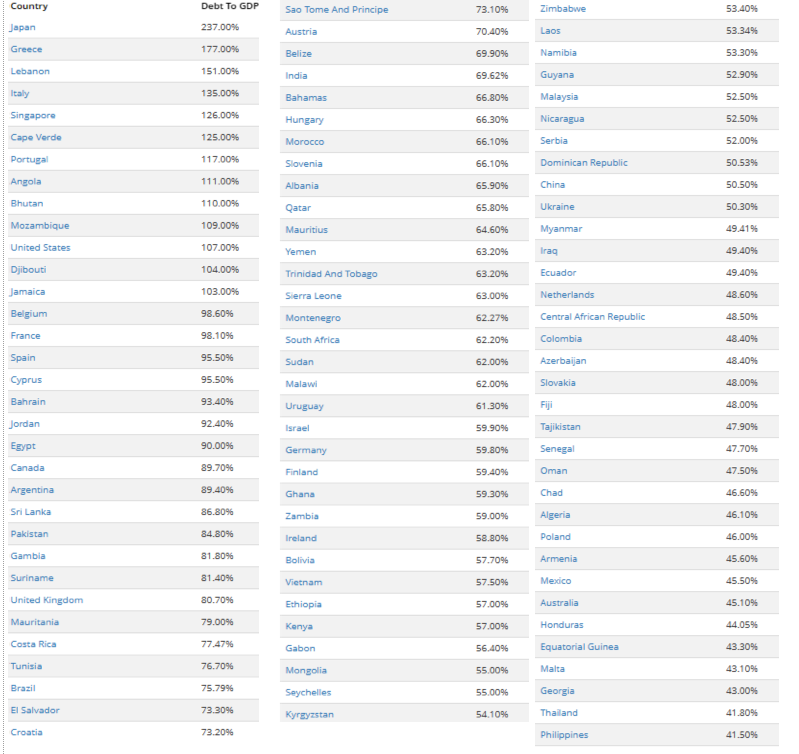
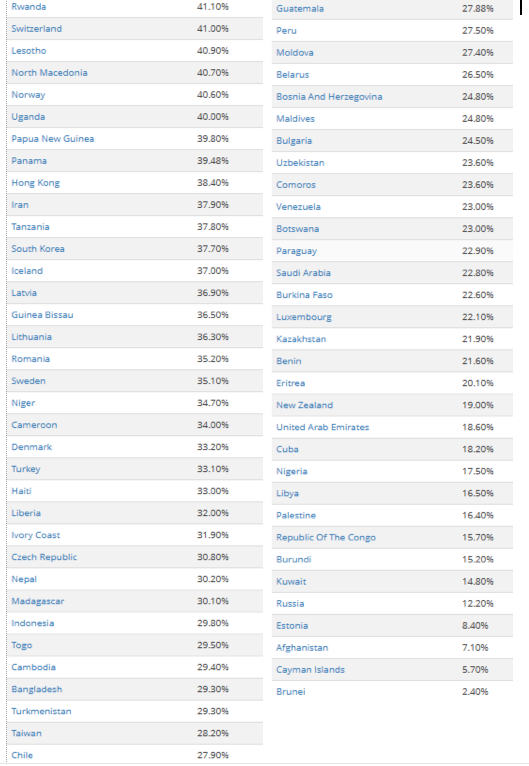
SUMMARY The CRFB never has and never will accept my challenge. They never will answer the questions, because the true answers would eliminate their reason for existence.
The CRFB is worse than useless. It is harmful to America. I believe they know they are harmful, in which case that would make them traitors.
I believe they are paid by the rich in America to widen the income/wealth/power Gap between the rich and the rest of us, in which case that would make them paid traitors.
I am angry at them. They hurt America.
If you believe they have answers and can meet the challenge, feel free to contact them. I’d be interested in seeing how they try to squirm out of this. Contact Maya MacGuineas at MacGuineas@crfb.org and find her on Twitter @MayaMacGuineas.
If you think I am angry at the CRFB, you’re right. I believe they have done, and continue to do, irreparable harm to America by giving aid and comfort to politicians who vote against benefits.
The claim that Medicare and Social Security can run short of money is absurd, especially so when the federal government, at the touch of a computer key, can provide all the money these agencies need.
The claim that the federal debt is too high also is absurd, when it isn’t even debt and it could be paid off entirely simply by returning the dollars in storage.
Even more absurd is to worry about the debt/GDP ratio, which compares a multi-year figure to a one-year figure, and is indicative or predictive of nothing.
Good luck.
Rodger Malcolm Mitchell
Monetary Sovereignty
Twitter: @rodgermitchell Search #monetarysovereignty
Facebook: Rodger Malcolm Mitchell
……………………………………………………………………..
The Sole Purpose of Government Is to Improve and Protect the Lives of the People.
MONETARY SOVEREIGNTY
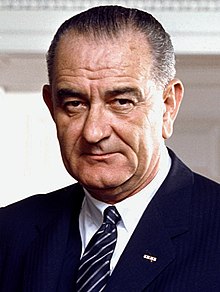 I hated Johnson. Later, when I added up all he accomplished, I decided he was one of the top three Presidents in U.S. history, though Vietnam killed his reputation.
I was ambivalent about Nixon and soon decided he was pretty good. At least he was more intelligent than most. Today, his support for a burglary would have been defended by 100% of the Republican party, and he never would have been forced from office. Back then, the GOP really was the party of law and order.
I thought Ford was weak and later decided he was strong. I think he could have become a fine President, given time.
I hated Jimmy Carter and still do. I like him more for his post-presidential work than for his Presidency.
I loved Reagan, but now I believe he was a phony.
I liked the elder Bush until he foolishly raised taxes after correctly promising not to.
I liked Bill Clinton until I realized his federal surpluses killed the American economy and caused the Bush II recession.
As for Bush II, eh. Eight wasted years. He attempted self-promotion and was terrible at that, too.
I was massively disappointed in Obama. I had thought he cared about the poor, but he was a proponent of federal austerity. I hope his library never gets built.
As for Trump, even before he was elected President, I wrote articles saying he was the 2nd coming of Hitler. Thank heavens he was dumb and lazy, or he would have been Hitler. I hope his library gets built in an underground bunker, where he is forced to live out his miserable life.
Finally, contrary to the pundits and the majority of Americans, I predict Biden will be remembered as one of our most effective Presidents, who despite a fascist GOP, will have accomplished more than any President since Johnson.
Because I’m aware the federal government has infinite money, and federal spending does not cause inflations, I lean more liberal than conservative. It will require a Democratic Congress and President to give us Medicare for All, Social Security for All, College for All, and the end of hunger in America. The Republicans won’t do it.
Before I became a permanent resident of Florida last year, I was a Cubs, Bears, Bulls, Blackhawks fan, but now care nothing for any of them. I still am a fan of Andy Pafko, however, though he stopped playing many, many years ago.
All of this came to mind what a friend told me she was an ardent Republican.
I asked why, and a puzzled look crossed her face. She hadn’t thought about why. Her family had voted Republican for ages.
Again, I asked why, and she had no idea, but said she probably would vote Republican, again.
I was a Cubs fan though the Cubs never did anything for me. So why was I a fan? Because I was a Chicagoan? Sure, but they were terrible, with Andy and without him. What made me scream with delight when they infrequently won, and why was I so blue all those times they lost. How did their wins and losses affect my life?
They didn’t.
Looked at objectively, the Cubs were a terrible team, unworthy of anyone’s adulation. Looked at objectively, the Republicans are an awful party, which does absolutely nothing for the vast majority of Americans. It clearly is the party of the rich, along with being the more immoral and dishonest of the two major parties. Their unwavering support for an obvious traitor is disgusting.
And Donald Trump, who unquestionably is the least honest, least intelligent, least patriotic, most dangerous-to-America of any past President, received over 70 million votes, mostly from people who “always vote Republican.”
There is no logic, but there is a reason: We are programmed to root. We root for our home state and city, our school, our sports teams, our friends and relatives, our company, and our favorite celebrity. But why?
Do other animals root?
Perhaps, as we’re social animals, we gain an evolutionary advantage if a member of our group wins in some way.
Could it be that if you consider yourself a Republican, you sense you have an evolutionary advantage if a Republican wins? That somehow, this strengthens your group, and this makes you safer?
It still begs the question, “Why do you consider yourself a Republican. What has the GOP done for you or those you care about?”
Consider the case of Herschel Walker. He received about half the votes. Half the votes! Do all those people really believe he would have been the better choice for Senator? Do they really want him to be their leader or representative?
We tend to vote for those who are like us. Whites tend to vote for whites; blacks tend to vote for blacks, Hispanic for Hispanics, Jews for Jews, men for men. The list goes on. But Herschel Walker is an immoral, brain-dead, nincompoop, who can’t put together two meaningful sentences.
Does that mean half the voters in Georgia are immoral, brain-dead nincompoops, who can’t put together two meaningful sentences? In what universe does even one intelligent person vote for Herschel Walker to represent the interests of Georgian people?
H. L. Mencken wrote:
I hated Johnson. Later, when I added up all he accomplished, I decided he was one of the top three Presidents in U.S. history, though Vietnam killed his reputation.
I was ambivalent about Nixon and soon decided he was pretty good. At least he was more intelligent than most. Today, his support for a burglary would have been defended by 100% of the Republican party, and he never would have been forced from office. Back then, the GOP really was the party of law and order.
I thought Ford was weak and later decided he was strong. I think he could have become a fine President, given time.
I hated Jimmy Carter and still do. I like him more for his post-presidential work than for his Presidency.
I loved Reagan, but now I believe he was a phony.
I liked the elder Bush until he foolishly raised taxes after correctly promising not to.
I liked Bill Clinton until I realized his federal surpluses killed the American economy and caused the Bush II recession.
As for Bush II, eh. Eight wasted years. He attempted self-promotion and was terrible at that, too.
I was massively disappointed in Obama. I had thought he cared about the poor, but he was a proponent of federal austerity. I hope his library never gets built.
As for Trump, even before he was elected President, I wrote articles saying he was the 2nd coming of Hitler. Thank heavens he was dumb and lazy, or he would have been Hitler. I hope his library gets built in an underground bunker, where he is forced to live out his miserable life.
Finally, contrary to the pundits and the majority of Americans, I predict Biden will be remembered as one of our most effective Presidents, who despite a fascist GOP, will have accomplished more than any President since Johnson.
Because I’m aware the federal government has infinite money, and federal spending does not cause inflations, I lean more liberal than conservative. It will require a Democratic Congress and President to give us Medicare for All, Social Security for All, College for All, and the end of hunger in America. The Republicans won’t do it.
Before I became a permanent resident of Florida last year, I was a Cubs, Bears, Bulls, Blackhawks fan, but now care nothing for any of them. I still am a fan of Andy Pafko, however, though he stopped playing many, many years ago.
All of this came to mind what a friend told me she was an ardent Republican.
I asked why, and a puzzled look crossed her face. She hadn’t thought about why. Her family had voted Republican for ages.
Again, I asked why, and she had no idea, but said she probably would vote Republican, again.
I was a Cubs fan though the Cubs never did anything for me. So why was I a fan? Because I was a Chicagoan? Sure, but they were terrible, with Andy and without him. What made me scream with delight when they infrequently won, and why was I so blue all those times they lost. How did their wins and losses affect my life?
They didn’t.
Looked at objectively, the Cubs were a terrible team, unworthy of anyone’s adulation. Looked at objectively, the Republicans are an awful party, which does absolutely nothing for the vast majority of Americans. It clearly is the party of the rich, along with being the more immoral and dishonest of the two major parties. Their unwavering support for an obvious traitor is disgusting.
And Donald Trump, who unquestionably is the least honest, least intelligent, least patriotic, most dangerous-to-America of any past President, received over 70 million votes, mostly from people who “always vote Republican.”
There is no logic, but there is a reason: We are programmed to root. We root for our home state and city, our school, our sports teams, our friends and relatives, our company, and our favorite celebrity. But why?
Do other animals root?
Perhaps, as we’re social animals, we gain an evolutionary advantage if a member of our group wins in some way.
Could it be that if you consider yourself a Republican, you sense you have an evolutionary advantage if a Republican wins? That somehow, this strengthens your group, and this makes you safer?
It still begs the question, “Why do you consider yourself a Republican. What has the GOP done for you or those you care about?”
Consider the case of Herschel Walker. He received about half the votes. Half the votes! Do all those people really believe he would have been the better choice for Senator? Do they really want him to be their leader or representative?
We tend to vote for those who are like us. Whites tend to vote for whites; blacks tend to vote for blacks, Hispanic for Hispanics, Jews for Jews, men for men. The list goes on. But Herschel Walker is an immoral, brain-dead, nincompoop, who can’t put together two meaningful sentences.
Does that mean half the voters in Georgia are immoral, brain-dead nincompoops, who can’t put together two meaningful sentences? In what universe does even one intelligent person vote for Herschel Walker to represent the interests of Georgian people?
H. L. Mencken wrote:


 #Monetary Sovereignty - Mitchell