I hated flossing. So, about 40 years ago, I stopped. Yet I have perfect gums and white teeth. Here’s my secret.
The purpose of flossing is to remove food particles from between your teeth. The purpose of removing food particles is to eliminate bacteria food.
When bacteria eat, they poop acid and feed other bacteria. The acid corrodes the calcium in your teeth, and the poop encourages infection in your gums.
So, the key to healthy gums is not merely to remove food particles but to remove bacteria.
This is what I do every day.
Morning
I take a small swig of hydrogen peroxide. I swish it energetically for 30 seconds to remove any traces of food and to kill all the bacteria and viruses that may have accumulated in my mouth.
I don’t spit it out.
With the peroxide still in my mouth, I put a tiny amount of toothpaste on my bush. I pretend I want the toothpaste tube to last a year. The peroxide + toothpaste will foam heavily, so I don’t want to feel like a rabid dog. I use the smallest amount of paste.
I brush my teeth. I make sure to get the inside front of my lower jaw. That’s the area where plaque really accumulates.
When I have brushed well, I spit but I don’t rinse. I leave the small remainder of the peroxide/paste to continue doing its work.
Evening
Before bed, I swish and gargle alcohol-based mouthwash for about 30 seconds. Gargling is important for killing germs at the back of my tongue. It also seems to help me avoid colds, flu and COVID.
And that’s it. My teeth gleam. My gums are firm. And I seldom get respiratory diseases.
And I never floss.
Warning
A small percentage of people have a bad reaction from peroxide. If you’re one of those people, stop or use less for a shorter time. Sometimes, the initial irritation disappears as the mouth becomes accustomed to the treatment.
Your dentist may not agree with the above. It’s not what dentists learn in school. But the proof will be in the pudding. If it doesn’t work for you, you always can go back to whatever you’ve been doing.
Many years ago, my dentist argued against it, but it’s what I’ve done for at least 40 years, and it works for me far better than flossing ever did. My gums are perfect and so are my teeth.
I hope it works for you.
Rodger Malcolm Mitchell
Monetary SovereigntyTwitter: @rodgermitchellSearch #monetarysovereigntyFacebook: Rodger Malcolm Mitchell
……………………………………………………………………..
The Sole Purpose of Government Is to Improve and Protect the Lives of the People.
With public debt at an all-time high, the government should do the same.
Immediately, Veronique de Rugy reveals her abject ignorance of economics. She equates federal financing with personalfinancing.
The two are diametrically different. The federal government is Monetarily Sovereign. It has the unlimited ability to create new dollars. It never can run short of dollars and never can be unable to pay any debts denominated in dollars.
The public is none of those things. It is monetarily non-sovereign. It has a limited ability to create new dollars. It can, and often does, run short of dollars. It can, and often is, unable to pay its debt denominated in dollars.
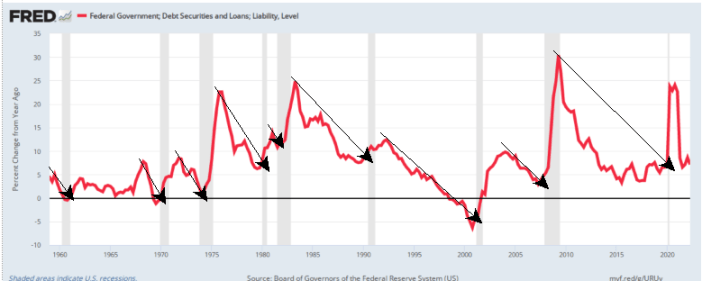
Recessions (gray bars) are caused by reduced debt growth and are cured by increased debt growth. By mathematical formula, Gross Domestic Product growth requires federal spending growth and federal debt growth.
GDP = Federal Spending + Non-federal spending + Net Exports.
This feat isn’t that hard now that the Congressional Budget Office (CBO) has released a series of budget options showing Congress how to do it.
In Libertarian terms, “how to do it” invariably requires reducing benefits to the public — specifically, the part of the public that is not rich.
It’s worth repeating that maintaining spending at the current level is not a viable option.
Given the dramatic increase in annual federal government spending over the next 30 years—from 22.3 percent of GDP to 30.2 percent—combined with federal tax revenues that have remained fairly constant at around 19 percent, CBO projects that future deficits will explode.
It’s forecasted to triple from 3.7 percent of GDP today to 11.1 percent in 2052. Over the next 10 years, primary deficits (deficits excluding interest payment on the debt) amount to $7.7 trillion. Meanwhile, deficits with interest payments total $15.8 trillion—roughly $1.6 trillion a year.
You’ll notice that Veronique never says why maintaining spending is “not a viable option.” All she does is quote large numbers to shock you.
In effect, she claims that Monetary Sovereignty is not a viable option, because it allows the government to create dollars.
The “not a viable option” claim resembles the “ticking time bomb” claim about the federal debt, that has been wrong for more than 80 years. In that time, the federal debt has grown more than 55,000%, yet the nation survives quite well, thank you.
Sadly, Libertarians refuse to learn from actual experience. They cling to the myth that a Monetarily Sovereign government should impose austerity, despite the repeated and inevitable failures of such a system.
Note, by the way, that half of our future total deficits will be driven by interest payments on the debt. This fact isn’t surprising considering the size of our deficits and the rise in interest rates.
Federal interest payments, which the government has the infinite ability to make, add growth dollars to the economy.
The U.S. federal government daily demonstrates that interest payments pose no burden on a government having the infinite ability to create the dollars with which it makes the payments. And for the same reason, interest payments pose no burden on federal taxpayers.
Given these realities, no one will be surprised that the ratio of debt to GDP, now roughly 100 percent, will, under the most conservative estimations, jump to 110 percent in 10 years.
In the next 30 years it will likely double. More realistically, in 2052 debt as a share of GDP will be 260 percent. And that’s assuming no major recessions or emergencies.
As we have seen here, and other places on this blog, the debt / GDP ratio is meaningless. Neither a low nor a high ratio indicates the health of an economy. The ratio predicts or demonstrates nothing.
Any time you read or hear about the “dangers” of a high debt / GDP ratio, you will know you are reading ignorance and lies.
GDP does not fund debt. Further, GDP is one-year figure while debt is a cumulative-over-many-years figure. No comparability at all.
Low ratios and high ratios can be seen equally among the world’s most and least healthy economies.
Despite these awful numbers, legislators in both parties are currently debating how best to add trillions more to the country’s credit card balance.
The federal government does not have anything comparable to a “credit card balance.” Libertarians use that term to trick you into believing that the federal government is about to go bankrupt. It isn’t and it can’t.
Many, for instance, want to add a new entitlement program in the form of the extended child tax credit.
The rich hate entitlement programs like Medicare, Medicaid, and Social Security because such programs benefit the poor and the middle, thereby closing the Gap between the rich and the rest.
Libertarians argue for the rich by feigning a brand of frugality that widens the Gap.
It is in this setting that the CBO published its report on budget options. The two-volume document highlights options for deficit reduction.
One volume details large possible spending reductions while the other lays out small ones—so the options are plenty. They include important reforms of some of the major drivers of future debt: Medicare, Medicaid, and Social Security.
The misnamed “reforms” actually are reductions in benefits to the poor and middle classes. The rich love cutting Medicare, Medicaid, and Social Security, while boosting dollars for the military and cutting taxes on the rich.
And heaven forbid there be a new benefit for the not-rich, extended child tax credit.
Ms. de Rugy, as a tool of the rich, dishonestly calls these cuts “reforms,” to dissuade you from objecting.
All told, it’s possible to achieve deficit reduction of $7.7 trillion over 10 years.
The mathematics are clear: A deficit reduction of $7.7 trillion will reduce GDP by about $7.7 trillion and lead to a recessionif we a lucky, and a depression if we are not.
That’s enough to accomplish what some people mistakenly believe to be out of reach: balancing the budget without raising taxes.
While “balancing the budget” is prudent for people, businesses and local governments, it is a disaster for the federal government. Sadly, Ms. de Rugy, being ignorant of economics, doesn’t understand this.
There are also a few options to simplify the tax code by removing or reducing unfair individual tax deductions and by cutting corporate welfare.
Lest you believe the previous sentence indicates the Libertarians are willing to crack down on the rich, read the next sentence.
For instance, it’s high time for Congress to end tax deductions for employer-paid health insurance. This tax deduction is one of the biggest of what we wrongly call “tax expenditures.”
Get it? First Ms. de Rugy wishes to cut Medicare and Medicaid. Then, to further “balance the budget,” she wishes to cut employer paid health insurance.
See the pattern? Starve the poor and middle classes to achieve a recession or depression. The very rich couldn’t be happier. They love widening the Gap between the rich and the rest. The wider the Gap, the richer they are.
It’s responsible for many of the gargantuan distortions in the health care market and the resulting enormous rise in health care costs.
The CBO report doesn’t eliminate this deduction; instead, it limits the income and payroll tax exclusion to the 50th percentile of premiums (i.e. annual contributions exceeding $8,900 for individual coverage and $21,600 a year for family coverage).
The savings from this reform alone would reduce the deficit by roughly $900 billion.
Why the limit? Why 50th percentile? No reason other than perhaps it seems more “generous” than eliminating the entire deduction.
A second good option is to cap the federal contribution to state-administered Medicaid programs.
Ah, more cuts to programs that help the poor. Ask Ms. de Rugy why not simply eliminate Social Security, Medicare, Medicaid, and all poverty aids. That would really “balance the budget.”
That federal block grant encourages states to expand the program’s benefits and eligibility standards—unreasonably in some cases—since they don’t have to shoulder the full bill.
CBO estimates that this reform would save $871 billion.
There is no reason for a Monetarily Sovereign nation to save $871 billion of the same dollars it has the infinite ability to create.
Ben Bernanke: “The U.S. government has a technology, called a printing press (or, today, its electronic equivalent), that allows it to produce as many U.S. dollars as it wishes at essentially no cost.”
The states are monetarily non-sovereign and are supported by taxpayers. The federal government is Monetarily Sovereign and is not supported by taxpayers.
Ms. de Rugy wishes unnecessarily to balance the budget by punishing the poorest Americans. One wonders about the kind of person who would recommend such cruelty.
CBO also projects that Uncle Sam could reduce the budget deficit by $121 billion by raising the federal retirement age.
CBO’s option would up this age “from 67 by two months per birth year for workers born between 1962 and 1978.
As a result, for all workers born in 1978 or later, the FRA would be 70.” Considering that seniors today live much longer than in the past and can work for many more years, this reform is a low-hanging fruit.
In yet another disgrace, Ms. de Rugy wishes to cut Social Security by raising the retirement age. This has scant effect on the rich, but would be a hardship for the poor.
Her “solution” involves moving retirement three years away for working people, in short to keep them working ’til they drop.
The rich, of course, can retire at will.
Congress could save another $184 billion by reducing Social Security benefits for high-income earners. I support a move away from an age-based program altogether since seniors are overrepresented in the top income quintile.
Social Security should be transformed into a need-based program (akin to welfare).
Nevertheless, the CBO’s option would be a step in the right direction.
A not-so-clever suggestion by Ms. de Rugy to make Social Security “akin to welfare.” The political right hesitates to cut Social Security directly, but would do it by making it “welfare,” and then cutting welfare.
As right wingers “know,” people accepting welfare are lazy takers, not worthy of help.
Further, with inflation, the need-based option falls ever more heavily on the poor, exactly what REASON wants.
There are so many more options for long-term deficit reduction. All Congress needs is a backbone. Considering the end-of-year spending bill going through Congress right now, I am not holding my breath.
SUMMARY
The article, which appeared in Reason.com, is a breathtaking litany of anti-poor, anti-middle, pro-rich recommendations to widen the Gap between the rich and the rest.
It is disgusting in its ignorance and cruelty, it’s lack of facts and its dissemination of false beliefs.
The sole purpose is to make the rich richer by widening the Gap between them and the rest of us.
Lacking any recognition of Monetary Sovereignty, the author promulgates the usual right-wing austerity that punishes all but the rich. It is an inexcusable exercise in dishonor and immorality by Ms. de Rugy and her Libertarian accomplices.
I have told you why federal deficits are necessary to grow the economy and why they don’t cause inflation. I have told you why interest rate increases are counterproductive in fighting against the shortages that do cause inflation.
And all of the information is completely useless to you because you have no control.
So here is something you can control: Getting the smoothest shave you ever had.
Being closer to 88 than 87 years old, I probably have shaved longer than you have. I began using a shaving brush and soap cup, which generated a nice thick lather but was somewhat of a waste of time.
I graduated to spray cans of Gillette shaving cream, which also generated a thick lather and came in a variety of “flavors” like mint and regular. And there I stayed for decades, until . . . .
. . . . until I thought about it.
The fundamental purpose of shave cream is to lubricate your skin. Sure, it does other things like cooling and “softening” (doubtful), but the primary effect is to make your skin slippery, so the razor will not drag.
Shave cream is the WD-40 of shaving. But WD-40 is not foamy. In fact, I know of no lubricating oil that is foamy.
When I want to lubricate gears, a saw blade, or a screw, I don’t use foam. The only lubrication I’m interested in touches the item itself. But foam is 3-dimensional.
The vast majority of a foam is above the surface. Only a tiny amount actually touches a surface.
So, when you use foam to lubricate your skin, very little of the foam actually touches your skin.
So, it’s lubricating nothing.
As you shave, nearly all of the foam is pushed away and washed away, while clogging the spaces between your razor’s blades.
All of this brings me to a product called, “CREMO SHAVE CREAM.”
Full disclosure. I have no relationship, financial or otherwise to this product.
Let me read from sections of the label:
Many save “creams” and gels are foamy formulas full of air — not the best lubricant. Cremo requires one unusually thin foam-free layer. It’s concentrated against your skin, not in a cloud that gets scraped down the drain.
Cremo Shave Cream is water-activated. Massge an almond-sized dollop onto your wet skin. Less often is the best shave. Add water as needed to keep it slippery.
It works.
It’s fast, smooth, slippery and it leaves my skin as soft as an elderly man’s could be. One hundred percent of that almond-sized dollop lays on your skin, rather than puffing up uselessly.
CREMO itself is inexpensive and because you will use so little, the cost will be negligible.
That is the useful information. Now you can return to the useless economics info, that you probably will doubt anyway. Enjoy.
Reason.com, a mouthpiece for the Libertarian Party, bills itself as “free minds, free markets.” More accurately, it should be called “closed minds, closed markets, and free lies.”
Here is the latest post from Eric Boehm, Reason.com’s economic policy reporter. As expected with Libertarian economic “thought,” it is loaded with wrong inferences, misunderstandings, and/or outright lies.
November’s $249 Billion Federal Budget Deficit Set a Record. Now, Congress Is Preparing To Spend Even More. The government spent $501 billion in November but collected just $252 billion in revenue, meaning that about 50 cents of every dollar spentwere borrowed. ERIC BOEHM | 12.16.2022 1:00 PM
The article comes with the photo and caption shown above.
Boehm doesn’t realize that his photo undermines his claim that “about 50 cents of every dollar spentwere borrowed.”
The photo shows someone (presumably representing the government) creating dollars from thin air using a copy machine. This immediately demonstrates the senselessness of the Libertarian economic claims because it illustrates why the federal government has no need to borrow dollars.
In fact, the government does create dollars from thin air simply by pressing computer keys, so it never borrows dollars.
Boehm claims that T-bills, T-notes, and T-bonds represent borrowed money. Completely false. They represent dollars deposited intoprivately held accounts, similar to safe deposit boxes. The government never touches the contents of those accounts.
The dollars are the property of the depositors, not of the government, and remain inviolate until the accounts mature when the contents are returned to the owners. The dollars never are borrowed or used by the government or by anyone else.
Though those dollars often incorrectly are termed federal “debt,” the government does not owe the money any more than a bank owes the contents of a safe deposit box.
As the St. Louis Federal Reserve Bank has said:
“The U.S. government can never become insolvent, i.e., unable to pay its bills . . . the government is not dependent on credit markets to remain operational.
“Not dependent on credit markets” is government-speak for, “does not borrow.”
Further, even if the T-securities were debt, the federal government pays all its debt by creating new dollars ad hoc. It does this by the simple expedient of passing laws and pressing computer keys, both of which it has the infinite ability to do.
Debt never is a burden on the U.S. government or on taxpayers.
As for those taxes you are forced to pay, they are destroyed upon receipt by the Treasury. You take dollars from your checking account — dollars that are part of the M2 money supply measure — and when they reach the Treasury, they cease to be part of any money supply measure.
There is no measure of the Treasury’s money holdings because the Treasury has infinite money. Thus, your tax dollars disappear, effectively destroyed.
So much for all that talk about falling deficits.
The federal government ran a $249 billion deficit during the month of November—that’s the largest total ever posted for that month, and a staggering $56 billion increase over the deficit from November 2021.
The economy is measured by Gross Domestic Product (GDP). The formula for GDP is:
GDP = Federal Spending + Non-federal spending + Net Exports
Thus, by simple algebra, federal spending always grows the economy. Boehm may not realize that he is complaining about economic growth.
Nearly 50 cents of every dollar spent were borrowed and added to the national debt. That’s utterly unsustainable.
“Unsustainable” is the favorite word of deficit liars, who never explain why any size deficit cannot be sustained.
In what year did the federal “debt” become “unsustainable”?
The gross federal “debt” (deposits) totaled $51 billion in 1940. It now totals about $30 trillion, nearly a 600-fold increase, and here we are, sustaining.
For over 80 years, the debt whiners have claimed the debt is “unsustainable.” Year after year after year, they have been proven wrong, and still, they learn nothing. Truly pitiful.
And now Congress is gearing up to spend even more.
Though the final details of a lame-duck session omnibus bill won’t be known until next week (likely not until just before lawmakers are asked to vote on it), it’s a near certainty that the final agreement will add to this year’s budget deficit and the ballooning national debt.
Translation: The final agreement will add to the budget deficit which will grow GDP.
Congress passed a short-term spending deal on Thursday night to avert a government shutdown and give lawmakers another week to hammer out a more comprehensive deal to fund the government through the end of the current fiscal year.
Where did the dollars to fund the government come from? The government merely created them from thin air by creating laws and pressing computer keys, something they can do forever.
That larger omnibus bill could include billions of dollars in additional military and humanitarian aid for Ukraine, as well as emergency funds for hurricane relief, The Washington Post reports.
The final price tag is likely to be about $1.7 trillion, according to Politico.
That will be $1.7 trillion added to Gross Domestic Product.
Depending on what else ends up in the final version of the end-of-year omnibus, the package will add between $240 billion and $585 billion to this year’s budget deficit, according to an analysis by the Committee for a Responsible Federal Budget (CRFB), a nonprofit that advocates for balancing the books.
It says much about your lack of economics knowledge when you resort to the CRFB for your ideas. Here is what happens when the government balances the books:
1804-1812: U. S. Federal Debt reduced 48%. Depression began 1807. 1817-1821: U. S. Federal Debt reduced 29%. Depression began 1819. 1823-1836: U. S. Federal Debt reduced 99%. Depression began 1837. 1852-1857: U. S. Federal Debt reduced 59%. Depression began 1857. 1867-1873: U. S. Federal Debt reduced 27%. Depression began 1873. 1880-1893: U. S. Federal Debt reduced 57%. Depression began 1893. 1920-1930: U. S. Federal Debt reduced 36%. Depression began 1929. 1997-2001: U. S. Federal Debt reduced 15%. Recession began 2001.
Balancing the books is a good idea for monetarily non-sovereign entities like cities, counties, states, euro nations, businesses, and individuals. They do not have the unlimited ability to create their own sovereign currencies.
In fact, they have no sovereign currencies.
But the U.S. government is Monetarily Sovereign. It can create infinite dollars and the legal ability to make those dollars worth anything it chooses.
Over the 10-year budget window used by the Congressional Budget Office and other number crunchers to assess the federal budget, the damage could exceed $5 trillion.
Recessions (vertical gray bars) follow reductions in federal deficit growth.
Translation: Exchange the words “economic growth“ for the term “damage” and you will see the truth.
“Not only would these policies increase deficits, but they would also worsen inflation,” the CRFB warns in its analysis.
“With inflation surging and debt approaching record levels, policymakers should avoid passing costly end-of-year policy changes.”
As always, the CRFB spouts nonsense. Inflation is not caused by or “worsened” by federal deficits. All inflations through history have been caused by shortages of important goods and services.
Changes in federal debt, i,e, deficits (red), do not correspond with changes in inflation (blue).
If federal deficits “worsened inflation,” one would expect the peaks and valleys of the above graph to correspond. They do not.
Inflations are not caused by federal spending. Today’s inflation was caused by COVID-related shortages of oil, food, shipping, lumber, computer chips, labor et al.
For much of the past year, the Biden administration has been touting falling deficit figures as evidence that the economy was picking upand, implicitly, as a signal that government spending could increase without adding to the nation’s tenuous fiscal situation.
If true, that would be incredibly uninformed by the Biden administration.
Mathematically, it is not possible for falling deficit figures to be evidence of growing Gross Domestic Product. That would be like falling food supplies being evidence of growing nutrition.
That was always misleading, as the falling deficit was entirely the result of one-time, emergency COVID-19 spending coming off the books.
The underlying figures showed all along that the deficit situation was continuing to worsen, and that President Joe Biden’s policies were adding trillions of dollars to the deficit over the long term.
Wait, Mr. Boehm. You say emergency COVID-19 spending came off the books, yet now we have inflation. What happened to your claim that increased federal spending causes inflation?
November’s spending and revenue figures should put an end to these silly games. We’re only two months into the fiscal year, but the federal government is now on pace to run a deficit of about $1.9 trillion, which would be the largest nonpandemic budget deficit ever and a huge increase from the $1.38 trillion deficit in the fiscal year that ended on September 30.
That spending has helped reduce the likelihood of a recession, which by the way, is defined as two consecutive quarters of reduced GDP — a reduction which is exactly what you want to do.
A major driver of November’s rapidly expanding deficit was something else that fiscal hawks have been warning about for a while: higher borrowing costs created byhigher interest rates.
The Wall Street Journal notes that the federal government spent 53 percent more on borrowing costs last month than it did in November 2021.
The higher borrowing costs were foolishly and arbitrarily created by the Fed. They do nothing to prevent/cure inflation. They do nothing to cure the shortages that cause inflation.
In fact, higher interest rates exacerbate the shortages and thus, exacerbate inflation. In essence, the Fed is applying leeches to cure anemia.
Higher borrowing costs are not the result of federal deficits. They are the result of Fed ignorance.
The best time to stop borrowing heavily was yesterday (or several years ago), but the second-best time would be today. Instead, Congress is likely to make this problem even worse—again—by continuing to spend like there’s no tomorrow.
SUMMARY
The entire Boehm article is based on commonly held myths. The facts are:
Federal deficits are necessary for economic growth. (That is simple mathematics.)
The U.S. federal government never borrows dollars. (Why would it, given its infinite ability to create dollars).
Reduced federal spending causes recessions and depressions. (Again, this is simple mathematics.)
Inflations are caused by shortages of key goods and services, not by federal spending. (As demonstrated by history).
Inflations are cured by federal spending to acquire and distribute the scarce goods and services. (Again, as demonstrated by history.)
Increasing interest rates does not help prevent or cure inflations.
Increasing interest rates exacerbates the shortages that cause inflations. (That is why raising interest rates is recessionary.)



 #Monetary Sovereignty - Mitchell