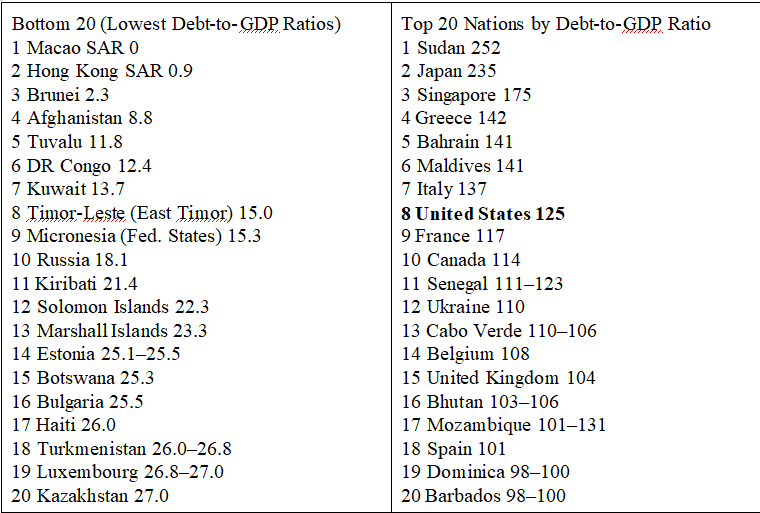
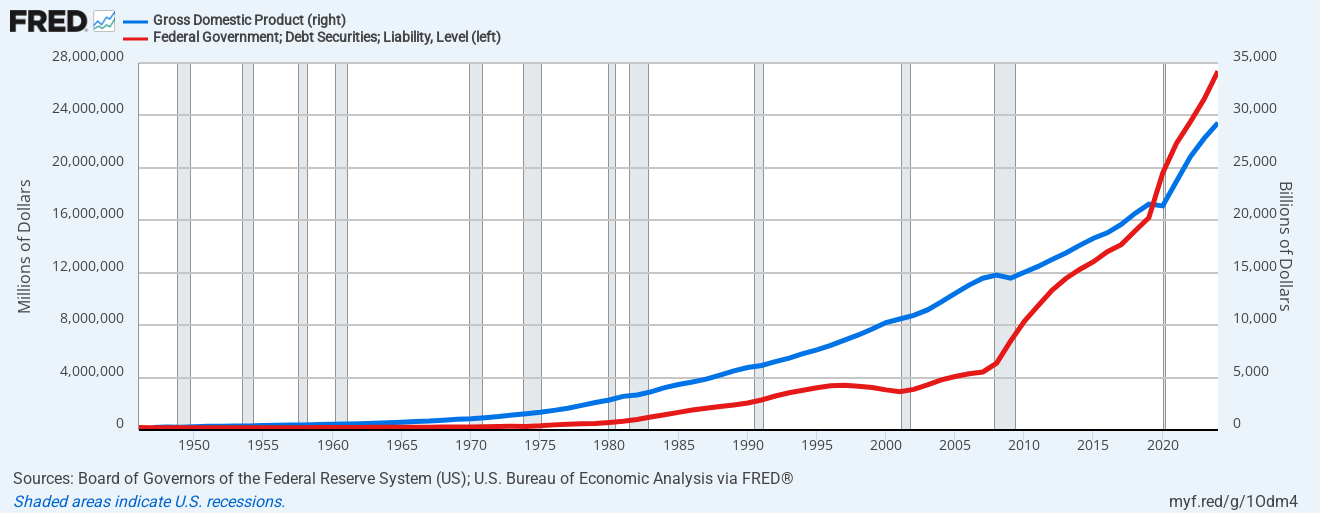
If you were to choose a theme song for economics, you could do worse than “Money Changes Everything” by Cyndi Lauper.
The federal government can create an infinite number of dollars without collecting a penny in taxes, simply by pressing a few computer keys. That is a primary feature of Monetary Sovereignty.
This power has the potential to change everything. The primary issue lies in Congress’s and the President’s three misleading claims:
- The false claim that federal spending requires “taxpayer dollars.“
- The false claim that federal spending causes inflation.
- The false claim that any proposed or existing federal project is unaffordable.
All of these claims have been debunked here. You can review the facts at your leisure. There is no need to repeat them now.
Consider the question, Why do we have governments? They are expensive, divisive, controlling, often inefficient, and counterproductive. Yet every society has one or more. Why?
The sole purpose of any government is to improve and protect the lives of the people. That’s the big reason. Without the rules that improve and protect our lives we have chaos, so we endure the loss of freedom to reap the benefits.
Whenever a government can improve and protect the lives of the people, but fails to do so, there had better be a good reason, or that government has no purpose and should be fired.
For a Monetarily Sovereign government, the “good reason” never should be “Improving and protecting the lives of the people costs too much.” The Monetarily Sovereign government has an infinite number of dollars at its fingertips.
Let’s discuss exampless:Moms of disabled kids denied care pin hope on lawsuit By Christopher O’Donnell Tampa Bay Times TAMPA — When Caroline Hagan was approved for at-home nursing care, it was a blessing for her family. The Lithia girl was born with Down syndrome, a congenital heart disease, hypothyroidism and a severe pediatric feeding disorder.
She takes 15 medications every day, either through a feeding tube or a spray dispenser, and needs constant care.
In March, Medicaid administrators agreed with the girl’s doctor to increase her weekly in-home nursing schedule from 50 to 90 hours. One nurse accompanied her to school, while another took over at 3 p.m., allowing her mom, Alyssa Hagan, to work her full-time administrative job.
But within three weeks, Sunshine Health, the company hired to run Florida’s program for medically fragile children, reversed its decision, saying the extra care wasn’t medically necessary. This has left her mom trying to work with a laptop perched on her knee while keeping up with Caroline, an active 4-year-old who must be monitored due to her risk of falling.
More specifically, a distant employee whose job is to save the company money made a money-saving decision: Let the mother pay rather than Sunshine Health.The Tampa Bay Times reported in June that Sunshine Health has denied at-home nursing for more than 100 medically fragile children this year. The company has continued to cut in-home nursing schedules and, in some cases, also refused to pay for prescribed medication.
Appeals against those decisions reviewed by the Florida Agency for Health Care Administration officers have mostly failed.
That is, political appointees overruled the doctor who was caring for Caroline.Now, Hagan and other families are pinning their hopes on a 13-year-old federal lawsuit that ordered Florida to provide skilled in-home nursing care to medically complex children so the burden of care doesn’t fall solely on parents.
In a rare legal move, eight mothers of disabled children who were denied care have filed sworn declarations in the case, outlining how the denial of medical services is putting their children’s health at risk.
Among the eight is Lakeland mom Brandie Campbell. Her son, Takoda, has multiple health issues, including heart defects, weak cartilage in his airways and autism.
Alena Nicely’s 7-year-old son, Tyler, has cerebral palsy, epilepsy, and difficulties breathing and swallowing. Nicely, who adopted Tyler from Hillsborough County’s foster care system in 2020, was denied at-home nursing even though she has arthritis in her spine and can barely lift Tyler, who weighs 76 pounds.
Orlando-area single mom Jamaris Westerband’s daughter was denied at-home nursing. That was despite the child’s neurologist warning that her pattern of prolonged seizures requires immediate care and that the child could need “rescue medication” if she has more than three seizures in an hour.
The girl sometimes needs to be intubated so she can be sedated when her seizures become too frequent.
Some parents, overwhelmed by the demands of caring for their child, are now considering putting them in long-term care institutions.
Visualize it. Given proper financial assistance, the parents are willing to accept the physical burden of caring for their children at home, but private for-profit companies have doomed the children to life in an institution, away from their parents.Sunshine Health issued the denials even though Florida is under a federal injunction to meet benchmarks to provide skilled in-home nursing.
“The consequences of these denials are dire. Parents are forced to forgo employment, delay their own medical care, and provide complex medical interventions without professional support.”
The state is paying Sunshine Health $12.9 billion to run the Children’s Medical Services program over roughly 5 1/2 years. It serves medically fragile children and youths up to the age of 20.
Keep in mind that states are monetarily non-sovereign, so their expenses are paid by state taxpayers. By contrast, the expenses of the Monetarily Sovereign federal government are paid not by taxpayers, but by a government employing pressing a few computer keys. No taxpayer money involved.Sunshine Health is owned by Centene, a publicly traded company that agreed to a $67 million settlement with Florida for overbilling for Medicaid services.
About $10 million of the settlement was given to the Hope Florida Foundation, the fundraising arm of an initiative started by Casey DeSantis (Governor DeSantis’s wife).
It donated the money to political groups, which passed most of it on to a political committee that helped defeat a ballot initiative to legalize recreational marijuana.
Do you see anything wrong with that process?
The list of failures to “improve and protect the lives of the people” goes on and on. The reason: Money.
While the primary purpose of the federal government is improvement and protection, which it can accomplish at no cost to taxpayers, the primary purpose of for-profit healthcare providers is profit.
So why has Congress shifted the financial responsibility onto the monetarily NON-sovereign states, who are usually in cahoots with big contributors?
The answer is in the question: Big contributors in the private sector.Mayik Vallejos, 10, has a genetic disorder that causes non-cancerous tumors to grow in various organs, including the brain. The tumors can cause seizures. He has also been diagnosed with Lennox-Gastaut syndrome, a severe form of childhood epilepsy characterized by multiple types of seizures.
He had open-heart surgery in 2020 and brain surgery a year later. He takes medication and liquid through a feeding tube.
For more than a year, Mayik received 136 hours of nursing care a week, which allowed his mother to work evenings as a Pizza Hut manager and homeschool one of her other children, who has attention deficit hyperactivity disorder.
Stop for a moment and think about it. A mother works nights so she can care for two of her children who need full-time attention. There are 168 hours in a week, so for 32 of those hours, she is the only caretaker.(When she sleeps, eats, and bathes I cannot imagine, but it seems like her entire life is consumed with some form of work, with no respite.)
Sunshine in February reduced (the nursing care) to 80 hours. Rogers appealed the denial, but a state hearing officer upheld it. She recently switched to a different nursing agency since the one she was with could not fill many of the assigned shifts.
The move triggered another evaluation of her son’s medical needs, and a Sunshine Health medical director earlier this month further reduced her in-home nursing schedule, this time to 48 hours a week.
The notice gives the child’s pediatrician or specialist 48 hours to dispute the decision with Sunshine officials. Parents say that’s not enough time to schedule a call with busy medical professionals.
She plans to file another appeal. Without skilled nursing, she cannot leave Mayik alone. She has missed numerous work shifts, and her paychecks have shrunk. “I’ve fallen behind in my bills,” she said. “I’m trying to figure out how to keep the lights on.”
What would you do? Clearly, the mother is not one of those mythical “lazy takers” that golfer Trump loves to criticize.The issue is money, which the Monetarily Sovereign government has in infinite supply, while Sunshine continually attempts to save.
A comprehensive, no-deductible Medicare for All plan would prevent these tragedies while fulfilling the federal government’s sole reaison d’etre: To improve and protect the lives of the people. And it wouldn’t cost us a cent.
But, of course, the private sector campaign contributors would hate it.
=================================================================Assume the goal is to help people become homeowners. Here’s Trump’s “solution” and article excerpts, also from the Tampa Bay Times.
50-year mortgage plan has pros, cons By Rebecca Liebson
By nearly every metric, it’s getting harder to buy a home in the United States. In Tampa Bay, the median home price shot up about 14% to $398,000 in just the past four years, according to data from Florida Realtors. Wages have not kept up, leaving more would-be buyers trapped renting.
Across the country, the median age of first-time buyers is now 40, according to data from the National Association of Realtors. That’s a far cry from 1980s, when most first-time buyers were in their late 20s.
This month, President Donald Trump voiced his support for a potential fix: a 50-year mortgage. In a post on Truth Social, Trump compared the idea to the creation of the 30-year mortgage under President Franklin Roosevelt. That innovation helped make homeownership the norm in the United States.
The logic is simple — if you lengthen the life of the loan from 30 years to 50, then the monthly payment will drop, lowering the barrier to entry for prospective home buyers.
But the longer it takes to pay down the interest, the higher the total costs will be at the end of the loan period. Plus, these loans would likely come with higher interest rates.
Hmmm. . . Longer loan period at higher interest rates? Now, who would really benefit from that? Right, the banks. Are you surprised that Trump would come up with a plan to benefit banks?“It could get you into a house faster but in the long run, it’s not going to build equity as fast,” said Kimber White, president of the National Association of Mortgage Brokers and a partner at Re Financial Services in Fort Lauderdale.
An analysis from Realtor.com compared the cost of a typical 30-year mortgage to the estimated costs of a 50-year mortgage.
Assume a $400,000 loan, with 10% down at a 6.25% interest rate. Though buyers could save about $250 on their monthly payments with a 50-year mortgage, they’d end up paying about $816,396 in interest.
Compare that to the $438,156 in interest they’d pay for a 30-year loan.
Yum, yum, an extra $380K in interest goes to the banks. Indentured servitude, anyone?Lei Wedge, a professor of finance at the University of South Florida’s Muma College of Business, said she fears many people might see this as a shortcut to homeownership without fully understanding the risks. Those who buy a home in their 30s may not even live long enough to pay off the loan, she said.
Hendrickson noted most buyers don’t stay in their homes for the entire length of the loan anyway. They could also potentially refinance to a 30-year loan down the line.
(Assuming there were no penalties for refinancing or that people had managed to save enough money to refinance, which may not be likely if they had to choose a 50-year mortgage in the first place.)There are other aspects of homeownership that federal, state and local leaders could target to help bring prices down, he said. “It’s not just the monthly payments, it’s the cost of the insurance, the cost of building houses, and the taxes that have gone up that’s hurting people too,” he said.
Wedge said lack of supply is one of the most pressing issues. She pointed to the increasing number of homes owned by institutional buyers.
An analysis from the Tampa Bay Times identified at least 117,000 investor-owned homes in Florida. “If you can place limits on those companies, then there would be more homes available,” she said.
In the meantime, Hendrickson said there are still options available to first-time homebuyers struggling to break into the market.
She recommended the statewide Hometown Heroes program, which provides down payment assistance and other benefits to Floridians working in certain professions. There are also several county and city-wide programs aimed at first-time buyers.
If you were the Monetarily Sovereign federal government and had infinite money available, what would you do to increase the home ownership goal? Here are some thoughts that wouldn’t cost federal taxpayers one cent (because federal spending doesn’t cost taxpayers anything).- Reverse “rental.” The federal government pays a flat monthly fee (say, $3,000 per month) to any private homeowner, regardless of the value of their home.
- Similar to #1, but the federal government pays a single down payment for any home purchase.
- The government pays for homeowners’ insurance.
Let’s say you had infinite dollars to encourage foreign visitors, and you decided that one way to achieve that goal was to make national parks a more attractive tourist destination.
‘Big hike’ in fees awaits foreign visitors to national parks in US By Matthew Brown and Matthew Daly Associated Press
BILLINGS, Mont. — A $100-per-person charge for foreigners entering Yellowstone, Grand Canyon, and other popular national parks is stoking apprehension among some tourist-oriented businesses that it could discourage travelers, but supporters say the change will generate money for cash-strapped parks.
Does this remind you of the phony claims that Medicare and Social Security are “cash-strapped”?
No agency of the federal government can be “cash-strapped” unless that is what Congress and the President want.
Again (I’ll keep pounding this fact), the federal government is Monetarily Sovereign. It has infinite money. Federal spending is not supported by federal taxes, which have only three functions, none of which is to pay for spending:
- To assure demand for the U.S. dollar by requiring taxes be paid in dollars and
- To control the economy by taxing what the government wishes to discourage and by giving tax breaks to what the government wishes to reward.
- To fool the public into believing that dollars are scarce to the federal government, which justifies limiting benefits, and thereby widens the income/wealth/power between the rich and the rest. It is the Gap that makes the rich wealthy. Without the Gap, no one would be rich; we all would be the same. The wider the Gap, the richer the wealthy.
The new fee was announced Nov. 25 by Interior Secretary Doug Burgum and takes effect Jan. 1. Foreign tourists also will see a sharp price increase for an annual parks pass, to $250 a vehicle. U.S. residents will continue to be charged $80 for it.
At the Whistling Swan Motel just outside Glacier National Park in northwestern Montana, owner Mark Howser estimates that 15% of his customers are foreigners. They come from Canada, China, India, Spain, France, Germany and elsewhere, said Howser, who also runs a bakery and general store.
Those visitors already pay up to $35 a vehicle to enter the park. Adding the $100-per-person charge for foreigners, Howser said, “is a sure-fire way of discouraging people from visiting Glacier.”
Interior officials described the new fee structure as “America-first pricing” that will ensure that international visitors contribute to maintaining parks.
For Yellowstone park, the $100 charge could generate $55 million annually to help fix deteriorating trails and aging bridges, said Brian Yablonski with the Property and Environment Research Center, a free market research group based in Bozeman, Montana.
If the charges for foreigners were extended to park sites nationwide, Yablonski said it could generate more than $1 billion from an estimated 14 million international visitors annually.
“Americans are already paying more than international visitors because they are paying taxes,” Yablonski said. “For international visitors, this is kind of a no-brainer, common-sense approach.”
“In a year where national park staff have already been cut by nearly 25%, we worry this will be yet another burden for already overworked employees,” said Emily Thompson, executive director of the
Coalition to Protect America’s National Parks. “National parks should be available and accessible to all, or America’s best idea will become America’s greatest shakedown.”
In short, if the goal is to increase visits to our national parks while improving the park experience, it can be easily accomplished with federal financial support. Charging admission discourages visits.In that vein, see here to learn what ChatGPT says.
Rodger Malcolm Mitchell
Twitter: @rodgermitchell
Search #monetarysovereignty
Facebook: Rodger Malcolm Mitchell;
MUCK RACK: https://muckrack.com/rodger-malcolm-mitchell;
……………………………………………………………………..
A Government’s Sole Purpose is to Improve and Protect The People’s Lives.
MONETARY SOVEREIGNTY