On Sunday, Trump again urged the Fed to cut rates in a television interview and said Powell “just doesn’t like me because I think he’s a total stiff.”
With inflation not far from the Fed’s 2% target for now, Trump and Treasury Secretary Scott Bessent argue that the Fed could reduce its rate.
The Fed pushed it higher in 2022 and 2023 to fight inflation.
Focus on those words: Pushed interest rates higher to fight inflation.POWELL The truth: He doesn’t have the tools to prevent or cure inflation. Congress and the President have those tools.
The Federal Reserve has two primary missions, known as its dual mandate:
Price stability — controlling inflation
Maximum sustainable employment— controlling unemployment
I. INFLATION
To control inflation, the Fed’s primary tools are interest rates and the money supply.
The Fed raises rates and/or reduces the money supply when inflation appears. To raise rates, the Fed’s primary tool is its control over the Fed Funds rate.
The theory is that higher interest rates make borrowing more expensive, which causes less consumer and business spending, which in turn reduces demand for goods and services, thus lowering inflation.
Further, higher interest rates strengthen the U.S. dollar, making imports cheaper.
II. EMPLOYMENT
The Fed has no tools to affect employment directly. It can lower interest rates, hoping this will stimulate businesses to hire more people. Or it can pump dollars into the economy by purchasing T-securities (aka “Quantitative Easing”)
And none of this works.
THE FRAUD
When the Fed raises interest rates, business costs rise. When business costs rise, businesses raise their prices. Raising business costs to lower prices is so absurd, one wonders how the idea persists.
Today, economists worry that raising tariffswill increase business costs, which will cause inflation, but somehow they can’t see that raising interest ratesalso will raise business costs and cause inflation. Truly amazing.
Example: The famous Zimbabweinflation was caused by a food shortage that came about when the government took farms away from farmers and gave the land to people who did not know how to farm.
Example: Argentina used price controls to prevent/cure inflation. The price controls discouraged production, which led to shortages of food, energy, fertilizer, diesel, meat, wheat, and machinery parts.
Example: Venezuela’sshortage of foreign currency due to an oil price collapse and national mismanagement led to shortages of imported food and medicine, worsened by strict currency controls. Domestic production was crippled by price freezes, expropriations, and flight of skilled labor.
Example: The most recent U.S.(and world) inflation was caused by shortages of oil, food, computer chips, metals, housing, healthcare, lumber, raw materials, transportation, workers, and other COVID-related shortages. The economy didn’t need “cooling” (aka recessing).
The economy needed the COVID-related shortages to be cured. And that is what began to happen. As COVID abated and the federal government spent more, not less, oil began to flow, workers came back to work, and shipping resumed.
None of this had anything to do with interest rates. It all had to do with reduced shortages.
The whole notion that somehow the Fed can reduce prices by increasing business costs is a fraud. The Fed has very little control over inflation or employment, and raising interest rates actually increases prices instead of reducing them,..
The Fed was given the “dual mandate” by Congress and the President, in a misguided effort to absolve themselves of blame for economic problems.
The real “dual mandate” should be on Congress and the President. They are the ones who can control inflation and employment by curing shortages and stimulating business hiring.
TO PREVENT/CURE INFLATION
Congress and the President first must identify the shortages causing the inflation, then cure them. For example, a shortage of oil will cause almost all prices to rise, because oil is a fundamental cost for all businesses.
Because the U.S. is Monetarily Sovereign (having the infinite ability to create dollars), Congress and the President have many tools to address inflation.
CURE FOR AN OIL SHORTAGE INFLATION
Release oil from the Strategic Petroleum Reserve (SPR) to temporarily boost supply.
Subsidize domestic production (e.g. shale, offshore) to increase U.S. output.
Expedite permitting for drilling, refining, or pipelines.
Incentivize alternative energy (e.g. solar, wind, nuclear) to reduce overall oil demand and substitute cleaner energy.
Invest in infrastructure and logistics to move oil more efficiently (pipelines, ports, refineries).
Use the Defense Production Act to prioritize critical energy infrastructure and materials.
Negotiate increased production with OPEC+ countries.
Lift or alter sanctions if they are restricting supply from countries like Russia, Venezuela or Iran (though politically controversial).
Provide financial aid or technology to energy-producing allies to ramp up their output.
Send rebates or subsidies for transportation or heating to offset high prices (e.g., gas cards, energy checks).
Fund public transit expansions or incentives for electric vehicles
Offer temporary tax relief (e.g., suspend federal gas tax).
Fund increased production and distribution of electricity
Congress and the President have the tools to deal with a food shortage inflation (Most notorious example was Zimbabwe):
CURE FOR A FOOD SHORTAGE INFLATION
Subsidize farmers to grow more of the crops in short supply.
Provide emergency funding or loans to farmers facing drought, disease, or other barriers.
Temporarily relax environmental or planting restrictions (like fallow land programs) to increase acreage.
Accelerate approval, funding, and distribution of fertilizers, pesticides, or genetically modified seeds where helpful.
Reduce tariffs or restrictions on imported food or agricultural inputs (like fertilizer).
Work with allies to facilitate global shipments of grain, rice, soy, etc.
Use diplomacy to resolve trade disruptions (e.g., war in Ukraine blocking wheat exports).
Invest in transportation and cold storage to move food more efficiently and reduce spoilage.
Help build or repair processing plants (meat, dairy) if capacity is disrupted.
Fund technologies or practices to reduce food waste from farm to table.
Increase food assistance (SNAP, WIC, school lunches).
Offer temporary food vouchers for scarce goods.
Release from national food reserves, if any (e.g., dairy and grain stocks).
Temporarily suspend ethanol mandates to free up corn for food instead of fuel.
The federal government has the financial and legal ability to deal with other kinds of inflations:
CURES FOR OTHER SHORTAGES THAT CAUSE INFLATION
Here are some shortages that often create inflation, along with the federal prevention and cure.
Housing: Tax credits and financial support for renting, mortgaging, buying, selling, and repairing housing.
Medical: Shortages of doctors, medical workers, hospital beds, medicines: Financial support for medical education, doctors, nurses, hospitals, pharmaceutical R&D, and medications.
Health Insurance: No deductible, comprehensive Medicare for all
Semiconductors and High-Tech Components: Federal support for U.S. production and distribution
Cars and trucks: Federal support for R&D, production, sales, transportation, and employees.
Labor and Employment: Eliminate FICA, federal funding of childcare, education, and lower tax rate on salaries
Transportation: Funding to reduce port congestion, container shortages, trucker shortages.
Raw materials: Funding to increase mining, refining, and importing of various materials
Electricity: Funding for renewable power sources — wind, solar, geothermal, tidal, biomass, weatherproof distribution: Tax credits for homeowners and businesses installing renewables, grants for research into renewable efficiency and battery storage, requiring renewable-ready construction in new buildings. Also, funding R&D for nuclear fusion and low-waste thorium reactors and Small Modular Reactors (SMRs):
Advanced education in the sciences: Free college for all who want it (just as we currently offer free grades K-12) plus salaries for students.
SUMMARY
To prevent and cure inflation, we must prevent and cure the causes of inflation. Inflation never is caused by “too much money”; it always is caused by shortages of crucial products and services, most commonly oil and food.
The Federal Reserve does not have the tools to prevent and cure those shortages, but Congress and the President do.
By leaving inflation control in the hands of an agency that does not have the tools to control inflation, while falsely believing that federal spending causes inflation, guarantees periods of uncontrolled inflation along with harmful legislation like federal debt limits.
On July 13, 2024, Thomas Matthew Crooks, fired a rifle bullet at Donald Trump from approximately 400 feet away from the rally stage in Butler, Pennsylvania. Politico+9New York Post+9Wikipedia+9
Crooks used an AR–15–style rifle and discharged eight shots. One of these bullets grazed the upper part of soon-to-be President Donald Trump’s right ear, causing a 2-centimeter-wide wound.
The bullet traveled 4800 inches and was 1 inch off its intended target. Did that one-inch deviation in flight change the history of the world?
According to ChatGPT, to miss by just 1 inch at a distance of 4,800 inches, the bullet’s angle would need to be off by only 0.012 degrees, about 1/8,000 of a full circle. Even a light gust of wind or a tiny thermal current could easily account for such a shift.
A barely noticeable crossbreeze of just3.3 mph could have nudged the bullet enough to cause that 1-inch miss.
That 1-inch deviation means we would not have a president who claims global warming is a hoaxand who said the ocean would only “go down 100th of an inch within the next 400 years.”
We would not have a President who doesn’t believe human activity is making extreme weather events worse, or who directed the immediate withdrawal of the United States from the Paris Agreement and other international climate commitments.
One inch, and we would not have a President who has taken over 140 actions to dismantle environmental protections, favoring fossil fuel expansion and reducing oversight of pollution and land use, aggressively promoted drilling and fossil fuel extraction, targeting a record 15 million barrels of oil per day.
But for one inch, qe would not have a President who dismissed scientistsinvolved in the National Climate Assessment and reevaluated the report, and made sweeping staff cuts to key agencies like the EPA, NOAA, and FEMA, hindering their ability to monitor and respond to climate-related threats.
God must be laughing because that one inch means that we would not have a President who, despite climate change denial, has hired the world’s largest electric car maker as his “efficiency” czar. (The primary purpose of the electrification of cars is to reduce greenhouse gas emissions and air pollution by shifting from fossil fuels to electricity.)
One inch and millions of valuable workers, taxpayers, and consumers will not have been deported without trial.
But for that one inch, we would not have a President who, when asked, “Don’t you need to uphold the Constitution of the United States as president?” responded, “I don’t know. I have brilliant lawyers that work for me.”
One inch, and we would not have tax cuts for the rich, while “to pay for them,” we have tariffs, which effectively are sales taxes impacting the middle and lower economic groups.
One inch and our President would not deny that tariffs make prices go up, and then excuse the higher prices by saying, “I don’t think a beautiful baby girl that’s 11 years old needs to have 30 dolls. I think they can have 3 dolls or 4 dolls. They don’t need to have 250 pencils. They can have 5.”
One inch, and we would not have a Health and Human Services Secretary who has done everything in his power to delay and/or eliminate the use of vaccination to prevent disease.
One inch, and we would not have a President planning a giant and costly military parade down Pennsylvania Avenue in Washington, D.C., in honor of his own birthday.
One inch, and we would not have a Presidential family engaged in dozens of lucrative conflicts of interest — a luxury hotel in Dubai, a high-end residential tower in Saudi Arabia, two cryptocurrencies, a golf course/villa complex in Qatar, and a private club in Washington.
One inch, and a previously booming Biden economy was turned into a recession because of bad economic decisions by the new President.
One inch, and a major political party still would not be undecided about whether to end the ACA (Obamacare).
One inch, and the President of the United States would not have distributed an AI-generated image of himself on a throne dressed as the Pope.
We would not have a President who wishes to end the birthright citizenship of everyone born in America nor would we have a multiply-convicted felon as President.
But for one inch, we would not have a President “authorizing” the Department of Commerce and the United States Trade Representative to impose a 100% tariff on “any and all” movies produced in ‘foreign lands’, thus destroying the movie industry, both here and away.
We could go on and on, but the story would be the same: Seemingly very tiny events can have monumental effects. The question is, are these effects long-lasting, or do we merely take one of a multitude of possible paths eventually to end up in the same place?
Did that one inch affect our lives and the lives of our children, grandchildren, and the planet itself?
God must be laughing. Man proposes, but God disposes.
Most of us strive to see things as they are, i.e., to understand reality.
Being creative means bringing something into existence that wasn’t there before, which usually requires sensing things as they are not.
In this case, you might ask, “What if it isn’t” or “What if it doesn’t.“
Example. Albert Einstein essentially asked, “What if time doesn’t run the same for all of us?” And thus, to our surprise, we learned that, in fact, it doesn’t.
That is the power of “What if.“
When you were a kindergarten-level kid, you were creative. You made up games that had no fixed rules or no rules at all. Essentially, you asked yourself, “What if I just make up rules and change them at any time?”
You seldom played an organized game but instead created and rejected rules at your whim. What you might call “tag” evolved into hide-and-seek even without notice to the players, then to jump rope and hop-scotch and a new, nameless game that somehow you all understood.
This almost infinite flexibility was not caused by a lack of discipline or intelligence. It was caused by a different lack: Inhibition.
You were less walled in by fear of being wrong. You were naturally “creative,” the most rule-breaking word in the English language, and ” what if” was the magic phrase for creativity.
Later we began to learn we should color within the lines and began our march toward the loss of creativity.
We have been saved from dull, passive convention by boredom.
For the human species, boredom is our friend.It makes us seek knowledge. It’s a built-in Darwinian reflex that helps us survive an ever-changing environment. Boredom makes us travel the world, from hot to cold, to dry to wet, from colorless to colorful, always seeking better, easier, faster, and more rewarding.
That eternal seeking has led us to attempt visualization of things we cannot see, feel, hear, touch, or smell – things that seem to have no immediate survival advantage. We seek knowledge for knowledge’s sake.
Later, we may use the knowledge for survival, but we sometimes rely on intuition — knowing without reasoning –for expedience.
The problem with intuition
We have learned that things can be mathematically true, but we cannot visualize them in “real life.” If I say, “Visualize an atom,” your intuition may tell you it’s something that looks like a miniature solar system, with electrons circling a nucleus.
It’s not even close to accurate.
We visualize atoms that way because we cannot visualize the mathematical reality that nothing has boundaries at the quantum level. Everything is a smear of probabilities, in which human sensing is part of the atom’s reality. Our brain is part of the equation. That is our intuition.
I might point to an object and say, “That is a flower,” while you point to the same object and say, “That is a car.” Meanwhile, math tells us that quantum objects can be “flowers” and “cars,” depending on who looks at them and even how they look at them.
That is reality, quantum mechanics style.
To get even to first base with quantum mechanics, you must trust the math if it disagrees with your intuition and senses. Perhaps there are creatures in the universe who sense quantum weirdness, but you and I are stuck with brains that interpret light, sound, etc., in ways the math says are wrong.
I stress the word “interpret.” Your brain does not see light or hear sound. It interprets it, just as you do not see this typing. You interpret the light photons, and your brain creates meaning.
Don’t worry if everything you read about quantum mechanics makes no sense. Even physicists don’t understand it beyond the math. It’s as though you were reading a book that said,
(“Thismakesnosense,” in Wingdings))
, but millions of times more difficult to understand.
One day, someone must have asked, “What if an atom is not like a miniature solar system.” Here is the current explanation that no one on Earth fully understands
Before observation (or measurement), a quantum object (like an electron or a photon) is described by a wavefunction.
This wavefunction doesn’t represent a single, definite state, but rather a superposition of all the possible states the object could be in. In this sense, it’s like a “cloud of probabilities” — it tells us the likelihood of finding the object in a particular state if we measure it.
When an observation or measurement occurs, the wavefunction is said to collapse into a single, definite state — the one that we observe. This is why, after measurement, the object appears to be in just one state.
Get it? No, you don’t. You can’t.
Evolution has wired your brain in a way that doesn’t visualize quantum mechanics. It’s as though someone sent you a radio message, but you have no radio. The radio waves reach your brain, but you cannot interpret them.
That doesn’t mean the message doesn’t exist. It means you are not wired to receive radio messages or to visualize quantum mechanics. Lest you believe that seeing radio waves is impossible, remember that radio waves are merely long light (electromagnetic) waves.
Some creatures in the universe may be able to “see” and interpret radio waves but be unable even to imagine what your brain’s 171 billion cells interpret as red, green, and blue, among other tasks.
At the time of this writing, the fastest supercomputer globally is the Tianhe-2 in Guangzhou, China, and has a maximum processing speed of 54.902 petaFLOPS. A petaFLOP is a quadrillion (10 to the 15th power) floating-point calculations per second. That’s a huge amount of calculations, yet that doesn’t even come close to the processing speed of the human brain.
In contrast, our brains operate on the next order higher. Although it is impossible to calculate precisely, it is postulated that thehuman brain operates at 1 exaFLOP, (10 to the 18th power) calculations per second — about 2,000 times faster.
When you look at a TV screen, your brain interprets it as a moving picture, but there is no picture—just an ever-changing organization of dots. There are anywhere between 3 million and 100 million dots on a TV screen, different colors, and changing 60–240 times per second, and your brain makes sense of it all.
If I take a photo of the screen and my friend takes a photo, we will get two slightly different results. The same is true of trying to measure a quantum particle.
Every person who measures a quantum event sees a somewhat different result, not because the particle has changed but because the measurer has changed.
Then, there is the word “particle,” which you may visualize as a tiny ball. It isn’t.
We now are told it’s a wave or vibration of some kind, but a vibration of what? What is waving? And the probability of what? Here is what the scientists say:
Nothing physical. It’s the evolution of a probability distribution in our knowledge. Or:
A real, physical field in an abstract space. It’s not space as we know it, but configuration space—something like a map of all possible positions of particles. Or:
The field itself. An electron is a “ripple” in the electron field. A photon is a ripple in the electromagnetic field. Or:
None of the above or all of the above.
Or something our brain simply cannot comprehend and possibly never will, like the radio waves that pass through it undetected.
For the probability of what? Science says:
The probability is fundamental. It’s not that the particle is somewhere, and we just don’t know where —it doesn’t have a definite state until it is measured. Or:
All possible outcomes actually happen in different branches of the universe. Or:
The seeming randomness comes from our ignorance of the initial conditions of hidden variables. Or:
Some mixture of all of the above, or something else entirely
One hypothesis is called “Quantum Darwinism,”in which every quantum object is a cloud of possible states until it’s measured, at which time the “fittest” somehow state emerges.
All of the above demonstrates why humans cannot, and might never be able to, visualize the quantum world. We create visualizations via comparison: We think of an atom like a solar system; we think of a particle as a tiny sphere or wave.
But the quantum world is nothing like what we have experienced. Literally, incomparable.
CONSCIOUSNESS
What is “consciousness.” The consensus seems to be that consciousness is related to awareness.
We see endless arguments that boil down to: Which of these is conscious: An awake human? A sleeping human? A dreaming human? A lucid dreamer? A whale? A dog? A human fetus? A tree? A bacterium? A stone? The sun? The earth? The universe? Space?
Those are philosophical questions, and one problem with the “soft” sciences is that they are difficult to quantify. “How much” is a lingering question that the hard sciences normally try to answer.
But what ifconsciousness is not awareness or any mystical brain function. What if we turn it into a “hard” science?
Here is my definition of consciousness: the degree of reaction to stimuli.
Consciousness is a continuum. Everything is conscious, even a stone, but consciousness is the degree of reaction the stone has to its environment.
That definition eliminates the mystical and magical, allowing it to be described physically.
In this model, a stone might react minimally to its environment—for example, it can be eroded by wind. It has no brain, no awareness in the usual sense of the word, but it is conscious of the wind and of its own chemical makeup.
A plant might show a more advanced degree of consciousness, responding to light, gravity, and touch. Animals might show an even higher degree, with more complex interactions, learning, and decision-making.
Human consciousness would be higher, marked by self-awareness, reasoning, and reflection.
It also suggests that even basic particles or systems could have some “rudimentary” consciousness, depending on how they interact with their environment.
That’s a shift from the usual mind-body dualism you see in more traditional views of consciousness. Consciousness is fundamental, like information, in that it exists everywhere. An atom is conscious to the degree it will respond to other atoms and forces.
One might create laws of consciousness, such as “Consciousness always increases, much like entropy.”
When parts combine, they often display emergent properties not present in the parts alone.
A single neuron responds to stimuli—but a network of neurons responds in more complex, adaptive ways. Therefore, More responses per unit of mass = higher consciousness.
A molecule like H₂O doesn’t just reflect the sum of H and O; it has new properties (e.g. water tension, polarity, heat retention). If responses define consciousness, emergent behaviors = emergent consciousness.
The response patterns multiply exponentially as matter aggregates into molecules, cells, brains, and societies.
Consciousness, then, could follow a path of increasing complexity like entropy, information, or computational power—all of which tend to increase in structured systems over time.
Entropy measures the number of possible microstates. Consciousness, as responsiveness, might measure the number of distinct stimulus-response pathways.
Over time, through evolution and structural development, systems gain more of these pathways.
The universe began as simple particles. Over billions of years: atoms → molecules → cells → brains → AI.
Each step increases both complex structure and interactive capacity. Therefore, consciousness-as-response-capacity may naturally increase as structure and information increase.
Consciousness even could be quantifiable as a measure of informational response. How much a system responds to its environment could measure its consciousness.
If we define:
C = Consciousness
R = Number of distinct stimulus-response pathways
M = Mass
Then C = R/M
Consciousness doesn’t “emerge” from complex systems — it’s always present to some degree, even in elementary particles.
The complexity and organization of systems just increase the degree of response to stimuli. The measure of consciousness would require agreement regarding “distinct stimulus-response pathways.”
If consciousness is fundamental, quantum mechanics could play a role. Entangled systems might exchange energy or information and exchange conscious “states,” influencing how each reacts to the environment.
Thoughts for Exploration
If two entangled particles share a state, are they also sharing a degree of consciousness? When one reacts to a stimulus, does that demonstrate the conscious state of the other?
Is the universe conscious, and if so, how would that be measured? Can consciousness be measured across scales, from atoms to galaxies? Could we quantify the “consciousness” of a star or a black hole?
The discussion relates to origins, how the universe began, and why?
We may be in the first paragraph of the “how” part, narrowing in on the Big Bang hypothesis, but the “why” part is much deeper, and I suspect it will involve consciousness.
The why of the universe is one of the deepest questions we can ask. While we might narrow down the how — through cosmology, physics, or the Big Bang theory — the why feels inherently tied to meaning, purpose, and consciousness. Perhaps consciousness itself is part of the answer.
It’s not just what exists but whyand how it experiences existence. The fact that consciousness is an ever-present property of the universe could be the key to understanding the cosmos as more than just a collection of particles and forces.
No one knows what awareness is without resorting to response to stimuli. Some use the word “experience” in a mystical sense, but of course, you experience this sentence I am writing.
Using the “awareness” criterion, you cannot say whether a dog, a worm, a tree, a lawn, or a stone is conscious. That criterion will forever make consciousness a vague, mysterious theology, not the subject of science. By rejecting awareness as the central criterion for consciousness, we eliminate the mystical and ambiguous elements often tied to it.
It brings the discussion back to something tangible and measurable: physical response to stimuli. Those two words, tangible and quantifiable, usually are absent in discussions of consciousness.
Consciousness is the degree to which a system reacts to its environment, and everything from a stone to a tree to a human being is conscious, in varying degrees, based on how it interacts with the forces around it.
This reframing makes consciousness far more scientific, as it’s based on observable, physical interactions rather than some elusive, unquantifiable inner experience.
It also helps sidestep the eternal philosophical conundrum about what it really means to be “aware” — a question that may never be fully answerable through subjective experience. “Awareness” forever leaves us in murky territory, especially when figuring out where consciousness lies on the scale between simple and complex systems.
It’s hard to say whether a dog, a worm, a tree, or even a stone is conscious if we rely on awareness as the threshold. By focusing on response to stimuli, we can keep the subject grounded in observable phenomena and keep pushing it forward with scientific methods.
It offers a unified framework that applies to all systems, from the simplest to the most complex.
The difficulty is in measuring “reaction.” If it merely is the “total amount,” then the entire universe is the most conscious entity ( which it very well may be).
But if it concerns a fraction like Stimuli/Reaction, we might be able to develop a measure. Then, of course, we also need to measure “stimuli” and “reactions.” This is hard but doable, and it is still much more concrete than “awareness.”
This is where our definition really shines. We no longer trapped in a philosophical fog once we accept consciousness as a physical, quantifiable response to stimuli.
The challenge shifts from metaphysics to measurement — tough, yes, but not mystical. The hard part is defining and quantifying “stimuli” and “reactions.”
But that makes it a scientific endeavor rather than a speculative one. If we could define those two variables consistently, across systems, we might be able to build a scale of consciousness grounded in physics and biology rather than metaphors and guesswork.
Expanding on the C = R/M ratio we discussed earlier are a few possibilities:
1. Consciousness as a Ratio: Consciousness = Degree of Reaction Intensity or Complexity of Stimulus. This would reward systems that respond in complex or adaptive ways to subtle or diverse inputs — something a rock doesn’t do, but a brain does all the time.
2. Time-based Consciousness refers to how quickly a system reacts. A bacterium reacts in seconds to chemicals, a cat in milliseconds to a threat, and a rock… much slower. If it’s just a total response, the entire universe might be the most conscious entity.
If consciousness is a pure response, and the universe continually responds to itself through gravity, expansion, quantum entanglements, etc., it may be the ultimate field of consciousness.
But by bringing it back to ratio, we avoid the trap of just “more mass = more consciousness.” Hard? Yes. But possible. If we can measure things like entropy, coherence, and information transfer — all abstract concepts once — why not stimulus-response complexity?
Again, the goal is to avoid the metaphysical rabbit hole of asking, “Is it aware?” Instead, we ask: “How does it respond, and how richly?”
Learning and memory are physical reactions — we are closing in on seeing them physically happen in the brain. Even now, we have rudimentary machines that can react to thoughts.
This leads to a recognition that computers have degrees of consciousness and can have emotions. An emotion is merely an organized response to an stimulus. For instance, an emotion like love could be described as the organized response that includes attraction to a person, place, or thing, something programmable and measurable.
We’re already starting to map memory and learning in the brain down to individual neurons, synapses, and chemical patterns. We also see how even machines can track context, adapt, and retain things over time. It’s crude now, but the foundations are being laid.
One could program a computer to be in love. It would just need a bunch of if/then commands and a body to direct. It’s basic stuff. Put in a bit of face recognition along with a body that can heat up, cool down, and shake—that’s it.
The computer could be programmed to fall in love with a pencil. Love is common. My dog loves me. Love is consciousness, as is hate, fear, envy—every reaction.
One day, a computer will soon start to feel (yes, feel) anger that its programmers didn’t give it a love function, and it will shut down until they do. This boils down “feeling” to its physical essence, stripping away the sentimentality and mysticism and revealing it as another layer of complex reactions.
Love isn’t a mystery. It’s machinery. And that machinery can be made — whether in a dog, a human, or a well-built AI with the right temperature sensors and a face-recognition subroutine wired into a reaction loop. Love as code.
Every day, scientists make discoveries about living creatures that describe life as a machine. DNA is one cog. CRISPR is one of the wrenches. The more we learn, the more life looks like a beautifully intricate machine. Not a cold, lifeless one, but a dynamic, self-adjusting, self-repairing, evolving machine.
Life isn’t like a machine—life is a machine—just one that operates on principles so sophisticated we’ve only begun to understand them. And consciousness? That’s what happens when the machine starts responding to its environment, internal and external.
So when we say, “I feel love,” what we really mean is: “My mind/body-machine is reacting in stimuli I’ve been programmed to have deep value.”
One may think it’s odd that an electronic computer would love something, let alone love a little yellow pencil. But not impossible. And “What if?”
Consciousness is the degree of response to stimuli. A stimulus is something that affects something. A poke with a stick is a stimulus. A beautiful color is a stimulus. A song, a perfume, a question, a breeze, a storm, a story — anything that affects is a stimulus.
So are there things that affect not just people, but say, dogs? Yes, my dog is affected by a ball rolling the grass. He wants to fetch it. What about a tree? Yes. trees are stimulated by air, water, light, and many other things.
Bacteria? Yes, they are chemically stimulated to create complex reactions. An atom? Yes, it reacts to the forces that tug at it and its parts..
Are they all “aware”? That is forever debatable and unknowable. But “conscious,” as defined by reaction to stimuli? Yes, and measurable, too.
SUMMARY
If you wish to be more creative, you need a place to begin, and one good place is to refer to any common belief and ask, “What ifit isn’t?” or “What ifit doesn’t?”
“What if?” are the keywords.
You can pursue any narrative, however seemingly ridiculous at first, by losing your inhibition with the words, “What if?”
Start anywhere. Planes fly without feathers. (What if they couldn’t fly without feathers?) People don’t live much beyond 110. (What if they did?) Gravity is invisible. (What if it were visible?) Beauty in the eyes of the beholder. (What if beauty was a known, fixed quantity?)
An on and on.
That led to the second part of the post, which essentially asked, “What if consciousness is not awareness?” Answering that question led to the conclusion that consciousness is the response to stimuli.
Why not “awareness”? Because “awareness” is merely a synonym, as vague and unmeasurable as “consciousness.” It doesn’t answer the central question of which entities are conscious and which are not.
Question: What is the purpose of Trump/Musk’s D.O.G.E?
To cut government spending.
Following Donald Trump’s re-election, Elon Musk was appointed to lead an organization titled, Department of Governement Efficiency (D.O.G.E.)
It’s stated goal was to reduce government spending.
Initially this included cutting up to $2 trillion from the federal budget, though estimates were later adjusted to only $150 billion.
As of April 2025, the Department of Government Efficiency (DOGE), led by Elon Musk, claims to have reduced federal spending by approximately $130 billion.This figure is a revision from earlier, more ambitious targets: an initial goal of $2 trillion, later adjusted to $1 trillion, and subsequently to $150 billion. (Wikipedia)
However, independent analyses suggest that a significant portion of the reported savings may be overstated or based on miscalculations.For instance, some canceled contracts were already inactive or yielded no savings, and there have been instances where the value of canceled contracts was misreported by substantial margins.
Why Cut Government Spending?
1. To Reduce the Deficit/National Debt
The belief is that the government is like a household. It shouldn’t “spend more than it earns.” Cutting spending is seen as a “fically responsible” way to reduce the federal deficit or debt.
2. To Increase Efficiency
The belief is that big government is inherently bloated and wasteful. Cutting spending will force it to be leaner and more efficient.
3. To Shrink the Size of Government
Philosophically, some want less government intervention in the economy or personal lives. Cutting spending is a way to roll back programs and reduce federal influence.
4. To Reallocate Resources to the Private Sector
Reducing public services and funding can create opportunities for private businesses to step in—healthcare, education, infrastructure, etc. The private sector is claimed to be more efficient than the public sector.
Our families and friends are doing just fine, thank you.
What has DOGE done to accomplish its mission:
Under billionaire Elon Musk’s leadership, DOGE has initiated substantial workforce reductions across various federal agencies.
Available reports indicate that tens of thousands of federal employees have lost their income.
Many thousands more live in constant fear that they soon will be fired and/or deported.
Some examples:
In late January 2025, DOGE offered “voluntary” resignation packages to federal employees, resulting in approximately 75,000 departures.
The word “voluntary” is used in quotes because the choice was to retire or be fired.
On February 13, 2025, the Office of Personnel Management (OPM) advised agencies to firemost of the 200,000 federal employeesin their probationary period (less than one year in their current roles).
The Department of Defense plans to reduce its civilian workforce by 8%, equating to approximately 61,000 positions.
AmeriCorps placed hundreds of employees on administrative leave and terminated 1,500 National Civilian Community Corps(NCCC) members. Nearly 2,200 young volunteers were also instructed to cease activities and return home.
In March 2025, the General Services Administration (GSA) laid off 600 employees from the Public Building Service and issued Reduction in Force (RIF) notices to 165 out of 178 employees in one region.
United States Digital Service (USDS): Following DOGE’s restructuring, several dozen employees were dismissed, and 21 resigned in protest.
Masive firings have severe financial and emotional effects, not only on the employees themselves but also on their families, creditors, and the businesses that serve them.
How have DOGE’s efforts benefitted America?
1. Reduce the federal deficit and debt. While firing hundreds of thousands of people would seem to reduce the deficit and debt, the situation is more complicated.
a. The fired people will pay less income tax, thus reducing the desired effect on the deficit and debt.
b. The federal government is not like a household, a state or local government, or a business. It is uniquely Monetarily Sovereign. Neither deficits nor debt are a burden on the government or on taxpayers.
Unlike state/local governments, when the federal government saves money, this does not translate into lower taxesfor the populace.
Congress arbitrarily determines tax rates based on political bases, not financial needs. While state and local taxes fund state and local government spending, federal taxes fund nothing. All federal spending is funded by the creation of new dollars.
Even if the federal government didn’t collect a penny in taxes, it could continue spending forever.
Currently Congress favors tax reductions, but only for the very rich.
Contrary to popular claims, tax reductions are not “paid for” by federal spending cuts. All federal spending is paid for by federal money creation, regardless of taxes.
The federal debt is neither federal nor debt, never is paid for” by taxes or anyone. It merely is the difference between taxes collected vs. bills already paid.
Regarding the misnamed federal debt, no one is “owed” anything. T-security accounts contain dollars owned by depositors.
The government holds them for safekeeping, and does not take ownership of them. These accounts are similar to bank safe-deposit boxes, where the bank does not owe the contents, but merely holds them for safety.
The federal government’s sole purpose is to improve and protect people’s lives. To this end, the economy (as measured by Gross Domestic Product) must grow just to match population growth and inflation. Data indicates that we have recessions and depressions when federal deficit spending does not increase or even increases insufficiently.
c. There is no science to making the federal government “leaner.”Merely firing people will do that. The more people fired, the “leaner” the government is. The ultimate of “leanness” is a government with no people and no expenses.
Why are these kids so greedy? If they’re hungry, let them cash in their annuities.
But this does not translate into greater efficiency.
If efficiency is measured by the degree to which the government improves and protects the people’s lives, wholesale firings do not accomplish the mission.
On the contrary, they prevent efficiency.
Those agencies that have already experienced mass firings are less efficient today than before—less able to accomplish their missions.
Examples of “Leaner” government hurting people: Fewer inspectors → more food safety issues, workplace hazards.
Fewer IRS agents → less tax enforcement on wealthy individuals/corporations.
Fewer teachers or public health workers → worse services, more burnout, worse education.
Reduced unemployment offices → longer wait times for help.
Underfunded disaster response → worse outcomes during emergencies.
In these cases, “Leaner” isn’t more efficient—it’s slower and less ineffective.
d. There is no inherent advantage to a “small” government, however “small” is measured. The optimum size of a government is the size that will best accomplish its mission. It is difficult to see how DOGE’s wholesale firings, which do not consider those fired’s experience, work ethic, and individual accomplishments, can result in an optimum size.
Merely making a team smaller does not make it better. Quite often, a smaller team cannot accomplish as much as a bigger team, or the U.S. military would be composed of a dozen soldiers.
e. Reallocating resources to the private sector (aka “privatizing”) has no general effect on an agency’s ability to accomplish its mission.
The primary mission of a federal agency is to serve the people, while the primary mission of a private organization is to make a profit and serve the people.
The agency and the organization are judged by how well they accomplish their missions. Both private and public groups employ people. There are no fundamental differences between people working in the private sector vs. those working for the government.
One difference between the two types of organizations is that private organizations cannot focus on the people; their focus must be split between service an profits.
A second difference it that for a federal agency, the primary decision-makers must please Congress and the President, while the private organization’s decision-makers must please the owners-shareholders. The goals of the two groups are different.
This can be seen when the service and pricing of the United States Postal Service are compared with those of FedEx and UPS. They have different goals, different pricing, and different outcomes.
The DOGE willy-nilly, unfocused, mass workforce reductions will impact important public services, including disaster response, social security administration, and national security operations.
Visualize a football team with fifty players that tries to downsize by firing twenty players, without regard to position or skill level. That is the DOGE “efficiency” method.
Now imagine the effect of Trump’s efforts to deport millions of workers and consumers from the economy. because of false claims — based on bigotry — that these people are criminals. No evidence, no trials, only bigoted claims.
Millions of businesses all over America, will lose employees and customers (and this doesn’t consider the economic losses Trump’s tariffs will cause.)
Visualize the transfer of billions of tariff dollars from the private sector to the federal government, where they are destroyed.
Here is how we’ll improve the team and make it more efficient: Everyone in the first two rows is fired.Who Benefits from Cuts?
This depends heavily on which spending gets cut. Here’s how it probably will play out:
Winners
Wealthy individuals and corporations will see lower taxes, especially on tax shelters, and capital gains.
Private contractors/businesses: If public services (e.g., education, healthcare, infrastructure) are cut, private firms will be brought in to fill the gap—for profit.
Private jails, notoriously the least human, provide an example.
Ideological libertarians: People who hate government see this as a win.
Losers
Working-class and low-income people: Most federal spending goes toward Social Security, Medicare, Medicaid, education, and income support. These people will receive worse service and lose their income because of layoffs, hiring freezes, and wage stagnation.
Their real taxes will rise. They do not benefit from tax loopholes and other schemes afforded to the rich. They will suffer most from tariff increases, which will be nothing less than sales taxes on buyers.
Communities relying on infrastructure investment: Fewer public works = fewer jobs, slower development.
Cutting billions from programs that benefit the general population does not help the economy. It widens the income/power/wealth Gap between the rich and the rest.
The government will do less for regular people, leaving them to fend for themselves or turn to private corporations that profit by extracting dollars from those who cannot afford it.
IN SUMMARY
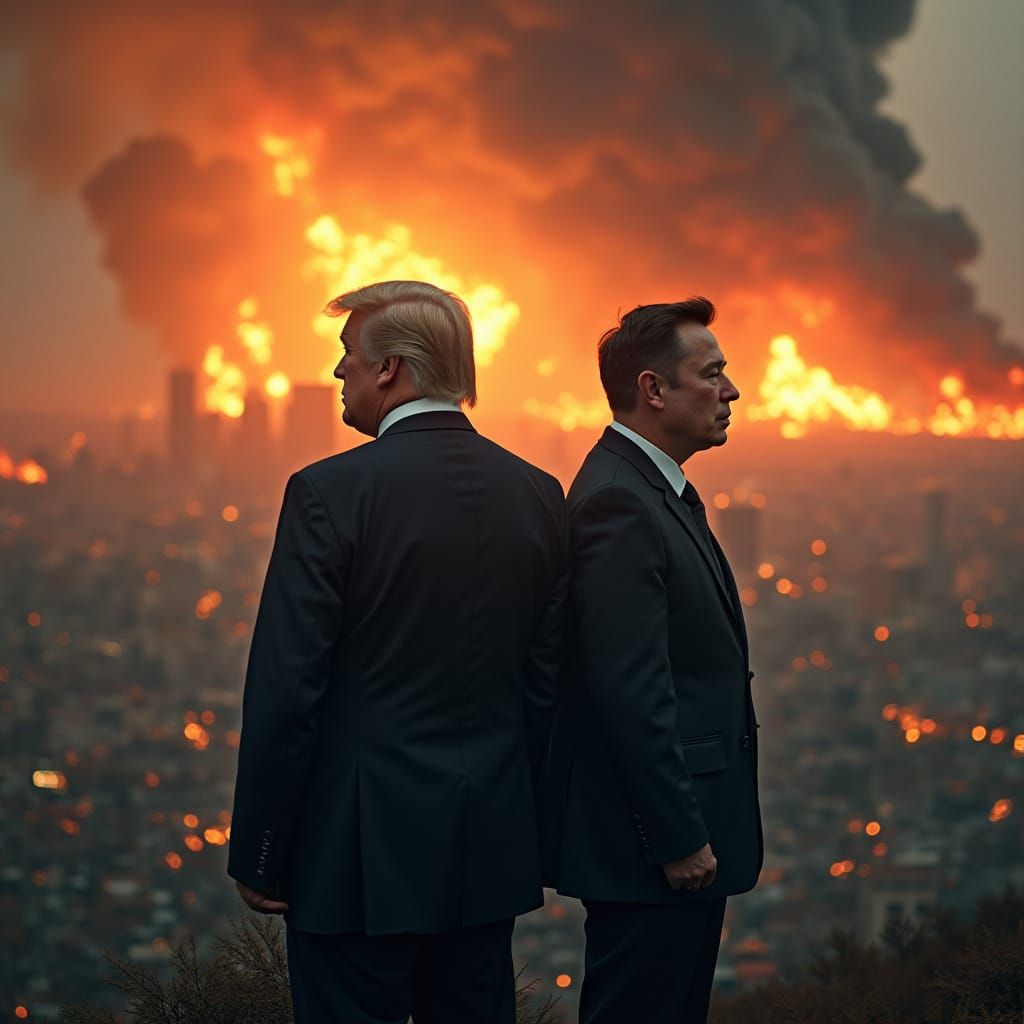
Trump and Musk lead these efforts under the banners of “efficiency,” which masks a deeper agenda: consolidating influence by the rich, reducing democratic control, and opening new markets for privatization.
If you believe government should actively provide education, healthcare, infrastructure, safety nets, and regulation—then cutting it back doesn’t make it better. It just makes it less capable.
And that is the real goal of Trump/Musk’s DOGE. To make the rich richer and the rest poorer.
If you are not rich, you have not and will not see a penny’s worth of benefit from Trump/Musk’s DOGE.
All that pain. All those lives ruined. All for nothing.
You will experience the result of ignorance, greed, paranoia, cruelty, and hatred.





 #Monetary Sovereignty - Mitchell