Gaetz’s Raiders surprised the dozens of Republicans taking part in the hearings in the government’s Sensitive Compartmented Information Facility (SCIF), and who were supposed to be there.
Next raid for the Goetz’s Raiders: Nancy Pelosi’s bedroom followed by pizza with Putin at Mar-a-Lago.
1. The gulf state of Qatar is one of the wealthiest nations on earth: U.S. GDP per capita: $54,541.70; Qatar GDP per capita: $112,531.50
2. Petroleum and natural gas account for more than 70% of total government revenue.
3. The Qatari riyal is pegged to the US dollar at a fixed exchange rate of $1 USD = 3.64 QllR.
4. Qatar spends massive amounts on . . . well, on whatever it wants, for instance:
Qatar Is Air-Conditioning the Outdoors Because of Climate Change
Qatar can afford the absurd costs of outdoor air-conditioning because it has a $320 billion sovereign wealth fund, which invests the country’s immense wealth derived from oil and natural gas reserves into real estate, infrastructure, and corporations around the world.
In fact, government spending actually can cure an inflation if the spending is directed toward curing the shortage (For instance, if an inflation is caused by a shortage of food, the government could buy food, or supplement farming, and give free food to the populace. That instantly would end the inflation.)
The Qatar government is wealthy because it has vast amounts of oil, which it exchanges for vast amounts of U.S. dollars.
But, the U.S. is even wealthier, because being Monetarily Sovereign, the U.S. government has infinite U.S. dollars.
Former Fed Chairman Ben Bernanke
Ben Bernanke:“The U.S. government has a technology, called a printing press (or, today, its electronic equivalent), that allows it to produce as many U.S. dollars as it wishes at essentially no cost.”
Alan Greenspan:“Central banks can issue currency, a non-interest-bearing claim on the government, effectively without limit. A government cannot become insolvent with respect to obligations in its own currency.”
St. Louis Federal Reserve:“As the sole manufacturer of dollars, whose debt is denominated in dollars, the U.S. government can never become insolvent, i.e.,unable to pay its bills. In this sense, the government is not dependent on borrowing to remain operational.
Qatar’s government has to drill oil and sell oil, to obtain dollars with which to fund its lavish spending on outdoor air conditioning, artificial islands, and other luxuries.
America’s government needs only to press a computer key to create enough dollars to:
–Eliminate the FICA tax,
–Federally fund free Medicare — parts A, B & D, plus long-term care — for everyone,
–Provide Social Security for all,
–Provide free education (including post-grad) for everyone,
–Pay students a salary for attending school,
–Eliminate federal taxes on business,
–Increase the standard income tax deduction, annually,
–And do whatever else it wishes.
Yes, America has the financial power to do all these things, while funding research to eliminate poverty, cure every disease, and fly to Mars, all without causing inflation.
All we need is the desire and the understanding of what is possible.
Gap Psychology describes the common desire to distance oneself from those “below” in any socio-economic ranking, and to come nearer those “above.” The socio-economic distance is referred to as “The Gap.”
Wide Gaps negatively affect poverty, health and longevity, education, housing, law and crime, war, leadership, ownership, bigotry, supply and demand, taxation, GDP, international relations, scientific advancement, the environment, human motivation and well-being, and virtually every other issue in economics.
Implementation of Monetary Sovereignty and The Ten Steps To Prosperity can grow the economy and narrow the Gaps:
Student loan debt is a huge problem, not only for the students themselves, but for all; of America.
Congress has several alternatives available to it, that would remove this huge albatross from the necks of America’s best and brightest, and even from the rest of us.
Congress simply could pay off all existing and future loans. Unlike students, the U.S. government never can run short of U.S. dollars.
Student loan debt burdens 44 million people in the United States.
However for CEOs of student loan companies, or investors on Wall Street, student debt is a lucrative commodity to be bought and sold for profit.
There, in two words, “lucrative commodity,” you see the fundamental reason why Congress, and especially this right-wing administration, like things just as they are, thank you.
Congress and the President are run by money.
Corporations such as Navient, Nelnet, and PHEAA service outstanding student debt on behalf of the Department of Education.
These companies also issue Student Loan Asset-Backed Securities (SLABS) in collaboration with major financial institutions like Wells Fargo, JP Morgan, and Goldman Sachs.
For these firms and their creditors, debt isn’t just an asset, it’s their bottom line.
You might wonder why the U.S. federal government, which handles trillions of dollars worth of Treasury certificates (T-bills, T-notes, T-bonds) needs to farm out the servicing of student loan debt and SLABS.
And, you might wonder why the government helps to create the indebtedness of America’s potential leaders.
MONEY is the answer.
Congress loves privatization, not because it is “more economical” than the federal bureaucracy (It isn’t), and not because the private sector can do the job better and more safely (It can’t, as the recession of 2008 demonstrated.)
Congress loves privatization because big donors love it. If somehow big donors wanted the federal government to do 1, 2, and 3 (above), that would be the way Congress and the President would vote.
Investors holding SLABS are entitled to coupon payments at regular intervals until the security reaches final maturity, or they can trade the assets in speculative secondary markets.
There is even a forum where SLABS investors can anonymously discuss their assets and transactions, free from unwanted public scrutiny.
Yet the financialization of student debt is almost never reported on in the media.
There is little public awareness that when student borrowers sign their Master Promissory Notes (affirming that they will repay their loans and “reasonable collection costs”), their debts may be securitized and sold to investors.
The rich speculators do not want you to know how valuable student debt is to them. You might want to eliminate student debt, heaven forbid.
SLABS resulted from specific federal policy decisions. On November 27, 1992, the Securities and Exchange Commission adopted Rule 3(a)(7) of the Investment Company Act of 1940, which allows companies who issue asset backed securities to be exempt from the legal definition of an “investment company.”
This exemption permits companies to avoid asset registration fees and regulatory oversight – making it profitable for student loan companies to issue securities, which effectively created the market for SLABS.
“Regulation” is a dirty word in the eyes of the rich. They opt for “free enterprise,” meaning “We can get away with anything when everything is legal.
Over the past few decades, student loan companies and Wall Street have amassed record profits.
Meanwhile, $1.6 trillion of student debt is crushing generations of Americans by delaying home ownership, causing generational wealth to decrease, and contributing to widespread depression and even suicide.
Since the ironically-named Bankruptcy Abuse Prevention and Consumer Protection Act of 2005, student debt is virtually impossible to discharge in bankruptcy.
Donald Trump repeatedly was able to discharge his and his companies’ debts via bankruptcy. He has boasted about how smart he was to take advantage of bankruptcy laws.
The rich lenders have made sure that students are not afforded this privilege.
Navient is the largest student loan servicing company and the largest issuer of SLABS. In filings with the SEC, Navient acknowledges the following risk factors: “An economic downturn may cause the market for auction rate notes to cease to exist… Holders of auction rate securities may be unable to sell their securities and may experience a potentially significant loss of market value.”
Due to the “securitization food chain”, if Navient or other SLABS issuers and holders experience a significant loss of revenue, they could default on their obligations – triggering negative consequences for Wall Street firms that market these securities to investors and supply credit to the greater public.
Those of you who remember the painful Great Recession of 2008, will note that massive debt default was the cause. For the rich, this lesson has not been inhibiting.
Greed and power tend to preclude caution.
As economist Michael Hudson has argued, “debts that can’t be paid, won’t be paid”, and the insistence of creditors to collect on those debts can trigger social unrest.
As the rational discontent of younger generations continues to grow, catalyzed by a lower quality of life than older generations, the accelerating climate crisis, and insurmountable student debt – activists may choose to utilize “the power of economic withdrawal.”
Young people could exploit the vulnerabilities of the SLABS market via debt strikes or boycotts, as advocated during the Occupy Wall Street movement in 2011.
Writes David Graeber in his comprehensive 2011 book Debt: The First 5000 Years. “For the last five thousand years, with remarkable regularity, popular insurrections have begun the same way: with the ritual destruction of the debt records-tablets.”
Activists concerned about student debt should ask themselves: what would such a symbolic protest look like in the United States today, and could it become popular enough to pose a significant threat to the status quo?
Historically, most social progress has been initiated by the young and the progressive, and resisted by the older and conservative.
The battles between the two often have been bloody and destructive, leaving the nation in tatters for decades or even generations. We still have not completely recovered from the atrocities of the Civil War, the Great Depression, and Vietnam.
For very good reasons, city, county, and state governments pay for grades K through 12. And these governments are not Monetarily Sovereign, so supporting education is a huge financial strain on them. Yet they do it.
For the same very good reasons, the federal government should fund grades 12+ — and it is Monetarily Sovereign, so such support would be no financial strain at all.
Student debt is an abomination that should not have begun, should not continue, and easily could be solved, if our government leaders had the morals and spine for it.
Perhaps, by rising up, marching, engaging in civil disobedience, and especially voting, young people may help our Congresspeople develop some decency, integrity, and vertebrae.
Gap Psychology describes the common desire to distance oneself from those “below” in any socio-economic ranking, and to come nearer those “above.” The socio-economic distance is referred to as “The Gap.”
Wide Gaps negatively affect poverty, health and longevity, education, housing, law and crime, war, leadership, ownership, bigotry, supply and demand, taxation, GDP, international relations, scientific advancement, the environment, human motivation and well-being, and virtually every other issue in economics.
Implementation of Monetary Sovereignty and The Ten Steps To Prosperity can grow the economy and narrow the Gaps:
His adversaries in Congress accuse him of defying the law, acting like a king, and speaking and acting in a way that was unbecoming of the presidency.
He is an outspoken, temperamental populist given to fiery speeches laden with insults, blatant racism, and suggestions that his political enemies be hanged.
He rose to political power by aligning himself with a loyal base of poor mountaineers and small farmers seeking a political champion.
He is hated for his adamant opposition to racial equality and the rule of law. Rather than root out institutional white supremacy that had fueled the American Civil War, he thwarts attempts to bring blacks equal protection under the law.
“Everyone would and must admit that the white race is superior to the black,” he said.
He suggests deporting millions of black men. He accuses [his political opponents] of plotting a coup.
He casts himself as the only thing standing between whites and “negro domination.”
As you may have guessed, the above excerpt is from an article titled, “The impeachment of Andrew Johnson,” though it sounds uncannily familiar, doesn’t it?
Donald Trump is the least intelligent, most immoral, least capable, most psychopathic President I’ve seen in my 84 years, and his administration’s record collection of temporary and acting incompetents (like substitute teachers) does nothing to improve his decision-making.
Yet despite himself, Trump sometimes accidentally does something right, though he probably doesn’t realize it — nor does Eric Boehm and the editors of Reason.com, as excerpts from the following article demonstrate:
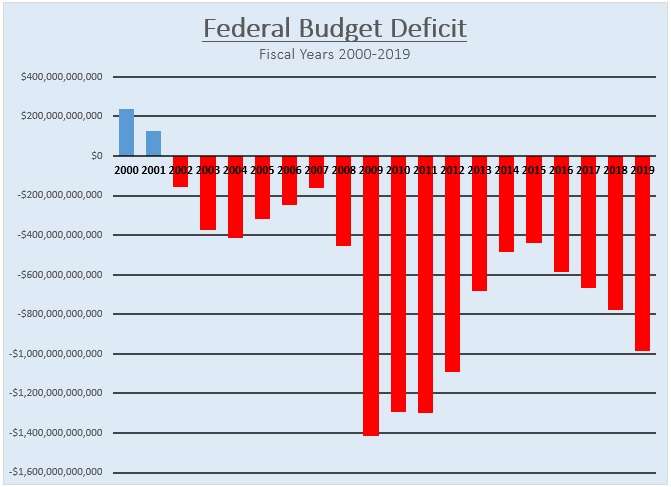
During the 2016 campaign, President Donald Trump said he’d be able to wipe out the national debt in eight years. Instead, after three years in office, he’s overseen a nearly 50 percent increase in the gap between how much the government takes in and how much it spends.
Chart by Eric Boehm. Source: U.S. Treasury data
The Treasury Department announced Friday that the official federal deficit for fiscal year 2019, which ended in September, was $984 billion—in line with what the Congressional Budget Office (CBO) estimated last month.
The announcement serves as official confirmation that the federal government’s mountain of red ink has grown dramatically during Trump’s first three years in the White House.
It is now approaching levels not seen since the early Obama years.
In order to “wipe out the national debt in 8 years,” (a 100% reduction in the debt) the Trump administration would have to run an 8-year surplus totaling about $20 trillion, i.e take $20 trillion out of the economy.
History has taught us that removing $20 trillion from the private sector — would cause, not just a recession, but a depression — and not just any old depression, but a depression the likes of which America never has experienced.
Every depression in U.S. history has been introduced with federal debt reduction, which takes dollars out of the private sector.
1804-1812: U. S. Federal Debt reduced 48%. Depression began 1807.
1817-1821: U. S. Federal Debt reduced 29%. Depression began 1819.
1823-1836: U. S. Federal Debt reduced 99%. Depression began 1837.
1852-1857: U. S. Federal Debt reduced 59%. Depression began 1857.
1867-1873: U. S. Federal Debt reduced 27%. Depression began 1873.
1880-1893: U. S. Federal Debt reduced 57%. Depression began 1893.
1920-1930: U. S. Federal Debt reduced 36%. Depression began 1929.
1997-2001: U. S. Federal Debt reduced 15%. Recession began 2001.
The economy usually is measured by Gross Domestic Product (GDP), and the formula for GDP is:
GDP =Federal Spending + Non-federal Spending + Net Exports.
To reduce federal debt one must reduce federal spending, and/or increase tax collections, both of which reduce GDP.
Federal deficit decreases cause recessions (vertical gray bars), which are cured by federal deficit increases.
By formula, federal debt reductions cut GDP.
The deficit is growing despite growth in tax revenues. The Treasury Department reported that while overall tax receipts rose by about 4 percent, federal spending grew by 8 percent.
In a statement, Treasury Secretary Steve Mnuchin said the data showed “President Trump’s economic agenda is working”; he also touted the low unemployment rate and ongoing economic growth.
One would think that deficit growth and economic growth happening simultaneously, and the fact that deficits pump growth dollars into the economy, would be sufficient to convince Trump, Mnuchin, and Eric Boehm that deficts grow the economy.
Sadly, such irrefutable evidence + mathematical logic don’t seem to be sufficient.
What’s really irresponsible is spending growth that’s outpacing revenue growth by a rate of 2-to-1.
Trump’s defenders will point out that he’s not solely responsible for setting the government’s budget.
That’s true, but he has the final say on all spending bills and he has been refusing to force the spending cuts Mnuchin says are necessary.
Why is “spending that’s outpacing revenue growth” (i.e. adding dollars to the economy) “irresponsible”?
Mnuchin never says, probably because it isn’t irresponsible; it’s necessary for economic growth.
When Congress passed a bipartisan budget plan in March 2017 that annihilated Obama-era spending caps, Trump begrudgingly signed the bill while promising that he’d never agree to another spending hike like that.
Earlier this year, when Congress passed another budget-busting spending bill, Trump signed it without so much as expressing a second thought.
Could it be that Trump intuitively understands that federal deficits spending adds growth dollars to the economy?
Perhaps nothing demonstrates Republicans’ complete abdication of fiscal conservatism as much as this: In three years in office, Trump has added more to the national debt than President George W. Bush did in his entire two terms. (Though Bush did have the advantage of starting out with a budget surplus in his first year.)
Fiscal conservatism, aka “austerity,” aka taking money from the private sector which needs the money, and giving it to the federal government, which doesn’t need the money, is the worst possible financial plan — unless one prefers recessions and depressions.
Recessions are caused by money shortages and cured by money supplements. The private sector is limited in its ability to create growth dollars; the federal government, being Monetarily Sovereign,is not limited.
Now we come to two of the most amazing sentences in Mr. Boehm’s article:
In the early Obama era, it was not uncommon to hear Republicans admit that Bush’s spendthrift ways had paved the way for worse.
Now, on an annual basis, Trump’s deficit spending is nearly as bad a Obama’s was over two terms.
During Bush’s 2nd term, the deficit averaged only about $250 Billion, at which point began the “Great Recession.”
During Obama’s 2 terms, the deficit averaged over $1 trillion, and the economy grew massively, and it continues to grow.
And yet, Mr. Boehm wants deficit reduction! It boggles.
Give Trump a few more years and I’m sure he’ll surpass Obama. That’s because the nature of the current budget deficit is fundamentally different from the peaks of the early 2010s.
Those deficits eventually tapered off for a variety of reasons. Recovery from the Great Recession boosted tax revenue.
The spending binge approved in response to the recession faded away.
And fiscally prudent Republicans imposed some modest caps on future spending growth.
But, Mr. Boehm, the deficit still averaged over $700 Billion — far more than the Bush later years — and the economy still grows, also far faster than during the Bush later years.
Coincidence, Mr. Boehm?
Now? The country is running a massive (and growing) deficit despite a decade of economic growth and a low unemployment rate.
“Higher outlays for Medicare, Social Security, Defense, and interest on the public debt” drove the deficit increase in fiscal year 2019, the Treasury Department says.
See how Boehm still doesn’t get it?
The “massive (and growing) deficit” has caused “a decade of economic growth and a low unemployment rate.”
Then Boehm goes on to exacerbate the ignorance:
The current deficit isn’t the result of temporary circumstances like World War II or a major recession.
It’s a systemic deficit, a result of poor budgeting and bad decision-making by members of Congress and the current administration.
It’s not going to resolve itself, and it’s on pace to get much worse.
We only can pray that he is correct and that the deficit will get much “worse,” i.e. pump much more growth money into the economy.
The Government Accountability Office (GAO) has called the federal government’s current fiscal situation “unsustainable,” and the CBO expects the national debt to hit “unprecedented levels” in the coming decades, well above the record highs set during World War II.
Ah, yes: “Unsustainable.” The favorite word of the economic ignorant. You probably have seen dozens of articles decrying the debt or deficit by using this word, and in not one of those articles did you ever see an explanation of why it supposedly is “unsustainable.”
“A deficit of this size following the longest span of economic growth in history shows just how reckless our leaders have become.
This is exactly the time when deficits should be contracting, not expanding,” Leon Panetta, co-chairman of the Committee for a Responsible Federal Budget, said in a statement.
No, Mr. Panetta. “The longest span of economic growth in history” was caused by deficits. Without deficits, there could have been no growth.
There is no time when deficits should be contracting unless one prefers a contracting economy.
And please don’t get me started on that Committee for a Responsible Federal Budget, which has been wrong forever about federal finances.
“But instead of getting our fiscal house in order and preparing for the next downturn, our leaders continue to binge on debt-fueled tax cuts and spending hikes rather than showing the leadership necessary to set our fiscal path.”
Clearly, Panetta believes (or more likely, is trying to make you believe) that our Monetarily Sovereign federal government can run short of its own sovereign currency, the U.S. dollar.
He also wants you to believe that federal financing is like personal financing.
You’ll notice (and this is important) that nowhere in Boehm’s diatribe is there any data showing how federal deficits have an adverse effect on the economy.
He simply spouts generalized reprimands like, “unsustainable,” “mountain of red ink,” “irresponsible,” “abdication of fiscal conservatism,” “spendthrift ways,” “spending binge,” “poor budgeting and bad decision-making,” and on and on.
But where, Mr. Boehm, are the data showing cause and effect — the data showing that large deficits cause some negative effect? They are nowhere to be found.
You will not find anywhere, a graph like the one above, showing that Federal deficit decreases cause recessions, which are cured by federal deficit increases.
The reason for the absence of such data: They do not exist.
A growing economy requires a growing supply of money, and federal deficit spending increases the money supply.
Even the ordinarily distasteful words “deficit,” and “debt,” are misleading, because they really represent surpluses for the economy.
Everything — language and the absence of data — has been gathered together to make you fear the one thing necessary to grow our economy: Federal deficit spending.
Why?
The very rich, who run America, do not want you to ask for more benefits from the federal government. This is their way making you agree to unnecessary limitations on what you receive from the government.
It’s a function of Gap Psychology, the desire of the rich to distance themselves from the rest of us. It is their way of becoming richer, for the larger the Gap the richer they are.
Democrats have abandoned all pretense of caring about the national debt, or even attempting to explain how they might pay for new federal programs.
And Republicans seem capable of offering nothing more than obviously false promises and empty rhetoric.
Mr. Boehm is right about the Democrats and Republicans duplicity, but not in the way he claims. These are the parties that have agreed on the useless — no, harmful — federal debt ceiling.
Both parties have capitulated the demands of the rich that you be misled.
Aside from that, Mr. Boehm’s article is one giant, misleading mess of false economics.
Gap Psychology describes the common desire to distance oneself from those “below” in any socio-economic ranking, and to come nearer those “above.” The socio-economic distance is referred to as “The Gap.”
Wide Gaps negatively affect poverty, health and longevity, education, housing, law and crime, war, leadership, ownership, bigotry, supply and demand, taxation, GDP, international relations, scientific advancement, the environment, human motivation and well-being, and virtually every other issue in economics.
Implementation of Monetary Sovereignty and The Ten Steps To Prosperity can grow the economy and narrow the Gaps:



 #Monetary Sovereignty - Mitchell