The one, simple economics question that determines whether someone knows WTF they are talking about

Have you ever read an economics textbook or treatise?

If so, you might have been dazzled, or impressed, by the number of mathematical formulas, the charts, the graphs, the abstruse language. No science offers more dizzying complexity than does economics, “the dismal science.”

And yet . . .

And yet, it all can be boiled down to one simple question, the answer to which opens up the entire subject like a bright ray of sunshine on a foggy morning. That question is:

What is the difference between federal government finances vs. state/local government finances?

It’s a question that separates the wheat from the chaff, so to speak, the knowledgeable from the pretenders.

Consider the common phrase “taxpayer dollars.” You see it often, usually in the context of some government spending. But which government?

If the author is referring to a state or local government, the phrase may be apt. But it never is appropriate when referring to federal government spending.

The federal government does not spend taxpayer dollars. Never. Not ever.

The answer to the question, the fundamental difference between federal government finances and state/local government finances is:

The federal government is Monetarily Sovereign; state/local governments are monetarily non-sovereign.

Almost everything in economics, every true statement, and every false statement is related to that one basic truth.

What does it mean? It means the federal government is the issuer of the U.S. dollar, while state and local governments (and you and me) are merely users of the U.S. dollar.

As the issuer, the federal government creates dollars at will. It creates at will, all the laws that govern the supply and value of the dollar. The issuer never can run short of dollars and has absolute control over the exchange value of the dollar.

The issuer of the dollar does not need to obtain dollars from any outside source. Having the unlimited ability to create dollars, it does not borrow them nor does it need to levy taxes in order to obtain dollars.

What erroneously is termed “borrowing” when referring to the federal debt, actually is the acceptance of deposits into federal security (T-bill, T-note, T-bond) accounts. The so-called federal “debt” is the total of those deposits, the purposes of which are to:

–Provide a safe, parking place for unused dollars and
–Help the Fed control interest rates.

Thus, the purpose of federal “debt” is to stabilize the dollar

The purpose of federal taxes is to help control the economy by taxing what the government wants to limit and by giving “tax breaks” to what the government wants to encourage.

Neither taxing nor accepting deposits into T-security accounts, provides spending dollars to the federal government, which has the unlimited ability to create spending dollars at the touch of a computer key.

Even if the federal government collected no taxes and accepted no deposits into T-security accounts, it could continue to spend, forever. The same cannot be said of state/local governments, which rely on income in order to spend.

Recently I saw an article titled How are U.S. taxpayer dollars spent? by David Roos. It contained such lines as:

Your federal income tax dollars help to pay for the items on the federal budget. The money the federal government borrows to cover the budget deficit is what creates the national debt.

I love the Tax Receipt Calculator on WhiteHouse.gov. It’s highly informative and not a little shocking to see exactly how my tax dollars are spent.

Why don’t all Americans receive a similar receipt when we file our taxes? If the corner store gives me a receipt with my pack of Slim Jims, shouldn’t the federal government give me a receipt for my generous (if compulsory) contribution to the national piggy bank?

Wouldn’t it be nice to receive a kindly written thank-you note from the IRS attached to a detailed receipt of how every cent of our tax dollars would be spent that year.

According to How Stuff Works.com, “Dave Roos is a freelance journalist who has contributed hundreds of articles to HowStuffWorks since 2007, with a specialty in personal finance, economics, and business. 

It is truly sad to have a specialty in something you know so little about, for Roos’s entire article, including the title, demonstrates a profound ignorance of economics. He does not understand the differences between federal finance and state/local government finance.

Federal taxpayer dollars are not spent. They are destroyed upon receipt. They disappear from any money-supply measure.

That’s right. Those precious dollars you work so hard to obtain, and then are forced to send to the federal government, are destroyed as soon as they hit the Treasury.  That is why no one can answer the question, “How many dollars does the federal government have.” The best answer is, “Infinite.”

By contrast, state/local taxes are spent. They first are deposited into a bank and later are distributed into the economy, all the while remaining in that money measure called M3.

Sadly, Mr. Roos is not alone in his misunderstanding of Monetary Sovereignty. For instance:

Why Governments Levy Taxes, By: Mark Kennan, Reviewed by: Sari Luciano, BS, Accounting/Business, Updated December 04, 2018
Governments provide a variety of services to the people they serve. In order to pay for these services, the government levies taxes on the citizens and companies who benefit from these services. The government must also make payments on any money borrowed to sustain operations.

And:

Why We Pay Taxes. Since 1950, individual income taxes have been the primary source of revenue for the U.S. federal government.By Sarah Pruitt
Together with payroll taxes (used to fund social programs like Social Security and Medicare), income taxes amount to roughly 80 percent of all federal revenue, and are the essential fuel on which our government runs.

And:

Why Do We Have Taxes?
Taxes, which are the main source of federal, state and local government revenues, pay for buildings, public education, highways, airplanes, rockets, road signs, and the salaries of millions of government employees.

Without taxes there would be no governments. Taxation is one of the several ways by which governments raise money to pay for the goods and services that they are called on to provide. Governments lack the major sources of revenue available to other sectors of the economy and must therefore rely on taxes to finance the majority of their expenditures.

The list goes on and on. Similar articles can be found everywhere, Yet not one sentence in the above examples is correct.

The federal government does not levy taxes to pay for federal services. It creates new money, ad hoc, to pay for whatever it wishes. Payroll taxes do not fund Medicare and Social Security.

The U.S. government does not borrow money. It has no need to. The federal government (unlike state/local governments) has no need for revenue of any sort.

Not only does the government not borrow, but it should not lend. “Lending” implies repayment, which the government does not need. If, for instance, the government wishes to encourage college attendance, it should not have a student loan program. It should have a student gift program.

President Obama: Washington Has to Live within its Means, 9/19/2011, By Colleen Curtis
Summary: The President’s plan for economic growth and deficit reduction offers a balanced approach to get our fiscal house in order, based on the values of shared responsibility and shared sacrifice

The President’s plan will enable Washington to live within its means, something Americans across the country have been doing for years. And the balanced approach means that no one group has to bear the burden alone. It means that everyone – including millionaires and billionaires – has to pay their fair share.

Obama’s knowledge of economics was abysmal. Deficit reduction guarantees recessions and depressions by taking growth dollars from the economy.

“Fiscal house in order” implies reducing federal debt, which simply stated, is the dreaded austerity, that has claimed the lives of many economies.

Red line: Federal Debt changes. Vertical gray bars: Recessions. Relative debt reduction leads to recessions which are cured by relative debt increases.

And rather than “shared sacrifice,” how about shared prosperity, as a better alternative.

And so far as “live with its means,” Obama confuses federal finance with personal finance. While you and I must live within our means (i.e. spend no more than our incomes), the federal government has no “means” to live within. The federal government’s “means” is infinite.

Why then, do we see headlines like this?

Newsweek
Stimulus Check Update as House Republicans Block $2,000 Plan, Trump Golfs, Khaleda Rahman

The COVID-19 relief deal remains in limbo over Christmas after House Republicans rejected President Donald Trump’s demand for $2,000 stimulus checks on Thursday, while the president spent the day golfing in Florida.

I’m not referring to the “Trump Golfs” part. We know why that is.  But, why do Republicans block the $2,000 stimulus?

Given that:

–The federal government has an infinite ability to create dollars
–Federal taxpayers do not fund federal spending, and
–The private sector has a desperate need for dollars,

Why the GOP reluctance to spend?

Yes, there are the GOP’s political considerations of not wanting to help the poor, and preferring to help the rich, but additionally, there is the belief (excuse?) that federal finances are no different from personal finances.

The public doesn’t understand the simple difference, and the GOP exploits that ignorance.

Contact your Senator or Representative to demand a $2,000 stimulus check (or better yet, Social Security for All). You will be met with the fake unaffordability issue.

Your Senator or Representative may or may not know the difference between federal financing and state, local and personal financing, but he/she makes the tacit assumption that you are ignorant about it.

That same assumed ignorance applies to arguments about Medicare for All, free college for all, and to every other debated federal expenditure.

Simply keep in mind that:

–The federal government can afford anything. It never can run short of dollars. It is the sovereign of dollars.
–Taxpayers do not pay for federal spending.
–The federal debt is not a burden on anyone. Lack of income is a burden on the populace
Federal spending does not cause inflation
–Federal finances are nothing like state/local government, and personal finances. The federal government is Monetarily Sovereign; state/local governments are monetarily non-sovereign.

Try to find candidates who understand the differences, and vote for them, or teach the ones you are stuck with.

Rodger Malcolm Mitchell

Monetary Sovereignty Twitter: @rodgermitchell Search #monetarysovereignty Facebook: Rodger Malcolm Mitchell …………………………………………………………………………………………………………………………………………………………………………………………………………………………………………………………………………………………..

THE SOLE PURPOSE OF GOVERNMENT IS TO IMPROVE AND PROTECT THE LIVES OF THE PEOPLE.

The most important problems in economics involve:

  1. Monetary Sovereignty describes money creation and destruction.
  2. Gap Psychology describes the common desire to distance oneself from those “below” in any socio-economic ranking, and to come nearer those “above.” The socio-economic distance is referred to as “The Gap.”

Wide Gaps negatively affect poverty, health and longevity, education, housing, law and crime, war, leadership, ownership, bigotry, supply and demand, taxation, GDP, international relations, scientific advancement, the environment, human motivation and well-being, and virtually every other issue in economics. Implementation of Monetary Sovereignty and The Ten Steps To Prosperity can grow the economy and narrow the Gaps:

Ten Steps To Prosperity:

  1. Eliminate FICA
  2. Federally funded Medicare — parts A, B & D, plus long-term care — for everyone
  3. Social Security for all or a reverse income tax
  4. Free education (including post-grad) for everyone
  5. Salary for attending school
  6. Eliminate federal taxes on business
  7. Increase the standard income tax deduction, annually. 
  8. Tax the very rich (the “.1%”) more, with higher progressive tax rates on all forms of income.
  9. Federal ownership of all banks
  10. Increase federal spending on the myriad initiatives that benefit America’s 99.9% 

The Ten Steps will grow the economy and narrow the income/wealth/power Gap between the rich and the rest.

MONETARY SOVEREIGNTY

Can you answer these few simple questions about our economy? Your Congressperson won’t.

Let’s begin with a few facts:

  1. Unlike state/local governments, the U.S. government is Monetarily Sovereign. That means it never, NEVER, unintentionally can run short of its own sovereign currency, the U.S. dollar.
  2. Federal taxes do not support federal spending. Even if all federal tax collections ceased, the federal government could continue spending forever.

    Amazon Pay Joins the War on Cash – #hiswai
    The federal government has infinite money. It cannot run short of dollars.
  3. The federal debt and deficit are not a burden on anyone — not on you, not on your grandchildren. On the contrary, when federal debt growth slows, we have recessions and depressions, which are cured by increases in federal debt growth.
  4. Inflations never are caused by federal deficit spending. Inflations always are caused by shortages, most often by shortages of food and/or energy. In fact, inflations often are cured by deficit spending to obtain and distribute the scarce goods.
  5. Federal deficit spending itself is not socialism. Socialism is government ownership and control. That said, some forms of socialism are good for the economy. Examples: Virtually all streets and highways, Social Security, public parks and beaches, many museums and zoos, many rivers and lakes, the military and VA hospitals, many libraries, federal lands, federal buildings, federal agencies like NASA, FBI, and CIA.
  6. Government in itself is neither good nor bad. Government is a tool. The function of the tool is to improve and protect the lives of the people. To the degree it fulfills that mission, it is good. Where it fails that mission, it is bad. Mere size is not an issue any more than the size of the pencil in the voter’s booth is an issue.

Given all of the above, why do we see an article like this? “Congress likely to avert government shutdown, Brady Tax Package heads toward floor vote”

I. Given Congress’s infinite checkbook, why is there even a discussion of a government shutdown?

II. The Democrats had suggested $1,200 checks. Even Trump wanted $2,000 checks. Why was this reduced to $600, and still is being debated, in face of the private sector’s worst financial crisis in many years?

III. Why exclude assistance to states?

IV. Why has Congress struggled for months to produce a plan for preventing/curing the COVID recession, that has hurt so many people?

V. Pfizer Says Millions of COVID-19 Vaccine Doses Are Sitting Unclaimed in Warehouse Coolers. The federal government has not given the company shipping instructions. Why?

You can contact your Senator or Representative– that person to whom you gave your valuable vote — and ask these questions.

Do you think you will get an informative answer? An honest answer? An intelligent answer?

If not, why did you toss away your vote on an uninformative, dishonest, unintelligent fool?

What should Congress really do? Institute the Ten Steps to Prosperity (below) immediately, especially rush Step #3: Social Security for All.

Give me one good reason why not.

Rodger Malcolm Mitchell

Monetary Sovereignty Twitter: @rodgermitchell Search #monetarysovereignty Facebook: Rodger Malcolm Mitchell …………………………………………………………………………………………………………………………………………………………………………………………………………………………………………………………………………………………..

THE SOLE PURPOSE OF GOVERNMENT IS TO IMPROVE AND PROTECT THE LIVES OF THE PEOPLE.

The most important problems in economics involve:

  1. Monetary Sovereignty describes money creation and destruction.
  2. Gap Psychology describes the common desire to distance oneself from those “below” in any socio-economic ranking, and to come nearer those “above.” The socio-economic distance is referred to as “The Gap.”

Wide Gaps negatively affect poverty, health and longevity, education, housing, law and crime, war, leadership, ownership, bigotry, supply and demand, taxation, GDP, international relations, scientific advancement, the environment, human motivation and well-being, and virtually every other issue in economics. Implementation of Monetary Sovereignty and The Ten Steps To Prosperity can grow the economy and narrow the Gaps:

Ten Steps To Prosperity:

  1. Eliminate FICA
  2. Federally funded Medicare — parts A, B & D, plus long-term care — for everyone
  3. Social Security for all or a reverse income tax
  4. Free education (including post-grad) for everyone
  5. Salary for attending school
  6. Eliminate federal taxes on business
  7. Increase the standard income tax deduction, annually. 
  8. Tax the very rich (the “.1%”) more, with higher progressive tax rates on all forms of income.
  9. Federal ownership of all banks
  10. Increase federal spending on the myriad initiatives that benefit America’s 99.9% 

The Ten Steps will grow the economy and narrow the income/wealth/power Gap between the rich and the rest.

MONETARY SOVEREIGNTY
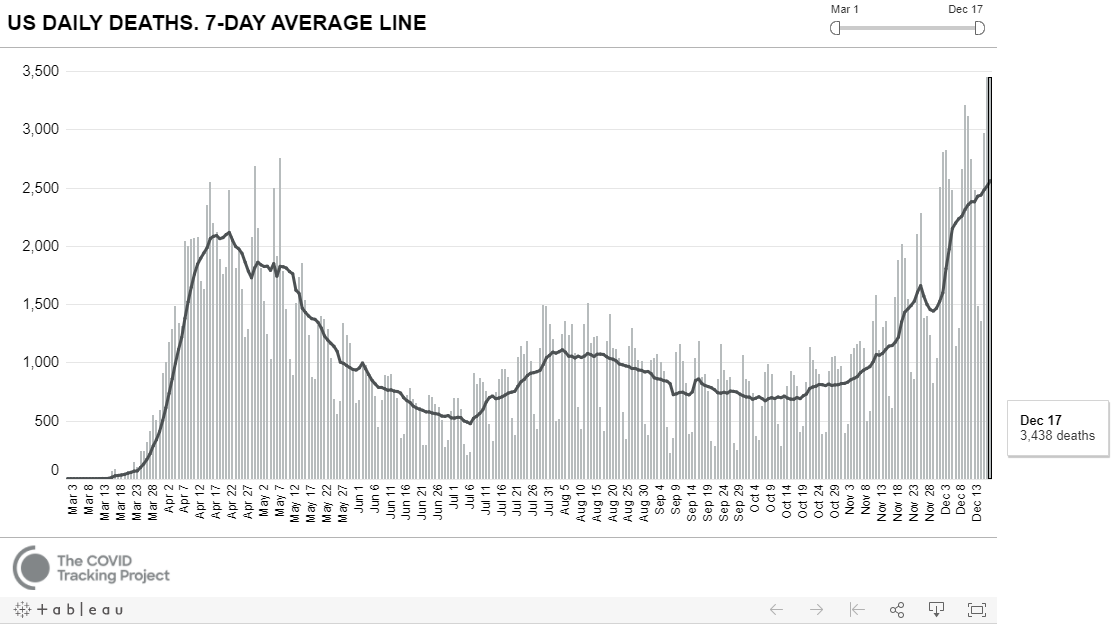
The enduring legacy of Donald J. Trump

THE ENDURING LEGACY OF DONALD J. TRUMP

The following is from October 22, 2020, when COVID-19 deaths were running at about 1,100 a day:

Faulty US Covid-19 response meant 130,000 to 210,000 avoidable deaths, report finds
By Maggie Fox, October 22, 2020

The Trump Administration’s faltering response to the coronavirus pandemic has led to anywhere between 130,000 and 210,000 deaths that could have been prevented, according to a report released Thursday by a team of disaster preparedness experts.

Insufficient testing, a lack of national mask mandates or guidance, a delayed overall response and outright mocking of basic public health practices by the administration has put the United States at the top of the global coronavirus death toll, the report from Columbia University Earth Institute’s National Center for Disaster Preparedness finds.

“We estimate that at least 130,000 deaths and perhaps as many as 210,000 could have been avoided with earlier policy interventions and more robust federal coordination and leadership,” the report reads.


…………………………..

The following is December 17, 2020, when deaths are running at about 3,000 a day:

U.S. COVID Deaths on December 17, 2020: 3,438; Total deaths: 313,797.


…………………………..

This is the near future:

This week’s national ensemble forecast predicts that the number of
newly reported COVID-19 deaths will likely increase over the next 4 weeks,
with 15,800 to 27,700 new deaths likely to be reported in the week ending
January 9, 2021.

The national ensemble predicts that a total of 357,000 to 391,000 COVID-19 deaths
will be reported by this date.


…………………………..


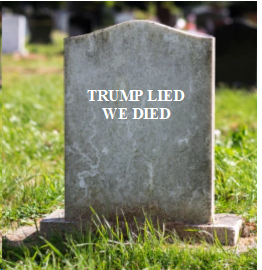
And this will be the enduring legacy:

THE ENDURING LEGACY OF DONALD J. TRUMP

……………………………………………………………………………………………………………………………………………………………………………………………………………………………………………………………………..


Rodger Malcolm Mitchell

Monetary Sovereignty Twitter: @rodgermitchell Search #monetarysovereignty Facebook: Rodger Malcolm Mitchell …………………………………………………………………………………………………………………………………………………………………………………………………………………………………………………………………………………………..

THE SOLE PURPOSE OF GOVERNMENT IS TO IMPROVE AND PROTECT THE LIVES OF THE PEOPLE.

The most important problems in economics involve:

  1. Monetary Sovereignty describes money creation and destruction.
  2. Gap Psychology describes the common desire to distance oneself from those “below” in any socio-economic ranking, and to come nearer those “above.” The socio-economic distance is referred to as “The Gap.”

Wide Gaps negatively affect poverty, health and longevity, education, housing, law and crime, war, leadership, ownership, bigotry, supply and demand, taxation, GDP, international relations, scientific advancement, the environment, human motivation and well-being, and virtually every other issue in economics. Implementation of Monetary Sovereignty and The Ten Steps To Prosperity can grow the economy and narrow the Gaps:

Ten Steps To Prosperity:

  1. Eliminate FICA
  2. Federally funded Medicare — parts A, B & D, plus long-term care — for everyone
  3. Social Security for all or a reverse income tax
  4. Free education (including post-grad) for everyone
  5. Salary for attending school
  6. Eliminate federal taxes on business
  7. Increase the standard income tax deduction, annually. 
  8. Tax the very rich (the “.1%”) more, with higher progressive tax rates on all forms of income.
  9. Federal ownership of all banks
  10. Increase federal spending on the myriad initiatives that benefit America’s 99.9% 

The Ten Steps will grow the economy and narrow the income/wealth/power Gap between the rich and the rest.

MONETARY SOVEREIGNTY
The Six Rules of Trump

Here are The Six Rules of Trump

Rule #1. All who touch Trump come away dirty

Rule #2. Eventually, Trump will stab you in the back

Rule #3. If it’s good, Trump created it. If it’s bad, you ruined it.

Rule #4. There is no discernable difference between a lie and a truth.

Rule #5. People who sacrifice without reward are suckers.

Rule #6. Trump is not the center of the universe; Trump is the universe.

……………………………………………………………………………………………………………………………………………………………………………………………………………………………………………………………………..
Attorney General William Barr did everything he could to ingratiate himself with President Trump. As Eric Zorn wrote for the Chicago Tribune:

Before this week, it was tough to identify the single most infamous act of William Barr’s tenure as U.S. attorney general.

Was it personally ordering the expansion of the security perimeter around Lafayette Park in Washington, D.C., in early June, clearing out protesters with tear gas just prior to President Donald Trump‘s photo-op holding up a Bible in front of St. John’s Episcopal Church?

Trump, Barr, and the Justice Department Takeover, Explained - Rolling Stone
Barr offered a flimsy argument for why Trump didn’t obstruct justice when he told Barr to remove special counsel Robert Mueller in the middle of his Russia probe.

Was it issuing a preemptive summary of the 2019 report of special counsel Robert Mueller into Russian election interference that a federal judge later characterized as “distorted” and “misleading” for the way he downplayed Trump’s obstruction of justice and abuse of power?

Was it openly campaigning for Trump by parroting the line of right-wing hysterics that electing moderate Democrat Joe Biden would mean our nation was “irrevocably committed to the socialist path”?

Was it his amplification and endorsement of Trump’s charge that the Obama administration had “spied on” the Trump campaign even though Department of Justice Inspector General Michael Horowitz concluded that the investigation into Russian interference in the 2016 election had been properly predicated?

Was Barr’s most infamous act overruling his own prosecutors and seeking leniency for Trump pal Roger Stone after Stone’s conviction on witness tampering and lying to investigators? That move was infamous enough that four federal prosecutors quit over it.

Or, related, was it trying to drop the case against Trump’s former national security adviser Michael Flynn, who’d pleaded guilty to lying to the FBI?

Was it having the Justice Department intervene on Trump’s behalf in a civil defamation suit filed by a woman who claimed Trump had raped her in the 1990s?

Was it declaring that pandemic-related restrictions such as stay-at-home orders were “the greatest intrusion on civil liberties in American history” aside from slavery? House Majority Whip Jim Clyburn, D-S.C., called that remark one of the “most ridiculous, tone-deaf, God-awful things I’ve ever heard.”

Was it casting doubt in advance on the integrity of the 2020 election with a series of unsupported warnings about fraud and foreign plots to defeat Trump?

Was it ignoring long-standing Justice Department policies after the 2020 election and authorizing prosecutors to investigate allegations of voter fraud before the results of the race were certified? That move, which weakened a safeguard protecting elections from partisan interference, prompted the Justice Department official in charge of voter fraud investigations, Richard Pilger, to step down almost immediately.

Or was it writing this cringeworthy, fawning letter of resignation?

Here are some excerpts: I have bolded some of the “highlights.”

“Dear Mr. President,

“I am greatly honored that you called on me to serve your Administration and the American people once again as Attorney General. I am proud to have played a role in the many successes and unprecedented achievements you have delivered for the American people.

“Your record is all the more historic because you accomplished it in the face of relentless, implacable resistance. Your 2016 victory speech in which you reached out to your opponents and called for working together for the benefit of the American people was immediately met by a partisan onslaught against you in which no tactic, no matter how abusing and deceitful, was out of bounds.

“The nadir of this campaign was the effort to cripple, if not oust, your Administration with frenzied and baseless accusations of collusion with Russia.”

Consider that this is a letter of resignation, not an obituary, but it is loaded with shameless adulation and applause for the boss, and not a word of truth to be found.

The unrelenting brown-nosing continues:

“Few could have weathered these attacks, much less forge ahead with a positive program for the country. You built the strongest and most resilient economy in American history — one that has brought unprecedented progress to those  previously left out. You have restored American military strength.

“By brokering historing peace deals in the Mideast you have achieved what most thought impossible. You have curbed illegal immigration and enhanced the security of our nation’s borders.

“You have advanced the rule of law by appointing a record number of judges committed to constitutional principles. With Operation Warp Speed, you delivered a vaccine for coronavirus on a schedule no one thoguht conveivable — a feat that will undoubtedly save millions of lives.”

This is not the place to argue why each of the bolded phrases actually is a misstatement of fact. Rather, the point is the butt-kissing, toadying nature of the so-called “letter of resignation,” that have little-to-nothing to do with Barr or with his resignation.

Ah, but Barr has even more butt-kissing to do:

“During your Administration, the Department of Justice has worked tirelessly to protect the public from violent crime; worked closely with leaders in Mexico to fight the drug cartels; cracked down on China‘s exploitation of our economy and workers; defended competitonin the marketplace, especially the technology sector; and supported the men and women of law enforcement who selflessly — and too often thanklessly — risk their lives to keep our communities safe.”

Far be it for us to point out that neither Trump nor Barr has done any of the above, nor will we be so discourteous as to point out how many of those under Barr have resigned in disgust.

He ends with a final bit of suckup:

“Wishing you, Melania, and your family a Merry Christmas and a Blessed Holiday Season. God Bless.”

Well, surely no one could possibly have done more to leave lip prints on the boss’s rear than Barr, not only with this bootlicking and mendacious letter, but with his ongoing job performance.

As House Judiciary Committee Chairman Jerry Nadler said,

“From misleading the American public about the Mueller report to his dangerous efforts to overturn COVID safety measures, from his callous disregard for civil rights to his rampant politicization of the Justice Department, William Barr was willing to do the president’s bidding on every front but one.

“Barr refused to play along with President Trump’s nonsensical claims to have won the election. He is now out as attorney general one month early.”

And here was Barr’s reward for drowning his reputation in mud, hoping to please Donald Trump:

President Trump assailed Attorney General Bill Barr.

“Joe Biden lied on the debate stage he said there’s nothing happening, nothing happening, and Bill Barr should have stepped up.

“All he had to do is say an investigation is going on.

“But when you affect an election … when they are saying things, making statements and the press is purposely not reporting it, Bill Barr, I believe, not believe I know, had an obligation to set the record straight.”

Trump said that Barr should have acted more like then-special counsel Robert Mueller, who was heading the Russia probe, and disputed a 2019 BuzzFeed report that Trump directed his former personal lawyer Michael Cohen to lie to Congress.

“But Bob Mueller stood up and he interjected that this article was false. Bill Barr should have done the same.” 

Barr, through sad experience, learned the Six Rules of Trump, though far too late to save his tattered reputation.

But I shed no tears for Barr, nor do I shed tears for Steve Bannon, Tom Price, Scott Pruitt, Ben Carson, Paul Manafort, Rick Gates, Michael Flynn, Michael Cohen, Wilbur Ross, Chris Collins, Duncan Hunter, Salvatore Testa, Tony Salerno, Roger Stone, Felix Sater, Jeffrey Epstein, Alexander Acosta, George Papadopoulos, Alex Van der Zwaan, Konstantin Kilimnik, Ralph Shortey, Timothy Nolan, et al.

Barr came in believing he could be the right-hand man to a king — perhaps even the controlling voice behind the throne. Instead, he became just another Trump joker, now discarded by the poseur.

Good riddance.

Rodger Malcolm Mitchell

Monetary Sovereignty Twitter: @rodgermitchell Search #monetarysovereignty Facebook: Rodger Malcolm Mitchell …………………………………………………………………………………………………………………………………………………………………………………………………………………………………………………………………………………………..

THE SOLE PURPOSE OF GOVERNMENT IS TO IMPROVE AND PROTECT THE LIVES OF THE PEOPLE.

The most important problems in economics involve:

  1. Monetary Sovereignty describes money creation and destruction.
  2. Gap Psychology describes the common desire to distance oneself from those “below” in any socio-economic ranking, and to come nearer those “above.” The socio-economic distance is referred to as “The Gap.”

Wide Gaps negatively affect poverty, health and longevity, education, housing, law and crime, war, leadership, ownership, bigotry, supply and demand, taxation, GDP, international relations, scientific advancement, the environment, human motivation and well-being, and virtually every other issue in economics. Implementation of Monetary Sovereignty and The Ten Steps To Prosperity can grow the economy and narrow the Gaps:

Ten Steps To Prosperity:

  1. Eliminate FICA
  2. Federally funded Medicare — parts A, B & D, plus long-term care — for everyone
  3. Social Security for all or a reverse income tax
  4. Free education (including post-grad) for everyone
  5. Salary for attending school
  6. Eliminate federal taxes on business
  7. Increase the standard income tax deduction, annually. 
  8. Tax the very rich (the “.1%”) more, with higher progressive tax rates on all forms of income.
  9. Federal ownership of all banks
  10. Increase federal spending on the myriad initiatives that benefit America’s 99.9% 

The Ten Steps will grow the economy and narrow the income/wealth/power Gap between the rich and the rest.

MONETARY SOVEREIGNTY