The economics scare-mongers defy facts. Were you fooled?

Since 1981, the CRFB (Committee for a Responsible Federal Budget) has been scaring you about a “soon-to-come economic doomsday.”

The fiscal apocalypse always is imminent — always just around the corner.

Does the fact that it never arrives embarrass the CRFB? Apparently not,

If you made the same wrong predictions every year for the past 40 years wouldn’t you be a bit hesitant about doing it yet again? And if you were one of the CRFB’s readers, wouldn’t you have learned long ago not to trust anything these people say?

It seems that being wrong again and again and again, doesn’t cause them any embarrassment, nor does it cause their followers any second thoughts.

The CRFB keeps peddling the same nonsense every year, using exactly the same words. Only the numbers change.

Today, the Congressional Budget Office (CBO) released its March 2021 Long-Term Budget Outlook, confirming that the federal budget is on an unsustainable long-term trajectory. 

Let us pause to examine the word “unsustainable.” What does it mean? The CRFB never says.

Does “unsustainable” mean the federal government will go bankrupt? No, that cannot happen.

It can happen to monetarily non-sovereign entities like U.S. states, counties, and cities. It can happen to euro nations because they are monetarily non-sovereign. It can happen to businesses, and to you and to me.

But it cannot happen to the U.S. government. It is Monetarily Sovereign. It creates U.S. dollars by the very act of paying creditors.

[To pay a creditor, the federal government sends instructions (in the form of a check or wire) to the creditor’s bank. The instructions say, “Pay to the order of________”

When the bank receives those instructions, it does as it is told. It increases the numbers in the creditor’s checking account. At the moment that happens, a money measure known as “M1” increases.

The bank then clears the instructions through the government’s own Federal Reserve Bank, which always approves government instructions. In short, the government approves its own instructions.

That is the way the federal government creates dollars.]

Because the government never can run short of instructions, it never can run short of dollars.

Does “unsustainable”  mean the federal government will be unable to pay its debts? No. Clearly having unlimited money gives the government unlimited ability to pay its debts.

Does “unsustainable” mean countries or people will begin to reject payment in dollars? No. The U.S. has a massive economy. Long after people begin to reject euros, and the money of smaller economies like those of Japan, Canada, Australia, England, China et al, they still will accept U.S. dollars.

Does “unsustainable” mean that one day, China will demand a return of all the dollars it has lent the U.S.? No. China has not lent the U.S. any dollars. (The U.S. government, having the unlimited ability to create dollars, has no need to borrow dollars.)

What erroneously is termed “borrowing” actually is China making deposits of U.S. dollars into its own T-security accounts held at the Federal Reserve Bank. There the dollars remain until China wants them back. The U.S. government has no need for them.

Whenever China wants those dollars returned, the Bank merely transfers them to China’s own checking account, at any bank in the world. This is a simple money transfer that is no burden on the U.S. or on taxpayers. It happens every day of the week.

Does “unsustainable” mean we will have uncontrolled inflation? No, our Monetarily Sovereign government has unlimited control over the value of the U.S. dollar, a control it has exercised many times over the years.

It formerly was accomplished by arbitrarily changing the dollar’s exchange value with gold or silver. Today, it is accomplished by arbitrarily changing the interest rates paid on Treasury Securities. Raising the rates makes the dollar more valuable (i.e., decreases inflation).

So what does “unsustainable” mean? It means, “We want you to be worried, frightened even, about some unknown thing lying in the shadows.” But folks, the only thing lying is the CRFB, and they do it every day:

Analysis of CBO’s March 2021 Long-Term Budget Outlook | Committee for a Responsible Federal Budget (crfb.org)

 Under current law, CBO projects federal debt held by the public to rise from less than 80 percent of GDP at the end of FY 2019 to 202 percent of GDP by 2051.

Under a more realistic scenario, debt could reach nearly 260 percent of GDP by 2051.

Why is it bad that the total of deposits into T-bill, T-note, and T-bond accounts (wrongly called “debt”) will be more than double Gross Domestic Product?

It isn’t. One has nothing to do with the other. It’s like announcing that the number of blond-haired people will be double the number of fire-plugs in Chicago. The “debt”/GDP ratio is an irrelevant apples/oranges comparison.

So-called “federal debt” is the total of deposits into T-security accounts, similar to bank savings accounts. In today’s federal bookkeeping system, it also is the net total of federal deficits run by the federal government in the 240 years since the U.S. began.

By contrast, GDP is a one-year total of spending by the U.S. public and private sectors. Increases or decreases in deposits do not correlate with increases or decreases in spending. The U.S. government has the power to stop accepting dollars in T-security accounts, while continuing to spend, forever.

Japan, which has a ratio exceeding 250%, long ago proved the meaninglessness of that meant-to-be-scary debt/GDP fraction.

Perhaps, that is why the CRFB never specifically says what problems the ratio supposedly causes — just a vague reference to “unsustainable.”

Deficits Will Explode. Under current law, CBO projects annual budget deficits will grow to 13.3 percent of GDP by 2051.

While this is lower than the COVID-driven deficit of 14.9 percent of GDP in FY 2020, it will be nearly three times higher than the 2019 deficit of 4.6 percent of GDP, roughly four times as high as the 3.3 percent of GDP average seen over the past 50 years, and higher than any point in modern history outside of World War II and the current crisis.

Ooooh, “explode”! How frightening. The CRFB fails to mention that 2020, 2019, the past 50 years, and World War II, all were periods of large deficits and of economic growth.

And what are those terrible “deficits” the CRFB wants to scare you with? Deficits are times when the federal government pumps more stimulus dollars into the private sector than it removes via taxing.

Not only does federal deficit spending stimulate economic growth, but the economy could not grow without federal deficit spending. In fact, when federal deficit spending is reduced, we have recessions and depressions.

When the growth in federal deficit spending is reduced (red line), we eventually have recessions, which are cured by increases in deficit spending. Other than that, there is no relationship between deficit spending and federal “debt” (blue line).

Is a growing economy something that should frighten you??? The idea is laughable.

Spending Will Continuously Outpace Revenue.

CBO projects spending will grow from 21.0 percent of GDP in 2019 to 31.8 percent of GDP by 2051, while revenue will grow from 16.3 to 18.5 percent of GDP.

Over the long term, rising health care, retirement, and interest costs will cause a significant increase in spending. Revenue will also grow under current law, but only modestly.

In the above paragraphs, the CRFB confuses federal finances with personal finances.

You and I, and indeed all monetarily non-sovereign entities, use income (“revenue”) to fund spending. Without some form of income, we can’t spend.

The Monetarily Sovereign government, which creates dollars, ad hoc, from thin air, whenever it spends, needs no income. In fact, the federal government destroys all income upon receipt.

When, for instance, your tax dollars reach the U.S. Treasury, they cease to be a part of any money measure (M0, M1, M2, M3). Your tax dollars effectively no longer exist.

While comparisons between revenue and spending are important for you and me, they are meaningless for the federal government. The CRFB intentionally confuses the two.

Major Trust Funds Are Headed Toward Insolvency.

CBO projects Highway Trust Fund (HTF) insolvency in FY 2022, Medicare Hospital Insurance (HI) trust fund insolvency in FY 2026, Social Security Old Age and Survivors Insurance (OASI) trust fund insolvency in calendar year 2032 and Social Security Disability Insurance (SSDI) trust fund insolvency in calendar year 2035.

On a theoretical combined basis, the Social Security program will be insolvent in calendar year 2032.

The major “trust funds” are not really trust funds (See “The phony ‘trust fund’ controversy”), and whatever one wishes to call them, they are not “headed for insolvency.”

Given that the federal government has the unlimited ability to create dollars, no federal agency can become insolvent unless the government wishes it to be insolvent. The federal government could (and should) end collection of the FICA tax, and still pay Social Security and Medicare benefits, forever.

The Long-Term Outlook is Similar to Last Year.

Ultimately, high debt levels will slow income and wage growth, increase interest payments, place upward pressure on interest rates, reduce the fiscal space available to respond to a recession or other emergency, place an undue burden on future generations, and heighten the risk of a fiscal crisis.

Once the current crisis ends, policymakers must work to get our long-term fiscal house in order.

It’s all a lie.

Increased debt levels (red line) have not slowed personal income growth (blue line).

As for “increased interest payments,” they stimulate economic growth by adding dollars to the private sector


There has been no “upward pressure on interest rates” which instead are at historic lows.

And because the federal government has the unlimited ability to create dollars, by definition it always has infinite “fiscal space” to respond to a recession or other emergency. It has demonstrated this infinite fiscal space by repeatedly passing multi-trillion dollar stimulus packages.

There is no burden on future generations. Future taxes will not fund today’s spending. The only burden on future generations would be a poverty burden if the government had not spent trillions to stimulate the economy.

And finally, “fiscal house in order” is a word-salad meaning nothing with regard to our Monetarily Sovereign federal government.

In Summary

The CRFB article is one gigantic lie, designed to scare those who do not understand the workings of a Monetarily Sovereign entity. It makes false claims that are contradicted by easily seen facts.

These are people who insist you are standing in the midst of a thunderstorm while you plainly can see the sun shining.
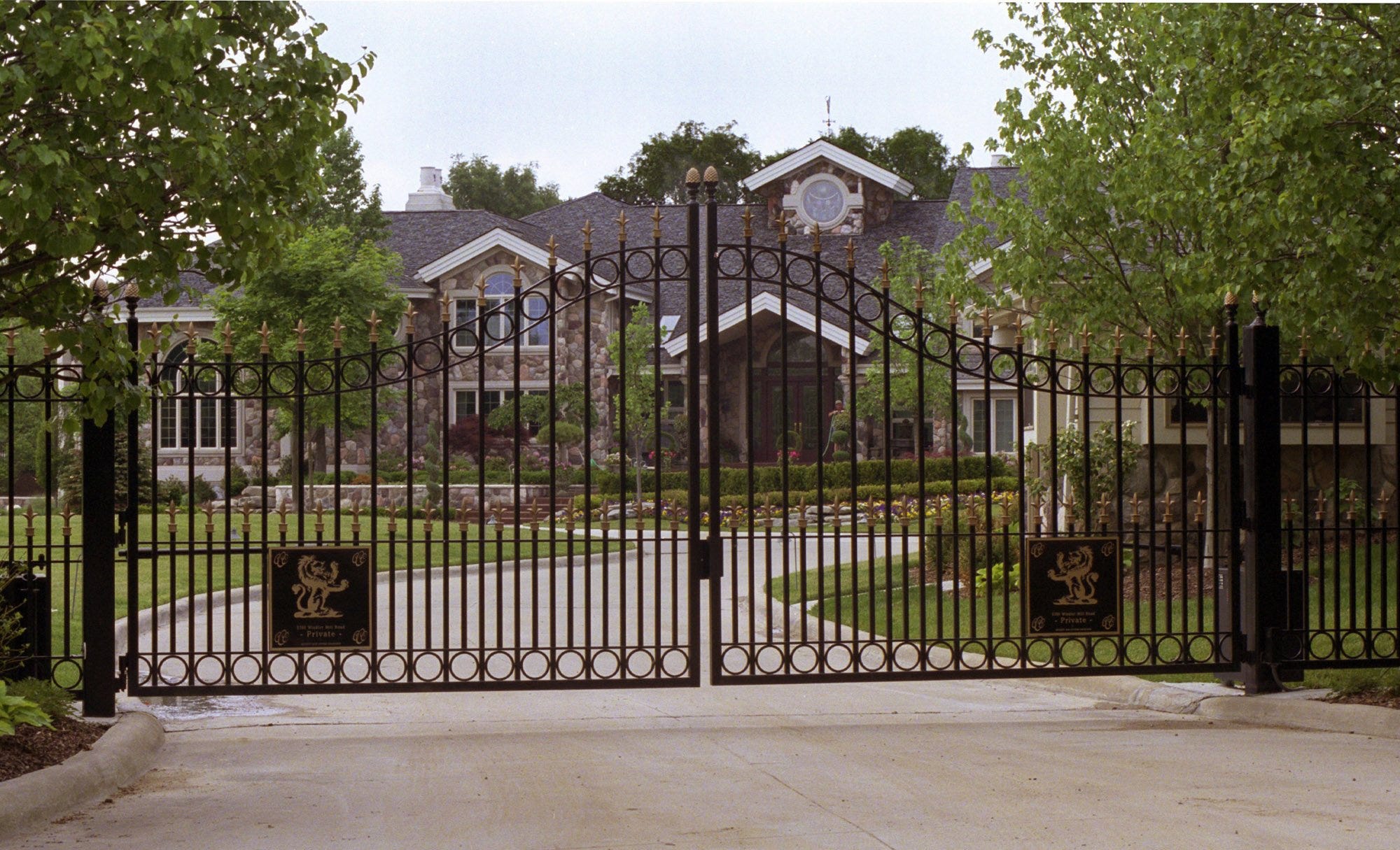
Michigan mansion once owned by Eminem is back on the market
Maintaining the Gap

Why does the CRFB lie about the economy? Because they are paid by, and controlled by, the very rich, who because of Gap Psychology, want you to accept higher taxes and lower federal benefits.

[“Rich” is a relative term. If you have $1,000, and everyone else has $1, you are rich.; The wider the Gap between you and those who are poorer, the richer you are.

“Gap Psychology” is the desire to become richer by widening the income/wealth/power Gap below, while narrowing the Gap above.

Being funded by the rich, the CRFB spreads lies that will influence you to believe the federal government can’t afford social benefits.

They want you meekly to accept your lower station in life, so that the rich can maintain or increase their control over America.]

This is the same motive behind the repeated, claims that federal deficit spending is the dreaded “socialism.” It isn’t. “Socialism” is government ownership and control. Though all governments are partly socialistic, most federal spending involves neither ownership nor control.

But the rich know that the word “socialism” has pejorative implications, so they apply it to such federal benefits as Medicare, Social Security, SNAP programs, etc.

It is all a lie proxies for the rich continually repeat until the false ideas are implanted so deeply into the public consciousness, that obvious facts are doubted.

Because of liars like the CRFB, the rich own you, and only the truth can set you free.

Rodger Malcolm Mitchell

Monetary Sovereignty Twitter: @rodgermitchell Search #monetarysovereignty Facebook: Rodger Malcolm Mitchell …………………………………………………………………………………………………………………………………………………………………………………………………………………………………………………………………………………………..

THE SOLE PURPOSE OF GOVERNMENT IS TO IMPROVE AND PROTECT THE LIVES OF THE PEOPLE.

The most important problems in economics involve:

  1. Monetary Sovereignty describes money creation and destruction.
  2. Gap Psychology describes the common desire to distance oneself from those “below” in any socio-economic ranking, and to come nearer those “above.” The socio-economic distance is referred to as “The Gap.”

Wide Gaps negatively affect poverty, health and longevity, education, housing, law and crime, war, leadership, ownership, bigotry, supply and demand, taxation, GDP, international relations, scientific advancement, the environment, human motivation and well-being, and virtually every other issue in economics. Implementation of Monetary Sovereignty and The Ten Steps To Prosperity can grow the economy and narrow the Gaps:

Ten Steps To Prosperity:

  1. Eliminate FICA
  2. Federally funded Medicare — parts A, B & D, plus long-term care — for everyone
  3. Social Security for all or a reverse income tax
  4. Free education (including post-grad) for everyone
  5. Salary for attending school
  6. Eliminate federal taxes on business
  7. Increase the standard income tax deduction, annually. 
  8. Tax the very rich (the “.1%”) more, with higher progressive tax rates on all forms of income.
  9. Federal ownership of all banks
  10. Increase federal spending on the myriad initiatives that benefit America’s 99.9% 

The Ten Steps will grow the economy and narrow the income/wealth/power Gap between the rich and the rest.

MONETARY SOVEREIGNTY

How intelligent is America? How intelligent are you? Here is one simple test

Intelligence can be measured in many ways, depending on what is being tested, the nature of the test itself, the method of scoring, the testing experience of the tester, and the testing experience of those being tested.

That said, two reasonably good criteria for intelligence are:

  1. The ability and willingness to evaluate data, and
  2. The refusal to accept opinions from proven liars and charlatans.

Here is one small example of what one might consider to be a test of intelligence:

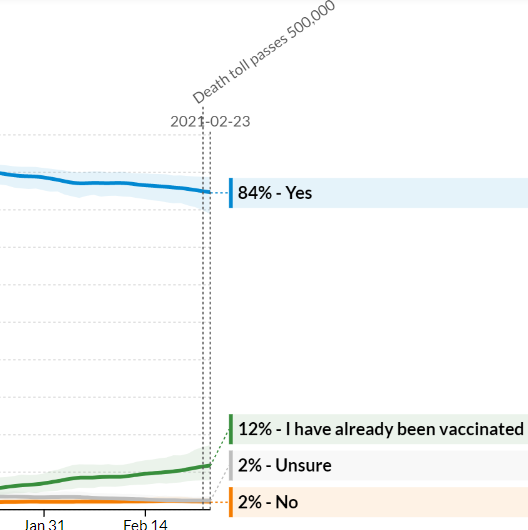
Percent who say they are unsure or will not take the COVID-19 vaccine
Survey of U.S. registered voters, Nov. 9, 2020, to Feb. 23, 2021

Reproduced from Civiqs; Chart: Axios Visuals

Now let’s view the extremes. First the bottom:

Do you plan to take a coronavirus vaccine if it becomes available?
Refined by: Party: Republican; Gender: Male; Age: 18-34; Race: White; Education: Non-College Graduate

The people least likely to take the vaccine are White, Republican males, age 18-34, who have not graduated college.


Then the top:

Do you plan to take a coronavirus vaccine if it becomes available?
Party: Refined by: Party: Democrat; Gender: Male; Age: 50-64; Race: White; Education: College Graduate

The people most likely to take the vaccine are White, Democrat males, age 50-64, who are college graduates.
—————————————————————————————————————————————————————–
The single biggest variable is Party, with only 2% of the Democrats saying they will not take the vaccine, while an astounding 64% of the Republicans saying they will refuse.
That comprises a massive number of Americans angling to receive Darwin Awards.
—————————————————————————————————————————————————————-

Unfortunately, those having low intelligence are not intelligent enough to understand that their opinions are based on low intelligence. So they follow others of low intelligence or others who will do them harm.

The clearest symptoms of low intelligence are acting indefensibly and defending the indefensible — for example, the people who encouraged, participated in, or defend the attempt to overturn the American elections by force, and/or who now speak longingly of secession from the United States.

Because truth and logic seldom penetrate the minds of the unintelligent (who usually prefer to believe and repeat rumors, conspiracy theories, and outright lies), the only hope is that these unintelligent people do not cause irreparable harm to the world.

Rodger Malcolm Mitchell

Monetary Sovereignty Twitter: @rodgermitchell Search #monetarysovereignty Facebook: Rodger Malcolm Mitchell …………………………………………………………………………………………………………………………………………………………………………………………………………………………………………………………………………………………..

THE SOLE PURPOSE OF GOVERNMENT IS TO IMPROVE AND PROTECT THE LIVES OF THE PEOPLE.

The most important problems in economics involve:

  1. Monetary Sovereignty describes money creation and destruction.
  2. Gap Psychology describes the common desire to distance oneself from those “below” in any socio-economic ranking, and to come nearer those “above.” The socio-economic distance is referred to as “The Gap.”

Wide Gaps negatively affect poverty, health and longevity, education, housing, law and crime, war, leadership, ownership, bigotry, supply and demand, taxation, GDP, international relations, scientific advancement, the environment, human motivation and well-being, and virtually every other issue in economics. Implementation of Monetary Sovereignty and The Ten Steps To Prosperity can grow the economy and narrow the Gaps:

Ten Steps To Prosperity:

  1. Eliminate FICA
  2. Federally funded Medicare — parts A, B & D, plus long-term care — for everyone
  3. Social Security for all or a reverse income tax
  4. Free education (including post-grad) for everyone
  5. Salary for attending school
  6. Eliminate federal taxes on business
  7. Increase the standard income tax deduction, annually. 
  8. Tax the very rich (the “.1%”) more, with higher progressive tax rates on all forms of income.
  9. Federal ownership of all banks
  10. Increase federal spending on the myriad initiatives that benefit America’s 99.9% 

The Ten Steps will grow the economy and narrow the income/wealth/power Gap between the rich and the rest.

MONETARY SOVEREIGNTY

Another example of taxing the poor more than the rich, and why the cities struggle

The rich have tax shelters, tax deductions, tax loss carryforwards, tax avoidance schemes, secret off-shore bank accounts, tax-deferred trusts, and high-powered accountants to see that they pay only a tiny portion of their earnings in taxes.Rauner's 'toilet' attack on Pritzker is a real loo-loo - Chicago Tribune

(The governor of Illinois, who lives in Chicago, took the toilets out of an empty mansion he owns, to take advantage of a law that lowers taxes for buildings without toilets.)

The rich have businesses to provide “platinum” health care policies along with “diamond” retirement programs.

President Trump is an example of that “most-favored-person” scam.

As I recall, this self-proclaimed billionaire hasn’t paid taxes in a decade.

Have you thought about the fact that you paid more taxes last year alone than Donald Trump paid in the past ten years, total?

The poor, on the other hand, are saddled with regressive, unnecessary FICA, exorbitant sales taxes, and other government fees and taxes that are difficult if not impossible to avoid.

On average, the lower-income groups pay a higher percentage of their income in taxes and government fees than do the rich.

And even those “friends of the poor” Democrats continue to pile it on, as this article in today’s Chicago Tribune can attest:

City’s 6 mph speeding ticket rules start Monday, and they’re looking lucrative
By John Byrne Chicago Tribune

(Democrat) Mayor Lori Lightfoot’s new stricter speed camera rules start Monday and, if the early warnings are any indication, they’re looking expensive for Chicago drivers.

As the city prepares to start ticketing drivers in Chicago going as little as 6 miles per hour over the posted speed limit, warnings mailed to people caught exceeding the new threshold show the change promises to be hugely lucrative for the city and a significant burden for residents already struggling to pay fines.

In the first week of the grace period that started in January, 52,498 warning notices were sent out, according to the Finance Department. The notices were intended to get people used to the fact they’re going to receive $35 tickets for being caught by any of more than 100 speed cameras around the city going from 6 to 9 mph too fast, according to the Finance Department.

Over a full year, such numbers would work out to over 2.7 million $35 tickets, with total revenue to the city of $95.5 million.

Under existing rules, cars caught by a camera going 10 mph over the limit get a $35 ticket, while those traveling 11 miles per hour and up above the posted speed get tagged for a $100 fine.

Now guess who will pay those fines. Will it be the wealthy suburbanites who ride to work downtown on comfortable, air-conditioned trains, or the poor slob who drives to work in the city, while hoping not to get carjacked on Chicago’s mean streets?

And with the available warning data pointing to more than 2.7 million tickets being issued annually under the new rules, the goal supposedly is not to cite drivers, but to promote safer driving.”

In order to avoid a speeding violation, drivers simply have to observe the speed limit.

Yes, it’s so simple to avoid going 6 miles per hour above the speed limit, that is, unless you drive in the real world, or on the Kennedy Expressway or Chicago’s Lake Shore Drive during the day or night, when the average speed is about 20 miles above the limit. Would you like to be a taxi driver who’s trying to get his impatient passenger to the airport on time?

Yes, you can drive the speed limit and get honked, fingered, rear-ended, or shot.

An now here’s the real knee-slapper:

With the new speed rules set to kick off Monday, the Lightfoot administration this week characterized the move as part of its larger “Vision Zero” plan to reduce car crashes.

“With the impacts of COVID-19, Chicago and many other cities experienced reduced traffic volumes that were accompanied by a surge in speeding and traffic deaths.

According to provisional data, 139 people died in traffic crashes in Chicago in 2020,” a news release read in part.

For perspective, compare that 139 figure to Chicago’s population of 2,700,000 and to the 725 people who died, and the nearly 4,000 who were injured, by gun violence in Chicago in the same year.

And sure, the purpose of those fines is to “promote traffic safety.” Believe that, and I’ll sell you one of the bridges over the Chicago River.

The real problem is, the monetarily non-sovereign cities, counties, and states don’t have enough money.

They can try to soak the rich with property taxes and wealth taxes, but the rich simply will move out and build their property where the taxes are lower.

That begins a cycle of exit, then urban decay, then more exit, especially in the cold-weather cities that don’t have as many tourists bringing in money, as do the southern areas. And ultimately, the poor get hammered.

So what is a mayor to do?

The answer, the only answer, is for the Monetarily Sovereign federal government to subsidize the big cities.

Too many politicians wrongly claim those big-city financial problems are due solely to mismanagement. Yes, there is plenty of waste in big-city government, as there is in all large enterprises.

But waste is not the real culprit. The real problem is the inevitable result of monetary non-sovereignty, which means that:

  1. The main source of money is taxes, fees, and fines
  2. The need for which goes up every year
  3. And mostly are paid by the lower-income groups

It’s a built-in, structural problem, that only can be solved via money coming from the Monetarily Sovereign federal government.

Unfortunately, Illinois, Chicago’s state, runs a $15 billion negative balance of payments with the federal government, so even the monetarily non-sovereign state can’t do much to help Chicago. Money is flowing out instead of in.

And while our cities and their lower-income residents struggle, we have economic know-nothings whining about the meaningless federal debt, a number that has increased nearly every year for 80 years, with no adverse effect.

Rodger Malcolm Mitchell

Monetary Sovereignty Twitter: @rodgermitchell Search #monetarysovereignty Facebook: Rodger Malcolm Mitchell …………………………………………………………………………………………………………………………………………………………………………………………………………………………………………………………………………………………..

THE SOLE PURPOSE OF GOVERNMENT IS TO IMPROVE AND PROTECT THE LIVES OF THE PEOPLE.

The most important problems in economics involve:

  1. Monetary Sovereignty describes money creation and destruction.
  2. Gap Psychology describes the common desire to distance oneself from those “below” in any socio-economic ranking, and to come nearer those “above.” The socio-economic distance is referred to as “The Gap.”

Wide Gaps negatively affect poverty, health and longevity, education, housing, law and crime, war, leadership, ownership, bigotry, supply and demand, taxation, GDP, international relations, scientific advancement, the environment, human motivation and well-being, and virtually every other issue in economics. Implementation of Monetary Sovereignty and The Ten Steps To Prosperity can grow the economy and narrow the Gaps:

Ten Steps To Prosperity:

  1. Eliminate FICA
  2. Federally funded Medicare — parts A, B & D, plus long-term care — for everyone
  3. Social Security for all or a reverse income tax
  4. Free education (including post-grad) for everyone
  5. Salary for attending school
  6. Eliminate federal taxes on business
  7. Increase the standard income tax deduction, annually. 
  8. Tax the very rich (the “.1%”) more, with higher progressive tax rates on all forms of income.
  9. Federal ownership of all banks
  10. Increase federal spending on the myriad initiatives that benefit America’s 99.9% 

The Ten Steps will grow the economy and narrow the income/wealth/power Gap between the rich and the rest.

MONETARY SOVEREIGNTY
Finally, the beginning of the end for cash bail?

Back in 2016, we published, “Money bail: Another foible of the Gaps.”

A few excerpts from that post:Casablanca Court Sentences Man to 5 Years for Bribing Judge - Alraiy Morocco news online

As most, regular readers of this blog know, the income/wealth/power Gaps between the rich and the rest, constitute the single, most important economic problem facing America and the world.

The Gaps exacerbate crime, disease, poor education and housing, infrastructure decline, the ecology, unnecessary war, and unfair justice, among other issues.

Today, we see an example in the following article from the October 1, 2016, Chicago Tribune:

Man held on $5 million bail in U. of I. shooting

An 18-year-old accused of fatally shooting a Mundelein man in the Campustown district at the University of Illinois at Urbana-Champaign early Sunday morning was ordered held in lieu of $5 million bail Friday afternoon.

Robert Patton is accused of shooting into a crowd early Sunday, killing George Korchev, 22, and injuring three others.

What was the purpose of money-bail, and why $5 million?

I’ll answer the 2nd question first: Why $5 million? The clear purpose was to make the bail unaffordable for Patton, so that he will not be loose on the street. The judge clearly does not trust Patton to be free, despite the fact that Patton turned himself in..

That being the case, why offer any bail at all?

If Patton had $5 million (or even the 10%, $500 thousand cash required) should he be free to go?  Would he be less a risk to the public if he were rich?

Then, the first question: What is the purpose of bail? According to the American Bar Association: Bail is not a fine. It is not supposed to be used as punishment.

The purpose of bail is simply to ensure that defendants will appear for trial and all pretrial hearings for which they must be present.

Money bail presumes that poorer people, who are less likely to have bail money, must be more likely to flee and are more dangerous to the community.

A rich man, accused of the same crimes as Patton, will make bail and be free.

As a side note, the existence of bail bondsmen — people who lend money to those whom the bondsmen trust to return to court — tacitly assumes they:

  1. Are better able to evaluate the reliability of the accused than is the judge who sets the bond.
  2. Are better able to apprehend a fleeing accused than are the police.

(Money bail) exists, as a constant reminder of the Gap between the rich and the rest

In 2019, we published a more thorough analysis of cash bail: “Money Bail: The pro-rich, anti-everyone-else “tax” on the accused”

It included a quote from Sen. Bernie Sanders:

“We lock up more than 2 million people in America, which is more of our own people than any country on Earth.

“Hundreds of thousands of incarcerated people in America have not been convicted of a crime and are solely in jail because they can’t afford their bail. We are criminalizing poverty.”

“Right now, hundreds of thousands of people without a criminal conviction are in jail simply because they could not afford bail. Young people can spend hundreds of days in jail, only to be acquitted — yet the severe damage to their lives cannot be undone.”

Well, good news for justice lovers:

Yahoo News, Mike Bebernes·Editor, January 16, 2020: A new law in New York state that eliminated cash bail for most nonviolent crimes went into effect at the beginning of January.

The change has been celebrated by criminal justice reform advocates but has been met with intense opposition from law enforcement and conservative politicians.

And then, this from the 2/22/2021 Chicago Tribune

Gov. Pritzker signs sweeping criminal justice overhaul
By Dan Petrella Chicago Tribune

Gov. J.B. Pritzker signed into law on Monday a sweeping criminal justice overhaul package that has been praised by reform advocates and panned by law enforcement groups.

The legislation will abolish cash bail in Illinois beginning in 2023, require police officers statewide to wear body cameras by 2025 , eliminate requirements for signing sworn affidavits when filing complaints against officers, and create a more robust statewide system for tracking police misconduct and decertifying officers who commit wrongdoing.

The measure, passed in the waning hours of the previous General Assembly’s lame-duck session in January, was advanced by the Illinois Legislative Black Caucus as part of its response to the public outcry over the death last year of George Floyd at the hands of Minneapolis police.

The package has the backing of organizations such as the American Civil Liberties Union of Illinois, advocates for domestic violence victims, and even some prosecutors, including Cook County State’s Attorney Kim Foxx.

But police unions and leadership organizations, including the Illinois Association of Chiefs of Police and the Illinois Sheriffs’ Association, have broadly criticized the changes.

Why do the police want cash bail? Because they most often deal with street crime, and street crime is the primary province of the lower-income groups. The police see the revolving door of arrests and releases, especially with regard to gun, drug, domestic abuse, and other crimes of violence.

It is disheartening for a police officer to risk his/her life each day, bringing in violent or potentially violent offenders, just to see them released back into the streets.

Though I empathize with the police on this issue,  I believe justice revolves around two questions:

  1. Is it worse for an innocent person to be locked up for weeks or months, or for a guilty person to be released into the public, where he/she can commit more crimes?
  2. Is it justice for a rich, guilty person to make bail and be released while a poor guilty person must stay in jail pending trial?

If you believe that “innocent until proven guilty” also means unpunished until proven guilty, as most Americans do, then you are outraged that the cash bail system is a method for punishing innocent people.

And if you believe that the law should treat rich and poor alike, then you are outraged that the cash bail system is a method for punishing poor, innocent people while leaving rich, guilty people unscathed.

The fundamental purpose of the cash bail system is to assure that POOR people show up for trial.

Traci Schlesinger, a sociologist at DePaul University and a board member for the Pretrial Justice Institute wrote about this issue. I urge you to click the link to read the entirety of his excellent article. Here are a few highlights:

“When people aren’t making it to court for their first appointment, most likely they’ll come to their second appointment—and nearly everyone makes it by the third.”

Most failure to appears (FTAs) are the result of forgetfulness or circumstances beyond a defendant’s control. They might need child care, or they are just confused by the court system. 

Nor are missed appointments unique to the criminal justice system. Multiple studies report no-show rates of 15 to 30 percent for medical appointments, which is about the same as the criminal court FTA rate in most U.S. jurisdictions. (Meanwhile), some parts of the civil court system, like small claims court and housing court, have absentee rates as high as 95 percent.

“If you miss a doctor’s appointment, you call and reschedule,” Rich-Shea said. “If you miss an appointment with your cable company, you call and reschedule. Why is this so different?”

FTA is also calculated differently in different jurisdictions at different times, and by various agencies. Some agencies calculate the total number of court appointments missed — so that one person who missed 10 court dates would generate 10 FTAs. Other jurisdictions count the number of individuals who failed to appear at any point during the lifetime of a case—so whether a person misses one or 10 court dates, for example, that person would be recorded as one FTA.

Court dates can drag out over months and even years, requiring a person who faces charges to return multiple times. Many courts are only open during weekday office hours, when many people find it most difficult to take time off from work.

In fact, the percentage of FTAs resulting from defendants absconding is exceedingly low, notes Syracuse University College of Law professor Lauryn Gouldin, author of a 2018 law review article on flight risk.

The largest study on court appearances to date, conducted by the Bureau of Justice Statistics between 1990 and 2004 in 40 of the 75 largest U.S. counties, found that more than three-quarters of defendants showed up for all of their court dates.

Of the minority that missed at least one hearing, 94 percent appeared in court within a year after their missed court date.

Even in Illinois, which now has taken the wise step of eliminating all cash bail, judges continue to be able to protect the public. If they believe the accused is a danger to the public, they can deny bail. Or, they can use an ankle monitor. Or they can send the police after the absent accused.

Money bail is a relic of “money justice,” when the rich receive preferential treatment from the courts. The elimination of money bail would be one step in eliminating the heinous tradition of courts favoring the wealthy.

Rodger Malcolm Mitchell

Monetary Sovereignty Twitter: @rodgermitchell Search #monetarysovereignty Facebook: Rodger Malcolm Mitchell …………………………………………………………………………………………………………………………………………………………………………………………………………………………………………………………………………………………..

THE SOLE PURPOSE OF GOVERNMENT IS TO IMPROVE AND PROTECT THE LIVES OF THE PEOPLE.

The most important problems in economics involve:

  1. Monetary Sovereignty describes money creation and destruction.
  2. Gap Psychology describes the common desire to distance oneself from those “below” in any socio-economic ranking, and to come nearer those “above.” The socio-economic distance is referred to as “The Gap.”

Wide Gaps negatively affect poverty, health and longevity, education, housing, law and crime, war, leadership, ownership, bigotry, supply and demand, taxation, GDP, international relations, scientific advancement, the environment, human motivation and well-being, and virtually every other issue in economics. Implementation of Monetary Sovereignty and The Ten Steps To Prosperity can grow the economy and narrow the Gaps:

Ten Steps To Prosperity:

  1. Eliminate FICA
  2. Federally funded Medicare — parts A, B & D, plus long-term care — for everyone
  3. Social Security for all or a reverse income tax
  4. Free education (including post-grad) for everyone
  5. Salary for attending school
  6. Eliminate federal taxes on business
  7. Increase the standard income tax deduction, annually. 
  8. Tax the very rich (the “.1%”) more, with higher progressive tax rates on all forms of income.
  9. Federal ownership of all banks
  10. Increase federal spending on the myriad initiatives that benefit America’s 99.9% 

The Ten Steps will grow the economy and narrow the income/wealth/power Gap between the rich and the rest.

MONETARY SOVEREIGNTY