The unspoken lie that is even bigger and more damaging than the “Big Lie.”

The “Big Lie” in economics is: Federal taxes fund federal spending.
12 Photos of Mitch McConnell Looking Sad
Hell, we can change any law we want to. Don’t let the voters know the government can’t run short of dollars. 

State and local taxes fund state and local spending, because state and local governments are monetarily non-sovereign, while the federal government is Monetarily Sovereign.

But federal taxes do not fund federal spending. Even if all federal tax collections were $0, the federal government could continue spending forever.

The federal government is the creator and issuer of the U.S. dollar. It doesn’t need or use tax dollars. The sole purpose of federal taxes is to aid the government in controlling the economy by taxing what it wishes to discourage and giving tax breaks to what it wishes to encourage.

That’s why the federal government is able to pass multi-trillion dollar spending bills without worrying about “Who’s going to pay for it?” They just create the money.

State and local governments are merely users of the U.S. dollar. They do need and use tax dollars.

And that makes all the difference.

That Big Lie leads to wooly-brained concerns that the U.S. government can run short of the very dollars it creates, and that its agencies can become insolvent.

But as big and nutty as the Big Lie is, there is an even bigger, nuttier, and more damaging lie:

The unspoken lie:
The federal government does not have the power to change its own laws.

Who would believe that? Well, the Committee for a Responsible Federal Budget (CRFB) for one. Here is what they tell people:

Some of the nation’s most important government programs are financed with dedicated revenue sources using federal trust funds. Four of those programs are within 14 years of insolvency.
FY 2022: Highway Trust Fund (HTF)
FY 2026: Medicare Hospital Insurance (HI) Trust Fund
CY 2032: Social Security Old Age and Survivors Insurance (OASI) Trust Fund
CY 2035 Social Security Disability Insurance (SSDI) Trust Fund

By law, trust fund spending cannot exceed revenue once reserves are depleted. Insolvency would trigger a 7 percent cut to disability benefits, a 13 percent cut in Medicare payments, a 25 percent cut in highway spending, and an abrupt across-the-board 27 percent cut in Social Security retirement benefits.

This situation supposedly is so dire, the CRFB article repeats it, just to make sure you are sufficiently frightened:

Under the law, trust fund programs cannot spend in excess of their dedicated funding sources.

Once the trust funds are depleted, the programs may only spend incoming revenue. For the Highway Trust Fund, this means new projects will be immediately halted and spending ultimately reduced by one-quarter.

For Medicare, all payments will be cut by 13 percent or delayed by an equivalent amount upon insolvency.

“By law”? “Under the law”?

Whose law are they talking about? Do they mean Russia’s law? China’s law? The CRFB’s law?

No, they are talking about America’s law, you know, the law that is created by Congress and the President.

It is the law that is not chiseled into marble, but rather changed every month of every year, at the whim and behest of Congress and the President.

There is absolutely nothing to prevent Congress and the President from changing the law and allowing trust fund spending to exceed revenues. A federal clerk on a typewriter could do it.

The CRFB continues on its errant path, with lie after lie:

Policymakers must restore solvency to the major trust funds to avoid abrupt across-the-board benefit and spending cuts.

However, solvency solutions can also improve the sustainability of the national debt, increase economic output and income, and improve policy outcomes.

Whoops, there’s the CRFB’s favorite word: “Sustainability.” What does it mean? No one knows, but it surely must be something important.

In 1940, the federal debt was $40 billion. Today, it has grown to about $25 TRILLION! That’s a 62,500% increase. Let me pretend to put it in scare headlines, like the CRFB does.

OUR FEDERAL DEBT HAS INCREASED SIXTY-TWO THOUSAND, FIVE HUNDRED PERCENT IN EIGHTY YEARS!

And yet here we are, sustaining a debt that supposedly can’t be sustained, along with the strongest economy in the world.

The article continues:

CBO’s budget projections generally assume trust fund programs continue spending as scheduled after insolvency, as if lawmakers used general revenues to support the funds. Under CBO’s baseline, debt will double from a near-record 100 percent of GDP in 2020 to over 200 percent of GDP by 2051.

Wait! What? “Used general revenues”? What does that mean?

It means that with all the wailing and weeping about “unsustainable,” the CRFB acknowledges that the federal government simply can pay for the bills and not rely on phony trust funds.

(Although the CRFB erroneously says the government could use “general revenues” the federal government does not use revenues for anything.)

The federal government simply could write checks to support all the spending of the Highway Trust Fund, the Medicare Hospital Insurance Trust Fund, the Social Security Old Age and Survivors Insurance Trust Fund, and the Social Security Disability Insurance Trust Fund — or better yet, do away with those trust funds altogether and simply pay the  bills.

That’s what it does for every other agency of the government.

There is no need for the dire consequences of insolvency.

Recognizing that the phony trust funds represent important benefits to Americans, here are the CRFB’s “solutions” to the Highway Trust Fund’s fake impending doom:

Policy 10-Year Savings
Revenue Options
Increase gas and diesel taxes by 10 cents $140 billion
Impose 1 cent per mile Vehicle Miles Traveled Tax on all vehicles $150 billion
Impose 5 cent per mile Vehicle Miles Traveled tax on commercial trucks, only $160 billion
Impose $5 per barrel per barrel tax on oil $160 billion
Impose $25 per ton carbon tax in place of the gas tax $700 billion
Spending Options 
Freeze Highway Spending for Five Years $60 billion
Replace Surface Transportation Block Grants with Matching Grants’ $70 billion
Cut Federal Transit Spending in Half $60 billion
Reduce Federal Share of National Highway Performance Program by 15%^ $50 billion
Repeal Davis-Bacon Act $20 billion

In short, the CRFB wants the federal government to remove $1.31 TRILLION from the economy as “revenue,” while adding $260 BILLION less than planned — a $1.57 trillion loss for the economy.

Do you think taking $1.57 TRILLION stimulus dollars from the private sector will affect economic growth? Who doesn’t think so?

Well, the CRFB doesn’t seem to think that’s a problem at all.

And here’s what the CRFB would like to do with Medicare Part A. (We should mention that the federal government simply pays for Medicare Part B. No trust fund, there. That’s exactly what they should do for Part A.)

Spending Options Billion
Improve Medicare Advantage Coding Intensity Adjustments $370
Establish Graduate Medical Education Fund Outside Medicar $105
Modernize Medicare and Medigap Cost-Sharing Rules $140
Eliminate Medicare Payments for Bad Debts $80
Reduce and Reform Post-Acute Care Payments $90
Revenue Options
Increase the HI Payroll Tax Rate by 0.5 Percentage Points $455
Broaden the HI Payroll Tax Base to Cover Employer Health Benefits $310
Expand the Base of the Net Investment Income Tax, Dedicate Half of all NIIT Revenue to the HI Trust Fund $225
Apply the Payroll Tax to Business Income for Self-Employed Workers to Reduce Tax Avoidance $200
Impose an Excise Tax on Sugar-Sweetened Beverages, Dedicate the Revenue to the HI Trust Fund $80

Here, the CRFB wants to remove $2.055 TRILLION from the private sector. So between just two of the phony “Trust Funds,” the CRFB suggests removing $3.7 TRILLION from the economy in just ten years.

What effect do you think that would have?

And that doesn’t even count what they want to do with the Social Security “Trust Funds.”

The CRFB use the euphemism, Social Security “reforms.” If they were being honest, they would label the Social Security benefit cuts and tax increases.”

And if  all this wasn’t damaging enough, let’s move on to what the CRFB wants to do about the $25 trillion federal “unsustainable” debt. The CRFB thinks that’s too high. How many trillions should we remove from the economy to pay that off, even though the so-called “debt” is nothing more than the total of deposits into T-security accounts, which are paid off simply by sending the dollars back?

These deposits are similar to deposits into a bank safety-deposit box. Money goes in, and when you want it, you take the money out. It’s not real debt at all.

The bottom line of all this is: The federal government can change any laws it wishes to change. It has full power to:

  1. Fund all federal benefits simply by issuing checks.
  2. Eliminate all “debt” by returning the money currently in T-security accounts.

All this “woe-is-us” wailing and moaning about debt and solvency is meant to mislead you. Federal finance is similar to the Monopoly game in which the federal government makes all the rules.

Pass a couple of laws and the federal government would be “debt”-free and its agencies would be flush with spending money, and you wouldn’t have to worry about your Social Security, Medicare, and road funds disappearing.

All it requires is for you, the voter, to understand the realities of Monetarily Sovereign federal finance.

Rodger Malcolm Mitchell

Monetary Sovereignty Twitter: @rodgermitchell Search #monetarysovereignty Facebook: Rodger Malcolm Mitchell …………………………………………………………………………………………………………………………………………………………………………………………………………………………………………………………………………………………..

THE SOLE PURPOSE OF GOVERNMENT IS TO IMPROVE AND PROTECT THE LIVES OF THE PEOPLE.

The most important problems in economics involve:

  1. Monetary Sovereignty describes money creation and destruction.
  2. Gap Psychology describes the common desire to distance oneself from those “below” in any socio-economic ranking, and to come nearer those “above.” The socio-economic distance is referred to as “The Gap.”

Wide Gaps negatively affect poverty, health and longevity, education, housing, law and crime, war, leadership, ownership, bigotry, supply and demand, taxation, GDP, international relations, scientific advancement, the environment, human motivation and well-being, and virtually every other issue in economics. Implementation of Monetary Sovereignty and The Ten Steps To Prosperity can grow the economy and narrow the Gaps:

Ten Steps To Prosperity:

  1. Eliminate FICA
  2. Federally funded Medicare — parts A, B & D, plus long-term care — for everyone
  3. Social Security for all
  4. Free education (including post-grad) for everyone
  5. Salary for attending school
  6. Eliminate federal taxes on business
  7. Increase the standard income tax deduction, annually. 
  8. Tax the very rich (the “.1%”) more, with higher progressive tax rates on all forms of income.
  9. Federal ownership of all banks
  10. Increase federal spending on the myriad initiatives that benefit America’s 99.9% 

The Ten Steps will grow the economy and narrow the income/wealth/power Gap between the rich and the rest.

MONETARY SOVEREIGNTY

Bold and Pitiful: The Biden budget proposal

Here are a few short excerpts from a much longer article that ran in the New York Times:

New York Times
Biden Team Preparing Up to $3 Trillion in New Spending for the Economy
Jim Tankersley

WASHINGTON — President Biden’s economic advisers are preparing to recommend spending as much as $3 trillion on a sweeping set of efforts aimed at boosting the economy, reducing carbon emissions and narrowing economic inequality.

The scope of the proposal under consideration highlights the aggressive approach the Biden administration wants to take as it tries to harness the power of the federal government to narrow economic inequality, reduce the carbon emissions that drive climate change and improve American manufacturing and high-technology industries in an escalating battle with China and other foreign competitors.

It’s bold; it’s pitiful.

No. the proposed $3 trillion isn’t pitiful. It’s bold and wonderful.

And no, the individual spending plans aren’t pitiful. They comprise the boldness this nation really needs to keep its leadership position in the world, and to help keep the world a viable place for humanity to exist.

The pitiful parts of that New York Times article are the phrases shown below in bold italics:

  1. The plan begins beginning with a giant infrastructure plan that may be financed in part through tax increases on corporations and the rich.
  2. Whether it can muster Republican support will depend in large part on how the bill is paid for.
  3. Officials have discussed offsetting some or all of the infrastructure spending by raising taxes on corporations, including increasing the corporate income tax rate above the current 21 percent rate and a variety of measures to force multinational corporations to pay more tax in the United States on income they earn abroad.
  4. Officials have weighed financing that plan through initiatives that would reduce federal spending by as much as $700 billion over a decade, like allowing Medicare to negotiate prescription drug costs with pharmaceutical companies.
  5. The officials have discussed further offsetting the spending increases by raising taxes on high-earning individuals and households, like raising the top marginal income tax rate to 39.6 percent from 37 percent.
  6. They have debated whether to lower the income threshold for the top marginal rate, to tax all individual income above $400,000 at 39.6 percent, in order to raise more revenue for his spending plans.
  7. Mr. Biden’s broader economic agenda will face a more difficult road in Congress than his relief bill, which was financed entirely by federal borrowing.

If they were talking about a state or local government spending program, yes those phrases would be appropriate. Those governments are monetarily non-sovereign. They must pay for their spending through taxes and borrowing.

But the federal government, being Monetarily Sovereign, does not use tax money or borrowed money to pay for spending.

In truth, federal tax money is destroyed upon receipt, and the federal government does not borrow. That is a fundamental difference between federal finances and state/local government finances.

Dealing with each of the seven phrases, above:America The Beautiful - Inspiration316 Radio

  1. All federal spending is financed via money creation.To pay for anything, the federal government sends instructions to creditors banks, instructing the banks to increase the balances in creditors’ checking accounts.
    .
    When the banks do as instructed, new (M1) money is created and added to the money supply.
  2. The bill will be paid for by the federal government’s infinite ability to create its own sovereign currency, the U.S. dollar.
  3. Raising taxes on corporations hurts American business, just as cutting taxes on corporations stimulates business.
  4. Federal spending adds stimulus dollars to the private sector. Attempts to reduce federal spending reduce stimulus payments.
  5. Tax increases offset nothing, though there may be some Gap-closing benefitto taxing billionaires.
  6. The proposal to tax incomes of $400,000 plus is counterproductive, however, because those are the people building businesses for U.S. growth. Perhaps incomes of $1 million or more should see increased taxation.
  7. The federal government does not borrow. Having the unlimited ability to create dollars, why would it borrow? Those T-securities, sometimes referred to as “borrowing,” are nothing more than accepting deposits into T-security accounts. It’s like putting dollars into interest-paying safe deposit boxes.
    .
    To pay off the misnamed “debt” the government simply takes the dollars out of those “boxes” and sends them back to the account owners.

Biden is hoping to do a number of great things: Advance clean energy, modernize the infrastructure with the construction of roads, bridges, rail lines, and electric vehicle charging stations., tax cuts to fight poverty, the most aggressive spending yet by the United States to reduce carbon emissions and combat climate change.

He would aid the development of other “high-growth industries of the future” like 5G telecommunications. He would spend money for rural broadband, advanced training for millions of workers and 1 million affordable and energy-efficient housing units.

His proposal includes money for improvements to the electric grid and other parts of the power sector.

Documents suggest Biden will include nearly $1 trillion in spending alone on the construction of roads, bridges, rail lines, ports, electric vehicle charging stations and

There would be investments in the caregiving economy and in skills and training needed by our workers to compete and win the global economy of the future.”

Biden’s campaign predicted that Mr. Biden’s investments would create 5 million new jobs in manufacturing and advanced industries, on top of restoring all the jobs lost last year in the Covid-19 crisis.

The second plan under discussion is focused on students, workers and people left on the sidelines of the job market. It would spend heavily on education and on programs meant to increase the participation of women in the labor force, by helping them balance work and caregiving. It includes free community college, universal pre-K education, a national paid leave program and efforts to reduce child care costs.

That plan would also make permanent two temporary provisions of Mr. Biden’s recent relief bill: expanded subsidies for low- and middle-income Americans to buy health insurance and tax credits aimed at cutting poverty, particularly for children.

Doing all of the above, which the federal government easily could fund, and could do so without causing inflation, would truly advance the lives of Americans and the other people of the world. It would demonstrate America’s leadership, and its ability and willingness to do good, not only for America but for the world.

Donald Trump spoke boldly, but actually proposed narrow, mean-spirited, harmful little things like eliminating healthcare for the poor, walling-in America, preventing Muslims from entering, fostering hatred against Mexicans and the Chinese, denying and delaying prevention of COVID, and widening the wealth/income/power Gap between the rich and the poor.

Lacking compassion for the poor, people of color, foreigners, and any who did not worship him, Trump spread hatred and bile. He supported bigotry, white supremacists, and conspiracy theorists. Then ironically, he called it all, “Make America Great, Again.”

Not since Lyndon Johnson, and Franklin Roosevelt before him, has any President proposed a plan to help America become that “America the beautiful” we of which we can be proud.

And that is why Republicans are united in opposition to biden They oppose everything Biden proposes, especially plans that really would establish the greatness of America.

The very last thing the Trumper, FoxNews, QAnon, NewsMax GOP wants is a successful Biden administration. This is the greatest fear of the Republican party.

But Biden can succeed if he has the courage to tell the American public the truth about Monetary Sovereignty.

If only. If only.

Rodger Malcolm Mitchell

Monetary Sovereignty Twitter: @rodgermitchell Search #monetarysovereignty Facebook: Rodger Malcolm Mitchell …………………………………………………………………………………………………………………………………………………………………………………………………………………………………………………………………………………………..

THE SOLE PURPOSE OF GOVERNMENT IS TO IMPROVE AND PROTECT THE LIVES OF THE PEOPLE.

The most important problems in economics involve:

  1. Monetary Sovereignty describes money creation and destruction.
  2. Gap Psychology describes the common desire to distance oneself from those “below” in any socio-economic ranking, and to come nearer those “above.” The socio-economic distance is referred to as “The Gap.”

Wide Gaps negatively affect poverty, health and longevity, education, housing, law and crime, war, leadership, ownership, bigotry, supply and demand, taxation, GDP, international relations, scientific advancement, the environment, human motivation and well-being, and virtually every other issue in economics. Implementation of Monetary Sovereignty and The Ten Steps To Prosperity can grow the economy and narrow the Gaps:

Ten Steps To Prosperity:

  1. Eliminate FICA
  2. Federally funded Medicare — parts A, B & D, plus long-term care — for everyone
  3. Social Security for all
  4. Free education (including post-grad) for everyone
  5. Salary for attending school
  6. Eliminate federal taxes on business
  7. Increase the standard income tax deduction, annually. 
  8. Tax the very rich (the “.1%”) more, with higher progressive tax rates on all forms of income.
  9. Federal ownership of all banks
  10. Increase federal spending on the myriad initiatives that benefit America’s 99.9% 

The Ten Steps will grow the economy and narrow the income/wealth/power Gap between the rich and the rest.

MONETARY SOVEREIGNTY

How Alabama, Florida, Georgia, Kansas, Mississippi, North Carolina, South Carolina, South Dakota, Tennessee, Texas, Wisconsin and Wyoming cheat the poor.

Actually, if you live in Alabama, Florida, Georgia, Kansas, Mississippi, North Carolina, South Carolina, South Dakota, Tennessee, Texas, Wisconsin and Wyoming,  your poor fellow citizens are not the only ones being cheated.

Poor or rich, if you live in those states, you are being cheated, too.Common Issues and Barriers to Access - Accessibility at UB - University at  Buffalo

Medicaid incentive fails to sway holdout states

By Geoff Mulvihill and Jeffrey Collins Associated Press

COLUMBIA, S.C. — Democrats’ nearly $2 trillion coronavirus relief package includes a big financial incentive for the states that have opted against expanding Medicaid to provide health coverage for more low-income Americans. It’s proving to be a tough sell.

Top Republican elected officials in the dozen states that have resisted expanding coverage under a key provision of former President Barack Obama’s health care law. Some have softened their opposition, but the key gatekeepers— governors or legislative leaders — indicated they have no plans to change course.

The federal government already pays 90% of the costs of expanding Medicaid coverage to more low-income adults.

If you are a political leader of any of these dozen states, all you needed to do was allow your low-income residents to receive health care.

The federal government would have been paying essentially the full cost for more than four years.

But you have refused free money from the federal government.

Thirty-six states have signed on to the expansion. Two more — Missouri and Oklahoma — are scheduled to begin their expansions in July.

Under the enticement included in the new coronavirus relief bill adopted by Congress and signed by President Joe Biden, the federal government would boost its share of costs in the regular Medicaid program, which offers coverage for the poorest Americans. 

An analysis by the Kaiser Family Foundation found the additional federal money would cover 150% to 400% of the cost for the holdout states to expand Medicaid.

In Texas, the incentives would send the state about $5 billion over two years. More than 1.4 million people in the state could become eligible for coverage.

For Georgia, the estimate says it would add a net $710 million to state coffers and in Tennessee, $900 million.

But your Republican state leaders have refused the money. Why? Two reasons?

  1. It would help low-income people, and the GOP is the Party of the Rich. It cares nothing for the poor. Remember, when it gives tax breaks, it gives them to the rich.
  2. It is a program initiated by the Democrats. Because the GOP hates the Democrats, they refuse everything proposed by Democrats. You, a taxpayer in those dozen states, are punished by that hatred.

“It’s the literal offer you can’t refuse, but let’s see if anyone refuses it, anyway,” said Katherine Hempstead, a senior policy adviser at the nonpartisan Robert Wood Johnson Foundation.

In Mississippi, one of the nation’s poorest states, advocates say up to 300,000 people — about one-tenth of the state’s population — could become eligible for health coverage if the state adopted the expansion.

Gov. Tate Reeves, a Republican, said he’s not going for it. He opposed it, even as the Mississippi Hospital Association said it could bring up to 19,000 jobs to the state.

“My position has not changed,” he said this week. “I am opposed to expanding Medicaid in Mississippi. I am opposed to ‘Obamacare’ expansion.”

Who cares that the poor can’t afford healthcare? Not Reeves. Not the GOP.

He calls it the “Obamacare expansion,” so naturally he opposes it, no matter the benefit to Mississippi.

In three of the states — Kansas, North Carolina and Wisconsin — the Democratic governor favors expansion but can’t convince a Republican-controlled legislature.

“It’s not a big enough bribe,” said Richard Hilderbrand, the chair of the Kansas Senate health committee.

Most politicians see the political advantages in helping the disadvantaged. After all, it is the American way, to help the underdog. Healthcare is a fundamental benefit that states provide to all their citizens.

But when your mind and heart are so hardened against the Democrats and against the people who traditionally vote Democratic, even money and jobs aren’t enough to reward you for being moral.

Many Republicans remain concerned about the long-term costs of the program and are ideologically opposed to expanding government health care to working-age adults.

These are the same politicians who themselves receive free health care insurance compliments of the voters, but are “ideologically opposed” to others receiving such a benefit. (“I’ve got mine; who cares about you.”)

“I acknowledge that there are some gaps in coverage that need to be addressed, but I think they can be addressed in ways that do not require us to create a whole new level of entitlement in the state of North Carolina,” said state Senate Leader Phil Berger, a Republican

“Some gaps” is a euphemism for “poor people are screwed.” And “they can be addressed” means “I don’t have a plan and I have no intention of creating one, and every time someone comes up with a plan, I vote against it.”

It’s a similar story in Wisconsin, where the GOP-dominated Legislature and Democratic Gov. Tony Evers are at odds over the expansion. The Democrats’ coronavirus aid package doesn’t change that, Assembly Speaker Robin Vos said earlier this month.

“It’s a non-starter, and we will continue to oppose the liberal wish list item of Medicaid expansion,” he said.

“Oppose the liberal wish list” means “I will vote against anything that helps our poor Wisconsinites or is proposed by Democrats. I’m against both those things.”

Hempstead, of the Robert Wood Johnson Foundation, said Medicaid expansion is a way to address one of the biggest shortcomings in the national health care landscape: How to get coverage for a group of adults whose incomes put them below the poverty line — $12,880 for a person living alone.

In states that haven’t expanded Medicaid, there are about 2.2 million such people, the Kaiser study found. They usually don’t qualify for traditional Medicaid programs. They also do not make enough to be eligible to buy subsidized private coverage on the health insurance marketplaces established under Obama’s overhaul.

Another 1.8 million in those states who make slightly more — up to $17,774 for an individual — qualify for subsidized coverage but often can’t afford it. They could be covered through an expansion of Medicaid.

The GOP says, “Who cares about those people? Let ’em get sick and die. Let their kids get sick and die. How much money did they contribute to my political campaign?”

Studies have found that adding coverage for these lower-income people reduces charity care in hospitals, allows some to be healthy enough to work and creates additional health care industry jobs.

The financial benefits partially or totally offset the states’ share of the costs over time.

Even in the holdout states, those arguments catch the attention of some Republicans. In Alabama, Gov. Kay Ivey left open the possibility of expanding Medicaid at some point in the future, but there are no plans to do so.

“The problem has always been how to pay for it,” Ivey spokeswoman Gina Maiola said.

Excuse me, Gov. Ivey, but the federal government already has told you how to pay for it. The feds will pay for it. You can’t get away with the phony “pay for it” excuse. Voters aren’t that dumb.

The real problem is a relatively recent one. It began during the Obama administration. The GOP measures loyalty to party and Trump above loyalty to America.

Any Republican who agrees with anything said or proposed by a Democrat, no matter how beneficial and accurate that thing may be, will be labeled a “RINO” (Republican In Name Only).

The party will attempt to ostracize you. Trump will insult you and work against you in the next election. You will be called a “socialist” and a “communist.”

You only will receive respect from the GOP if you are a Trump bootlicker, who for instance, wishes to eliminate Obamacare with nothing to replace it, or to lie about the CORONA virus.

It was not always thus. There actually were times past when the two parties could pass legislation to benefit America’s less fortunate. (Hard to believe, isn’t it?)

Today, Fox News, NewsMax, and conspiracy theories run the GOP.  Those folks think your patriotism is not measured by how much you care about Americans, but rather about how much you hate immigrants and Democrats, and how hard you wave a flag — especially a Confederate flag.

So you of the “dirty dozen” states that refuse federal money, continue to pay your state taxes, knowing those state tax dollars could be less if there were more federal dollars coming in.

At least you have the good feeling that comes from not lifting a finger, even when paid to do so, to help those in your state who are less fortunate than you.

We only can hope this is temporary. One day, Trump and his Trumpist stooges will be gone, and America can return to being the compassionate beacon of morality most of us want it to be.

We want a return to America the beautiful, not America the mean-spirited, selfish, uncaring, hard-hearted, bigoted . . .

Rodger Malcolm Mitchell

Monetary Sovereignty Twitter: @rodgermitchell Search #monetarysovereignty Facebook: Rodger Malcolm Mitchell …………………………………………………………………………………………………………………………………………………………………………………………………………………………………………………………………………………………..

THE SOLE PURPOSE OF GOVERNMENT IS TO IMPROVE AND PROTECT THE LIVES OF THE PEOPLE.

The most important problems in economics involve:

  1. Monetary Sovereignty describes money creation and destruction.
  2. Gap Psychology describes the common desire to distance oneself from those “below” in any socio-economic ranking, and to come nearer those “above.” The socio-economic distance is referred to as “The Gap.”

Wide Gaps negatively affect poverty, health and longevity, education, housing, law and crime, war, leadership, ownership, bigotry, supply and demand, taxation, GDP, international relations, scientific advancement, the environment, human motivation and well-being, and virtually every other issue in economics. Implementation of Monetary Sovereignty and The Ten Steps To Prosperity can grow the economy and narrow the Gaps:

Ten Steps To Prosperity:

  1. Eliminate FICA
  2. Federally funded Medicare — parts A, B & D, plus long-term care — for everyone
  3. Social Security for all
  4. Free education (including post-grad) for everyone
  5. Salary for attending school
  6. Eliminate federal taxes on business
  7. Increase the standard income tax deduction, annually. 
  8. Tax the very rich (the “.1%”) more, with higher progressive tax rates on all forms of income.
  9. Federal ownership of all banks
  10. Increase federal spending on the myriad initiatives that benefit America’s 99.9% 

The Ten Steps will grow the economy and narrow the income/wealth/power Gap between the rich and the rest.

MONETARY SOVEREIGNTY
Federal deficit spending causes inflation except when . . .

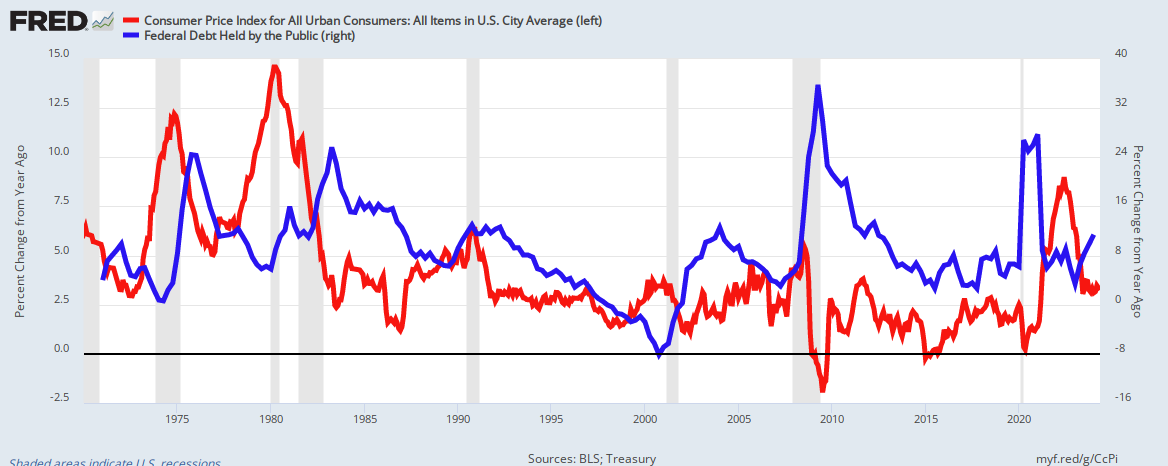
As “everyone” knows and claims, federal deficit spending causes inflation . . . except when it doesn’t.

As you can see from the graph below, it doesn’t.

Each place where the red and blue lines diverge indicates a lack of correlation between federal deficit spending and inflation.

BLUE line = Federal deficit spending. RED line = inflation. Vertical gray bars = recessions.

Lack of correlation between federal deficit spending seems to be more the rule than the exception. All inflations and hyperinflations have been caused by scarcity, usually shortages of food and/or energy.

That said, it is possible, though rare, for federal deficit spending to cause a shortage during major wars, especially a shortage of fuel. War machinery uses a great deal of oil, and inflation is highly related to oil prices.

But contrary to popular belief, federal spending to stimulate economic growth, or to reduce poverty, or to provide benefits to the underclasses, does not cause inflations.

It also does not “overheat” the economy (whatever that means), or any other similarly vague terms used by economists to make you think they know what they are talking about.

In fact, federal deficit spending not only cures recessions (as the graph shows), but it also can cure inflations, if the spending is used to purchase from abroad, then distribute to the public, the items that are in short supply.

For example, the most common cause of inflation these days is an oil shortage, which can be cured domestically by the federal government buying oil on the open market and distributing it to the private sector.

That is the purpose of the Strategic Petrolium Reserve:

According to the United States Energy Information Administration, approximately 4.1 billion barrels of oil are held in strategic reserves, of which 1.4 billion is government-controlled.

The remainder is held by private industry. In 2004 the U.S. Strategic Petroleum Reserve had the largest strategic reserve, with much of the remainder held by the other 27 members of the International Energy Agency.

Global oil consumption is in the region of 0.1 billion barrels per day. The 4.1 billion barrels reserve is equivalent to 41 days of production. The reserve is intended to be used to cover short-term supply disruptions.

Covering a 50% shortfall would deplete the reserves in 82 days.

It is those “short-term supply disruptions,” not federal deficit spending, that cause inflation.

How did the federal government obtain 1.4 billion barrels of inflation-preventing oil in its strategic reserve? Answer: Federal deficit spending.

I remind you of this because we now have, just balancing on a knife’s edge, a Democratic administration, which historically has tried to provide benefits for the lower- and middle-income groups.

The resistance to Medicare for All, Social Security for All, College for All, Basic Nutrition for All, along with improved infrastructure, usually comes from the party of the rich, the GOP.

Their excuses for not providing benefits to the “not-rich” can be summarized by three lies:

  1. The federal government can’t afford it without tax increases. (But our Monetarily Sovereign government has the unlimited ability to create dollars, i.e “print money.” So taxes are not necessary. See here.).
  2. The lazy poor will use benefits as an excuse not to work (except that is a proven myth, promulgated by the rich, and has no basis in fact. See here.).
  3. Deficit spending will cause inflation. (See the above graph).

O.K., politicians, what’s your next excuse for not implementing the Ten Steps to Prosperity? (below).

Rodger Malcolm Mitchell

Monetary Sovereignty Twitter: @rodgermitchell Search #monetarysovereignty Facebook: Rodger Malcolm Mitchell …………………………………………………………………………………………………………………………………………………………………………………………………………………………………………………………………………………………..

THE SOLE PURPOSE OF GOVERNMENT IS TO IMPROVE AND PROTECT THE LIVES OF THE PEOPLE.

The most important problems in economics involve:

  1. Monetary Sovereignty describes money creation and destruction.
  2. Gap Psychology describes the common desire to distance oneself from those “below” in any socio-economic ranking, and to come nearer those “above.” The socio-economic distance is referred to as “The Gap.”

Wide Gaps negatively affect poverty, health and longevity, education, housing, law and crime, war, leadership, ownership, bigotry, supply and demand, taxation, GDP, international relations, scientific advancement, the environment, human motivation and well-being, and virtually every other issue in economics. Implementation of Monetary Sovereignty and The Ten Steps To Prosperity can grow the economy and narrow the Gaps:

Ten Steps To Prosperity:

  1. Eliminate FICA
  2. Federally funded Medicare — parts A, B & D, plus long-term care — for everyone
  3. Social Security for all
  4. Free education (including post-grad) for everyone
  5. Salary for attending school
  6. Eliminate federal taxes on business
  7. Increase the standard income tax deduction, annually. 
  8. Tax the very rich (the “.1%”) more, with higher progressive tax rates on all forms of income.
  9. Federal ownership of all banks
  10. Increase federal spending on the myriad initiatives that benefit America’s 99.9% 

The Ten Steps will grow the economy and narrow the income/wealth/power Gap between the rich and the rest.

MONETARY SOVEREIGNTY