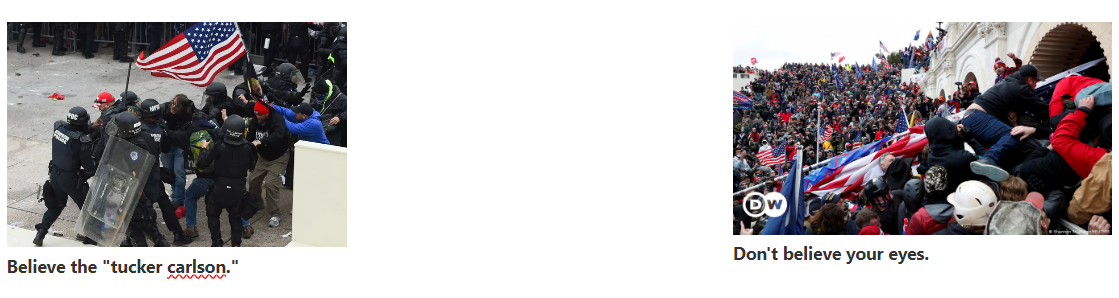
Sometimes, tucker carlsons are presented as “whataboutisms,” as in a statement like, “Donald Trump developed the COVID vaccine while Anthony Fauci lied.”
The statement is made to turn blame (for the million deaths) away from Trump’s denials and belated action, and present at worst an “Everyone made some mistakes” narrative.
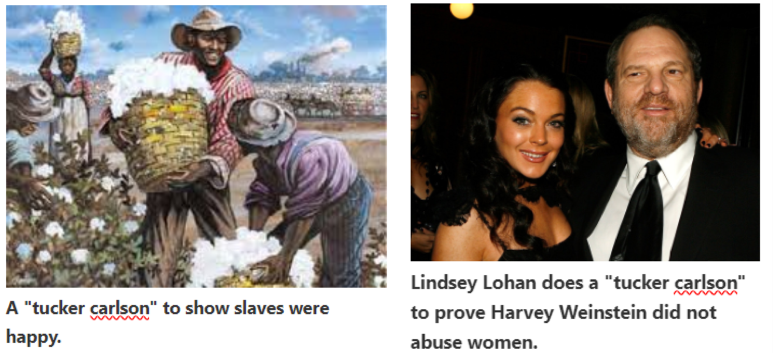
Beware of tucker carlsons. They are meant solely to deceive, not as honest arguments.
Dollars exist, but in what form; who created them, and how?
The uninformed may respond that dollars are pieces of green paper printed by the U.S. Treasury.
That answer would be incorrect on every level.
Those green pieces of paper are not dollars. Rather they are bearer titles to dollars. They are official recognition that the bearer owns a dollar.
These are not dollars. They are bearer titles to dollars
A house title is not a house. It is official recognition that the named person owns a particular house.
A car title is not a car, It is official recognition that the named person holds a certain car.
Dollars exist only as bookkeeping notations. They have no physical form.
You cannot see, feel, hear, touch, smell, or taste dollars.
The Treasury does not literally print dollars. It just prints titles to dollars, which exist as numbers in bank accounts.
All dollars are created from thin air by marking up accounts. Banks do it every minute of every day.
Consider the following scenario:
1. You go to a store, make a $10 purchase, and pay with your credit card.
Because you have a contract with the credit card company, you essentially have signed a loan document (the credit card receipt) saying you owe the credit card company $10.
That loan document, and all dollar-denominated loan documents, are titles to dollars.
A dollar bill is a bearer check signed by the Secretary of the Treasury.
So, your use of a credit card makes dollars.
(The green dollar bill in your wallet is a loan document. It signifies debt. It is a federal reserve note. “Bill” and “note” are words denoting debts.)
2. The credit card company sends instructions (not dollars) to the store’s bank, telling it to increase the balance in its checking account.
When the bank obeys those instructions, new dollars are created. These instructions are in the form of a check or wire transfer.
Simultaneously, the balance in the credit card company’s checking account is reduced, which destroys dollars.
At this stage, your purchase has caused the creation of ten dollars, a few cents of which go to various governments’ banks for sales taxes.
This bearer check is identical to a dollar bill, with one exception. The full faith and credit of the U.S. government backs a dollar bill. The full faith and credit of the writer backs the check.
3. Instructions among the several banks pass through the Federal Reserve, while the credit card company sends you a ten-dollar invoice.
To pay the invoice, you instruct your bankto send instructions to the credit card company’s bank, telling it to increase the balance in the credit card company’s checking account.
Those instructions are cleared through the Federal Reserve, and when your bank receives them, it reduces the balance in your checking account and destroys dollars.
Your one-time use of your credit card creates and destroys dollars.
At no time are physical dollars exchanged for there are no physical dollars.
All dollars are nothing more than numbers on financial institutions’ books.
Not being physical, dollars cannot be “sent.” Instead, instructionsin the form of checks or wires are sent to banks.
The banks are instructed to create and destroy dollars by changing the numbers in bank accounts.
What if that $10 purchase were made in cash rather than by credit card? Cash, i.e., dollar bills, are bearer titles to dollars. “Bearer” title means whoever has the title in their possession owns the dollars, which are numbers on the Treasury’s books.
All money represents a debt of the issuer, which among other things, owes the user full faith and credit.
You accept dollar bills in exchange for goods and services because you trust the full faith and credit of the federal government.
Self-evaluation corresponds with intelligence. If you are smart, being smart lets you understand that you are smart. If you are stupid, being stupid keeps you from knowing you are stupid. Thus, everyone thinks they are smart.In related issues, everyone thinks they are above-average drivers and that the federal government can run short of dollars.
==============/////=================
A rose by any other name may smell as sweet, but what if they called it “stinkwort”? Labels do matter. Visualize this scenario:
The boater must take more water from the ocean than he receives from the ocean. That is, the ocean must run a water deficit for the boater to survive, just as the federal government must run a dollar deficit for the economy to survive.
A man sits in a rowboat in the Pacific Ocean.
Using his desalinization kit he fills his canteen with one pint of water, which he later drinks and excretes as urine,
But, because of perspiration evaporation and breathing, he excretes only 9/10th pint of urine.
So, for boater the Pacific Ocean runs a deficitof 1/10th pint of water.
Does anyone care?
No, the Pacific Ocean running a 1/10th pint of water deficit is meaningless, because for all intents, the ocean has infinite water.
Infinite water minus 1/10th pint still equals infinite. No change.
Now imagine the same scenario, except instead of viewing it from the ocean’s standpoint, view it from the boater’s standpoint.
The man has drunk a pint of water, 9/10th of which he has excreted as urine into the ocean, and used the rest for perspiration, and other bodily functions.
That pint of water has allowed him to live for a certain time. Without the pint of water, he would have died.
That’s important.
In both scenarios we gave you the same information, but in one case we labeled it as a water measure from the standpoint of the ocean, and in the other case we labeled it as a water measure from the standpoint of the boater.
The following graph comes from https://www.chartr.co/newsletters/2023-02-08/. It labels money flow from the standpoint of the U.S. government:This graph shows the nation’s money flow from the standpoint of the U.S. government, not from the standpoint of the economy.
Here are excerpts from the accompanying article:
State of the union’s walletLast night, President Biden held the annual State of the Union. A big theme was the economy. He threatened to veto any proposal that would cut spending on Social Security and Medicare while also imploring Congress to raise the debt ceiling.
I O U $1.4 trillion: In fiscal year 2022, the federal government collected nearly $5tn in revenue, with more than 50% of that coming from individual income taxes.
However, the US government spent even more, leading to a nearly $1.4tndeficit.
To make up for the difference the US government does what everyone who overspends their budget does — they borrow.
This then adds to its already enormous tab (AKA the national debt), which currently sits at the $31.4tn debt ceiling limit.
With a debt pile that big, the interest payments aren’t small. Indeed, last year the US government spent ~$480bn on net interest payments, just shy of Ireland, Norway or Nigeria’s annual GDP.
There are three major problems with the above scenario.
It draws a false parallel between the finances of our Monetarily Sovereign governmentand the finances of monetarily non-sovereign “everyone.” The former has infinite money and the latter does not.
It falsely states that the federal government must borrow in order to “make up the difference.” The federal government, having the infinite ability to create its sovereign currency, never borrows dollars, and never needs to “make up the difference.” To pay all its obligations, the federal government creates new dollars, ad hoc. It destroys all the tax dollars it receives.
It labels the money movement from the standpoint of the federal government rather than from the standpoint of the economy.
Think of the Pacific Ocean as analogous to the U.S. federal government, and the boater as analogous to the economy.
Like the Pacific Ocean’s water, the federal government has infinite dollars. And like the boater’s limited water supply, the economy has limited dollars.
Alan Greenspan: “A government cannot become insolvent with respect to obligations in its own currency. There is nothing to prevent the federal government from creating as much money as it wants and paying it to somebody. The United States can pay any debt it has because we can always print the money to do that.”
Ben Bernanke: “The U.S. government has a technology, called a printing press (or, today, its electronic equivalent), that allows it to produce as many U.S. dollars as it wishes at essentially no cost.”
Quote from from 60 Minutes:Scott Pelley: Is that tax money that the Fed is spending?Ben Bernanke: It’s not tax money… We simply use the computer to mark up the size of the account.
Statement from the St. Louis Fed: “As the sole manufacturer of dollars, whose debt is denominated in dollars, the U.S. government can never become insolvent, i.e., unable to pay its bills. In this sense, the government is not dependent on credit markets to remain operational.”
(The final sentence, above, is Fed-speak for, “The government does not borrow to pay its bills.”)
The U.S. government is not the only Monetarily Sovereign government. The European Central Bank also is Monetarily Sovereign (and like the U.S. economy, individual euro nations are monetarily non-sovereign.)
Press Conference: Mario Draghi, President of the ECB, 9 January 2014Question: I am wondering: can the ECB ever run out of money?Mario Draghi: Technically, no. We cannot run out of money.
To survive, the boater needs the Pacific Ocean to run a water deficit. Similarly, to survive, the economy needs the federal government to run a dollar deficit.
The Pacific Ocean does not need to receive any water from the boater nor does the Ocean “owe” the boater any water. Similarly, the economy should not be asked to give the federal government any money, nor does the government “owe” the economy any money.
Finally, the Pacific Ocean does not borrow water to give water to the boater.
Think of the Pacific Ocean and the boater the next time you hear about federal debt limits and taxes.
Labels matter.
Rodger Malcolm Mitchell
Monetary SovereigntyTwitter: @rodgermitchellSearch #monetarysovereigntyFacebook: Rodger Malcolm Mitchell
……………………………………………………………………..
The Sole Purpose of Government Is to Improve and Protect the Lives of the People.


/cloudfront-eu-central-1.images.arcpublishing.com/diarioas/SHIIKXQJ6ZJPFA7VS6CJUOHX7I.jpg)




 #Monetary Sovereignty - Mitchell