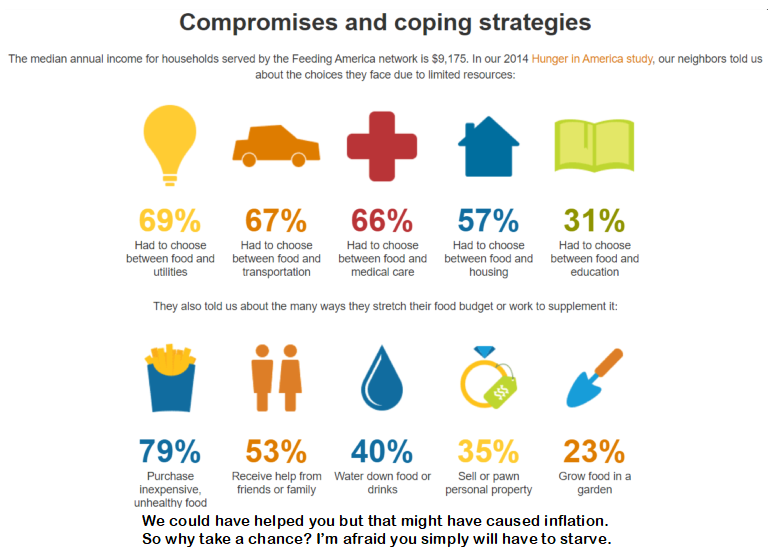
It’s a real question. If you had to choose between #1. Inflation or #2. Sickness, A Recession, A Depression, Poverty, Illiteracy, Starvation, Homelessness, Crime and some other bad stuff I could mention, would you chose #1 or #2?
It may sound like a no-brainer, and perhaps it is in the literal sense of “no brain,” because the vast majority of Americans claim they would rather experience #2 rather than #1.
Do you agree that you would prefer to experience sickness, a recession, a depression, poverty, illiteracy, Starvation, Homelessness, Crime, etc. than to experience inflation?
Let’s begin with the generally uncontested fact that the federal government created the laws that created the U.S. dollar. Because the federal government can create any laws it wishes, it can create as many dollars as it wishes, and cannot unintentionally run short of dollars. The experts agree:
Former Fed Chairman, Alan Greenspan:“The United States can pay any debt it has because we can always print the money to do that.”
Former Fed Chairman, Ben Bernanke:“The U.S. government has a technology, called a printing press (or, today, its electronic equivalent), that allows it to produce as many U.S. dollars as it wishes at essentially no cost.”
We could add to the discussion the fact that federal deficit spending does not cause inflation, which we have proved here and here and dozens of other places on this blog.
We could insist that shortages cause inflations, and those shortages can be cured by federal deficit spending. Thus, we can show that rather than causing inflations, federal deficit spending can cure inflations.
Sorry, but spending money on lifeguards and floatation devices would have caused inflation.
But, wait. Why struggle against a tide of misinformation? Let’s assume, for the sake of argument, that federal deficit spending does indeed, cause inflation.
It’s what most Americans believe.
Because the federal government can’t run short of its own sovereign currency, it could risk inflation by using that currency to pay for:
Comprehensive, generous Medicare insurance for every man, woman, and child in America
Generous Social Security benefits for every man, woman, and child in America, regardless of age, income, or wealth
All costs of education from K-12 and beyond, including advanced degrees from top universities
Rent and other housing subsidies, for all.
A healthful diet for all Americans
Subsidies for all states, counties, cities, and villages, so that none of them would have to levy taxes.
Ending the FICA deduction from salaries
Expanded research in all the sciences: Mathematics, Biology, Botany, Social Sciences, Philosophy, Geology, Physics, Chemistry, Astronomy, and all the other sciences not mentioned.
The purpose of such spending would be to improve and extend the lives of humans and the other living creatures with whom we share the earth.
The government has the ability to fund all of #1 through #8. But many people wrongly object, “But that would cause inflation.”
If those people were correct, and that spending would cause inflation, it only would mean they have chosen a lesser life rather than experience inflation.
They have chosen sickness rather than health, poverty instead of affluence, taxation rather than being tax-free, homelessness rather than sheltered, stagnancy rather than advancement, and ignorance rather than knowledge, all for the fear of inflation.
Would you rather suffer from incurable, painful disease than suffer from inflation? Would you rather risk being impoverished and homeless than to risk inflation? Would you prefer that your children be unable to attend the best colleges having the best resources money can buy, just so you don’t see prices rise?
Would you rather the type of research that amazed you with the Internet, cell phones, artificial intelligence, moon landings, etc. be discontinued for lack of funds, just so inflation can be avoided?
Would you prefer that America default on its debts by enforcing a debt ceiling? Would you rather that the federal government cease to improve our military?
Would you rather see the government do nothing to prevent or cure recessions and depressions, just because the cure – federal deficit spending – might cause inflation?
In summary, even if we admit the belief, just for the sake of argument, that federal spending causes inflation, we are left with very unsavory alternatives.
Think about it. Do you really believe that the possibility, or even the false probability, that federal deficit spending could cause inflation is more important than all of the things federal money could buy?
You often hear about the “entitlements crisis. Here is what it is and the 3 solutions — no, make that the 3 fake solutions + the one real solution.
In US Economics, what is the Entitlement Crisis?Erin J. Hill, Last Modified Date: February 28, 2023The United States entitlement crisis refers to the deficit between what programs such as Social Security and Medicare will require in comparison to how much funding is available.
Men: We have three solutions to your situation. Man: How about taking the rope off my neck. Men: Hmm, never thought of that one.
Immediately, Erin J. Hill starts on the wrong foot when she talks about “how much funding is available.”
The U.S. federal government uniquely is Monetarily Sovereign.
It created the first dollars from thin air by passing laws it created from thin air.
So long as the federal government can pass laws, it can pass laws that create dollars.
(Former Federal Reserve Chairman Alan Greenspan: “There is nothing to prevent the federal government from creating as much money as it wants and paying it to somebody.”)
This means that the cost of these programs will be more than what is in the federal budget.
There is nothing to prevent the U.S. federal government from increasing what is in the federal budget enough to pay for all the entitlements, twice over.
Government officials have not yet discovered a long-term solution for the issue, although some have suggested raising taxes on certain goods and making some government programs harder to be accepted into.
Those are the two fake solutions to the manufactured crisis, raise taxes and cut benefits. Both solutions would impoverish the middle- and lower-income groups by widening the income/wealth/power Gapbetween the rich and the rest.
Here is the third fake solution:
For two decades, campaign after campaign, Republican politicians have floated the idea of privatizing government entitlement programs including Social Security and Medicare. And campaign after campaign — from Paul Ryan to George W. Bush — it’s been a loser.
But for some reason, they keep trying. The latest is Don Bolduc, New Hampshire’s GOP Senate nominee, who advocated privatizing Medicareduring a campaign town hall in early August, according to a recording of the event obtained by POLITICO.
In a statement, Bolduc spokesperson Jimmy Thompson walked back Bolduc’s comments, saying the candidate now opposes privatizing Medicare, Medicaid and Social Security.
“Having served 10 tours of combat in Afghanistan, General Bolduc relies on his health care from the VA,” Thompson said in an email. “He knows first-hand how important its services are to veterans, and he believes that every American who is eligible should be able to rely on the benefits they have paid into it, including Medicare, Medicaid and Social Security.”
Having wilted from the political heat, Bolduc retreated to his military service for shelter. But he wrongly said people should rely on the benefits they have paid into it.
What people have paid may be politically relevant, as President Franklin D. Roosevelt claimed, but it is not financially relevant. Those FICA dollars are destroyed upon receipt by the U.S. Treasury.
FICA payments are made with M2 money-supply dollars. When they reach the Treasury, they cease to be part of any money supply. They disappear into the government’s infinite money-creation system. Infinity + FICA dollars = infinity.
(President Roosevelt, the originator of Social Security: “We put those payroll contributions there so as to give the contributors a legal, moral, and political right to collect their pensions. With those taxes in there, no damn politician can ever scrap my Social Security program.”)
FICA does not exist for financial reasons.It is all psychological. The government neither needs nor uses those dollars, but FICA makes people feel they are entitled to the benefits.
All entitlement benefits are paid the same way every federal obligation is paid: By the ad hoc creation of new dollars.
Even if all FICA collections ended (as they should), the federal government could continue funding entitlements, forever.
The 3 “solutions” are especially supported by the rich-loving GOP. Sadly, the Democrats agree that “something must be done} about the crisis, though their solutions involve raising taxes or cutting benefits, either of which would recess the economy and widen theGap between the rich and the rest.
Most agree that the entitlement crisis is a result of poor government budgeting and overzealous spending.
No, the crisis is not due to budgeting and spending. It is an artificially manufactured crisis based on to failure to understand Monetary Sovereignty and the federal government’s infinite ability to pay for things with U.S. dollars.
(Former Federal Reserve Chairman, Ben Bernanke: “The U.S. government has a technology, called a printing press (or, today, its electronic equivalent), that allows it to produce as many U.S. dollars as it wishes at essentially no cost.”)
Programs like Medicaid have been expanded, and overspending is a large issue within the government. This has resulted in a much higher national debt.
These factors, combined with the housing crisis and government bailouts may result in some programs being downsized or cut altogether.
Overspending is a non-issue for a government that pays for everything with dollars it creates at will.
The so-called “national debt” is not even a debt. It is the total of deposits into T-security accounts, which resemble safe deposit boxes. The depositors in those accounts are not lenders. They are owners.
The government never touches the deposits which remain the property of the depositors.
To pay off the so-called debt, the federal government merely returns the deposits, plus interest, which the government has the infinite ability to do.
The sole purpose of those deposits is not to provide the government with spending money. The purpose is to provide a safe, interest-paying place for dollar-users to store currently unused dollars. This stabilizes the dollar by making it safer to own.
As Baby Boomers get older, many expect the Medicare program to be placed under heavy financial stress.
Baby Boomers expect this because that is what they have been (falsely) told.
Some studies have shown that if the entitlement crisis is not remedied soon, in 15 years the only programs that will be able to be funded will be Social Security, Medicare, Medicaid, federal employee retirement, and interest on the national debt.
Other programs would have to be cut or funded through deficit spending.
No federal programs ever need to be cancelled for the government’s lack of money. The federal government never lacks money.
Federal deficit spending not only is beneficial (It adds dollars to the economy), but it is necessary for economic growth. When deficit spending is absent, we have depressions:
Fact: U.S. depressions tend to come on the heels of federal surpluses.
1804-1812: U. S. Federal Debt reduced 48%. Depression began 1807.
1817-1821: U. S. Federal Debt reduced 29%. Depression began 1819.
1823-1836: U. S. Federal Debt reduced 99%. Depression began 1837.
1852-1857: U. S. Federal Debt reduced 59%. Depression began 1857.
1867-1873: U. S. Federal Debt reduced 27%. Depression began 1873.
1880-1893: U. S. Federal Debt reduced 57%. Depression began 1893.
1920-1930: U. S. Federal Debt reduced 36%. Depression began 1929.
1997-2001: U. S. Federal Debt reduced 15%. Recession began 2001.
Even when federal deficit spending exists, but in too-small amounts, we have recessions:
When federal deficit growth (blue line) declines, we have recessions (vertical gray bars) which are cured by increased federal deficit spending.
One of the primary reasons for the entitlement crisis happening in this time frame is that roughly 78 million baby boomers will reach retirement age during this time period.
The primary reason for the “entitlement crisis” is people being told there is a crisis, when the so-called crisis is an invention of the rich.
They want to grow richer by widening the Gap between the rich and the rest. This widening can be accomplished by reducing the net income of the rest.
The government easily could fund entitlement programs, not just for the 78 million baby boomers, but for every man, woman, and child in America.
While many agree that the entitlement crisis is a huge issue facing the American economy, others believe that the issue has been blown out of proportion.
It hasn’t been blown out of proportion. It doesn’t even exist. It is pure fiction.
Some even go so far as to say that it is a sham used to raise taxes and scare the public out of their money.
I’ll say it. It is a sham used to raise taxes and to scare the public out of their money. Pure and simple.
There is no debate, however, on the United States economy being in a tough position. In order to stop a crisis, either now or further in the future, changes need to be made to remedy government spending.
Raising taxes to pre tax-cut rates would also allow more breathing room, along with downsizing many government programs.
The author restates the pitifully wrong “solutions” to the non-problem of federal insolvency.
(Alan Greenspan: “A government cannot become insolvent with respect to obligations in its own currency.”)
Deficit growth declined before the recession. Increased deficit growth cured the recession.
If nothing is done and lawmakers continue to turn a blind eye, the coming economic crisis may bear many similarities to the one which started in 2007.
The recession of 2007 was caused by reduced deficit growth from 2003 through 2007.
It was cured by increased deficit growth from 2007 through 2009.
Fortunately, the problems at hand are not insurmountable, and changes in Social Security and Medicare can be made so that both programs can be sustainable.
These changes need to be implemented sooner rather than later, though, before it’s too late.
The “changes” lead us to the 4th, the real solution: The federal government should eliminate all FICA taxes and should fund:
Comprehensive, no-deductible Medicare for every, man woman and child in America.
Social Security benefits for every man, woman, and child in America, regardless of age, income, or wealth
School for grades K-12 + graduate levels for everyone who wants it.
That one tax cut and those three easily affordable benefits would enrich America far beyond current myopic visions.
They permanently would eliminate the crippling and false financial equivalence between our Monetarily Sovereign U.S. government and the monetarily non-sovereign states, counties, cities, businesses, euro nations and people.
Scott Pelley: Is that tax money that the Fed is spending?
Ben Bernanke: It’s not tax money… We simply use the computer to mark up the size of the account.
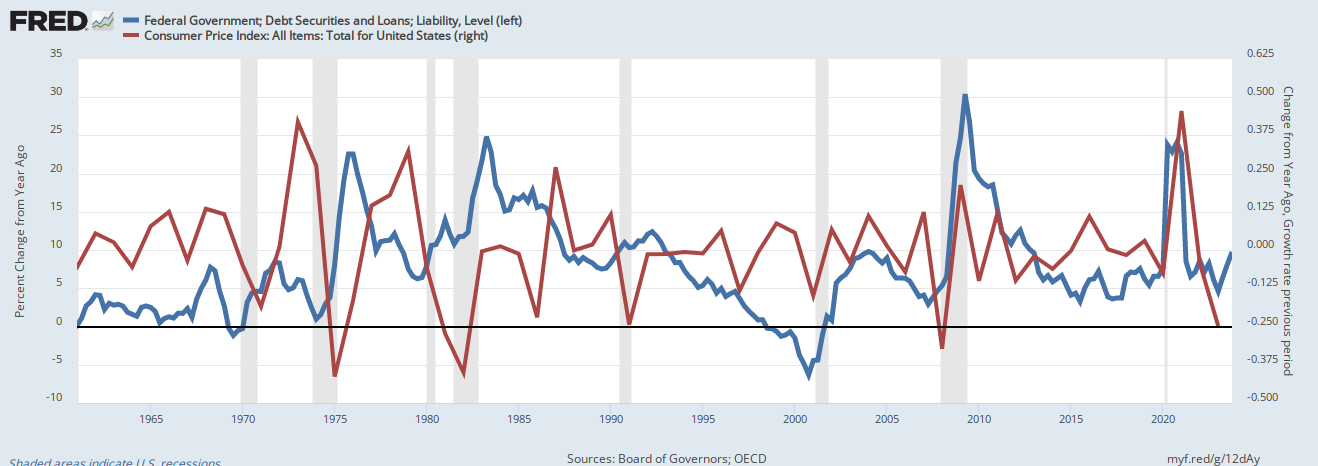
And finally, lest you believe the myth that federal spending causes inflation, it’s just that: a myth.
There is no relationship between changes in federal debt (blue) and changes in the consumer price index (red).
Ofttimes, the simplest solutions are the best solutions.
Rodger Malcolm Mitchell
Monetary SovereigntyTwitter: @rodgermitchellSearch #monetarysovereigntyFacebook: Rodger Malcolm Mitchell
……………………………………………………………………..
The Sole Purpose of Government Is to Improve and Protect the Lives of the People.
I often listen to the public radio show, “Freakonomics Radio” by Stephen J. Dubner. Today, the story was about insurance and how intractable it is, both from the insurance providers’ and the buyers’ perspectives.
We all have some forms of insurance: Life, health, accident, liability, home, personal property, unemployment, retirement, and many others.
Lloyds of London has a reputation for creating individualized policies to insure anything: An actress’s legs, a quarterback’s arm, a pianist’s fingers.
Among the several insurance problems, the fundamental problem is adverse selection. The insurance company wants to cover people who will not have an immediate claim. The buyer wants to get his money’s worth in claims.
A life insurance seller wants young, healthy customers who will not make claims for many years while paying premiums all those years.
All insurers want the insured to buy as soon as possible, then wait a long time before making a claim (for instance, a health policy) or never make a claim (an auto liability policy),
But the insured ideally would like to purchase his insurance as late as possible — just before making a claim — or never.
To minimize adverse selection, insurers hire actuaries. These people use research and probability formulas to determine the likelihood of a person making a claim and how significant that claim is might be.
This leads to another problem: Adverse denial. Suppose those who will make the fewest and most minor claims are the only people accepted, and all others are denied. In that case, many people will be denied insurance, and the basic premise of insurance — to protect against misfortune — would be lost.
For example, on average, black people get sick and die sooner than white people. If the law allowed, insurance companies would charge blacks higher premiums than whites or refuse insurance to blacks altogether.
However, the law does not allow this, so the premiums charged to white people must be higher than they ordinarily would be to make up the difference.
Any time an insurer accepts something other than the lowest possible risk, the lowest risk people must pay more. Some, but not all, of this can be baked into the premiums. For example, most life insurance policies consider age and prior illness when determining premiums. But no insurer can consider every possible risk category and remain competitive.
So, in general, the lowest-risk people do, in part, fund higher-risk people for all sorts of insurance.
That said, a substantial portion of our population is not financially protected by insurance, either because no company will insure them or because the premium is higher than what people wish to pay.
In short, the risk is too high for any potential insurer, and the premium is too high for potential insureds.
The fact that the problem is considered intractable puzzles me because we already have solved it, not just once, but many times.
Medicare, for instance, solves it for the worst health risks: Older people who already are sick with terminal illnesses cannot be refused when they reach the qualifying age.
More than 18 percent of Americans depend on Medicare for their health coverage, and in 2019 Medicare the enrollment reached over 60 million.
You can start receiving Medicare Part A (hospital insurance) benefits with no premium once you are 65 or older if you or your spouse worked and paid Medicare taxes for a certain period. You can know you are eligible for premium-free Medicare A if one of the following applies to you:
You currently receive or are eligible for Social Security.You currently receive or are eligible for Railroad Retirement Board (RRB) benefits.You or your spouse served in a Medicare-covered government job.
You can purchase Medicare Part B benefits if you are eligible for Medicare Part A. It is a voluntary program that requires you to pay monthly premiums. For 2022, the standard premium is $170.10 (or higher, depending on income).
No matter how sick you are, even on death’s doorstep, you can receive insurance if you meet the above requirements.
How does the government avoid adverse selection? Mostly, it doesn’t. Yes, there are qualifications; adverse selection is not the consideration.
Why can the government afford Medicare when private insurance companies must worry about adverse selection? Contrary to popular belief, people with FICA deducted from their salaries do not fund Medicare.
The federal government, being Monetarily Sovereign, has the infinite ability to create U.S. dollars.
It neither needs nor uses tax dollars to pay for anything. Even if total FICA collections equaled $0, the federal government still has the infinite power to fund something better than our current Medicare.
The government could fund a comprehensive, no-deductible Medicare for every man, woman, and child in America.
Alan Greenspan: “There is nothing to prevent the federal government from creating as much money as it wants and paying it to somebody.”Quote from former Fed Chairman Ben Bernanke when he was on 60 Minutes:Scott Pelley: Is that tax money that the Fed is spending?Ben Bernanke: It’s not tax money… We simply use the computer to mark up the size of the account.
And that is the solution to the healthcare insurance problem. The federal government should “use the computer to mark up the size of the account” and fund a form of Medicare far better than current Medicare.
I have Medicare, but I also pay for a concierge primary care doctor. I pay her an annual fee in addition to what she receives from Medicare.
My previous primary care doctor, who received Medicare reimbursement, had about 2,500 patients. My concierge doctor self-limits to about 600 patients. This allows her more time to do precisely what she studied for years to do: Treat patients.
She spends time studying my particular needs and discussing my health with me. If I go into the hospital, she has admittance privileges and can oversee my treatment there while discussing my case with all the doctors and nurses.
The federal government has sufficient resources to pay every primary care doctor to be a concierge doctor who can spend the time each patient deserves.
(The federal government also has the resources to provide free medical schooling for all prospective doctors, so there would be plenty of people available to be the abovementioned concierge doctors.)
All drivers need auto liability insurance. The federal government should provide it free. All homeowners and renters need insurance. The federal government should provide it.
There is no logical reason why more affluent people can afford insurance while poorer people cannot. Ironically, it is the poorer who need insurance more than, the richer.
The Freakonomics radio show ignored the fundamental truths about the American economy:
The solution to many of life’s problems stares us in the face, yet disinformation from the top prevents it.
No, federal financing is not the dreaded “socialism” (which is government ownership and direction, not just government funding.)
And no, federal spending does not cause inflation. On the contrary, federal spending can reduce inflation by acquiring goods and services, the scarcity of which is the real cause of inflation.
There is a solution. We need only to recognize it.
Rodger Malcolm Mitchell
Monetary SovereigntyTwitter: @rodgermitchellSearch #monetarysovereigntyFacebook: Rodger Malcolm Mitchell
……………………………………………………………………..
The Sole Purpose of Government Is to Improve and Protect the Lives of the People.
The difference between misinformation and disinformation is that the former can be accidental and unintentional, while the latter is intentional.
While the Libertarian website, Reason.com, always has spewed wrong ideas, I have come to believe they now are well into the disinformation stage.
In short, they have transitioned from loud-mouth, bar-stool buffoons to louder-mouth Tucker Carlson.
I admitted that even I don’t believe what I say. Why should you?
Here is the latest headline:
I caught up with the 96-year-old recently in Southern California and conducted a long interview about his life and work that will appear as a Reason podcast.
Here’s part of our conversation about President Joe Biden’s massive $6.8 trillion budget plan, the role of government spending and Federal Reserve policy in causing inflation, the bailout of Silicon Valley Bank, and why Smith believes “it’s very hard to keep Democrats [from] wanting to make the world better by spending other people’s money.“
I must admit that the headline and the introductory paragraphs told me I would not be able to stomach listening to the entire drivel. Here are my comments based on just the above:
Greenspan: A government cannot become insolvent with respect to obligations in its own currency.
Starting with the simplest, there is no Nobel Prize in economics, nor should there be. It’s called The Sveriges Riksbank Prize in Economic Sciences in Memory of Alfred Nobel.
It’s like me injuring myself and awarding me the Rodger Mitchell medal in memory of the Military Order of the Purple Heart.
Or, having taking some pictures at my family Thanksgiving dinner, I award myself the Mitchell Award for Best Picture in memory of the Academy of Motion Pictures Arts and Sciences Awards for Best Pictures.
Also, there should be no real Nobel Prize in economics because economics has not yet graduated to science levels. It is a philosophy that lacks proof, but exists on intuition and belief.
Sciences make verifiable predictions. Economics makes predictions that can’t be verified. They are little more than hunches.
Economists are like stock market chartists with their “head and shoulders” graphs, histograms, and MACDs, all of which sound scientific but in reality are balderdash.
“GOVERNMENT SPENDING CAUSING INFLATION”
Next, there is no evidence that federal spending causes inflation. It is a common belief in economics circles, but it is based on the logical intuition that if you have more of something its value declines.
Sadly, Facts don’t agree with intuition.
Money is unlike other commodities. It always is in demand.
If we have plenty of oil, we don’t use more. There becomes a surfeit that needs to be stored at a significant cost. The price goes down. When there is too much, production can’t be shut down in and instant; when there is a shortage, production can’t be started instantly.
If we have plenty of food, we don’t begin to eat more. The extra must expensively be stored or allowed to rot. The the price goes down. When there is too much or too little, production can’t respond quickly.
By contrast, the federal government quickly can produce more dollars when needed, simply by giving them away or spending them. In the unlikely event there ever are too many dollars, the government could tax them away.
Another major reason why money is unique: If you have plenty of money, you still want more. Storage not only is free, but receives interest. The usual rules of supply and demand don’t operate.
Having plenty of money does not reduce the price of money. It actually can increase the value of money, because investing opens new areas for more investing.
That is why we see graphs like this:
There is no relationship between federal debt (red line) and inflation (blue line).
The peaks and valleys in the above graph do not match. There is no cause/effect relationship.
There is a strong relationship between inflation and oil supplies (green, as evidenced by oil prices).
The peaks and valleys match. There is a cause/effect relationship.
“BAILOUT OF SILICON VALLEY BANK”
The bailout of the Silicon Valley Bank (SVP) was necessary to prevent massive losses to the economy and to individual depositors.
Bernanke: The U.S. government has a technology, called a printing press (or, today, its electronic equivalent), that allows it to produce as many U.S. dollars as it wishes at essentially no cost.
Gross Domestic Product (GDP) is a measure of the economy by being a measure of spending (GDP = Federal and Nonfederal Spending + Net Exports).
Adding dollars to the economy increases GDP; taking dollars from the economy reduces GDP.
Dollars held by banks are dollars in the economy as part of the M2 money supply measure. Allowing SVP depositors to lose money would reduce GDP, which would be recessionary.
Gillespie and Zuckerman advocate punishing the bank and those responsible by allowing them to fail, the classic “cut one’s nose to spite one’s face” situation.
Because banks operate under a profit motive, their leaders face the ongoing temptation to engage in higher-risk activities. When these activities fail, the banks, not having infinite funds with which to pay off depositors, fail.
The prevention and cure is to have all banks owned by the federal government, an entity that is not motivated to take higher risks and has the infinite ability to pay depositors. There is no public purpose for banks to be privately owned.
Bank depositors already are insured (up to $250,000) by the federal government. Federal ownership would expand that protection while decreasing risk.
“SPENDING OTHER PEOPLE’S MONEY”
This pejorative trope, though often expressed, is based on the false notion that the federal government spends federal tax dollars.
While state and local governments, being monetarily non-sovereign, do spend taxpayer dollars, the federal government operates differently.
Greenspan: There is nothing to prevent the federal government from creating as much money as it wants and paying it to somebody.
Being Monetarily Sovereign, the federal government has the infinite ability to create dollars.
Alan Greenspan: “A government cannot become insolvent with respect to obligations in its own currency.”Ben Bernanke: “The U.S. government has a technology, called a printing press (or, today, its electronic equivalent), that allows it to produce as many U.S. dollars as it wishes at essentially no cost.”Alan Greenspan: “There is nothing to prevent the federal government from creating as much money as it wants and paying it to somebody.”Alan Greenspan: “The United States can pay any debt it has because we can always print the money to do that.”
The federal government neither needs nor uses tax dollars. Even if it stopped collecting taxes, the federal government could continue spending forever.
The primary purpose of federal taxes is to control the economy by taxing what the government wishes to discourage and by giving tax breaks to what the government wishes to encourage. A secondary purpose is to insure acceptance of US dollars by requiring them to be used for taxes and other payments.
Reason.com, that Libertarian, anarchist organization, has become more far right-wing of late, and following in the Fox News / Tucker Carlson tradition, has resorted to exaggeration and outright lies — i.e misinformation and disinformation — to push its anti-government agenda.
The federal government is very good at one thing: Creating dollars. Thus it has no profit motive. Its motives revolve around its voter constituency. The more it can do to please its voters, the more votes it can acquire.
The Republican constituency is the rich, and the Republicans know it.
The Democrats’ constituency is the not-rich, but the Democrats don’t understand economics. So, despite creating such social programs as Social Security, Medicare, Medicaid, and poverty-fighting plans, the Democrats repeatedly fall into the trap of not recognizing Monetary Sovereignty.
Thus, they go along with the “can’t afford it” excuses for not implementing Medicare for All, Social Security for All, free college for all and other social programs that would benefit America.
Meanwhile, the Libertarians join hands with the Republicans to widen the Gap between the rich and the rest. Disgraceful.
The next time you read any Libertarian or Republican wish list, ask yourself, does this help the not-rich or does it widen the Gap between the rich and the rest? Then vote accordingly.
Rodger Malcolm Mitchell
Monetary SovereigntyTwitter: @rodgermitchellSearch #monetarysovereigntyFacebook: Rodger Malcolm Mitchell
……………………………………………………………………..
The Sole Purpose of Government Is to Improve and Protect the Lives of the People.







 #Monetary Sovereignty - Mitchell