–Stephanie Kelton vs. Maya MacGuineas: The Big Truth vs. the Big Lie

Twitter: @rodgermitchell; Search #monetarysovereignty
Facebook: Rodger Malcolm Mitchell

Mitchell’s laws:
●Those, who do not understand the differences between Monetary Sovereignty and monetary non-sovereignty, do not understand economics.
●The more federal budgets are cut and taxes increased, the weaker an economy becomes. .
Liberals think the purpose of government is to protect the poor and powerless from the rich and powerful. Conservatives think the purpose of government is to protect the rich and powerful from the poor and powerless.
●Austerity is the government’s method for widening
the gap between rich and poor.
●Until the 99% understand the need for federal deficits, the upper 1% will rule.
To survive long term, a monetarily non-sovereign government must have a positive balance of payments.
●Everything in economics devolves to motive,
and the motive is the Gap.
==================================================================================================================================================================

Regular readers of this blog might remember:

“Stephanie Kelton: Bon Voyage and Godspeed Saturday, Dec 27 2014”

Reader Ian Winograd alerted me to the fact that Stephanie Kelton has been chosen to be Chief Economist for Senate Budget Committee. This is great news.

As many of you know, Stephanie is Chair of the Economics Department at the University of Missouri, Kansas City. UMKC is the primary hub for Modern Monetary Theory, the sister of Monetary Sovereignty.

Presumably, Stephanie will have the opportunity to insert some reality into the government’s budgeting process, although she will be constrained by politics.

I then listed some of the problems she would face, including:

Many people go to Washington, filled with knowledge and faith, but then the political birds whisper in their ears — things like “To get along, go along,” and “The people can’t handle the truth,” and “It’s not politically possible,” and the not-so-subtle threat, “You can accomplish more on the inside than on the outside.”

And soon those well-meaning people sip the political drug, and gradually lose their principles, and themselves become part of the Big Lie.

I believe Stephanie has too much courage and honesty to fall into that trap, and here comes a test of my belief in her:

The arch-enemy of truth and one of the foremost purveyors of the Big Lie, Maya MacGuineas just appeared before Stephanie’s committee.

MacGuineas Testifies Before Senate Budget Committee on Balanced Budget
March 11, 2015

Maya MacGuineas, president of the Committee for a Responsible Federal Budget, told the Senate Budget Committee today that our long-term budget problems persist despite the recent good news on annual deficits.

To MacGuinness, a reduction in deficits (i.e. austerity, i.e. reduced income for the economy, i.e. “just-what-the-rich-want”) is good news.

Yes, to the rich, starving the economy of money is wonderful, because it punishes the poor more than the rich, thereby widening the Gap between the rich and the rest.

Testifying at the hearing, “The Better Way: Benefits of a Balanced Budget,” MacGuineas cited the advantages of taking steps to put debt on a more sustainable path, as the country’s debt-to-GDP ratio is the highest since WWII.

A “balanced budget” means the government removes as many dollars from the economy as it puts in, thereby assuring recession. (See: #3 and #4 here.)

A “sustainable” debt is one a debtor can pay off in a timely manner. But there is no debt, of any size, the federal government could not pay off. Every debt in dollars is sustainable to the U.S. federal government.

Not only does our Monetarily Sovereign government have the unlimited ability to create its sovereign dollars, but paying off the debt requires that virtually no new dollars be created.

The so-called federal “debt” really is nothing more than the total of T-security accounts at the Federal Reserve Bank. These accounts are much like savings accounts.

How does a bank “pay off” savings accounts? It simply debits the savings accounts and credits checking accounts. No new dollars needed.

So when MacGuineas whines about federal debt “sustainability,” she is mouthing the Big Lie.

MacGuineas said, “trillion dollar deficits are projected to come back within a decade.”

Translation: The government will pump a trillion dollars worth of stimulus into the economy, every year.

And this is a bad thing??

Ideally, MacGuineas said, the country would balance the budget over the business cycle.

Translation: This is ideal for the rich — you know, the people who pay her salary. Not so good for the poor and middle, but who cares about them? Right, Maya?

“This doesn’t mean we should balance the budget every year. In fact, it makes economic sense to borrow during recessions, and save during times of higher growth.

Here, MacGuineas admits (without realizing it) that deficits grow the economy.

That being the case, why would she not want the economy to grow every year. Answer: She is paid by rich people, not to want it.

But getting to balance on average would allow us to save when the economy is strong and have the government help inject more money into the economy when it is weak.

No, federal deficit spending, which pumps dollars into the economy, allows us to save more of those dollars.

MacGuineas listed the benefits of putting the debt on a downward path relative to the economy: faster economic growth, higher wages, lower interest rates, increased flexibility to respond to crises, and declining government interest payments that would free up resources for higher priorities.

That’s a lot of BS for one short sentence:

1. First she confuses deficit reduction with debt reduction — two completely different actions. The government could eliminate all debt tomorrow while continuing to run deficits. Simply liquidate all T-security accounts and transfer the proceeds to the owners.

2. GDP = Federal Spending + Non-federal Spending + Net Exports. There is no mechanism by which removing dollars from the economy leads to “faster economic growth and higher wages.”

3. The Fed controls interest rates, and has them near zero already. Why MacGuineas wants them lower is a mystery.

4. Tying the government’s hands by forcing austerity does not provide “increased flexibility” and does not “free up resources.”

MacGuineas (pretends she) believes the government can run short of its own sovereign currency, so must husband it for emergencies, like you and I must But you and I are monetarily non-sovereign — much different from the U.S. government.

She (pretends she) has no knowledge of the differences between Monetary Sovereignty and monetary non-sovereignty. She’d be fired if she mentioned those differences.

Finally, MacGuineas warned about the danger of increasing deficits. Last year, Congress added $100 billion to the debt through 2024. Congress again 2 this year, faces demands for a highway bill, patching the Sustainable Growth Rate, and preventing sequestration. Without responsible budgeting, they could add $2 trillion above what current law allows.

Translation: Actually she didn’t warn about the danger of increasing deficits. She merely said deficits were increasing. She never explained why that was dangerous. The reason: Increased deficits pump dollars into the economy, enriching the economy and helping it grow.

“The United States is poised to take off economically. In order to do that we need to increase our competitiveness, grow our economy, and ensure the gains are spread broadly. Key to all of those things will be controlling our national debt,” she said.

And there you have the Big Lie, all tied up, nice and neat, into one sentence.

Today, I sent the following note to Stephanie Kelton, along with an attachment of MacGuineas’s posting:

Just curious about this, Stephanie. Since Maya is 100% wrong, as usual, I was wondering how your committee reacted to her comments:

MacGuineas Testifies Before Senate Budget Committee on Balanced Budget

I’ll let you know Stephanie’s response.

Rodger Malcolm Mitchell
Monetary Sovereignty

===================================================================================
The Ten Steps to Prosperity:

1. Eliminate FICA (Click here)
2. Federally funded Medicare — parts A, B & D plus long term nursing care — for everyone (Click here)
3. Provide an Economic Bonus to every man, woman and child in America, and/or every state a per capita Economic Bonus. (Click here) Or institute a reverse income tax.
4. Federally funded, free education (including post-grad) for everyone. Click here
5. Salary for attending school (Click here)
6. Eliminate corporate taxes (Click here)
7. Increase the standard income tax deduction annually. (Refer to this.)
8. Tax the very rich (.1%) more, with higher, progressive tax rates on all forms of income. (Click here)
9. Federal ownership of all banks (Click here and here)
10. Increase federal spending on the myriad initiatives that benefit America’s 99% (Click here)

Initiating The Ten Steps sequentially will add dollars to the economy, stimulate the economy, and narrow the income/wealth/power Gap between the rich and the rest.
——————————————————————————————————————————————

10 Steps to Economic Misery: (Click here:)
1. Maintain or increase the FICA tax..
2. Spread the myth Social Security, Medicare and the U.S. government are insolvent.
3. Cut federal employment in the military, post office, other federal agencies.
4. Broaden the income tax base so more lower income people will pay.
5. Cut financial assistance to the states.
6. Spread the myth federal taxes pay for federal spending.
7. Allow banks to trade for their own accounts; save them when their investments go sour.
8. Never prosecute any banker for criminal activity.
9. Nominate arch conservatives to the Supreme Court.
10. Reduce the federal deficit and debt

No nation can tax itself into prosperity, nor grow without money growth. Monetary Sovereignty: Cutting federal deficits to grow the economy is like applying leeches to cure anemia.
1. A growing economy requires a growing supply of dollars (GDP=Federal Spending + Non-federal Spending + Net Exports)
2. All deficit spending grows the supply of dollars
3. The limit to federal deficit spending is an inflation that cannot be cured with interest rate control.
4. The limit to non-federal deficit spending is the ability to borrow.

THE RECESSION CLOCK
Monetary Sovereignty

Monetary Sovereignty

Vertical gray bars mark recessions.

As the federal deficit growth lines drop, we approach recession, which will be cured only when the growth lines rise. Increasing federal deficit growth (aka “stimulus”) is necessary for long-term economic growth.

#MONETARYSOVEREIGNTY

–Oh woe! Here we go again: The phony trade-deficit hysteria

Twitter: @rodgermitchell; Search #monetarysovereignty
Facebook: Rodger Malcolm Mitchell

Mitchell’s laws:
●Those, who do not understand the differences between Monetary Sovereignty and monetary non-sovereignty, do not understand economics.
●The more federal budgets are cut and taxes increased, the weaker an economy becomes. .
Liberals think the purpose of government is to protect the poor and powerless from the rich and powerful. Conservatives think the purpose of government is to protect the rich and powerful from the poor and powerless.
●Austerity is the government’s method for widening
the gap between rich and poor.
●Until the 99% understand the need for federal deficits, the upper 1% will rule.
To survive long term, a monetarily non-sovereign government must have a positive balance of payments.
●Everything in economics devolves to motive,
and the motive is the Gap.
==================================================================================================================================================================

Oh woe! Here we go again: The phony trade-deficit hysteria. Seldom has so much Henny-Penny, sky-is-falling BS been packed into one short article.

OpEdNews Op Eds 3/7/2015
Trade Deficit Drops To Enormous, Humongous Level In January
By Dave Johnson

The U.S. Census Bureau reported Friday that the January goods and services trade deficit was $41.8 billion in January, down $3.8 billion from $45.6 billion in December.

Since the neo-liberal “free trade” pro-corporate ideology took hold in the late 1970s the US has consistently run a trade deficit every single year, and it just gets worse. This literally drains our economy, jobs, wages, factories, entire industries and our ability to make a living as a country.

Rep. Alan Grayson Explains Trade Deficit Harm:

“Day after day, month after month, and year after year, Americans are buying goods and services manufactured by foreigners, and those foreigners are not buying goods and services manufactured by Americans.

“We are creating millions — no — tens of millions of jobs in other countries with our purchasing power, and we are losing tens of millions of jobs in our country, because foreigners are not buying our goods and services.

“What are they doing? They’re buying our assets.

“So we lose twice. We lose the jobs, and we are driven deeper and deeper into national debt — and, ultimately, national bankruptcy. That is the end game.

“That’s why we have the most unequal distribution of income [among all industrial nations] in our country, [and] the most unequal distribution of wealth in our history.

“Let’s not only have a trade policy. For once, let’s also have a trade deficit policy.

“Let’s deal with the reality that has robbed the American Middle Class now for decades. Let’s address it, and let’s defeat it. That’s what I’m calling [for], right now.

“Let’s stop digging deeper. Let’s raise ourselves up, let’s climb out of this hole, and rebuild the American Middle Class. Thank you very much.”

First, let us dispense with the notion that a trade deficit is harmful and that a trade surplus would be better. We wrote about this myth way back in 2009:

The China trade deficit myth Thursday, Nov 19 2009

A trade deficit is an example of one country devoting great effort to creating scarce materials for another country in exchange for something that requires no effort by the other country.

In that sense, China is our servant. They work, sweat and strain and use their valuable resources to create and ship to us the things we want, while we, hardly lifting a finger, ship dollars to them.

Who has the better deal?

As readers of this blog know, the federal government creates unlimited dollars at the touch of a computer key. It does so by sending instructions to its creditors’ banks, telling the banks to increase the balances in the creditors’ checking accounts.

That is how the federal government pays its bills.

At the instant the banks comply with these instructions, dollars are created — yes, created from thin air. That is the reality of Monetarily Sovereign finances.

It is possible (and commonplace) for the U.S. to run short of various food items, various ores and various manufactured items. It even is possible for us to run short of labor. But it is absolutely, positively impossible for us to run short of dollars (unless Congress demands “debt limits”).

When we run a so-called “trade deficit,” we receive goods and services that may be in short supply here, and in exchange we send U.S. dollars, which are in infinite supply to us.

When we receive more goods and services than we send, why do we call it a “trade deficit,” when receiving more than we send really is a “trade surplus“?

As for “robbing the American Middle Class,” this is the old, “Blame the opposition for your own crimes” ploy. Nothing has done more to rob the “American Middle Class” than the Congressional programs to cut federal deficit spending.

The vast majority of federal spending benefits the middle and lower income/wealth/power groups. From Social Security to Medicare to Medicaid to all the poverty aids to federal construction projects — federal deficit spending benefits the very people Rep. Grayson pretends to love.

So Congress increases FICA (the most regressive tax in U.S. history), while forcing the states, counties and cities to rely on sales taxes (the 2nd most regressive taxes in U.S. history). Meanwhile, Social Security benefits have decreased and many programs benefiting the poor and middle classes cut — and all the while, Congress proclaims its everlasting affection for the “American Middle Class.”

Does it get any phonier than that?

And as for the loss of dollars involved in a “trade deficit,” here’s a very, simple solution:

How to defeat that huge, frightening, trade deficit, Chinese dragon — in one simple step Friday, Mar 9 2012

Every quarter, the federal government should replace the trade deficit. It should send the amount of the trade deficit to the American consumers, dollar for dollar.

It could be in the form of mailed checks — something resembling the very first stimulus attempt in 2008. The result: Consumers would continue to have spending money, businesses would continue to thrive and hire employees, and at long last, Congress could stop blaming China for its own mistakes.

And as for Rep. Grayson’s “concern” about the loss of jobs, if the above-mentioned checks don’t replace enough lost income, the federal government simply should buy more goods and services from American suppliers.

Spend more on roads, bridges and dams, more on schools and teachers, more on R&D, more on building things, creating things, discovering things. There is no limit to the goods and services the federal government can buy.

Or very simply, begin to institute the “Ten Steps to Prosperity.”

Bottom lines:
1. The thing we misname “trade deficit” actually is a “trade surplus,” and is a benefit to the U.S.
2. Congressional “cut-the-debt” policies, not the so-called “trade deficit,” are responsible for the loss of jobs and the widening of the Gap between the rich and the rest.

Congress has failed to help the “American Middle Class,” but Congress is very good at two things:
— Spouting the Big Lie
— and pointing fingers of blame.

Rodger Malcolm Mitchell
Monetary Sovereignty

===================================================================================
The Ten Steps to Prosperity:

1. Eliminate FICA (Click here)
2. Federally funded Medicare — parts A, B & D plus long term nursing care — for everyone (Click here)
3. Provide an Economic Bonus to every man, woman and child in America, and/or every state a per capita Economic Bonus. (Click here) Or institute a reverse income tax.
4. Federally funded, free education (including post-grad) for everyone. Click here
5. Salary for attending school (Click here)
6. Eliminate corporate taxes (Click here)
7. Increase the standard income tax deduction annually. (Refer to this.)
8. Tax the very rich (.1%) more, with higher, progressive tax rates on all forms of income. (Click here)
9. Federal ownership of all banks (Click here and here)
10. Increase federal spending on the myriad initiatives that benefit America’s 99% (Click here)

Initiating The Ten Steps sequentially will add dollars to the economy, stimulate the economy, and narrow the income/wealth/power Gap between the rich and the rest.
——————————————————————————————————————————————

10 Steps to Economic Misery: (Click here:)
1. Maintain or increase the FICA tax..
2. Spread the myth Social Security, Medicare and the U.S. government are insolvent.
3. Cut federal employment in the military, post office, other federal agencies.
4. Broaden the income tax base so more lower income people will pay.
5. Cut financial assistance to the states.
6. Spread the myth federal taxes pay for federal spending.
7. Allow banks to trade for their own accounts; save them when their investments go sour.
8. Never prosecute any banker for criminal activity.
9. Nominate arch conservatives to the Supreme Court.
10. Reduce the federal deficit and debt

No nation can tax itself into prosperity, nor grow without money growth. Monetary Sovereignty: Cutting federal deficits to grow the economy is like applying leeches to cure anemia.
1. A growing economy requires a growing supply of dollars (GDP=Federal Spending + Non-federal Spending + Net Exports)
2. All deficit spending grows the supply of dollars
3. The limit to federal deficit spending is an inflation that cannot be cured with interest rate control.
4. The limit to non-federal deficit spending is the ability to borrow.

THE RECESSION CLOCK
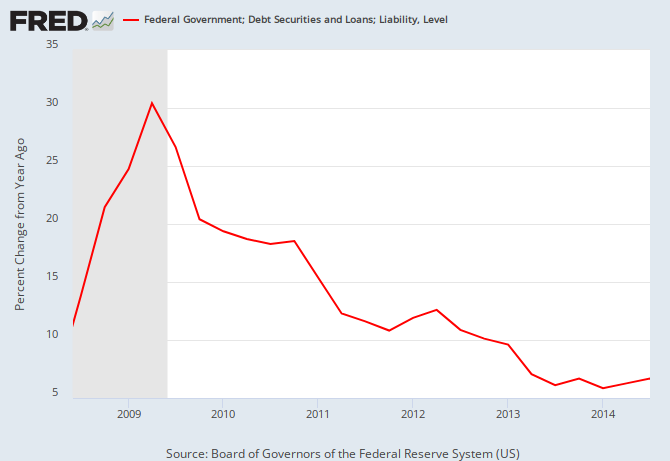
Monetary Sovereignty

Monetary Sovereignty

Vertical gray bars mark recessions.

As the federal deficit growth lines drop, we approach recession, which will be cured only when the growth lines rise. Increasing federal deficit growth (aka “stimulus”) is necessary for long-term economic growth.

#MONETARYSOVEREIGNTY

–Medicare drug negotiation: How can something sound so good and be so wrong?

Twitter: @rodgermitchell; Search #monetarysovereignty
Facebook: Rodger Malcolm Mitchell

Mitchell’s laws:
●Those, who do not understand the differences between Monetary Sovereignty and monetary non-sovereignty, do not understand economics.
●The more federal budgets are cut and taxes increased, the weaker an economy becomes. .
Liberals think the purpose of government is to protect the poor and powerless from the rich and powerful. Conservatives think the purpose of government is to protect the rich and powerful from the poor and powerless.
●Austerity is the government’s method for widening
the gap between rich and poor.
●Until the 99% understand the need for federal deficits, the upper 1% will rule.
To survive long term, a monetarily non-sovereign government must have a positive balance of payments.
●Everything in economics devolves to motive,
and the motive is the Gap.
==================================================================================================================================================================

An excellent blog called the National Memo, recently published this post by David Lazarus: Consumer Confidential: Costco-Visa Deal Shows Why Medicare Should Negotiate Drug Prices.

Here are some excerpts:

Costco’s deal to replace American Express with Visa as its exclusive credit-card company highlights an economic principle that should surprise no one.

Consumers benefit when a business uses its market power to negotiate lower prices and passes along the savings to customers.

Conservatives have championed such market forces for decades, arguing that if government regulators just got out of the way of businesses, consumers would be the big winners.

That is, unless we’re talking about drug prices.

Medicare, the federal healthcare program, is prohibited by law from haggling with makers of prescription drugs over the prices paid by its 54 million beneficiaries.

O.K., it may be a bit of a stretch to equate Costco’s shopping for a credit card company with Medicare’s non-negotiation of drug prices.

But the point is that negotiation often achieves lower prices than does failure to negotiate. (Are we allowed to say, “Well, duh” for that revelation?)

The post continued:

That bizarre stipulation was put in place in 2003 by the administration of former President George W. Bush.

Republican lawmakers, backed by the powerful pharmaceutical industry, argued at the time that the private sector was in a better position to ensure fair pricing of prescription meds.

In subsequent years, Republicans have repeatedly beaten back attempts by Democratic lawmakers to lift this prohibition.

Yep, as usual, the Republicans are on the side of big business and against consumers. But ironically, as you shall see, the Republicans are right — sort of.

“Private competition works,” Sen. Charles Grassley, an Iowa Republican and a principal author of the 2003 law.

Surely that had nothing to do with the almost $240,000 Grassley received from pharmaceutical interests in the 2002 election cycle, prior to his leadership role in drafting the Medicare legislation, according to the Center for Responsive Politics.

And it’s probably just a coincidence that no industry spends more lobbying lawmakers than the drug industry.

The reality, of course, is that conservative politicians and their profit-minded business allies have subverted market forces to ensure that Americans pay some of the highest drug prices in the world.

The United States spends almost $1,000 a person annually on prescription meds, according to the Organization for Economic Cooperation and Development.

That’s about twice as much as the likes of Canada, Japan, Germany and France, which permit their state-run insurance plans to negotiate the best possible terms with drug companies.

And yep, as usual, the Republicans rake in big money to take their stands on behalf of big business. Again, “Well, duh.” Nothing new here.

Sen. Harry Reid, the Nevada Democrat who was then the Senate majority leader, had a prudent response to this sentiment.

“The Department of Veterans Affairs is able to negotiate for lower-priced drugs,” he said. “HMOs can negotiate. Wal-Mart can negotiate. Why in the world shouldn’t Medicare be able to do that?”

Yes, why in the world?

Medicaid, the insurance program for low-income people, is allowed to negotiate discounts for members. The Congressional Budget Office estimates that if Medicare had the same bargaining power, it could save $116 billion over 10 years.

That’s serious money, and it’s your money we’re talking about. These are taxpayer dollars at stake.

Sounds good, right?

Ah but, longtime readers of this blog see the clue. Those are not taxpayer dollars we’re talking about. Those are government dollars.

Unlike state and local governments, which need and use taxpayer dollars to pay their bills, the federal government does not use taxpayer dollars for anything. It destroys taxpayer dollars upon receipt, simply because it has no need for them.

The federal government is Monetarily Sovereign, meaning it creates unlimited dollars, ad hoc, by paying bills.

Each time the federal government pays a bill, it sends instructions to the creditor’s bank, instructing the bank to increase the balance in the creditor’s checking account. At the moment the bank complies, and not before, brand new dollars are created.

No taxpayer dollars involved.

Federal bill paying (deficit spending) is the method used by the federal government, to add dollars to the economy and to stimulate the economy. Millions of companies benefit from government payments, and those companies hire workers, who spend money, and the economy grows.

But the National Memo article writer, David Lazarus, seemingly does not understand the differences between Monetary Sovereignty (the federal government) and monetary non-sovereignty (you and me, and businesses, and state and local governments).

He thinks that when the government saves money it benefits taxpayers. But the reality is, when the government spends money it benefits taxpayers and everyone else.

If Medicare were to negotiate drug prices, what would happen? Pharmaceutical companies would make less money. But unlike the Monetarily Sovereign federal government, the monetarily non-sovereign pharmaceutical companies are part of the private economy.

Unlike the federal government, which neither needs nor uses income, private companies need and use their income to hire people, pay salaries, buy goods and services, and generally help stimulate the economy.

The Republicans, bless their souls, are as usual, pro-big money and big business, and anti- little money, but on this one issue, they are right (by accident).

Neither Medicare, nor any other branch of the federal government, should negotiate with private industry . . . not the pharmaceutical companies, not the war supplies companies, not the road-building companies . . . as a money saving exercise.

The federal government cannot run short of dollars, and does not need to save money, and its spending grows the economy.

There may be arguments for the federal government to negotiate for lower prices, the primary one probably being that federal prices conceivably could set prices in the private sector. So, as the argument might go, if the federal government overpays for a road (beneficial to the economy), presumably that could force state and local governments to overpay for roads (bad for state and local taxpayers).

But, in the real world, that sort of crossover doesn’t seem to happen. Medicaid’s negotiations don’t seem to lower Medicare’s prices. What one buyer pays often is quite different from what another pays. That guy sitting next to you on an airplane might have paid half what you paid for a ticket.

Bottom line:
1. State and local taxpayers pay for state and local government spending, but federal taxpayers do not pay for federal spending.
2. Federal spending adds dollars to the private sector, which stimulates the private sector (i.e. stimulates the economy)

Contrary to popular intuition, Medicare should not begin to negotiate with the private sector for drugs. It’s simply a case of something sounding so good and being so wrong.

Rodger Malcolm Mitchell
Monetary Sovereignty

===================================================================================
The Ten Steps to Prosperity:

1. Eliminate FICA (Click here)
2. Federally funded Medicare — parts A, B & D plus long term nursing care — for everyone (Click here)
3. Provide an Economic Bonus to every man, woman and child in America, and/or every state a per capita Economic Bonus. (Click here) Or institute a reverse income tax.
4. Federally funded, free education (including post-grad) for everyone. Click here
5. Salary for attending school (Click here)
6. Eliminate corporate taxes (Click here)
7. Increase the standard income tax deduction annually. (Refer to this.)
8. Tax the very rich (.1%) more, with higher, progressive tax rates on all forms of income. (Click here)
9. Federal ownership of all banks (Click here and here)
10. Increase federal spending on the myriad initiatives that benefit America’s 99% (Click here)

Initiating The Ten Steps sequentially will add dollars to the economy, stimulate the economy, and narrow the income/wealth/power Gap between the rich and the rest.
——————————————————————————————————————————————

10 Steps to Economic Misery: (Click here:)
1. Maintain or increase the FICA tax..
2. Spread the myth Social Security, Medicare and the U.S. government are insolvent.
3. Cut federal employment in the military, post office, other federal agencies.
4. Broaden the income tax base so more lower income people will pay.
5. Cut financial assistance to the states.
6. Spread the myth federal taxes pay for federal spending.
7. Allow banks to trade for their own accounts; save them when their investments go sour.
8. Never prosecute any banker for criminal activity.
9. Nominate arch conservatives to the Supreme Court.
10. Reduce the federal deficit and debt

No nation can tax itself into prosperity, nor grow without money growth. Monetary Sovereignty: Cutting federal deficits to grow the economy is like applying leeches to cure anemia.
1. A growing economy requires a growing supply of dollars (GDP=Federal Spending + Non-federal Spending + Net Exports)
2. All deficit spending grows the supply of dollars
3. The limit to federal deficit spending is an inflation that cannot be cured with interest rate control.
4. The limit to non-federal deficit spending is the ability to borrow.

THE RECESSION CLOCK
Monetary Sovereignty

Monetary Sovereignty

Vertical gray bars mark recessions.

As the federal deficit growth lines drop, we approach recession, which will be cured only when the growth lines rise. Increasing federal deficit growth (aka “stimulus”) is necessary for long-term economic growth.

#MONETARYSOVEREIGNTY

–Justice Scalia’s perfect response and reasonable interpretation

Twitter: @rodgermitchell; Search #monetarysovereignty
Facebook: Rodger Malcolm Mitchell

Mitchell’s laws:
●Those, who do not understand the differences between Monetary Sovereignty and monetary non-sovereignty, do not understand economics.
●The more federal budgets are cut and taxes increased, the weaker an economy becomes. .
Liberals think the purpose of government is to protect the poor and powerless from the rich and powerful. Conservatives think the purpose of government is to protect the rich and powerful from the poor and powerless.
●Austerity is the government’s method for widening
the gap between rich and poor.
●Until the 99% understand the need for federal deficits, the upper 1% will rule.
To survive long term, a monetarily non-sovereign government must have a positive balance of payments.
●Everything in economics devolves to motive,
and the motive is the Gap.
==================================================================================================================================================================

When told that deciding against the government in the the ACA (Obamacare) case before the Supreme Court (King v. Burwell) could result in the loss of health care insurance for more than 7 million Americans, Justice Antonin (“Money is speech”) Scalia gave the perfect conservative response:

“If the only reasonable interpretation of a particular provision produces disastrous consequences in the rest of the statute, it nonetheless means what it says.”

Could he have said it any better?

Here is a translation of his majestic, soaring words.

“I am rich, and the people who put me here are rich. I personally have the best health care insurance in the world, and I can access the best doctors in the world. So can all my friends.

“I neither was selected nor paid to worry about what happens to the ordinary people of America, as a result of my decisions. I was selected and paid to defend the rights of the rich and powerful.

“So long as I do that, I will continue to take free vacations with the rich and powerful. Those are my people, not those ‘tired, poor, huddled masses,’ you bleeding-heart liberals love to bleat about.

“I don’t know a single, poor person, and I don’t care to.

“I am called ‘Justice,’ but it is not my job seek justice, but rather to read the words, and if I can find some way to make them comport with what the rich people want, I will rule accordingly.

“I am a conservative, bought and paid for.”

This “Justice” indicates that so far as he is concerned, the ONLY reasonable interpretation will cause disastrous consequences for the poor. For him, there are no other reasonable interpretations.

Strangely, other Supreme Court Justices do find other reasonable interpretations. But, if Scalia wears conservative blinders, who provided them?

Challenge to Health Overhaul Puts Obscure Think Tank in Spotlight

WASHINGTON — In the orbit of Washington think tanks, the Competitive Enterprise Institute is an obscure name with a modest budget that belies its political connections to conservative titans like the Koch brothers.

But the institute, a libertarian research group, enjoyed a coming-out of sorts on Wednesday, as the lawsuit that it organized and bankrolled — challenging the Affordable Care Act — was heard by the Supreme Court.

The case has the potential to end federal insurance subsidies for some 7.5 million people in 34 states.

Until now, the 31-year-old think tank was probably best known as a strident critic of what it calls “global warming alarmism.” It has also been a ceaseless advocate for small government.

It has teamed up with state attorneys general to challenge an array of Obama administration regulations on financial, air-quality and other issues.

Ah, that beautiful Libertian troika at work: Small government (aka reduce benefits to the poor) no global warming and no pollution control. It’s hard to top the Libertarians for modern enlightenment.

The institute said its positions are “developed independently and are not influenced by the views of donors.

Those donors include conservative billionaires Charles G. and David H. Koch, Dunn’s Foundation for the Advancement of Right Thinking in Florida and the Sarah Scaife Foundation in Pittsburgh, Exxon Mobil, General Motors, Verizon and many other major corporations.

Thank goodness all those Libertarian, anti-poor, anti-health, pro-wealth positions are not influenced by people who are known to throw their money away.

Note to “Justice” Scalia: Next time you speak about “reasonable interpretations,” tell us how we should interpret your free ride on Dick Cheney’s Air Force Two jet to a duck hunting vacation — a vacation hosted by a party to a case coming before you.

You refused to recuse yourself for a clear conflict of interest.

Let us know what the “reasonable interpretation” of that should be.

Rodger Malcolm Mitchell
Monetary Sovereignty

P.S. More Scalia right-wing “twist-the-law-to-suit-my-political-agenda”:

Here’s What Scalia Said About Obamacare Last Week. It’s Not What He Said 3 Years Ago.
Posted: 03/09/2015

While many principals in this saga have engaged in “motivated reasoning” — that is, starting with a preferred political outcome, then crafting logic to fit it — Scalia is becoming famous for it.

===================================================================================
The Ten Steps to Prosperity:

1. Eliminate FICA (Click here)
2. Federally funded Medicare — parts A, B & D plus long term nursing care — for everyone (Click here)
3. Provide an Economic Bonus to every man, woman and child in America, and/or every state a per capita Economic Bonus. (Click here) Or institute a reverse income tax.
4. Federally funded, free education (including post-grad) for everyone. Click here
5. Salary for attending school (Click here)
6. Eliminate corporate taxes (Click here)
7. Increase the standard income tax deduction annually. (Refer to this.)
8. Tax the very rich (.1%) more, with higher, progressive tax rates on all forms of income. (Click here)
9. Federal ownership of all banks (Click here and here)
10. Increase federal spending on the myriad initiatives that benefit America’s 99% (Click here)

Initiating The Ten Steps sequentially will add dollars to the economy, stimulate the economy, and narrow the income/wealth/power Gap between the rich and the rest.
——————————————————————————————————————————————

10 Steps to Economic Misery: (Click here:)
1. Maintain or increase the FICA tax..
2. Spread the myth Social Security, Medicare and the U.S. government are insolvent.
3. Cut federal employment in the military, post office, other federal agencies.
4. Broaden the income tax base so more lower income people will pay.
5. Cut financial assistance to the states.
6. Spread the myth federal taxes pay for federal spending.
7. Allow banks to trade for their own accounts; save them when their investments go sour.
8. Never prosecute any banker for criminal activity.
9. Nominate arch conservatives to the Supreme Court.
10. Reduce the federal deficit and debt

No nation can tax itself into prosperity, nor grow without money growth. Monetary Sovereignty: Cutting federal deficits to grow the economy is like applying leeches to cure anemia.
1. A growing economy requires a growing supply of dollars (GDP=Federal Spending + Non-federal Spending + Net Exports)
2. All deficit spending grows the supply of dollars
3. The limit to federal deficit spending is an inflation that cannot be cured with interest rate control.
4. The limit to non-federal deficit spending is the ability to borrow.

THE RECESSION CLOCK
Monetary Sovereignty

Monetary Sovereignty

Vertical gray bars mark recessions.

As the federal deficit growth lines drop, we approach recession, which will be cured only when the growth lines rise. Increasing federal deficit growth (aka “stimulus”) is necessary for long-term economic growth.

#MONETARYSOVEREIGNTY