–Stephanie Kelton: Bon Voyage and Godspeed

Twitter: @rodgermitchell; Search #monetarysovereignty
Facebook: Rodger Malcolm Mitchell

Mitchell’s laws:
●Those, who do not understand the differences between Monetary Sovereignty and monetary non-sovereignty, do not understand economics.
●The more federal budgets are cut and taxes increased, the weaker an economy becomes. .
Liberals think the purpose of government is to protect the poor and powerless from the rich and powerful. Conservatives think the purpose of government is to protect the rich and powerful from the poor and powerless.
●Austerity is the government’s method for widening
the gap between rich and poor.
●Until the 99% understand the need for federal deficits, the upper 1% will rule.
To survive long term, a monetarily non-sovereign government must have a positive balance of payments.
●Everything in economics devolves to motive,
and the motive is the Gap.
==================================================================================================================================================================

Reader Ian Winograd alerted me to the fact that Stephanie Kelton has been chosen to be Chief Economist for Senate Budget Committee. This is great news.

As many of you know, Stephanie is Chair of the Economics Department at the University of Missouri, Kansas City. UMKC is the primary hub for Modern Monetary Theory, the sister of Monetary Sovereignty.

Presumably, Stephanie will have the opportunity to insert some reality into the government’s budgeting process, although she will be constrained by politics. To give you some idea, here are the people with whom she will deal.

This morning, I dropped Stephanie a note:

Hi Stephanie,

Wow! I don’t know how you made it happen, but I’m sure glad you did. Now, you’ll have a bigger, better chance to spread the truth.

Believe this 80-year-old man: It won’t be easy.

Many people go to Washington, filled with knowledge and faith, but then the political birds whisper in their ears — things like “To get along, go along,” and “The people can’t handle the truth,” and “It’s not politically possible,” and the not-so-subtle threat, “You can accomplish more on the inside than on the outside.”

And soon those well-meaning people sip the political drug, and gradually lose their principles, and themselves become part of the Big Lie.

I’m sure every Fed Chairman knows the truth. Some even have hinted at it. But the political birds convinced them to go along politically, and they gave credibility to the Big Lie.

I’m sure Eric Holder knew he should prosecute the banksters, but the political birds convinced him to go along. I’m sure George Bush knew torture is wrong, but the birds swayed him by political expediency. I’m sure at least some Senators know the facts of MMT and Monetary Sovereignty. But, the political birds convince them to stay silent.

There’s a funny thing about surrendering beliefs: It becomes easier every time you do it, and after a while, you barely can remember what your real beliefs are.

Anyway, you’ve fought long and hard to spread the truth. And now the opportunity has arisen and you’ll have a bigger megaphone.

I know you’ll do great things.

Much good luck to you. Let me know if I can be of assistance.

Rodger

Her response:

All good words. Thx, Rodger.

I suspect her job will resemble trying to reverse course on the world’s largest oil tanker, currently in full speed.

But . . . we can hope.

Rodger Malcolm Mitchell
Monetary Sovereignty

===================================================================================
Ten Steps to Prosperity:
1. Eliminate FICA (Click here)
2. Federally funded Medicare — parts A, B & D plus long term nursing care — for everyone (Click here)
3. Provide an Economic Bonus to every man, woman and child in America, and/or every state a per capita Economic Bonus. (Click here) Or institute a reverse income tax.
4. Free education (including post-grad) for everyone. Click here
5. Salary for attending school (Click here)
6. Eliminate corporate taxes (Click here)
7. Increase the standard income tax deduction annually. (Refer to this.)
8. Tax the very rich (.1%) more, with higher, progressive tax rates on all forms of income. (Click here)
9. Federal ownership of all banks (Click here and here)

10. Increase federal spending on the myriad initiatives that benefit America’s 99% (Click here)

The Ten Steps will add dollars to the economy, stimulate the economy, and narrow the income/wealth/power Gap between the rich and the rest.
——————————————————————————————————————————————

10 Steps to Economic Misery: (Click here:)
1. Maintain or increase the FICA tax..
2. Spread the myth Social Security, Medicare and the U.S. government are insolvent.
3. Cut federal employment in the military, post office, other federal agencies.
4. Broaden the income tax base so more lower income people will pay.
5. Cut financial assistance to the states.
6. Spread the myth federal taxes pay for federal spending.
7. Allow banks to trade for their own accounts; save them when their investments go sour.
8. Never prosecute any banker for criminal activity.
9. Nominate arch conservatives to the Supreme Court.
10. Reduce the federal deficit and debt

No nation can tax itself into prosperity, nor grow without money growth. Monetary Sovereignty: Cutting federal deficits to grow the economy is like applying leeches to cure anemia.
1. A growing economy requires a growing supply of dollars (GDP=Federal Spending + Non-federal Spending + Net Exports)
2. All deficit spending grows the supply of dollars
3. The limit to federal deficit spending is an inflation that cannot be cured with interest rate control.
4. The limit to non-federal deficit spending is the ability to borrow.

THE RECESSION CLOCK
Monetary Sovereignty

Monetary Sovereignty

Vertical gray bars mark recessions.

As the federal deficit growth lines drop, we approach recession, which will be cured only when the growth lines rise. Increasing federal deficit growth (aka “stimulus”) is necessary for long-term economic growth.

#MONETARYSOVEREIGNTY

This is the single biggest problem facing America

Twitter: @rodgermitchell; Search #monetarysovereignty
Facebook: Rodger Malcolm Mitchell

Mitchell’s laws:
●Those, who do not understand the differences between Monetary Sovereignty and monetary non-sovereignty, do not understand economics.
●The more federal budgets are cut and taxes increased, the weaker an economy becomes. .
Liberals think the purpose of government is to protect the poor and powerless from the rich and powerful. Conservatives think the purpose of government is to protect the rich and powerful from the poor and powerless.
●Austerity is the government’s method for widening
the gap between rich and poor.
●Until the 99% understand the need for federal deficits, the upper 1% will rule.
To survive long term, a monetarily non-sovereign government must have a positive balance of payments.
●Everything in economics devolves to motive, and the motive is the Gap.
==================================================================================================================================================================

In November, 2013, we published “The real reason for Quantitative Easing,” which featured these paragraphs:

What is the single biggest problem facing the American economy? No, it’s not the federal deficit or the debt, not inflation, deflation, recession or depression, not reduced employment or unemployment, not health care or Social Security.

No, the single biggest problem facing the American economy is the growing Gap between the few very rich and the rest of us.

Now, more than a year later, with the economy growing, unemployment down, the stock market exploding and President Obama finally showing some spine, has this single biggest problem eased?

PEW RESEARCH
DECEMBER 17, 2014
America’s wealth gap between middle-income and upper-income families is widest on record
BY RICHARD FRY AND RAKESH KOCHHAR

The wealth gap between America’s high income group and everyone else has reached record high levels since the economic recovery from the Great Recession of 2007-09, with a clear trajectory of increasing wealth for the upper-income families and no wealth growth for the middle- and lower-income families.

In 2013, the median wealth of the nation’s upper-income families ($639,400) was nearly seven times the median wealth of middle-income families ($96,500), the widest wealth gap seen in 30 years when the Federal Reserve began collecting these data.

monetary sovereignty

In addition, America’s upper-income families have a median net worth that is nearly 70 times that of the country’s lower-income families, also the widest wealth gap between these families in 30 years.

The Gap, between the rich and the rest, grew following the “Great Recession,” but it also grew during the “Great Recession”:

The wealth gap between upper-income and middle-income families also widened during the Great Recession.

The median wealth of all three income groups declined from 2007 to 2010. But upper-income families were not hit nearly as hard as lower- and middle-income families.

Median wealth declined by 17% from 2007 ($718,000) to 2010 ($595,300) among upper-income families. In contrast, middle-income (-39%) and lower-income (-41%) families had larger declines in wealth.

Keep in mind that the rich don’t care about absolute dollars; they are interested in comparative dollars, i.e. the Gap.

It is the Gap that makes them rich. (Without the Gap, no one would be rich, and the larger the Gap, the richer they are.)

monetary sovereignty

The rich, with help primarily from conservatives in Congress and the conservative Supreme Court, bribe politicians to adopt policies that widen the Gap. A sampling of these policies:

1. Increase FICA and reduce Social Security benefits.
2. Charge for Medicare and include deductibles and “holes” and limits in payments. Attempt to make Medicare and Social Security privately funded.
3. No support for medical insurance below age 65.
4. Very little assistance for college education, and make student loans the only loans not dischargeable in bankruptcy.
5. Cut corporate tax rates and increase the many tax “loopholes” for the rich, not available to lower income taxpayers.
6. Allow wealthy bankers to trade risky futures accounts, then be reimbursed for losses by the government.
7. Opt for “smaller federal government,” especially cutting programs that benefit the 99%.

Since conservatives opt for policies that benefit the rich and widen the Gap, and the vast majority of the people are not rich, one wonders why conservatives seem to be winning the battle for approval by the 99%.

I can think of 4 reasons for this departure from self interest. (Perhaps you can think of more).
–Hatred for a black President
–Obama is a conservative disguised as a liberal, so he preaches the conservative “cut deficits” agenda, thus reducing liberal votes.
–The people don’t understand Monetary Sovereignty, so they believe that federal deficit spending causes inflation and is unsustainable.
–The voters despise those poorer than themselves, especially the black and brown –people who are considered to be lazy “takers.”

monetary sovereignty

The current gap between blacks and whites has reached its highest point since 1989, when whites had 17 times the wealth of black households. The current white-to-Hispanic wealth ratio has reached a level not seen since 2001.

The Gap not only is a Gap in wealth, income and power, but also a Gap in fairness of opportunity. Attending college is a key step toward economic success, but attending college has two, often unaffordable costs: Tuition and the time that otherwise could be spent earning money.

The Impact of Inequality on Growth
By Jared Bernstein | December 4, 2013

The interaction between high levels of wealth concentration and a political system heavily influenced by money threatens to give rise to politics that are more responsive to special interests than, for example, the need for investments in public goods that would boost productivity and growth.

In short, rather than bribing politicians to pass laws that benefit the whole nation, the rich bribe politicians to pass laws that funnel money from the poor to the rich.

The fact that conservative politics benefits the few rich, yet the majority of Americans voted conservative in the past election, gives testimony to the truth of: “Nobody ever went broke underestimating the intelligence of the American public.”

Apparently, visceral hatred of blacks, browns, the poor, immigrants, gays and non-Christians trumps logical self interest, patriotism or compassion.

Rodger Malcolm Mitchell
Monetary Sovereignty

===================================================================================
Ten Steps to Prosperity:
1. Eliminate FICA (Click here)
2. Federally funded Medicare — parts A, B & D plus long term nursing care — for everyone (Click here)
3. Provide an Economic Bonus to every man, woman and child in America, and/or every state a per capita Economic Bonus. (Click here) Or institute a reverse income tax.
4. Free education (including post-grad) for everyone. Click here
5. Salary for attending school (Click here)
6. Eliminate corporate taxes (Click here)
7. Increase the standard income tax deduction annually. (Refer to this.)
8. Tax the very rich (.1%) more, with higher, progressive tax rates on all forms of income. (Click here)
9. Federal ownership of all banks (Click here and here)

10. Increase federal spending on the myriad initiatives that benefit America’s 99% (Click here)

The Ten Steps will add dollars to the economy, stimulate the economy, and narrow the income/wealth/power Gap between the rich and the rest.
——————————————————————————————————————————————

10 Steps to Economic Misery: (Click here:)
1. Maintain or increase the FICA tax..
2. Spread the myth Social Security, Medicare and the U.S. government are insolvent.
3. Cut federal employment in the military, post office, other federal agencies.
4. Broaden the income tax base so more lower income people will pay.
5. Cut financial assistance to the states.
6. Spread the myth federal taxes pay for federal spending.
7. Allow banks to trade for their own accounts; save them when their investments go sour.
8. Never prosecute any banker for criminal activity.
9. Nominate arch conservatives to the Supreme Court.
10. Reduce the federal deficit and debt

No nation can tax itself into prosperity, nor grow without money growth. Monetary Sovereignty: Cutting federal deficits to grow the economy is like applying leeches to cure anemia.
1. A growing economy requires a growing supply of dollars (GDP=Federal Spending + Non-federal Spending + Net Exports)
2. All deficit spending grows the supply of dollars
3. The limit to federal deficit spending is an inflation that cannot be cured with interest rate control.
4. The limit to non-federal deficit spending is the ability to borrow.

THE RECESSION CLOCK
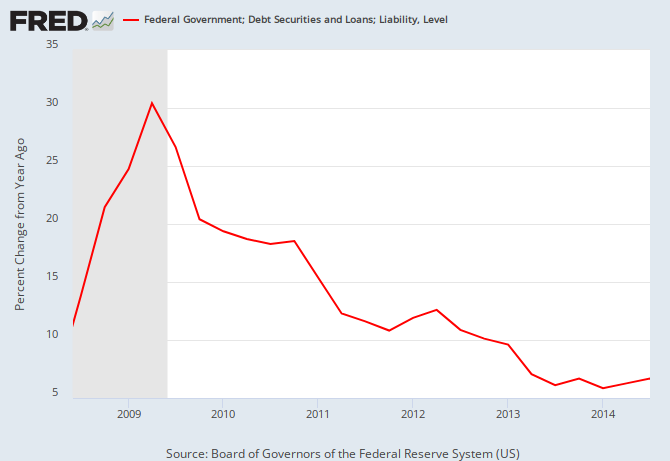
Monetary Sovereignty

Monetary Sovereignty

Vertical gray bars mark recessions.

As the federal deficit growth lines drop, we approach recession, which will be cured only when the growth lines rise. Increasing federal deficit growth (aka “stimulus”) is necessary for long-term economic growth.

#MONETARYSOVEREIGNTY

–What is the purpose of the Congressional Budget Office?

==================================================================================================================================================================
Twitter: @rodgermitchell; Search #monetarysovereignty
Facebook: Rodger Malcolm Mitchell

Mitchell’s laws:
●Those, who do not understand the differences between Monetary Sovereignty and monetary non-sovereignty, do not understand economics.
●The more federal budgets are cut and taxes increased, the weaker an economy becomes. .
Liberals think the purpose of government is to protect the poor and powerless from the rich and powerful. Conservatives think the purpose of government is to protect the rich and powerful from the poor and powerless.
●Austerity is the government’s method for widening
the gap between rich and poor.
●Until the 99% understand the need for federal deficits, the upper 1% will rule.
To survive long term, a monetarily non-sovereign government must have a positive balance of payments.
●Everything in economics devolves to motive,
and the motive is the Gap.
==================================================================================================================================================================

What is the purpose of the Congressional Budget Office (CBO)?

According to the CBO itself: “Each year, the agency’s economists and budget analysts produce dozens of reports and hundreds of cost estimates for proposed legislation.”

So, you may believe the CBO analyzes current and future taxes and spending plans, to help Congress determine current and future deficits.

And you would be right — but wrong.

I just read an article speculating that the Republicans will play games with the Congressional Budget Office (CBO) in an effort to appear conservative while spending more than is disclosed.

Here are a few excerpts:

Will The GOP Turn The CBO Into A Fantasy League?
By Howard Hill
(a former investment banker who created a number of groundbreaking deal structures and analytic techniques on Wall Street, and later helped manage a $100 billion portfolio. His book Finance Monsters was recently published.)
December 23, 2014

News that Doug Elmendorf will not be appointed to another term as head of the Congressional Budget Office bodes ill for future budget policy discussions.

The CBO is the official non-partisan scorekeeper for all things budgetary. The soon-to-be outgoing chief of that crucial office is held in high esteem by both parties for his fair-minded neutrality.

The CBO’s analysis of the likely 10-year effects of the Affordable Care Act is a prime example. Democrats seized on the overall deficit savings from Obamacare that came from several cost-control measures in the Act and new taxes on “Cadillac” employer-provided insurance plans.

For their part, Republicans got political talking points from the estimate that the workforce would shrink when middle-aged workers left jobs they held on to as the only way to maintain their health insurance.

No matter. The (D)s could trumpet the deficit cutting, and the (R)s could say it cost jobs.

Even current “rules” of CBO analyses are subject to partisan gaming. For example, when a bill increases deficits too much to be acceptable in the CBO’s standard 10-year analysis, the bills are often changed to make the expensive (but popular) aspects of the bill expire early.

With a wink and a nudge, the bill’s sponsors figure that Congress will extend the popular but expensive features when they are up for expiration.

Another example was the automatic sunsetting of the tax cuts put into place in 2001 and 2003. When they were originally set to expire in 2010, the country was still suffering the after-effects of the 2008 recession, so most of the cuts stayed in place. In political speak, not extending all the cuts was labeled “raising taxes.”

The latter example is especially significant if the new head of the CBO uses the dynamic scoring that radicals like Rep. Paul Ryan (R-WI) want.

According to the supply-side devotees that want the new method of scoring, tax cuts always spur additional economic growth, effectively growing our way out of the revenue shortfalls that are inevitable when tax rates are cut.

Some of the trillion and a half dollars added to the national debt by the tax cuts comes back to the Treasury by virtue of the extra growth in the economy and employment.

The CBO estimated that our national debt from that relatively modest tax cut would grow by only $1.1 to $1.3 trillion with those positive feedback effects from the tax cuts.

Translation: Rather than projecting taxes and spending from current levels, “dynamic scoring” assumes that tax cuts cause increased personal income, which in turn causes increased spending, which actually increase tax receipts.

It used to be called the “Laffer curve.” The purpose is to cut taxes on the rich while demonstrating future fiscal prudence: Lower taxes and a reduced deficit.

As (Republican) Governor Sam Brownback said when he pushed Kansas to make drastic tax cuts, he was using the state as his “laboratory” — and he even hired supply-side guru Art Laffer to advise.

Kansas is bordered by four states with very similar economies. They didn’t duplicate his tax cuts. What better real-world experiment could we have?

Since the Brownback/Laffer policies were put into place, the Kansas economy grew slower and unemployment dropped less than in any of the bordering states.

This year, Kansas will probably finish depleting its rainy day fund, let its roads fall apart even more, close schools all over the state, and raid specific purpose funds to give them to the general fund.

That’s to plug the $279 million gap in this year’s budget that’s still left after last year’s budget cuts.

And the problem being pushed into next year is already expected to be more than twice as big ($648 million).

So maybe the incoming head of the CBO analysis should use this real data from the real world, where tax cuts seem to make an economy grow slower than no tax cuts.

Now that’s a plan! More unemployment, slower growth, and bigger deficits.

Howard Hill may or may not be a great investment banker, but clearly he doesn’t know squat about economics, specifically Monetary Sovereignty.

He doesn’t understand that:
1. The federal government is Monetarily Sovereign, never can run short of its sovereign currency, the dollar, and neither needs nor uses tax dollars to fund its spending.

2. Federal deficits not only are not a problem, but increased federal deficits are necessary to grow the U.S. economy. That is why deficit cuts inhibit economic growth.

3. The federal debt is nothing more than bank deposits — the total of deposits in T-security accounts at the Federal Reserve Bank — and could be “paid off” simply by transferring the dollars in these accounts to the T-security owners’ checking accounts.

4. Kansas is monetarily non-sovereign, so it does need and use tax dollars to fund its spending. Using the Kansas experience as an example for the U.S. is like using a house on the moon as an example for a house on the sun.

In short, the politicians (at the behest of the rich) have made sure the Congressional Budget Office is unable to provide accurate predictions about current and future deficits, and even if the CBO could perform this task, the results would be useless.

The entire CBO mission is a charade, created by Congress and President Richard Nixon on July 12, 1974, as part of the Congressional Budget and Impoundment Control Act.

Ironically, three years earlier, President Nixon had invalidated the future CBO’s mission, when he took the U.S. off its gold standard, and made the government Monetarily Sovereign.

Not only was the CBO unable to predict deficits, but predicting deficits became a useless exercise.

Federal spending is not limited by taxes, deficits or by debt. It is limited only by an inflation that cannot be controlled with interest rate increases.

Because the CBO cannot predict deficits, and deficits do not limit spending or tax reduction, the CBO’s contribution to American economics merely is to track dollars coming in and dollars going out — much like your checkbook balance — a job that could be handled by a 3rd grade class.

Why the charade? The politicians have brainwashed the public into believing federal finances are like personal finances. For most people, their current spending is based on their current wealth plus predictions of their future income.

If your current wealth is $5,000, and you believe that next year you’ll earn $50,000, you would be unlikely to buy a $200 thousand car and a $10 million airplan. But if instead you had $5,000 and knew you were going to earn $20 million next year, you just might buy that airplane.

Federal finances are different. The federal government’s wealth is infinite (It creates dollars at will) and it’s future earnings also are infinite (Next year it again will create dollars at will). The federal government not only could buy that $10 million airplane, but a whole fleet of them — at $100 million each.

The CBO is a useless agency — actually a harmful agency — because it gives false meaning to the meaningless deficit.

The CBO however, does have one value: It employs people, thereby stimulating the economy.

Rodger Malcolm Mitchell
Monetary Sovereignty

===================================================================================
Ten Steps to Prosperity:
1. Eliminate FICA (Click here)
2. Federally funded Medicare — parts A, B & D plus long term nursing care — for everyone (Click here)
3. Provide an Economic Bonus to every man, woman and child in America, and/or every state a per capita Economic Bonus. (Click here) Or institute a reverse income tax.
4. Free education (including post-grad) for everyone. Click here
5. Salary for attending school (Click here)
6. Eliminate corporate taxes (Click here)
7. Increase the standard income tax deduction annually. (Refer to this.)
8. Tax the very rich (.1%) more, with higher, progressive tax rates on all forms of income. (Click here)
9. Federal ownership of all banks (Click here and here)

10. Increase federal spending on the myriad initiatives that benefit America’s 99% (Click here)

The Ten Steps will add dollars to the economy, stimulate the economy, and narrow the income/wealth/power Gap between the rich and the rest.
——————————————————————————————————————————————

10 Steps to Economic Misery: (Click here:)
1. Maintain or increase the FICA tax..
2. Spread the myth Social Security, Medicare and the U.S. government are insolvent.
3. Cut federal employment in the military, post office, other federal agencies.
4. Broaden the income tax base so more lower income people will pay.
5. Cut financial assistance to the states.
6. Spread the myth federal taxes pay for federal spending.
7. Allow banks to trade for their own accounts; save them when their investments go sour.
8. Never prosecute any banker for criminal activity.
9. Nominate arch conservatives to the Supreme Court.
10. Reduce the federal deficit and debt

No nation can tax itself into prosperity, nor grow without money growth. Monetary Sovereignty: Cutting federal deficits to grow the economy is like applying leeches to cure anemia.
1. A growing economy requires a growing supply of dollars (GDP=Federal Spending + Non-federal Spending + Net Exports)
2. All deficit spending grows the supply of dollars
3. The limit to federal deficit spending is an inflation that cannot be cured with interest rate control.
4. The limit to non-federal deficit spending is the ability to borrow.

THE RECESSION CLOCK
Monetary Sovereignty

Monetary Sovereignty

Vertical gray bars mark recessions.

As the federal deficit growth lines drop, we approach recession, which will be cured only when the growth lines rise. Increasing federal deficit growth (aka “stimulus”) is necessary for long-term economic growth.

#MONETARYSOVEREIGNTY

–A short note to college students certain about Palestine/Israel

Twitter: @rodgermitchell; Search #monetarysovereignty
Facebook: Rodger Malcolm Mitchell

Mitchell’s laws:
●Those, who do not understand the differences between Monetary Sovereignty and monetary non-sovereignty, do not understand economics.
●The more federal budgets are cut and taxes increased, the weaker an economy becomes. .
Liberals think the purpose of government is to protect the poor and powerless from the rich and powerful. Conservatives think the purpose of government is to protect the rich and powerful from the poor and powerless.
●Austerity is the government’s method for widening
the gap between rich and poor.
●Until the 99% understand the need for federal deficits, the upper 1% will rule.
To survive long term, a monetarily non-sovereign government must have a positive balance of payments.
●Everything in economics devolves to motive,
and the motive is the Gap.
==================================================================================================================================================================

I remember being in college, when the world was simple. There, safely tucked into the cloister and ivy, everything was obvious. Later, the real world was less obvious, and today things have become complex.

For you, today’s college students, the world still is simple: Make grades, party and be certain about what you believe. For you, it is obvious that the Palestinians, whoever they may be (See: here), are poor, beleaguered underdogs, being oppressed by the evil and mighty Israelis.

So you follow along, chanting the words you were given, to protest march in the streets, and to call for boycotts of Israel, and otherwise to demonstrate your deep and perfect knowledge of the Mideast.

Sometimes, on very rare occasions, you may find you still have a little bit to learn (Those occasions will increase in frequency as you grow older.) And perhaps, just perhaps, this may be one of those times:

A “very good question” in Mideast conflict
By Jeff Robbins

At a panel on the Mideast conflict two years ago, then-Representative Barney Frank asked the late Leonard Fein, a left-leaning critic of Israeli Prime Minister Benjamin Netanyahu, why it was that if the Palestinians truly desired a two-state solution, they had continued to reject Israeli offers of a Palestinian state in return for peace.

“That,” replied Fein, “is a very good question.”

Why, indeed, is it that the Palestinians rejected Israel’s offer for an independent Palestinian state comprised of virtually all of the West Bank, the Gaza Strip, and a capital in East Jerusalem in 2000, in 2001, and then again in 2008? After all, acceptance of any of those peace deals would have resulted not just in an end to the settlement construction that the Palestinians assert is the obstacle to peace, but the evacuation of tens of thousands of Israelis from the West Bank.

President Bill Clinton described Yasser Arafat’s rejection of the Palestinian state offered by the Israelis at the end of his second term as tragic.

Former Secretary of State Condoleezza Rice describes the even more favorable offer made by Israel in 2008, and the high hopes that the United States had that, at long last, the Palestinians would accept the state that had been offered them in return for peace.

“In the end, the Palestinians walked away from the negotiations. . . . Had [Palestinian President Mahmoud Abbas] expressed a willingness to accept the extraordinary terms he’d been offered, it might have been a turning point in the history of the intractable conflict.”

So yes, the Palestinians (or more correctly, the Gazans) indeed are poor and they are beleaguered and they are oppressed, the question being: Who exactly is the oppressor?

Of course, you know none of this, for all your young eyes can see is Israelis killing civilians — you know, those civilians behind whom the Hamas fighters were hiding as they fired their rockets, and whose homes Hamas usurped to dig their attack tunnels.

The fact is, as the article so eloquently continues:

The Palestinian street opposes any end of conflict with Israel that fails to bring about its (Israel’s) disappearance.

Fewer than 30 percent of Palestinians support a two-state solution — a West Bank/Gaza state living in lasting peace with Israel. Almost two-thirds (said) “resistance should continue until all of historic Palestine is liberated” (i.e. Israel is obliterated).

And this past September, 80 percent of Palestinians polled said that Hamas should continue to fire rockets at Israel, with Hamas, receiving an 88 percent approval rating, compared with only 36 percent approving the considerably more moderate Palestinian Authority government led by Abbas.

Abbas told the Washington Post that he was in no hurry to make peace with the Israelis, and that he refused even to negotiate with them. Rather, Abbas preferred to wait, hoping that international pressure on Israel would force it to capitulate without any corresponding obligation on the Palestinians’ part to agree to live in peace. “Until then,” Abbas told the Post, “in the West Bank we have a good reality . . . the people are living a normal life.”

The Palestinians’ argument that UN intervention is necessary because they cannot otherwise obtain a state represents a dearly-held narrative that has been adopted wholesale in certain quarters. Sadly, however, it is a narrative that is tough to square with what has actually occurred.

Why would “fewer than 30 percent of Palestinians support a two-state solution — a West Bank/Gaza state living in lasting peace with Israel”? They have been taught to hate, taught from an early age, in their schools, taught by their political leaders.

So, dear students, the world is a bit more complex than your leaders and the Islamists have told you. Neither Hamas nor the PLO wants peace with Israel. Their motives are much darker.

They will settle for nothing less than the total destruction of Israel, and their not “understanding” why Israel resists negotiating its own eradication, is but a pretense for the gullible.

ISIS Closing in on Israel from the North and the South
The Fiscal Times By Riyadh Mohammed, Dec 23, 2014

(ISIS) says it has recruited three Syrian rebel groups operating in the south of the country in an area bordering the Israeli occupied Golan Heights — that have switched their loyalties to ISIS.

This switch means that Israel, the U.S.’s closest ally in the Middle East, could be threatened from the southwest by the Egyptian ISIS group of Ansar Bait al-Maqdis in Sinai and by ISIS in southern Syria.

ISIS has been criticized by many Arabs and Muslims for not taking its fight to Israel and instead fighting fellow Arabs and Muslims. An attack aimed at Israel may boost ISIS’s popularity in the Arab world and refresh its recruitment and funding efforts.

Israel is stuck in the midst of the world’s longest war — the 1,300 year war between Islam and Christianity — with the current Mideast conflict being but a sentence in a paragraph in a religious war tome.

And that sentence reads, “Non-muslims are infidels who must be killed. There is no room for compromise.”

France Orders Troop Reinforcements After Attacks
By AURELIEN BREEDEN and ALAN COWELL DEC. 23, 2014

After a string of attacks across France that have heightened concerns about Islamic militancy, Prime Minister Manuel Valls said on Tuesday that hundreds of additional military personnel would be ordered onto the streets.

“There is a terrorist threat in France,” Mr. Valls told a news conference in Paris. “It is undoubtedly the main challenge of our time.”

Security concerns in France and elsewhere have been heightened by the radicalization of thousands of Europeans who have traveled to Syria and Iraq to join the Islamic State, which seeks the establishment of an Islamic caliphate.

So march on, young collegiates, chant the protest slogans taught to you, boycott and express your outrage. But be careful of what you desire.

If the “infidels” of Israel are destroyed, the “infidels” of Europe will be next, then to be followed in death, by the “infidels” of America.

This centuries-long war knows no boundaries, and the peace you want may not be the peace you receive.

It may be an eternal peace.

Rodger Malcolm Mitchell
Monetary Sovereignty

PS: An update from 3/7/15

Hamas Focuses on Rebuilding Tunnels as Gazans Suffer
Hamas’ focus on reconstructing its tunnels, while ignoring the lack of housing in Gaza points to the military wing’s dominance in the organization.

The rampant tunnel reconstruction is not only indicative of the military wing’s conduct, but also of the warped priorities of a movement that started out as a welfare organization.

The military wing has risen against its founders. Operation Protective Edge inflicted immense damage on Gaza, resulting in more than 2,200 fatalities, thousands of wounded and unprecedented devastation to houses and infrastructure.

A quarter of the population is homeless. Still today, thousands of families whose homes were destroyed live in public buildings.

Once again, Hamas is investing the scant resources it can get its hands on in preparing for the next war.

Perhaps it would appeal to America’s university children, and their naive Boycott, Divestment and Sanctions Movement, to refer to “peace tunnels.”

===================================================================================
Ten Steps to Prosperity:
1. Eliminate FICA (Click here)
2. Federally funded Medicare — parts A, B & D plus long term nursing care — for everyone (Click here)
3. Provide an Economic Bonus to every man, woman and child in America, and/or every state a per capita Economic Bonus. (Click here) Or institute a reverse income tax.
4. Free education (including post-grad) for everyone. Click here
5. Salary for attending school (Click here)
6. Eliminate corporate taxes (Click here)
7. Increase the standard income tax deduction annually. (Refer to this.)
8. Tax the very rich (.1%) more, with higher, progressive tax rates on all forms of income. (Click here)
9. Federal ownership of all banks (Click here and here)

10. Increase federal spending on the myriad initiatives that benefit America’s 99% (Click here)

The Ten Steps will add dollars to the economy, stimulate the economy, and narrow the income/wealth/power Gap between the rich and the rest.
——————————————————————————————————————————————

10 Steps to Economic Misery: (Click here:)
1. Maintain or increase the FICA tax..
2. Spread the myth Social Security, Medicare and the U.S. government are insolvent.
3. Cut federal employment in the military, post office, other federal agencies.
4. Broaden the income tax base so more lower income people will pay.
5. Cut financial assistance to the states.
6. Spread the myth federal taxes pay for federal spending.
7. Allow banks to trade for their own accounts; save them when their investments go sour.
8. Never prosecute any banker for criminal activity.
9. Nominate arch conservatives to the Supreme Court.
10. Reduce the federal deficit and debt

No nation can tax itself into prosperity, nor grow without money growth. Monetary Sovereignty: Cutting federal deficits to grow the economy is like applying leeches to cure anemia.
1. A growing economy requires a growing supply of dollars (GDP=Federal Spending + Non-federal Spending + Net Exports)
2. All deficit spending grows the supply of dollars
3. The limit to federal deficit spending is an inflation that cannot be cured with interest rate control.
4. The limit to non-federal deficit spending is the ability to borrow.

THE RECESSION CLOCK
Monetary Sovereignty

Monetary Sovereignty

Vertical gray bars mark recessions.

As the federal deficit growth lines drop, we approach recession, which will be cured only when the growth lines rise. Increasing federal deficit growth (aka “stimulus”) is necessary for long-term economic growth.

#MONETARYSOVEREIGNTY