–Do Modern Monetary Theory and Monetary Sovereignty really hate each other?

Twitter: @rodgermitchell; Search #monetarysovereignty
Facebook: Rodger Malcolm Mitchell

Mitchell’s laws:
●Those, who do not understand the differences between Monetary Sovereignty and monetary non-sovereignty, do not understand economics.
●The more federal budgets are cut and taxes increased, the weaker an economy becomes. .
Liberals think the purpose of government is to protect the poor and powerless from the rich and powerful. Conservatives think the purpose of government is to protect the rich and powerful from the poor and powerless.
●Austerity is the government’s method for widening
the gap between rich and poor.
●Until the 99% understand the need for federal deficits, the upper 1% will rule.
To survive long term, a monetarily non-sovereign government must have a positive balance of payments.
●Everything in economics devolves to motive,
and the motive is the Gap.
==================================================================================================================================================================

Do proponents of Modern Monetary Theory (MMT) and Monetary Sovereignty MS) really hate each other?

One might think so, based on the tone of the comments below the post, “Another word on MMT’s Jobs Guarantee and ‘The Rise Of Bullshit Jobs’,” Wednesday, Feb 4 2015

But, nothing could be further from the truth. Our disagreements are more like wrestling matches between twins. I very much like and respect Warren Mosler (the father of MMT), Stephanie Kelton, Randy Wray and all the folks at UMKC (the heart of MMT academics).

I mention this, because reader “tetrahedron 720” recently commented on the above-mentioned post:

“I somehow think this should be MS and MMT working together to complement each other’s strengths, not one OR the other in a battle to the finish. MS provides the demand and subsequent employment followed by the JG to capture what the private sector cannot. No?”

To the degree these sister philosophies can be summarized in a few, short sentences, here is what I see:

In describing the facts of federal and non-federal finances, MS and MMT are essentially the same. I know of no important differences.

Both schools agree that the federal government cannot run short of dollars, federal taxes do not fund federal spending, federal deficits are necessary for long-term economic growth, and federal “trust funds” (example: the Social Security “trust fund”) are nothing more than accounting conveniences and not real repositories of dollars.

Where MMT and MS differ most is in some of the recommendations, based on those very same facts.

MMT appears to believe that unemployment and price instability are our primary economic problems. They even created a “Center for Full Employment and Price Stability” at UMKC.

MS believes that the growing income/wealth/power Gap and the slow-growing overall economy are our primary problems. So MS focuses on narrowing the Gap, and growing the economy.

———————

While MMT welcomes low-paying jobs as an improvement over unemployment, MS believes low-paying jobs are a trap — the rich’s method for increasing wage slavery and widening the Gap.

———————

While MMT would seek directly to provide low-paying jobs as a partial cure for unemployment, MS would seek directly to provide funds to the “not-rich” as a partial cure for the too-wide Gap.

———————

While MMT asks for more direct government control over employment, MS asks for more government funding for private sector employment.

———————

While MMT believes inflation should be controlled by government balancing of deficits, MS believes inflation should be controlled by government balancing of interest rates.

———————

While MMT is discussed and presented in academic terms (except for Warren’s excellent book), MS is discussed and written in lay terms.

———————

The are many exceptions to the above. For instance, MS believes all banks and utilities should be federalized, and I suspect some in MMT may agree. We all agree on the elimination of FICA.

Interestingly, despite overwhelming similarities, each philosophy was created separately. MMT was created first, and later, MS was created without the knowledge that MMT existed.

One could think of it as “convergent evolution” (the process whereby different organisms, independently evolve similar traits, based on facing similar problems).

So in answer to the question, “Do proponents of Modern Monetary Theory (MMT)and Monetary Sovereignty (MS) really hate each other?,” the answer is most assuredly, “No.”

We stand side-by-side in the fight against the widespread economic ignorance, fostered by the rich and powerful.

Rodger Malcolm Mitchell
Monetary Sovereignty

===================================================================================
The Ten Steps to Prosperity:

1. Eliminate FICA (Click here)
2. Federally funded Medicare — parts A, B & D plus long term nursing care — for everyone (Click here)
3. Provide an Economic Bonus to every man, woman and child in America, and/or every state a per capita Economic Bonus. (Click here) Or institute a reverse income tax.
4. Federally funded, free education (including post-grad) for everyone. Click here
5. Salary for attending school (Click here)
6. Eliminate corporate taxes (Click here)
7. Increase the standard income tax deduction annually. (Refer to this.)
8. Tax the very rich (.1%) more, with higher, progressive tax rates on all forms of income. (Click here)
9. Federal ownership of all banks (Click here and here)
10. Increase federal spending on the myriad initiatives that benefit America’s 99% (Click here)

Initiating The Ten Steps sequentially will add dollars to the economy, stimulate the economy, and narrow the income/wealth/power Gap between the rich and the rest.
——————————————————————————————————————————————

10 Steps to Economic Misery: (Click here:)
1. Maintain or increase the FICA tax..
2. Spread the myth Social Security, Medicare and the U.S. government are insolvent.
3. Cut federal employment in the military, post office, other federal agencies.
4. Broaden the income tax base so more lower income people will pay.
5. Cut financial assistance to the states.
6. Spread the myth federal taxes pay for federal spending.
7. Allow banks to trade for their own accounts; save them when their investments go sour.
8. Never prosecute any banker for criminal activity.
9. Nominate arch conservatives to the Supreme Court.
10. Reduce the federal deficit and debt

No nation can tax itself into prosperity, nor grow without money growth. Monetary Sovereignty: Cutting federal deficits to grow the economy is like applying leeches to cure anemia.
1. A growing economy requires a growing supply of dollars (GDP=Federal Spending + Non-federal Spending + Net Exports)
2. All deficit spending grows the supply of dollars
3. The limit to federal deficit spending is an inflation that cannot be cured with interest rate control.
4. The limit to non-federal deficit spending is the ability to borrow.

THE RECESSION CLOCK
Monetary Sovereignty

Monetary Sovereignty

Vertical gray bars mark recessions.

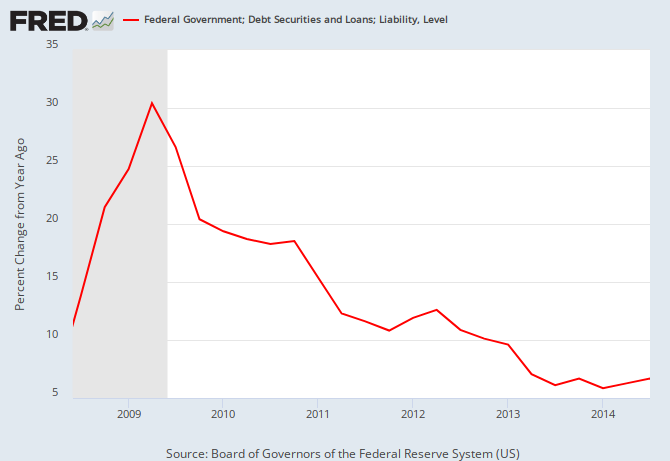
As the federal deficit growth lines drop, we approach recession, which will be cured only when the growth lines rise. Increasing federal deficit growth (aka “stimulus”) is necessary for long-term economic growth.

#MONETARYSOVEREIGNTY

–Can you afford to live? Can the federal government afford you to live?

Twitter: @rodgermitchell; Search #monetarysovereignty
Facebook: Rodger Malcolm Mitchell

Mitchell’s laws:
●Those, who do not understand the differences between Monetary Sovereignty and monetary non-sovereignty, do not understand economics.
●The more federal budgets are cut and taxes increased, the weaker an economy becomes. .
Liberals think the purpose of government is to protect the poor and powerless from the rich and powerful. Conservatives think the purpose of government is to protect the rich and powerful from the poor and powerless.
●Austerity is the government’s method for widening
the gap between rich and poor.
●Until the 99% understand the need for federal deficits, the upper 1% will rule.
To survive long term, a monetarily non-sovereign government must have a positive balance of payments.
●Everything in economics devolves to motive,
and the motive is the Gap.
==================================================================================================================================================================

Can you afford to live? Can the federal government afford you to live? Should America have a “Medicare for Everyone” program?

The following article appeared in the January-February issue of AARP Bulletin:

How Do You Pay for a $1,200 Pill?
Specialty drugs can mean miracles and heartbreak
By Bill Hogan

Sue Trevor (has a) disabling form of psoriasis. “The pharmacist called to let me know my Stelara was ready. She said, ‘I wanted to let you know that you now have a copay.’ It was $1,578 for each injection, four times a year.”

Trevor was able to pay for only one treatment, and that was with financial help from a nonprofit group.

Since then, here share has increased to $2,728 per injection.

Can Sue Trevor afford to live?

By giving new hope to patients with cancer, hepatitis C, multiple sclerosis, Parkinson’s disease, psoriasis and rheumatoid arthritis, to name a few, specialty drugs are the Rolls-Royces of the pharmaceutical industry.

But these drugs come with costs to match. Solaris, for instance, which treats two life-threatening blood diseases, costs $440,000 per year.

Can our Monetarily Sovereign federal government afford to pay for such drugs?

Right wing budget cutters will tell you, “No,” and that people should be self-sufficient, and not be takers, who receive federal help.

Leigh Purvis, director of health services research at the AARP Public Policy Institute says, “There are lots of great new medications out there, but the sad fact is that many of them are so expensive that consumers may not be able to afford them.”

A key factor driving up health care costs (is) specialty drugs. Nineteen of the 28 drugs approved by the FDA were specialty drugs, the third year in a row that specialty drugs accounted for the majority of approvals.

John Rother, president and CEO of the National Coalition on Health Care, warns of “a tsunami of expensive medicines that could literally bankrupt the health care system.”

Really?? Bankrupt the U.S. government, which being Monetarily Sovereign, creates unlimited dollars ad hoc, simply by paying bills?

Sovaldi, a medication that’s been shown to cure about 90% of common cases of hepatitis C, which, if left untreated, can lead to liver damage, cirrhosis, liver cancer and death.

A typical 12-week regimen costs $84,000.

An estimated 3.2 million Americans are infected, 75% of them boomers.

So, debt hawks, what shall we do about these Americans? Tell them to be self-sufficient, because our Monetarily Sovereign government refuses to pay?

How insurance plans arrive at prices for prescription medicine is hugely complicated. Drugmakers set a sticker price and insurers bargain over the price.

Plans organize covered drugs by tiers. A generic drug might require a flat $10 copayment. But a drug in the fourth or fifth tier — the specialty tier — might require patients to pay as much as 33% of the cost.

For Medicare Part D, 95% of all plans had at least one drug in the specialty tier.

Unlike Medicaid and Veterans Affairs, Medicare is forbidden by law from using its strength in numbers to negotiate lower prices. Instead, negotiations are left to private insurance companies, which which drugs to offer and prices and cost sharing rules.

Think about that. The law prevents Medicare even from negotiating. The payers decide what to pay, based on profitability.

If Medicare Part D were a single-payer (government) plan (Part D for everyone), profitability and affordability would not be considerations. More people could have relief from their suffering, plus longer lives.

But it gets even worse:

While Part D enrollees can accept drugs provided at no cost by their manufacturers, Medicare bars manufacturers from offering any kind of co-pay assistance or other financial help.

In the United States, our so-called “1st world country,” being sick, while not being rich, can mean a lifetime of preventable misery or even a death sentence.

Why? Because the debt hawks tell you to be self-sufficient and not to accept help from the government. They tell the Big Lie that our Monetarily Sovereign government could run short of its own sovereign currency, the dollar.

And you believe it!

And its not just medicine. Another AARP article says:

Millions of older Americans rely on community-based programs funded by the Older Americans Act, created 50 years ago to help people live independently as they age.

It funds nutrition services (including Meals on Wheels), caregiver support, transportation and a host of other services for vulnerable older Americans.

But congress has been unable to reach an agreement on reauthorizing this important law.

To the debt hawks, the suffering of actual people is not a problem; the problem is the federal deficit.

Why? No one knows. For a Monetarily Sovereign nation, deficits are absolutely necessary for economic growth. The deficit cutters won’t tell you that. They want to cut what makes the economy grow.

And the beat goes on:

Where’s the War on Alzheimer’s?
As research funding lags, cases are increasing — with staggering costs.
By. T. R. Reid

The most expensive disease in america is devouring federal and state health care budgets, and depleting the life savings of millions of victims and their families.

Recent studies show that the cost of caring for Americans with Alzheimer’s disease and other dementias has surpassed the cost of treatment for cancer patients or victims of heart disease.

“If we don’t get some control over this disease, says Huntington Potter, a neurobiologist at the U. of Colorado School of Medicine, “its going to bankrupt both Medicare and Medicaid.”

No, these federal agencies cannot be bankrupted. But real, live Americans are being bankrupted by Alzheimer’s disease (not to mention the horrors of the disease, itself.)

The disease is costly, and the ignorance about federal financing is even more costly.

Washington has committed some $5.4 billion this fiscal year to cancer research, about $1.2 billion to heart disease and $3 billion to HIV/AIDS. Research funding for Alzheimer’s will reach just $566 million.

The disease can linger for years or decades. That makes the cost, both for government insurance programs and for families, extremely high.

Our Monetarily Sovereign federal government can afford the cost, and never go bankrupt, but doesn’t pay it. The bitter irony: Families cannot afford the cost, and do go bankrupt, while trying to pay it.

Ah, the list goes on and on — things the federal government can and should fund, to improve our lives, but won’t do because of the Big Lie that the federal government “can’t afford it.”

And right about now, I hear the wailing, the crying and the moaning about “inflation,” and not just inflation but “hyper-inflation,” as the names “Weimar, Zimbabwe, Argentina” come spilling out.

Never mind that though people are suffering and dying right now, today, from lack of federal assistance, while America never, in its history has had hyper-inflation.

And never mind that the Fed controls inflation quite well, simply by controlling interest rates.

And never mind that there has been no relationship between federal spending and inflation, but rather the relationship has been with oil prices. See: “Oil causes inflation.”

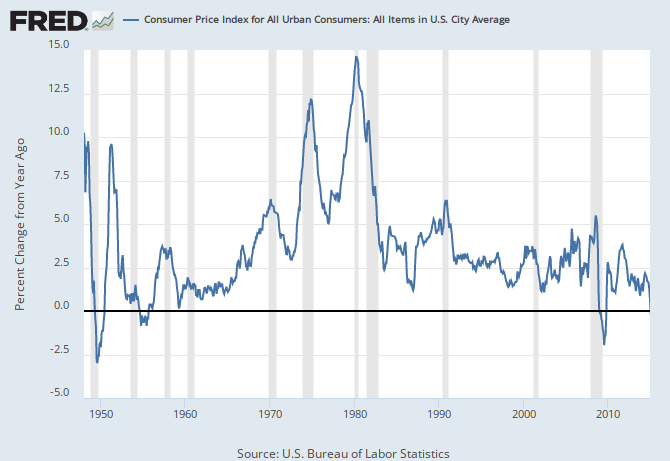
And never mind that despite those “terrible” deficits, we are sinking into deflation, which most economists say is more devastating than inflation.

monetary sovereignty

The Risk Of Deflation In America Is Rapidly Escalating
WALTER KURTZ, JAN. 11, 2015, 2:10 PM

Unlike a number of other nations — especially some countries in Europe — the US is currently not dealing with general price declines. However, the risks of such an occurrence have increased materially.

This for example can be seen in the intermediate-term market-based inflation expectations, which have fallen to 2009 levels — when deflation was a serious concern.

One key data point supporting these rising risks came from last Friday’s jobs report. The report showed wage growth falling from a fairly stable level of 2% per annum. In particular, “production and nonsupervisory employees” saw a sharp decline in wage growth — in spite of robust growth in payrolls.

Translation: There has been a big increase in low pay jobs. The Gap is widening.

Bottom line:
1. The federal government needs to spend more on health R&D and on health care.
2. Federal “affordability” is not an issue. People’s affordability is the issue.
3. The “threat” of possible inflation is way overblown, especially as compared with the reality of human suffering.
4. The “world leader” should provide a federally funded, fully funded (no deductibles) Medicare Parts A, B and D, plus home and nursing care, for all Americans.

It’s not what the rich want, but it’s what the 99% need, if we are to be able to afford to live.

Rodger Malcolm Mitchell
Monetary Sovereignty

===================================================================================
The Ten Steps to Prosperity:

1. Eliminate FICA (Click here)
2. Federally funded Medicare — parts A, B & D plus long term nursing care — for everyone (Click here)
3. Provide an Economic Bonus to every man, woman and child in America, and/or every state a per capita Economic Bonus. (Click here) Or institute a reverse income tax.
4. Federally funded, free education (including post-grad) for everyone. Click here
5. Salary for attending school (Click here)
6. Eliminate corporate taxes (Click here)
7. Increase the standard income tax deduction annually. (Refer to this.)
8. Tax the very rich (.1%) more, with higher, progressive tax rates on all forms of income. (Click here)
9. Federal ownership of all banks (Click here and here)
10. Increase federal spending on the myriad initiatives that benefit America’s 99% (Click here)

Initiating The Ten Steps sequentially will add dollars to the economy, stimulate the economy, and narrow the income/wealth/power Gap between the rich and the rest.
——————————————————————————————————————————————

10 Steps to Economic Misery: (Click here:)
1. Maintain or increase the FICA tax..
2. Spread the myth Social Security, Medicare and the U.S. government are insolvent.
3. Cut federal employment in the military, post office, other federal agencies.
4. Broaden the income tax base so more lower income people will pay.
5. Cut financial assistance to the states.
6. Spread the myth federal taxes pay for federal spending.
7. Allow banks to trade for their own accounts; save them when their investments go sour.
8. Never prosecute any banker for criminal activity.
9. Nominate arch conservatives to the Supreme Court.
10. Reduce the federal deficit and debt

No nation can tax itself into prosperity, nor grow without money growth. Monetary Sovereignty: Cutting federal deficits to grow the economy is like applying leeches to cure anemia.
1. A growing economy requires a growing supply of dollars (GDP=Federal Spending + Non-federal Spending + Net Exports)
2. All deficit spending grows the supply of dollars
3. The limit to federal deficit spending is an inflation that cannot be cured with interest rate control.
4. The limit to non-federal deficit spending is the ability to borrow.

THE RECESSION CLOCK
Monetary Sovereignty

Monetary Sovereignty

Vertical gray bars mark recessions.

As the federal deficit growth lines drop, we approach recession, which will be cured only when the growth lines rise. Increasing federal deficit growth (aka “stimulus”) is necessary for long-term economic growth.

#MONETARYSOVEREIGNTY
–Another word on MMT’s Jobs Guarantee and “The Rise Of Bullshit Jobs”

==================================================================================================================================================================
Twitter: @rodgermitchell; Search #monetarysovereignty
Facebook: Rodger Malcolm Mitchell

Mitchell’s laws:
●Those, who do not understand the differences between Monetary Sovereignty and monetary non-sovereignty, do not understand economics.
●The more federal budgets are cut and taxes increased, the weaker an economy becomes. .
Liberals think the purpose of government is to protect the poor and powerless from the rich and powerful. Conservatives think the purpose of government is to protect the rich and powerful from the poor and powerless.
●Austerity is the government’s method for widening
the gap between rich and poor.
●Until the 99% understand the need for federal deficits, the upper 1% will rule.
To survive long term, a monetarily non-sovereign government must have a positive balance of payments.
●Everything in economics devolves to motive,
and the motive is the Gap.
==================================================================================================================================================================

Regular readers of this blog know I believe Modern Monetary Theory (MMT)to be an excellent, perhaps only, accurate description of financial reality and the differences between Monetarily Sovereign and monetarily non-sovereign finances.

However, when MMT begins making recommendations, presumably based on these differences, it sometimes gets into a bit of trouble. Specifically, its Jobs Guarantee (JG, formerly Employer of Last Resort) departs from reality and drifts into wishful, academic dreaming.

You can read Why Modern Monetary Theory’s Employer of Last Resort is a bad idea and MMT’s Job Guarantee (JG) — “Another crazy, rightwing, Austrian nutjob?” to see some of my many, many objections to this program.

Now comes the blog, naked capitalism, with the article titled, “The Rise of Bullshit Jobs.” The article quotes from other contradicting authors.

But the following quotes constitute the gist:

Back in the early-1930s, renowned economist, John Maynard Keynes, predicted that technical innovations and rising productivity would mean that advanced country workers would be able to work only 15 hours and still enjoy rising living standards.

David Graeber asks why Keynes’ prophecy has not come true and instead we find ourselves working a range of meaningless “bullshit jobs” that many of us hate:

Technology has been marshaled, if anything, to figure out ways to make us all work more. In order to achieve this, jobs have had to be created that are, effectively, pointless.

The number of workers employed as domestic servants, in industry, and in the farm sector has collapsed dramatically (while) “professional, managerial, clerical, sales, and service workers” tripled.”

Productive jobs have, just as predicted, been largely automated away.

But rather than allowing a massive reduction of working hours, we have seen the . . . creation of whole new industries . . . what I propose to call “bullshit jobs.”

It’s as if someone were out there making up pointless jobs just for the sake of keeping us all working.

The idea that the lower classes needed to be kept busy for their own sake was presented in moralistic terms but was in fact ruthlessly economic.

Historically . . .the whole point of making the peasants work . . . was to enable them to be exploited by the newly-emerging entrepreneurial class.

And there it is. The rich have brainwashed the not-rich into believing that labor itself, even pointless labor, is ethically superior, and that people accepting “freebies” from the government are moral cripples, to be despised.

Anyone proposing increases for unemployment compensation, food stamps and other aids to the poor, receives sneering and angry diatribes about lazy, good-for-nothing sloths.

So indoctrinated are the commoners, they believe it is far better to live modestly and labor for scant money, than to live like billionaires and receive money for scant labor.

Remarkably, they become hostile to anyone suggesting that the goal of government should be to improve their lives, not merely to give them work.

Does this mean that the regal likes of Bill Gates, Warren Buffett, Larry Ellison, the Koch brothers, the Waltons, and all those other billionaires, whose primary “work” consists bending over to allow for sycophant butt kissing — does it mean these royalty feel inferior and immoral for not digging ditches?

One thing that the historical record makes obviously clear is that Adam Smith and his laissez-faire buddies were a bunch of closet-case statists, who needed brutal government policies to whip the English peasantry into a good capitalistic workforce willing to accept wage slavery.

Historian Michael Perelman outlined the many different policies through which peasants were forced off the land—from the enactment of so-called Game Laws that prohibited peasants from hunting, to the destruction of the peasant productivity by fencing the commons into smaller lots.

Read of Adam Smith’s proto-capitalist colleagues complaining and whining about how peasants are too independent and comfortable to be properly exploited, and trying to figure out how to force them to accept a life of wage slavery.

“The possession of a cow or two, with a hog, and a few geese, naturally exalts the peasant. . . . In sauntering after his cattle, he acquires a habit of indolence. Quarter, half, and occasionally whole days, are imperceptibly lost. Day labour becomes disgusting; the aversion in- creases by indulgence. And at length the sale of a half-fed calf, or hog, furnishes the means of adding intemperance to idleness.”

Note the words used to describe peasants who do not work hard — “indolence,” “days lost,” “indulgence,” “intemperance” and “idleness” — words seldom used when describing political or capitalistic royalty.

Thus, by acquiescing to the belief that being beasts of burden is exalting, they live as beasts of burden, and resent those who do not. They say, “If I have to work, he should too,” completely neglecting the reality that today’s technology should allow them to work less, while living better.

MMT’s JG is built to provide “bullshit jobs” at minimum wages, which tell the peasants to hold their heads up high for doing such work. How a “bullshit” job accomplishes this is not readily explained, except that supposedly, it is the sweat labor in of itself that is ennobling.

The MMT people are good people and they are smart people, but they have bought into the “labor = godliness,” “ant vs. grasshopper” myths provided by the rich, and cannot imagine a world where the goal is not work, but life.

So they bang on, telling themselves and anyone who will listen, how much they love working, and everyone else should love it, too (while they look forward to weekends and vacations and retirement, where they can live the way the rich people do).

Sorry, MMT. Don’t show Americans how they can work more, for less. Show Americans how they can work less, for more.

Rodger Malcolm Mitchell
Monetary Sovereignty

===================================================================================
Ten Steps to Prosperity:
1. Eliminate FICA (Click here)
2. Federally funded Medicare — parts A, B & D plus long term nursing care — for everyone (Click here)
3. Provide an Economic Bonus to every man, woman and child in America, and/or every state a per capita Economic Bonus. (Click here) Or institute a reverse income tax.
4. Free education (including post-grad) for everyone. Click here
5. Salary for attending school (Click here)
6. Eliminate corporate taxes (Click here)
7. Increase the standard income tax deduction annually. (Refer to this.)
8. Tax the very rich (.1%) more, with higher, progressive tax rates on all forms of income. (Click here)
9. Federal ownership of all banks (Click here and here)

10. Increase federal spending on the myriad initiatives that benefit America’s 99% (Click here)

The Ten Steps will add dollars to the economy, stimulate the economy, and narrow the income/wealth/power Gap between the rich and the rest.
——————————————————————————————————————————————

10 Steps to Economic Misery: (Click here:)
1. Maintain or increase the FICA tax..
2. Spread the myth Social Security, Medicare and the U.S. government are insolvent.
3. Cut federal employment in the military, post office, other federal agencies.
4. Broaden the income tax base so more lower income people will pay.
5. Cut financial assistance to the states.
6. Spread the myth federal taxes pay for federal spending.
7. Allow banks to trade for their own accounts; save them when their investments go sour.
8. Never prosecute any banker for criminal activity.
9. Nominate arch conservatives to the Supreme Court.
10. Reduce the federal deficit and debt

No nation can tax itself into prosperity, nor grow without money growth. Monetary Sovereignty: Cutting federal deficits to grow the economy is like applying leeches to cure anemia.
1. A growing economy requires a growing supply of dollars (GDP=Federal Spending + Non-federal Spending + Net Exports)
2. All deficit spending grows the supply of dollars
3. The limit to federal deficit spending is an inflation that cannot be cured with interest rate control.
4. The limit to non-federal deficit spending is the ability to borrow.

THE RECESSION CLOCK
Monetary Sovereignty

Monetary Sovereignty

Vertical gray bars mark recessions.

As the federal deficit growth lines drop, we approach recession, which will be cured only when the growth lines rise. Increasing federal deficit growth (aka “stimulus”) is necessary for long-term economic growth.

#MONETARYSOVEREIGNTY

–Which are most limited in supply: Energy? Water? Food? Money?

=================================================================================
Twitter: @rodgermitchell; Search #monetarysovereignty
Facebook: Rodger Malcolm Mitchell

Mitchell’s laws:
●Those, who do not understand the differences between Monetary Sovereignty and monetary non-sovereignty, do not understand economics.
●The more federal budgets are cut and taxes increased, the weaker an economy becomes. .
Liberals think the purpose of government is to protect the poor and powerless from the rich and powerful. Conservatives think the purpose of government is to protect the rich and powerful from the poor and powerless.
●Austerity is the government’s method for widening
the gap between rich and poor.
●Until the 99% understand the need for federal deficits, the upper 1% will rule.
To survive long term, a monetarily non-sovereign government must have a positive balance of payments.
●Everything in economics devolves to motive,
and the motive is the Gap.
==================================================================================================================================================================

The February, 2015 edition of Scientific American Magazine, contained an article by Michael E. Webber, titled, “Energy, Water and Food Must Be Solved Together. Our future rides on our ability to integrate Energy, Water, Food.”

I suggest you read it.

Some excerpts:

In July 2012 three of India’s regional electric grids failed, triggering the largest blackout on earth. More than 620 million people—9 percent of the world’s population—were left powerless.

The cause: the strain of food production from a lack of water. Because of major drought, farmers plugged in more and more electric pumps to draw water from deeper and deeper belowground for irrigation.

Those pumps, working furiously under the hot sun, increased the demand on power plants. At the same time, low water levels meant hydroelectric dams were generating less electricity than normal.

Making matters worse, runoff from those irrigated farms during floods earlier in the year left piles of silt right behind the dams, reducing the water capacity in the dam reservoirs. Suddenly, a population larger than all of Europe and twice as large as that of the U.S. was plunged into darkness.

The essence of the article is that energy, water and food not only are our three most critical resources, but the three are intimately related.

A shortage of one can create a shortage of the others.

With infinite energy, we have all the water we need, because we can desalt the oceans, dig very deep wells and move water across continents.

With infinite water, we have all the energy we need, because we can build widespread hydroelectric plants or irrigate unlimited energy crops.

With infinite energy and water, we can make the deserts bloom and build highly productive indoor farms that produce food year-round.

We do not live in a world with infinite resources. We live in a world of constraints.

The article goes on to explain that:

The most obvious measure is to reduce waste. In the U.S., 25 percent or more of our food goes in the dump. Because we pour so much energy and water into producing food, reducing the proportion of waste can spare several resources at once.

The article speaks of: Eating less meat, turning discarded food into natural gas, recycling waste water, “vertical” farms, “smart” electronics that use less power.

It speaks of desalination of brackish ground water, using the methane from fracking to power the cleaning of water, “smart” electric and water grids that waste less, “smart” food packaging that give a more accurate reading of spoilage, and on and on and on.

Personal responsibility plays a role, too. Demand for fresh salads that land on our winter plates from 5,000 miles away, creates a far-flung, energy-hungry food distribution system.

Our personal choices for more of everything just push our resources to the edge.

The energy-water-food nexus is the most vexing problem to face our planet.

If we add “global warming” to that trio, we have four major problems for which there are plenty of solutions, even with current technologies. But:

There is no shortage of water. The oceans are filled with it. There is a shortage of desalination and pipelines.

There is no shortage of food. We have millions of acres that could be cultivated, either with the addition of water or with the construction of vertical or horizontal greenhouses.

There is no shortage of energy. Above us, the sun sends down vast amounts of direct solar energy, and creates wind, wave and hydroelectric power. Below us, a huge store of geothermal energy lies waiting to be used. Plus we can create enormous amounts of nuclear energy.

There is no shortage of brainpower or labor. The world has available the potential brains and backs of billions.

So what is the problem? The problem is the perceived shortage of money.

Given sufficient money, we already have the know-how to desalinate, purify and pipe enough clean water for every use — for drinking, for farming, for hydroelectric dams.

Given sufficient money, we already have the know-how to water the deserts, build the greenhouses and ship the food to those who need it.

Given sufficient money, we already have the know-how to create enough solar farms, wind farms, tidal energy and safe nuclear energy to last forever.

Given sufficient money, we already have the know-how to eliminate the increases in CO2 and methane, the two “greenhouse gases” most responsible for global warming.

Given sufficient money, we can fund the research that will improve further, our abilities to accomplish the above.

And finally, given sufficient money, we can educate and pay our seven-billion-and-climbing world population to do the work that is called for.

It all depends on “given sufficient money,” and money is the one resource we have, not only in sufficient measure, but in infinite measure. Yet, ironically, we limit this unlimited resource by our own ignorance.

How few people understand Monetary Sovereignty? How few people understand that a Monetarily Sovereign government creates money simply by pressing computer keys?

How few people understand that a Monetarily Sovereign government not only has the infinite ability to create its sovereign currency, but the equal ability to set the value of that currency (which governments actually do all the time)?

How many people ignorantly believe that a preventable or curable inflation is worse than doing without water, doing without food and doing without energy?

We have all the assets we need: Adequate technology and the ability to improve it; adequate brainpower and the ability to use it; adequate manpower and the ability to educate it; adequate water and adequate land and a nearly infinite source of power raining down on us for the next few million years.

And here we sit, with the unlimited ability to fund these assets, yet we let our ignorant fears prevent us from saving ourselves.

Ignorance. I suspect that is what killed the Neandertals. Will it kill us?

Rodger Malcolm Mitchell
Monetary Sovereignty

===================================================================================
Ten Steps to Prosperity:
1. Eliminate FICA (Click here)
2. Federally funded Medicare — parts A, B & D plus long term nursing care — for everyone (Click here)
3. Provide an Economic Bonus to every man, woman and child in America, and/or every state a per capita Economic Bonus. (Click here) Or institute a reverse income tax.
4. Free education (including post-grad) for everyone. Click here
5. Salary for attending school (Click here)
6. Eliminate corporate taxes (Click here)
7. Increase the standard income tax deduction annually. (Refer to this.)
8. Tax the very rich (.1%) more, with higher, progressive tax rates on all forms of income. (Click here)
9. Federal ownership of all banks (Click here and here)

10. Increase federal spending on the myriad initiatives that benefit America’s 99% (Click here)

The Ten Steps will add dollars to the economy, stimulate the economy, and narrow the income/wealth/power Gap between the rich and the rest.
——————————————————————————————————————————————

10 Steps to Economic Misery: (Click here:)
1. Maintain or increase the FICA tax..
2. Spread the myth Social Security, Medicare and the U.S. government are insolvent.
3. Cut federal employment in the military, post office, other federal agencies.
4. Broaden the income tax base so more lower income people will pay.
5. Cut financial assistance to the states.
6. Spread the myth federal taxes pay for federal spending.
7. Allow banks to trade for their own accounts; save them when their investments go sour.
8. Never prosecute any banker for criminal activity.
9. Nominate arch conservatives to the Supreme Court.
10. Reduce the federal deficit and debt

No nation can tax itself into prosperity, nor grow without money growth. Monetary Sovereignty: Cutting federal deficits to grow the economy is like applying leeches to cure anemia.
1. A growing economy requires a growing supply of dollars (GDP=Federal Spending + Non-federal Spending + Net Exports)
2. All deficit spending grows the supply of dollars
3. The limit to federal deficit spending is an inflation that cannot be cured with interest rate control.
4. The limit to non-federal deficit spending is the ability to borrow.

THE RECESSION CLOCK
Monetary Sovereignty

Monetary Sovereignty

Vertical gray bars mark recessions.

As the federal deficit growth lines drop, we approach recession, which will be cured only when the growth lines rise. Increasing federal deficit growth (aka “stimulus”) is necessary for long-term economic growth.

#MONETARYSOVEREIGNTY