The Federal Insurance Contributions Act (FICA) tax supposedly funds two major programs:
Social Security provides benefits for retirees, disabled individuals, and survivors of deceased workers. It’s designed to offer a safety net for individuals who can no longer work.
Medicare provides health insurance for people 65 and older and for some younger people with disabilities. It helps cover hospital care, medical services, and, in some cases, prescription drugs.
Great news! You can take money from your right-hand pocket and put it in your left. Think of it as a gift from me.
That is what you are supposed to believe.
Unfortunately, FICA funds nothing. That is because of Monetary Sovereignty. All FICA dollars are destroyed upon receipt by the Treasury.
They begin in the M2 money supply measure, but upon arrival at the Treasury, they cease to be part of any money supply measure. Effectively, they are destroyed.
Due to the misinformation and disinformation you have been given, many bad things have happened to your Social Security and Medicare. Here are just a few:
1. Trust Fund Shortfalls: The Social Security and Medicare “Trust Funds” are not real trust funds. They are merely balance sheets showing additions and subtractions. Congress controls them totally and can change the numbers at will.
Their sole “purpose” (if one can label it a purpose) is to make you falsely believe you should accept smaller benefits. The trust funds and FICA were created and exist only to limit your benefits.
2. Demographic Changes: The government says that an aging population is causing more people to draw benefits while fewer workers are paying into the system.
While those facts are true, they lead to the lie that Social Security and Medicare are running short of money. Your FICA dollars do not fund Social Security or Medicare, and the “trust funds” do not pay for benefits.
The FICA receipts are recorded as accounting credits and combined with other Treasury receipts. The federal government owns the accounts and can unilaterally raise or lower collections and expenditures.
All Social Security and Medicare benefits are funded by creating new money, which the federal government can do endlessly.
3. Increase in Full Retirement Age (FRA): The Social Security FRA has been increased from 65 to 67 for those born in 1960 or later. This means people have to wait longer to receive full benefits.
4. Higher Earnings Subject to Social Security Tax: The maximum income subject to Social Security tax has been increased over the years.
5. Higher Medicare Premiums: Larger Medicare premiums are deducted from Social Security checks for most retirees.
6. Up to 85% of your SS benefits are subject to income tax. You giveth via FICA and the government taketh — and then taketh again via income tax.
Sorry, kids, but I’m running out of money. I’ll have to cut your benefits.
7. At most, Medicareonly pays 80% of your costs while paying reduced fees to doctors and hospitals. (Have you noticed that doctors and hospitals always receive less than they bill?)
In short, you and your medical team receive less than you should.
While all of the above are financially unnecessary and based on the false premise that federal spending is funded by taxes (like state government spending is), at least they are apparent.
People can see that they receive fewer net dollars from the government.
The following is the worst because it looks like a benefit but isn’t:
8. The Inflation Reduction Act (IRA) allows Medicare to negotiate prices for certain high-cost drugs under Medicare Part B and Part D
These drugs treat conditions like heart disease, diabetes, and cancer. The negotiations are projected to save Medicare beneficiaries $1.5 billion in out-of-pocket costs when the new prices take effect in 2026.
Sounds great? It’s supposed to.
Now, think about it. Where will the money come from?
Numbers 1 through 7 obviously take dollars from the private sector, otherwise known as “the economy,” and transfer them to the government, which neither needs nor uses them.
The government already has infinite dollars. When it spends dollars, it simply passes a law and creates new ones. It can do this endlessly at no cost other than pressing a computer key.
Former Fed Chairman Alan Greenspan: “A government cannot become insolvent with respect to obligations in its own currency. There is nothing to prevent the federal government from creating as much money as it wants and paying it to somebody. The United States can pay any debt it has because we can always print the money to do that.”
Former Fed Chairman Ben Bernanke:“The U.S. government has a technology, called a printing press (or, today, its electronic equivalent), that allows it to produce as many U.S. dollars as it wishes at essentially no cost. It’s not tax money… We simply use the computer to mark up the size of the account.”
Let me get this straight. Do you really believe I have Trust Funds, and they are running short of dollars???
Fed Chairman Jerome Powell:“As a central bank, we have the ability to create money digitally.”
St. Louis Fed:“As the sole manufacturer of dollars, whose debt is denominated in dollars, the U.S. government can never become insolvent, i.e., unable to pay its bills. In this sense, the government is not dependent on credit markets to remain operational.”
Number 8, which masquerades as a benefit to the private sector, is just a transfer of dollars from one part of the economy (the people who work for pharmaceutical companies) to another (the people who pay FICA).
No new dollars are created, which means no new benefits are created. The government forces one part of the economy to pay another and claims it is providing you with a benefit.
Even worse, the charade supports the false belief that federal spending is funded by federal taxes, specifically the lie that FICA funds SS and Medicare.
It is akin to the lie that your employer pays half of FICA, when in fact, you pay all of it.
Your employer includes the cost of FICA when determining your salary. That is why employers love to classify workers as “independent contractors.”
It allows them to pay higher salaries at less cost.
One day, probably not during my lifetime, the American public will understand that federal government financing differs from state/local government financing.
The former is Monetarily Sovereign. The latter is monetarily non-sovereign. If you don’t know the difference, you don’t understand federal government finance. Click this link to begin understanding.
The people have not been informed that federal taxes fund nothing and that the government pays for everything by creating new dollars ad hoc.
So what is the purpose of federal taxes if not for funding spending? Read this.
The people need to be informed that the government has 100% control over the U.S. dollar it invented. It can give dollars any value (inflation). Historically, it has often arbitrarily changed the value of the dollar.
It can pay for anything, no matter how many dollars are needed.
Yes, the federal government could pay for comprehensive, no-deductible, free Medicare for every man, woman, and child in America. And yes, it could pay everyone a free Social Security benefit, eliminating poverty, homelessness, illiteracy, hunger, and inequality in America.
And yes, it could pay to make America, as the Bible said, “. . . the light of the world. A city set on a hill . . . .”
And it could do it all without collecting a penny in taxes.
So long as you accept the lies, you will continue to be like cattle grunting and mooing toward the slaughter.
And sadly, I can’t see that changing during my few remaining years.
Rodger Malcolm Mitchell
Monetary SovereigntyTwitter: @rodgermitchellSearch #monetarysovereigntyFacebook: Rodger Malcolm Mitchell;MUCK RACK: https://muckrack.com/rodger-malcolm-mitchell; https://www.academia.edu/
……………………………………………………………………..
The Sole Purpose of Government Is to Improve and Protect the Lives of the People.
There are other examples, but listing them would be wasteful — of your time and mine.
I looked online for claims about federal government wasteful spending. Here are a few of the hundreds I found:
Camo Uniforms for the Afghan Army: The Pentagon spent $28 million on camouflage uniforms for the Afghan National Army that were unsuitable for the desert environment.
Hipster Anti-Smoking Campaign: The National Institutes of Health spent $5 million on a campaign targeting hipsters to stop smoking, including paying them to blog about quitting.
Quail Cocaine Study: Over $500,000 was spent to study how cocaine affects the sexual behavior of Japanese quails.
Hamster Fights: More than $3 million was spent on research involving hamster fights to study aggression1.
Solar Panels for Veterans Affairs: The Department of Veterans Affairs spent $8 million on solar panels that were never used.
The Federal Register–every member of Congress automatically receives a new copy every day, at a $1 million annual cost, even though the contents are available for free online.
I could waste time listing dozens more, but these alone “waste” about $45.5 million a year, which is sufficient to outrage a Congress that voted for these expenditures and the media, which wasted time writing about them, but only on slow news days.
Before I comment further, perhaps we should try to agree on something fundamental: What is “waste”?
I suggest waste is anything that costs significantly more than its benefits over any agreed-upon period.
For instance, let me start with the gross basics: When a bear poops in the woods, is that poop considered waste?
No, because it costs the bear nothing and benefits the forest by providing growth nutrients.
Based on that definition, are the above examples of waste truly waste, or are they more like that cost-free, beneficial bear poop?
This is not a dollar. It is a bearer instrument saying the bearer owns a dollar. The dollar itself is just a number in an account.
Let’s assume there was no benefit to those cameo uniforms, anti-smoking campaigns, quail cocaine studies, etc.
Did they fall under the costs-more-than-its-benefits criterion for waste?
I say, “No.”
Every one of them took dollars from a federal government that has the infinite ability to create unlimited dollars at the touch of a computer key.
So the cost was negligible — perhaps similar to the bear’s cost in expending the effort to squat.
As former Fed Chairman Ben Bernanke said, “The U.S. government has a technology, called a printing press (or, today, its electronic equivalent), that allows it to produce as many U.S. dollars as it wishes at essentially no cost.”
But what was the benefit? Every one of those endeavors added dollars to the Gross Domestic Product.
Not only did they grow the economy as a whole, but they benefitted specific individuals. Businesses employed people to create those uniforms, the solar panels, and the printed federal register.
People were paid dollars to run the hamster and cocaine studies.
Those people used their newly earned dollars to buy things from other businesses with employees. The new money flowed through the economy, benefiting thousands and then thousands more.
It is quite possible that down the line, you yourself might have received dollars that began with the quail cocaine study.
Should he be afraid to waste sand?
One might object, “Taxpayer dollars were spent. The money came from somewhere.”
In reality, not one dollar, not even one cent, of taxpayer money was spent.
The federal government (unlike state and local governments) pays all its bills with newly created dollars.
Like the first U.S. dollars, created from thin air in 1794, and all subsequent trillions of dollars, the dollars that paid for “wasteful” federal spending were created at no cost, from thin air.
Here’s how it’s done now:
To pay an invoice, the federal government creates instructions (not dollars) from thin air. The instructions are in the form of a check or wire.
The instructions tell the creditor’s bank to increase the balance in the creditor’s checking account (“Pay to the order of _____.”)
The bank obeys those instructions by pressing computer keys. The instant the bank presses those keys, new dollars appear out of thin air and are added to the M2 money supply.
The instructions then are passed to the Federal Reserve which first “clears” them by tallying them against the government’s checking account ( Treasury General Account).
Finally, the creditor’s bank is informed that the check has cleared so it can balance its books.
Everything is just numbers in accounts based on instructions and laws. So long as the federal government can create laws, it can create instructions and dollars. The government has no limits other than the self-imposed.
Many people don’t understand that all dollars are just numbers in accounts. There are no physical dollars. Even a dollar bill is not a dollar. It is the title to a dollar. Just as a house title is not a house, and a car title is not a car, a dollar bill is not a dollar. It is a bearer instrument saying, in essence, “The bearer of this bill is the owner of a dollar.”
Eventually, that paper instrument will be shredded, but dollars, having been created from thin air, are immortal until someone pays off a debt somewhere in the world, at which time dollars will be destroyed.
In summary, all dollars are digital entries—numbers, nothing else. There are no physical dollars. The federal government controls all those entries by passing laws.
To talk about federal waste is akin to saying that the federal government wastes numbers. It’s like worrying that the federal government will run short of the number “seven.”
The federal government can pass a law saying that the Social Security “Trust Fund” now has an additional ten trillion dollars, and those dollars would instantly exist.
It is illogical to claim that the federal government wastes the dollars it has the infinite ability to create. You cannot waste what is available in unlimited quantities.
The real federal waste comes not from faulty spending but from failure to use resources infinitely available.The real waste comes from statements like these:
The Social Security Trust Fund will run out of money in (year).
FICA funds Social Security and Medicare.
Federal trust funds pay for (program).
The Medicare Trust Fund will run out of money in (year).
The debt ceiling is a prudent way to (_____).
The federal government should live within its means.
The federal debt is too high.
The federal deficit is too high.
The federal debt or deficit is unsustainable.
Government spending causes inflation
The federal government can’t afford to pay for (program).
Federal taxes fund federal spending.
Federal funding of (program) is a waste of money
Federal funding of (program) is a waste of taxpayer money.
Federal benefits for (program) must be cut or taxes increased.
The federal government should lend, not give, money to (anyone or anything).
Federal finances are like personal, business, or local government finances
Not one of these commonly heard statements is correct. Not one.
They all mark the writer or speaker as ignorant about our government’s Monetary Sovereignty or as wanting to widen the income/wealth/power Gap between the rich and the rest.
When you read about federal government waste, remember this: When a Monetarily Sovereign government, having unlimited funds, doesn’t spend to feed the hungry, house the poor, or protect its people, that is the worst possible waste, the waste of the government’s power to do good.
Rodger Malcolm Mitchell
Monetary SovereigntyTwitter: @rodgermitchellSearch #monetarysovereigntyFacebook: Rodger Malcolm Mitchell;MUCK RACK: https://muckrack.com/rodger-malcolm-mitchell; https://www.academia.edu/
……………………………………………………………………..
The Sole Purpose of Government Is to Improve and Protect the Lives of the People.
The sole purpose of government is to improve and protect the people’s lives.
Why else would we, the people, turn over control of our lives to a government?
Why else would we. the people, give our precious money and limited power to a small group that tells them what they are allowed to do and not allowed to do?
But the International Monetary Fund (IMF) has different purposes, according to their site:
1. Furthering international monetary cooperation for consultation and collaboration on international monetary problems. 2. Facilitating the expansion and balanced growth of international trade, and to contributing thereby to the promotion and maintenance of high levels of employment, real income and productive resources. 3. Promoting orderly exchangearrangements among members, and to avoiding competitive exchange depreciation. 4. The elimination of foreign exchangerestrictions which hamper the growth of world trade. 5. Making the resources of the Fund temporarily available to members to correct maladjustments in their balance of payments without measures destructive of prosperity. 6. Shortening the duration and lessening the degree of disequilibrium in the international balances of payments of memberss
Nowhere are improving and protecting the people’s lives mentioned. It’s all about the governments and their money.
That is why the IMF never met an austerity it didn’t love.
It almost always recommends some form of austerity as a cure for what it deems “excessive” government debt.
Here’s what austerity means:
Reducing Expenditure: Governments may cut spending on public services, welfare benefits, and salariesfor public sector workers. This can include limiting the terms of unemployment benefits, reducing government employees’ wages,or cutting programs for the poor.
Increasing Revenue: This can be achieved by raising taxes, targeting tax fraud and evasion, or privatizing government-owned businesses to raise capital.
Economic Impact: Austerity measures act like contractionary fiscal policy, which can slow economic growth. This is because they reduce the amount of money circulating in the economy, which can lead to lower consumer spending and investment.
Debt Management: The primary goal of austerity is to reduce the risk of default on government debt. High levels of debt can lead to creditors demanding higher interest rates, making it more expensive for a country to borrow money.
Cut benefits, increase taxes, slow growth, and ensure the government pays its obligations to other governments. That is about as pro-government and “non-people” as you can get.
It can be said sweetly and nobly as President John Kennedy with his “Ask not what your country can do for you — ask what you can do for your country” speech.
Ah, those lofty words that sound so patriotic and easy on the ear, but are a prescription for an impoverished nation living under a dictatorship.
I prefer to ask politicians, “What will you do for us in return for your salary, lifestyle, and the prestige we have given you?”
Alan Greenspan: “A government cannot become insolvent with respect to obligations in its own currency.”
The IMF functions as an employee of governments and not of the people.
Based on history and its own statements, the IMF may have a different maxim: The sole purpose of people is to improve and protect their government.
That is true in America. Here, the federal government has infinite money but still demands taxes from the people.
Here, politicians decry federal deficits, though the government can pay any invoice merely by pressing computer keys.
Here, our government pretends to struggle with funding benefits for the poor, though it has no trouble funding tax breaks for the rich.
“Improving and protecting the people’s lives” seems to be the last thing the IFM and U.S. politicians worry about.
U.S. government budget deficits and an escalating debt load pose “a growing risk” to the global economy, marring an otherwise stellar economic performance, the International Monetary Fund said on Thursday.
Translation: The federal government is putting more dollars into people’s pockets than it is taking out, and as a result, the economy is doing great.
The “growing risk” is that somehow the poor will discover the government’s infinite ability to fund benefits, and demand more and better.
The United States over the next several years faces “a pressing need” to reduce its debt burden, which could require broad-based income tax increases and cuts in popular entitlement programs, the fund said at the conclusion of its annual review of the U.S. economy.
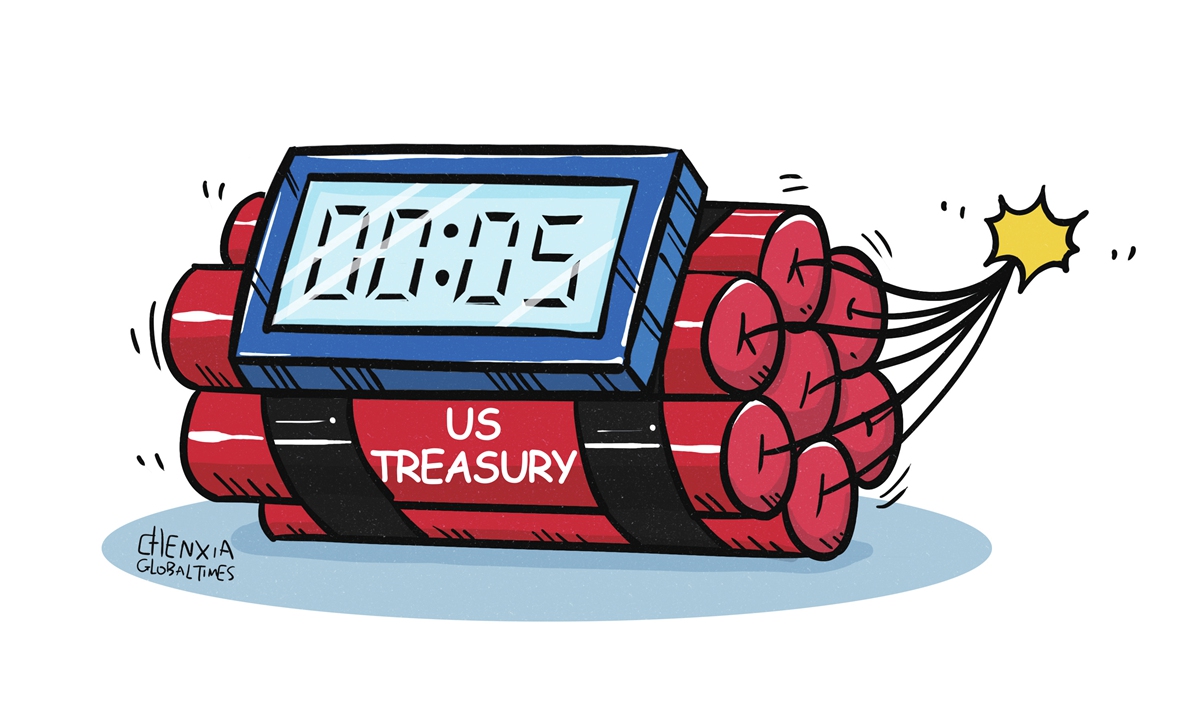
Translation: This “pressing need” often has been described as a “ticking time bomb,” which has been “ticking” for eighty-four years without exploding.
Our Monetarily Sovereign (MS) government has infinite dollars.
Why then does the IMF want, the government unnecessarily to take more money from the people and cut benefits to those who need them.
The required fiscal adjustment will mean “difficult political decisions over the course of multiple years,” the fund said, warning that an unchecked rise in debt could eventually sap U.S. growth and snowball into global financial distress.
Translation: “Difficult political decisions” are those that screw the people while sounding like the IMF is helping them.
For instance, raising Medicare, Social Security, and unemployment taxes with the false explanation that these taxes are needed to “save” the benefits.
These decisions are difficult, but we politicans, being heroic, are ready to sacrifice your lives to make the rich richer.
The rise in debt stimulated U.S. growth and “snowballed” into the people’s financial success. So, cut the debt.
“Now is a good time,” said Kristalina Georgieva, the fund’s managing director. “The U.S. economy is very strong, and it is in good times where you can do more to prepare yourself for risks in the future.”
Translation: The U.S. economy is very strong because the government has increased spending.
Therefore, now is a good time to weaken it by taking money out of the economy. GDP=Federal and Non-federal Spending + Net Exports.
You can be sure that if the economy was suffering, Ms. Georgieva would offer the same prescription: Austerity. It’s what they always recommend, regardless of the circumstances.
President Biden has ruled out at least one of the fund’s suggested remedies: Higher taxes on people making less than $400,000 a year.
Translation: The IMF wants to take dollars out of the pockets of the poorer people.
Apparently, these people should ask not what the country can do for them but what they can do for the rich people.
But debt aside, the IMF statement praised the U.S. economy for “a remarkable performance” in recent years.
Inflation has largely been brought under control without the sharp increase in unemployment that many economists had expected.
Gross domestic product (GDP) growth remains above expectations and is expected to continue.
Translation: We, the IMF, are completely clueless about how high levels of federal deficit spending can cause these remarkable outcomes, but whatever the reason, we want it stopped.
“The U.S. is the only G-20 economy whose GDP level now exceeds the pre-pandemic level. This is good for the U.S. and it is good for the global economy,” Georgieva told reporters.
Translation: The federal debt (that isn’t federal and isn’t debt — See: National Debt ) is up, and all this good stuff is happening. We of the IMF don’t understand why, and we want it stopped.
Despite the U.S. debt bulge, financial markets remain untroubled. The return that the government must offer to entice investors to purchase 10-year treasury securities hovers around 4.2 percent, below rates that were typical before the Great Recession.
Translation: The IMF is shocked that financial markets are untroubled by sales and profit growth.
Jerome Powell: “Look how well I’m driving.”
The U.S. government doesn’t really don’t care how many treasury securities are purchased.
Those dollars mean nothing to a government that has infinite dollars.
The government sets the interest rate at any level the Fed chooses.
It’s what the Fed does to make people think it is driving the car when, in fact, it is just going along for the ride.
The U.S. economy also is attracting an increasing share of global capital, according to Georgieva.
Before the pandemic, 18 percent of funds invested outside national borders was placed in the United States.
Today, the U.S. share of mobile finance is 33 percent, she said.
Translation: The so-called “federal debt” that bothers the IMF doesn’t seem to bother knowledgeable investors.
Debts and deficits will be an early challenge for the next president. In early 2025, Congress must lift the statutory debt ceiling or see the United States default on its debt.
Lawmakers also must decide by the end of 2025 to extend Trump’s 2017 tax cuts or allow them to expire, thus increasing taxes on most Americans.
Translation: Debts and deficits will grow the economy, but politicians, economists, the media and IMF will argue that the debt and deficits should be reduced. It’s what the very rich want us to say.
In April, as part of a separate review, IMF officials chided the United States for government deficits that stimulated the economy, saying they effectively made it more difficult for the Federal Reserve to cut interest rates.
Translation: Deficits grew the economy and enriched the private sector, but how is the Fed going to justify its existence if it can’t manipulate interest rates?
The IMF’s slogan should be: The sole purpose of people is to protect and improve their government and the rich people.
On Thursday, citing potential upside risks to inflation, the IMF said the Fed should wait to cut interest rates until “at least late 2024.”
Translation: Otherwise, it will be too easy for those who aren’t rich to buy cars, houses, refrigerators, furniture, and every other product whose price is increased by high interest rates (i.e., all products).
Thursday’s IMF statement is just the latest warning on the U.S. debt picture.
On Tuesday, the Organization for Economic Co-Operation and Development said that adding debt at a time of higher interest rateswill limit the ability of the United States to meet other needs, including defense, an aging population, and future economic shocks.
Translation: We have no idea what this means. The U.S. government has proved it has infinite moneyto meet all needs, including defense, an aging population, and future economic shocks. But, the IMF felt compelled to make a statement, however wrong.
Years of repeated tax cuts have narrowed the government’s revenue base at a time when it faces escalating spending commitments for programs such as Social Security and Medicare, as well as rising interest charges, the OECD said.
Translation: Federal taxes do not fund federal spending. Even if it collected zero taxes, it could continue spending forever.
But then, it couldn’t take dollars from the poor for social benefits or just limit those benefits altogether.
That is not what our real patrons, the rich, want.
As a share of the economy, corporate income tax payments are now less than half what they were in 1967, according to the Congressional Budget Office.
Interest expenses on the national debt over the same period have doubled to 2.4 percent of gross domestic product.
Translation: The government is taking comparatively less money from corporations, and adding more money to the economy in interest. This is working spectacularly, so it must be stopped???
The OECD, a group of more than three dozen advanced economies, called for a “sustained but steady multiyear” budget effort to curb debt.
Only Italy, Greece and Japan have higher gross debt-to-GDP ratios, the OECD said in its annual assessment of the U.S. economy.
Translation: Because the IMF is are clueless about the fundamental differences between a Monetarily Sovereign (MS) government and a monetarily non-sovereign government, it lumps Italy, Greece, and Japan into our comparison.
Italy and Greece, not being MS, must rely on the (EU) European Union to provide them with money. Japan, being MS, doesn’t need any help.
Government debt held by the public, which excludes Treasury securities in the Social Security Trust Fund, is equal to 99 percent of total U.S. output and is expected to hit 122 percent in 2034, according to the CBO.
Translation: The useless Debt/GDP ratio is the phony number of last resort for those who don’t understand MS; therefore, the IMF tries to fool you with it.
Many economists say the government’s growing debt burden must be addressed with a mix of spending cuts and tax increases.
Stabilizing the debt relative to the size of the economy is “a really important goal,” Jared Bernstein, the chairman of the White House Council of Economic Advisers, said at the Brookings Institution this week.
Someone please tell Mr. Bernstein that federal debt is two things, neither of which has any meaning relative to the size of our economy (which is GDP).
The two meanings of federal debt are:
The historical net total of federal deficits— the difference between federal spending and federal taxes. Simply add all the spending the government has ever done and subtract all the income the federal government has ever received. That’s the debt.
The current total of all outstanding Treasury Securities (T-bills, T-notes, T-bonds, etc.)
With regard to #1, the “debt” would have some meaning if the federal government was monetarily non-sovereign: it doesn’t use a currency it issues. This resembles city, county, and state governments, as well as businesses, you, and me.
It’s relevant because we monetarily non-sovereign types might have difficulty paying all those outstanding bills. The Monetarily Sovereign U.S. government has no such difficulty because it has the infinite ability to create dollars.
Regarding #2, Treasury Securities are accounts wholly owned by the depositors. The government doesn’t owe the contents of those accounts because it never takes ownership of the money. It just holds the dollars for safekeeping.
This resembles bank safe deposit boxes. The contents are not part of bank debt because the bank never owns them.
By contrast, city, county, and state notes and bonds are in accounts owed by the respective cities, counties, and states, which rely on income to pay them off.
Because the populace has been pumped with wrong information about Monetary Sovereignty (MS), what should be easily understood is widely misunderstood. Does even the great Warren Buffett not get it?
He understands federal finance and strongly favors Social Security, yet does even he not know how that program is financed?
We have tried to make the simple even simpler with such posts as:
Airlines are sovereign over their mileage points. They cannot run short of points and can give them any value they choose. They are in “points debt” because they issue more points than they receive back from customers.
At its core, Monetary Sovereignty is dead simple. It merely says:
The U.S. federal government created an arbitrary number of dollars and gave them an arbitrary value by passing laws.
The government retains the power to pass infinite laws, create infinite dollars, and give dollars any values it chooses.
Because of these powers, the government cannot run short of dollars. It pays all its obligations with newly created dollars and does not need tax dollars.
Even if the federal government didn’t collect a penny in taxes, it could continue spending forever. No payment, however large, is a burden on the federal government or on federal taxpayers.
The posts gave examples of Monetary Sovereignty with airline mileage points, Monopoly dollars, and store coupons.
In each case, the issuer cannot run short of the points/dollars/coupons because all are numbers on computers typed at the creator’s whim.
Warren Buffett
Yet, despite that simplicity, even great financial brains seem confused:
Social Security has long been a subject of intense discussion in America, but investing legend Warren Buffett’s position on the issue is unmistakably clear.
During Buffett’s company, Berkshire Hathaway’s annual shareholders meeting in 2005, an audience member posed a blunt question: “I’m asking for your opinion on Social Security. Shall we call it the government-sponsored Ponzi scheme for retirees?”
Buffett’s answer was wrong.
He explained that, while it was proposed as insurance because that was “the only way [President Franklin] Roosevelt could get it passed,” Social Security is essentially a “transfer payment by the people who are in their productive years to the people who are past their productive years.”
And Buffett liked that mechanism.
“I think that the obligation for the people who do well in this society is to provide a reasonable level of sustenance for those beyond their productive years,” he said.
No, no, no. Social Security is nothing like “a transfer payment from people in their productive years to people past their productive years.”
And while he may imply there is a moral obligation for the productive people to aid those past productive years, that is not how Social Security operates.
Target is sovereign over its coupons. It cannot run short of coupons; it makes all the rules re. its coupons, and it runs “coupon deficits” (receives fewer coupons than it issues) and is in “coupon debt” (the total coupons issued is more than the coupons received.)
If it did, two things would be necessary:
1. Social Security would have to be supported by more affluent people, which it is not. Even the FICA tax, which ostensibly supports SS, is collected mostly from medium-to-lower salariedpeople — and only from the first $160K of salary.
I wonder whether Mr. Buffett collects any salary at all. If he obtains all his income via stock gains, dividends, interest, and other non-salary sources, he doesn’t pay FICA. No “transfer” there.
2. More importantly, and contrary to popular belief, FICA does not fund Social Security (or Medicare.) All federal spending is funded by newly created dollars.
Tax dollars, which begin, in the M2 money supply measure, suddenly disappear from anymoney supply measure when they hit the U.S. Treasury. They effectively are destroyed.
Ask yourself , “How much money can the federal government spend in any given year? Given that the government has the infinite ability to create dollars, how many dollars can it spend?
Right, it can spend infinite dollars. It never can run short.
What is any number added to infinity? Infinity. Those FICA dollars disappear into an infinite dollar hole, never heard from again.
The fake Social Security and Medicare Trust Funds, which supposedly receive FICA dollars and spend those dollars on benefits, do no such thing. In fact, they aren’t even trust funds.
They are bookkeeping mechanisms that only record inflows and outflows. They aren’t “trust funds” if the federal government can add to them, take from them, or revise them in any way and at any time it chooses?
If you go to any federal finance website, you will see how the government implies or even states outright that federal taxes fund federal spending. Yet, clearly, this isn’t true. Even if the federal government collected zero taxes, it could continue spending forever.
That is the reality of all large Monetarily Sovereign entities.
Consider the European Union, which is sovereign over the euro:
The federal government is sovereign over its “coupons,” aka dollars. It cannot run short of dollars; it makes all the rules re. its dollars, and it runs “dollar deficits” (receives fewer dollars than it issues) and is in ” debt” (the total dollars issued is more than the dollars received.)
No large Monetarily Sovereign nation can run short of its own sovereign currency — unless it wants to.
Why would it want to? To foster the false belief that benefits to the middle- and lower-income groups are unaffordable and unsustainable without benefit cuts or tax increases.
That is the basis for the Big Lie: “Social Security and Medicare can’t continue unless we cut your benefits or increase your taxes.”
Who benefits from the Big Lie: The rich who run America. They are rich because of a wide financial Gapbetween them and the rest of us. The wider the Gap, the richer they are.
There are two ways the rich widen the Gap:
They increase their net income with tax dodges for which they bribe politicians.
They reduce your net income by falsely claiming that benefits are unaffordable and unsustainable. They bribe the media and politicians to tell that lie.
Although Mr. Buffett seems to try to claim the high ground by “complaining” that his secretary pays a higher tax rate than he does, it’s hard to believe he doesn’t understand the realities of Monetary Sovereignty.
Therefore, I believe he intentionally lies about Social Security being a “transfer payment by the people who are in their productive years to the people who are past their productive years.”
Sadly, you receive the Big Lie from three groups the rich bribe: Politicians, news media, and educators. And there are the lies coming from the rich, themselves.
That Niagara Falls of false information drowns out the truth, which is why the simplicity of Monetary Sovereignty is so difficult for many people to understand.
Rodger Malcolm Mitchell
Monetary SovereigntyTwitter: @rodgermitchellSearch #monetarysovereigntyFacebook: Rodger Malcolm Mitchell
……………………………………………………………………..
The Sole Purpose of Government Is to Improve and Protect the Lives of the People.





:max_bytes(150000):strip_icc()/GettyImages-671519300-e1ecfe47b0734333a9ac17eb46f6f398.jpg)





 #Monetary Sovereignty - Mitchell