–Is Federal money better than other money??

Mitchell’s laws:
●The more budgets are cut and taxes increased, the weaker an economy becomes.

●Until the 99% understand the need for federal deficits, the upper 1% will rule.
●To survive long term, a monetarily non-sovereign government must have a positive balance of payments.
●Austerity = poverty and leads to civil disorder.
●Those, who do not understand the differences between Monetary Sovereignty and monetary non-sovereignty, do not understand economics.

==========================================================================================================================================

In other posts on this blog, we have discussed how reductions in federal debt growth, as shown by the following graph, “Federal Government Debt-Domestic Nonfinancial Sectors,” immediately precede recessions. This comes as no surprise, since a growing economy requires a growing supply of money, and deficit spending is the federal government’s method for adding money to the economy.
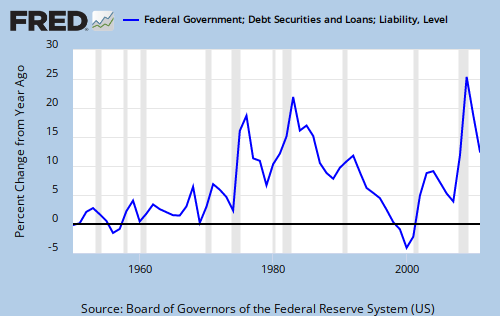
Federal debt
FEDERAL GOVERNMENT DEBT- PERCENTAGE CHANGE FROM YEAR AGO

Clearly, federal debt/money growth is essential to keep us out of recessions. Yet, when we look at “Debt Outstanding Domestic Nonfinancial Sectors” which includes not only Federal debt, but also outstanding credit market debt of state and local governments, and private nonfinancial sectors we do not see the same pattern.

Total Nonfinancial Debt
TOTAL DOMESTIC NONFINANCIAL DEBT — PERCENTAGE CHANGE FROM YEAR AGO

In fact, when we subtract federal debt from total debt, leaving only state, local and private debt, we see the opposite pattern. Recessions more often seem to follow increases in state, local and private debt.


STATE, LOCAL AND PRIVATE DEBT, PERCENT CHANGE FROM YEAR AGO

Now in one sense, money is money. Your buying on your credit card creates debt/money, just as federal deficit spending creates debt/money. Presumably, both should have the same stimulative effect on the economy. They do, but not long term. Why?

Because, unlike the federal government, you, your business and local governments cannot create new money endlessly to service your debts. Your debts can pile up to the point where you must liquidate them by paying them off or by going bankrupt. When non-federal debts become too large, a growing number of people, states, cities and businesses must pull back and stop further borrowing, i.e. stop creating money, or even destroy money by paying off loans. When that happens, we have a recession.

(As an aside, this is one reason the early stimulus efforts had so little effect. People used the stimulus money to pay off loans, so while the federal deficit spending created money, the loan pay-downs destroyed it. Debt reduction destroys debt/money.)

During the recession, and for a short time after, we tend to cut back on our personal borrowing and liquidate debt/money. Then we begin to resume borrowing, more and more, until again, we hit our personal limits and cut back, causing yet another recession. The sole prevention of this cycle, which averages about 5 years in length, is to make sure that federal deficit spending grows sufficiently to offset periodic money destruction by the private sector.

In summary, federal deficit spending is good for the economy, always good, endlessly good (up to the point of inflation). Private and local government spending/borrowing also is good, but not endlessly. Unlike the federal government, the private and local-government sectors eventually reach a point where debt is unaffordable and unsustainable.

To prevent recessions, the government continuously must provide stimulus spending, then provide added stimulus spending to offset the periodic reduction of money creation by the private sector.

Rodger Malcolm Mitchell
Monetary Sovereignty


==========================================================================================================================================
No nation can tax itself into prosperity, nor grow without money growth. Monetary Sovereignty: Cutting federal deficits to grow the economy is like applying leeches to cure anemia. Two key equations in economics:
Federal Deficits – Net Imports = Net Private Savings
Gross Domestic Product = Federal Spending + Private Investment and Consumption + Net exports

#MONETARY SOVEREIGNTY

–Punish BP or . . . ?

An alternative to popular faith

Those rotten scoundrels have ruined our oceans and our shores. They should pay not only for the cleanup, not only for the jobs lost because of the pollution, not only for the damage, but they even should pay for jobs lost because of President Obama’s decision to stop deep-water drilling. BP should pay, pay, pay until they bleed, then pay some more. These people must be held accountable.

Phew! Now I feel better.

But, wait. What is BP? It’s a legal description, nothing more than words on a piece of paper. It has no physical existence. You can’t punish BP any more than you can punish a law or a page of sheet music. BP, as a legal entity, neither caused, nor can cure, the oil spill. That disaster was caused by people, and it is people, not a piece of paper, who must be held accountable.

So the question becomes, which people should be punished? BP has a huge number of employees, the vast majority of whom had nothing to do with the oil spill. It has a huge number of innocent shareholders, a huge number of innocent suppliers, a huge number of innocent oil users. In some ways, you and I are part of BP, because as users of oil and oil-related products (i.e. all products) we are affected by what its employees do.

Which of those people should be “held accountable”? What if holding all of BP “accountable” means thousands of innocent people will be fired, or innocent suppliers will be put out of business, or all of us will have to pay more for our oil and gas, or all of us who hold BP stock, either directly or as part of a fund, will lose? What if punishing BP has an adverse effect on the whole economy. Is that wise?

Somewhere between vengeance and economic reality lies the answer. Punishing BP, as a company, punishes all of us who already are suffering from the gusher. And though widespread vengeance may feel good, there is a “cut-nose-spite-face” aspect to be considered. So, what can be done to help prevent a repeat?

First, let’s identify the people specifically responsible. Certain BP employees. Certain employees of BP suppliers. The guys who mixed and poured the rotten cement that didn’t hold.

And, with all the focus on BP, let’s not forget those government employees who failed equally. I’m talking about the people who, after having been bribed with nice gifts, so readily approved all of BP’s actions.

Yes, we should fine, fire, even jail all the responsible individuals. That would help prevent future problems. Of course, that doesn’t pay for all the efforts to cure the situation nor for all the losses. Who should pay the billions for that?

If you really care about the economy, and are not just flailing out in retribution, you would agree the economically wise approach would be for the federal government to pay. That way, the guilty would be punished, the innocent spared and the economy stimulated.

Government pays = people benefit. BP pays = people pay.

So what’s your choice: Vengeance or money in your pocket?

Rodger Malcolm Mitchell
http://www.rodgermitchell.com

No nation can tax itself into prosperity

— Let’s blame China

An alternative to popular faith

Here we go, again. The typical beggar-thy-neighbor approach to international trade.

————————————————————————————-
6/10/10: By David Lawder; WASHINGTON (Reuters) – Treasury Secretary Timothy Geithner said on Thursday that reform of China’s exchange rate is “critically important” to the U.S. and global economies and a more flexible yuan was in China’s interest.
[…]
In his testimony, Geithner said the Obama administration wanted China to change policies that disadvantage American companies and to provide a more level playing field for U.S. products and investments. He vowed the administration would “apply forcefully” all remedies available under U.S. law to curb China’s unfair trade practices, including anti-dumping and countervailing duty complaints.
[…]
“A stronger yuan would benefit China because it would boost the purchasing power of households and encourage firms to shift production for domestic demand, rather than for export,” he said. “[…]which is particularly important now, with China’s economy facing a risk of inflation in goods and in asset prices.”

————————————————————————————-

Think of it this way. When two nations each have the unlimited ability to create money, which nation benefits from a positive balance of trade? That is, which nation benefits when one sends more of its goods and services to the other?

In CHINA TRADE we saw that the nation exporting fewer resources (i.e. exporting more, easily created money), has the advantage. The Obama administration seems to believe international trade is a zero-sum game, where for every “winner” (net goods and services exporter) there is a “loser” (net goods and services importer). So in their minds, for the U.S. to be a winner, we must make sure there are enough nations that are losers – as I said, the beggar thy neighbor approach to international trade.

The technical truth is, the U.S. could we wealthy without exporting a single dollar’s worth of goods and services. Visualize that our exports were zero and the U.S. government were the sole “export” customer. Rather than exporting steel, sausage and services, the government would buy all this output. No, don’t get excited. I don’t suggest we stop exporting. I’m just trying to demonstrate a point.

Could the government afford it? Yes, the government has the unlimited ability to create the money to afford anything. Would our industries suffer? No, they would receive the same money as if they actually had exported. Would this increase the money supply to inflationary levels? No, the total money within the economy would be the same as if it had come in from other nations.

Yes, we’d have to solve the problem of what we do with all the goods and services we produce (Create new industries for this purpose??), but the U.S. literally could survive and prosper with no exports at all – as though it were the only nation on earth.

The Obama administration merely has set up China as a straw man, to take the blame for our economy’s failure to grow as fast as it should. But, the real blame should go to the debt hawk belief that federal deficit spending should be minimized. For years, our stimulus efforts have been too-little, too-late, and even today, while growth is painfully slow, and millions are out of work, there is more concern about so-called debt (i.e. money created) than about economic success.

Rodger Malcolm Mitchell
http://www.rodgermitchell.com

No nation can tax itself into prosperity

–How the debt hawks will destroy the U.K.

An alternative to popular faith

Cameron Warns Britons of ‘Decades’ of Austerity
By SARAH LYALL, Published: June 7, 2010

LONDON — Prime Minister David Cameron said Monday that Britain’s financial situation was “even worse than we thought” and that the country would have to make savage spending cuts to bring its swelling deficit under control.

Stern and grim-faced in a speech in Milton Keynes, just north of London, Mr. Cameron said, “How we deal with these things will affect our economy, our society — indeed our whole way of life. The decisions we make will affect every single person in our country,” he said. “And the effects of those decisions will stay with us for years, perhaps decades, to come.
[…]
Dave Prentis, the general secretary of Unison, a union that represents many public service workers, nonetheless told the Press Association news agency that Mr. Cameron’s speech was “a chilling attack on the public sector, public sector workers, the poor, the sick and the vulnerable, and a warning that their way of life will change.”
[…]
“Nothing illustrates better the total irresponsibility of the last government’s approach than the fact that they kept ratcheting up unaffordable government spending even when the economy was shrinking,” Cameron said.
[…]
As a cautionary tale, he mentioned Greece, where profligate spending led to a huge budget deficit and eventually a downgrading on financial markets.

While Britain’s economic position is stronger than that of Greece, he said, “Greece stands as a warning of what happens to countries that lose their credibility, or whose governments pretend that difficult decisions can be avoided.”

—————————————————————————————————————————————————————————

The U.K. was smart not to lose control over their money. They remain monetarily sovereign. Unlike the euro-using nations, the U.K. can create their money at will. But suddenly, they have forgotten why they didn’t switch to the euro.

Now, the debt hawks have the U.K. preparing for “decades of austerity” (aka, decades of poverty), as they falsely compare themselves to Greece. Wake up, U.K. You aren’t like Greece and you don’t need to choose poverty.

Mr. Cameron said, “. . . if you start with a large structural deficit, ramping up spending even further is likely to undermine confidence and investment, not encourage it.” This is as false a statement as it’s possible to make. I challenge Mr. Cameron to explain how government spending, which is the way government adds money to the economy, can reduce investment or economic growth. It simply is total nonsense.

It’s difficult to imagine why an otherwise intelligent people intentionally will subject themselves to decades of misery based on a foolish belief that not only is unproven, but factually has been proven wrong on many levels. While some of the same ignorance exists in the U.S., we only can pray it does not reach the extreme levels of utter stupidity it apparently has reached in the U.K.

Rodger Malcolm Mitchell
http://www.rodgermitchell.com

No nation can tax itself into prosperity