Here is the Republican solution to student debt, as brought to you by the Libertarian Reason.com
Can Republicans Fix Student Debt?Unlike Democrats, Senate and House Republicans have released proposals that would actually tackle the root causes of increasing student loan debt.Emma Camp | 6.16.2023
As a long-awaited Supreme Court decision on President Joe Biden’s massive student loan forgiveness plan looms, Senate Republicans have unveiled a plan of their own to address the nation’s climbing student loan debt burden.
However, instead of promising blanket forgiveness, the Senate Republicans’ plan aims to reform how student loans are given out in the first place—seeking to direct students toward high-quality programs and limit access to schools that provide a poor return on students’ investment.
As you will see later in this “plan,” the Republicans believe the only purpose of attending college is to make more money. They measure “return on students’ investment” solely by the salaries students will receive after graduation.
The plan is composed of five separate bills. Three of the bills focus on ensuring that prospective borrowers are aware of the financial tradeoffs of taking out student loans and the financial outcomes for alumni of specific institutions.
The last two tackle the federal student loan system itself, cutting down the number of repayment plans and limiting the circumstances in which federal student loans can be given out.
The first bill in the package focuses on increasing transparency from colleges.
The bill seeks to require colleges and universities to provide a wide range of data on student outcomes and enrollment trends to the National Center for Education Statistics, which would create a database of this information aimed at helping prospective students make informed educational decisions.
Transparency is a good thing.
“Student outcomes” might have to do with graduation rates, dropout rates, advanced degrees, and employment after graduation. But they wouldn’t measure what students learn.
And most importantly, it doesn’t address the student loan indebtedness problem.
Can anyone tell me why a nation whose competitiveness relies on its young people to being educated wants to “limit the circumstances in which federal student loans can be given out?”
If the Republicans ran a company, would they want to limit the circumstances in which the company could profit?
It’s absolutely nuts, especially since the U.S. federal government has infinite dollars.
The proposal’s second bill would require colleges and universities to use a standardized financial aid offer form to maximize transparency around the true cost of attending a given institution.
The third bill in the proposal has similar aims, requiring that students applying for federal student loans receive information detailing sample payments for their loans, as well as how long they would expect to be paying off their student loans and what income they can expect to make after graduating from a given school.
These two “solutions” are reasonable in that they provide borrowing information. But they still fall far short of solving the student loan indebtedness problem.
They merely say, “Here’s what it will cost you, and if you can’t afford it, don’t go to college or take out a loan.”
But the purpose of the student loan program is to enable more children to attend college, not to winnow down the number that can afford it.
The fourth bill cuts down on the number of repayment plans available to borrowers.
The bill would consolidate the host of current repayment options down to two—a standard 10-year repayment plan and a Revised Pay As You Earn (REPAYE) repayment plan with minor changes.
The REPAYE plan is an income-driven repayment (IDR) plan, which currently allows borrowers to pay a monthly amount fixed to their income, achieving forgiveness after at least 20 years of payments.
Importantly, the fourth bill also cuts off access to federal student loans for students attending programs that do not result in median earnings higher than those of adults who only have a high school diploma—or a bachelor’s degree, in the case of a graduate program.
To Republican minds, the purpose of attending college is to make more money. Otherwise, it supposedly is a waste of time and money.
The right-wing mentality says that the arts — music, dance, painting, theater, writing, sculpture, etc., — should be measured by how much money you can make from them.
History and philosophy also should be measured by the money you can make, not by their contributions to human culture. Mathematics, too. And teaching. And physics.
To the right-wingers, if your education doesn’t pay you more money, the government shouldn’t help you, no matter how valuable to America it might be. WHY?
Most importantly, the Republicans assume college has no social benefits. But, the 18 through 24 age period is a maturation time, a time to go from childhood to adulthood.
College provides the non-financial benefits of learning about the world along with other young people of like age.
Again, the Republicans measure everything by dollars, while falsely claiming the government doesn’t have enough dollars.
The final bill in the package would eliminate Graduate PLUS Loans—a type of federal student loan whose borrowing cap was removed in 2006.
The removal of this cap has been directly connected to a rapid increase in graduate school tuition, as—unlike for undergraduate programs—graduate students were able to borrow an unlimited amount from the federal government, incentivizing universities to jack up prices.
The function of the student loan program is to help more students afford college. So, of course, colleges have more room to “jack up” prices with more students able to pay. That is a fundamental result of affordability.
The government must pump more growth dollars into the economy when colleges increase prices. That benefits the economy.
Capping loans merely means that fewer students will be able to afford advanced degrees.How does that benefit America? It doesn’t. It simply reduces the number of highly educated Americans and widens the income/wealth/power Gap between the rich and the rest.
Notably, House Republicans have also introduced their own legislation aiming to reform federal student loans.
Their proposal would provide “targeted” student debt relief to those who have consistently made payments but have seen their debt increase anyway.
The GOP (aka, “the party of the rich”) wants to give “targeted” relief to those who were able to afford debt payments, conveniently leaving out those who were financially weaker and unable to make payments.
The proposal would also reform existing income-driven repayment plans and mandate considerable warnings for borrowers before student loan payments resume in October.
“Colleges and universities using the availability of federal loans to increase their tuitions have left too many students drowning in debt without a path for success,” said Sen. Bill Cassidy (R–La.) in a Wednesday statement.
No, Sen. Cassidy, the government has left students drowning in debt by lending them money that should have been given.
Grades K-12 have been government supported for centuries. Grades 13+ also should be government-funded, not just at community schools, but top schools, too.
The more kids who decide to go for advanced degrees, the better off America will be.
“Unlike President Biden’s student loan schemes, this plan addresses the root causes of the student debt crisis. It puts downward pressure on tuition and empowers students to make the educational decisions that put them on track to academically and financially succeed.”
No, it cleverly disempowers poorer students and widens the education gap between the rich and the rest. It does nothing about the “root causes of the student debt crisis.”
The Republicans’ plans offer a constructive solution to the problems that plague the federal student loan system. Rather than focusing on short-term solutions—like Biden’s $400 billion student loan forgiveness boondoggle—Republicans’ plans target the sloppy government policies which directly cause rising student debt.
In particular, the Senate’s attempt to eliminate Graduate PLUS Loans and both plans’ proposals to reform income-driven repayment plans take direct aim at some of the most fiscally irresponsible federal student loan policies.
To Republicans, “fiscally irresponsible” means money going to the poor and middle classes. Notably, it does not mean the tax loopholes given to the rich.
While both bills face an unlikely path toward actually becoming law, they provide a clear template for what a sensible response to the student loan crisis looks like—and policies that are actually likely to lower the cost of college, not raise it.
Except, the bills ignore the fundamental purpose of education in America: To improve America.
The original Colonists understood that. Sadly, today’s inferior crop of politicians is so taken with what’s in it for them that they completely ignore the question, “What’s in it for America.”
THE ROOT CAUSES OF THE STUDENT DEBT CRISIS
Educating young people benefits America. That is why the American colonies mandated free education for our children.
And that came when reading, writing, and arithmetic were much less important to our agrarian society than they are today.
Yet, taxpayers willingly bore the cost of education.
Today, primary education and especially advanced education are far more critical. The world has advanced, and to remain competitive, America must rely on its educated young people.
There are three root causes of the student debt crisis:
Attending college is expensive. Many families find tuition, food and lodging, books, and materials unaffordable.
Not having a job is expensive. Many children can’t afford college because their families need them to stay home and work full-time. Even with a free ride that includes everything in point #1, some kids can’t afford not to work full time.
The federal government, which has infinite dollars, lends rather than giving money to the students.
The latter point is an extension of the false belief that our Monetarily Sovereign government’s finances are like personal finances.
The ignorant idea that the federal government spends too much contradicts the simple formula: Gross Domestic Product (GDP) = Federal Spending + Nonfederal Spending + Net Exports.
GDP is the measure of our economy, so by formula, increased Federal Spending grows our economy, and decreased Federal Spending shrinks our economy. Simple algebra.
Thus, the Federal Government never should lend to Americans; it only should give to Americans.
The student debt crisis results from requiring students to borrow from the government rather than receiving dollars with no payback requirement.
The government neither needs nor even uses the dollars that are paid back. The solution to the student debt crisis is straightforward. Just as local governments fund local schools, the federal government should fund colleges and universities.
In fact, the federal government can do it more easily than can local governments because the federal government uniquely is Monetarily Sovereign; it cannot run short of dollars.
The federal government even should pay students a salary for attending college, so the students’ college attendance does not penalize the student’s family monetarily.
It is beyond stupid for the U.S. government to take dollars from students when America’s competitive position depends on our young people being educated, and the government has infinite money to pay for their education.
Of course, a government that refuses to recognize Monetary Sovereignty and the formula GDP = Federal Spending + Nonfederal Spending + Net Exportsis already beyond stupid, so the extra stupidity is to be expected.
II. Federal Spending is all the spending the federal government does. It includes every dollar the government spends.
III. Nonfederal spending includes all the dollars spent in the economy by every individual, every business, and every state/local government.
IV. Net Imports is the difference between dollars spent on imports vs. dollars received for exports. Usually, we spend more on imports than we receive for exports, so just to break even, either Federal Spending or Non-federal spending must take up the slack.
However, if we break even, the economy will shrink because of inflation. So — and this is very important– for the economy to grow, government spending must grow.
There is no way for the economy to grow when government spending does not grow. That is basic algebra.
Now someone might say, what if federal spending doesn’t grow but nonfederal spending grows enough to overcome both Net Imports and Inflation.
The problem with that hypothetical scenario is that when Federal Spending doesn’t grow, there is no way for the Non-federal sector to obtain the spending dollars that would grow the economy.
In fact, not only do we have recessions and depressions when Federal Spending doesn’t grow, we even have recessions and depressions when Federal Spending grows, but too little to overcome inflation and Net Imports.
U.S. depressions come on the heels of federal surpluses.
1804-1812: U. S. Federal Debt reduced 48%. Depression began 1807.
1817-1821: U. S. Federal Debt reduced 29%. Depression began 1819.
1823-1836: U. S. Federal Debt reduced 99%. Depression began 1837.
1852-1857: U. S. Federal Debt reduced 59%. Depression began 1857.
1867-1873: U. S. Federal Debt reduced 27%. Depression began 1873.
1880-1893: U. S. Federal Debt reduced 57%. Depression began 1893.
1920-1930: U. S. Federal Debt reduced 36%. Depression began 1929.
1997-2001: U. S. Federal Debt reduced 15%. Recession began 2001.
When the money supply decreases, or even increases, but not enough, we have recessions.Federal Spending increases the money supply. When the money supply increases, GDP increases. When the money supply decreases, we have recessions and depressions. The above graph shows the parallel paths taken by the money supply and GDP.
Again, GDP is the measure of two things. It is the measure of the economy, and it is the measure of spending. This is just simple algebra. You don’t need a degree in economics to understand it.
And yet, Congress, the President, the Republican, Democratic, and especially the Libertarian Parties pretend it’s all a mystery to them because they say they don’t want Federal Spending to grow.
In essence, they don’t want the economy to grow; more accurately, they want us to have recessions and depressions that affect the rich much less than they affect the rest of us.
Congress, the media, and the economists all parrot the same line. They claim federal spending is “unsustainable” and should be reduced. But what makes federal spending “unsustainable”?
The federal government is Monetarily Sovereign, meaning it cannot run short of U.S. dollars. The Federal government can pay any bill of any size if it’s denominated in dollars. Send the government an invoice for a trillion dollars; it could pay it tomorrow by pressing computer keys.
This is not just my opinion. It is a well-known fact:
Former Federal Reserve Chairman, Alan Greenspan: “A government cannot become insolvent with respect to obligations in its own currency.”
Alan Greenspan: “There is nothing to prevent the federal government from creating as much money as it wants and paying it to somebody.”
Alan Greenspan: “The United States can pay any debt it has because we can always print the money to do that.”
Former Fed Chairman, Ben Bernanke: “The U.S. government has a technology, called a printing press (or, today, its electronic equivalent), that allows it to produce as many U.S. dollars as it wishesat essentially no cost.”
Quote from Ben Bernanke when he was on 60 Minutes:Scott Pelley: Is that tax money that the Fed is spending?Ben Bernanke: It’s not tax money… We simply use the computer to mark up the size of the account.
Despite what you’ve read and heard, not only can the government create all the dollars it needs by pressing computer keys, but it never needs to borrow dollars.
Statement from the St. Louis Fed:“As the sole manufacturer of dollars, whose debt is denominated in dollars, the U.S. government can never become insolvent, i.e., unable to pay its bills. In this sense, the government is not dependent on credit markets to remain operational.”
The words “not dependent on credit markets” means the federal government does not borrow. Those T-bills, T-notes, and T-bonds that wrongly are called “borrowing” are nothing of the sort.
A borrower borrows because it needs money. The federal government doesn’t. The government merely accepts deposits into T-security accounts. It never touches those dollars. Why would it, given its infinite ability to create dollars?
The purposes of T-securities are not to provide the government with spending dollars, but rather to:
To provide a safe storage place for unused dollars. This helps stabilize the dollar
To help the Fed control interest rates.
And then there is the false “inflation” claim. The mantra is that we will have inflation if the federal government prints money.
Historically, that simply is not true:
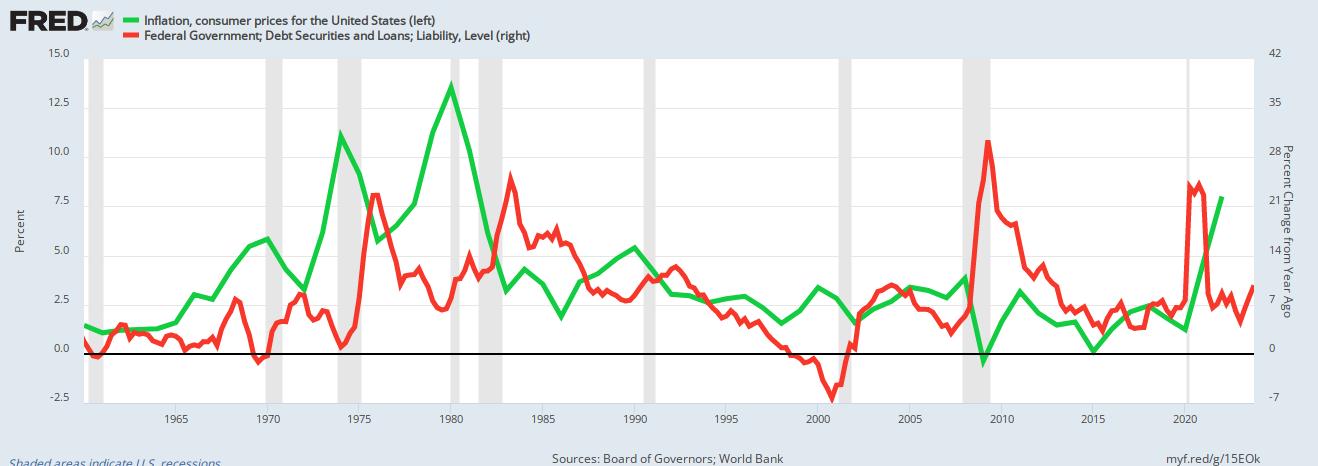
If federal spending caused inflation the red spending line and the green inflation line would essentially be parallel. They are not. They move randomly with respect to one another.The thing that always causes prices to rise is scarcity. You know this from experience.
When weather causes a shortage of oranges or apples, the price of oranges and apples goes up.
When COVID creates shortages of oil, steel, lumber, computer chips, labor, etc., the price of everything goes up. We have inflation.
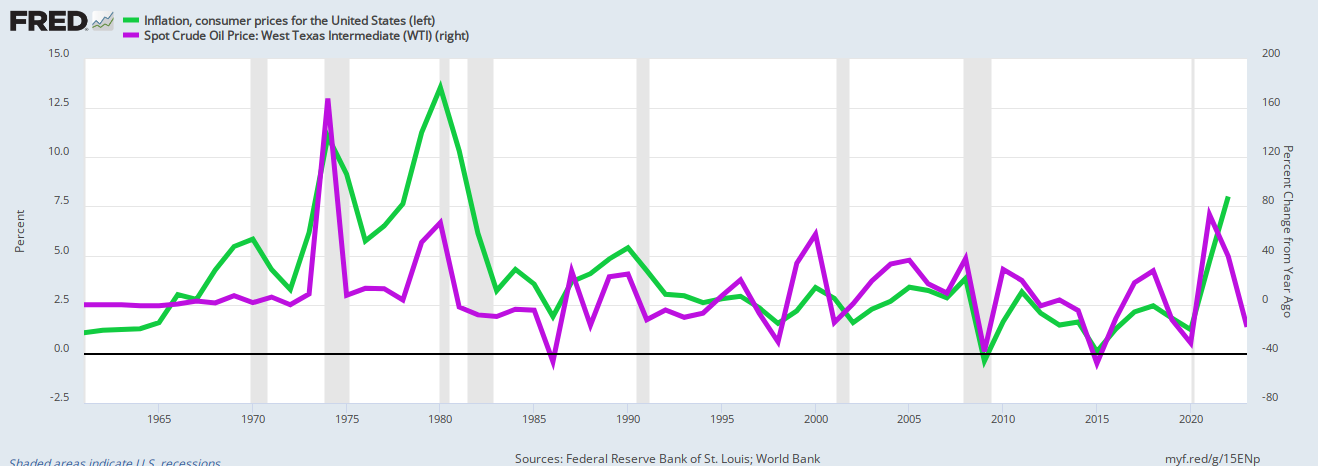
The single most common scarcity that has caused inflation for the past few decades is the scarcity of oil:Oil scarcity causes oil prices to rise, and because the price of oil affects the prices of almost every other product, oil scarcity causes inflation.
While federal spending does not parallel inflation, the scarcity of oil does parallel inflation.
Again, none of this is rocket science, and none of it is secret. Politicians, the media, and economists all have these data.
So why do they conduct these mock battles about a useless, meaningless, misleading debt ceiling? Why all the lies?
Because the politicians, media, and economists have been bribed by the rich, who run America.
The politicians are bribed by campaign contributions and promises of lucrative employment at think tanks.
The media are bribed by advertising dollars and by straight-out ownership of the media.
The economists are bribed by contributions to their universities and promises of employment in think tanks and controlled corporations.
And why do the rich want the politicians, media, and economists to pretend that federal spending should be reduced? It’s because of something called “Gap Psychology.”
The word “rich” is comparative, not absolute. Someone with a million dollars is poor if everyone else has ten million. Someone who has a hundred dollars is rich if everyone has one dollar. Getting richer requires acquiring more compared to everyone else.
You can do this in either or both of two ways:
Acquiring more for yourself and/or
Making sure everyone else has less.
Gap Psychology is the human desire to distance oneself from those below you and/or to come closer to those above you on any scale of income, wealth, or power.
Most people wish to become richer. This is especially true of the rich, who are driven by their insatiable desire to become even richer, i.e., distancing themselves from those below and coming closer to those above.
They hate your receiving government-funded healthcare insurance. They hate food stamps, unemployment benefits, government-funded college — anything that even slightly narrows the Gap between them and those below.
To distance themselves from the middle and lower quadrants, the rich do all they can to make you believe the federal government cannot afford to give you benefits. They draw false comparisons between your personal financing and federal government financing.
They talk about federal “borrowing”though the government, unlike you, does not borrow dollars.
They talk about the federal “credit card,” though the government uses nothing that resembles a credit card.
They talk about “out-of-control” spending, though unlike you, the federal government has the infinite ability to spend.
They claim federal deficit spending is “unsustainable” though the government has “sustained” deficit spending for more than 80 years — deficit spending that grew the economy from several billion dollars to thirty trillion.
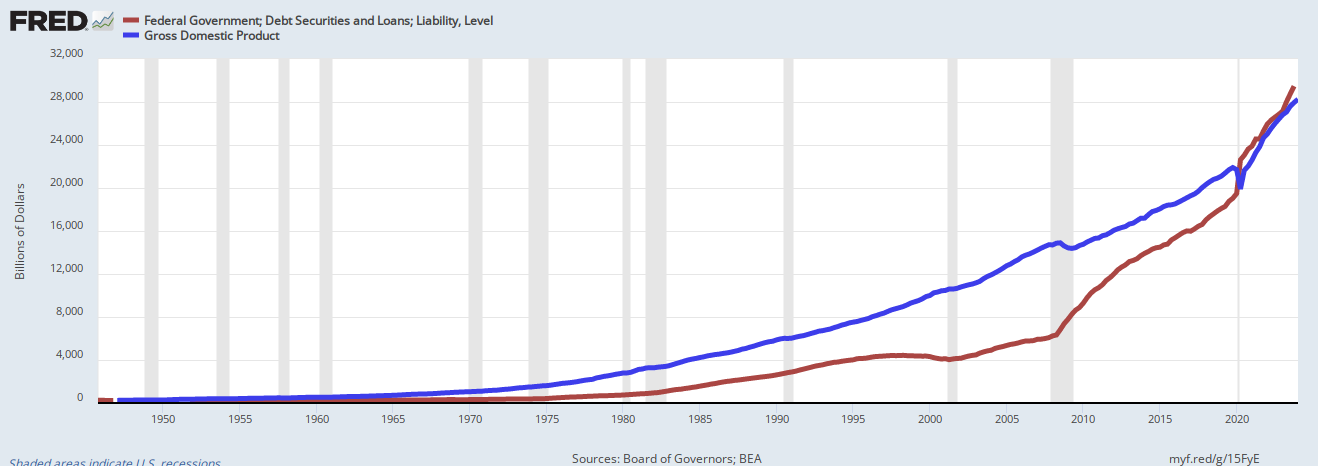
Here is another graph that shows the essentially parallel paths of federal spending and GDP.
Naturally, the lines essentially are parallel. Federal Spending is an integral part of GDP. It would be like a graph comparing total touchdowns with total points. The lines essentially would be parallel.
To say that federal spending is too high, unsustainable, or out-of-control — i.e., to say that federal spending should be reduced — is to say that economic growth is too high, unsustainable, out of control, and should be cut.
No one believes that, not even the rich. They just want to cut the benefits you receive, not the benefits they receive.
They bribe Congress to give them tax loopholes so that they, like Donald Trump, pay at a far lower rate than the average salaried person.
And they spread the myth that giving the Internal Revenue Service more money will send investigators after you when the money was meant to investigate the rich.
Everywhere you turn, the rich have bribed your sources of information to indoctrinate you with the belief that federal spending should be cut and taxes increased, especially the spending and taxes related to benefits for you who are not rich.The purpose of federal taxes is different from the purpose of state/local government taxes. Federal taxes do not provide spending money to the federal government, which already has infinite spending money. Federal taxes have two financial purposes plus a third purpose that should anger you:
To control the economy by taxing what the government wishes to discourage and by giving tax breaks to what the government wishes to encourage
To assure demand for the U.S. dollar by requiring taxes to be paid in dollars. And here is the one you’ll really hate:
To help widen the income/wealth/power Gap by giving tax loopholes to the rich.
And now we have the phony “debt-limit” struggle. The Republicans (the party of the rich) demand cuts to Medicare, Medicaid, food stamps, etc., and the Democrats (pretending to be the party of the poor) fight weakly against too many cuts (just a few).
And neither of them tells you the truth. The entire charade is a professional wrestling exhibition held in the halls of Congress.
The bottom line is: You have been brainwashed into ignorance. Federal deficit spending is not unsustainable, nor does it cause inflation.
The federal government easily could fund no-deductible, comprehensive, generous Medicare and Social Security benefits for every man, woman, and child in America, a college education for everyone who wanted it, food so that no child in America ever would need to go hungry, and decent housing for even the poorest among us.
The federal government could do all that while funding the military, medical research and development, the physical sciences, renewable energy, and all the other things that would improve your life and the lives of those you love.
It can be done, and it will be done, but first, you must understand the lies you are being fed and then demand, en masse, that the government does what it was formed to do.
Rodger Malcolm Mitchell
Monetary SovereigntyTwitter: @rodgermitchellSearch #monetarysovereigntyFacebook: Rodger Malcolm Mitchell
……………………………………………………………………..
The Sole Purpose of Government Is to Improve and Protect the Lives of the People.
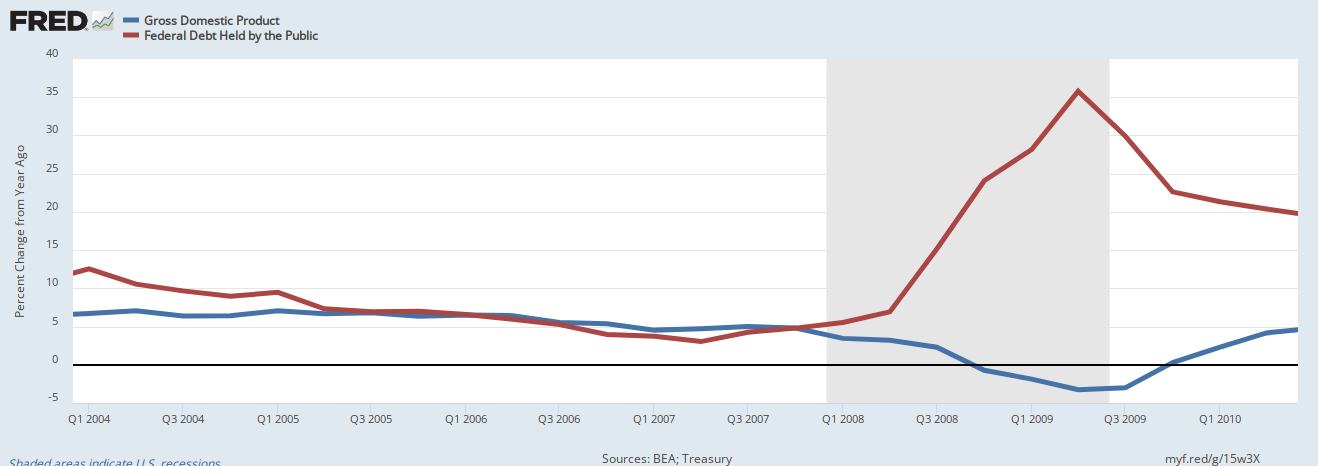
We did it with the “Economic Stimulus Act 2008. The federal government simply sent people money.
Generally, low and middle-income taxpayers received up to $300 per person or $600 per couple.
The purpose was to stimulate economic growth and to cure the recession.
It worked:
As federal deficits (blue) declined, we fell into a deep recession, cured only by a robust increase in federal deficit spending (red).
Gross Domestic Product (GDP) is a common measure of the economy. The above graph should come as no surprise. The formula for economic growth is:
GDP = Federal Spending+ Nonfederal Spending + Net Exports
Mathematically, as federal deficit spending decreases, economic growth falls, and as federal deficit spending increases, economic growth increases.
If you want economic growth, you want federal deficit spending to increase.
I’ve written about this many times.It’s simple algebra. I’m not sure why this is a mystery to the politicians who think a debt limit is prudent finance. It’s exceedingly ignorant finance.
I mention this again because of an article I just read on MEDPAGETODAY:
Uninsured Rate Hits Record Low of 8.3% — But that number will slowly rise as pandemic health insurance protections unwind, experts say by Joyce Frieden, Washington Editor, MedPage Today May 24, 2023
WASHINGTON — The uninsured rate in the U.S. has fallen to a record-low 8.3%, but that percentage is expected to gradually increase as insurance protections from the COVID-19 pandemic wind down, according to officials from the Congressional Budget Office (CBO).
Why will insurance protections “wind down.” For the same reason we currently have a debt=limit battle in Congress. Sheer ignorance.
The federal government has repeatedly proved that it has the infinite ability to pay for anything. Why is it “winding down” payments for healthcare insurance?
The temporary policies enacted in the wake of the COVID-19 pandemic “have contributed to a record low uninsurance rate in 2023 of 8.3% and record-high enrollment in both Medicaid and ACA [Affordable Care Act] marketplace coverage,”said Caroline Hanson, Ph.D., principal analyst at the CBO, during a briefing sponsored by Health Affairs.
“As those temporary policies expire under current law, the distribution of coverage will change and the share of people who lack insurance is expected to increase by 2033.”
CBO is projecting an uninsured rate of 10.1% by 2033, and “while that’s obviously higher than the 8.3% that we’re estimating for 2023, it is nevertheless lower than the uninsured rate in the last year prior to the COVID-19 pandemic,” which was about 12%, she said.
Think about it. America has about 330 million people. A ten percent uninsured rate means 33 MILLION (!) people in America will have to do without health care insurance. I hope you’re not among them.
Whether or not you have insurance, here are some data that should concern you:
“A widely cited study published in the American Journal of Public Health in 2009 analyzed data from the National Health Interview Survey and found that uninsured individuals had a 40% higher risk of death compared to their insured counterparts. This study estimated that lack of health insurance contributed to approximately 45,000 deaths annually in the United States.
“Another study published in the Annals of Internal Medicine in 2017 conducted a systematic review and meta-analysis of previous research. The analysis concluded that uninsured individuals faced a 25% higher risk of mortality compared to those with insurance.”
When you don’t have healthcare insurance, you die younger.
“Throughout the 2023-33 period, employment-based coverage will remain the largest source of health insurance, with average monthly enrollment between 155 million and 159 million,” Hanson and co-authors wrote in an article published in Health Affairs.
Employer-based health care insurance has two features seldom discussed.
It ties employees to their employer, making job negotiation and movement much more difficult
It is paid for by the employee because the employer figures the cost as part of the employment. Salaries could be higher without this “perk.”
If the federal government funded a comprehensive Medicare for All plan, employees would earn more without costing employers more.
However, they added, “in addition to policy changes over the course of the next decade, demographic and macroeconomic changes affect trends in coverage in the CBO’s projections.”
The Families First Coronavirus Response Act of 2020 gave states a 6.2-percentage-point boost in their Medicaid matching rates as long as the states didn’t disenroll anyone in Medicaid or CHIP for the duration of the COVID public health emergency.
Hanson noted that this law “allowed people to remain enrolled regardless of their changes in eligibility. So, for example, even if they had an income increase that would have made them ineligible but for the policy,” they were still able to stay on Medicaid.
The COVID public health emergency has been canceled now. Disenrollments can begin.
As a result of the law, Medicaid enrollment has grown substantially since 2019 — by 16.1 million enrollees, she said. But that has been superseded by another act of Congress, which allowed states to begin “unwinding” the continuous eligibility rules and start disenrolling people from Medicaid and CHIP beginning on April 1.
In total, “15.5 million people will be transitioning out of Medicaid after eligibility redetermination,” said Hanson. “Among that 15.5 million people, CBO is estimating that 6.2 million of them will go uninsured and the remainder will be enrolled in another source of coverage,” such as individual coverage or employment-based coverage.
Of those who are leaving Medicaid, how many are leaving voluntarily and how many are “falling through the cracks” because they didn’t receive their disenrollment notification or failed to fill out the required paperwork to reapply?
“We recognize that before these continuous eligibility requirements were put into place, people were losing Medicaid coverage, both because they were becoming no longer eligible for Medicaid, and … because they did not complete the application process despite remaining eligible,” said CBO analyst Claire Hou, PhD. However, she added, “we’re currently not aware of any data that would allow us to quantify the size of those two different groups.”
All of the above would be unnecessary if our Monetarily Sovereign federal government (which has unlimited funds) simply would fund a comprehensive, no-deductibles Medicare for All program.
Hanson delivered some bad news for those footing the bill for private health insurance. “We are projecting relatively high short-term premium growth rates in private health insurance, and this is for a few reasons,” she said.
“One is the economy-wide inflation that we’re experiencing in 2023 and that we have been experiencing, and that has not fully reflected itself in premiums yet.
And another contributor is the continued bouncing back of medical spending after the suppressed utilization that we saw earlier in the pandemic.”
The study authors project average premium increases of 6.5% in 2023, 5.9% during 2024-2025, and 5.7% in 2026-2027.
The current and projected-to-increase hardship on the American people is totally unnecessary. The federal government efficiently could ameliorate this hardship by:
Funding comprehensive, no-deductible Medicare for every man, woman, and child in America
Funding Social Security benefits for every man, woman, and child in America.
Both would add dollars to Gross Domestic Product, thus growing the economy.
Instead, Congress battles over the unbelievably stupid debt ceiling. How do those people manage to dress themselves in the morning, much less be elected to America’s Congress? It boggles the mind.
Here is what true experts say about Monetarily Sovereign entities like the United States government and the European Union:
Alan Greenspan: “A government cannot become insolvent with respect to obligations in its own currency.”
Alan Greenspan: “There is nothing to prevent the federal government from creating as much money as it wantsand paying it to somebody.”
Alan Greenspan: “The United States can pay any debtit has because we can always print the money to do that.”
Ben Bernanke: “The U.S. government has a technology, called a printing press (or, today, its electronic equivalent), that allows it to produce as many U.S. dollars as it wishes at essentially no cost.”
Quote from former Fed Chairman Ben Bernanke when he was on 60 Minutes: Scott Pelley: Is that tax money that the Fed is spending? Ben Bernanke: It’s not tax money… We simply use the computer to mark up the size of the account.
Statement from the St. Louis Fed: “As the sole manufacturer of dollars, whose debt is denominated in dollars, the U.S. government can never become insolvent, i.e., unable to pay its bills. In this sense, the government is not dependent on credit marketsto remain operational.”
Press Conference: Mario Draghi, President of the ECB, 9 January 2014 Question: I am wondering: can the ECB ever run out of money? Mario Draghi: Technically, no. We cannot run out of money.
Here is what people who are ignorant of Monetary Sovereignty say:
Although it’s volatile (like personal bank balances often are), the treasury’s cash pile of $57.3bn, recorded last Thursday, is by far the lowest figure for more than a year — and it’s well below the $150bn minimum that the treasury reportedly likes to keep as a buffer.
The X-date Treasury Secretary Janet Yellen has said to lawmakers that the “X-date” — the date when the US can no longer guarantee its ability to pay bills— is June 1st.
If the US government does run out of money, the biggest problem is a default on its debt.
Most analysts agree that a default would lead to complete financial chaos but the reality is that it’s anyone’s guess, because it’s never happened before.
“Will someone please get me a longer rope, so I don’t have to kill myself.”
The current debt ceiling stands at a whopping $31.4 trillion, legally limiting how much the treasury can borrow.
Because the government has the infinite ability to create dollars, it never borrows dollars. Sadly, the public doesn’t comprehend that simple fact.
Talks between President Biden and Speaker Kevin McCarthy are set to resume today, as each side negotiates the latest fiscal package that would raise the limit, though both parties remain ideologically opposed on whether the new debt ceiling should come with deep cuts to, or caps on, federal spending.
The U.S. federal government has the infinite ability to pay its bills simply by pressing a computer key. It also has the infinite ability to raise the phony debt ceiling, which it already has done 94 times.
The spending that resulted in the current debt had been authorized by previous Congresses and previous Presidents. The current Republican House essentially is saying, “Even though the money already is spent, by both Democratic and Republican Congresses and Presidents — and even though we have infinite money to pay our bills — we aren’t going to pay what we owe.”
Sounds like something six-times-bankrupt Donald Trump would do. Despite being a billionaire, he has cheated many creditors, and now his party threatens to do what he has called “smart business.”
This is exactly what the 14th Amendment was written to stop.
(“The validity of the public debt of the United States, authorized by law, including debts incurred for payment of pensions and bounties for services in suppressing insurrection or rebellion, shall not be questioned.”)
Now, the party of the biggest crook in Presidential history threatens to cheat our creditors unless the current President yields to their demands to raise your taxes (though not the taxes of the very rich) or to cut your benenfits (though not the benefits of the very rich).
Ironically, if President Biden invokes the 14th Amendment, the party that wants to cheat our creditors will claim that this is cheating the Constitution.
The question is, will the Democrats follow the Constitution and end the ridiculous “debt ceiling,” once and for all.
Then, we can leave it up to the right-wing SCOTUS, beholden to the “party-of-law-and-order,” to wriggle a way to claim that the Constitution really doesn’t say what it says.
Hey, they did it for the 2nd Amendment with regard to well-regulated militias; why not the 14th?

 If the Republicans ran a company, would they want to limit the circumstances in which the company could profit?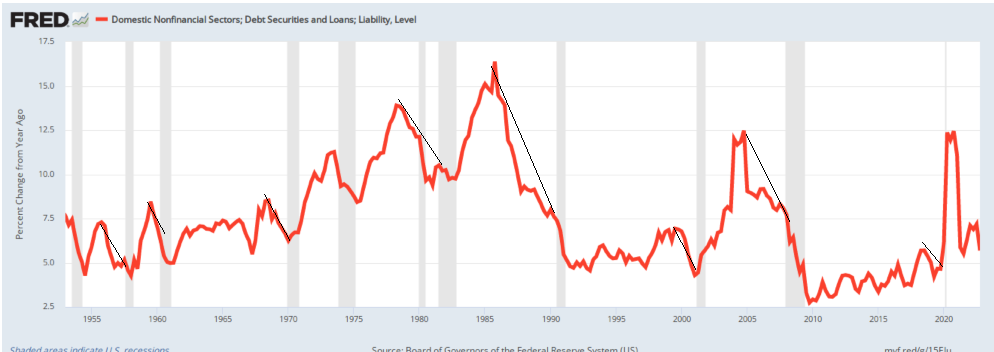



 #Monetary Sovereignty - Mitchell