Here is a letter from a doctor, a cardiologist, who begs the U.S. government to understand Monetary Sovereignty. But, he may not know it.
He may not know that the U.S. federal government is Monetarily Sovereign, so it never can run short of its sovereign currency, the U.S. dollar.
He may not know that despite the common but mistaken, bleating about the federal debt and deficits, the U.S. has, and always will have, plenty of money to pay any bills, foreseeable and unforeseeable.
Present the federal government with a billion-dollar invoice, and it could pay it in full today. Make that invoice a trillion dollars or a hundred trillion.
Same thing.
He may not know that even if the federal government also stopped collecting income tax dollars, FICA tax dollars, tariff dollars, student loan dollars, and all the other dollars it now receives, the government still could spend forever.
Even without collecting any money, the Monetarily Sovereign U.S. government could pay any obligation denominated in dollars. Creating massive deficits does not affect the federal government’s ability to pay its creditors.
The doctor may not know thatfederal deficits don’t cause inflation (Inflation is caused by shortages of crucial goods and services, most often oil and food.)
In short, the doctor may not know that the U.S. government is infinitely wealthy, and that federal spending is necessary to grow the economy.
And no, this has nothing to do with government ownership of the Mississippi River, the Rocky Mountains, the 200-mile Exclusive Economic Zone (EEZ), Lake Michigan, or the Statue of Liberty.
It has to do with the fact that a Monetarily Sovereign nation has the infinite ability to create its own sovereign currency.
This truth has been recognized by at least two respected Chairmen of the Federal Reserve, by a spokesperson for the St. Louis Federal Bank, by the head of the European Union, and by those of us who recognize the power of Monetary Sovereignty:
Alan Greenspan: “A government cannot become insolvent with respect to obligations in its own currency. There is nothing to prevent the federal government from creating as much money as it wantsand paying it to somebody. The United States can pay any debt it has because we can always print the money to do that.”
Ben Bernanke: “The U.S. government has a technology, called a printing press (or, today, its electronic equivalent), that allows it to produce as many U.S. dollars as it wishesat essentially no cost.”
Scott Pelley: Is that tax money that the Fed is spending?Ben Bernanke: It’s not tax money… We simply use the computer to mark up the size of the account.
Statement from the St. Louis Fed:“As the sole manufacturer of dollars, whose debt is denominated in dollars, the U.S. government can never become insolvent, i.e., unable to pay its bills. In this sense, the government is not dependent on credit markets to remain operational.”
Question: I am wondering: can the ECB ever run out of money?Mario Draghi, President of the Monetarily Sovereign ECB: “Technically, no. We cannot run out of money.”
Mentally juxtapose the above facts about Monetarily Sovereign money issuers with these facts:
By 2025, the firm forecasts a shortage of more than 400,000 home health aides and 29,400 nurse practitioners.
Sick, and waiting for a doctor.
A major factor is demographics: People are living longer, requiring more medical attention as they do, while members of the aging healthcare workforce are starting to retire faster than they can be replaced.
Other reasons include burnout(overworked employees are leaving the profession at an accelerating rate); the rise in chronic conditions such as diabetes, heart disease, cancer, and Alzheimer’s disease (leading to overextended staff at hospitals and long-term care facilities); and the nation’s inability to produce enough doctors and nurses to meet growing demand (partly because of faculty shortages at nursing and medical schools).
Shortages of certain kinds of healthcare practitioners, such as nurses and certified nursing assistants, are also due to the relatively low compensation levels, relatively high job demands, and education requirements in those fields.
In summary:
Our Monetarily Sovereign federal government has infinite dollars and infinite control over the value of its sovereign currency.
There is an increasingly severe shortage of doctors, nurses, other healthcare workers, and hospitals.
Does putting # numbers 1 and 2 together give you any ideas?
Now read the doctor’s letter:
The Broken Medicare System Is Forcing Physicians Out— Yet another physician pay cut will prevent timely access to careby Rick W. Snyder II, a cardiologist. November 20, 2023In any career, 25 years of dedicated work is much to let go of. In medicine, it amounts to hundreds of patient relationships and the blood, sweat, and tears that go into starting and maintaining a practice.
Yet, after all that time, one of my physician colleagues recently had to let go of her beloved private practice — not by choice and not without tears for her dear, elderly Medicare patients who now face fewer options for care.
Her story is, unfortunately not unique.
Physicians and their patients have suffered through more than 2 decades of uncertainty caused by precarious Medicare funding.
We’ve seen how these cuts have forced unwanted changes in medical practices. While their practices stay open, the Medicare system underpays our nation’s physicians to the point that some are forced to make difficult decisions about which patients they can care for.
Eventually, when these practices barely have their heads above water, that “next round of cuts” proves to be the last straw.
Like clockwork, another Medicare physician payment cut is on the horizon for January.
Why does an infinitely wealthy government cut payments to doctors, particularly when there is a growing shortage of doctors?
Who is at fault for this ridiculous situation?
I’m afraid the day is near — if not already here — that there will not be enough physiciansto care for Medicare patients.
Physicians who participate in the program are forced to do more with less, which leaves no good choices. The situation hinders our ability as physiciansto provide the complex, quality care these elderly and sometimes disabled patients need and prevents us from seeing as many Medicare patients as we would like.
Furthermore, it contributes to burnout and moral distress because we can’t do what we swore an oath to do: to put our patients first.
As president of the Texas Medical Association (TMA), I hear concerns from our physician members as they face ongoing practice viability challenges.
“If this additional [Medicare] payment cut goes through, in the midst of inflation and COVID causing rising costs for staff salaries and benefits, I would have no choice but to stop caring for these patients,” a worried physician shared with TMA.
“We are dying,” said another. “I can’t even keep a full staff. All the doctors I have referred patients to are leaving or gone.”
“I’m terrified for what this will mean for my elderly patients and their access to care,” yet another concerned doctor said.
“The mental stress of making ends meet is not good for patient care,” another colleague warned.
Not only is this system unsustainable for our nation’s physicians, but it’s also unfairly stacked against them.
It’s the same system that concurrently pays hospital-based clinics more for some of the same services an independent community physician provides. On top of that, Medicare helps hospitals cover uncompensated care.
I’m not saying hospitals don’t deserve to be paid for what they do. But when independent physician practices get swallowed up by a hospital or bought out by another entity just to survive, the cost of care can increase, creating ripple effects on our economy.
This kind of rapid consolidation is rampant in our healthcare system, partly because of payment incentives like those in Medicare.
“Our practice is already shutting its clinic doors as we instead focus on being a purely hospital-based practice due to already meager reimbursement,” another worried Texas physician shared with TMA.
“We simply cannot afford the overhead. Ongoing cuts to [Medicare] physician reimbursement not only hurt us — the physicians trying to provide the best quality care to our patients — but it ultimately hurts the patients and their loved ones suffering from life-altering conditions.”
“I barely scrape through making payrolls every pay period. Any more [Medicare] reimbursement [cuts are] going to put me and thousands of physicians like me underwater and force us to shut down or join [a private] equity company or [insurer-owned] clinics who put their wallets ahead of patient care,” said another frustrated physician.
We should be preserving independent medicine and patient choice — not undermining it. It’s time for Congress to address the root of the problem.
Solutions
The first simple step physicians and other healthcare professionals can take is to advocate for Congress to enact laws directed at paying physicians fairly for services provided to Medicare patients.
At a minimum, that entails pay that keeps pace with inflation. Like other industries’ labor costs are tied to the Consumer Price Index (CPI).
But even a tie to the CPI won’t cure the growing shortage of doctors. America needs more doctors, not just the same number.
Medicare physician payments should at least be tied to a similar physician practice cost inflation measure, the Medicare Economic Index (MEI).
Several physician members of Congress are leading the charge on such a reform with a bipartisan House bill that behooves support: H.R. 2474, the Strengthening Medicare for Patients and Providers Act.
The legislation’s centerpiece is an annual, inflation-based Medicare physician payment update based on the full MEI.
Our current predicament is tied to the fact that Medicare physician payments haven’t even come close to keeping up with inflation over more than 20 years.
Since 2001, Medicare physician payments have lagged 26% behind inflation while hospital and other health industry payments have kept pace, according to the American Medical Association. Over the same period, the CPI for physician services in U.S. cities increased by 65%.
Just think about that: What would you say if you worked more than 20 years with no raise and pay cuts to boot? I know what my colleagues across Texas are saying:
“If [another cut is] enacted, our [Medicare] reimbursement rate will be lower than what we received in 2012,” one physician calculated.
Another said, “My Medicare reimbursement, factoring for inflation, is less than half of what it was in 1998.”
The frustration and the effect of Medicare payment cuts on physician practice viability are real. Likewise, access to care concerns for Medicare patients is therefore very real, too.
Don’t let a broken Medicare system break the backbone of the healthcare system for our most vulnerable patients.
Rick W. Snyder II, MD, opens in a new tab or window is a cardiologist and president of the Texas Medical Association.
Who is at fault for the cuts to doctor’s reimbursement, when funding should be increased dramatically to support the need for more doctors?
Congress and the President, particularly the Libertarians and the Republicans, both of which care more about federal government money than the health of Americans.
The American people have not questioned why the finances of the Monetarily Sovereign government take precedence over the finances of the monetarily non-sovereign public.
For more than 30 years, those few who understand Monetary Sovereignty have been explaining why an infinitely wealthy, Monetarily Sovereign government has the infinite ability and the moral obligation to fund certain services to the public, including:
Education
Health
Shelter
The environment
Science
Energy
Elderly support
This does not imply government ownership (aka “socialism”) but rather, government fundingof the private sector.
The federal government already provides some funding for all these services, just not enough. The shortfall in funding results from the wrongheaded belief that federal funding is “unsustainable.”
This is despite all the evidence that the federal government can “sustain” any level of spending.
The government could provide a generous, comprehensive, no-deductible Medicarefor every man, woman, and child in America.
There should be no need for people to guess about whether they should buy a Medicare supplement policy, “A” through “N”, or whether to buy one of a dozen different Part D plans. All medical contingencies should and could be covered for everyone.
And there should be no need for doctors and other healthcare workers to struggle financially, a struggle that leads to shortages in all areas of medical care. These people (along with teachers) should be among the best compensated of all Americans. The federal government has the wherewithal to assure that happens.
The federal government could fund all education K through 16+ without collecting a penny in taxes.
Homelessness never should become a financial necessity. Clean air, water, and land should be available to all. Scientists, who make the discoveries that improve our lives, should not be forced to beg universities for funding. The elderly should not need to struggle, financially.
Dr. Snyder was forced by circumstance to write his letter. That is a disgrace to America. It is a disgrace that Libertarians and Republicans, and to a lesser degree Democrats, allow America’s rich to dictate impoverishing terms.
If it were up to right-leaning politicians and the right-leaning public, we would have no Medicare, no “Obamacare,” no public schools, and no renewable energy. Poverty, homelessness, and starvation would be even more rampant than now. Our air, water, and land would be dirtier. Climate change will become unbearable.
We would return to the times of royalty, where a handful of people lived utopian lives and the rest of use wallowed in misery.
All who claim federal deficit spending is “unsustainable” or that “government is the problem,” fall into just two categories.
The Liars, who do the bidding of the very rich and/or
The Economically Ignorant, who were taught that federal finances are like personal finances and who haven’t been shown the facts.
There are no other alternatives. I suspect Dr. Snyder falls into category # 2.
Shame on the liars of category #1 for destroying the American dream.
Rodger Malcolm Mitchell
Monetary SovereigntyTwitter: @rodgermitchellSearch #monetarysovereigntyFacebook: Rodger Malcolm Mitchell
……………………………………………………………………..
The Sole Purpose of Government Is to Improve and Protect the Lives of the People.
I’m sure you will find this difficult to believe, but the U.S. government lies to you about many things, this time about its finances.
The following is from the government Bureau of the Fiscal Service:
A sustainable fiscal policy is defined as one where the ratio of debt held by the public to GDP (the debt-to-GDP ratio) is stable or declining over the long term.
That is the definition of a “sustainable fiscal policy??? Who in the government invented such a definition?
First, the debt/GDP ratio is a ridiculous, meaningless number with zero analytical or predictive power. A high ratio says nothing. A low ratio says nothing. A rising or declining ratio says nothing.
The Debt/GDP ratio is a classic Apples/Oranges measure. GDP (Gross Domestic Product) is an annual, usually one-year measure of productivity. Debt is a decade-long measure of net deposits. GDP begins every year at 0. Debt is cumulative. Mathematically, it’s a silly fraction, no better than butterflies/butter churns.
But it gets worse:
Countries with the Highest Debt-to-GDP Ratios (%)
Venezuela — 350%
Japan — 266%
Sudan — 259%
Greece — 206%
Lebanon — 172%
Cabo Verde — 157%
Italy — 156%
Libya — 155%
Portugal — 134%
Singapore — 131%
Bahrain — 128%
United States — 128%
Countries with the Lowest Debt-to-GDP Ratios (%)
Brunei — 3.2%
Afghanistan — 7.8%
Kuwait — 11.5%
Congo (Dem. Rep.) — 15.2%
Eswatini — 15.5%
Burundi — 15.9%
Palestine — 16.4%
Russia — 17.8%
Botswana — 18.2%
Estonia — 18.2%t
Do the above ratios tell you anything about whether a government’s fiscal policy is “sustainable”? Is Russia’s economy more “sustainable” than Japan’s and the US’s?
Then there is this graph. What does it tell you about sustainability (whatever that supposedly means)?
Gross Federal Debt / DGP is red. GDP is dark blue.Real (inflation-adjusted) GDP is light blue.
The debt/GDP ratio rose during World War II. Then, for about 35 years, it declined until 1980, when it began to rise. In 1996, the ratio had a 5-year decline, after which it grew until 2020 and a short decline.
Meanwhile, GDP has had relatively steady growth.
So, what did the debt/GDP ratio tell you about the economy? What did it predict? What did the ratio say about “sustainability”? Nothing.
GDP measures the size of the nation’s economy in terms of the total value of all final goods and services that are produced in a year.
Considering financial results relative to GDP is a useful indicator of the economy’s capacity to sustain the government’s many programs.
I keep reading and rereading that phrase, “the economy’s capacity to sustain the government’s many programs. “ I can’t visualize what it means.
Does it mean the government is running out of money (which, for a Monetarily Sovereign government is impossible)?
Former Federal Reserve Chairman Alan Greenspan: “There is nothing to prevent the federal government from creating as much money as it wants and paying it to somebody.”
Does it mean the government doesn’t have enough people to run its programs? (Just hire enough people.)
Or what?
World War II tested the government’s “capacity to sustain many programs.” It merely spent more money, hired more people, and sustained very nicely, thank you.
Since then, despite repeated claims that the federal debt is a “ticking time bomb,” and much to the consternation of the debt Henny Penny crowd, the economy keeps growing and remaining healthy. Even COVID was only a short-term setback for the U.S. economy.
This report presents data, including debt, as a percent of GDP to help readers assess whether current fiscal policy is sustainable. The debt-to-GDP ratio was approximately 97 percent at the end of FY 2022, down from roughly 100 percent at the end of FY 2021.
The long-term fiscal projections in this report are based on the same economic and demographic assumptions that underlie the SOSI.
The Statement of Social Insurance (SOSI) presents the projected actuarial present value of the estimated future revenue and estimated future expendituresof the Social Security, Medicare, Railroad Retirement, and Black Lung social insurance programs which are administered by the SSA, HHS, RRB, and DOL, respectively.
In short, the government is comparing probable expenses of these social programs with projected revenue — mostly tax receipts.
There’s one small problem with that comparison. The federal government’s finances are nothing like the finances of monetarily non-sovereign entities like you, me, businesses, and local governments, which require income to pay bills.
The federal government requires, and indeed uses, no income to pay its bills. Being Monetarily Sovereign, it creates new dollars every time it pays a creditor. In fact, paying creditors is how the federal government creates dollars.
To pay a bill, the government sends instructions (not dollars) to the creditor’s bank. The instructions are in the form of a check or wire, telling the bank to increase the balance in the creditor’s checking account (“Pay to the order of”).
When the bank does as instructed, new dollars are created and added to the M2 money supply measure.
Thus, even if the federal government received $0 taxes and any other revenue, it could continue spending forever simply by sending instructions to banks.
The current fiscal path is unsustainable.
To determine if current fiscal policy is sustainable, the projections based on the assumptions discussed in the Financial Report assume current policy will continue indefinitely.
The projections are therefore neither forecasts nor predictions.
Nevertheless, the projections demonstrate that policy changes need to be enacted for the actual financial outcomes to differ from those projected.
I don’t know what the above paragraphs are supposed to mean, but I’ll take a guess. See if you agree with this translation:
“The government can’t keep increasing deficits the way it has been for the past eighty years. We don’t know why, but it simply can’t.
“Although this isn’t a forecast or a prediction (if there is any difference between the two), something has to change, just because we say so.”
If there is another meaning, please let me know.
The debt-to-GDP ratio ratio was approximately 97 percent at the end of FY 2022. Under current policy and based on this report’s assumptions, it is projected to reach 566 percent by 2097.
The projected continuous rise of the debt-to-GDP ratio indicates that current policy is unsustainable.
Let’s return to the Debt/GDP graph. In 1974, the Debt/GDP ratio was 23%. By 2022, 48 years later, the ratio was 97%, a 4.217-fold increase.
The government forecasts and predicts (Oops, supposedly it isn’t a forecast or a prediction) — let’s say it’s a WAG (wild ass guess) that by 2097, which is 75 years later, the ratio will be 566, which represents a 5.8% increase from the 97% of 2022.
In short, we had a 4.217-fold increase in 48 years, and the WAG is for a 5.8-fold increase in 75 years. And that is supposed to be “unsustainable.” Except . . .
Except the Treasury’s WAG is that future ratio growth proportionately will be less than the past ratio growth.
Apparently, Wild Ass Guesses aren’t as accurate as they used to be. Not that it matters because, as we have seen, Debt/GDP for a Monetarily Sovereign entity is meaningless.
Federal “debt” isn’t federal, and it isn’t debt.
It’s deposits into T-security accounts that are wholly owned by the depositorsand never invaded by the federal government. That’s right. The government doesn’t own or even touch those dollars. They belong to depositors.
The government merely holds them in safe keeping, like it holds whatever is in your bank safe deposit box.
To “pay off” the misnamed “debt,” the government merely returns the depositor’s’ dollars to the depositors. It does that every day.
Think about it. Do you really think the government of China would turn over ownership of billions of their dollars to U.S. government usage?
In summary, the Treasury supports the lie that the growing “Federal Debt/ GDP is in some way “unsustainable,” without ever saying what they mean by “unsustainable.”
There never has been a time when the U.S. government has not been able to “sustain” (whatever that means) its “debt” (whatever that means).
So why the lies?
For much of the government, it’s pure ignorance. The people writing this stuff simply do not understand Monetary Sovereignty.
But for some, it’s malevolence, paid for by the rich who run America.“Rich” is a comparative.There are two ways to become richer: Get more for yourself or make those below you have less.
A millionaire is rich if everyone else has a thousand dollars. But a millionaire is poor if everyone else has a billion dollars. It’s the income/wealth/power Gap that determines whether you are rich or poor.
Cutting the Debt/GDP ratio requires cuts to such programs as Social Security, Medicare, and/or other benefits for those who aren’t rich. Or it requires increases in FICA and income taxes — the taxes that most affect the not-rich. You seldom hear recommendations to reduce the tax loopholes enjoyed by the rich.
By impoverishing the middle and the poor, the rich make themselves richer. So, they bribe the media, the politicians, and the university economists to tell you your benefits must be cut and your taxes increased because “the current policy is unsustainable.”
They rely on the public’s ignorance about Monetary Sovereignty, and so far, that has worked.
Rodger Malcolm Mitchell
Monetary SovereigntyTwitter: @rodgermitchellSearch #monetarysovereigntyFacebook: Rodger Malcolm Mitchell
……………………………………………………………………..
The Sole Purpose of Government Is to Improve and Protect the Lives of the People.
Both begin with the tacit (or not-so-tacit) assumption that government is harmful, and that people should be allowed to do what they darn well please.
The only significant difference between Libertarians and Republicans is the latter’s belief that only the rich should be allowed to do what they please, the rest of us being too lazy and too ignorant to know what is best.
Well, on reconsideration, that’s what they both believe, so perhaps there’s no difference at all.
Let us explore what the omniscient and omnipotent rich believe:
Moody’s calculates that interest payments on the national debt will consume over a quarter of federal tax revenue by 2033, up from just 9 percent last year. ERIC BOEHM | 11.14.2023 4:15 PM
The “national debt” doesn’t “consume”anything. The so-called “debt” is two things, related by law and size, but not by function, neither of which is debt. The national debt is the:
Total of federal deficits — the difference between federal tax collections and federal spending, which by law equal the:
Net total of deposits into Treasury Security (T-bill, T-note. T-bond) accounts.
The government never touches the dollars in T-security accounts. Those dollars belong to the depositors.
Two weeks ago, Treasury Secretary Janet Yellen caused some eyebrows to tilt when she told reporters that rising bond yields were “an important reflection of the stronger economy.”
That’s contrary to the, let’s say, traditional view of how government-issued bonds work.
A bond’s yield—that is, the return an investor expects to be paid at the end of the bond’s term—is the result of buyers pricing their risk into the purchase.
That is true of privately issued bonds, but far less so of federal bonds, which are risk-free (or close to it, depending on what Congress does regarding the useless and infantile “debt ceiling.”)
Interest rates on federal bonds evolve from the basic T-bill interest rate the Federal Reserve creates by fiat in its attempts to fight inflation.
The Fed has no need to make rates attractive because it has no financial need to accept deposits in T-security accounts. The accounts resemble bank safe deposit boxes. The government holds and protects the contents but doesn’t take ownership of them.
Being Monetarily Sovereign, the federal government can create all the dollars it wants simply by stroking computer keys.
Former Fed Chairman Ben Bernanke: “The U.S. government has a technology, called a printing press (or, today, its electronic equivalent), that allows it to produce as many U.S. dollars as it wishes at essentially no cost.”
Contrary to popular wisdom, the federal government does not borrow its own sovereign currency. That confuses people who should (and probably do) know better.
To “pay off” these bills, notes, and bonds, the federal government merely returns the dollars from accounts that are wholly owned by depositors. The government never uses those dollars; it merely stores them, meaning it did not borrow the money.
Treasury bonds have historically been some of the most reliable investments out there and, as a result, have typically carried low yields.
In other words: Because you can be very confident that the U.S. government will pay you back at the end of the term, you know that your investment is safe, but you also don’t stand to make much on the risk.
And while U.S. Treasury bonds remain very safe investments, the traditional view would say that the recent uptick in yields means investors are pricing just a bit more risk into those purchases.
It really means:
The Fed arbitrarily has raised the prime interest rate and/or
Other investments carry low enough risk and/or are profitable enough to warrant switching over and/or
A potential investor wishes to make a sale and retrieve so many dollars the private markets couldn’t handle without causing significant price movement (This can be true of government purchases).
Or, a significant depositor (like China et al.) has decided to switch investments.
For example, the yield on 10-year Treasury bonds—a key benchmark that helps determine the rates of mortgages, student loans, and more—hit a 16-year-high of 5 percent late in October, though it has fallen a bit since then.
By no coincidence, the prime rate was last reconsidered on November 1, 2023. The Federal Open Market Committee voted to keep the target range for the fed funds rate at 5.25% – 5.50%. Therefore, the United States Prime Rate remains at 8.50%.
In short: Buyers will demand higher yields to make riskier investments.
That’s why the 10-year U.S. Treasury bond yield peaked at 5 percent, while a 10-year Russian bond comes with a yield north of 12 percent. (As an aside, there’s something cool and quite libertarian about all this: Governments must answer to the market.
It costs the Russian government more to borrow funds simply because investors are less confident that Russia won’t stiff them a decade from now.)
The U.S. government does not “answer to the market” the way a private bond issuer must.
The government arbitrarily sets the prime rate at any place it pleases, usually with an eye toward inflation.
Because the federal government is Monetarily Sovereign, it doesn’t need to set interest rates for its own financial reasons. It can pay any interest rate with equal ease.
Eric Boehm, the author of the article, seems ignorant of a Monetarily Sovereign government’s bonds from a private sector bond issuer.
Sadly, you can go on government websites that will tell you the government borrows and taxes to fund spending. This is wrong and results from ignorance and/or intent to deceive. Unlike you and me, the federal government has no need for any sort of income.
Why would a government, that has the infinite ability to create dollars, borrow dollars? It wouldn’t. As for taxes, the federal purpose is not to acquire spending funds but to:
Control the economy by taxing what the government wishes to discourage and by giving tax breaks to whom the government wishes to reward
Create assured demand by requiring taxes to be paid in dollars.
At the direction of the rich, to fool the populace into accepting cuts to benefits and tax increases. both of which widen the income/wealth/power Gap between the rich and the rest. This is one way the rich become richer.
Quote from former Fed Chairman Ben Bernanke when he was on 60 Minutes: Scott Pelley: Is that tax money that the Fed is spending? Ben Bernanke: It’s not tax money… We simply use the computer to mark up the size of the account.
So, what could be causing investors to price higher risk into U.S. Treasury bonds right now? Yellen says it results from a strong economy and the sense that interest rates will remain higher for a longer-than-expected period.
But that seems to ignore the 300-pound gorilla in the room—or, rather, the $33 trillion mountain of IOUs threatening to bury the Treasury building and the U.S. economy.
Nonsense. That $33 Trillion is the most recent culmination of 84 years’ worth of deficits, beginning with a federal “debt” of $40 Billion in 1939.
Not once, in all those 84 years, has the misnamed “debt” buried the Treasury building or the U.S. economy.
On the contrary, deficits add growth dollars to the economy while the lack of deficits leads to recessions.
Declining deficits lead to recessions (vertical gray bars), which are cured by increasing deficits.
It seems more likely that investors are looking at the trajectory of federal budget deficits and the national debt and are now hedging their bets ever so slightly to account for the possibility of a first-ever federal default.
If there ever is a default, it will not be because the infinitely survivable federal “debt” is so large, but rather because an infinitely ignorant Congress arbitrarily has decided to enforce the infinitely stupid debt ceiling.
Moody’s, one of the world’s “big three” credit rating services, added a significant data point in favor of that conclusion on Friday when it lowered the federal government’s credit outlook from “stable” to “negative.”
As long as boobs like Marjorie Taylor Greene and Mike Johnson run the House of Representatives, I would put the risk of something stupid at nearly 100%
The change reflects Moody’s belief that “downside risks to the nation’s fiscal strength have increased ‘and may no longer be fully offset by the sovereign’s unique credit strengths,'” The Wall Street Journal reported.
Moody’s calculates that interest payments on the national debt will consume over a quarter of federal tax revenue by 2033, up from just 9 percent last year.
The “national debt” consumes nothing.
Unlike private sector (including state/local government) interest payments, federal interest payments do not burden our Monetarily Sovereign government. It could pay any amount of interest simply by tapping computer keys.
Need to make a $1 Billion interest payment? No problem for the federal government. What about a $100 Trillion payment? Still no problem.
The only thing that exceeds the government’s infinite ability to pay any financial obligation is the infinite ignorance of those who don’t understand Monetary Sovereignty.
The announcement from Moody’s comes just three months after another of the primary credit rating services downgraded the federal government’s rating from “AAA” to “AA+” in August.
The change made Friday by Moody’s is not a rating downgrade but signals that one could be coming soon.
Rating downgrades never came during significant deficit growth but only when Congress politically debated whether it wished to pay its bills.
The political party that doesn’t hold the Presidency always tries to prevent economic growth by cutting the federal spending that grows the economy, all in the name of “fiscal prudence.”
That way, they can criticize the President for lack of economic growth and hope to fool a naive voting public.
Forget the “unwieldy pile of debt. The downgrade is 100% based on the debt ceiling and Congress’s willingness (not ability) to pay.
“Without effective fiscal policy measures to reduce government spending or increase revenues, Moody’s expects that the US’s fiscal deficits will remain very large, significantly weakening debt affordability,” Moody’s said in Friday’s announcement.
The above sentence is wrong. The so-called “debt” (that is not a debt of the U.S. government) is infinitely affordable.
Alan Greenspan: “A government cannot become insolvent with respect to obligations in its own currency.”
“Continued political polarization within U.S. Congress raises the risk that successive governments will not be able to reach consensus on a fiscal plan to slow the decline in debt affordability.”
The polarization is entirely political. It has nothing to do with “debt affordability.” I suspect Eric Boehm knows this and simply is being paid to spread the bullsh*t.
Yet, in Washington, that announcement was greeted by a chorus of federal officials (and their mouthpieces) denying reality yet again.
White House Press Secretary Karine Jean-Pierre said in a statement that the outlook change from Moody’s was “yet another consequence of congressional Republican extremism and dysfunction.”
True.
Yellen, on Monday, said she “disagrees” with Moody’s decision and claimed the Biden administration is “completely committed to a credible and sustainable fiscal path.”
I don’t know what “credible” means in this context, but the fiscal path is infinitely sustainable.
There it is, where the Libertarians and the Republicans agree: Cut benefits to those who are not rich.
Both parties have sold their souls to the rich. You’ll notice no mention of raising taxes on the rich and no mention of eliminating the tax loopholes that allow billionaires like Donald Trump to pay less in taxes than you do.
No, the Libertarians and the Republicans want the money to come from the elderly on Social Security and from the sick on Medicare and Medicaid.
They claim it’s those poor lazy freeloaders who are taking all the money.
In Yellen’s view, then, increased bond yields do not reflect increasing concern from investors about the fiscal state of the federal government, and growing federal budget deficits are a “sustainable fiscal path.”
Neither claim makes much sense.
Boehm says Janet Yellen “may turn out to be right” about a statement that “makes no sense.”
Wrong, Eric. Both claims are correct.
She may turn out to be right, but this comes off as a lot of politically motivated gaslighting.
Huh? “Neither claim makes much sense,” but “She may turn out to be right”?
Poor Eric, he stands firmly with his legs planted on both sides of the fence.
Americans would be wise to keep in mind that the sky is still blue and gravity still pulls you toward the center of the Earth, no matter how many federal officials might claim otherwise.
Americans would be wiser to keep in mind that 84 years of politically motivated bullsh*t warnings about our “unsustainable” federal debt, have proven wrong, wrong, wrong.
Sadly, that has not stopped Boehm et al from taking paychecks to spread it thick and wide.
If you wish to contact Boehm, you can write to his employer at: Reason Foundation, 1630 Connecticut Ave NW, Suite 600, Washington, DC 20009, or call them at (202) 986-0916, or even tweet him at @EricBoehm87.
Does your neighbor understand the close relationship between federal deficits and economic growth? Do you?
I’m unsure whether to laugh or cry when I read about how the “federal debt” is too high and “unsustainable.” It is amazing how few people seem to understand that Gross Domestic Product growth (economic growth) relies on federal deficit and “debt” growth.
The two are intertwined, with economic growth being the outcome of “federal debt” and deficit growth.
I put “federal debt” in quotes because it isn’t federal, and it isn’t debt. It’s deposits in T-security accounts owned by the depositors, not the federal government.
These accounts resemble bank safe deposit boxes in that the contents remain the property of the depositors, the bank never touches them, and they are not the bank’s debts.
Similarly, the contents of T-security accounts remain the property of depositors; the federal government never touches them, and they are not the federal government’s debts.
The purpose of T-securities is not to provide spending funds to the federal government (which already has infinite spending funds) but to provide a safe, interest-paying storage place for unused dollars. This stabilizes the demand for the dollar.
Here is a graph demonstrating the close relationship between deficit spending and economic growth.
Federal deficits and economic growth go hand-in-hand.
The lines parallel because of this formula:
Gross Domestic Product = Federal Spending + Non-federal Spending + Net Exports.
Increases in Federal Spending directly increase economic growth (GDP), but they also increase Non-federal spending by adding dollars to the private sector.
Thus,federal deficit spending is absolutely no-kidding-around necessary for economic growth.
The economy can’t grow without the supply of money growing.The following graph shows the nearly identical tracks of GDP (blue) and both the broad money supply measure (M3) and a narrower money supply measure (purple).
Federal deficit spending grows the supply of money and, thus, the economy.
Economic growth (blue) parallels the M2 (purple) money supply measure and the M3 (green) money supply measure.
If you wonder whether economic growth is necessary, consider that the combination of inflation and population growth requires more money just to break even, making a $0 deficit recessionary.
The reality is that even small, insufficient deficit growth has led lead to inflations, which is demonstrated by the following graph:
Every recession begins after a period of declining deficits.
Even when “federal debt” growth is above zero, it can lead to recessions (vertical gray bars) when the rate of growth declines.
Recessions are cured by increases in the “federal debt” growth rate.
When your neighbor claims the “federal debt” and deficit are too high and demands a reduction, here’s what he unknowingly (perhaps) is asking for:
U.S. depressions come on the heels of federal surpluses.
1804-1812: U. S. Federal Debt reduced 48%. Depression began 1807. 1817-1821: U. S. Federal Debt reduced 29%. Depression began 1819. 1823-1836: U. S. Federal Debt reduced 99%. Depression began 1837. 1852-1857: U. S. Federal Debt reduced 59%. Depression began 1857. 1867-1873: U. S. Federal Debt reduced 27%. Depression began 1873. 1880-1893: U. S. Federal Debt reduced 57%. Depression began 1893. 1920-1930: U. S. Federal Debt reduced 36%. Depression began 1929. 1997-2001: U. S. Federal Debt reduced 15%. Recession began 2001.
Every depression in U.S. history has been caused by federal deficit reductions(“Federal debt” is the net total of federal deficits because that is how “federal debt” is wrongly defined.)
Does your neighbor understand that in demanding “debt” cuts, he is demanding a depression? Do you?
If you don’t understand it, I can’t blame you. You’ve received wrong information from all sides, even from trusted sources. Consider this startlingly inaccurate information from Investopedia:
Austerity refers to a set of economic policies a government implements to control public sector debt. Governments put austerity measures in place when their public debt is so large that the risk of default or the inability to service the required payments on its obligations becomes a real possibility.
The U.S. government has the unlimited ability to create U.S. dollars. So, large deficits never have and never will force the U.S. federal government to default.
The only way the government can default is if Congress and the President simplydecide not to pay what they owe, for instance, because of the extraordinarily foolish “debt ceiling.”
This misguided event could occur even when deficits are small; the size of deficits is irrelevant to the government’s ability to pay what it owes.
The goal of austerity is to improve a government’s financial health.
Austerity never improves the financial health of a Monetarily Sovereign government, i.e., the U.S. government’s infinite ability to create its sovereign currency.
Austerity always worsens the financial health of an economy. Always.
Default risk can spiral out of control quickly. As an individual, company, or country slips further into debt, lenders will charge a higher rate of return for future loans, making it more difficult for the borrower to raise capital.
Here, Investopedia demonstrates abject ignorance about economics. Individuals and companies are monetarily non-sovereign. The U.S. federal government is Monetarily Sovereign. The two are as different as black and white, and Investopedia doesn’t understand it.
If you and your neighbor are confused, that is the reason. You receive bad information from trusted sources.
Individuals and companies use dollars but do not have the unlimited ability to create dollars. You can run shortof dollars. You may need to borrow dollars.
By contrast, the U.S. federal government cannot unintentionally run short of dollars. It has the infinite ability to create dollars. Even if the U.S. government didn’t collect a penny in taxes, it and all its agencies could continue spending forever. Congress and the President merely must vote to make that happen.
Alan Greenspan: “A government cannot become insolvent with respect to obligations in its own currency. There is nothing to prevent the federal government from creating as much money as it wants and paying it to somebody. The United States can pay any debt it has because we can always print the money to do that.”
That is why the Supreme Court, Congress, the White House, the Military, Medicare, and Social Security — all federal agencies — cannot run short of dollars unless Congress and the President want them to.
For the above reasons, the federal government never borrows dollars. It creates, ad hoc, all the dollars it ever needs.
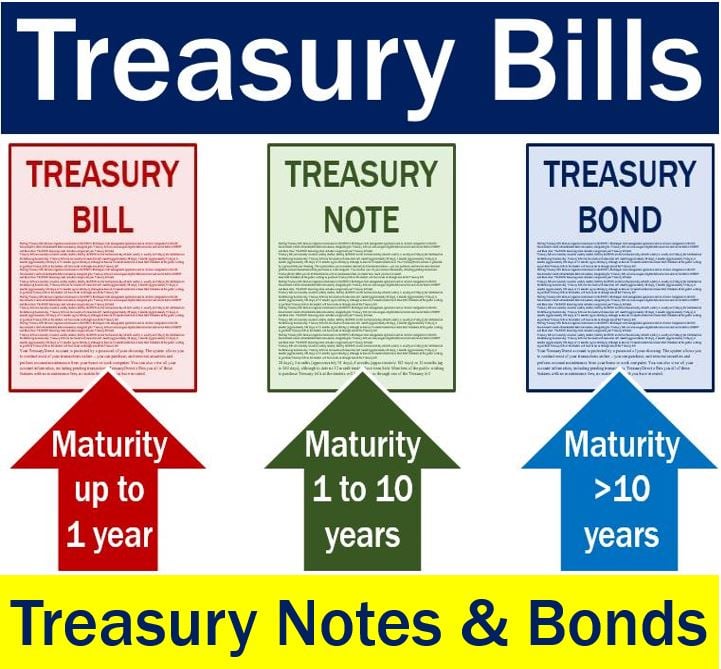
While T-bills, T-notes, and T-bonds include the words “bills,” “notes,” and “bonds” — terms often associated with borrowing — T-securities are not borrowing. They are deposits by depositors into their own accounts.
Imagine putting dollars into your bank safe deposit box. The bank has not borrowed those dollars. It only has provided a storage place to deposit things of value. Those things of value are not federal debt. The government does not owe them to you.
When a T-security reaches maturity, the federal government merely returns your dollars to you. It’s a simple transfer of your dollars from one of your accounts to another of your accounts — from your T-security account to your checking account.
If the federal government wished, it could reduce the “federal debt” to $0 simply by returning all your dollars currently residing in your T-security accounts. This would not be a financial burden on the government.
Finally, interest rates on T-securities are not determined by the private sector. They are set by the Federal Reserve in its attempts to control inflation.
Everywhere you turn, some “expert” wrongly conflates “federal debt” with private debt. It’s as wrong as conflating “giving someone the bird” (handing him a parrot) with the same words meaning “showing your middle finger.”
Federal government finances have nothing in common with personal, business, or state/local government finances.
Perhaps you understand this, and maybe even your neighbor does, too. But why do America’s “experts,” the media, the politicians, and the university economists act so gosh darned ignorant about elementary facts?
I suspect the operative word is “act.” Too many of them have been bribed by the rich, who run America, to make you believe the government can’t afford to give you benefits.
You are told that Social Security, Medicare, Medicaid, and all other social benefit programs must be cut, and your taxes must be increased. It’s all a lie, told to widen the income/wealth/power Gap between the rich and you. This is how the rich grow richer.
Did you know all this? If you do, have you complained to your Senator and Representative? It’s not too late. Or you can simply pay the additional FICA and do with less Medicare and Social Security. It’s what the rich hope, sucker.
 Even without collecting any money, the Monetarily Sovereign U.S. government could pay any obligation denominated in dollars. Creating massive deficits does not affect the federal government’s ability to pay its creditors.
The doctor may not know that federal deficits don’t cause inflation (Inflation is caused by shortages of crucial goods and services, most often oil and food.)
In short, the doctor may not know that the U.S. government is infinitely wealthy, and that federal spending is necessary to grow the economy.
And no, this has nothing to do with government ownership of the Mississippi River, the Rocky Mountains, the 200-mile Exclusive Economic Zone (EEZ), Lake Michigan, or the Statue of Liberty.
It has to do with the fact that a Monetarily Sovereign nation has the infinite ability to create its own sovereign currency.
This truth has been recognized by at least two respected Chairmen of the Federal Reserve, by a spokesperson for the St. Louis Federal Bank, by the head of the European Union, and by those of us who recognize the power of Monetary Sovereignty:
Even without collecting any money, the Monetarily Sovereign U.S. government could pay any obligation denominated in dollars. Creating massive deficits does not affect the federal government’s ability to pay its creditors.
The doctor may not know that federal deficits don’t cause inflation (Inflation is caused by shortages of crucial goods and services, most often oil and food.)
In short, the doctor may not know that the U.S. government is infinitely wealthy, and that federal spending is necessary to grow the economy.
And no, this has nothing to do with government ownership of the Mississippi River, the Rocky Mountains, the 200-mile Exclusive Economic Zone (EEZ), Lake Michigan, or the Statue of Liberty.
It has to do with the fact that a Monetarily Sovereign nation has the infinite ability to create its own sovereign currency.
This truth has been recognized by at least two respected Chairmen of the Federal Reserve, by a spokesperson for the St. Louis Federal Bank, by the head of the European Union, and by those of us who recognize the power of Monetary Sovereignty:






 #Monetary Sovereignty - Mitchell