Hospitals are deploying their political power to protect their bottom lines in the battle to control healthcare costs.
The point of contention: For decades, Medicare has paid hospitals — including hospital-owned physician practices that may not be physically located in a hospital building — about double the rates it pays other doctors and facilities for the same services, such as mammograms, colonoscopies, and blood tests.
The rationale has been that hospitals have higher fixed costs, such as 24/7 emergency rooms and uncompensated care for uninsured people.
I can understand why federally funded Medicare would pay moreto organizations with higher fixed costs, but why would they pay lessto organizations with lower fixed costs?
I know. That sounds like double talk. If you pay more to one group, you pay less to another. But there is a point to be made.
Colleen DeGuzman
Medicare is an agency of the Monetarily Sovereign federal government. Contrary to popular wisdom, Medicare is not funded by FICA taxes.
All federal tax dollars, including FICA, are destroyed upon receiptby the U.S. Treasury.
The dollars begin in the M2 money supply measure, but when they reach the Treasury, they cease to be part of any money supply measure.
Effectively, they are destroyed. There cannot be a money supply measure for an entity with the limitless ability to create dollars by clicking computer keys.
Alan Greenspan: “A government cannot become insolvent with respect to obligations in its own currency. There is nothing to prevent the federal government from creating as much money as it wants and paying it to somebody. The United States can pay any debt it has because we can always print the money to do that.”
All federal agencies — Congress, the White House, SCOTUS, the military, etc. are funded the same way: By federal new money creation. That includes Medicare and Social Security.
Since the federal government can create dollars, why should it try to save dollars? It shouldn’t.
When there is a question about how much the federal government should pay for anything, the wise course is to err on the side of paying more. That would add growth dollars to the economy at no cost to anyone.
Suppose the goal is to pay hospitals the same rate as other doctors and facilities for the same services. In that case, the federal government shouldn’t cut hospital pay but rather increase the pay to other doctors and facilities.
Insurers, doctors, and consumer advocates have long complained it’s an unequal and unfair arrangement that results in higher costs for patients and taxpayers.
It may or may not be “unfair,” but why would hospital pay be considered too high? No one has demonstrated that hospitals should receive less money. So why is reducing hospital pay the cure for “unfairness”?
It’s also a profit incentive for hospitals to buy up physician practices, which health economists say can lead to hospital consolidation and higher prices.
It would seem that the real profit incentive is not with the hospitals to buy physician practices. Instead, there would be an incentive for doctors to sell their practices, depending on how Medicare dollars are split between doctors and hospitals.
In December, the House passed a bill that included a provision requiring Medicare to pay the same rates for medical infusions, like chemotherapy and many treatments for autoimmune conditions, regardless of whether they’re done in a doctor’s office or clinic owned by a hospital or by a different entity.
The policy, known as site-neutral payment, has sparked a ferocious lobbying battle in the Senate, not the first of its kind, with hospitals determined to kill such legislation.
There would be no need for “ferocious lobbying” if doctors’ pay were increased rather than hospitals’ pay decreased.
According to the Congressional Budget Office, the House legislation would save Medicare an estimated $3.7 billion over a decade.
To put this in perspective, the program is projected to pay hospitals upward of $2 trillion during that same period. But hospitals have long argued that adopting site-neutral payments would force them to cut jobs or services or close facilities altogether — particularly in rural areas. And senators are listening.
“Saving Medicare $3.7 billion is identical to saying, “cost the economy 3.7 billion it otherwise would have received.”
“The Senate is very much attuned to rural concerns,” Sen. Ron Wyden (D-Ore.), who chairs the Finance Committee, told KFF Health News. His panel has jurisdiction over Medicare, the health program for seniors and people with disabilities.
“I have heard many questions about how these proposals would affect rural communities and rural facilities,” he said. “So we’re taking a look at it.”
Outpatient departments at rural hospitals can have outsize importance to their communities. Taking any funding away from stand-alone rural hospitals is seen as risky. Scores have closed in the past decade due to financial problems.
With fewer patients, rural hospitals often struggle to attract doctors and update technology amid rising costs.
Taking money from rural hospitals impoverishes them while doing nothing for doctors or for the federal government, which has infinite money. This is how economics ignorance hurts everyone.
Sen. Bill Cassidy, R-La., a physician serving on the Finance Committee, indicated he was apprehensive about the legislation.
“In some cases,” he said, higher Medicare hospital payments are “justified.”
“In some cases, it doesn’t seem to be,” he said. He told KFF Health News he was planning to introduce legislation on the issue but didn’t provide details, and his office didn’t respond to inquiries.
As the two senators show, the issue doesn’t break cleanly along partisan lines. In December, the House quickly passed the Lower Costs, More Transparency Act, the broader bill that included this Medicare payment change, with 166 Republicans and 154 Democrats voting.
Whenever Congress votes for “lower costs for the federal government,” it means “Fewer growth dollars for the economy, i.e., the private sector.” Lower costs for the federal government means taking money from you.
In short, you pay for all federal savings.
“It’s more about how close different members are to the hospital industry,” said Matthew Fiedler, a former White House health economist under President Obama and now a senior fellow at the Brookings Institution.
Barack Obama was notoriously ignorant about federal finances. He famously claimed the federal government had to “live within its means.”
The federal government always lives with its means because its “means” are infinite. It never can run short of dollars.
Obama also signed the Budget Control Act to cut annual government spending by about $1 trillion over the next 10 years. Additionally, the act charged the Joint Select Committee on Deficit Reduction with finding an additional $1.5 trillion in savings.
Translation: The Budget Control Act aimed to reduce the economy’s supply of growth dollars by $1 trillion and charged the Joint Select Committee on Economic Growth Reduction with taking another $1.5 trillion from the American people.
The American Hospital Association described the site-neutral policy as a “cut” to hospital Medicare payments.
It said in a statement to a House subcommittee that it “disregards important differences in patient safety and quality standards required in these facilities.”
Rather than cutting payments to hospitals, Medicare could accomplish equality by increasing payments to healthcare suppliers, not in hospitals. This would satisfy rural hospitals, grow the economy, and improve the nation’s healthcare.
Chip Kahn, president and CEO of the Federation of American Hospitals, representing for-profit hospitals, offered a similar characterization of the House-passed legislation.
“This is no time for so-called ‘site-neutral’ Medicare cuts that could harm beneficiaries,” he said in a statement.
Right. There has never been a time to make cuts to save the federal government money.
“This is not a hospital cut. It is rolling back an unethical price increase,” said Mark Miller, a former MedPAC executive director now an executive vice president at Arnold Ventures, a philanthropy founded by John and Laura Arnold.
No, it’s a hospital cut. All the mealy-mouth rationalizations don’t change that fact. It is an unnecessary cut with zero benefit to America and much pain to the economy and our hospitals.
Large hospital systems with the money to buy physician practices, Miller said, have exploited the disparity between Medicare payments to physician offices and hospitals to increase their revenue and consolidate.
Miller said he’s hopeful the site-neutral provision of the House bill will be part of a larger government spending bill that must be passed next month to keep the government open.
If lawmakers need to offset the bill’s costs, “then it is more likely to get in the funding package,” he said.
But, lawmakers do not need to offset the bill’s costs. The reluctance to spend and keep the government open is total bullshit. Yes, there is no better way to state it: Total bullshit that has been fed to the American public.
The purpose of the bullshit is simple: To make the middle- and lower-income groups stop asking for federal benefits. When the people are told (falsely) that Medicare and Social Security “can’t afford” more benefits or even existing benefits, they meekly accept their impoverishment.
And that makes the rich, who run America, richer.
Sorry, folks, but your representatives are cheating you by keeping you ignorant of federal finances. Ignorance is costly.
The House-passed legislation is viewed as an “incremental” change, said Fiedler, but it faces a rough path forward.
Evening out Medicare payment for physician-administered drugs, hospitals fear, could lead to similar moves for other outpatient services.
“Hospitals have a lot of money at stake and will fight this hard,” he said. “Hospitals feel if they lose here, there will be more substantial steps down the road.”
Yes, the rich will fight like hell to widenthe Gap between the rich and the rest — if we let them get away with the Big Lie — the bullshit that the federal government can run short of dollars.
President Kennedy was wrong when he said, “My fellow Americans: ask not what your country can do for you — ask what you can do for your country.”
He should have said, “Ask not how much you can pay your federal government — ask how much your federal government will pay you.”
More than 30 million older Americans are enrolled in Medicare Advantage plans, wooed by lower premiums and more benefits than traditional Medicare offers.
Since Medicare is funded by the federal government (not by FICA taxes), how is Medicare Advantage able to “woo” people with lower premiums and more benefits? What is their secret to saving?
But a bipartisan group of lawmakers is increasingly concerned that insurance companies are preying on seniors and, in some cases, denying care that would otherwise be approved by traditional Medicare.
Is this a surprise? Preying on seniors and denying care is the whole point of Medicare Advantage. The government created the program to reward the rich.
Any thinking person could predict that a private, for-profit program, competing with a government not-for-profit program, would have to deny services and fool customers. How else can they make a profit while taking business from the government program?
“It was stunning how many times senators on both sides of the aisle kept linking constituent problems with denying authorizations for care,” Sen. Ron Wyden (D-Ore.) said in an interview, referring to a bevy of complaints from colleagues during a recent Senate Finance Committee hearing.
Businesses are strongly motivated to deny authorizations for the most expensive procedures, the exact procedures for which people most need insurance. Prior authorization is a notorious scam.
Congress has already gone after insurers for their celebrity-filled ads and misleading directories. But its scrutiny of these care denials, expected to continue into next year, could have a far greater impact and reshape the rules for one of the most profitable parts of the insurance industry.
The private health insurance industry cannot survive without prior authorization or some other process that skims away their highest costs.
“CMS is very attuned to what is going on on the Hill,” Sean Creighton, managing director of policy for consulting firm Avalere Health, said of the Centers for Medicare and Medicaid Services. He added that next year will likely bring “more scrutiny by the Hill and CMS on this, and there will be more reporting requirements for the plans and actions the plans are required to take to lessen the burden on providers and patients.”
Yes, “more scrutiny and more reporting requirements” — anything to avoid doing what really should be done: Eliminate FICA and offer federally funded, comprehensive, no-deductible, no-copay Medicare for every man, woman, and child in America.
The federal government could pay for the whole thing by tapping a computer key, and it could do it without the need to supervise private insurance services.
The hugely profitable private healthcare insurers, who bribe Congress, would object.
And, of course, the rich who run America don’t want it, because it would narrow the income/wealth/power Gap between the rich and the rest of us. Keeping the poorer poor is how the rich stay rich. That is what the rich bribe Congress to do.
Legislation requiring insurers to more quickly approve requests for routine care passed unanimously in the House in 2022, but stalled in the Senate over cost concerns.
What do we do now? Medicare Advantage won’t pay.
Federal “cost concerns” are unnecessary.
Because the federal government is Monetarily Sovereign, cost never should be a primary consideration.
The Improving Seniors’ Timely Access to Care Act, which mandates insurers quickly approve requests for routine care and respond within 24 hours to any urgent request, was reintroduced this year in the House and passed out of the House Ways and Means Committee this summer as part of a larger health care package.
Still, lawmakers are peppering the Biden administration with demands for reforming the commonly used tool called prior authorization, the process in which health insurers require patients to get insurer approval ahead of time for certain treatments or medications.
Without prior authorization, Medicare Advantage would have no price “advantage,” and scant ability to compete with Medicare.
It “has turned into a process of basically just stopping people from getting care,” said Rep. Pramila Jayapal (D-Wash.), leader of the House Progressive Caucus.
Stopping people from getting care — i.e. stopping health insurers from paying big bills — is the point. Imagine a car insurer demanding that people get prior authorization before starting the car, and then denying any long or more risky drives.
Jayapal was one of more than three dozen House Democrats who told CMS this month of “a concerning rise in prior authorizations,” accused health insurers of prioritizing “profits over people” and asked for “a robust method of enforcement to rein in this behavior.”
Oh, really” A business that prioritizes profits? Who could have predicted that? There would be no need to “rein in this behavior” if the federal government funded health care.
Unlike traditional Medicare, Medicare Advantage plans can employ prior authorization and restrict beneficiaries to certain doctors within their network. Those are among the incentives private insurers have to participate in the program and enrollment has doubled during the last decade.
But Sen. James Lankford (R-Okla.) said some hospitals in his state won’t take Medicare Advantage plans any more. “We can’t do it because we can’t afford the constant chasing from all the denials,” he said.
AHIP, the trade group representing insurers, told POLITICO that prior authorization was among the tools that can curb wasteful spending.
Prior authorization has very little to do with wasteful spending and everything to do with cutting big costs. If a doctor, who knows a patient, authorizes a procedure, and some lowly insurance company employee, who never met the patient refuses to pay for the doctor-authorized procedure, how does that prevent “wastefulspending?
“These tools are important when coordinating care, reducing unnecessary and low-value care, and promoting affordability for patients and consumers,” said spokesperson David Allen in a statement.
Utter nonsense. It’s double-talk for “the less we pay, the more we make.”
CMS has a track record of responding to liberal concerns, which could translate into big changes for Medicare Advantage in the coming years. Earlier this month, it proposed a rule to improve the standards for behavioral health networks following complaints from Congress about woefully inaccurate mental health provider directories, which some lawmakers said amounted to fraud.
How are we going to pay this? I thought we were covered.
It also for the first time this year is evaluating Medicare Advantage television ads before they air, following prodding from lawmakers and numerous complaints from elderly consumers who felt duped by the ubiquitous ads.
Interesting that Medicare Advantage can provide “more benefits” at “lower prices,” and still afford all that television advertising, reap profits, and even pay taxes — and compete with Medicare. Do you believe in magic? Where does all the extra money come from? Service refusal.
CMS also proposed a rule earlier this month that plans be required to factor the impact of prior authorization denials on marginalized and underserved communities, part of a larger effort by the agency to close gaps in health equity. The rule, if finalized, would take effect in 2025.
You can be sure that the insurance companies will find a way around that one. Service denial is the bedrock of Medicare Advantage. Without service denial, the program could not exist.
Sen. Elizabeth Warren (D-Mass.), who wants the agency to go further, has proposed an amendment that would require CMS to collect and publish data from Medicare Advantage plans on their prior authorization practices to make public the number of prior authorization requests, denials and appeals by type of medical care.
She has support from Sen. Mike Crapo (R-Idaho), who said during a recent hearing that his support for Medicare Advantage plans “does not mean that I like the prior authorization process and that I do not see some problems here that need to be solved.”
Original Medicare does not require prior authorization. Congress could outlaw the whole prior authorization, service denial scam, but that would end Medicare Advantage and all those wonderful profits, along with all those wonderful political bribes.
Insurer advocacy group Better Medicare Alliance told POLITICO it supports legislation and regulations to create an electronic prior authorization process that could expedite prior authorization decisions that typically take up to a week or more.
No, expediting a failed process doesn’t make it a good process. The whole process says, “We know more than your doctor about your health needs” and/or “Your doctor is crooked, so we’ll have one of our flunkies make your healthcare decisions.”
“Our goal has always been to protect prior authorization’s essential function — coordinating safe, effective, high-value care— while also strengthening and streamlining this clinical tool to better serve beneficiaries,” Mary Beth Donahue, president and CEO of the group, said in a statement.
Pardon me if I laugh, but does anyone believe the purpose of prior authorization is to “coordinate safe, effective, high-value care, while strengthening blah, blah, blah”? The purpose of prior authorization is to save money via service denial. Period.
BY DAVID LIM AND ADAM CANCRYN | AUGUST 23, 2023 Creighton suspects insurers would be fine with implementing guardrails for prior authorization, as long as they can continue to use it.
“It is super important that in this case one doesn’t throw out the prior authorization with the bath water,” he said. “It is just finding that balance.”
No, that is exactly what should be done: Throw out prior authorization. It’s an invitation to cheating helpless, sick patients stuck with big bills or no service.
But many physicians complain that balance has tipped too far in favor of Medicare Advantage plans.
A survey released earlier this month by the physicians’ trade group Medical Group Management Association found 97 percent of medical group practices said an insurer delayed or denied medically necessary care.
Another 92 percent said they had hired staff specifically to process prior authorization requests. A December 2022 survey from the American Medical Association also found that 94 percent of physicians reported care delays due to prior authorization denials or processing.
“Even when you are doing the most cost-effective treatment, you are going through the [prior authorization] process,” said Vivek Kavadi, chief radiation oncology officer for U.S. Oncology, a network of more than 1,200 physicians.
Studies show that oncology faces the most prior approval requests.
“I’m sorry Mrs. Jones, but we can’t operate on your cancer until we get prior authorization. It could take weeks, while your cancer grows and metastasizes. Or the procedure could be denied in which case you’ll be on the hook for $50,000 which will bankrupt you and your family. Or maybe, you’ll just die. Which do you choose?”
Five oncologists told POLITICO that prior authorization requests are increasing as more patients migrate from traditional Medicare to Medicare Advantage. This surge of insurer prior approval demands has put a strain on their practices’ resources, they said.
The people who migrate tend to be the ones who least can afford to pay for denied procedures. As usual, the rich have found a way to cheat the middle and the poor.
Insurers may at times contract with radiation benefit managers, companies that manage claims processing and keep a cut of savings they generate.
This can encourage more services requiring prior authorization and create a “greater incentive to identify opportunities where denials can be pushed on to the provider,” said Constantine Mantz, chief policy officer for the oncology network GenesisCare.
If you pay people to deny services, they will deny services.
EviCore, a radiation benefit manager, said its work is meant to ensure patients receive care grounded in the latest clinical evidence as quickly as possible. “For requests that don’t meet evidence-based guidelines, the [physician] has the opportunity to discuss the case … which can help resolve any concerns prior to initiating a formal appeal,” the company said in a statement.
So, the goal is to prevent a doctor from prescribing an unnecessary procedure, and this will be cleared up when the doctor discusses the case with a “benefit manager”? Really?
BMA did not wish to comment and AHIP declined to respond to a list of questions on radiation benefit managers.
Medicare Advantage plans have been slow to update their coverage policies and at times lag Medicare in which treatments are covered, Mantz said. This can lead to situations where a Medicare Advantage plan denies care after a prior authorization request that would be covered under traditional Medicare.
Of course. What other outcome could there be? The whole purpose of prior approval is to deny payment.
BY ALICE MIRANDA OLLSTEIN AND LAUREN GARDNER | OCTOBER 05, 2023 05:00 AM HHS’ Office of the Inspector General in a 2022 report found 13 percent out of a sample of claims from Medicare Advantage plans in which care was denied under prior authorization for services that should have been approved.
You can be sure the 13 percent figure is low, but even if were accurate, would you go to a hospital knowing there was a 13 percent chance your legitimate procedure would not be covered? I wouldn’t.
If a request is denied, a doctor can file an appeal and eventually speak with another physician to plead their case.
This is exactly what you don’t want your doctor spending his valuable time doing: Pleading his case to another doctor who has not seen you and doesn’t even know you.
Recent studies have shown that most appeals to a denial get overturned. In 2021, Medicare Advantage plans fully or partially denied more than 2 million claims through prior authorization, but 82 percent of those were overturned after an appeal, according to an analysis from the think tank KFF.
A 2019 survey from ASTRO found 62 percent of oncologists, who appealed on behalf of their patients, got their prior authorization denial overturned.
If the vast majority of denials are overturned, something clearly is wrong with the denial process. It would be informative to know why denials are overturned. What are the circumstances that cause all those “bad” denials and their cancellation.
Apparently, those denials were unnecessary, and when the doctors caught the insurance companies with their hands in the cookie jar, the denials were reversed. The insurance companies seemingly tell their people, “Deny everything you can, but if a doctor objects, reverse the denial. Just make the process as tedious as possible.”
But doctors say getting through the appeals process can take weeks.
“It feels more like the business model is a way for insurance companies to potentially reduce costs by feeling that physicians won’t want to participate in this peer-to-peer process because it is a burden on time,” said Amar Rewari, chief of radiation oncology for the Maryland-based health system Luminis Health.Mei
The insurance companies increase profits by making the process difficult for patients and doctors. This is the opposite of what one would expect from a health service.
SUMMARY
No public purpose is served by transferring the cost of health care to the private sector, where profitability requirements can supersede healthcare needs.Though cutting prices is a selling strategy, it is a poor tradeoff for bad service.
Innocent consumers, lured in by lower prices and coverages not offered by Original Medicare, too often find themselves uninsured at just the times when they need help most, with bankruptcy-causing bills or not receiving medical care at all.
The federal government already had proved its capability of funding healthcare services with Original Medicare. a relatively no-hassle service.
Unnecessarily, Medicare saves money by not paying for everything. There are co-pays, deductibles, and some services not covered. But the federal government, being Monetarily Sovereign, does not need to save money. It has infinite dollars.
The federal government is financially capable of providing comprehensive, all-inclusive, no-copay, no-deductible Medicare to every man woman and child in America, without collecting a penny in taxes.
The purpose of government is to improve and protect the lives of the people. The U.S. government, having unlimited financial capability, and already having the experience funding medical care, should carry out its mandate.
The U.S. federal government is not like state/local governments, not like euro governments, not like businesses, and not like you and me.
It uniquely is Monetarily Sovereign. It cannot, unwillingly, run short of its own sovereign currency, the U.S. dollar. As real experts have said:
Former Federal Reserve Chairman, Alan Greenspan: “A government cannot become insolvent with respect to obligations in its own currency. There is nothing to prevent the federal government from creating as much money as it wants and paying it to somebody. The United States can pay any debt it has because we can always print the money to do that.”
Former Fed Chairman, Ben Bernanke: “The U.S. government has a technology, called a printing press (or, today, its electronic equivalent), that allows it to produce as many U.S. dollars as it wishes at essentially no cost.”
Quote from 60 Minutes: Scott Pelley: Is that tax money that the Fed is spending? Ben Bernanke: It’s not tax money… We simply use the computer to mark up the size of the account.
Statement from the St. Louis Fed: “As the sole manufacturer of dollars, whose debt is denominated in dollars, the U.S. government can never become insolvent, i.e., unable to pay its bills. In this sense, the government is not dependent on credit markets to remain operational.”
Press Conference: Mario Draghi, President of the Monetarily Sovereign ECB, 9 January 2014 Question: can the ECB ever run out of money? Mario Draghi: Technically, no. We cannot run out of money.
Because the U.S. federal government has the infinite ability to create its sovereign currency, the U.S. dollar, it never borrows dollars.Contrary to popular wisdom, T-bills, T-notes, and T-bonds do not represent borrowing. They simply are deposits, the purpose of which is to provide a safe place to store unused dollars and to help the Fed control interest rates.
The government never touches those dollars, which remain the property of the depositors.
Not only can our Monetarily Sovereign government not run short of dollars, but federal deficits are necessary to grow the economy, as evidenced by the formula: GDP = Federal Spending + Nonfederal Spending + Net Exports.
When we don’t have sufficient federal deficits, we have depressions and recessions:
1804-1812: U. S. Federal Debt reduced 48%. Depression began 1807. 1817-1821: U. S. Federal Debt reduced 29%. Depression began 1819. 1823-1836: U. S. Federal Debt reduced 99%. Depression began 1837. 1852-1857: U. S. Federal Debt reduced 59%. Depression began 1857. 1867-1873: U. S. Federal Debt reduced 27%. Depression began 1873. 1880-1893: U. S. Federal Debt reduced 57%. Depression began 1893. 1920-1930: U. S. Federal Debt reduced 36%. Depression began 1929. 1997-2001: U. S. Federal Debt reduced 15%. Recession began 2001.
Periodically, we publish yet another shrieking claim that the U.S. federal debt is “unsustainable”and a “ticking time bomb.” This lie has been told to you every year (really, almost every day) since 1940, and that bomb never has exploded, nor ever will.
Rather than repeat the entire list of the thousands of lies to which you have been subject, I will list samples here as a reference and add periodically, at the end, new “federal debt is a ticking time bomb” lies as I encounter them:
September 26, 1940, New York Times: The federal budget was a “ticking time-bomb which can eventually destroy the American system,” said Robert M. Hanes, president of the American Bankers Association.
By 1960, the debt was “threatening the country’s fiscal future,” said Secretary of Commerce Frederick H. Mueller. (“The enormous cost of various Federal programs is a time-bomb threatening the country’s fiscal future, Secretary of Commerce Frederick H. Mueller warned here yesterday.”)
In 1984: AFL-CIO President Lane Kirkland said. “It’s a time bomb ticking away.”
In 1985: “The federal deficit is a ticking time bomb, and it’s about to blow up,” U.S. Sen. Mitch McConnell. (Remember him?)
Later in 1985: Los Angeles Times: “We labeled the deficit a ‘ticking time bomb’ that threatens to permanently undermine the strength and vitality of the American economy.”
In 1987: Richmond Times-Dispatch – Richmond, VA: “100TH CONGRESS FACING U.S. DEFICIT’ TIME BOMB'”
Later in 1987: The Dallas Morning News: “A fiscal time bomb is slowly ticking that, if not defused, could explode into a financial crisis within the next few years for the federal government.”
In 1989: FORTUNE Magazine: “A TIME BOMB FOR U.S. TAXPAYERS“
In 1992: The Pantagraph – Bloomington, Illinois: “I have seen where politicians in Washington have expressed little or no concern about this ticking time bomb they have helped to create, that being the enormous federal budget deficit, approaching $4 trillion.“
Later in 1992, Ross Perot said, “Our great nation is sitting right on top of a ticking time bomb. We have a national debt of $4 trillion.”
In 1995: Kansas City Star: “Concerned citizens. . . regard the national debt as a ticking time bomb poised to explode with devastating consequences at some future date.”
In 2004: Bradenton Herald: “A NATION AT RISK: TWIN DEFICIT A TICKING TIME BOMB“
In 2005: Providence Journal: “Some lawmakers see the Medicare drug benefit for what it is: a ticking time bomb.”
In 2006: NewsMax.com, “We have to worry about the deficit . . . when we combine it with the trade deficit, we have a real ticking time bomb in our economy,” said Mrs. Clinton.
In 2007: USA Today: “Like a ticking time bomb, the national debt is an explosion waiting to happen.“
In 2010: Heritage Foundation: “Why the National Debt is a Ticking Time Bomb. Interest rates on government bonds are virtually guaranteed to jump over the next few years.
In 2010: Reason Alert: “. . . the time bomb that’s ticking under the federal budget like a Guy Fawkes’ powder keg.”
In 2011: Washington Post, Lori Montgomery:”. . . defuse the biggest budgetary time bombs that are set to explode.”
June 19, 2013: Chamber of Commerce: Safety net spending is a ‘time bomb’, By Jim Tankersley: The U.S. Chamber of Commerce is worried that not enough Americans are worried about social safety net spending. The nation’s largest business lobbying group launched a renewed effort Wednesday to reduce projected federal spending on safety-net programs, labeling them a “ticking time bomb” that, left unchanged, “will bankrupt this nation.”
On June 15, 2014: CBN News: “The United States of Debt: A Ticking Time Bomb“
On January 27, 2017: America’s “debt bomb is going to explode.” That’s according to financial strategist Peter Schiff. Schiff said that while low interest rates had helped keep a lid on U.S. debt, it couldn’t be contained for much longer. Interest rates and inflation are rising, creditors will demand higher premiums, and the country is headed “off the edge of a cliff.”
February 16, 2018 America’s Debt Bomb By Andrew Soergel, Senior Reporter: Conservatives and deficit hawks are hurling criticism at Washington for deepening America’s debt hole.
April 10, 2019,The National Debt: America’s Ticking Time Bomb. TIL Journal. Entire nations can go bankrupt. One prominent example was the *nation of Greece which was threatened with insolvency, a decade ago. Greece survived the economic crisis because the European Union and the IMF bailed the nation out.
SEP 12, 2019, Our national ticking time bomb, By BILL YEARGIN SPECIAL TO THE SUN SENTINEL | At some point, investors will become concerned about lending to a debt-riddled U.S., which will result in having to offer higher interest rates to attract the money. Even with rates low today, interest expense is the federal government’s third-highest expenditure following the elderly and military. The U.S. already borrows all the money it uses to pay its interest expense, sort of like a Ponzi scheme. Lack of investor confidence will only make this problem worse.
JANUARY 06, 2020, National debt is a time bomb, BY MARK MANSPERGER, Tri City Herald | The increase in the U.S. deficit last year was about $1.1 trillion, bringing our total national debt to more than $23 trillion! This fiscal year, the deficit is forecasted to be even higher, and when the economy eventually slows down, our annual deficits could be pushing $2 trillion a year! This is financial madness. there’s not going to be a drastic cut in federal expenditures — that is, until we go broke — nor are we going to “grow our way” out of this predicament. Therefore, to gain control of this looming debt, we’re going to have to raise taxes.
February 14, 2020, OMG! It’s February 14, 2020, and the national debt is still a ticking time bomb! The national debt: A ticking time bomb?America is “headed toward a crisis,” said Tiana Lowe in WashingonExaminer.com. The Treasury Department reported last week that the federal deficit swelled to more than $1 trillion in 2019 for the first time since 2012. Even more alarming was the report from the bipartisan Congressional Budget Office (CBO) predicting that $1 trillion deficits will continue for the next 10 years, eventually reaching $1.7 trillion in 2030
August 29, 2020, LOS ANGELES, California: America’s mountain of debt is a ticking time bomb The United States not only looks ill, but also dead broke. To offset the pandemic-induced “Great Cessation,” the U.S. Federal Reserve and Congress have marshalled staggering sums of stimulus spending out of fear that the economy would otherwise plunge to 1930s soup kitchen levels. Assuming that America eventually defeats COVID-19 and does not devolve into a Terminator-like dystopia, how will it avoid the approaching fiscal cliff and national bankruptcy?
April 16, 2021, NATIONAL POLICY: ECONOMY AND TAXES / MARK ALEXANDER / The National Debt Clock: A Ticking Time Bomb: At the moment, our national debt exceeds $28 TRILLION — about 80% held as public debt and the rest as intragovernmental debt. That is $225,000 per taxpayer. Federal annual spending this year is almost $8 trillion, and more than half of that is deficit spending — piling on the national debt.
June 17, 2022Time Bomb On National Debt Is Counting Down Faster Thanks To Fed’s Rate Hike, Tim Brown /We are now staring down the barrel of the end of the U.S. economy based on fiat money, printed out of thin air but charged back to the people at ridiculous interest rates. Now, the national debt is approaching $31 trillion,which is $12 trillion more than when Donald Trump took office in 2017 and more than half of that debt was tacked on in his final year. Then we’ve had the disastrous year and a half of Joe Biden. Now, the Fed is now hiking its rates and that spells even more trouble for the national debt and the economy at large.
December 4, 2022 America’s ticking time bomb: $66 trillion in debt that could crash the economy By Stephen Moore, The national debt is $31 trillion when including Social Security’s and Medicare’s unfunded liabilities. Wake up, America. That ticking sound you’re hearing is the American debt time bomb that with each passing day is getting precariously close to detonatingand crashing the US economy.
January 13, 2023.A ticking time bomb in the U.S. economy is running perilously close to detonation. Long considered a harbinger of bad luck, Friday, Jan. 13 came with a warning for Congress that the country could default on its debt as soon as June. With the U.S. reaching its debt limit of $31.4 trillion on Jan. 19, Treasury Secretary Janet Yellen urged lawmakers to increase or suspend the debt ceiling.
April 22, 2023The Debt Ceiling Debate Is About More Than Debt, Jim Tankersley, WASHINGTON — Speaker Kevin McCarthy of California has repeatedly said that he and his fellow House Republicans are refusing to raise the nation’s borrowing limit,and risking economic catastrophe, to force a reckoning on America’s $31 trillion national debt. “Without exaggeration, America’s debt is a ticking time bomb that will detonate unless we take serious, responsible action,” he said this week.
November 3, 2023 The Fuse on America’s Debt Bomb Just Got Shorter,J Antoni Heritage Organization. The Treasury is now on track to borrow almost as much in just six months as it did in the previous 12 months. That’s nearly a doubling of the deficit. Because the federal debt is $33.7 trillion, just a 1 percent increase in yields adds $337 billion to the annual cost of servicing the debt over time. Absent spending reform, eventually no one will be willing to hold the bomb anymore, and the yields on U.S. debt will begin to resemble those in Argentina.
February 2, 2024How Florida can help defuse the nation’s debt bomb By BARRY W. POULSON,professor emeritus of economics at the University of Colorado Boulder and DAVID M. WALKER,former comptroller general of the United States. Washington’s out-of-control spending, combined with fiscal and monetary policies have resulted in trillion-dollar-plus annual deficits, over $34 trillion in federal debt, over $125 trillion in total federal liabilities and unfunded obligations, and excess inflation. Excessive spending and loose monetary policy increase inflation in the short term, and mounting debt burdens serve to reduce future economic growth and shift the economic burden and consequences of mounting debt burdens to future generations.
February 8, 2024Legendary investor Paul Tudor Jones says a ‘debt bomb’ is about to go off in the U.S.: ‘We’re fast-pouring consumption like crazy’. The U.S. economy may seem like it’s firing on all cylinders, but underneath the surface, a “debt bomb” could be on the verge of exploding, according to billionaire hedge fund manager Paul Tudor Jones. The esteemed investor said in an interview with CNBC that he couldn’t deny the economy was strong, but that it was actually “on steroids” due to massive government spending and borrowing.
Jones is not the only one to call attention to the growing deficit issue in the U.S. On Sunday, Federal Reserve Chairman Jerome Powell took a rare dive into politics, telling CBS’s 60 Minutes that the national debt was “growing faster than the economy,” and calling for lawmakers to get the federal government “back on a sustainable fiscal path.”
Meanwhile, U.S. Treasury Secretary Janet Yellen has said she is not yet worried about the increasing national debt as long as the government keeps in check the net payments it makes on its debt relative to GDP. Those payments are projected to rise from 2.5% last year to 2.9% next year, according to the Office of Management and Budget—below their level in the early 1990s.
Jones told CNBC that the strong economy could postpone the effects of the government’s deficit spending, but only for a little while. “The only question is … when does that manifest itself in markets?” he added. “It could be this year, it could be next year. Productivity may mask and it might be three or four years from now. But clearly, clearly we’re on an unsustainable path.”
———————–//———————–
Or it could be in ten years or maybe fifty years or a hundred years. But clearly, if we wait long enough, something will happen to prove them right, perhaps in a thousand years.
Today, his makes “only” 84 years of the debt nuts being wrong. If prophets are wrong, wrong, wrong, for 84 years, at what point does the world stop believing them?
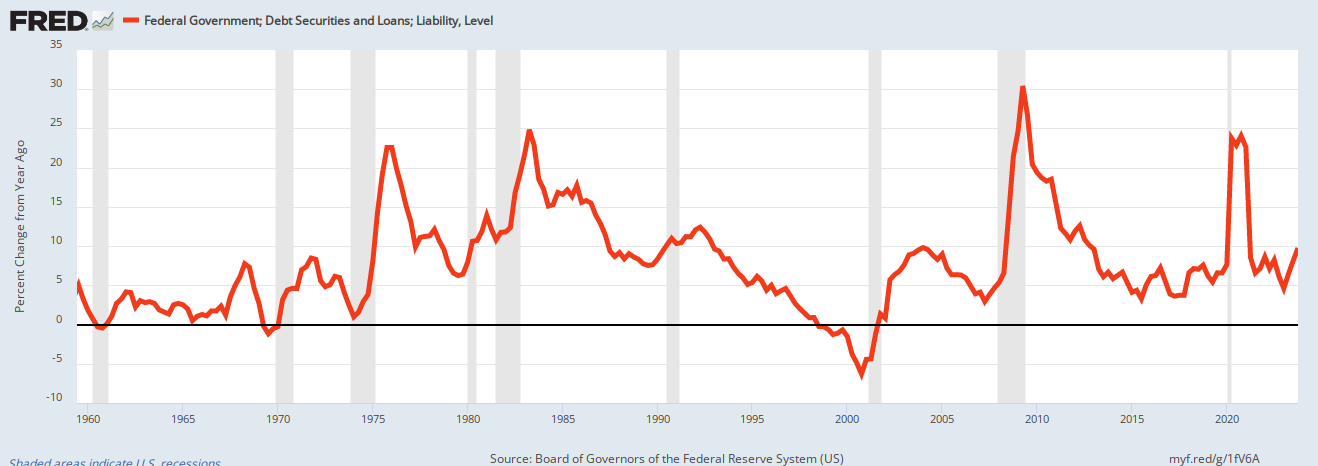
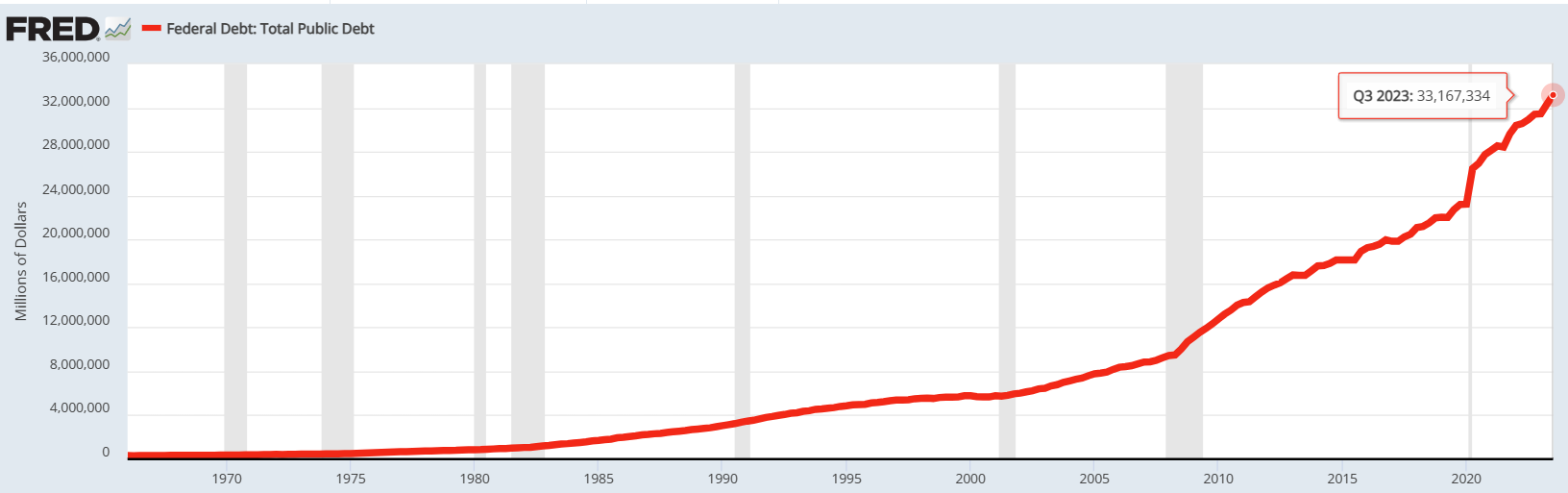
Year after year we see the federal deficit yielding economic growth. When deficits are insufficient, we have had recessions, which were cured by increased deficits.
When deficits decline, we have recessions (vertical gray bars) which are cured by increased deficits.
If, year after year, respected economists keep predicting something terrible is imminent, yet exactly the opposite happens, at what point do they reexamine their beliefs?
Gap Psychology describes the common desire to distance oneself from those “below” in any socio-economic ranking, and to come nearer those “above.” The socio-economic distance is referred to as “The Gap.”
Wide Gaps negatively affect poverty, health and longevity, education, housing, law and crime, war, leadership, ownership, bigotry, supply and demand, taxation, GDP, international relations, scientific advancement, the environment, human motivation and well-being, and virtually every other issue in economics.
As you read this post, think about these two simple questions. What would happen if your city, county, and state stopped collecting taxes. What would happen if the U.S. government stopped collecting taxes?
Later, if you’re in school, you can ask your economics professor. See if he/she knows.
—–/////—–
“Rich” is a comparative. A person earning $100,000 is rich if everyone else earns $10,000. But that person earning $10,00 is rich if everyone else earns $1,000.
The income/wealth/power Gap below you and above you determines how rich you are. The average annual income in 1930 was about $4,800. Adjusted for inflation, that’s equivalent to $85,000 today.
Thus, the wealthy need to make you poorer to make themselves richer. Here is how they plan to do it:
Graham commented while debating Sen. Bernie Sanders during a “Senate Project” debate.
There is not one legitimate reason why seniors will “have to” take less or pay more. Not one. The U.S. federal government, being Monetarily Sovereign, cannot run short of dollars.
Alan Greenspan: “A government cannot become insolvent with respect to obligations in its own currency. There is nothing to prevent the federal government from creating as much money as it wants and paying it to somebody. The United States can pay any debt it has because we can always print the money to do that.”
And because the federal government cannot become insolvent, no federal government agency can become insolvent unless that is what Congress and the President want.
Social Security and Medicare are not funded by FICA taxes or other taxes. Like every other federal agency, these agencies, including Congress, the Supreme Court, the White House, the armed services, etc., are funded by new dollar creation.
Ben Bernanke:“The U.S. government has a technology, called a printing press (or, today, its electronic equivalent), that allows it to produce as many U.S. dollars as it wishes at essentially no cost.”
Keep these facts in mind as you read the following:
Senator Sanders: Bring your Social Security plan to the floor. All it does is raise taxes. People like me must take a little less and pay a little more to get out of this mess.
Quote from 60 Minutes: Scott Pelley: Is that tax money that the Fed is spending? Ben Bernanke: It’s not tax money… We simply use the computer to mark up the size of the account.
Even Sanders, a proponent of Medicare for All and increased Social Security parrots the Big Lie that federal taxes fund federal spending.
We must adjust the age again like Ronald Reagan and Tip — Tip O’Neil did. There is a bipartisan way forward. You describe problems, but your answer is always the government — it’s always socialism,” Graham said.
Graham deceivingly uses the epithet “socialism.” But it’s not socialism. Socialism is government ownership and control, not government funding.
Strangely, he doesn’t use that word when describing his own salary, which, in fact, is socialism, as is the Veteran’s Administration Hospitals, the military, and the U.S. court system.
The cost of supporting SCOTUS, POTUS, Congress, and many other approximately 1,000 federal agencieshas increased, but we don’t hear that spending for those agencies needs to be cut.
Instead, federal spending goes up to accommodate increased needs. In 2023, the federal government spent $1.7 trillion more than it collected in taxes.
The federal government has spent over $33 TRILLION more than it has collected in taxes.
The federal government has spent over $33 TRILLION more than it has collected in taxes. Yet, the government has no problem paying its creditors.
Federal deficits are not a burden or obligation on anyone. A federal deficit is merely the number of growth dollars the government pumps into the economy. You and I don’t owe those dollars. Even the government doesn’t owe those dollars. They have already been paid to creditors.
No one owes the federal deficit or debt. Those are just record-keeping numbers.
Why, then, do people who know better (or should know better) talk about having to raise taxes?
Sanders admitted that Social Security “has a solvency issue,” but his proposal — also backed by Sen. Elizabeth Warren — would extend solvency for 75 years while increasing benefits for recipients by $2,400 per year.
Sanders’s proposal would ostensibly fund this expansion of Social Security via a tax on high-earning households, per CNBC.
While I have no object to a tax on high-earning households, it has several problems:
It would have trouble passing Congress, whose members are bribed by the rich not to tax wealthy folk.
Even if high-income were taxed at higher rates, the rich don’t pay those rates. They slip through tax loopholes Congress has given them.
Most importantly, Social Security does not have a “solvency issue,” nor do taxes fund Social Security.
Social Security has an ignorance issue — Congress, the President, and the public wrongly claim FICA funds Social Security (and Medicare).
President Franklin D. Roosevelt, the originator of Social Security, instituted the FICA tax not to fund Social Security but to protect it. “We put those payroll contributions there to give the contributors a legal, moral, and political right to collect their pensions… With those taxes in there, no damn politician can ever scrap my Social Security program.”
Little did he expect that the “damn politicians” would find a way to kill Social Security by the death of a thousand cuts.
It resulted from a series of administrative rulings issued by the Treasury Department in the program’s early years.
In 1983, GOP President Ronald Reagan and Congress changed the law by explicitly authorizing the taxation of Social Security benefits. This was part of the 1983 Amendments, and this law overrode the earlier administrative rulings from the Treasury Department.
Aside from the fact that federal taxes don’t fund federal spending, the federal government taxing its own benefits — the right hand gives, and the left hand takes away — defies logic.
And here is the ultimate irony. People who earn more receive higher benefits. Why?
Why does a person earning $100,000 a year receive higher Social Security benefits than a person earning $30,000 a year? Shouldn’t it be the other way around?
Federal poverty benefits are based on how littleyou earn. But Social Security is based on how muchyou earn. It’s a senseless formula based on the Big Lie that federal taxes fund federal spending.
Federal taxes fund nothing. The purposes of federal taxes are:
To narrow the income/wealth/power Gapbetween the rich and the rest. (But because of tax loopholes, the rich pay a lower percentage of their income in taxes than the rest of us. Federal taxes actually widen the Gap.)
To assure demand for the U.S. dollar by requiring taxes to be paid in dollars. (But there is no shortage of demand for U.S. dollars. Even people, businesses, and nations that don’t pay taxes want dollars.)
To control the economy by taxing what the government wishes to discourage and giving tax breaks to what the government wishes to reward. (But by bribing Congress, the rich have twisted this purpose to their favor. They are the ones being rewarded with tax breaks.)
To fool the public into believing that their federal benefits are limited by taxes collected.
Does the White House have a solvency issue? The Supreme Court? Congress? The Army? The Air Force? The Central Intelligence Agency? The U.S. Treasury? The Federal Reserve?
No. These agencies never are said to be in danger of insolvency. Why do we see a special tax, ostensibly to support Social Security and Medicare, but no special taxes to support the White House, the Supreme Court, Congress, et al?
Because the function of FICA is not to fund Social Security and Medicarebut to provide political cover for limiting these programs. They are programs supposedly to benefit the powerless. But the federal government neither needs nor uses tax dollars.
Congress and the President claim that taxes fund spending so they can pretend to be “forced” to cut benefitsby blaming “insolvency.”
Graham also said that Sanders’ Medicare for All program would eliminate private-sector health care, which would be extremely costly.
“Costly” to whom? Cost means nothing to the federal government, which, being Monetarily Sovereign, has the infinite ability to pay any invoice to any creditor.
A “Medicare for All” would cost consumers nothing. That is the whole point of the program.
So, to whom would it be “costly.” Answer: The health insurance companies would lose all that lucrative income. That’s why every Senator in Congress has received bribes (aka “campaign contributions”) from health insurance companies — every single one.
Knewz reported that Sanders and 14 other senators introduced the Medicare for All plan in May to “guarantee health care in the United States as a fundamental human right to all.”
“There has to be some sense of responsibility here. You just can’t tax people into oblivion and turn every problem over to the government,” Graham said.
You can’t turn “every” problem over to the government. Still, we expect certain basics from our government — Enough food to feed our loved ones and ourselves, a safe place to live, and protection from attack by domestic criminals and foreigners. Education, and healthcare.
If you elected officials can’t provide those basics, who needs you? Get lost. We’ll elect someone who understands the purpose of government.
SUMMARY
The bottom line of this entire article is a straightforward truth. Unlike state/local governments, the U.S. federal government does not pay its bills with tax dollars. It destroys every tax dollar it receives.
State/local governments, being monetarily non-sovereign, survive on tax dollars. But, even if the federal government collected zero taxes, it could continue spending, forever. It cannot become insolvent.
Social Security and Medicare are federal agencies. They cannot become insolvent unless that is what Congress and the President want.
The government has the infinite ability to pay creditors by creating new dollars ad hoc. Having that infinite ability, the federal government does not borrow.
Treasury securities — T-bills, T-notes, and T-bonds– erroneously termed “borrowing” should be called “money storage.” The sole purposes of T-securities are:
To provide a safe place to store unused dollars and
To help the Federal Reserve control interest rates.
Every dollar deposited into T-security accounts remains the property of the depositors. They neither are touched, borrowed, nor owed by the government.
The federal government pays all its creditors on time and in full. Thus, the federal debt merely is an accounting number that shows how many growth dollars have been pumped into the economy. Increasing the misnamed “debt” increases the growth dollars added to Gross Domestic Product.
Far from being a worrisome burden, the growing federal “deficit” and “debt” are absolutely necessary for a healthy economy.
Why isn’t every economist in America broadcasting this truth? That is a mystery I’ve not been able to solve.

/https://static.texastribune.org/media/profiles/Colleen_DeGuzman_TT_01.jpg)




 #Monetary Sovereignty - Mitchell