Is the trade deficit a problem? Not for the U.S.

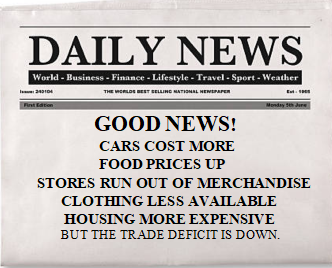
Is this good news or bad news?

Country’s trade deficit narrows to a 5-year low. By Ana Swanson, The New York Times.

WASHINGTON — The U.S. trade deficit in goods and services narrowed more than 10% from August to September, as the Trump administration’s tariffs continued to weigh on trade,

data from the Commerce Department showed.

Imports grew just 0.6% from August to $342.1 billion, while exports rose 3% in the month, to $289.3 billion, according to data released Thursday.

Because exports grew more than imports, the U.S. trade deficit shrank, in line with the Trump administration’s goals.

At $52.8 billion, the trade deficit in goods and services hit its lowest level in September since June 2020, when the United States was in the midst of the COVID-19 pandemic.

Trade experts have cautioned against drawing too many conclusions from a few months of Data and said that trade patterns have recently been distorted by businesses’ efforts to avoid paying tariffs.

President Donald Trump has long seen the trade deficit as a sign of economic weakness.

Trump repeats a standard error: treating the trade deficit as a report card on national health. His reason: The word “deficit” confuses people.

If we send more money to foreigners than they send us, that’s a money deficit. If they send us more goods and services than we send them, that’s our goods and services surplus.

A trade is an exchange of presumed equals (“I’ll send you ‘A’ if you send me ‘B.'”)

So why is it called a trade “deficit”? Isn’t it also a trade “surplus”?

Further, the U.S. creates dollars at will by pressing a few computer keys. Virtually no labor or raw materials are required, and we can make dollars endlessly.

The goods and services we receive rely on labor and raw materials, which are limited resources. We offer something that costs us nothing to create, and in return, we receive valuable items; yet, we refer to this as a “deficit.”

It’s quite strange. I would gladly accept that kind of “trade” any day of the year.

It feels more like stealing than trading. Each year, I experience what some might call a “deficit” with my grocer, my favorite restaurants, my gas station, and others. I exchange dollars—currency that my government can produce at no cost—for valuable food and gasoline.

I don’t feel cheated. While I worked for some of my income, as a retiree, most of my current earnings come to me effortlessly. Despite that, I can still exchange those dollars for valuable goods and services.

And still, by the current definition, I’m running a “trade deficit.” It’s nuts.

I wouldn’t have had to work as much if my government had given me dollars for health care, food, housing, education, etc., which it easily could have done at virtually no effort, just by punching a few more computer keys.

The sweeping tariffs Trump has imposed on imports from countries around the world this year, including on automobiles, metals and furniture, have led to big swings in trade.

Before tariffs went into effect, many U.S. businesses brought in a surge of products to avoid paying import taxes.

After Trump’s global tariffs took effect on August 7, imports slowed sharply, then recovered somewhat in September.

On August 29, the Trump administration also ended the “de minimis” exemption, which allowed foreign shipments valued at less than $800 to come into the United States tariff-free.

Opponents criticized the rule as a loophole that penalized U.S. manufacturers in favor of foreign competitors.

That’s another way of saying, “Make imports more expensive to consumers, so American manufacturers can charge consumers more and/or deliver inferior products.

That might help a few American manufacturers, but do you want higher prices and inferior quality?

Is this good news or bad news? If Americans are buying fewer goods because they are more expensive or harder to obtain, the deficit will decrease. However, this also means a reduction in consumer welfare, which is essentially what inflation and recessions mean.

Currently, we are trading inflation for a shrinking trade deficit—a lousy trade by any definition.

In short, Trump has made trade worse to make the “trade deficit” numbers look better.  

SUMMARY

The term “trade deficit” is often misunderstood; it can actually be considered a trade surplus by logical standards. We receive valuable and often scarce goods and services in exchange for dollars, which our government can produce in unlimited quantities at virtually no cost or effort.

Rodger Malcolm Mitchell

Monetary Sovereignty

Twitter: @rodgermitchell

Search #monetarysovereignty

Facebook: Rodger Malcolm Mitchell;

MUCK RACK: https://muckrack.com/rodger-malcolm-mitchell;

https://www.academia.edu/

……………………………………………………………………..

A Government’s Sole Purpose is to Improve and Protect The People’s Lives.

MONETARY SOVEREIGNTY

When is “waste” not waste?

The Chicago Bears have scored at least one touchdown in almost every game. Therefore, the Chicago Cubs should be able to score at least one touchdown in every game.

If you think that comment is ignorant, why? Because baseball and football are different activities operating under different rules.

So what about this comment: “Government has to start living within its means, just like families do.” It too is ignorant, and for the same reason. The federal government and families operate under different financial rules.

The statement was made repeatedly by President Barack Obama in 2011 and 2012. He also vowed to cut the debt by trillions of dollars, which makes him one of the more economically ignorant Presidents in American history.

The differences between football and baseball are well known. The differences between the finances of our Monetarily Sovereign federal government and a monetarily non-sovereign family still cause confusion, partly because the same words are used: “Debt,” “deficit,” “bond,” “note,” “bill,” “owe,” “pay.”

It’s just that the words have different meanings for the federal government vs. households. And although football and baseball share words—ball, win, score, game, position, league. player, helmet, team, catch, run — we are educated in the difference, and would laugh at anyone who confuses the two.

Federal “waste” is completely unlike family “waste,” and for the same reasons.

The Festivus Report is Senator Rand Paul’s way of complaining about what he considers to be wasteful federal spending.  Here are a few items from the 2024 report. As you read, decide for yourself whether you consider any (all?) of them to be “wasteful.”

1. F-35 Sustainment Cost Overruns — Tens of Billions. The F-35 program is the most expensive weapons system in history. GAO and the DoD IG report that maintenance costs are projected to exceed expectations by $1.3 trillion over the jets’ lifetimes.

Why it’s considered waste: Underperformance; aircraft not meeting readiness targets; cost inflation far above projections.

2. Failed DoD Program: Future Combat Systems (FCS) — $18 Billion Lost. Canceled in 2009 after years of development.

Cost taxpayers over $18 billion with almost nothing field-ready. Why it’s a waste: The Largest failed weapons modernization attempt since the Cold War.

3. Hurricane Katrina & Sandy Aid Duplication — Several Billion. GAO found: Multiple billions in duplicated housing payments (FEMA + SBA + HUD). Fraud, improper payments, and administrative failures across federal disaster relief programs.

4. Nuclear Waste Repository Project: Yucca Mountain — ~$15 Billion. Congress spent roughly $15 billion designing and preparing Yucca Mountain as the nation’s nuclear waste site. The project has been effectively abandoned for political reasons.

Why it’s a waste: The facility was never opened despite the massive investment.

5. ACA Federal Co-op Failures — $2.4 Billion. The Affordable Care Act created 23 non-profit insurance co-ops. 21 of the 23 collapsed, losing ~$2.4 billion in federal loans.

Why it’s a waste: Most co-ops failed within a few years, leaving almost no lasting benefit.

6. Border Wall Cancellations — $2 Billion in Stranded Materials & Contracts. When the administration changed in 2021, DHS paid over $2 billion in continued contract costs, demobilization, storage of unused materials, and cancellation penalties.

Why it’s a waste: Taxpayers paid for materials and contracts that never produced the intended infrastructure.

7. Federal Improper Payments — Over $200 Billion Annually. Not fraud—just errors. Medicaid improper payments in recent years: $50–80 billion. Medicare: $30–40+ billion. Earned Income Tax Credit: $15–20 billion. UI benefits during COVID spikes: tens of billions. Annual total often exceeds $200 billion, easily clearing the $1 billion threshold. 

Why it’s a waste: Payments made to the wrong person, in the wrong amount, or with no documentation.

8. USPS Pre-Funding Mandate Losses — Tens of Billions. For years, USPS had to pre-fund 75 years of employee health benefits: This created massive financial losses of tens of billions. 

While not “waste” caused by USPS mismanagement, it’s widely cited as economically irrational spending.

9. IRS Business Systems Modernization (early 2000s failures) — ~$2–3 Billion Lost: An attempt to completely modernize IRS IT systems. Vast portions had to be scrapped or rebuilt because contractors and the IRS couldn’t deliver working systems.

Why it’s a waste: Billions spent, but many components never functioned.

10. Afghanistan Reconstruction Waste — Over $19 Billion Identified From the Special Inspector General for Afghanistan Reconstruction: More than $19 billion in documented waste, fraud, and abuse. Examples: empty schools, unused power plants, abandoned buildings, failed police programs, and aircraft that were scrapped for pennies.

Why it’s a waste: Projects that were never usable or never used.

Have you already decided which, if any, of these expenditures are federal “waste”?

Let’s first clarify what we mean by the term “waste.”

Rand Paul claims “waste” includes: “Underperformance, not meeting readiness targets, cost inflation far above projections, failed modernization, duplicated payments, never opened, failed quickly, never produced, and payments made to the wrong person, in the wrong amount.”

Do you agree that those things constitute waste?

Here is the Merriam-Webster definition: to spend money or consume property extravagantly or improvidently.
Uncle Sam is throwing big stacks of dollars into a bonfire.
I never use these tax dollars. I make new ones for spending.

Virtually everything the federal government does would be considered “extravagant.” Let’s face it, for the federal government, “million” barely rates a footnote on any budget. Even “billion” may not be noticeable. “Trillion” is the standard.

I suspect Rand Paul is talking about something like “useless,” as in flushing money down the toilet or throwing it in a bonfire.

That is why I take issue with Paul, because I don’t feel money is being used uselessly in the ten examples. I don’t feel they “flush money down the toilet” or “burn money in a bonfire.” In fact, I suggest that those projects were valuable to the American economy.

Let’s begin with these facts:

  • None of the ten projects cost you, the American taxpayer, one cent. The federal government does not pay its bills with tax dollars. It pays with newly created dollars, ad hoc, simply by pressing computer keys, which it can do, endlessly.
  • Gross Domestic Product = Federal Spending + Nonfederal Spending + Net Exports. All federal spending grows the U.S. economy and enriches the American people as the dollars circulate.
  • Some things were accomplished. New products were invented; new systems were learned, and old systems were discarded. Learning what doesn’t work can be as valuable as learning what does.
  • None of the spending reduced the federal government’s ability to spend in the future. The government has the infinite ability to create dollars and use them for any purpose it chooses.

In short, for a Monetary Sovereign nation, “waste” is never about dollars. It is about real resources. Domestic failed programs circulate money into the economy. Only programs that destroy or export real resources can cause true economic loss.

Even then, the loss is mitigated by the political and financial positive effects of spending U.S. dollars in another nation. That nation, having dollars, is more likely to become a customer for U.S. businesses. Enriching other nations benefits our economy; we sell more to nations that have dollars than to nations that don’t

Consider number 10. “Afghanistan reconstruction.” To the extent that American businesses were involved, we benefited from the dollars these businesses received and from the experience they gained.

A substantial portion of Afghanistan’s reconstruction spending went to U.S. contractors, paid American engineers, logisticians, security firms, and auditors, flowed through U.S. banks, payrolls, suppliers, and insurers, and supported domestic production of equipment and services.

The only real loss would have been any U.S. raw materials used to make things left in Afghanistan.

Number 8, “USPS Pre-Funding Mandate Losses” isn’t even a cost. It’s just bookkeeping. Nothing was spent.

Public discussion of “wasteful federal spending” almost always misses the central point of Monetary Sovereignty: dollars are not a scarce federal resource.

Again, the U.S. government, being Monetarily Sovereign, cannot run out of dollars, does not need to obtain dollars from taxpayers, and creates new dollars every time it spends. Therefore, evaluating “waste” in terms of dollars alone is analytically meaningless.

A dollar spent by the federal government is not lost; it is added to Gross Domestic Product (GDP), the commonly used measure of our economy.  Every federal dollar spent—whether you approve of the program or not—enters the private sector as income.

Reminder: GDP = Federal Spending+Nonfederal Spending+Net Exports

In that sense, so-called “wasteful spending” is still “helicopter money,” and helicopter money is by definition stimulative, not lost. It enlarges GDP and strengthens private balance sheets.

A failed defense program, a scrapped IT project, a canceled contract, or even an improper payment all have the same macroeconomic effect: they increase domestic income. They are engineering or managerial failures, not monetary failures, for a Monetarily Sovereign government.

A resource constraint matters only when it prevents something else from happening. During the years of Afghanistan reconstruction, the United States did not experience full employment, nor did it cancel or delay major domestic projects because labor or industrial capacity had been “used up.”

Construction workers, engineers, manufacturers, and logistics firms were not exhausted; many sectors had idle capacity. In fact, much industrial and organizational capacity expanded during this period rather than contracted.

Most of the materials used—steel, concrete, fuel, vehicles, electronics—were manufactured goods that can be reproduced. Their destruction represents transformation, not permanent loss.

The real, irrecoverable losses were human lives, injuries, and trauma, and possibly some rare raw materials. Those losses are real and cannot be dismissed.

Claims of broader “economic waste” rely on treating money as a scarce resource and assuming a “crowding out” that did not occur. Absent full employment or canceled domestic production, those claims are hypothetical at best.

Meanwhile, the spending itself generated income, employment, industrial experience, and hard-won institutional learning. Removing dollars from the analysis leaves a narrower and more honest accounting of what was truly lost and what was gained.

SUMMARY

The strongest objection to this framing is that real resources are finite, even if money is not. Critics argue that Afghanistan reconstruction consumed labor, materials, and attention that could have been used at home.

This objection sounds persuasive, but it only holds if those resources were actually scarce.

The only “waste” is the federal collection of taxes, in the sense that the federal government creates dollars by spending and destroys dollars by collecting taxes.

Federal taxes do not fund federal spending. Their only purposes are to control the economy and to assure demand for the dollar. Federal spending never is a sign of waste.

Rodger Malcolm Mitchell

Monetary Sovereignty

Twitter: @rodgermitchell

Search #monetarysovereignty

Facebook: Rodger Malcolm Mitchell;

MUCK RACK: https://muckrack.com/rodger-malcolm-mitchell;

https://www.academia.edu/

……………………………………………………………………..

A Government’s Sole Purpose is to Improve and Protect The People’s Lives.

MONETARY SOVEREIGNTY
The inflation myths debunked. It’s never “money-printing.” It’s always shortages.

The purpose of any government is to protect and improve the lives of the people. However, when proposals are made to achieve these goals, we are often met with two main objections:

  1. The government can’t afford it, and
  2. It will cause inflation.

The “can’t afford it” objection often leads to name-calling, such as “socialism,” “communism,” and “anti-capitalism.” This name-calling serves as a substitute for genuine thought. Labeling something doesn’t prove whether it’s good or bad.

It just demonstrates that the name-caller doesn’t want to discuss facts and believes the name alone is sufficient.

Some individuals who prefer not to engage in name-calling yet are concerned about federal budgets can be persuaded by the facts surrounding Monetary Sovereignty. This concept highlights that the federal government can create an unlimited amount of dollars instantly and spend them in any manner it chooses.

These individuals recognize that the federal government differs from state and local governments, which are not monetarily sovereign. Federal deficits and debt do not limit its spending capacity. Economic growth requires federal deficits, as they inject growth dollars into the economy.

Insufficient federal deficit spending has caused every recession and depression in U.S. history.

Reduced deficits (red) lead to recessions (vertical gray bars). Recessions are cured by increased deficits. U.S. depressions come on the heels of federal surpluses.

1804-1812: U. S. Federal Debt reduced 48%. Depression began 1807.
1817-1821: U. S. Federal Debt reduced 29%. Depression began 1819.
1823-1836: U. S. Federal Debt reduced 99%. Depression began 1837.
1852-1857: U. S. Federal Debt reduced 59%. Depression began 1857.
1867-1873: U. S. Federal Debt reduced 27%. Depression began 1873.
1880-1893: U. S. Federal Debt reduced 57%. Depression began 1893.
1920-1930: U. S. Federal Debt reduced 36%. Depression began 1929.
1997-2001: U. S. Federal Debt reduced 15%. Recession began 2001.

Gross Domestic Product (blue) parallels federal deficits (red).

There are several programs that a government, having infinite money, easily can afford. Among them are:

  • End FICA
  • Comprehensive, no-deductible, free Medicare for every American, regardless of age and medical history
  • Social Security for every American
  • Free college for all Americans who want it.
  • Housing subsidies for all
  • Food subsidies for all

Though such programs would cost trillions, the federal government can create trillions simply by voting and then pressing computer keys.

Once debt worriers see that the government can’t run out of dollars and that deficit spending is necessary to fulfill the federal government’s obligations of “protect and improve,” they resort to their final objection: “But it would cause inflation.”

Does Federal  Deficit Spending Cause Inflation?

There are no major historical inflations that were primarily caused by a Monetarily Sovereign government spending “too much.”

Every severe inflation episode traces back to real shortages, production collapses, or exchange-rate breakdowns, not to government deficits.

Here are some of the major inflations people think were caused by excessive spending — and why that belief is wrong:

1. Weimar Germany (1921–1923): Popular myth: runaway printing caused inflation.
Reality: Germany lost its industrial Ruhr region during the French occupation. This led to a massive drop in coal and steel output. Reparations required payment in foreign currency. The government was forced to buy foreign currency at any price. Workers were paid NOT to work during Ruhr resistance. Production collapsed.

Cause: Severe loss of real output + currency collapse, not spending.

2. Zimbabwe (2000s): Popular myth: reckless printing for government spending.
Reality: Mugabe’s land reforms destroyed commercial farming, which resulted in a 40%–60% drop in agricultural output. Corn and tobacco production collapsed. Drought worsened food supply.

Cause: Food shortage.

3. Hungary (1945–46): Worst hyperinflation ever/ Popular myth: runaway spending after WWII.
Reality: Production collapsed from war damage. Transportation, factories, and agriculture all were destroyed. Occupying Soviet forces extracted resources.

Cause: War-induced physical destruction and confiscation of supplies, causing massive shortages.

4. United States (1970s): Popular myth: The government spent too much during Vietnam and the Great Society.
Reality: The OPEC oil embargo in 1973 and the second oil shock in 1979. Oil prices quadrupled, which led to cost increases everywhere. Inflation tracked energy prices almost perfectly.

Cause: Energy shortage.

5. Post-COVID Inflation (2021–2022): Popular Myth: Stimulus checks “overheated” the economy.
Reality: Factory shutdowns caused durable goods shortages. Global shipping breakdown caused container-related shortages. Semiconductor shortages led to car and truck shortages. Energy price spikes. Labor shortages.

Cause: Widespread shortages of virtually all supplies and means of production.

6. Latin American inflations: Argentina, Brazil (various decades) Popular myth: Populist spending,
Reality: Debt denominated in foreign currency. Currency crises make imports unaffordable. Prices rise because supply shrinks.

Cause: Currency crisis leads to supply failures.

7. Confederate States of America (Civil War): Popular myth: Currency printing.
Reality: Massive destruction of productive capacity. The Union blockade cut off imports. Farms and railroads were destroyed.

Cause: War shortages

Conclusion: There is no major historical example where government spending caused inflation. Every well-studied inflation is rooted in:  Energy shortages, food shortages, and the loss of production capacity,

8. Yugoslavia, 1992–1994: Popular myth: Excessive government spending.
Reality: Civil war shortages: Slovenia had only ~8% of Yugoslavia’s population but produced about 20%+ of total GDP and an even larger share of high-value industrial output. Lost production capacity of electronics, electrical machinery, pharmaceuticals, metals and machinery. UN santions caused loss of imports (fuel, food, medicines). Breakup of supply chains between republics.

Cause: War shortages, sanctions, economic isolation.

SUMMARY
A Monetarily Sovereign government cannot unintentionally run short of its sovereign currency. It can pay for anything denominated in its currency, provided that currency is accepted by the populace.

Inflation is not caused by “too much money chasing too few goods.” Instead, it results from a scarcity of essential goods, particularly energy and food.

Typically, inflation is caused by:

  1. War shortages
  2. Oil producer price gouging
  3. Pandemic shortages of labor, goods, and services.
  4. Weather that affects food production
  5. Government mismanagement of supply sources.
  6. Shipping interference
  7. Monetary non-sovereignty causing a money shortage

No high inflation in world history was driven primarily by deficits in a Monetary Sovereign nation. The mechanism is always real resource scarcity, not the nominal size of the money supply.

HYPERINFLATION

Hyperinflation is a very rapid general increase in the prices of goods and services, exceeding 50% per month. Prices increase when goods and services are in short supply.

Here is a brief background on hyperinflations since 1900:

War & Occupation
Germany (1921–1923) –Sortages of coal and industrial output collapsed after the Ruhr occupation; food imports were scarce.

Hungary (1945–1946) – Post-WWII destruction left food and housing in extreme shortage.

Greece (1941–1946) – Axis occupation caused famine; food and fuel were critically short.

China (1948–1949) – Civil war disrupted grain supply and transport; rice shortages drove inflation.

Philippines (1942–1944) – Japanese occupation currency collapsed as rice and basic goods disappeared.

State Collapse & Civil War
Yugoslavia (1992–1994) – Sanctions and war cut off oil and food imports; shortages everywhere.

Zimbabwe (2007–2009) – Land seizures destroyed agriculture; maize and wheat shortages were central.

Congo/Zaire (1991–1996) – Civil war disrupted mining and food supply; fuel shortages were common.

Angola (1991–1999) – Civil war devastated agriculture; food and fuel were scarce.

Mozambique (1980s–1990s) – Civil war destroyed farming; food shortages drove inflation.

Nicaragua (1987–1991) – War and sanctions cut off imports; food and fuel shortages.

Commodity & External Shocks
Bolivia (1984–1986) – The Collapse of tin exports led to a foreign exchange shortage; imported fuel and food became unaffordable.

Peru (1988–1990) – Debt default plus falling exports; shortages of imported fuel and food.

Venezuela (2016–present) – Oil price collapse cut off foreign exchange; imports of food and medicine dried up.

Chronic Fiscal Mismanagement
Argentina (1989–1990) – Loss of confidence in the austral; shortages of imported fuel and consumer goods.

Brazil (1980s–1994) – Chronic deficits; shortages less acute, but inflation fed by wage-price spirals and import dependence.

Turkey (1990s–2001) – Fiscal deficits; not classic shortages, but reliance on imported energy created vulnerability.

Israel (1983–1985) – Fuel imports were a pressure point.

Post-Soviet Transition
Russia (1992–1994) – Collapse of Soviet supply chains; food and fuel shortages were widespread.

Ukraine (1993–1995) – Grain and energy shortages after the USSR’s collapse.

Georgia (1993–1995) – Energy shortages (electricity, fuel) and food scarcity.

Armenia (1992–1994) – Blockades caused fuel and food shortages.

Belarus (1994–2000) – Energy and food supply disruptions during transition.

Baltics (early 1990s) – Energy shortages after the Soviet breakup.

The Pattern
Food shortages dominate in war-torn or agrarian economies (Hungary, Greece, Zimbabwe, Nicaragua).

Energy shortages dominate in industrial economies or those reliant on imports (Germany, Yugoslavia, Venezuela, and post-Soviet states).

Export collapse (tin in Bolivia, oil in Venezuela, agriculture in Zimbabwe) removes foreign exchange, making imports of food and fuel impossible.

Rodger Malcolm Mitchell

Monetary Sovereignty

Twitter: @rodgermitchell

Search #monetarysovereignty

Facebook: Rodger Malcolm Mitchell;

MUCK RACK: https://muckrack.com/rodger-malcolm-mitchell;

https://www.academia.edu/


……………………………………………………………………..

A Government’s Sole Purpose is to Improve and Protect The People’s Lives.


MONETARY SOVEREIGNTY

Eleanor Pringle and Fortune display dismal understanding of economics.

You might think, OK, hope, that Fortune Magazine economics writers would understand. . .  well . . .  economics.
Eleanor Pringle
Eleanor Pringle

Alas, Eleanor Pringle may have shattered any such hope.

“Eleanor Pringle is an award-winning senior reporter at Fortune covering news, the economy, and personal finance. Eleanor previously worked as a business correspondent and news editor in regional news in the U.K. She completed her journalism training with the Press Association after earning a degree from the University of East Anglia.”

Immediately, we sense a potential problem. Those words, “the economy and personal finance — do they hint that she doesn’t understand the difference between the federal government’s finance and personal finance?

Keep that question in mind as you read the following excerpts from her article in Foutune.

Two months into the new fiscal year, the US government is already spending more than $10 billion a week servicing the national debt.

Uh, oh. What does Ms. Pringle mean by “servicing“? Is she talking about returning the principal or paying the interest? There is a difference.

To grasp the difference, she first must understand the fundamentals of Monetary Sovereignty, which she clearly does not.

If you are a regular reader, you know that federal  (Monetarily Sovereign) finances are very different from the monetarily non-sovereign finances of state and local governments, businesses and individuals.

I won’t go into the details here, because you readers know them, but for a refresher, read “Common Myths in Economics . . .”

Briefly:

  1. The federal government has the unlimited power to create dollars merely by passing laws and pressing computer keys. It never can run short of dollars to pay interest or bills.
  2. Given that power, the government never borrows dollars. It just makes new ones. Those T-bills, T-notes, and T-bonds do not represent borrowing. They are deposit accounts whose purpose is not to supply the government with spending money.
  3. Instead, the purposes are to help the Fed control interest rates and to provide a safe place to store unused dollars.
  4. The T-securities represent deposits into savings accounts, and paying off the misnamed “debt” (deposits) merely requires returning the dollars that are in those accounts. Returning dollars that already exist in accounts is not a burden on the government.
  5. Finally, the “debt” (which is not debt) also is not a burden on taxpayers, because federal taxes do not pay for anything. Even if all federal tax collections totaled $0, the federal government could continue spending and paying forever.

If you buy a Treasury Bill, you will deposit your Federal Reserve Notes (aka, dollar bills) into your Treasury Bill account, and you will receive a Treasury Bill. It’s a simple dollar exchange — your Federal Reserve notes for Treasury bills, all of which are U.S. dollars.

To pay this off, the government simply reverses the process. It exchanges Federal Reserve Notes for Treasury Bills. No tax dollars are involved.

Your deposited dollars remain in your account until maturity, when they are returned. As for the interest, the federal government presses a few computer keys, and the interest dollars are added to your account and then, upon maturity, they are returned to you with the principal.

Unlike real debt, which burdens borrowers, this federal Treasury round-trip process imposes no burden on the federal government or taxpayers.

Ms. Pringle’s article continues:

The calendar year may have a few weeks left to tick off, but as far as the government’s budget is concerned, we’re in fiscal 2026. And in a matter of weeks, the Treasury has already paid out a 12-figure sum to service the nation’s debt.

Unlike the tax and calendar year, the government’s financial calendar runs to the end of September. According to Treasury data, in the nine weeks since, it has spent $104 billion in interest on its $38 trillion borrowing burden.

That’s more than $11 billion a week, and already represents 15% of federal spending in the current fiscal year.

Economists may be hopeful that the Treasury would make some New (fiscal) Year’s resolutions: Perhaps either scaling back its borrowing, and the additional interest rates on that debt as a result, or drumming up some meaningful revenue to offset the costs.

The federal government does not borrow, and the additional interest adds to Gross Domestic Product (GDP).

GDP = Federal Spending + Nonfederal Spending + Net Exports

President Trump and his cabinet have been discussing debt more meaningfully in this administration. While economists say some of their methods are “peculiar,” the Oval Office has nevertheless devised some money-making schemes, like tariffs, estimated to offset $3 trillion through fiscal year 2035.

This is, unfortunately, $1 trillion lower than previous estimates from the Congressional Budget Office (CBO) earlier this year.

A “money-making scheme” like tariffs simply is a money-transfer scheme that moves dollars from the private sector (aka “the economy“) to the federal government, which neither needs nor uses those dollars. The federal government creates new dollars, ad hoc, for every dollar it spends.

There’s also the issue of how much money will be left over to offset the debt from tariff revenue.

Tariffs do not “offset” T-securities. Unlike T-securities, tariffs are taxes taken from the economy. While T-securities are merely a savings device, tariffs impoverish the economy, drawing us toward recession.

Current estimations suggest that duties will bring in between $300 billion and $400 billion a year, which would help to pay a fraction of the yearly interest payments totaling more than $1 trillion in gross spending in 2025.

Those “$300 billion and $400 billion a year” are tax dollars, subtracted from the economy along with all other tax dollars.

However, President Trump has pledged to share proceeds from the tariff project with individuals, sharing a “dividend” of $2,000 per person. This, according to the Committee for a Responsible Federal Budget (CRFB), would cost $600 billion annually.

The “$2,000 per person is far less than the ongoing, year-after-year cost of the tariffs — a net loss for the economy. And it comes with a caveat: The reduction of federal support for healthcare.

While money is coming in to help rebalance the books (unless it has already been spent, and more, on tariff rebate cheques), government borrowing doesn’t appear to be slowing.

No books are being “rebalanced.” Tariffs drain the economy of dollars.

The ostensible purpose of tariffs is to protect American businesses and American jobs. This could be accomplished by additional government spending to support businesses and jobs, thereby growing the economy rather than punishing it, as tariffs do.

Last week, the Peterson Foundation, which lobbies for responsible fiscal action, published an analysis of the Treasury’s Quarterly Refunding process, which shares government borrowing expectations.

The foundation wrote that the government’s borrowing will increase, issuing $158 billion more in debt in the first half of this fiscal year than in the same period a year earlier.

The sentence should read, “Deposits into T-securities accounts will increase by $158 billion more in the first half of this fiscal year than in the same period a year earlier.” This is not a financial burden on the federal government or on taxpayers.

This demonstrates that the world is more reliant on the U.S. dollar than it was last year. It does NOT demonstrate that the federal government is indebted to anyone, or living beyond its means, or that future grandchildren will owe the “debt.”

And now for the focus on the fake, “sky is falling” scenario:

Debt is a key risk for 2026

Deutsche Bank is generally bullish. It expects global growth of 3.2% in 2026, with the U.S. economy projected to expand by 2.4%. Trade uncertainty is fading, which will boost growth, the bank added, with households also benefiting from tax cuts from Trump’s “One Big, Beautiful Bill” Act.

One small caveat. The line should read, “. . .  Rich households also benefiting from tax cuts from Trump’s ‘One Big, Beautiful Bill’ Act.” As for the poor and middle, who cares about them? Not Trump.

But deficits cast a shadow, on a global scale, over that rosy outlook. The institution wrote: “Many countries face high deficits with limited fiscal and monetary ability. The expected structural shift towards fiscal impulse in 2026 will further widen deficits and heighten concerns around ongoing debt sustainability issues.”

Add two words to the sentence, and it would be correct: “Many monetarily non-sovereign countries face high deficits with limited fiscal and monetary ability.” If monetarily non-sovereign countries like Germany, Italy, France, Portugal, et al face high deficits, they indeed have “limited fiscal and monetary ability.”

But if Monetarily Sovereign countries like the UK, Japan, China, and the U.S. face high deficits, their fiscal and monetary ability remains infinite.

I’d love to explain this to Ms. Pringle, but I suspect she would reject the notion that personal finances are diametrically opposed to federal finances.

In the U.S., in particular, fiscal risks are on the rise, the bank added: “We expect the 2026 deficit to reach 6.7%, with further widening if we see lower tariff revenues or more targeted fiscal stimulus that renews market concerns. Congress is also up against the clock to negotiate on healthcare subsidies and appropriations bills before the stopgap funding again expires on January 30.”

The net total of federal deficits is called the “federal debt” (red line), which parallels economic growth (blue dashed line). GDP=Federal Spending + nonfederal spending + Net Exports.

The government may also be banking on a shift of wealth over the next few decades, which could be leveraged to balance its bottom line.

The Great Wealth Transfer is expected to see $80 trillion change hands over the next 20 years, according to UBS. Some studies put that figure even higher, saying as much as $124 trillion will be passed down from older generations to their younger counterparts.

Wealth consistently transfers from older individuals to younger ones, as older individuals pass away and new ones are born. Viewing this as a problem seems ignorant at best and misleading at worst.

And this new flow of wealth represents an opportunity for tax revenue, UBS’s chief economist Paul Donovan believes. “Governments have long mobilized private wealth to support public finances,” he told a media briefing last month.

“There are several approaches. One is to influence market behavior—encouraging individuals to buy government bonds through incentives like tax-free premium bonds, which channel savings directly into state financing.

Suddenly, without warning, Ms. Pringle stops talking about federal debt and begins talking about state/local government debt.

The line, “Governments have long mobilized private wealth to support public finances,” refers only to monetarily non-sovereign state/local governments. The federal government does not use “private wealth to support public finances.”

Apparently, Ms. Pringle wishes to replace federal bonds with municipal bonds. She wants the federal government to raise taxes so that more (rich) people will buy federal tax-free state/local municipal bonds. This is a strange view. Increasing federal taxes will take more dollars out of the economy, while buying more municipal bonds helps add to state/local government (monetary non-sovereign) indebtedness.

Prudential regulation can also steer pension funds toward domestic government debt, as seen in the UK after 1945, when a debt-to-GDP ratio of 240% was successfully reduced over decades.”

The Debt-to-GDP ratio is the most useless calculation in all of economics. It shows nothing. See Myth #8 of “Common Debt Myths . . .” The ratio reveals nothing about a nation’s ability to service its debts, its financial strength, or anything else.

Anyone who uses the Debt/GDP ratio to demonstrate anything reveals a profound ignorance of national finances.

He added: “More contentious options exist, such as taxing wealth through capital gains or inheritance levies. In practice, the initial focus tends to be on financial repression—using tax incentives or regulation to direct money into government bonds—before moving toward wealth taxation.”

Any federal tax increase — ANY — is financial repression because dollars are taken from the economy and given to the federal government, where they cease to exist.

(Taxes are paid with dollars from the M2 money supply measure. When they reach the Treasury, they cease to exist in any money supply measure.)

The federal government does not spend tax dollars. Instead, it creates new dollars ad hoc.

State/local taxes stay in the economy, but they tend to be regressive, hitting the poor and middle much harder than the rich. For example, sales taxes are massively regressive, as are FICA and most real estate taxes.

The question is, “What is the real problem?”

High federal deficits and debt? These are not problems. They are additions to Gross Domestic Product.

Paying for federal projects? This is not a problem. The federal government can do this endlessly simply by voting to fund projects, and then creating the necessary dollars, ad hoc.

There are two problems that should be addressed:

  1. How to support economic growth without negatively impacting the world.
  2. How to reduce poverty, while narrowing the income/wealth/power Gap between the rich and the rest.

Rather than tilt at the windmill of phony federal “debt,” we should:

1 Eliminate FICA. It is a regressive tax that unfairly targets the lower- and middle-income workers, and contrary to popular myth, it doesn’t fund Medicare or Social Security. Like all federal taxes, it funds nothing.

The primary intent of FICA, as stated by President Franklin D. Roosevelt, was to deceive the public into believing they had funded their benefits. The idea was to deter politicians from cutting them. That has not worked.

The fact is that FICA limits benefits by creating a misleading ceiling through a fictitious “trust fund.

Additionally, because FICA is a business expense, like all business expenses, it is passed on to consumers and thus is inflationary. Further, it discourages hiring by making employees more expensive and lowering net wages.

2. Tax-free Social Security for All, regardless of age, income, or wealth. Providing everyone with the same financial benefits would grow the economy, reduce poverty, and narrow the income/wealth/power Gap.

Receiving a $10,000 stipend, for instance, would improve the lives of the poor more than the middle class, and improve the middle class more than the rich.

3. Comprehensive, no-deductible Medicare for everyone, regardless of age, income, wealth, or health history.

4. Federal support for college attendance.

5. Federal, per-capita support for the monetarily non-sovereign states, allowing them to reduce their regressive taxes.

6. Targeted federal support for economically important businesses. Rather than levying tariffs, which are paid by American consumers, the federal government should support the same businesses financially, either through tax benefits or direct payments.

This would grow the economy and benefit consumers, and using taxes this way is part of one real purpose of federal taxation: controlling the economy.

In summary, understanding Monetary Sovereignty is the first step in understanding economics. Without that understanding, all commentary about the economy is useless.

Rodger Malcolm Mitchell

Monetary Sovereignty

Twitter: @rodgermitchell

Search #monetarysovereignty

Facebook: Rodger Malcolm Mitchell;

MUCK RACK: https://muckrack.com/rodger-malcolm-mitchell;

https://www.academia.edu/

……………………………………………………………………..

A Government’s Sole Purpose is to Improve and Protect The People’s Lives.

MONETARY SOVEREIGNTY