Student loans and the unforgivable debt

Twitter: @rodgermitchell; Search #monetarysovereignty

Facebook: Rodger Malcolm Mitchell

Mitchell’s laws:

•Those, who do not understand the differences between Monetary Sovereignty and monetary non-sovereignty, do not understand economics.

•Any monetarily NON-sovereign government — be it city, county, state or nation — that runs an ongoing trade deficit, eventually will run out of money.

•The more federal budgets are cut and taxes increased, the weaker an economy becomes..

Liberals think the purpose of government is to protect the poor and powerless from the rich and powerful. Conservatives think the purpose of government is to protect the rich and powerful from the poor and powerless.

•The single most important problem in economics is the Gap between rich and the rest..

•Austerity is the government’s method for widening the Gap between rich and poor.

•Until the 99% understand the need for federal deficits, the upper 1% will rule.

•Everything in economics devolves to motive, and the motive is the Gap between the rich and the rest..

============================================================================================================================================================================================================================================================

I know of no undertaking more important to the growth, success and survival of America than the education of our people.

Our forefathers knew it:

Historical Timeline of Public Education in the US

1647: The General Court of the Massachusetts Bay Colony decrees that every town of fifty families should have an elementary school and that every town of 100 families should have a Latin school.

1790: Pennsylvania state constitution calls for free public education but only for poor children. It is expected that rich people will pay for their children’s schooling.

1817: A petition presented in the Boston Town Meeting calls for establishing of a system of free public primary schools. Main support comes from local merchants, businessmen and wealthier artisans. Many wage earners oppose it, because they don’t want to pay the taxes.

1820: First public high school in the U.S., Boston English, opens.

1827: Massachusetts passes a law making all grades of public school open to all pupils free of charge.

1851: State of Massachusetts passes first its compulsory education law.

Today, free education, grades K – 12, is available to virtually all Americans, and mostly mandatory for those 18 and under. This education is paid for by monetarily non-sovereign governments: State, county, city, village — i.e., it is paid for by taxpayers.

Through time, mechanization and technology have made America’s competitiveness and success dependent on education beyond grade 12.

1945: At the end of World War 2, the G.I. Bill of Rights gives thousands of working class men college scholarships for the first time in U.S. history.

The “Ten Steps to Prosperity” (below) contains two steps directly addressing education:

4. Free education (including post-grad) for everyone. Click here

5. Salary for attending school (Click here)

The November 30th issue of Time Magazine contains an article titled, “But can America afford this approach to solving the student debt,” by Haley Sweetland Edwards:

“I’m a correspondent at TIME. Previously, I was an editor at the Washington Monthly, where I wrote about policy and regulation. I studied philosophy and history at Yale and journalism and politics at Columbia.”

Some thoughts from Ms. Edwards’s article:

Tens of millions of Americans collectively owe $1.3 trillion in student debt.

In the past eight years, the federal government has quietly, almost imperceptibly, changed the rules of the loan game. It has made itself the primary bank for students and put in place an expansive new safety net.

Rather than owing for-profit lenders, students will owe dollars to the federal government, which being Monetarily Sovereign, has no need to collect dollars from students.

A key provision allows all federal borrowers to cap their monthly payments at 10% or 15% of their discretionary income and wipes any remaining balance off the books after 20 or 25 years.

The great “improvement” is that students will not be in debt for life; they will be in debt “only” for their first 20-25 years after college, the prime family-building times of their lives.

Paying this debt effectively will require their children to apply for school debt, and so the cycle will continue.

Bush and Rubio have advanced higher-education plans that would overhaul the accreditation process to clear the wary for new, online institutions offering cut-rate degrees.

The thought of online institutions offering cut-rate degrees to the masses, makes one shiver.

It is the perfect right-wing solution, guaranteed to widen the gap between the rich (who can afford the best brick-and-mortar universities), and the rest (who will be “educated” by cut-rate, online schools.)

Hillary Clinton offers a smorgasbord approach, including cutting loan-interest rates, expanding existing grant programs and offering rewards to colleges that keep their tuition low.

In short, she offers the typical left-wing, complex, convoluted Obamacare-esque sort of, not quite, pretend solution to two problems that need real solutions: Eliminating onerous student debt and educating our population.

And now, for the inevitable Big Lie:

But this new federal safety net contains serious flaws. The Brookings Institution estimated that it could cost taxpayers $250 billion over the next 10 years.

Wrong, of course. Taxpayers do not fund federal spending. That is the basis for Monetary Sovereignty, and is the fundamental difference between the Monetarily Sovereign federal government and the monetarily non-sovereign state and local governments.

And here, Ms. Edwards repeats the Big Lie:

It allows (students) to run up vast debts . . . and to leave future taxpayers holding the bag.

Oh, well, it is ever thus. Anyway, she gets down to the rest of the problem:

Perhaps most damning, while the program takes the pressure off students, it does nothing to control the actual price of tuition, which has risen like crazy for years.

It also arguably makes it more likely that tuition will rise even more quickly in the future, as students’ ability to pay becomes a moot point.

First, it won’t really be a “moot point,” because student still will pay. The rich ones will pay out of their own checkbooks, and the rest again will take out loans. The loan payments merely will be capped.

But let’s get beyond the details and explore the theory, which is: Federal support makes ability to pay moot, so prices will rise. Is this a justifiable concern and is it a real problem?

The closest parallel I can think of is Medicare. It pays most of the doctors’ bills. And if you ever review those bills to see what Medicare pays doctors, you will find that far from being out of control, they are so “in control,” that most doctors are underpaid.

With but few exceptions, doctors net less today than they did in the pre-Medicare days. Medicare actually has held down fees. So much for the effects of the “moot point.”

Though health care costs have risen, most of that rise can be attributed to more sophisticated and expensive tests with more sophisticated and expensive machines and better hospital facilities. (Are you old enough to remember when nearly all hospital rooms were “doubles,” “triples” or “wards”?)

But, let’s say, for argument sake, that university tuitions do rise dramatically, because of the “moot point” effect, and that the federal government pays a great deal more, and schools and teachers get rich. Here’s what would happen:

–The government would pump more dollars into the economy, which would grow the economy.

–The public schools would receive more dollars, requiring less state taxes to support them.

–Some private schools would expand and improve their facilities while others simply would get rich

–Teachers’ pay would increase, resulting in more people and better people wanting to be teachers.

–Students wouldn’t have to shop around for scholarships, some of which require free labor (Think: Athletic scholarships)

–Schools wouldn’t have to shop around for donors, many of whom come with “strings” (Think: Koch brothers dictating curriculums)

Frankly, I can’t imagine a single reason why rising, federally funded tuitions would be harmful, and if there are any, surely the benefits would outweigh them.

Ms. Edwards’s article includes many interesting points, and I advise you to read it in the Time Magazine issue. But all her points have to do with loan capping, scholarships and grants, and none really levels the playing field between the rich and the rest, and none eliminates the financial penalty for attending college.

So we are left with two questions:

1. Is it in America’s best interests for all those who want a college education to be able to afford it?

2. Should the federal government fund what is in the nation’s best interests?

At the end of World War II, our answer to both questions was, “Yes.” Sadly, we have drifted away from sense and into the Big Lie. We have made it more difficult to earn a college education, when we should be making it easier.

Bottom line: The entire student loan program is unforgivable, in every sense of that word.

Rodger Malcolm Mitchell

Monetary Sovereignty

===================================================================================

Ten Steps to Prosperity:

1. Eliminate FICA (Click here)

2. Federally funded Medicare — parts A, B & D plus long term nursing care — for everyone (Click here)

3. Provide an Economic Bonus to every man, woman and child in America, and/or every state a per capita Economic Bonus. (Click here) Or institute a reverse income tax.

4. Free education (including post-grad) for everyone. Click here

5. Salary for attending school (Click here)

6. Eliminate corporate taxes (Click here)

7. Increase the standard income tax deduction annually Click here

8. Tax the very rich (.1%) more, with higher, progressive tax rates on all forms of income. (Click here)

9. Federal ownership of all banks (Click here and here)

10. Increase federal spending on the myriad initiatives that benefit America’s 99% (Click here)

The Ten Steps will add dollars to the economy, stimulate the economy, and narrow the income/wealth/power Gap between the rich and the rest.

——————————————————————————————————————————————

10 Steps to Economic Misery: (Click here:)

1. Maintain or increase the FICA tax..

2. Spread the myth Social Security, Medicare and the U.S. government are insolvent.

3. Cut federal employment in the military, post office, other federal agencies.

4. Broaden the income tax base so more lower income people will pay.

5. Cut financial assistance to the states.

6. Spread the myth federal taxes pay for federal spending.

7. Allow banks to trade for their own accounts; save them when their investments go sour.

8. Never prosecute any banker for criminal activity.

9. Nominate arch conservatives to the Supreme Court.

10. Reduce the federal deficit and debt

No nation can tax itself into prosperity, nor grow without money growth. Monetary Sovereignty: Cutting federal deficits to grow the economy is like applying leeches to cure anemia.

1. A growing economy requires a growing supply of dollars (GDP=Federal Spending + Non-federal Spending + Net Exports)

2. All deficit spending grows the supply of dollars

3. The limit to federal deficit spending is an inflation that cannot be cured with interest rate control.

4. The limit to non-federal deficit spending is the ability to borrow.

THE RECESSION CLOCK

Recessions come only after the blue line drops below zero.

Monetary Sovereignty

Vertical gray bars mark recessions.

As the federal deficit growth lines drop, we approach recession, which will be cured only when the growth lines rise. Increasing federal deficit growth (aka “stimulus”) is necessary for long-term economic growth.

#MONETARYSOVEREIGNTY

Ignorant or dishonest? You decide

Twitter: @rodgermitchell; Search #monetarysovereignty
Facebook: Rodger Malcolm Mitchell

Mitchell’s laws:
•Those, who do not understand the differences between Monetary Sovereignty and monetary non-sovereignty, do not understand economics.
•Any monetarily NON-sovereign government — be it city, county, state or nation — that runs an ongoing trade deficit, eventually will run out of money.
•The more federal budgets are cut and taxes increased, the weaker an economy becomes..

Liberals think the purpose of government is to protect the poor and powerless from the rich and powerful. Conservatives think the purpose of government is to protect the rich and powerful from the poor and powerless.

•The single most important problem in economics is the Gap between rich and the rest..
•Austerity is the government’s method for widening
the Gap between rich and poor.
•Until the 99% understand the need for federal deficits, the upper 1% will rule.
•Everything in economics devolves to motive, and the motive is the Gap between the rich and the rest..

============================================================================================================================================================================================================================================================

IMPROVEMENTS IN ECONOMY NOT ENOUGH TO CURE BUDGET WOES

WASHINGTON, DC – Maya MacGuineas, Executive Director of the Committee for a Responsible Federal Budget, released the following statement today in response to the Office of Management and Budget’s Mid-Session Review, which is now estimating a deficit of $445 billion.

“The good news is that the numbers moved in our favor. The bad news is that we still face a tremendously challenging situation.

“We cannot continue to allow this burden to multiply for our children and our children’s children.”

Hope as we might, we will not be able to grow our way out of the nation’s fiscal problems. “While improvements in the economy are always welcome, the higher receipts should not be viewed as license to spend more, but rather as an opportunity to take steps toward eliminating the deficit,” said MacGuineas.

Maya MacGuineas spoke of our “tremendously challenging situation” way back in 2004.

Then in 2007:  

The New America Foundation co-hosted a forum entitled The Unavoidable Challenge: Confronting Our Nation’s Fiscal Crisis with the Heritage Foundation and the Public Policy Institute.

Maya MacGuineas, director of the Fiscal Policy Program at New America and president of the Committee for a Responsible Federal Budget, kicked off the conference by emphasizing the size and inevitability of the problem and asserting the need for specific solutions.

She pointed to three options:

1. Do nothing and watch the problem metastasize;
2. Increase revenues, but taxes are already above historical levels, and, assuming no cuts in spending, would have to grow to more than 30% of GDP to handle the coming growth in entitlements in the short term, which would cripple economic growth; or
3. Cut spending, which must include entitlements.

Sen. Lindsey Graham (R-SC) argued that time is running out, and that currently scheduled benefits are unsustainable.

Note how tax increases (which the rich hate) “would cripple economic growth,” but spending cuts (which have the same effect on the economy as tax increases, but punish the middle and poor) are recommended.

That was in 2007, when Maya MacGuineas’s “tremendously challenging situation” morphed to her “fiscal crisis.” Her solution: Cut benefits to the middle classes and the poor.

Graham used the favorite right-wing word, “unsustainable,” a word which never is explained. Why are federal “deficits” and “debt” “unsustainable”? No one knows. (They mean “bad,” but “unsustainable” sounds so much more perspicacious.)

Let’s jump ahead three years:

Mid-Session Review Shows Unsustainable Path
July 23, 2010

“A trillion-dollar-plus deficit is manageable this year if, and only if, there is a plan to bring the debt back down to a manageable level over the decade.

This, however, is a recipe for fiscal disaster,” said CRFB president Maya MacGuineas. “We have got to do something about the coming tide of red ink before our creditors force us to make changes under their terms, instead of under our own.

“How many more terrible budget projections do we need before we decide enough is enough?”

“Our creditors” are T-security account depositors at the Federal Reserve Bank. The FRB pays them off by the simple expedient of returning their existing dollars, exactly the same way your bank pays you your savings account deposited dollars. No problem at all.

Somehow we survived MacGuineas’s $445 billion “challenging situation” back in 2004, and we survived Graham’s “unsustainable fiscal crisis” of 2007, and now, in 2010, we are faced with a trillion-dollar-plus “fiscal disaster.”

Can we sustain? Let’s jump ahead to 2012:

Our country’s debt trajectory is unsustainable.

Historically, debt held by the public has averaged less than 40 percent of GDP since 1970. Today’s debt is roughly 70 percent of GDP and rising fast, particularly due to the retirement</b. of the baby boom population and rapid health care cost growth.

The United States is currently at a crossroads, where fundamental but thoughtful changes can be made now, or else far more painful ones can be forced upon us down the road.

Well, years have passed and our “unsustainable fiscal crisis” still is “unsustainable,” and remains at “a crossroads” — a remarkably slow, unsustainable crossroads.

As always, the problem is “retirement” (Social Security) and “health care” (Medicare), and the solution, as usual, is to cut both programs — programs benefit the middle and lower income groups.

And now we arrive at 2015. The Committee for a Responsible Federal Budget (CRFB) continues its usual rant about federal (misnamed) “debt” and (misnamed) “deficits.”

More properly, the “federal debt” should be called “deposits” and “federal deficits” should be called “economic surpluses.”

The (misnamed) “federal debt,” actually is the total of interest-paying deposits in T-security accounts at the Federal Reserve Bank. Think: Savings accounts at your local bank.

The (misnamed) “deficits” are the surplus of federal dollars entering the economy via federal spending, vs. the dollars leaving the economy via federal taxes.

When was the last time your local bank’s debt increased? Answer: Every time someone like you made a deposit.

As you deposited dollars to your savings or checking account, did you say to yourself, “I’m putting my bank deeper into an unsustainable debt?”

That’s what the CRFB would say.

And when our federal government cuts taxes and/or increases spending, this is a surplus for our economy. That’s a good thing, folks, even though MacGuineas thinks it’s a deficit “crisis.”

It puts dollars into the pockets of “our children and our children’s children.”

Bottom line: For more than 10 years, MacGuineas and her accomplices, have told you the federal deficit and debt are unsustainable crises, with catastrophe imminent. The were wrong in 2004, still wrong in 2007, wrong again in 2010 and 2012 — and every year in between — and continue to be wrong today.

We continue to sustain, our economy grows and our children have not been asked to pay the government’s debt (a legally impossible request).

The right wing “solution” to this non-problem inevitably is to cut benefits to the middle and lower income groups, which is their real goal.

So the question is: Are they ignorant or dishonest and well-paid tools of the very rich?

You decide.

Rodger Malcolm Mitchell
Monetary Sovereignty

===================================================================================
Ten Steps to Prosperity:
1. Eliminate FICA (Click here)
2. Federally funded Medicare — parts A, B & D plus long term nursing care — for everyone (Click here)
3. Provide an Economic Bonus to every man, woman and child in America, and/or every state a per capita Economic Bonus. (Click here) Or institute a reverse income tax.
4. Free education (including post-grad) for everyone. Click here
5. Salary for attending school (Click here)
6. Eliminate corporate taxes (Click here)
7. Increase the standard income tax deduction annually Click here
8. Tax the very rich (.1%) more, with higher, progressive tax rates on all forms of income. (Click here)
9. Federal ownership of all banks (Click here and here)

10. Increase federal spending on the myriad initiatives that benefit America’s 99% (Click here)

The Ten Steps will add dollars to the economy, stimulate the economy, and narrow the income/wealth/power Gap between the rich and the rest.
——————————————————————————————————————————————

10 Steps to Economic Misery: (Click here:)
1. Maintain or increase the FICA tax..
2. Spread the myth Social Security, Medicare and the U.S. government are insolvent.
3. Cut federal employment in the military, post office, other federal agencies.
4. Broaden the income tax base so more lower income people will pay.
5. Cut financial assistance to the states.
6. Spread the myth federal taxes pay for federal spending.
7. Allow banks to trade for their own accounts; save them when their investments go sour.
8. Never prosecute any banker for criminal activity.
9. Nominate arch conservatives to the Supreme Court.
10. Reduce the federal deficit and debt

No nation can tax itself into prosperity, nor grow without money growth. Monetary Sovereignty: Cutting federal deficits to grow the economy is like applying leeches to cure anemia.
1. A growing economy requires a growing supply of dollars (GDP=Federal Spending + Non-federal Spending + Net Exports)
2. All deficit spending grows the supply of dollars
3. The limit to federal deficit spending is an inflation that cannot be cured with interest rate control.
4. The limit to non-federal deficit spending is the ability to borrow.

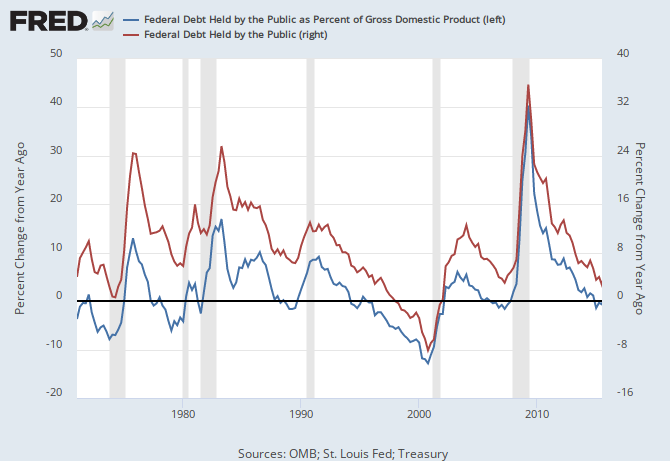
THE RECESSION CLOCK

Recessions come only after the blue line drops below zero.
Monetary Sovereignty

Vertical gray bars mark recessions.

As the federal deficit growth lines drop, we approach recession, which will be cured only when the growth lines rise. Increasing federal deficit growth (aka “stimulus”) is necessary for long-term economic growth.

#MONETARYSOVEREIGNTY

America’s #1 gun myth exposed: Part II

Twitter: @rodgermitchell; Search #monetarysovereignty
Facebook: Rodger Malcolm Mitchell

Mitchell’s laws:
•Those, who do not understand the differences between Monetary Sovereignty and monetary non-sovereignty, do not understand economics.
•Any monetarily NON-sovereign government — be it city, county, state or nation — that runs an ongoing trade deficit, eventually will run out of money.
•The more federal budgets are cut and taxes increased, the weaker an economy becomes..

Liberals think the purpose of government is to protect the poor and powerless from the rich and powerful. Conservatives think the purpose of government is to protect the rich and powerful from the poor and powerless.

•The single most important problem in economics is the Gap between rich and the rest..
•Austerity is the government’s method for widening
the Gap between rich and poor.
•Until the 99% understand the need for federal deficits, the upper 1% will rule.
•Everything in economics devolves to motive, and the motive is the Gap between the rich and the rest..

============================================================================================================================================================================================================================================================

Because the NRA has been so successful with its propaganda, you may not realize that:

Top Constitutional Lawyers Explain What the Second Amendment Really Says About Gun Control

For almost 200 years after it was adopted, the Second Amendment was interpreted to protect the right for militias to bear arms, but not individuals.

In 1939, the Supreme Court ruled in United States v. Miller that restricting access to shotguns or machine guns by citizens outside the military was permissible.

“The right to bear arms was thought to ensure well-regulated state militias,” Harvard constitutional law professor Richard J. Fallon told Mic. “Regulation of firearms was permissible as long as it did not interfere with state militias.”

Historically, conservatives actually tended to support gun control, seeing it as a way to stop crime.

That changed in the 1970s, when conservatives began to make the argument that the Second Amendments protects individuals, rather than just the military.

The current, right-wing interpretation of the 2nd Amendment, with the belief that the “militia” phrase has no meaning whatsoever, is a recent phenomenon.

The most important recent Supreme Court decision dealing with gun regulation came in 2008, when the court ruled in the case District of Columbia v. Heller.

At issue was the constitutionality of the District’s ban on handguns, which at the time was one of the most restrictive in the country.

In a 5-4 decision, the court struck down the ban, claiming it infringed on an individual right, namely “the right of the people to keep and bear arms.”

However, the court also explicitly stated that while owning handguns is protected as an individual right, possession of “dangerous and unusual weapons” is not.

Get it? Even the right wing court ruled that banning guns is constitutional, with the only question being, “Which guns can be banned.?”

Two weeks ago, 49 Republican senators voted against a failed bill that would have expanded background checks and closed the so-called gun show loophole, with Florida Sen. Marco Rubio stating that such an expansion “would impede the Second Amendment right of a large number of Americans.”

What these politicians get wrong: Those absolutist positions were never supported by the Supreme Court’s Heller ruling, which was intentionally narrow.

By broadcasting the same lie repeatedly, the politicians, well-paid by the NRA and gun manufacturers, have implanted the notion that any restrictions on gun ownership are unconstitutional.

Absolutely false. That wasn’t true when the 2nd Amendment was written, and it never has been true, since.

“Heller set out sort of a bare-bones holding that there is a constitutionally protected right to bear arms, but most of the hard questions have not yet been considered by the Supreme Court,” Fallon told Mic. “Although the Supreme Court has recognized a Second Amendment right to bear arms, it has not recognized an absolute right of everybody to bear arms, of all kinds, at all places, in all circumstances.”

Other constitutional lawyers go even further, saying that although conservatives may not want to admit it, Heller actually paved the way for more gun control restrictions.

“I believe ‘assault weapons’ are indeed what the court had in mind when it wrote in Heller about ‘dangerous and unusual weapons,” Harvard Law professor and renowned legal scholar Laurence Tribe told Mic. “I believe military-style assault weapons will never be protected by the court in the name of the Second Amendment.”

The only question is whether a bribed and cowardly Congress will pass more restrictive laws, and/or whether local and state governments have the will to challenge restrictions to a right-wing Supreme Court, known for ignoring the “militia” rule.

Tribe told Mic. “The Second Amendment and the Constitution as a whole are abused by those who treat them as a sick suicide pact.”

And now, I await the informative comments from those who have more guns than teeth, and fewer brains than either.

Rodger Malcolm Mitchell
Monetary Sovereignty

===================================================================================
Ten Steps to Prosperity:
1. Eliminate FICA (Click here)
2. Federally funded Medicare — parts A, B & D plus long term nursing care — for everyone (Click here)
3. Provide an Economic Bonus to every man, woman and child in America, and/or every state a per capita Economic Bonus. (Click here) Or institute a reverse income tax.
4. Free education (including post-grad) for everyone. Click here
5. Salary for attending school (Click here)
6. Eliminate corporate taxes (Click here)
7. Increase the standard income tax deduction annually Click here
8. Tax the very rich (.1%) more, with higher, progressive tax rates on all forms of income. (Click here)
9. Federal ownership of all banks (Click here and here)

10. Increase federal spending on the myriad initiatives that benefit America’s 99% (Click here)

The Ten Steps will add dollars to the economy, stimulate the economy, and narrow the income/wealth/power Gap between the rich and the rest.
——————————————————————————————————————————————

10 Steps to Economic Misery: (Click here:)
1. Maintain or increase the FICA tax..
2. Spread the myth Social Security, Medicare and the U.S. government are insolvent.
3. Cut federal employment in the military, post office, other federal agencies.
4. Broaden the income tax base so more lower income people will pay.
5. Cut financial assistance to the states.
6. Spread the myth federal taxes pay for federal spending.
7. Allow banks to trade for their own accounts; save them when their investments go sour.
8. Never prosecute any banker for criminal activity.
9. Nominate arch conservatives to the Supreme Court.
10. Reduce the federal deficit and debt

No nation can tax itself into prosperity, nor grow without money growth. Monetary Sovereignty: Cutting federal deficits to grow the economy is like applying leeches to cure anemia.
1. A growing economy requires a growing supply of dollars (GDP=Federal Spending + Non-federal Spending + Net Exports)
2. All deficit spending grows the supply of dollars
3. The limit to federal deficit spending is an inflation that cannot be cured with interest rate control.
4. The limit to non-federal deficit spending is the ability to borrow.

THE RECESSION CLOCK

Recessions come only after the blue line drops below zero.

Monetary Sovereignty

Vertical gray bars mark recessions.

As the federal deficit growth lines drop, we approach recession, which will be cured only when the growth lines rise. Increasing federal deficit growth (aka “stimulus”) is necessary for long-term economic growth.

#MONETARYSOVEREIGNTY

America’s #1 Gun Myth exposed

Twitter: @rodgermitchell; Search #monetarysovereignty
Facebook: Rodger Malcolm Mitchell

Mitchell’s laws:
•Those, who do not understand the differences between Monetary Sovereignty and monetary non-sovereignty, do not understand economics.
•Any monetarily NON-sovereign government — be it city, county, state or nation — that runs an ongoing trade deficit, eventually will run out of money.
•The more federal budgets are cut and taxes increased, the weaker an economy becomes..

Liberals think the purpose of government is to protect the poor and powerless from the rich and powerful. Conservatives think the purpose of government is to protect the rich and powerful from the poor and powerless.

•The single most important problem in economics is the Gap between rich and the rest..
•Austerity is the government’s method for widening
the Gap between rich and poor.
•Until the 99% understand the need for federal deficits, the upper 1% will rule.
•Everything in economics devolves to motive, and the motive is the Gap between the rich and the rest..

============================================================================================================================================================================================================================================================

Every time America suffers yet another multiple shooting (there have been an average of one a day this year) four claims are sure to be made:

Claims:

1. We need more (or fewer) laws vetting gun ownership

2. If the victims had been carrying guns, they would have been able to prevent the multiple shooting.

3. If gun ownership were restricted, then only “bad guys” would have guns and the “good guys” would be helpless to defend themselves.

4. The mere knowledge that “good guys” have guns prevents “bad guys” from committing mass shootings.

All four claims are deficient in that they misdirect us from the real problem.

How do I know?

Australia enacted one of the largest gun reforms ever nearly 2 decades ago — and gun deaths plummeted
Christina Sterbenz, Oct. 11, 2015

A push for tighter gun laws in the US has once again taken center stage in the wake of a 26-year-old man opening fire on Umpqua Community College in Roseburg, Oregon, and killing 10 people. The suspected shooter, Chris Mercer, carried with him three pistols, a rifle, and five extra magazines — all legally obtained.

Forced to react to yet another mass shooting, President Barack Obama reiterated points he’s made before: That the US is the “only advanced country in the world that sees these mass shootings every few months” and “this type of mass violence does not happen in other developed countries.”

By strange “coincidence,” the U.S. has more guns per capita than any other nation on earth — nearly double the next highest country, Serbia.

We are the only nation on earth with more guns than people.

America’s #1 gun myth is: Widespread gun ownership reduces gun killings and makes American’s safer.

In 1996, a man named Martin Bryant became the worst killer in Australia’s history. After walking into a cafe in Port Arthur, Tasmania, he killed 35 people and wounded 23 others with a semiautomatic rifle and another semiautomatic assault weapon.

As a result, Australia enacted one of the largest gun reforms in recent history — and gun deaths plummeted. The changes remain the gold standard for advocates of gun control today.

Note the difference? In America, whenever we have a mass shooting, the the gun manufacturersand their paid stooge, the NRA, call for more guns. Australia did the opposite.

Australia gives its national government only limited powers. So Prime Minister John Howard challenged the country’s various states to support nationwide reform while the national government banned the import of specific weapons.

For a while, some states seemed unwilling to pass the reform.

Just as would happen in America.

Howard, however, made clear his government would counter with a referendum to alter Australia’s Constitution and give itself the power to regulate guns.

“The fundamental problem was the ready availability of high-powered weapons, which enabled people to convert their murderous impulses into mass killing.

Certainly, shortcomings in treating mental illness and the harmful influence of violent video games and movies may have played a role. But nothing trumps easy access to a gun.”

These reforms passed, creating the National Firearms Agreement. Aside from banning certain semiautomatic and self-loading rifles and shotguns, the legislation required all firearm-license applicants to show “genuine reason” for owning a gun, which couldn’t include self-defense.

Aside from the NFA, Australia still had to remove the guns then on its streets and instituted a mandatory, federally financed gun-buyback program. Australia’s government purchased nearly 700,000 guns. Percentage-wise, that’s the equivalent of 40 million in the US.

Actually, America would have to buy back more than 40 million guns. Australia currently has 22 guns per 100 people. The U.S. has an astounding 113 guns per 100 people, a difference of 91 guns for every 100 people.

To get down to Australia’s level, the U.S government would have to buy back about 300 million guns. That is how swamped with guns America is.

Researchers from two different Australian universities found that, in the decade after the NFA was introduced, the firearm homicide rate fell by 59% and the firearm suicide rate fell by 65% — without increases in other types of deaths.

”Our gun buyback took about a fifth of our guns out of circulation but it approximately halved the number of gun-owning households,” said Andrew Leigh, the author of an academic study on Australia’s gun reform. “If the US could dramatically decrease the number of households with guns, it would have many fewer deaths.”

Among the reasons stands the shining fact that Australia hasn’t experienced a massacre similar to Port Arthur since. Many studies do show a drop outside expected trends in gun deaths as well. And of those that have found the opposite, many have been discredited.

Research shows a strong correlation between the amount of guns and the amount of gun homicides — on a national, state, and personal level.

While one logically may expect that reducing the number of guns reduces the number of gun killings, logic sorely has been missing in the U.S. gun debate. For too many Americans, the love of guns and the fear of others who have guns, is like a religious experience that transcends all logic.

Howard acknowledge Australia’s difference from the US: A more urban society, nothing similar to the US Second Amendment, and no organization like the National Rifle Association.

The National Rifle Association is well paid by the gun manufacturers to “take the heat” for gun deaths. The arms industry can hide behind the NRA, and not be sued or even criticized for the killings. (Have you recently heard any criticism of Colt, Glock, Beretta, Smith & Wesson et al? They are among the biggest manufacturers of guns. The NRA is given tons of money to absorb all the criticism.)

In the US, President Obama is well aware of Australia’s massive effort — and the subsequent decline in violence. “When Australia had a mass killing … it was just so shocking the entire country said, ‘Well, we’re going to completely change our gun laws,’ and they did. And it hasn’t happened since.”

Donald Trump and the rest of the Republican Party has misdirected our fears toward terrorism, while saying nothing — absolutely nothing — about the dangers of guns. It like the misdirection of a magician, who makes you focus on one thing, while fooling you about the real thing.

In fact, the odds of being killed by a terrorist are much, much lower than the odds of your winning Spain’s Sorteo Extraordinario de Navidad (Spanish Christmas Lottery), the world’s largest lottery — whether you enter or not.

Here are the figures for 2004 through 2014: U.S. terrorism deaths: 295. U.S. gun deaths: 127,562.

Bottom line:

1. Australia has proved that fewer guns results in fewer gun killings. Guns in the general population do not make us safer.
2. A policy based on “good guys having guns protects us” is a myth, promulgated by the arms industry to sell guns and increase profits.
3. There is no logical reason why the U.S. doesn’t follow Australia’s lead in reducing gun deaths.

Rather than spending your money to buy a gun, while allowing everyone else to own a gun, you should spend the same money to buy a ticket in the Sorteo Extraordinario de Navidad. Your odds of living a long, happy, healthy life would be better.

Rodger Malcolm Mitchell
Monetary Sovereignty

===================================================================================
Ten Steps to Prosperity:
1. Eliminate FICA (Click here)
2. Federally funded Medicare — parts A, B & D plus long term nursing care — for everyone (Click here)
3. Provide an Economic Bonus to every man, woman and child in America, and/or every state a per capita Economic Bonus. (Click here) Or institute a reverse income tax.
4. Free education (including post-grad) for everyone. Click here
5. Salary for attending school (Click here)
6. Eliminate corporate taxes (Click here)
7. Increase the standard income tax deduction annually Click here
8. Tax the very rich (.1%) more, with higher, progressive tax rates on all forms of income. (Click here)
9. Federal ownership of all banks (Click here and here)

10. Increase federal spending on the myriad initiatives that benefit America’s 99% (Click here)

The Ten Steps will add dollars to the economy, stimulate the economy, and narrow the income/wealth/power Gap between the rich and the rest.
——————————————————————————————————————————————

10 Steps to Economic Misery: (Click here:)
1. Maintain or increase the FICA tax..
2. Spread the myth Social Security, Medicare and the U.S. government are insolvent.
3. Cut federal employment in the military, post office, other federal agencies.
4. Broaden the income tax base so more lower income people will pay.
5. Cut financial assistance to the states.
6. Spread the myth federal taxes pay for federal spending.
7. Allow banks to trade for their own accounts; save them when their investments go sour.
8. Never prosecute any banker for criminal activity.
9. Nominate arch conservatives to the Supreme Court.
10. Reduce the federal deficit and debt

No nation can tax itself into prosperity, nor grow without money growth. Monetary Sovereignty: Cutting federal deficits to grow the economy is like applying leeches to cure anemia.
1. A growing economy requires a growing supply of dollars (GDP=Federal Spending + Non-federal Spending + Net Exports)
2. All deficit spending grows the supply of dollars
3. The limit to federal deficit spending is an inflation that cannot be cured with interest rate control.
4. The limit to non-federal deficit spending is the ability to borrow.

THE RECESSION CLOCK

Recessions come only after the blue line drops below zero.

Monetary Sovereignty

Vertical gray bars mark recessions.

As the federal deficit growth lines drop, we approach recession, which will be cured only when the growth lines rise. Increasing federal deficit growth (aka “stimulus”) is necessary for long-term economic growth.

#MONETARYSOVEREIGNTY