The “let ’em starve” solution to poverty

Twitter: @rodgermitchell; Search #monetarysovereignty
Facebook: Rodger Malcolm Mitchell

============================================================================================================================================================================================================================================================

The latest “gotcha” from the rich to the poor:

More Than 500,000 Adults Will Lose SNAP Benefits in 2016 as Waivers Expire
BY ED BOLEN, DOTTIE ROSENBAUM, STACY DEAN, and BRYNNE KEITH-JENNINGS

Affected Unemployed Childless Individuals Are Very Poor; Few Qualify for Other Help

One of the harshest pieces of the 1996 welfare law, this provision limits such individuals to three months of SNAP benefits in any 36-month period when they aren’t employed or in a work or training program for at least 20 hours a week.

Why is this a “gotcha”? Because in order to receive benefits, a childless individual must earn no more than $1,276 gross per month (annualized to $15,312 gross).

So in order to maintain benefits, the impoverished must find a job that pays no more than $1,276 a month. Let’s say he finds a job that pays $1,500 a month. That would mean he would work a full month for an additional $224.

The rules dissuade the recipient from taking any job that pays less than what? $2,000 per month? $2,500 per month?

A job paying $2,000 would gain him an additional $724 a month, or $8,688 per year. Would you be encouraged to work for a full year, to gain an extra $8,688?

Few people would, especially considering the nature of those low-end jobs: Mindless, backbreaking jobs with no future, supervised by harsh taskmasters.

So the system is designed for failure.

Gotcha.

This provision limits such individuals to three months of SNAP benefits in any 36-month period when they aren’t employed or in a work or training program for at least 20 hours a week.

Even SNAP recipients, whose state operates few or no employment programs and fails to offer them a spot in a work or training program — which is the case in most states — have their benefits cut off after three months irrespective of whether they are searching diligently for a job.

Gotcha, again!

You have to find a job or enroll in a work or training program, even though your state doesn’t offer one.

And this program must take at least 20 hours of your time every week, which limits your ability to search for jobs.

Gotcha, yet again!

And yes, we know. You probably live in a neighborhood that doesn’t have any food stores, so you have to spend time and money travelling to another neighborhood to buy your necessities. (Gotcha!)

And yes, we know. You probably live in a high-crime neighborhood, so you dare not go out at night to buy what you need. But your days are filled with “training,” such as it is, or with trying to find a job. (Gotcha!)

Because this provision denies basic food assistance to people who want to work and will accept any job or work program slot offered, it is effectively a severe time limit rather than a work requirement, as such requirements are commonly understood.

And then what will the poor do? Starve?

The 1996 welfare law allows states to suspend the three-month limit in areas with high and sustained unemployment.

In 2016, the time limit will be in effect in more than 40 states.  In 22 states, it will be the first time the time limit has been in effect since before the recession.

As a result, at least 500,000 and as many as 1 million SNAP recipients will have their benefits cut off in 2016.

A few southeastern states that are electing to re-implement the time limit statewide even though some or all of the state qualifies for a waiver, such as Arkansas, Florida, Mississippi, and North Carolina.

Among those who report their race, about half are white, a third are African American, and a tenth are Hispanic.  Half have only a high school diploma or GED, and one-quarter have not completed high school.

The popular myth is that providing food assistance enables the lazy poor to to sit back and let the dollars roll in. Punishing the poor supposedly “encourages” people to work.

Cutting off food assistance to poor unemployed and underemployed workers doesn’t enable them to find employment or secure more hours of work.

Congress could make the three-month limit in a given state contingent on the state offering a job or training position to all nondisabled childless adults subject to the limit who don’t otherwise find employment.

Congress could also allow diligent job search to count toward the requirement, as it generally does under work requirements for other programs.

But such congressional action seems unlikely.

Consequently, states and local charities that work with this population need to prepare for the consequences as substantial numbers of indigent individuals in their communities lose food assistance.

So what will the poor do? Starve?

Yes, some will. Some may attempt to obtain help from their impoverished friends and relatives.

But many will turn to crime: Dope dealing, burglary, robbery, prostitution.

Did you ever wonder why poor neighborhoods have more crime than wealthier neighborhoods? It’s not that “those people” were born criminals. It’s because they cannot find legitimate work.

Starving the poor leads to crime, which leads to violence, which leads to more people in prison, which leads to higher prison costs and more ex-cons back on the street.

And these ex-cons can’t find work, partly because they are ex-cons, so the problem grow and multiplies.

Some people may sneer that showing compassion to the poor (the open hand) rather than the closed fist, is being a “bleeding heart liberal.”

But lifting the poor benefits everyone.

Impoverishment saves you no money. In fact it costs you money, as well as costing you your personal safety if you become the victim of crime.

Rather than taking delight in stomping on the poor, we should take delight in implementing the Ten Steps to Prosperity (below), in this case, especially Step #3.

Why will Congress not take the simple steps to reduce the problem?

Because Congress is ruled by the rich, and the rich want a steady supply of desperate slaves, willing to take any job, no matter how unpleasant — and afraid to complain about treatment or condition.

As Project Runway Junior host, Kelly Osbourne said,  “If you kick every Latino out of this country, who is going to be cleaning your toilet, Donald Trump?”

Stereotypical, but you can’t beat that for honesty.

Rodger Malcolm Mitchell
Monetary Sovereignty


===================================================================================
Ten Steps to Prosperity:
1. Eliminate FICA (Click here)
2. Federally funded Medicare — parts A, B & D plus long term nursing care — for everyone (Click here)
3. Provide an Economic Bonus to every man, woman and child in America, and/or every state a per capita Economic Bonus. (Click here) Or institute a reverse income tax.
4. Free education (including post-grad) for everyone. Click here
5. Salary for attending school (Click here)
6. Eliminate corporate taxes (Click here)
7. Increase the standard income tax deduction annually Click here
8. Tax the very rich (.1%) more, with higher, progressive tax rates on all forms of income. (Click here)
9. Federal ownership of all banks (Click here and here)

10. Increase federal spending on the myriad initiatives that benefit America’s 99% (Click here)

The Ten Steps will grow the economy, and narrow the income/wealth/power Gap between the rich and you.
========================================================================================================================================================================================================================================================================================================

10 Steps to Economic Misery: (Click here:)
1. Maintain or increase the FICA tax..
2. Spread the myth Social Security, Medicare and the U.S. government are insolvent.
3. Cut federal employment in the military, post office, other federal agencies.
4. Broaden the income tax base so more lower income people will pay.
5. Cut financial assistance to the states.
6. Spread the myth federal taxes pay for federal spending.
7. Allow banks to trade for their own accounts; save them when their investments go sour.
8. Never prosecute any banker for criminal activity.
9. Nominate arch conservatives to the Supreme Court.
10. Reduce the federal deficit and debt

THE RECESSION CLOCK

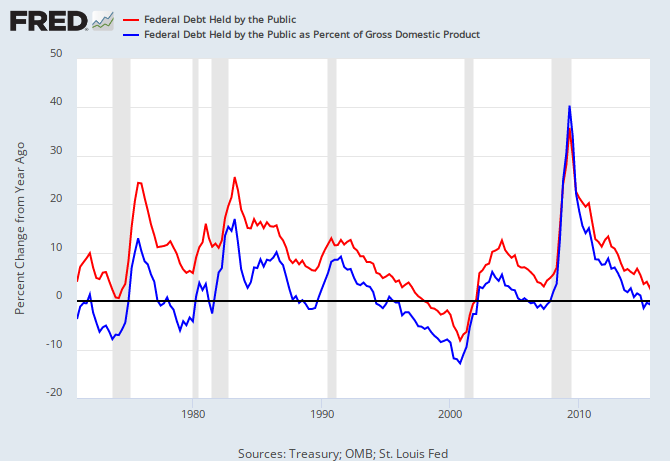
Recessions begin an average of 2 years after the blue line first dips below zero. A common phenomenon is for the line briefly to dip below zero, then rise above zero, before falling dramatically below zero. There was a brief dip below zero in 2015, followed by another dip – the familiar pre-recession pattern.
Recessions are cured by a rising red line.
Monetary Sovereignty

Vertical gray bars mark recessions.

As the federal deficit growth lines drop, we approach recession, which will be cured only when the growth lines rise. Increasing federal deficit growth (aka “stimulus”) is necessary for long-term economic growth.

————————————————————————————————————————————————————————————————————————————————————————————————-

Mitchell’s laws:
•Those, who do not understand the differences between Monetary Sovereignty and monetary non-sovereignty, do not understand economics.
•Any monetarily NON-sovereign government — be it city, county, state or nation — that runs an ongoing trade deficit, eventually will run out of money.
•The more federal budgets are cut and taxes increased, the weaker an economy becomes..

•No nation can tax itself into prosperity, nor grow without money growth.
•Cutting federal deficits to grow the economy is like applying leeches to cure anemia.
•A growing economy requires a growing supply of money (GDP = Federal Spending + Non-federal Spending + Net Exports)
•Deficit spending grows the supply of money
•The limit to federal deficit spending is an inflation that cannot be cured with interest rate control.
•The limit to non-federal deficit spending is the ability to borrow.

Liberals think the purpose of government is to protect the poor and powerless from the rich and powerful. Conservatives think the purpose of government is to protect the rich and powerful from the poor and powerless.

•The single most important problem in economics is the Gap between rich and the rest..
•Austerity is the government’s method for widening
the Gap between rich and poor.
•Until the 99% understand the need for federal deficits, the upper 1% will rule.
•Everything in economics devolves to motive, and the motive is the Gap between the rich and the rest..

MONETARY SOVEREIGNTY

The steel fist or the helping hand?

Twitter: @rodgermitchell; Search #monetarysovereignty
Facebook: Rodger Malcolm Mitchell

============================================================================================================================================================================================================================================================

A fundamental difference between the right-wing and the left-wing is their reflexive approach to problem solving.

The right gravitates toward the steel fist. The left prefers the helping hand.

Consider the problem of poverty. The conservative right usually opts for punishment. Take away food stamps and other welfare payments to “prod” the poor into getting jobs. (See:
More on Kasich, the Republican “moderate”)

The liberal left opts for financial support to help the poor survive so they can lift themselves out of poverty.

It’s more an emotional than an intellectual response, in which the right feels poverty is a personal failing for which people should not be rewarded. The left feels poverty is society’s failing, for which society should provide positive solutions.

In this vein, consider the problem of youth violence:

To Reduce Gun Violence, Potential Offenders Offered Support And Cash
March 28, 20164:00 PM ET

Not long ago, the city of Richmond, Calif., was considered one of the most dangerous cities in America. There was a skyrocketing homicide rate fueled by gangs of young men settling personal or territorial disputes.

The conservative right approach would be stricter enforcement and harsher penalties, more police, more “stop-and-frisk,” more people in jail.

Today, the city of about 100,000 residents is called a national model for reducing gun violence. Many cities around the country are adopting their unconventional strategy to prevent violence —– which includes paying potential criminals to stay out of trouble.

Joseph McCoy is one of about a half dozen “Neighborhood Change Agents” who keep track, sometimes a couple times a day, of scores of known gun offenders or youths at risk of being shot.

“If it is a shooting, we definitely go to check out see what’s going on, because we try to create a pause on the next shooting,” he says. “We’re trying to figure out how to keep the next shooting from happening.”

The agents are city employees and all ex-cons with serious street cred.

“We do something real simple that folks just don’t realize how, how powerful it is. We love on our youngsters! We come from a sincere place that we love each and every last one of the people we touch and we try to touch as many people as possible,” he says.

This street outreach is just one part of a broader program designed by DeVone Boggan, the former director of a city department called the Office of Neighborhood Safety. Bogan made a startling discovery in meetings with local law enforcement.

“What I continued to hear was folks believed that there were 17 people responsible for 70 percent of the firearm activity in our city. Seventeen people! We can do something about that,” Boggan says.

Boggan and his team identified those 17 people and several more and made them an offer. The fellowship will give them counseling, social services, a job and a chance to travel if they develop a “life map,” agree to stay in contact every day and stay out of trouble.

Then the fellowship will pay them up to a $1,000 a month for nine months.

The result: Richmond has seen its murder rate cut in half since the fellowship began.

Just ask 18-year-old Joel Contreras. He was involved with guns, robberies and trouble. Contreras says when he was first offered a chance to change his life he turned it down.

The conservative approach would have been to arrest him and throw away the key, thereby throwing away a valuable human life, while endlessly paying for his incarceration.

“I walked away from him. Ten minutes later, I hit the corner. I get shot. The car got shot a couple times, me and my friend were both injured,” Contreras says.

When the outreach workers came back to see him, Contreras says he was ready to listen.

“They helped me get a job. They helped me get my driver’s license. They was pushing me, pushing me, helping me out. They helped me get back in school, which I wouldn’t be able to do without them. I graduated high school thanks to them,” he says.

Notice the repeated emphasis on “helped me,” rather than “punished me.”

The approach is attracting interest from across the country.

“They always ask me is it going to work and how much is it going to cost?” says Angela Wolf, a researcher for the Oakland-based National Council on Crime and Delinquency.

The traditional focus is, “How much will the cure cost,” rather than “How much does the problem cost.”

“If you have city leaders that aren’t willing to think outside the box and try something different, this is going to be a harder program to get off the ground,” Wolf says.

That’s especially true if a city doesn’t see immediate results.

Allwyn Brown, the acting police chief in Richmond, says he knows that “neighborhood change agents” don’t cooperate or share information with his officers. But he says that while ONS’ approach is different, they share a common goal.

“Here’s the thing: We recognize that the problem is bigger that what we can deal with and you know, arresting and incarcerating people isn’t going to solve the problem. I mean, it just isn’t,” Brown says.

To many of us, and especially to conservatives, paying criminals to be good goes against the moral grain. “Why should we reward them for doing what the rest of us do automatically, without rewards? We should be tough on crime.”

Being “tough on crime” fails to reduce crime in a free nation. (It can work in a harsh dictatorship, where penalties are grossly outsized compared with the offenses.)

Paying people to be good may cause revulsion among conservatives.  But under the theory that “you can catch more flies with honey than with vinegar,” we should seek solutions that work rather than approaches that merely satisfy a deep-seated lust to hurt “bad guys.”.

In guiding young people, love and the helping hand usually usually have better, longer-lasting effects than spankings and the steel fist.

The helping hand is what the Ten Steps to Prosperity (below) is designed to accomplish.

Rodger Malcolm Mitchell
Monetary Sovereignty


===================================================================================
Ten Steps to Prosperity:
1. Eliminate FICA (Click here)
2. Federally funded Medicare — parts A, B & D plus long term nursing care — for everyone (Click here)
3. Provide an Economic Bonus to every man, woman and child in America, and/or every state a per capita Economic Bonus. (Click here) Or institute a reverse income tax.
4. Free education (including post-grad) for everyone. Click here
5. Salary for attending school (Click here)
6. Eliminate corporate taxes (Click here)
7. Increase the standard income tax deduction annually Click here
8. Tax the very rich (.1%) more, with higher, progressive tax rates on all forms of income. (Click here)
9. Federal ownership of all banks (Click here and here)

10. Increase federal spending on the myriad initiatives that benefit America’s 99% (Click here)

The Ten Steps will grow the economy, and narrow the income/wealth/power Gap between the rich and you.
========================================================================================================================================================================================================================================================================================================

10 Steps to Economic Misery: (Click here:)
1. Maintain or increase the FICA tax..
2. Spread the myth Social Security, Medicare and the U.S. government are insolvent.
3. Cut federal employment in the military, post office, other federal agencies.
4. Broaden the income tax base so more lower income people will pay.
5. Cut financial assistance to the states.
6. Spread the myth federal taxes pay for federal spending.
7. Allow banks to trade for their own accounts; save them when their investments go sour.
8. Never prosecute any banker for criminal activity.
9. Nominate arch conservatives to the Supreme Court.
10. Reduce the federal deficit and debt

THE RECESSION CLOCK

Recessions begin an average of 2 years after the blue line first dips below zero. A common phenomenon is for the line briefly to dip below zero, then rise above zero, before falling dramatically below zero. There was a brief dip below zero in 2015, followed by another dip – the familiar pre-recession pattern.
Recessions are cured by a rising red line.

Monetary Sovereignty

Vertical gray bars mark recessions.

As the federal deficit growth lines drop, we approach recession, which will be cured only when the growth lines rise. Increasing federal deficit growth (aka “stimulus”) is necessary for long-term economic growth.

————————————————————————————————————————————————————————————————————————————————————————————————-

Mitchell’s laws:
•Those, who do not understand the differences between Monetary Sovereignty and monetary non-sovereignty, do not understand economics.
•Any monetarily NON-sovereign government — be it city, county, state or nation — that runs an ongoing trade deficit, eventually will run out of money.
•The more federal budgets are cut and taxes increased, the weaker an economy becomes..

•No nation can tax itself into prosperity, nor grow without money growth.
•Cutting federal deficits to grow the economy is like applying leeches to cure anemia.
•A growing economy requires a growing supply of money (GDP = Federal Spending + Non-federal Spending + Net Exports)
•Deficit spending grows the supply of money
•The limit to federal deficit spending is an inflation that cannot be cured with interest rate control.
•The limit to non-federal deficit spending is the ability to borrow.

Liberals think the purpose of government is to protect the poor and powerless from the rich and powerful. Conservatives think the purpose of government is to protect the rich and powerful from the poor and powerless.

•The single most important problem in economics is the Gap between rich and the rest..
•Austerity is the government’s method for widening
the Gap between rich and poor.
•Until the 99% understand the need for federal deficits, the upper 1% will rule.
•Everything in economics devolves to motive, and the motive is the Gap between the rich and the rest..

MONETARY SOVEREIGNTY

More on Kasich, the Republican “moderate”


Twitter: @rodgermitchell; Search #monetarysovereignty
Facebook: Rodger Malcolm Mitchell

============================================================================================================================================================================================================================================================

To Republicans, a “moderate” is anyone who is less mean-spirited, less deceptive, and importantly, less unelectable than Donald Trump and Ted Cruz.

Apparently, John Kasich is the right wing’s best alternative to those two luminaries.

In a recent post, “Do you really know John Kasich, the moderate republican?”, we showed you what Kasich really stands for.

Here’s a bit more on Kasich:

The controversial reason tens of thousands of people just lost their food stamps
By Max Ehrenfreund and Roberto A. Ferdman

As many as 1 million Americans will stop receiving food stamps over the course of this year beginning on Friday, the consequence of a controversial work mandate that has been reinstated in 22 states as the economy improves.

The 20-year-old rule — which was suspended in many states during the economic recession — requires that adults without children or disabilities must have a job in order to receive food stamps through the Supplemental Nutrition Assistance Program for more than three months, with some exceptions.

Many states have begun to reimpose the federal rule as the economy recovers, with the largest group reviving it at the beginning of this year. As a result, many recipients’ three-month limit expires today, April 1.

Not just the rich, but many (most?) of those above the poverty line subscribe to the myth that the poor are lazy, good-for-nothings, who would rather receive a tiny stipend from the government and live in poverty and misery, than work.

The false stereotype is of “welfare mamas,” black women, with no husbands, who sell food stamps for drugs and who have no desire to lift themselves out of their miserable existence.

Apparently, Kasich subscribes to this false stereotype, or if he doesn’t personally, he believes the Republican voters do.

So he cynically punishes the poor and helpless to demonstrate how strict he is with the “useless” dregs of our society — and to gain votes from the misery of the powerless.

The change has reignited a fierce debate between conservative leaders, who say waiving the mandate discourages people from working, and their liberal counterparts, who say the three-month time limit ignores the reality that jobs are still hard to come by for low-skilled workers.

Kasich’s wants you to believe the cure for unemployment is to punish the unemployed. Blaming the victim is a favorite tactic of the persecutor.

Kasich, who helped author the work requirement as a U.S. congressman in 1996, is among the conservative politicians arguing that able-bodied adults should not receive SNAP benefits if they are not working.

A spokesman for Kasich, a candidate for the Republican presidential nomination, said reinstating the requirement would prod people to seek work in the improving economy.

You see, people, like cattle need to be prodded to better themselves. Not all people — not people like “us.” Just people like “them,” who prefer the hardscrabble life of joyless poverty than actually working.

“These are, again, adults — no dependents, physically and mentally capable of working,” said Rob Nichols, a spokesman for Kasich’s presidential campaign, in a recent interview. “Just as much as we believe in the social safety net, we also believe it’s a sin not to help oneself.”

To Kasich, not being able to find a job is a “sin.” (Why are Republicans so frantic about “sin”? The unemployed are “sinners.” Abortion is a “sin.” Undocumented immigrants are “sinners.” Gays are “sinners.” Medical marijuana is a “sin.” Teaching evolution is a sin. Flag burning is a “sin.” Research on embryos is a “sin.” Could it be they doth protest too much?)

Punishing the poor and helpless is the real sin.

The single biggest problem in America is the widening Gap between the rich and the rest. There are two ways to address problems: With a closed fist or a helping hand.

Kasich has chosen the closed fist, which history demonstrates, seldom works, (as witness the failed “War on Drugs.”)

Punishing the poor will not reduce the number of poor, nor will it close the Gap between the rich and the rest. With the initiation of the Ten Steps to Prosperity (below), the poor will demonstrate they are real people, just like us — people who have hopes and ambitions and just need a helping hand.

Rodger Malcolm Mitchell
Monetary Sovereignty


===================================================================================
Ten Steps to Prosperity:
1. Eliminate FICA (Click here)
2. Federally funded Medicare — parts A, B & D plus long term nursing care — for everyone (Click here)
3. Provide an Economic Bonus to every man, woman and child in America, and/or every state a per capita Economic Bonus. (Click here) Or institute a reverse income tax.
4. Free education (including post-grad) for everyone. Click here
5. Salary for attending school (Click here)
6. Eliminate corporate taxes (Click here)
7. Increase the standard income tax deduction annually Click here
8. Tax the very rich (.1%) more, with higher, progressive tax rates on all forms of income. (Click here)
9. Federal ownership of all banks (Click here and here)

10. Increase federal spending on the myriad initiatives that benefit America’s 99% (Click here)

The Ten Steps will grow the economy, and narrow the income/wealth/power Gap between the rich and you.
========================================================================================================================================================================================================================================================================================================

10 Steps to Economic Misery: (Click here:)
1. Maintain or increase the FICA tax..
2. Spread the myth Social Security, Medicare and the U.S. government are insolvent.
3. Cut federal employment in the military, post office, other federal agencies.
4. Broaden the income tax base so more lower income people will pay.
5. Cut financial assistance to the states.
6. Spread the myth federal taxes pay for federal spending.
7. Allow banks to trade for their own accounts; save them when their investments go sour.
8. Never prosecute any banker for criminal activity.
9. Nominate arch conservatives to the Supreme Court.
10. Reduce the federal deficit and debt

THE RECESSION CLOCK

Recessions begin an average of 2 years after the blue line first dips below zero. A common phenomenon is for the line briefly to dip below zero, then rise above zero, before falling dramatically below zero. There was a brief dip below zero in 2015, followed by another dip – the familiar pre-recession pattern.
Recessions are cured by a rising red line.

Monetary Sovereignty

Vertical gray bars mark recessions.

As the federal deficit growth lines drop, we approach recession, which will be cured only when the growth lines rise. Increasing federal deficit growth (aka “stimulus”) is necessary for long-term economic growth.

————————————————————————————————————————————————————————————————————————————————————————————————-

Mitchell’s laws:
•Those, who do not understand the differences between Monetary Sovereignty and monetary non-sovereignty, do not understand economics.
•Any monetarily NON-sovereign government — be it city, county, state or nation — that runs an ongoing trade deficit, eventually will run out of money.
•The more federal budgets are cut and taxes increased, the weaker an economy becomes..

•No nation can tax itself into prosperity, nor grow without money growth.
•Cutting federal deficits to grow the economy is like applying leeches to cure anemia.
•A growing economy requires a growing supply of money (GDP = Federal Spending + Non-federal Spending + Net Exports)
•Deficit spending grows the supply of money
•The limit to federal deficit spending is an inflation that cannot be cured with interest rate control.
•The limit to non-federal deficit spending is the ability to borrow.

Liberals think the purpose of government is to protect the poor and powerless from the rich and powerful. Conservatives think the purpose of government is to protect the rich and powerful from the poor and powerless.

•The single most important problem in economics is the Gap between rich and the rest..
•Austerity is the government’s method for widening
the Gap between rich and poor.
•Until the 99% understand the need for federal deficits, the upper 1% will rule.
•Everything in economics devolves to motive, and the motive is the Gap between the rich and the rest..

MONETARY SOVEREIGNTY

Is a neutral Supreme Court possible?

Twitter: @rodgermitchell; Search #monetarysovereignty
Facebook: Rodger Malcolm Mitchell

============================================================================================================================================================================================================================================================

Sorry, but this article will be a bit of”ring-round the rosie,” because it asks a complicated question with many answers .

Some arguments never will end, simply because we can find no conclusive right or wrong. At best (or worst), some arguments devolve into a social consensus, where they linger a while, after which they rises anew.

Consider abortion. On one side are those whose focus is on the fetus’s rights, it’s life, and its happiness. On the other side are those whose focus is on the mother’s rights, her life, and her happiness.

Some consider abortion to be fetus murder, and they have some logic on their side. Others consider forcibly preventing abortion to be a form of emotional, financial and even physical murder of the mother.  They have a certain logic on their side.

For the past few years, we’ve seen news about the largest beleaguered “minority” in America: Evangelical Christians (reportedly about 25% of the adult U.S. population).

To Evangelicals, Veto a Raw Deal.
Florida Sun Sentinel, 4/1/16; by Jenny Jarvie
Ga. religious conservatives see governor’s axing of “religious liberty” bill as betrayal.

To much of corporate America, the bill amounted to legalized discrimination against gay people, by allowing them to be denied certain services and protections.

Bank of America, AT&T and hundreds of other companies had taken out full page ads to protest the bill.

The governor said he could see no compelling reason for the bill. It would have assured that a pastor could not be forced to perform a same-sex wedding and that non-profit, faith-based organizations could legally refuse to rent property for events they found objectionable.

It also would have given such groups the right to fire or not hire people whose practices they opposed on religious grounds.

There’s growing sense that we’re a majority whose rights and freedoms are being trampled upon,” said Mike Stone, senior pastor of Emmanuel Baptist Church in Blackshear, GA.

I empathize with the evangelicals.  I do see the logic on their side. I am Jewish, and if someone wanted me to rent an auditorium to Nazis, I’d object. Strenuously.

Because I tend to be pro-choice, I also would object to renting that auditorium to Donald Trump.

In  Burwell v. Hobby Lobby Stores, Inc., the Supreme Court extended the protections of the Religious Freedom Restoration Act (RFRA) to Hobby Lobby, Mardel, and Conestoga Wood Specialties, three closely held corporations, and held that the contraception mandate of the Affordable Care Act substantially burdened their religious exercise.

The sincerity of their religious beliefs was never disputed. As such, they had no difficulty meeting RFRA’s requirement that their asserted beliefs be both sincere and religious in nature. 

In the wake of the decision, however, critics have expressed concern that future courts will be powerless to block insincere RFRA claims brought by wholly secular corporations seeking to evade generally applicable laws.

In her powerful dissent, Justice Ginsburg proclaimed an “overriding interest” in “keeping the courts ‘out of the business of evaluating’ . . . the sincerity with which an asserted religious belief is held.”

Fortunately, courts historically have demonstrated that they are able to ferret out insincere religious claims. There is a long tradition of courts competently scrutinizing asserted religious beliefs for sincerity without delving into their validity or verity.

And I suggest this is all beside the point.

It’s all about two kinds of beliefs: Sincerely held beliefs and religious beliefs. To conform to the Supreme Court’s ruling, a belief must be both sincerely held and religious.

And the Court ruled that it magically is competent to distinguish both sincerity and religiosity. (Mind reading?)

Let’s say I see you sneaking out of my neighbor’s house, and because of your manner (stealthy, bent and furtive), and your clothing (you’re wearing a face-hiding hood in summer) or other factors (you’re carrying a big, dripping knife and a large bag), I sincerely believe you have murdered my neighbor and stolen his valuables.

So I shoot you.

It turns out you were enlisted by my neighbor to cut down a bee hive from a tree. But, since I sincerely believed you were a murderer, was I legally entitled to shoot you?

No? Why not?

Well, let’s assume the Court, using its crystal ball or ouija board, somehow can determine that my belief was sincere, and I wasn’t just engaging in a bit of live target practice, still it wasn’t a religious belief.

Let’s try another example. You are a taxpayer, and the local school lunch program, for which you pay in taxes, includes, but is not limited to, pork, shrimp and rabbit, all of which are forbidden in Leviticus. Should you be able to force the school to serve only Kosher meals?

Or, let’s get closer to the Burwell v. Hobby Lobby Stores, Inc. case.

You are a Jehovah’s Witness. You feel blood transfusions are a sin, so your closely held company refuses to fund insurance that covers your 22 thousand employees for transfusions. Have you converted your employees into defacto Jehovah’s Witnesses?

In truth there are all sorts of caveats in the Burwell decision, including the definition of “closely held,” and whether there are other less-restrictive ways to accomplish the government’s aims.

Virtually all bad legal decisions devolve into a morass of Rube Goldbergian rules, exceptions, qualifications and interpretations. “Burwell” is no exception.

Example: The decision requires that closely held corporations be considered “persons” who have religious rights (though presumably not voting rights).

Again, I suggest this is beside the point.

The United States is not a theocracy. It intentionally was created to be a secular nation, because theocracies invariably become dictatorships. The leader speaks for God, and no one may disagree with God. That is one of the great differences between the U.S. and, for instance, Saudi Arabia.

And while American law makes some accommodation for each individual’s religious practices, secular law trumps religious law.

Supposedly.

So, supposedly, the Supreme Court focuses on secular law, and avoids if at all possible, delving into religious law.

In the Burwell case, the Court’s right-wing made a religious decision, and then desperately searched for rationales to justify its decision.

The idea that, as Ruth Bader Ginsberg dissented: “commercial enterprises, including corporations, along with partnerships and sole proprietorships, can opt out of any law (saving only tax laws) they judge incompatible with their sincerely held religious beliefs” — this idea is so preposterous, it would be humorous but for the real-life implications.

Even now, the Burwell decision has limited the secular rights of more than 22 thousand people, and we are at only the beginning.

The United States Supreme Court ruled in Employment Division v. Smith that a person may not defy neutral laws of general applicability even as an expression of religious belief.

“To permit this,” wrote Justice Scalia, “would make the professed doctrines of religious belief superior to the law of the land, and in effect to permit every citizen to become a law unto himself.”

He wrote that generally applicable laws do not have to meet the standard of strict scrutiny, because such a requirement would create “a private right to ignore generally applicable laws.”

Yet, Scalia was one of the most energetic supporters of Burwell. Such is the incongruity caused by faulty decisions based on personal ideology rather than on law.

(One can only wonder what the decision of this Court, which is composed solely of Catholics and Jews, would have been had the plaintiffs been Muslim or Buddhist.)

In every similar case, the Court now must determine individual definitions of what constitutes a “religion,” what constitutes “sincerity,” what constitutes “undue burden,” and whether an individual’s personal interpretation of his religious doctrine, supercedes secular law (except in tax cases).

Many thought Roe v. Wade decided abortion rights. Many now think Burwell decided contraceptive rights for “closely held corporations. Thomas Jefferson may have believed the 1st Amendment clarified the position of religion in American law.

All were wrong. The battle between religious and secular rights never ends.

This particularly will be true with a Supreme Court that ignores its mission of legal independence and neutrality, and relies instead on personal ideology. These arguments never end because the Court’s decisions are based on the volatility of Supreme Court membership.

That the Court infamously has a solid right-wing and a solid left-wing is a disgrace. Such a division is understandable for Congress, but for the court to be so political leads to the question: Of what value is the Supreme Court, if it is no different from a Congressional, politically-driven, ideology-driven committee?

If this Court is so weak-minded it cannot even maintain a secular legal balance, but repeatedly drifts into religious interpretations, it is nothing more than a term-for-life carbuncle on citizens’ necks.

The question then becomes, is there a way to find and appoint and guide Justice who will be more neutral arbitrators of secular law, or will we forever fight the democracy vs theocracy battle between immobile sides?

Rodger Malcolm Mitchell
Monetary Sovereignty


===================================================================================
Ten Steps to Prosperity:
1. Eliminate FICA (Click here)
2. Federally funded Medicare — parts A, B & D plus long term nursing care — for everyone (Click here)
3. Provide an Economic Bonus to every man, woman and child in America, and/or every state a per capita Economic Bonus. (Click here) Or institute a reverse income tax.
4. Free education (including post-grad) for everyone. Click here
5. Salary for attending school (Click here)
6. Eliminate corporate taxes (Click here)
7. Increase the standard income tax deduction annually Click here
8. Tax the very rich (.1%) more, with higher, progressive tax rates on all forms of income. (Click here)
9. Federal ownership of all banks (Click here and here)

10. Increase federal spending on the myriad initiatives that benefit America’s 99% (Click here)

The Ten Steps will grow the economy, and narrow the income/wealth/power Gap between the rich and you.
========================================================================================================================================================================================================================================================================================================

10 Steps to Economic Misery: (Click here:)
1. Maintain or increase the FICA tax..
2. Spread the myth Social Security, Medicare and the U.S. government are insolvent.
3. Cut federal employment in the military, post office, other federal agencies.
4. Broaden the income tax base so more lower income people will pay.
5. Cut financial assistance to the states.
6. Spread the myth federal taxes pay for federal spending.
7. Allow banks to trade for their own accounts; save them when their investments go sour.
8. Never prosecute any banker for criminal activity.
9. Nominate arch conservatives to the Supreme Court.
10. Reduce the federal deficit and debt

THE RECESSION CLOCK

Recessions begin an average of 2 years after the blue line first dips below zero. A common phenomenon is for the line briefly to dip below zero, then rise above zero, before falling dramatically below zero. There was a brief dip below zero in 2015, followed by another dip – the familiar pre-recession pattern.
Recessions are cured by a rising red line.

Monetary Sovereignty

Vertical gray bars mark recessions.

As the federal deficit growth lines drop, we approach recession, which will be cured only when the growth lines rise. Increasing federal deficit growth (aka “stimulus”) is necessary for long-term economic growth.

————————————————————————————————————————————————————————————————————————————————————————————————-

Mitchell’s laws:
•Those, who do not understand the differences between Monetary Sovereignty and monetary non-sovereignty, do not understand economics.
•Any monetarily NON-sovereign government — be it city, county, state or nation — that runs an ongoing trade deficit, eventually will run out of money.
•The more federal budgets are cut and taxes increased, the weaker an economy becomes..

•No nation can tax itself into prosperity, nor grow without money growth.
•Cutting federal deficits to grow the economy is like applying leeches to cure anemia.
•A growing economy requires a growing supply of money (GDP = Federal Spending + Non-federal Spending + Net Exports)
•Deficit spending grows the supply of money
•The limit to federal deficit spending is an inflation that cannot be cured with interest rate control.
•The limit to non-federal deficit spending is the ability to borrow.

Liberals think the purpose of government is to protect the poor and powerless from the rich and powerful. Conservatives think the purpose of government is to protect the rich and powerful from the poor and powerless.

•The single most important problem in economics is the Gap between rich and the rest..
•Austerity is the government’s method for widening
the Gap between rich and poor.
•Until the 99% understand the need for federal deficits, the upper 1% will rule.
•Everything in economics devolves to motive, and the motive is the Gap between the rich and the rest..

MONETARY SOVEREIGNTY