Why you soon may demand socialism

Twitter: @rodgermitchell; Search #monetarysovereignty
Facebook: Rodger Malcolm Mitchell

============================================================================================================================================================================================================================================================

How much wealth do you own? Add it up.

Add up your stocks and bonds. Count your land. Include your car(s), house(s), clothing, appliances. You own all that stuff.

How much do you own, in total? Hold that figure in your mind.

The future of the world presumably is the “Internet of Things” (IoT), where everything is interconnected. Soon you may own a self-driving car, that not only take you places, but tell your garage when you will arrive, so the garage will open for you.

It may tell your house lights to turn on, and your heat or air conditioning to come to the temperature you want.

Your refrigerator may already have told your supermarket warehouse to deliver what you need (via a drone which enters your house through a drone portal, of course). Or your 3-D printer may print your meal.

Your oven may begin to cook; your sleeping clothes and bed may become toasty warm or pleasant cool, depending on the outdoor temperature.

While you were away, your windows and carpet cleaned, your wall painting device did its thing (or the walls simply changed to the latest color), and of course your lawn was mowed, watered, fertilized and de-bugged from below by your underground machines.

Your clothes may tell your closet when your shirts need to be washed, so the closet will wash them and hang them (or destroy them and 3-D print new ones).

Everything will be connected: Your TV, your phone, your bank account, your house, car, closet, bathroom, kitchen, garden, sidewalk — everything blended into one smooth servant.

Your ownership of all that centrally connected stuff will be part of your wealth.

But what if it no longer was supported?

Google’s Nest might pay customers as compensation for shutting down their $300 smart-home devices

Nest, the smart-home company owned by Google’s holding company, Alphabet, sparked outrage this week after it announced that it was discontinuing support for a line of $300 smart-home devices that can control household features like lights and security alarms, meaning they wouldn’t work anymore.

In 2014 — just nine months after Nest was bought by Google — Nest acquired Revolv, a smart-home-device maker that built a line of hubs that could control house lights, security features, and so on. But the deal was primarily an acquihire, which means the company was bought for its talent.

Nest immediately stopped selling Revolv products, and Revolv developers were instead put to work on “Work with Nest.”

About a month ago, Revolv announced that it was shutting down its service and that Revolv products would no longer work by May.

Think of this in the future. Your self-driving car sits idle. Your automatic home no longer will heat or cool. Your automatic clothing, TV, phone, toaster, stove, refrigerator, furnace, air conditioner — all those things that yesterday may have been worth so much — all now worthless.

Revolv owner Arlo Gilbert wrote a post that kicked off the current furor. “Is the era of IoT bringing an end to the concept of ownership? Are we just buying intentionally temporary hardware?”

When everything is connected, what will you actually own? A car that won’t drive. A computer that won’t compute. A phone that won’t let you play the latest video game (horrors!)

None of this is entirely new. We already rely on the electric company, the gas company, the water company, the sewers, the streets, the food and drug stores. And though many of our more important services either are government owned or government supervised, still bad things happen.

If there is a major storm, the electricity may go out. While it’s out, all your appliances are useless. If it stays out long enough, your house may become unlivable.

Multiply by gas, water and sewage service ending and your expensive house, that center of your wealth, now is worthless.

Then multiply that by everything you own, from your interconnected shoes to your interconnected hat, all being at the mercy of some companies controlling the cloud, and what exactly is left of your wealth?

How much do you now own, in total? What was that figure you computed at the beginning of this post?

Here is my prediction: As more and more of our stuff is connected, and relies on the whims of people like Google, there will be a call for more and more government regulation, then control, then ownership.

It will become the time where private ownership disappears, and government ownership becomes the norm. The Age of Socialism.

And who will control the government? Silly question. It will be the rich.

The Internet of Things will be the pathway to the ultimate control of the populace by the rich.

From dependency, grows slavery.

Rodger Malcolm Mitchell
Monetary Sovereignty


===================================================================================
Ten Steps to Prosperity:
1. Eliminate FICA (Click here)
2. Federally funded Medicare — parts A, B & D plus long term nursing care — for everyone (Click here)
3. Provide an Economic Bonus to every man, woman and child in America, and/or every state a per capita Economic Bonus. (Click here) Or institute a reverse income tax.
4. Free education (including post-grad) for everyone. Click here
5. Salary for attending school (Click here)
6. Eliminate corporate taxes (Click here)
7. Increase the standard income tax deduction annually Click here
8. Tax the very rich (.1%) more, with higher, progressive tax rates on all forms of income. (Click here)
9. Federal ownership of all banks (Click here and here)

10. Increase federal spending on the myriad initiatives that benefit America’s 99% (Click here)

The Ten Steps will grow the economy, and narrow the income/wealth/power Gap between the rich and you.
========================================================================================================================================================================================================================================================================================================

10 Steps to Economic Misery: (Click here:)
1. Maintain or increase the FICA tax..
2. Spread the myth Social Security, Medicare and the U.S. government are insolvent.
3. Cut federal employment in the military, post office, other federal agencies.
4. Broaden the income tax base so more lower income people will pay.
5. Cut financial assistance to the states.
6. Spread the myth federal taxes pay for federal spending.
7. Allow banks to trade for their own accounts; save them when their investments go sour.
8. Never prosecute any banker for criminal activity.
9. Nominate arch conservatives to the Supreme Court.
10. Reduce the federal deficit and debt

THE RECESSION CLOCK

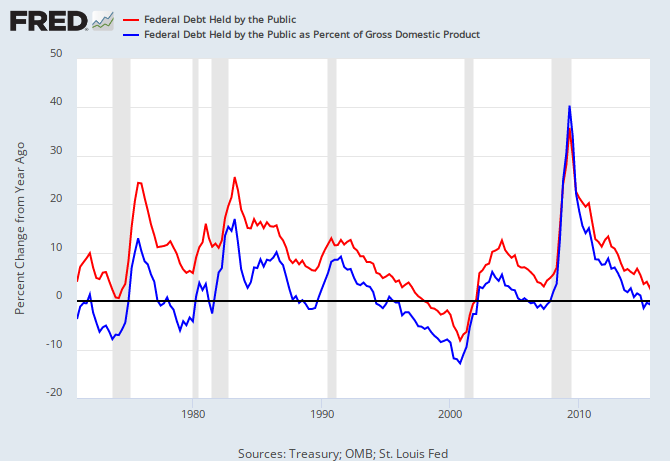
Recessions begin an average of 2 years after the blue line first dips below zero. A common phenomenon is for the line briefly to dip below zero, then rise above zero, before falling dramatically below zero. There was a brief dip below zero in 2015, followed by another dip – the familiar pre-recession pattern.
Recessions are cured by a rising red line.
Monetary Sovereignty

Vertical gray bars mark recessions.

As the federal deficit growth lines drop, we approach recession, which will be cured only when the growth lines rise. Increasing federal deficit growth (aka “stimulus”) is necessary for long-term economic growth.

————————————————————————————————————————————————————————————————————————————————————————————————-

Mitchell’s laws:
•Those, who do not understand the differences between Monetary Sovereignty and monetary non-sovereignty, do not understand economics.
•Any monetarily NON-sovereign government — be it city, county, state or nation — that runs an ongoing trade deficit, eventually will run out of money.
•The more federal budgets are cut and taxes increased, the weaker an economy becomes..

•No nation can tax itself into prosperity, nor grow without money growth.
•Cutting federal deficits to grow the economy is like applying leeches to cure anemia.
•A growing economy requires a growing supply of money (GDP = Federal Spending + Non-federal Spending + Net Exports)
•Deficit spending grows the supply of money
•The limit to federal deficit spending is an inflation that cannot be cured with interest rate control.
•The limit to non-federal deficit spending is the ability to borrow.

Liberals think the purpose of government is to protect the poor and powerless from the rich and powerful. Conservatives think the purpose of government is to protect the rich and powerful from the poor and powerless.

•The single most important problem in economics is the Gap between rich and the rest..
•Austerity is the government’s method for widening
the Gap between rich and poor.
•Until the 99% understand the need for federal deficits, the upper 1% will rule.
•Everything in economics devolves to motive, and the motive is the Gap between the rich and the rest..

MONETARY SOVEREIGNTY


Krugman proves America never will have Medicare.

Twitter: @rodgermitchell; Search #monetarysovereignty
Facebook: Rodger Malcolm Mitchell

============================================================================================================================================================================================================================================================

In a New York Times article titled, Health Reform Realities, Nobel Prize winning economist/columnist, (O.K., it wasn’t a real Nobel Prize) Paul Krugman tells us why there never will be a Medicare program in America.

“What?” you say. “There already is a Medicare program in America.”

Yes, that is reality, but reality does not seem to affect the opinions of this Hillary Clinton sycophant, as he does his very best to destroy all things Bernie Sanders.

Here are a few excerpts:

Health reform is the signature achievement of the Obama presidency. It was the biggest expansion of the social safety net since Medicare was established in the 1960s.

Well, so he did remember that Medicare exists, though later you’ll see he forgets.

It more or less achieves a goal — access to health insurance for all Americans — that progressives have been trying to reach for three generations. And it is already producing dramatic results, with the percentage of uninsured Americans falling to record lows.

Obamacare is, however, what engineers would call a kludge: a somewhat awkward, clumsy device with lots of moving parts. This makes it more expensive than it should be, and will probably always cause a significant number of people to fall through the cracks.

He’s right about that. The Affordable Care Act, as we previously have said, is a classic Rube Goldberg machine, with many problems “fixed” by rubber bands and tape.

By contrast Medicare already exists, it’s relatively easy, and we know how to do it. And Medicare for All, would solve the problems Krugman mentions, and no one would “fall through the cracks.”

The question for progressives — a question that is now central to the Democratic primary — is whether these failings mean that they should re-litigate their own biggest political success in almost half a century, and try for something better.

My answer, as you might guess, is that they shouldn’t, that they should seek incremental change on health care (Bring back the public option!) and focus their main efforts on other issues — that is, that Bernie Sanders is wrong about this and Hillary Clinton is right.

In Krugmanland, Bernie always is wrong and Hillary always is right.

But the main point is that we should think clearly about why health reform looks the way it does.

If we could start from scratch, many, perhaps most, health economists would recommend single-payer, a Medicare-type program covering everyone.

He sort of, kind of, almost seems to acknowledge that Medicare for Everyone would be a good plan. But he covers his butt with the mealy-mouth words, “. . . many, perhaps most, health economists . . .

That way, he himself doesn’t have to recommend it, because . . . well because it’s a Bernie Sanders plan. But he doesn’t want to admit his blind bias, so he invents other reasons why the plan is no good.

Leave on one side the virtual impossibility of achieving single-payer. Single-payer isn’t a politically feasible goal in America, for three big reasons that aren’t going away.

Er, uh, Paul, we already have single-payer in America. It’s called “Medicare.” The main problem: It begins at age 65 (corrupted to 67).

As for political feasibility, here’s a brief history: President Teddy Roosevelt’s platform included health insurance when he ran for president in 1912.

But the idea for a national health plan didn’t gain steam until it was pushed by U.S. President Harry S. Truman. On November 19, 1945, seven months into his presidency, Truman sent a message to Congress, calling for creation of a national health insurance fund, open to all Americans.

Although Truman fought to get a bill passed during his term, he was unsuccessful and it was another 20 years before Medicare would become a reality.

President John F. Kennedy made his own unsuccessful push for a national health care program for seniors.

But it wasn’t until 1965 – after legislation was signed by President Lyndon B Johnson – that Americans started receiving Medicare health coverage.

What does that little history tell you? It tells me that doing the right thing can take time and effort, and if you don’t give up, and don’t make excuses for initial failure, eventually you can succeed, and make America better.

Now, as you read Krugman’s next paragraphs, imagine you are Teddy Roosevelt, or Harry Truman, or Jack Kennedy, or Lyndon Johnson, and Paul Krugman is your political/economics advisor. What would you say to him, when he tells you . . . ?

“First, like it or not, incumbent players have a lot of power. Private insurers played a major part in killing health reform in the early 1990s, so this time around reformers went for a system that preserved their role and gave them plenty of new business.”

Would you say: “But Paul, despite those ‘incumbent players,’ who were around in all the years prior to 1965, and still are around, we do have Medicare today.

“Second, single-payer would require a lot of additional tax revenue — and we would be talking about taxes on the middle class, not just the wealthy.”

Would you say, “But Paul, you just mouthed the Big Lie, the easily rebutted statement that federal taxes fund federal spending. No Paul, they don’t, and you know it.”

“It’s true that higher taxes would be offset by a sharp reduction or even elimination of private insurance premiums, but it would be difficult to make that case to the broad public, especially given the chorus of misinformation you know would dominate the airwaves.”

You might say, “So Paul, not only are higher taxes unnecessary, but there actually would be a huge financial savings for America, via the elimination of private insurance premiums.

The only problem would be the ‘chorus of misinformation’ which you, yourself are supplying.”

“Finally, and I suspect most important, switching to single-payer would impose a lot of disruption on tens of millions of families who currently have good coverage through their employers.

You might say that they would end up just as well off, and it might well be true for most people — although not those with especially good policies.

But getting voters to believe that would be a very steep climb.”

You might say, “Paul, if by ‘disruption,’ you mean that people would receive free medical care rather than having to pay for much of it, I’d guess most people would opt for ‘disruption.’

‘As for “especially good policies,” what says that Medicare for All would not supply policies that are even better than those “especially good” private policies?

‘And Paul, getting voters to believe it wouldn’t be such a steep climb if columnists would disseminate lies about the program. I’m referring to you, Paul.

“Now Paul, do you have any other phony and cowardly reasons why our next President should not fight to achieve Medicare for All”?

“There are many items on the progressive agenda, ranging from an effective climate change policy, to making college affordable for all, to restoring some of the lost bargaining power of workers.

“Making progress on any of these items is going to be a hard slog, even if Democrats hold the White House and, less likely, retake the Senate.

“Indeed, room for maneuver will be limited even if a post-Trump Republican Party moves away from the scorched-earth opposition it offered President Obama.

“So progressives must set some priorities. And it’s really hard to see, given this picture, why it makes any sense to spend political capital on a quixotic attempt at a do-over, not of a political failure, but of health reform — their biggest victory in many years.”

Would you say, “Paul, it’s a good thing you weren’t around to advise President Lyndon Johnson, who during his term:

–Passed the Civil Rights Acts of 1964 and 1968
–Appointed the first black justice to the Supreme Court (Thurgood Marshall)
–Passed the Elementary and Secondary Education Act and the Higher Education Act
–Established the National Endowment for the Humanities and the National Endowment for the Arts
–Created Head Start, food stamps, Work Study, Medicare, and Medicaid
–Continued NASA’s Apollo 8 program, with the first manned flight to the Moon
–Passed the Immigration Act of 1965

“Paul, would you have told President Johnson to’get some priorities’ and not to ‘spend political capital on quixotic attempts’?

“Well Paul, maybe you would have, if you were talking to Bernie Sanders and were more interested in lifting Hillary Clinton than in lifting America.”

Thankfully, Krugman and his ilk were not around to advise Lyndon Johnson, or if they were, Lyndon didn’t listen.

And that is exactly what you should do with Krugman: Don’t listen, and especially don’t listen to the Big Lie.

We have Medicare today. We could have Medicare for All, tomorrow.

We just need the right leader — and no Krugmans need apply.

Rodger Malcolm Mitchell
Monetary Sovereignty

===================================================================================
Ten Steps to Prosperity:
1. Eliminate FICA (Click here)
2. Federally funded Medicare — parts A, B & D plus long term nursing care — for everyone (Click here)
3. Provide an Economic Bonus to every man, woman and child in America, and/or every state a per capita Economic Bonus. (Click here) Or institute a reverse income tax.
4. Free education (including post-grad) for everyone. Click here
5. Salary for attending school (Click here)
6. Eliminate corporate taxes (Click here)
7. Increase the standard income tax deduction annually Click here
8. Tax the very rich (.1%) more, with higher, progressive tax rates on all forms of income. (Click here)
9. Federal ownership of all banks (Click here and here)

10. Increase federal spending on the myriad initiatives that benefit America’s 99% (Click here)

The Ten Steps will grow the economy, and narrow the income/wealth/power Gap between the rich and you.
========================================================================================================================================================================================================================================================================================================

10 Steps to Economic Misery: (Click here:)
1. Maintain or increase the FICA tax..
2. Spread the myth Social Security, Medicare and the U.S. government are insolvent.
3. Cut federal employment in the military, post office, other federal agencies.
4. Broaden the income tax base so more lower income people will pay.
5. Cut financial assistance to the states.
6. Spread the myth federal taxes pay for federal spending.
7. Allow banks to trade for their own accounts; save them when their investments go sour.
8. Never prosecute any banker for criminal activity.
9. Nominate arch conservatives to the Supreme Court.
10. Reduce the federal deficit and debt

THE RECESSION CLOCK

Recessions begin an average of 2 years after the blue line first dips below zero. A common phenomenon is for the line briefly to dip below zero, then rise above zero, before falling dramatically below zero. There was a brief dip below zero in 2015, followed by another dip – the familiar pre-recession pattern.
Recessions are cured by a rising red line.

Monetary Sovereignty

Vertical gray bars mark recessions.

As the federal deficit growth lines drop, we approach recession, which will be cured only when the growth lines rise. Increasing federal deficit growth (aka “stimulus”) is necessary for long-term economic growth.

————————————————————————————————————————————————————————————————————————————————————————————————-

Mitchell’s laws:
•Those, who do not understand the differences between Monetary Sovereignty and monetary non-sovereignty, do not understand economics.
•Any monetarily NON-sovereign government — be it city, county, state or nation — that runs an ongoing trade deficit, eventually will run out of money.
•The more federal budgets are cut and taxes increased, the weaker an economy becomes..

•No nation can tax itself into prosperity, nor grow without money growth.
•Cutting federal deficits to grow the economy is like applying leeches to cure anemia.
•A growing economy requires a growing supply of money (GDP = Federal Spending + Non-federal Spending + Net Exports)
•Deficit spending grows the supply of money
•The limit to federal deficit spending is an inflation that cannot be cured with interest rate control.
•The limit to non-federal deficit spending is the ability to borrow.

Liberals think the purpose of government is to protect the poor and powerless from the rich and powerful. Conservatives think the purpose of government is to protect the rich and powerful from the poor and powerless.

•The single most important problem in economics is the Gap between rich and the rest..
•Austerity is the government’s method for widening
the Gap between rich and poor.
•Until the 99% understand the need for federal deficits, the upper 1% will rule.
•Everything in economics devolves to motive, and the motive is the Gap between the rich and the rest..

MONETARY SOVEREIGNTY
e

The theft machine; makers and takers

Twitter: @rodgermitchell; Search #monetarysovereignty
Facebook: Rodger Malcolm Mitchell

============================================================================================================================================================================================================================================================

The party of the rich likes to characterize and caricature those with lower income as “takers,” while the rich supposedly are “makers.”

The myth is that while the rich slave, day after day, to pay your salary, the less affluent lay back in their gilded hammocks, and drink mai tais courtesy of their food stamps, Medicaid, Medicare and Social Security payments.

Ah, those beneficial, merciful, compassionate rich-folk “makers,” sweating and dying for we unappreciative “takers.”

And that is why it’s a myth.

Fact: The rich do not provide jobs, other than maid, butler, gardener and chauffeur-type jobs. The rich mostly are employees and investors, who receive huge salaries and huge dividends and other fabulous perks from the companies that provide jobs to the “makers” and “takers” alike.

The primary difference between a “maker” and a “taker” is the former makes and takes more money, while the latter makes and takes less. This imbalance — otherwise known as the “Gap” — is exactly the way the rich want it.

And when there even is a hint of possible fairness, the rich howl like overfed, but still ravenous, dogs.

For example, President Obama has just instituted a new rule requiring — get this — requiring financial advisors to give their best advice to their clients.

Their best advice? How shocking!

A new rule unveiled today by the Obama administration requires retirement advisers to always act in the best interest of their client.
by Heather Long

Currently, it is legal for an adviser to get paid more money (similar to a kickback) if he or she gets you to invest in fund A instead of fund B (even if fund B might be a better investment for you).

For example, an adviser might make $200 if he or she has you invest $10,000 in a stock fund but only $130 if he or she has you invest in a bond fund.

Why is a rule requiring your financial advisors to give you their best advice even necessary?

No one would have the stones to argue against that. Right? Well, actually . . .

The new Obama administration rule — known as the Fiduciary Standard — is a big shakeup of the industry.

Wall Street is anxious about the change. Many financial firms’ stocks plummeted in recent weeks as it became clear the White House was moving forward with the rule.

If there is anything that frightens, even angers, the rich, it’s requiring them to act in an ethical manner. The rich like to complain about “food stamp mamas” who, when they receive their $147 per month, might spend a few dollars on cigarettes. To the rich, that’s criminal!

But when the rich give you bad advice so they can rake in thousands more for themselves, well, that’s just business.

And then there’s this:

The ‘Panama Papers’ Expose the Secret World of the 1%
By Rana Foroohar and Matt Vella

The revelations will reinforce the anger of the growing number of people who believe the world’s political leaders, business tycoons and ultra-wealthy have co-opted systems designed to lift everybody up – democracy, capitalism, free markets.

It’s also only the tip of the iceberg. “The size of the leak is unprecedented, but the tricks the Mossack Fonseca (law firm) has allegedly used for its clients are neither new nor surprising,” says Heather Lowe, director of government affairs for Global Financial Integrity, a Washington-based nonprofit consultancy.

“Anonymous shell companies and the failure of governments to require lawyers, corporate-service companies or banks to collect beneficial-ownership information on clients leave the door wide open for dirty money to flow around the globe virtually unhindered.”

Globalization has allowed the capital and assets of the rich to travel more freely than those of everyone else.

The result is rampant tax avoidance, labor offshoring and a class of elites that flies 35,000 feet over the problems of nations and their taxpayers.

“The 1% can move anywhere they want and profit handsomely from the relocation,” says Peter Atwater, a behavioral economist.

“But the 99% are left with the aftermath–the empty buildings of a deserted Detroit, the toxic waste from chemical plants in West Virginia or the unsustainable tax liabilities of Puerto Rico.”

Developing and emerging economies lost $7.8 trillion in cash from 2004 to 2013 because of maneuvers like those allegedly perfected by Mossack.

Illicit outflows are increasing at a rate of 6.5% a year, twice the rate of global GDP growth.

What exactly is the problem? Corporate and personal greed, as many have suggested? Loose regulation and bribery as others claim? The rich not paying their fair share of taxes?

Not exactly.

New rules released by the U.S. Treasury on April 4 crack down on American corporations that allow themselves to be acquired by foreign firms to avoid U.S. taxes (aka “inversions.”)

How will these new rules by the Treasury, which will increase U.S. tax collections, help the 99%?

Answer: They won’t. Forcing U.S. corporations to pay more in taxes will not put even one dollar into your pockets. It might satisfy a visceral need to punish the rich, but in reality, it will cost you money, and it doesn’t punish the rich. It punishes businesses, our employers.

But it doesn’t even punish businesses.

When business income is good, businesses hire more people and pay higher salaries. That is what puts dollars in your pockets.

But taxes reduce business income. So the more taxes the federal government collects from businesses, the fewer people businesses hire, and the less they can afford to pay those people.

And no, don’t believe that if business pay their “fair share” of taxes, you’ll pay less. Federal taxes are not based on need; the federal government doesn’t “need” any taxes. None at all. Taxes are based on influence. Those with more, pay less.

In summary, business taxes punish workers.

America’s business taxes already are too high. How do I know? Just look at all those companies that want to take advantage of lower business taxes elsewhere — the “inversions” the Treasury is trying to stop.

In essence, Obama’s new rules say, “America’s businesses are trying to increase their profitability, by cutting their tax bills. That’s outrageous. We should hamper America’s businesses, by taxing them more, so they will be less competitive internationally, and less able to pay salaries.”

Not only is this ridiculous on the face of it, but it gets even more ridiculous, because as we said earlier, the U.S. federal government doesn’t need the tax dollars. Being Monetarily Sovereign, it creates all the dollars it needs, simply by paying bills.

In summary, the rich are the real “takers,” the working unrich are the real “makers,” American business is overtaxed by a government that neither needs nor uses tax money.

What is the motive for all this nonsense? The usual: To widen the “Gap” between the rich and the rest.

The rich like to portray themselves as job makers, so they can justify their outrageous salaries and tax loopholes. They want the 99% to vote for politicians who are most likely to provide tax benefits for the rich, while punishing the non-rich.

But in order to make the whole theft machine work, the rich have to promulgate the “Big Lie,” the fiction that federal taxes are necessary to fund federal spending, and the reason why Social Security, Medicare, Medicaid, food stamps, etc. supposedly are “going broke.”

So co-conspirators like Barack Obama, Hillary Clinton and the Republicans, pretend to create and enforce rules against gouging of the non-rich. They write meaningless little laws that never are enforced, and are offset by special tax provisions that apply only to the rich — and no bankster ever is prosecuted, much less, jailed.

I know Americans are not going to do anything about it, and will continue to believe the party line. But wouldn’t it be fun is somehow a tipping point of Americans understood that federal taxes are unnecessary?

Meanwhile, the theft machine grinds on.

Rodger Malcolm Mitchell
Monetary Sovereignty


===================================================================================
Ten Steps to Prosperity:
1. Eliminate FICA (Click here)
2. Federally funded Medicare — parts A, B & D plus long term nursing care — for everyone (Click here)
3. Provide an Economic Bonus to every man, woman and child in America, and/or every state a per capita Economic Bonus. (Click here) Or institute a reverse income tax.
4. Free education (including post-grad) for everyone. Click here
5. Salary for attending school (Click here)
6. Eliminate corporate taxes (Click here)
7. Increase the standard income tax deduction annually Click here
8. Tax the very rich (.1%) more, with higher, progressive tax rates on all forms of income. (Click here)
9. Federal ownership of all banks (Click here and here)

10. Increase federal spending on the myriad initiatives that benefit America’s 99% (Click here)

The Ten Steps will grow the economy, and narrow the income/wealth/power Gap between the rich and you.
========================================================================================================================================================================================================================================================================================================

10 Steps to Economic Misery: (Click here:)
1. Maintain or increase the FICA tax..
2. Spread the myth Social Security, Medicare and the U.S. government are insolvent.
3. Cut federal employment in the military, post office, other federal agencies.
4. Broaden the income tax base so more lower income people will pay.
5. Cut financial assistance to the states.
6. Spread the myth federal taxes pay for federal spending.
7. Allow banks to trade for their own accounts; save them when their investments go sour.
8. Never prosecute any banker for criminal activity.
9. Nominate arch conservatives to the Supreme Court.
10. Reduce the federal deficit and debt

THE RECESSION CLOCK

Recessions begin an average of 2 years after the blue line first dips below zero. A common phenomenon is for the line briefly to dip below zero, then rise above zero, before falling dramatically below zero. There was a brief dip below zero in 2015, followed by another dip – the familiar pre-recession pattern.
Recessions are cured by a rising red line.

Monetary Sovereignty

Vertical gray bars mark recessions.

As the federal deficit growth lines drop, we approach recession, which will be cured only when the growth lines rise. Increasing federal deficit growth (aka “stimulus”) is necessary for long-term economic growth.

————————————————————————————————————————————————————————————————————————————————————————————————-

Mitchell’s laws:
•Those, who do not understand the differences between Monetary Sovereignty and monetary non-sovereignty, do not understand economics.
•Any monetarily NON-sovereign government — be it city, county, state or nation — that runs an ongoing trade deficit, eventually will run out of money.
•The more federal budgets are cut and taxes increased, the weaker an economy becomes..

•No nation can tax itself into prosperity, nor grow without money growth.
•Cutting federal deficits to grow the economy is like applying leeches to cure anemia.
•A growing economy requires a growing supply of money (GDP = Federal Spending + Non-federal Spending + Net Exports)
•Deficit spending grows the supply of money
•The limit to federal deficit spending is an inflation that cannot be cured with interest rate control.
•The limit to non-federal deficit spending is the ability to borrow.

Liberals think the purpose of government is to protect the poor and powerless from the rich and powerful. Conservatives think the purpose of government is to protect the rich and powerful from the poor and powerless.

•The single most important problem in economics is the Gap between rich and the rest..
•Austerity is the government’s method for widening
the Gap between rich and poor.
•Until the 99% understand the need for federal deficits, the upper 1% will rule.
•Everything in economics devolves to motive, and the motive is the Gap between the rich and the rest..

MONETARY SOVEREIGNTY

Sanders speaks the truth and lies

Twitter: @rodgermitchell; Search #monetarysovereignty
Facebook: Rodger Malcolm Mitchell

============================================================================================================================================================================================================================================================

Bernie Sanders’ comments on the Panama Papers and the Panama Free Trade Agreement, were a simultaneous combination of truth and falsehood. Can you spot the differences?

“We now know, as a result of the ‘Panama Papers’ released by an international consortium of investigative journalists, that more than 214,000 entities throughout the world have been using a law firm in Panama to avoid paying taxes.

“At a time of massive income and wealth inequality in the United States and around the world, the wealthiest people and largest corporations must start paying their fair share of taxes. Children should not go hungry while billionaires use offshore tax havens to avoid paying their fair share of taxes.

“The Panama Free Trade Agreement put a stamp of approval on Panama, a world leader when it comes to allowing the wealthy and the powerful to avoid taxes.

“I was opposed to the Panama Free Trade Agreement from day one. I predicted that the passage of this disastrous trade deal would make it easier, not harder, for the wealthy and large corporations to evade taxes by sheltering billions of dollars offshore.

I wish I had been proven wrong about this, but it has now come to light that the extent of Panama’s tax avoidance scams is even worse than I had feared.

“My opponent, on the other hand, opposed this trade agreement when she was running against Barack Obama for president in 2008. But when it really mattered she quickly reversed course and helped push the Panama Free Trade Agreement through Congress as Secretary of State. The results have been a disaster.

“The American people are sick and tired of establishment politicians who say one thing during a campaign and do the exact opposite the day after the election.

“It is time for real change. As president, I will use my authority to terminate the Panama Free Trade Agreement within six months.

My administration will conduct an immediate investigation into U.S. banks, corporations and wealthy individuals who have been stashing their cash in Panama to avoid taxes. If any of them have violated U.S. law, my administration will prosecute them to the fullest extent of the law.”

Sanders is correct about the “massive income and wealth inequality.” That is the single biggest economic problem facing America and the world.

He is wrong about wanting the rich to pay their “fair share of taxes.” There is no “fair share of taxes, simply because there neither are, nor ever can be, fair taxes. (See: Which Taxes Are Fairest? Which Taxes are Least Fair?)

Since it is functionally impossible for taxes to be fair, it is equally impossible for shares of taxes to be fair.

However, allowing the wealthy to avoid taxes, while less wealthy do not have these exits, is manifestly unfair, and not just unfair, but bad economics.

Our economy relies upon the great mass of people (“the 99%”) having sufficient spending and saving dollars, and when disproportionate dollars are taken away by the federal government, the economy suffers.

Sanders is speaking in sound bites, which by necessity, ignore the true complexity of taxation.

For example, state and local taxes are economically neutral; the dollars do not leave the money supply, but rather are deposited in banks and later recirculated.

By contrast, federal taxes are economically harmful in that all dollars sent to the Federal government disappear from the money supply. They  neither are deposited nor recirculated. The federal government creates brand new dollars, whenever it spends.

Because all federal taxation removes dollars from the economy, it has a negative effect on economic growth. This is true for federal taxation of the rich, the middle, the poor and businesses.

Taxing businesses, i.e. removing dollars from businesses, when one wishes to increase the health and growth of businesses is economically non-sensical. Dollars taken from businesses cannot be used to pay salaries, to pay suppliers or to reinvest for growth.

Taxing individual consumers, when one wishes to grow the demand and purchasing power in the economy, is equally nonsensical. You cannot spend, save or invest the tax dollars taken from you.

The only positive effect of federal taxation would occur when the rich are taxed as part of a larger program to reduce the Gap between the rich and the rest (See: #8 in the Ten Steps to Prosperity — below).

In summary, the goal should not be to collect more federal taxes. Businesses and the 99% should not pay federal taxes at all. The federal government, being Monetarily Sovereign, neither needs nor uses tax dollars.

The goal should be to grow the economy while narrowing the Gap between the rich and the rest.

The problem is not with free trade agreements, per se. Making trade easier should help both parties. The devil is in the details.

Any agreement, no matter how seemingly benign, will affect individuals differently. Jobs will be gained; other jobs will be lost. Some companies will prosper; others will suffer. Some people will benefit from lower prices; some business will benefit from higher prices.

The measure of any trade agreement is how it affects each nation, overall.

For example, our trade with China has cost American jobs for the few and lowered prices for the many. On balance, it probably is beneficial, especially if duties (which go to the federal government and disappear from the economy) have been lowered.

Sanders knows all this, but undoubtedly he believes he cannot explain it, especially not in sound bites to an audience that is ignorant of economics.

So he makes it a “tax fairness” issue, with trade agreements as the bogeymen.

Some truth mixed with some lies may be the best we can get from a politician.

At least it’s not all lies.

Rodger Malcolm Mitchell
Monetary Sovereignty


===================================================================================
Ten Steps to Prosperity:
1. Eliminate FICA (Click here)
2. Federally funded Medicare — parts A, B & D plus long term nursing care — for everyone (Click here)
3. Provide an Economic Bonus to every man, woman and child in America, and/or every state a per capita Economic Bonus. (Click here) Or institute a reverse income tax.
4. Free education (including post-grad) for everyone. Click here
5. Salary for attending school (Click here)
6. Eliminate corporate taxes (Click here)
7. Increase the standard income tax deduction annually Click here
8. Tax the very rich (.1%) more, with higher, progressive tax rates on all forms of income. (Click here)
9. Federal ownership of all banks (Click here and here)

10. Increase federal spending on the myriad initiatives that benefit America’s 99% (Click here)

The Ten Steps will grow the economy, and narrow the income/wealth/power Gap between the rich and you.
========================================================================================================================================================================================================================================================================================================

10 Steps to Economic Misery: (Click here:)
1. Maintain or increase the FICA tax..
2. Spread the myth Social Security, Medicare and the U.S. government are insolvent.
3. Cut federal employment in the military, post office, other federal agencies.
4. Broaden the income tax base so more lower income people will pay.
5. Cut financial assistance to the states.
6. Spread the myth federal taxes pay for federal spending.
7. Allow banks to trade for their own accounts; save them when their investments go sour.
8. Never prosecute any banker for criminal activity.
9. Nominate arch conservatives to the Supreme Court.
10. Reduce the federal deficit and debt

THE RECESSION CLOCK

Recessions begin an average of 2 years after the blue line first dips below zero. A common phenomenon is for the line briefly to dip below zero, then rise above zero, before falling dramatically below zero. There was a brief dip below zero in 2015, followed by another dip – the familiar pre-recession pattern.
Recessions are cured by a rising red line.

Monetary Sovereignty

Vertical gray bars mark recessions.

As the federal deficit growth lines drop, we approach recession, which will be cured only when the growth lines rise. Increasing federal deficit growth (aka “stimulus”) is necessary for long-term economic growth.

————————————————————————————————————————————————————————————————————————————————————————————————-

Mitchell’s laws:
•Those, who do not understand the differences between Monetary Sovereignty and monetary non-sovereignty, do not understand economics.
•Any monetarily NON-sovereign government — be it city, county, state or nation — that runs an ongoing trade deficit, eventually will run out of money.
•The more federal budgets are cut and taxes increased, the weaker an economy becomes..

•No nation can tax itself into prosperity, nor grow without money growth.
•Cutting federal deficits to grow the economy is like applying leeches to cure anemia.
•A growing economy requires a growing supply of money (GDP = Federal Spending + Non-federal Spending + Net Exports)
•Deficit spending grows the supply of money
•The limit to federal deficit spending is an inflation that cannot be cured with interest rate control.
•The limit to non-federal deficit spending is the ability to borrow.

Liberals think the purpose of government is to protect the poor and powerless from the rich and powerful. Conservatives think the purpose of government is to protect the rich and powerful from the poor and powerless.

•The single most important problem in economics is the Gap between rich and the rest..
•Austerity is the government’s method for widening
the Gap between rich and poor.
•Until the 99% understand the need for federal deficits, the upper 1% will rule.
•Everything in economics devolves to motive, and the motive is the Gap between the rich and the rest..

MONETARY SOVEREIGNTY