Economics in a thousand words

Twitter: @rodgermitchell; Search #monetarysovereignty
Facebook: Rodger Malcolm Mitchell

============================================================================================================================================================================================================================================================

Science is the search for cause and effect. The human thought process first answers the question, “What?” then seeks, “Why?” and “How?”

Scientific thought begins with facts, from which are derived data and finally conjecture (hypothesis).

Scientific proof comes from physical evidence, predictability, and reproducibility. In chemistry, a physical science, the prediction can be made that combining chlorine with sodium will produce (predictability) common salt. So chemists repeatedly combine those two elements (reproducibility), and repeatedly produce salt (physical evidence).

Social sciences, of which economics is one, rely on the vagaries of human thought, emotion, superstition and belief. Predictability, reproducibility and physical evidence often are lacking.

What then constitutes proof in economics? There are no proofs in economics. There only are facts and data from which emerge hypotheses.

Hypotheses are not certainty. Facts and data can breed multiple hypotheses. The lack of scientific certainty can produce emotional certainty, with resultant firm beliefs leading to strong disagreements. (Think of disagreements about religion and politics.)

Though the science of economics is massively complex, and even includes its own mysterious technical jargon, the layperson can understand basic economics by learning just a few facts.

The following are what I believe to be those important facts of economics. If you, or any person, holds a conjecture that does not comport with these facts, this is your opportunity to eliminate a conflicting hypothesis from your beliefs.

Facts:

  1. All money is debt. There is no, nor ever has been, any form of money that is not debt.
  2. The value of debt/money is supported by collateral, which determines its acceptance.
  3. All money is created by debtors, who owe the holders of money, full faith and credit as collateral. The collateral for the U.S. dollar is the full faith and credit of the U.S. government.
  4. The secondary collateral for money may be a physical asset, for instance gold, a house, a car, land, etc. While gold, houses, cars and land are not in themselves money, additional collateral can increase the acceptance of money.
  5. All money is created by laws.  In the late 1770’s, the new U.S. federal government created laws from thin air. Some of these laws created the original dollars, also from thin air. Money-creation laws may be written, oral or mutually understood. All laws and all forms of money are no more than ideas, with no physical existence. The federal government’s legal device for money creation is deficit spending.
  6. Any person or group of people can create money, simply by passing or agreeing to laws that create debt. Such money creators are known as “borrowers” and “debtors.” Examples are: Banks that accept deposits (which they owe to depositors), mortgagors (who owe to mortgagees). In each case, the acceptance and Value of money is based first on the borrower’s full faith and credit.
  7. In addition to full faith and credit, the Value of money is based on Supply and Demand, according to the formula: Value = Demand/Supply.
  8. Demand = Reward/Risk. The Reward for owning money is interest, with increased rates causing increased Demand. The Risk of owning money is inflation.
  9. Laws have no physical existence. Having no physical existence, laws can be created in unlimited quantities by any person or entity, their only effective limit being their acceptance.
  10. Because all money is created by laws, money can be created in unlimited quantities by lawmakers. This is known as Monetary Sovereignty, the unlimited ability to create a sovereign currency by the creation of laws.
  11. Lawmakers never can unintentionally run short of their own sovereign currency. The simple expedient of passing a new law, gives the lawmakers unlimited ability to pay any debt denominated in their own sovereign currency.
  12. A lawmaking entity never needs to ask (by taxing or borrowing) outside entities for supplies of its own sovereign currency. The U.S., for instance, being Monetarily Sovereign, neither needs nor uses taxing or borrowing to pay its obligations.
  13. Federal financing is unlike personal financing. Federal deficits are not directly linked to federal debt. Deficits, the difference between taxes and spending, are not directly linked to federal debt, the total of deposits in T-security accounts at the Federal Reserve Bank. Federal deficits could exist without federal debt, and federal debt could exist without federal deficits.
  14. U.S. “borrowing” consists solely of providing safe storage and investment of its own sovereign currency, the dollar, via Treasury accounts (bills, notes and bonds) at the Federal Reserve Bank, i.e bank accounts. (The term “debt” for these accounts can be misleading in that unlike personal and business debt, FRB accounts are not a burden on the Monetarily Sovereign federal government. The FRB accounts are paid off, as are all other bank accounts, by simple transfers of existing dollars from the FRB accounts to checking accounts.)
  15. A Monetarily Sovereign entity pays debts denominated in its own sovereign currency, by creating its sovereign currency ad hoc, and delivering that sovereign currency to creditors. The entity neither needs, nor uses, nor even retains taxes denominated in its own sovereign currency.
  16. Inflation (i.e price inflation) is the loss in Value of a currency compared with the prices of goods and services. Value (or Price) = Demand/Supply.
  17. Inflation can be caused by any combination of:
    1. An increase in the Supply of a currency
    2. A decrease in the Demand for a currency
    3. An increase in the Demand for goods and services
    4. A decrease in the Supply of goods and services.
    5. An decrease in the Reward for owning money (interest)
    6. An increase in the risk of owning money (cumulative inflation)

    ====================================================================================================================
    You now know the most important facts in the science of economics.

    The following is a mention of selected data and conjecture. The purpose of this mention is to address certain common misconceptions about money.

    The sole purposes of taxing are political and as money-supply control.

    Politically, taxes give the illusion that they pay for spending. The purpose is to limit financial demands by the populace. (Many leaders fear that demands for money would grow excessively if the populace ever were to understand that the federal government is not limited in its ability to pay bills.)

    1. Leaders claim that money creation (incorrectly called “printing”) will lead to an uncontrollable inflation and,
    2. Leaders fear that the gap between the rich and the rest will narrow.

    (The gap is what makes the rich rich. Without the gap, no one would be rich, and the wider the gap, the richer they are. So, the rich want the gap to widen. They pay politicians, the media, university economists, and other influentials to cut deficit spending [money creation] and to tell the populace that the federal government is monetarily non-sovereign, federal taxes are necessary for federal spending, and federal “debt” is owed by taxpayers.)

    Historically, inflations have been caused by a decrease in the Supply of goods and services (primarily, oil and secondarily, food), with an increase in the Supply of currency being an exacerbating government response, not the initial cause.

    Historically, inflations have been prevented and cured via interest rate control and increased Supply of goods and services.

    Though some economists recommend controlling inflation by reducing the supply of money (increased taxation and/or reduced spending), these devices are determined by Congress, and therefore are slow, politically controversial and inexact. By contrast, interest rate increases can be accomplished quickly by the Federal Reserve and in small increments.

    For comparison:

    Meteorology, like economics, currently suffers limited predictability and reproducibility, primarily because of the mathematically chaotic nature of weather. Like economics, it one day may mature as a science, when computer modeling of historical data improves.

    Religion is not, and never will be, a science. It is based solely on one fact (the universe exists), with no data leading to the prime conjecture, the existence of one or more gods, and no proofs.

Rodger Malcolm Mitchell
Monetary Sovereignty


===================================================================================
Ten Steps to Prosperity:
1. Eliminate FICA (Click here)
2. Federally funded Medicare — parts A, B & D plus long term nursing care — for everyone (Click here)
3. Provide an Economic Bonus to every man, woman and child in America, and/or every state a per capita Economic Bonus. (Click here) Or institute a reverse income tax.
4. Free education (including post-grad) for everyone. Click here
5. Salary for attending school (Click here)
6. Eliminate corporate taxes (Click here)
7. Increase the standard income tax deduction annually Click here
8. Tax the very rich (.1%) more, with higher, progressive tax rates on all forms of income. (Click here)
9. Federal ownership of all banks (Click here and here)

10. Increase federal spending on the myriad initiatives that benefit America’s 99% (Click here)

The Ten Steps will grow the economy, and narrow the income/wealth/power Gap between the rich and you.
========================================================================================================================================================================================================================================================================================================

10 Steps to Economic Misery: (Click here:)
1. Maintain or increase the FICA tax..
2. Spread the myth Social Security, Medicare and the U.S. government are insolvent.
3. Cut federal employment in the military, post office, other federal agencies.
4. Broaden the income tax base so more lower income people will pay.
5. Cut financial assistance to the states.
6. Spread the myth federal taxes pay for federal spending.
7. Allow banks to trade for their own accounts; save them when their investments go sour.
8. Never prosecute any banker for criminal activity.
9. Nominate arch conservatives to the Supreme Court.
10. Reduce the federal deficit and debt

THE RECESSION CLOCK

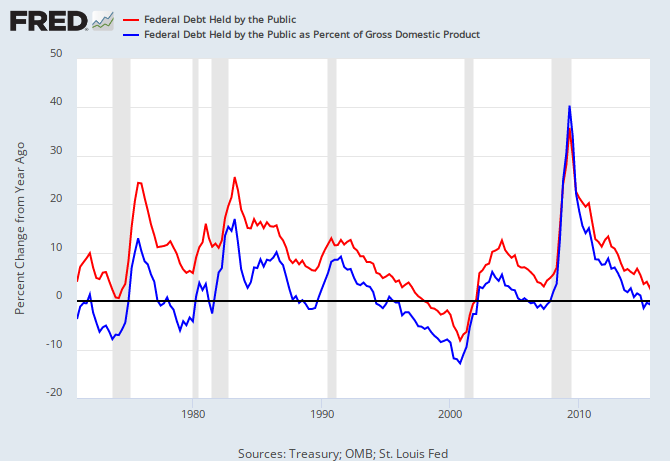
Recessions begin an average of 2 years after the blue line first dips below zero. A common phenomenon is for the line briefly to dip below zero, then rise above zero, before falling dramatically below zero. There was a brief dip below zero in 2015, followed by another dip – the familiar pre-recession pattern.
Recessions are cured by a rising red line.
Monetary Sovereignty

Vertical gray bars mark recessions.

As the federal deficit growth lines drop, we approach recession, which will be cured only when the growth lines rise. Increasing federal deficit growth (aka “stimulus”) is necessary for long-term economic growth.

————————————————————————————————————————————————————————————————————————————————————————————————-

Mitchell’s laws:
•Those, who do not understand the differences between Monetary Sovereignty and monetary non-sovereignty, do not understand economics.
•Any monetarily NON-sovereign government — be it city, county, state or nation — that runs an ongoing trade deficit, eventually will run out of money.
•The more federal budgets are cut and taxes increased, the weaker an economy becomes..

•No nation can tax itself into prosperity, nor grow without money growth.
•Cutting federal deficits to grow the economy is like applying leeches to cure anemia.
•A growing economy requires a growing supply of money (GDP = Federal Spending + Non-federal Spending + Net Exports)
•Deficit spending grows the supply of money
•The limit to federal deficit spending is an inflation that cannot be cured with interest rate control.
•The limit to non-federal deficit spending is the ability to borrow.

Liberals think the purpose of government is to protect the poor and powerless from the rich and powerful. Conservatives think the purpose of government is to protect the rich and powerful from the poor and powerless.

•The single most important problem in economics is the Gap between rich and the rest..
•Austerity is the government’s method for widening
the Gap between rich and poor.
•Until the 99% understand the need for federal deficits, the upper 1% will rule.
•Everything in economics devolves to motive, and the motive is the Gap between the rich and the rest..

MONETARY SOVEREIGNTY

Nancy Gibbs is ignorant or a liar. Jeff Spross is wise. Pick one.

Twitter: @rodgermitchell; Search #monetarysovereignty
Facebook: Rodger Malcolm Mitchell

============================================================================================================================================================================================================================================================

Nancy Gibbs is ignorant of economics or a liar. She is the editor of Time Magazine, which published the infamous cover story claiming the American people owe the federal government’s debt. Monetary Sovereignty

Now, the actual author of the ridiculous story is a man who forever will be remembered for making a public fool of himself, Jim Grant.  We discussed his error-laced article at Time flies and Time (Magazine) Lies.

(Grant is the editor of “Grant’s Interest Rate Observer.” I suggest you allow his economic “expertise” to be your guide about ever  using his services.)

But this is about Ms. Gibbs, who compounded the idiocy of publishing Grant’s article, by posting a small article of her own. Here are some excerpts:

For this issue we invited Jim Grant, a wise economic analyst, to explain one of the most seemingly incomprehensible numbers around: the $13.9 trillion in debt the U.Sl. government is carrying on the national credit card.

If Jim Grant is a “wise” economic analyst, then Ms. Gibbs is an equally “wise” magazine editor. You be the judge of that.

She is correct that the $13 trillion debt is incomprehensible — to her. Clearly, the entire subject of federal debt is incomprehensible to her.

And as for that “credit card” reference, what can one say? Ignorant? Stupid? Intentionally misleading? Note to Ms. Gibbs: Learn the difference between Monetary Sovereignty and monetary non-sovereignty.

As we mark tax day, it’s appropriate to remember, as Jim points out, that the $42,998.12 share of federal debt for each and every American ultimately represent a form of deferred tax that must one day be paid.

The above sentence is absolutely, 100% wrong. The federal debt is the total of T-security accounts at the Federal Reserve Bank, i.e. bank accounts.

Taxpayers do not pay the debt. The dollars exist at the Bank, and to pay off these accounts, the Bank simply does what every banks does. It transfers these existing dollars to the T-security holders’ checking accounts.

How far off is the reckoning? There was some progress last year when the deficit clocked in at $405 billion, the lowest since 2008. But . . .

Ah, the day of “reckoning,” which supposedly has been looming over us since at least 1940, when the NY Times referred to our mere $50 billion (now $13 or $18 trillion, depending on what you count) as a “ticking time bomb”.

That surely is the slowest time bomb in history.

I can’t continue. This is too painful.

Let’s move away from Ms. Gibbs (How did she ever get to be the editor of Time Magazine?) and her ignorant? stupid? intentionally misleading? article and go to something that makes actual sense:

Why America’s gigantic national debt is a good thing
by Jeff Spross

America’s chattering class always seems to try to make the “debt crisis” a thing. Just take the new Time Magazine cover story by James Grant.

For anyone who follows this stuff, Grant’s argument is exasperatingly familiar: The $13.9 trillion the U.S. owes to creditors is unmanageable; the Federal Reserve artificially lowers interest rates with its magical money-creating powers; we’d be better off with “sound money” and balanced budgets.

There is too much error-by-way-of-half-truth here to directly rebut. Instead, let me tell you the correct story.

Let’s start where Grant does, with the idea that the federal budget is like a family’s budget. As Grant awkwardly half admits later, this is totally wrong.

Individuals, families, and businesses are all cash-constrained. To get money, they have to go out and do something: get a job, sell goods and services, or borrow.

That’s not true of the federal government, since the Constitution invests it with the unique power to create money.

So any government with a fiat currency system, which is what America and most advanced Western nations have now, can always just create money to pay off creditors in a pinch.

That’s why interest rates on U.S. debt are so low — a sign of investors’ trust. It’s why we’ve happily run a debt for almost two centuries, and why Japan’s interest rates remain quite low despite a debt load far larger than ours.

Perfect. Well, almost perfect. The euro nations have a fiat money system, but being monetarily non-sovereign, they can’t create money at will.

And anyway, the U.S. government does not create money to pay off it’s so-called “debt,” though it does create money to pay off creditors.

Confused? There are two, completely different processes:

  1. The so-called “debt,” which consists of T-security investment accounts at the Federal Reserve Bank are “paid off” by transferring existing dollars from those investment accounts to holders’ checking accounts. No new money involved.
  2.  However, creditors — i.e. those people who sell to the federal government — are paid off by money creation. The federal government sends instructions to the creditors’ banks, instructing those banks to increase the balances in the creditors’ checking accounts. When the banks obey those instructions, dollars are created.

That does not mean investors are somehow getting hoodwinked. A government with a fiat currency is simply a one-of-a-kind thing in the economy. Its bonds are distinct from those of a corporation or even a state.

They’re a uniquely safe investment, and the people buying them know this.

. . . super-low interest rates are effectively a demand from the financial markets for more U.S. debt. . . a signal the government needs to use its powers to step in and do something about the economy.

Correct. And what is that “something about the economy” the federal government must do?

Deficit spend. Deficit spending creates dollars and dollar creation stimulates economic growth.

It’s true, as Grant says, that printing money is not wealth creation. But it can enable wealth creation.

Grant mocks the idea of stimulus, saying we doubled the size of the federal debt after the Great Recession and got only a sluggish recovery for our efforts.

But plenty of economists looked at the economic hole left by the 2008 financial crisis, and concluded the stimulus policies on the table weren’t nearly big enough to fill it.

Absolutely correct.  Contrary to pundits’ claims that the stimulus didn’t work, the stimulus was far too little, and way too late.

It’s like feeding a starving child a single cracker, and afterward, when the child still starves, saying, “Well feeding doesn’t cure starvation.”

And why has the stimulus been too little and too late? Because of the debt hawks — the people like Nancy Gibbs and Jim Grant, who publicly wring their hands about the “excessive” size of the meager cracker we gave that starving child.

Then, Jeff Spross addresses the debt hawks favorite (phony) bugaboo: Hyperinflation, as in “We’ll turn into Zimbabwe or the Weimar Republic.”

Historically, hyperinflations have been really hard to pull off, precisely because the government has to go to such an extreme.

Most have been associated with war or some other similar calamity. Even our massive  debt and deficit buildups in WWII only briefly rocketed inflation to 10 percent before quickly falling back to earth.

Moreover, inflation is not a universal evil. Moderate inflation, in the range of 3 to 4 percent, is one sign of a healthy economy.

It means employment is plentiful, labor markets are tight, and wages are increasing — which is what puts upward pressure on prices.

What’s remarkable is not that the Fed is trying to increase inflation, as Grant complains. It’s that inflation is rock bottom and the Fed can’t seem to make it go higher.

The Fed can’t create new economic activity out of nothing. And if the private markets aren’t doing so on their own either, even with low interest rates, government fiscal stimulus is the only remaining option.

Ironically, those in Congress often have complained the Fed isn’t doing enough to stimulate the economy. But stimulating the economy is not the Fed’s job.  It’s Congress’s job, a job Congress has shied away from doing.

The repeated complaints about deficit spending are, in fact, complaints about economic growth.  The primary way to grow the economy is via deficit spending, but Congress, bought and paid for by the rich, pretends otherwise.

The rich are perfectly happy with a weak economy and the begging-for-jobs people it produces. Low salaries, high profits, big bonuses for the .1% and shareholders.  What could be better?

So there you have it, A Tale of Two Publications, Time Magazine and theweek.com. The former repeatedly has published the most wrongheaded, truly harmful claims that the federal “deficit” will send us into economic hell, while the latter, in a few short paragraphs, demolishes the Times’ — what else can I call it –the Times’ bullsh*t.

Nice going Jeff Spross. America, indeed the world, needs more like you.

Rodger Malcolm Mitchell
Monetary Sovereignty


===================================================================================
Ten Steps to Prosperity:
1. Eliminate FICA (Click here)
2. Federally funded Medicare — parts A, B & D plus long term nursing care — for everyone (Click here)
3. Provide an Economic Bonus to every man, woman and child in America, and/or every state a per capita Economic Bonus. (Click here) Or institute a reverse income tax.
4. Free education (including post-grad) for everyone. Click here
5. Salary for attending school (Click here)
6. Eliminate corporate taxes (Click here)
7. Increase the standard income tax deduction annually Click here
8. Tax the very rich (.1%) more, with higher, progressive tax rates on all forms of income. (Click here)
9. Federal ownership of all banks (Click here and here)

10. Increase federal spending on the myriad initiatives that benefit America’s 99% (Click here)

The Ten Steps will grow the economy, and narrow the income/wealth/power Gap between the rich and you.
========================================================================================================================================================================================================================================================================================================

10 Steps to Economic Misery: (Click here:)
1. Maintain or increase the FICA tax..
2. Spread the myth Social Security, Medicare and the U.S. government are insolvent.
3. Cut federal employment in the military, post office, other federal agencies.
4. Broaden the income tax base so more lower income people will pay.
5. Cut financial assistance to the states.
6. Spread the myth federal taxes pay for federal spending.
7. Allow banks to trade for their own accounts; save them when their investments go sour.
8. Never prosecute any banker for criminal activity.
9. Nominate arch conservatives to the Supreme Court.
10. Reduce the federal deficit and debt

THE RECESSION CLOCK

Recessions begin an average of 2 years after the blue line first dips below zero. A common phenomenon is for the line briefly to dip below zero, then rise above zero, before falling dramatically below zero. There was a brief dip below zero in 2015, followed by another dip – the familiar pre-recession pattern.
Recessions are cured by a rising red line.

Monetary Sovereignty

Vertical gray bars mark recessions.

As the federal deficit growth lines drop, we approach recession, which will be cured only when the growth lines rise. Increasing federal deficit growth (aka “stimulus”) is necessary for long-term economic growth.

————————————————————————————————————————————————————————————————————————————————————————————————-

Mitchell’s laws:
•Those, who do not understand the differences between Monetary Sovereignty and monetary non-sovereignty, do not understand economics.
•Any monetarily NON-sovereign government — be it city, county, state or nation — that runs an ongoing trade deficit, eventually will run out of money.
•The more federal budgets are cut and taxes increased, the weaker an economy becomes..

•No nation can tax itself into prosperity, nor grow without money growth.
•Cutting federal deficits to grow the economy is like applying leeches to cure anemia.
•A growing economy requires a growing supply of money (GDP = Federal Spending + Non-federal Spending + Net Exports)
•Deficit spending grows the supply of money
•The limit to federal deficit spending is an inflation that cannot be cured with interest rate control.
•The limit to non-federal deficit spending is the ability to borrow.

Liberals think the purpose of government is to protect the poor and powerless from the rich and powerful. Conservatives think the purpose of government is to protect the rich and powerful from the poor and powerless.

•The single most important problem in economics is the Gap between rich and the rest..
•Austerity is the government’s method for widening
the Gap between rich and poor.
•Until the 99% understand the need for federal deficits, the upper 1% will rule.
•Everything in economics devolves to motive, and the motive is the Gap between the rich and the rest..

MONETARY SOVEREIGNTY

What will be the Sanders legacy?

Twitter: @rodgermitchell; Search #monetarysovereignty
Facebook: Rodger Malcolm Mitchell

============================================================================================================================================================================================================================================================

I’m disappointed, though not surprised, that the math seems to indicate Bernie Sanders will not be the Democrats’ candidate for President. So this might be the time to reflect on what his efforts will have accomplished and what his legacy will be.

A recent article addresses this issue: Sanders Adviser Says Campaign May Have To ‘Reevaluate’ After Tuesday

“There is not a single doubt in my mind that the strong campaign that Bernie Sanders is waging right now is making the Democratic Party better, stronger and more focused on the populist progressive issues that we need to take on if we are going to be successful in November,” said Neil Sroka with the progressive group Democracy for America.

Right now, the Clinton campaign and other Democrats are getting worried that some of Sanders’ attacks are going to leave a mark that will hurt her in the general election, should she be the nominee.

Mo Elleithee, executive director of the Georgetown Institute of Politics and Public Service said, the way Sanders and his surrogates handle the next month-and-a-half will determine his campaign’s legacy.

Elleithee: “People ought to feel good about what he did.  “The problem is too often campaigns in this position end up squandering a lot of that goodwill as part of the end game.”

The hard part is knowing when the end game has begun.

In 2011, we published, The next speech a courageous President Obama will give”

Unfortunately, the words “courageous President Obama” seem to have a false ring about them, and the proposed speech never was given. You can go to the site and see what might have been.

Now, five years have passed, and times have changed somewhat, at least changed enough to require modifications. So here is an update. Call it “The courageous Bernie Sanders speech that will assure his legacy among the greatest American politicians of all time.”

My fellow Americans,

Together, we fought the great fight. Though we did not achieve the nomination, we achieved something far more important.

We focused attention on the gap between the rich and the rest, and we planted seeds of ideas, that may yet grow into progress for those who have not seen progress, success for those who have not been allowed success, and a clear vision of a bright future for those who have felt there was no future.

Now, we should gather together to support Mrs. Clinton in her quest to make this a better world.

Meanwhile, the time has come for an admission: For many years, you have been told lies, monstrous lies – by the media, by the Tea Party, by the Republicans, by the Democrats, and yes, I’m sorry to say, recently by me.

And all these lies through the years, have chipped away at our great nation. They led to the Great Recession, to the weak-recovery in which too many of us did not participate, to the unemployment, low employment and underpaid employment – all unnecessary, all preventable and all curable.

We, in Washington, have preached government savings and austerity, when we should have preached government spending and prosperity. 

Well, the lies stop right here, right now. During the next few minutes, I’m going to tell you exactly how we can return to prosperity , not just for the few, but for all. 

First, we’ll rid ourselves of the false belief that federal financing is similar to personal financing.  The United States government does something you cannot do — something no state or local government can do — something no business can do.

The federal government has the unlimited ability to create its own sovereign currency, the U.S. dollar.  Even if all federal taxes — all income taxes, all payroll taxes, all federal taxes of every kind — even if all federal taxes disappeared, the federal government could continue paying its bills, forever.

Contrary to what you have been told, we are not “broke,” not “going broke,” and not “insolvent.” Despite going through recessions, depressions, inflations, World Wars and smaller insurgencies, the U.S. government never has failed to pay a bill, and never will.

Second, the federal deficit, the difference between taxes and spending, neither is a burden on the federal government nor a threat to our economy. On the contrary, the federal deficit is necessary to grow the economy. 

There simply is no way – I repeat, no way – to grow an economy by increasing taxes or with reduced federal spending. Cutting the federal deficit is the sure way to sink the economy. That is true today, tomorrow, and for all time in the future.

Money is the lifeblood of our economy, and efforts to cut the federal deficit are like applying leeches to cure anemia.

Similarly, the so-called federal debt is not at all like your personal debt. The federal debt is nothing more than the total of Treasury security accounts at the Federal Reserve Bank.  In short, the so-called debt — the total of T-bills, T-notes and T-bonds — actually is bank accounts, similar to savings accounts.

Here’s a little secret. The federal government could pay off that so-called “debt” — those T-bills — tomorrow, the same way your bank pays off your savings account. The government merely could take the existing dollars in those Treasury accounts  and transfer them to the checking accounts of T-bill holders. No new dollars needed.

The so-called debt would disappear. This is something you never have been told, but it is an absolute fact.

To close the gap, between the rich and the rest of us, we should get rid of FICA, the payroll tax. It’s the worst, most regressive tax in America. Despite what you have been told, FICA does not pay for Social Security. FICA does not pay for Medicare. FICA does not pay for anything. It is nothing more than a useless – no, harmful – tax on the working class.

Even without FICA, our government has the unlimited ability to provide comprehensive, no-deductible Medicare for every man, woman and child in America. All your medical bills would be paid, and it would not cost you one cent.

And even without FICA, not just the elderly, but every American — you, your children and your grandchildren, could receive Social Security benefits, also at no cost to you.

This is not magic or pie-in-the-sky. This is economic reality — the reality that has been hidden from you all these years. FICA is an obsolete carbuncle on the neck of our economy.

Medicare and Social security are federal agencies. Like all of the thousand federal agencies – like the Department of Defense, like the Supreme Court, like the White House, like Congress itself – all federal agencies are supported in exactly the same way – by federal deficit spending.

There is no FICA for the military, there is no FICA for Congress or for the courts or for the White House. There is no FICA for the CIA or the FBI. And starting now, there should be no FICA for Social Security or for Medicare. Like every other federal agency, they simply should be supported by the federal government.

What will this accomplish? Not having to pay FICA will put money into your pockets, so you’ll be able to save more and spend more. Not having to pay FICA will put money in the pockets of businesses, large and small, so they’ll be able to invest more and hire more. And when you spend more, that will stimulate business to hire even more. And all those new hires, will spend even more – and the economy will grow toward prosperity.

In fact, unlike state taxes, which pay for state spending, and local taxes, which pay for local spending, federal taxes do not pay for any federal spending. Federal taxes can, and should, be eliminated.

We shouldn’t eliminate them all at once. Too much change, all at once, isn’t a good thing.  But we can, and should, begin to reduce taxes from the bottom up.  We should to increase the standard deduction on your income taxes, by $10,000 each year.

This means, fewer and fewer people, in the lower income groups, will have money taken from their pockets. Today the standard deduction is about $5,000. Next year it can be $15,000. The following year, $25,000.

Within ten years, no one earning less than $100,000 would pay any federal income tax at all. You’ll keep all the money you earn.

The federal government doesn’t need your money, so it shouldn’t take your money.

I know what you’re thinking: Inflation. Don’t worry about inflation. I’ll address that in the next couple of minutes. For now, think  about the money you’ll save and how that will grow our economy – and what prosperity will mean to you and to your loved ones.

Pay your rent or your mortgage. Buy food. Make a down payment on a car. Pay a college tuition. Buy clothes. Take a vacation. It’s your money.

There will be other parts to the plan, the details of which I’ll present in the future. For instance, the federal government can and should  help the states – which by the way, do not have the unlimited ability to pay their bills – help the states get out of their financial problems.

And the government can and should increase support for road and bridge repair and building, transportation, research & development, education, policing, food and drug development and inspection, and many other important functions on our march to prosperity.

What will all of this cost? I estimate about $4 trillion the first year, and even more in succeeding years. Can the government afford it? Yes, the government could afford ten times that amount. There is no limit to what the federal government can afford.

And that brings us back to the subject of inflation. Those who do not want you to prosper — the rich who want to widen the gap between them and you — they will warn you about the dangers of the government “printing” money.

In short, they will lie to you.

Visualize this: Say a fire has started in your house. You are told that if you call the fire department, they will pour water on the fire, the water could ruin your carpets.

Will you call the fire department to put out the fire, or will you hesitate for fear of ruining your carpets?

Well America, our house is on fire, and that fire – that recession from which we still have not recovered –that low employment  and poor pay — those excessive taxes and inadequate health care — they all need to be dealt with now. Not tomorrow, not next week, but now. No hesitation.

Now.

We should take care of our immediate problems immediately, and if – big IF – if we have inflation, we’ll deal with that too, and here is how:

Hillary Clinton, our next president, should tell Janet Yellen, Chair of the Fed,  “Janet, you have one assignment. It’s not to regulate the economy; it’s not to stimulate bank lending; it’s not to cure the recession. Those are my jobs. Your one assignment is very simple: Do exactly what you’re best at: Control inflation. That will be your sole focus.

“If you see inflation going above your target, do what you always have done — raise interest rates, buy and sell T-bonds, etc. —  to prevent and cure inflation. And if – another big IF – if despite all your best efforts, you still can’t control inflation, we simply will cut back on spending. But we’ll keep that in card our back pocket, to be used only if – big IF –if all the other methods you successfully have employed over the years, somehow stop working this time.”

So that’s a brief outline of my plan for prosperity. Within two weeks, I will present to America, more details of the plan.

Yes, I know. The rich and the people paid by the rich will hate this plan. They will hate the idea that you, the 99% will thrive, and the gap between the rich and the rest will shrink.

The rich and the people paid by the rich, will deliver their usual rants about the dangers of the deficit, the debt and inflation — all false. These people do not want you to prosper. They do not want you to live the beautiful lives they already live.

So they will tell you anything to keep you from success. The rich and the media and economists paid by the rich do not care about you. They want you to remain subservient to them.

Don’t let it happen.

Soon you will see the details, and when you do, demand that Congress take action. Do not allow these people to keep you from prosperity. Do not fall for the usual myths about deficits, debt and inflation. Do not buy the punishing austerity they will try to sell you.

Contact your Congressperson and tell him or her you want prosperity, not austerity.

Prosperity, not austerity. Prosperity, not austerity. That is your choice for yourself, for your children and for your grandchildren.

Prosperity, not austerity. It is yours to choose.

God bless you and God bless America.

If Bernie Sanders gives that speech, and follows it up with something resembling the Ten Steps to Prosperity (below), his legacy of greatness will far exceed that of most Presidents.

He will be remembered as the man who saved the 99% — the “Lincoln” of the middle and lower income groups.

The man who set us free from the chains of enslavement to austerity.

Rodger Malcolm Mitchell
Monetary Sovereignty


===================================================================================
Ten Steps to Prosperity:
1. Eliminate FICA (Click here)
2. Federally funded Medicare — parts A, B & D plus long term nursing care — for everyone (Click here)
3. Provide an Economic Bonus to every man, woman and child in America, and/or every state a per capita Economic Bonus. (Click here) Or institute a reverse income tax.
4. Free education (including post-grad) for everyone. Click here
5. Salary for attending school (Click here)
6. Eliminate corporate taxes (Click here)
7. Increase the standard income tax deduction annually Click here
8. Tax the very rich (.1%) more, with higher, progressive tax rates on all forms of income. (Click here)
9. Federal ownership of all banks (Click here and here)

10. Increase federal spending on the myriad initiatives that benefit America’s 99% (Click here)

The Ten Steps will grow the economy, and narrow the income/wealth/power Gap between the rich and you.
========================================================================================================================================================================================================================================================================================================

10 Steps to Economic Misery: (Click here:)
1. Maintain or increase the FICA tax..
2. Spread the myth Social Security, Medicare and the U.S. government are insolvent.
3. Cut federal employment in the military, post office, other federal agencies.
4. Broaden the income tax base so more lower income people will pay.
5. Cut financial assistance to the states.
6. Spread the myth federal taxes pay for federal spending.
7. Allow banks to trade for their own accounts; save them when their investments go sour.
8. Never prosecute any banker for criminal activity.
9. Nominate arch conservatives to the Supreme Court.
10. Reduce the federal deficit and debt

THE RECESSION CLOCK

Recessions begin an average of 2 years after the blue line first dips below zero. A common phenomenon is for the line briefly to dip below zero, then rise above zero, before falling dramatically below zero. There was a brief dip below zero in 2015, followed by another dip – the familiar pre-recession pattern.
Recessions are cured by a rising red line.

Monetary Sovereignty

Vertical gray bars mark recessions.

As the federal deficit growth lines drop, we approach recession, which will be cured only when the growth lines rise. Increasing federal deficit growth (aka “stimulus”) is necessary for long-term economic growth.

————————————————————————————————————————————————————————————————————————————————————————————————-

Mitchell’s laws:
•Those, who do not understand the differences between Monetary Sovereignty and monetary non-sovereignty, do not understand economics.
•Any monetarily NON-sovereign government — be it city, county, state or nation — that runs an ongoing trade deficit, eventually will run out of money.
•The more federal budgets are cut and taxes increased, the weaker an economy becomes..

•No nation can tax itself into prosperity, nor grow without money growth.
•Cutting federal deficits to grow the economy is like applying leeches to cure anemia.
•A growing economy requires a growing supply of money (GDP = Federal Spending + Non-federal Spending + Net Exports)
•Deficit spending grows the supply of money
•The limit to federal deficit spending is an inflation that cannot be cured with interest rate control.
•The limit to non-federal deficit spending is the ability to borrow.

Liberals think the purpose of government is to protect the poor and powerless from the rich and powerful. Conservatives think the purpose of government is to protect the rich and powerful from the poor and powerless.

•The single most important problem in economics is the Gap between rich and the rest..
•Austerity is the government’s method for widening
the Gap between rich and poor.
•Until the 99% understand the need for federal deficits, the upper 1% will rule.
•Everything in economics devolves to motive, and the motive is the Gap between the rich and the rest..

MONETARY SOVEREIGNTY

Time flies and Time (Magazine) Lies

Twitter: @rodgermitchell; Search #monetarysovereignty
Facebook: Rodger Malcolm Mitchell

============================================================================================================================================================================================================================================================

Thank you to reader Zen, for sending us this article from Time Magazine.

Rarely, it’s due to stupidity. Often, it’s just ignorance of the subject. But sometimes it’s blatant lying, and I suspect this is one of those times.

Time Magazine and James Grant have collaborated in publishing the most inaccurate, misleading, wrongheaded article I’ve seen in many years — and that’s saying something.

I mean, I’ve see stuff by such as Sarah Palin, and Rush Limbaugh, and Sean Hannity, and Michael Savage, and Glenn Beck, so I thought I had seen and heard the worst of the worst. This beats all.

Let me introduce Grant’s article with a reminder that a bit more than a year ago, we published, Congress, the media, the economists: The same Big Lie since 1940. What the hell is the problem?

The post reminded us all that way back in 1940, the New York times published an article titled, “FEDERAL DEBT, A TICKING TIME BOMB (Sept 26, 1940, New York Times). Subsequently, through the years, there have been hundreds, probably thousands, of articles using the “Ticking Time Bomb” analogy to describe the federal debt.

At the time of the 1940 article, the Gross Federal debt was in the neighborhood of $50 billion dollars. Today, Gross debt is about $18 Trillion, and that so-called “time bomb” still is ticking. So much for the New York Times accuracy.

monetary sovereignty

That is why I believe Time Magazine and James Grant are not stupid or ignorant, but must be lying. It simply does not require much intelligence to understand that if a $50 billion debt is a “ticking time bomb,” and it still has not exploded at $18 trillion, there must be a fallacy involved.

Maybe, just maybe, the debt is not too high after all.

Here just a few of the Time/Grant comments. You decide whether they are lies or just accidental misstatements:

The United States of Insolvency
James Grant, April 14, 2016, (Grant is the editor of Grant’s Interest Rate Observer)
$13,903,107,629,266. Can the nation afford this much debt? James Grant offers his view

Immediately, with the headline, Time/Grant provides wrong info. If by “insolvency,” Time/Grant means the federal government might be unable to pay its bills, then that is 100% impossible for the United States Government to be insolvent.

As a Monetarily Sovereign nation, the world’s leading nation financially, a nation whose money is used universally, the United States creates dollars, ad hoc, by the very act of paying bills. It cannot run short of its own sovereign currency to pay bills, because paying bills is the way the government creates dollars.

Even if all tax collections were $0, and all federal lands and all other federal assets also were $0, the U.S. federal government still could continue paying bills, forever.

That is why the Gross Federal Debt was able to increase 3,600% in just the past 75 years, through recessions, depressions, World Wars and smaller conflicts, and still we’ve had no “insolvency.” Not even close.

Here’s what Time/Grant said next:

This much I have learned about debt after 40 years of writing and study: It is better not to incur it. Once it is incurred, it is better to pay it off. America, we have a problem.

And now, right below the misleading headline, we have the misleading first sentence. Time/Grant wants you to believe that federal financing is the same and personal financing.

Yes, if your personal debt gets large, you might become insolvent. The same is true for businesses and state and local governments, all of which are monetarily NON-sovereign. You and they cannot create dollars by paying bills.

The federal government can and does. Every day.

And no, it is not “better not to incur (debt)” if you’re the federal government. Federal debt actually is moderately beneficial, because it forces the government to pay interest into the economy, and that federal interest is stimulative.

And no, it is not “better to pay it off.” The federal debt is absolutely no burden of any kind on the federal government, or on federal taxpayers or on anyone else. Neither you, nor your children nor your grandchildren ever will be asked to pay off the federal debt, or will your taxes be increased to pay the debt. Never.

The bullsh*t continues:

We owe more than we can easily repay. We spend too much and borrow too much. Worse, we promise too much. We conjure dollar bills by the trillions–pull them right out of thin air. I won’t insist that this can’t go on, because it has. I only say that it will eventually stop.

How much BS can a writer pack into one tiny paragraph?

First, we do not “owe more than we can easily repay.” The so-called federal debt is nothing more than the total of T-security accounts at the Federal Reserve Bank. The (misnamed) “debt” is bank deposits, similar to savings accounts.

To “lend” to the government, you buy a T-bill (or T-note or T-bond). Dollars are transferred from your personal checking account and added to your T-bill account at the FRB. It’s as though you transferred dollars from your bank checking account to your bank savings account.

So how does the government “pay off” this so-called “debt”? The same way any bank “pays off” its depositors: It transfers existing dollars in one account to another account. “Paying off” deposits involves simply transferring dollars. No new dollars needed.

Do Time/Grant not know this? Well, in fact, they do know it, because think of the next sentences: “We conjure dollar bills by the trillions–pull them right out of thin air. I won’t insist that this can’t go on, because it has. I only say that it will eventually stop.”

And there, Time/Grant may have proved his article is the result neither of stupidity nor of ignorance, but rather of outright lying. We, in fact, do create dollars out of thin air. We always have.

In 1775, there was no such thing as a U.S. dollar. A few years later, there were millions. Where did they come from? A sovereign nation creates its own sovereign currency by passing laws (which it creates from thin air), and these laws create money from thin air.

So long as the U.S. government does not run short of laws, it never can run short of dollars, for it is laws that create dollars.

I don’t know the date, but I believe that I know the reason. It will stop when the world loses confidence in the dollars we owe. Come that moment of truth, the nation will resemble Chicago, a once prosperous polity now trying to persuade its once trusting creditors that it is actually solvent.

By now, Time/Grant’s nose must be 10 feet long. He falsely equates Chicago with the U.S. government. But cities, counties and states are not sovereign over the dollar. They cannot create dollars at will, simply by paying bills. The U.S. government can and does.

And as far as the world losing confidence in the dollar, I pray you and your great, great grandchildren live long enough to see that happen, for your family would set all sorts of records for longevity.

To date, not only does the world have confidence in the U.S. dollar, but it has confidence in Canadian, Australian, Japanese, British, Mexican, and Brazilian sovereign currency, plus the currencies of dozens of other nations. The threat that somehow the world would lose confidence in the American dollar is silly.

To understand our financial fix, put yourself in the position of the government. Say you earn the typical American family income, and you spend and borrow as the government does. So assuming, you would earn $54,000 a year, spend $64,000 a year and charge $10,000 to your already slightly overburdened credit card. I say slightly overburdened–your outstanding balance is about $223,000.

Of course, MasterCard wouldn’t allow you to run up that kind of tab. At an annual percentage rate of 15%, the cost to service a $223,000 balance would absorb 62% of your pretax income.

But the government is different from you and me (and Chicago). It has a central bank.

The first paragraph is false, because as we have discussed, your finances are different from federal finances.

Then, in the last paragraph, the misstatement is admitted. Yes, the government is different from you and me (and Chicago). And that is the whole point.

The Federal Reserve is the government’s Monopoly-money machine. It sets some interest rates and influences many others. It materializes dollars.

And now Time/Grant begins to walk back all the bullsh*t we have been fed in the first part of his article:

Dollars aren’t so much minted these days. Rather, they issue from the Fed’s computers in billowing digital clouds. The cost of producing them is only the energy expended on tapping the keys. The Fed emits these electronic greenbacks to attempt to control the course of economic events. It’s a heaven-sent monetary system for a big-spending government.

Exactly correct. Dollars exist as computer digits, under the control of the federal government. They indeed are Monopoly money.

Now tell us again how such a nation that creates dollars merely by tapping computer keys can be unable to pay bills denominated in those same dollars.

You may struggle to pay that midteens rate on your outstanding credit-card balance. The Treasury gets by paying an average of just 1.8% on that portion of the debt, held by savers and investors both here and abroad.

Just as the government creates dollars by paying all bills, it creates dollars by paying interest. No problem. Just push some computer keys.

One can assume that the creditors trust the currency in which they expect to be repaid. I wonder why, and for how much longer. The Fed once fought inflation. Now it actually sets out to cause it–about 2% a year is the target. Striving to inflate, it presses down interest rates and rustles up new dollars.

Yes, not only does the federal government create dollars out of thin air, but it controls inflation. In all respects, the federal government is sovereign over the dollar. So to all those folks who warn that the U.S. will turn into Zimbabwe or pre-War Germany, hyperinflation here never has happened, never will happen and can’t happen.

Contrary to popular myth, hyperinflation is not caused by “money-printing.” Hyperinflation is caused by shortages of goods, especially oil, and to a lesser extent, food. The “money-printing comes as a result of the hyperinflation, not as a cause.

And now comes the inevitable gold pitch:

From the nation’s 18th century founding until 1971, the dollar was defined as a weight of gold or silver. Americans did business with paper, of course. But these commercial bills and banknotes were convertible into monetary bedrock, the precious metals. The expression sound as a dollar derives from the ring of a gold piece when you plunked it on a counter.

Ah, that good old, reliable gold. Every depression in U.S. history has come while we were on some sort of gold standard. Allowing the value of one’s currency to be determined by the amount of gold mined, is foolish at best and suicidal at worst.

Remember, gold has very little intrinsic value. It’s a metal whose utility is less than that of copper, iron, aluminum or any other metal you can imagine. It is expensive to store, expensive to ship, expensive  to guard, difficult to use for paying bills, and it pays no interest. And the price varies wildly, so it is not safe in any sense of the word.

It is common for the same people who lie about federal debt also to lie about gold.

Sound money coincided with balanced budgets.

And thus, we are treated to yet more bullsh*t.

Fact: Recessions tend to come on the heels of reductions in federal debt/money growth. U.S. depressions tend to come on the heels of federal surpluses. See: Here.

In short, a growing economy requires a growing money supply. For a Monetarily Sovereign nation, a balanced budget is the absolute worst financial program, guaranteed to result in recessions and depressions.

Easy money rarely fails to please–at first. It buoys stocks, bonds and commercial real estate. House prices jump, and car sales zoom. (Average auto-lending rates, now 4%, have been nearly sawed in half since 2007.)

And those are bad things??

Politicians, noticing how a bull market fattens public pension funds, ratchet up the benefits they promise to retirees (a fact that state and federal pensioners are encouraged to remember on Election Day).

It’s bad enough that Time/Grant confuses federal debt with federal deficits (We can have deficits without T-securities, and we can have T-securities without deficits), but again, Time/Grant confuses state and local financing with federal financing.

Should we have grown accustomed to that kind of dissembling by now?

Maybe you had a taste of modern economics in school. If so, you probably learned that the federal budget needn’t be balanced–it’s nothing like a family budget, the teacher would say–and that gold is a barbarous relic.

To manage the business cycle, the argument went, a government must have the flexibility to print money, to muscle around interest rates and to spend more than it takes in–in short, to “stimulate.”

My teachers didn’t say that, though I wish they had. Most schools ignorantly teach that Monetary Sovereignty and monetary non-sovereignty are the same thing.

Oh, we have stimulated. Between the fiscal years 2008 and 2012 alone, federal deficits totaled $5.6 trillion. The public debt nearly doubled in the same span of years, to $11.2 trillion. The Federal Reserve tickled $1.6 trillion in new digital dollars into existence. True, our Great Recession proved no Great Depression, but the post-2008 recovery is the limpest on record.

The Great Recession was cured by increased deficit spending, which because of misstatements by the like of Time/Grant, was dramatically reduced with harmful debt ceilings, fiscal cliffs and the notorious sequestration, all pushed by the Time/Grants of the world.

In other words, the “limpest on record” recovery was caused by the Time/Grants et al, who succeeded in forcing cuts to federal deficit spending. Money is the lifeblood of our economy, but at a time when the nation needed more blood, the Time/Grants of the world were applying leeches to our economic body.

Then, as the patient suffered from blood loss, they claimed not enough leeches were applied.

And now, we come to the real reason for this article. Remember that Time is published by Time Inc. a big corporation, owned and operated by rich people. It publishes such magazines as Time, Fortune, and Sports Illustrated. It’s big money. And Grant not only is paid by these rich people, but his own clientele tends to have wealth.

Here is what the rich want you to believe:

The granddaddy of far-off commitments was Social Security, which dates from the 1930s. Medicare and Medicaid in the 1960s and the Affordable Care Act in 2010 duly followed.

The debt, as big as it is, is the measure of past spending in excess of tax receipts, a pattern of bad fiscal habits that traces its intellectual roots to John Maynard Keynes and has its dollars-and-cents origins with Lyndon Johnson and his Great Society.

What awaits us and our children and their children is the unpaid tab of the future.

Ah, the lies just keep on comin’. Notice how all our “problems” would be solved if only we would cut Social Security, cut Medicare, cut Medicaid and cut Obamacare — you know, the stuff that’s meaningless to the rich, but important to us not-rich.

As for defense spending, we dare not cut that. All those military supplying companies, owned by the rich, are too important, which social spending apparently is not (because it benefits the not-rich).

And finally, the most mysterious line in this whole shameful article:

Debt per se is neither good nor bad, though less is usually better than more.

What!!! Time/Grant spends an entire article telling us how awful the federal debt is, and then, at the very bottom of the piece, we are told that federal debt is “neither good nor bad”???

The public debt will fall due someday. (Some of it falls due just about every day.) It will have to be repaid or refinanced. If repaid, where would the money come from? It would come from you, naturally.

No, it won’t. You won’t pay one cent to repay the debt. The dollars already exist in the T-security accounts at the FRB.

Anyway, the rest of the article continues in that vein — confusing Monetary Sovereignty with monetary non-sovereignty — pretending that federal financing is like personal financing, and falsely claiming that federal taxes pay for federal spending.

Time/Grant ends with another shot at Social Security, Medicare, and Medicaid, hoping you will ask to receive lower benefits and pay higher taxes on the benefits you receive. The purpose is to widen the Gap between the rich and the rest.

It is the Gap that makes the rich rich, and the wider the Gap, the richer they are..

It would be frightening if the article’s goal merely were to enrich the already rich, but no, the objective of this disgraceful article is to impoverish the not-rich. Disgusting.

I wish the Time/Grant folks ill.

Lots of it.

Rodger Malcolm Mitchell
Monetary Sovereignty


===================================================================================
Ten Steps to Prosperity:
1. Eliminate FICA (Click here)
2. Federally funded Medicare — parts A, B & D plus long term nursing care — for everyone (Click here)
3. Provide an Economic Bonus to every man, woman and child in America, and/or every state a per capita Economic Bonus. (Click here) Or institute a reverse income tax.
4. Free education (including post-grad) for everyone. Click here
5. Salary for attending school (Click here)
6. Eliminate corporate taxes (Click here)
7. Increase the standard income tax deduction annually Click here
8. Tax the very rich (.1%) more, with higher, progressive tax rates on all forms of income. (Click here)
9. Federal ownership of all banks (Click here and here)

10. Increase federal spending on the myriad initiatives that benefit America’s 99% (Click here)

The Ten Steps will grow the economy, and narrow the income/wealth/power Gap between the rich and you.
========================================================================================================================================================================================================================================================================================================

10 Steps to Economic Misery: (Click here:)
1. Maintain or increase the FICA tax..
2. Spread the myth Social Security, Medicare and the U.S. government are insolvent.
3. Cut federal employment in the military, post office, other federal agencies.
4. Broaden the income tax base so more lower income people will pay.
5. Cut financial assistance to the states.
6. Spread the myth federal taxes pay for federal spending.
7. Allow banks to trade for their own accounts; save them when their investments go sour.
8. Never prosecute any banker for criminal activity.
9. Nominate arch conservatives to the Supreme Court.
10. Reduce the federal deficit and debt

THE RECESSION CLOCK

Recessions begin an average of 2 years after the blue line first dips below zero. A common phenomenon is for the line briefly to dip below zero, then rise above zero, before falling dramatically below zero. There was a brief dip below zero in 2015, followed by another dip – the familiar pre-recession pattern.
Recessions are cured by a rising red line.

Monetary Sovereignty

Vertical gray bars mark recessions.

As the federal deficit growth lines drop, we approach recession, which will be cured only when the growth lines rise. Increasing federal deficit growth (aka “stimulus”) is necessary for long-term economic growth.

————————————————————————————————————————————————————————————————————————————————————————————————-

Mitchell’s laws:
•Those, who do not understand the differences between Monetary Sovereignty and monetary non-sovereignty, do not understand economics.
•Any monetarily NON-sovereign government — be it city, county, state or nation — that runs an ongoing trade deficit, eventually will run out of money.
•The more federal budgets are cut and taxes increased, the weaker an economy becomes..

•No nation can tax itself into prosperity, nor grow without money growth.
•Cutting federal deficits to grow the economy is like applying leeches to cure anemia.
•A growing economy requires a growing supply of money (GDP = Federal Spending + Non-federal Spending + Net Exports)
•Deficit spending grows the supply of money
•The limit to federal deficit spending is an inflation that cannot be cured with interest rate control.
•The limit to non-federal deficit spending is the ability to borrow.

Liberals think the purpose of government is to protect the poor and powerless from the rich and powerful. Conservatives think the purpose of government is to protect the rich and powerful from the poor and powerless.

•The single most important problem in economics is the Gap between rich and the rest..
•Austerity is the government’s method for widening
the Gap between rich and poor.
•Until the 99% understand the need for federal deficits, the upper 1% will rule.
•Everything in economics devolves to motive, and the motive is the Gap between the rich and the rest..

MONETARY SOVEREIGNTY