The minimum wage: Good or bad?

The minimum wage: Good or bad?

The answer is: Neither . . . or both. I’ll give you my answer.

The minimum wage, any minimum wage, affects:

  1. Low wage workers
  2. Unions
  3. Businesses
  4. States, counties, and cities
  5. The nation

A recent article addresses some of these issues:

This governor says a low minimum wage is great for his state Rick Newman

Yahoo Finance By Rick Newman, May 6, 2016 11:07 AM

When Florida Gov. Rick Scott traveled to California recently to speak at the Milken Institute’s annual gathering of business leaders it was to persuade California companies to move to Florida.

“Our taxes are lower than in California, our regulations are less,” Scott, a Republican who’s been governor since 2011, explains in the video above. “I want more jobs in our state.”

Scott points to some research showing higher wages will lead employers to hire fewer people. “Raising the minimum wage means people are going to lose their jobs,” he says. “In Florida, you can compete globally.”

By that, he means that the Florida minimum wage of $8.05, while higher than the federal minimum, can help companies compete with foreign producers in China, Mexico, Vietnam and elsewhere that pay a fraction of U.S. wages.

States that have lost jobs and businesses to Florida recently include California (where the minimum wage is $10 and will rise to $15 in some areas by 2022), Pennsylvania ($7.25, but the state also has the nation’s second-highest corporate tax rate), New York ($9 minimum wage, rising to $15 in many areas by 2018) and Connecticut ($9.60, rising to $10.10 in 2017).

Immediately, we see the complexity of the minimum wage argument. Governor Scott conflates low taxes and few regulations with low minimum wage, to create a picture of a state that is more competitive with other states.

The difficulty is:

  1. Florida’s comparatively low minimum wage, low taxes, and few regulations do not make it competitive with other countries, especially poorer nations where wages, taxes and regulations are far lower than Florida’s.
  2. It is difficult to say what exactly accounts for any of Florida’s successes in attracting business from other states. Taxes? Regulations? (Which regulations?) Minimum wage? (At what level?) The weather? Sea port? Unionization? Some other factors?

Florida’s hardly the only state luring businesses with low taxes.

General Electric recently chose to relocate its headquarters from Connecticut to Massachusetts, swapping the threat of higher taxes in the Nutmeg state for tax sweeteners.

Foreign automakers and other manufacturers generally locate their factories these days in nonunionized, low-tax southern states such as Tennessee and Alabama instead of in the Northeast or Midwest.

Florida even nabbed billionaire hedge-fund manager David Tepper, who recently moved his personal residence from New Jersey, where the top individual income-tax rate is nearly 9%. In Florida, there’s no individual income tax.

The article switches focus from minimum wage to taxes.

Economists generally agree that a minimum wage can stifle hiring if it’s too high – but they don’t agree on what’s too high and what’s just right.

There are also some unhappy tradeoffs that come with low taxes. Florida typically ranks high in surveys of the most business-friendly states by organizations such as CNBC and the Tax Foundation, but low state taxes often mean a lower level of government services or higher taxes at the local level.

Wallethub, for instance, finds that Florida is friendlier for high-income taxpayers than for lower-income ones. It also finds that Florida ranks below average on government services, the overall economic climate and safety.

Let’s see if we can sort this all out. Florida is business-friendly, not because it has a low minimum wage, but for a variety of reasons, and no one is able to say, which of those reasons are most important.

Additionally, no on knows what level of minimum wage will “stifle” hiring.

And if we do identify a minimum wage level that “stifles” hiring, we still have to decide whether having more lower-paying jobs is economically and socially better than offering fewer, higher paid jobs.

Which do you think is economically and socially better?
-More, lower paying jobs, i.e. a low unemployment state filled with Walmart greeters and Wendy’s servers, many of whom require two jobs to survive, or
–Fewer, higher paying jobs, i.e. a higher unemployment state and a greater need for  unemployment insurance payments.

(When salaries are low, more people take multiple jobs, which exacerbates the unemployment rate.)

In 2014, the Median Household income for the United States was $53,657.  Florida’s was $46,140, 14% lower. Only seven states had a lower median income than Florida’s.

Being opposed to a wide Gap between the rich and the rest, I would opt for fewer, higher paying jobs — if that were the only alternative — which it isn’t, as we will see.

Florida, in it’s efforts to please the rich, charges no tax on income (good for the rich), but does charge a general, regressive sales tax of 6% (bad for the poor and middle classes). Florida’s lack of income tax dollars results in poorer social services for the lower and middle income groups.

Let us return to the “interested parties” and try to summarize how an increased minimum wage affects each:

  1. Low wage workers: There probably will be a reduction in available jobs as American businesses:
    1. become less internationally competitive
    2. or move more production overseas
    3. or mechanize to find more ways to cut human labor
  2. Unions: May focus more on non-salary demands (vacation time, insurance, tenure), which magnify the effects (good and bad) of an increased minimum wage.
  3. Businesses: Seemingly countering the above-mentioned negative effects would be increased demand by those workers who benefit from increased wages. However, because a higher minimum wage does not add dollars to the economy, and may actually reduce dollars as businesses spend more on overseas production, total GDP, total wages and total jobs offered probably would suffer.
  4. States, counties, and cities: Some would benefit and some would suffer, depending on local circumstances. There would be a widening of the Gap between the state, county, and city “haves” and the “have-nots,” as salary differences are reduced but local effects (weather, geography, mores, taxes, tourism) become relatively more important.
  5. The nation: Some workers will benefit and some will lose. With no net increase in the money supply — and even a possible decrease, due to increased imports — it is difficult to identify a source of national benefit from an increased minimum wage.

My opinion: Lowest paid workers should receive pay increases, but from the federal government, not from businesses. These increases can come from the first seven steps, and the tenth step, in the “Ten Steps to Prosperity” (below). For example:

*Eliminating FICA, instituting Medicare for All, free education for all, and salary for attending school (Steps #1, #2, #4, and #5) not only would put more dollars into workers’ pockets, but reduce U.S. business costs and add dollars to the economy, stimulating GDP — all of which would add jobs and narrow the Gap between the rich and the rest.

*An economic bonus for every man, woman and child (Step #3) would provide the same benefit to the lowest income people as a minimum wage increase, while adding dollars to, and thus stimulating, the overall economy.

*Eliminating corporate taxes (Step #6) would make American business more internationally competitive, while stimulating the economy and adding American jobs.

*Finally, increase federal spending in initiatives that benefit the 99.9% (Step #10) is a catchall that includes most federal domestic spending, from road building to computer programming, all of which would increase employment and wages.

Bottom line: The fundamental goals of an increase in the minimum wage are to: lift the lower income groups, narrow the Gap between the rich and the rest, and grow the economy.

But, forcing American business to pay more won’t do it.

The federal government is the only organization having the resources to accomplish those goals.

I oppose a minimum wage increase as being counter-effective, and favor instead, instituting the Ten Steps to Prosperity.

Rodger Malcolm Mitchell
Monetary Sovereignty
===================================================================================
Ten Steps to Prosperity:
1. ELIMINATE FICA (Ten Reasons to Eliminate FICA )
Although the article lists 10 reasons to eliminate FICA, there are two fundamental reasons:
*FICA is the most regressive tax in American history, widening the Gap by punishing the low and middle-income groups, while leaving the rich untouched, and
*The federal government, being Monetarily Sovereign, neither needs nor uses FICA to support Social Security and Medicare.
2. FEDERALLY FUNDED MEDICARE — PARTS A, B & D, PLUS LONG TERM CARE — FOR EVERYONE (H.R. 676, Medicare for All )
This article addresses the questions:
*Does the economy benefit when the rich afford better health care than the rest of Americans?
*Aside from improved health care, what are the other economic effects of “Medicare for everyone?”
*How much would it cost taxpayers?
*Who opposes it?”
3. PROVIDE AN ECONOMIC BONUS TO EVERY MAN, WOMAN AND CHILD IN AMERICA, AND/OR EVERY STATE, A PER CAPITA ECONOMIC BONUS (The JG (Jobs Guarantee) vs the GI (Guaranteed Income) vs the EB) Or institute a reverse income tax.
This article is the fifth in a series about direct financial assistance to Americans:

Why Modern Monetary Theory’s Employer of Last Resort is a bad idea. Sunday, Jan 1 2012
MMT’s Job Guarantee (JG) — “Another crazy, rightwing, Austrian nutjob?” Thursday, Jan 12 2012
Why Modern Monetary Theory’s Jobs Guarantee is like the EU’s euro: A beloved solution to the wrong problem. Tuesday, May 29 2012
“You can’t fire me. I’m on JG” Saturday, Jun 2 2012

Economic growth should include the “bottom” 99.9%, not just the .1%, the only question being, how best to accomplish that. Modern Monetary Theory (MMT) favors giving everyone a job. Monetary Sovereignty (MS) favors giving everyone money. The five articles describe the pros and cons of each approach.
4. FREE EDUCATION (INCLUDING POST-GRAD) FOR EVERYONEFive reasons why we should eliminate school loans
Monetarily non-sovereign State and local governments, despite their limited finances, support grades K-12. That level of education may have been sufficient for a largely agrarian economy, but not for our currently more technical economy that demands greater numbers of highly educated workers.
Because state and local funding is so limited, grades K-12 receive short shrift, especially those schools whose populations come from the lowest economic groups. And college is too costly for most families.
An educated populace benefits a nation, and benefiting the nation is the purpose of the federal government, which has the unlimited ability to pay for K-16 and beyond.
5. SALARY FOR ATTENDING SCHOOL
Even were schooling to be completely free, many young people cannot attend, because they and their families cannot afford to support non-workers. In a foundering boat, everyone needs to bail, and no one can take time off for study.
If a young person’s “job” is to learn and be productive, he/she should be paid to do that job, especially since that job is one of America’s most important.
6. ELIMINATE CORPORATE TAXES
Corporations themselves exist only as legalities. They don’t pay taxes or pay for anything else. They are dollar-tranferring machines. They transfer dollars from customers to employees, suppliers, shareholders and the government (the later having no use for those dollars).
Any tax on corporations reduces the amount going to employees, suppliers and shareholders, which diminishes the economy. Ultimately, all corporate taxes come around and reappear as deductions from your personal income.
7. INCREASE THE STANDARD INCOME TAX DEDUCTION, ANNUALLY. (Refer to this.)
Federal taxes punish taxpayers and harm the economy. The federal government has no need for those punishing and harmful tax dollars. There are several ways to reduce taxes, and we should evaluate and choose the most progressive approaches.
Cutting FICA and corporate taxes would be an good early step, as both dramatically affect the 99%. Annual increases in the standard income tax deduction, and a reverse income tax also would provide benefits from the bottom up. Both would narrow the Gap.
8. TAX THE VERY RICH (THE “.1%) MORE, WITH HIGHER PROGRESSIVE TAX RATES ON ALL FORMS OF INCOME. (TROPHIC CASCADE)
There was a time when I argued against increasing anyone’s federal taxes. After all, the federal government has no need for tax dollars, and all taxes reduce Gross Domestic Product, thereby negatively affecting the entire economy, including the 99.9%.
But I have come to realize that narrowing the Gap requires trimming the top. It simply would not be possible to provide the 99.9% with enough benefits to narrow the Gap in any meaningful way. Bill Gates reportedly owns $70 billion. To get to that level, he must have been earning $10 billion a year. Pick any acceptable Gap (1000 to 1?), and the lowest paid American would have to receive $10 million a year. Unreasonable.
9. FEDERAL OWNERSHIP OF ALL BANKS (Click The end of private banking and How should America decide “who-gets-money”?)
Banks have created all the dollars that exist. Even dollars created at the direction of the federal government, actually come into being when banks increase the numbers in checking accounts. This gives the banks enormous financial power, and as we all know, power corrupts — especially when multiplied by a profit motive.
Although the federal government also is powerful and corrupted, it does not suffer from a profit motive, the world’s most corrupting influence.
10. INCREASE FEDERAL SPENDING ON THE MYRIAD INITIATIVES THAT BENEFIT AMERICA’S 99.9% (Federal agencies)Browse the agencies. See how many agencies benefit the lower- and middle-income/wealth/ power groups, by adding dollars to the economy and/or by actions more beneficial to the 99.9% than to the .1%.
Save this reference as your primer to current economics. Sadly, much of the material is not being taught in American schools, which is all the more reason for you to use it.

The Ten Steps will grow the economy, and narrow the income/wealth/power Gap between the rich and you.
========================================================================================================================================================================================================================================================================================================

10 Steps to Economic Misery: (Click here:)
1. Maintain or increase the FICA tax..
2. Spread the myth Social Security, Medicare and the U.S. government are insolvent.
3. Cut federal employment in the military, post office, other federal agencies.
4. Broaden the income tax base so more lower income people will pay.
5. Cut financial assistance to the states.
6. Spread the myth federal taxes pay for federal spending.
7. Allow banks to trade for their own accounts; save them when their investments go sour.
8. Never prosecute any banker for criminal activity.
9. Nominate arch conservatives to the Supreme Court.
10. Reduce the federal deficit and debt

THE RECESSION CLOCK

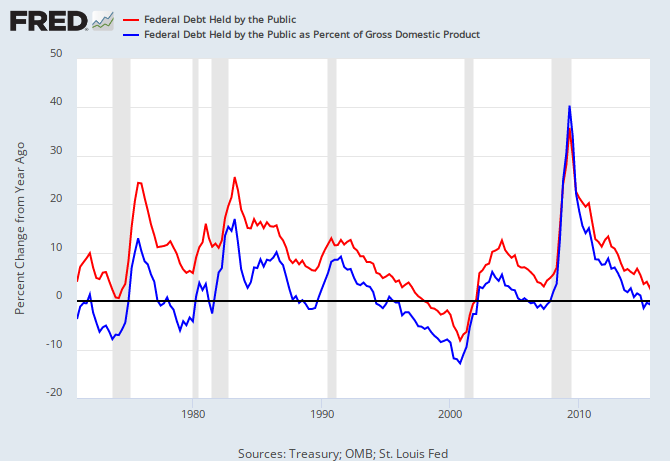
Recessions begin an average of 2 years after the blue line first dips below zero. A common phenomenon is for the line briefly to dip below zero, then rise above zero, before falling dramatically below zero. There was a brief dip below zero in 2015, followed by another dip – the familiar pre-recession pattern.
Recessions are cured by a rising red line.
Monetary Sovereignty

Vertical gray bars mark recessions.

As the federal deficit growth lines drop, we approach recession, which will be cured only when the growth lines rise. Increasing federal deficit growth (aka “stimulus”) is necessary for long-term economic growth.

————————————————————————————————————————————————————————————————————————————————————————————————-

Mitchell’s laws:
•Those, who do not understand the differences between Monetary Sovereignty and monetary non-sovereignty, do not understand economics.
•Any monetarily NON-sovereign government — be it city, county, state or nation — that runs an ongoing trade deficit, eventually will run out of money.
•The more federal budgets are cut and taxes increased, the weaker an economy becomes..

•No nation can tax itself into prosperity, nor grow without money growth.
•Cutting federal deficits to grow the economy is like applying leeches to cure anemia.
•A growing economy requires a growing supply of money (GDP = Federal Spending + Non-federal Spending + Net Exports)
•Deficit spending grows the supply of money
•The limit to federal deficit spending is an inflation that cannot be cured with interest rate control.
•The limit to non-federal deficit spending is the ability to borrow.

Liberals think the purpose of government is to protect the poor and powerless from the rich and powerful. Conservatives think the purpose of government is to protect the rich and powerful from the poor and powerless.

•The single most important problem in economics is the Gap between rich and the rest..
•Austerity is the government’s method for widening
the Gap between rich and poor.
•Until the 99% understand the need for federal deficits, the upper 1% will rule.
•Everything in economics devolves to motive, and the motive is the Gap between the rich and the rest..

MONETARY SOVEREIGNTY


Reversal of fortune: Liberal Republicans? Conservative Democrats?

Things change.

Since the Civil War,  and even well before, American Southerners essentially have had one fundamental political issue: Slavery.

This subsequently has broadened into more generalized hatred of non-whites, non-Christians, gays and foreigners, but it began with contempt for slaves. (Hatred does not accept boundaries.)

Because Lincoln was a Republican, the old “Solid South” voted against Republicans (i.e for Democrats) for nearly 100 years.

Wikipedia: By the mid-1960s, changes had come in many of the Southern states.

Former Dixiecrat Senator Strom Thurmond, of South Carolina changed parties in 1964; Texas elected a Republican Senator in 1961; Florida and Arkansas elected Republican governors in 1966.

In the upper South, where Republicans had always been a small presence, Republicans gained a few House and Senate seats.

Republican President Richard Nixon adopted a “Southern Strategy” for the presidential election of 1972: Continue enforcement of the civil rights legislation of the 1960s, but be quiet about it, so that offended Southern whites would continue to blame the Democrats, while talking up the Democrats’ increasing association with liberal views.

This strategy was wildly successful – Nixon carried every southern state by huge margins.

What formerly was Republican Lincolnian liberalism transitioned into Republican Nixonian conservatism. Today, the “Solid South” still votes hatred.

Nixon’s cynical pandering to Southern bigotry worked, and the same voters who were solidly Democratic are now solidly Republican.

But things change.

The nation’s population has become less white, and the nation, as a whole, has moved toward the liberal side of the spectrum.

Meanwhile, the nation’s richest .1% generally remain conservative, and their money (aka “free speech”) has moved the nation’s politicians to the right.

The leftward move of the population and the rightward move of the politicians is a dichotomy that never long continues.

Now, comes Donald Trump, a nominative Republican, who:
–donated money to Democrats
–does not subscribe to the conservative’s small government (code for “state’s rights”)
–likes single-payer Medicare and considers healthcare to be one of three federal responsibilities (along with education and the military)
–supports Planned Parenthood (except for abortion)
–historically has not adhered to the conservative agenda

In short, Trump, the anti-Cruz, still leans conservative, but is the most liberal of all Republican Presidential wannabes.

And, now comes Hillary Clinton nominative Democrat, who agrees with the Obama conservative agenda:
–cutting Social Security benefits
–budget-balancing deficit reduction and austerity
–coddling criminal bankers
–disagreeing with Bernie Sanders’ expansion of Medicare

In short, Clinton, the anti-Sanders, still leans liberal, but is the most conservative of the Democratic Presidential wannabes.

Are we witnessing the start of a trend, in which the Republicans become liberal and the Democrats become conservative?

A few facts:
*Congress currently is conservative.
*The nation, as a whole, has become far more liberal over the years.
*The population among the traditionally liberal is growing, while the conservative population is declining.
*The adoption of “Obamacare,” though invented by a conservative, still is a sign of growing liberalism
*The laws benefiting gays are signs of growing liberalism
*Even conservative media tend to lean liberal with regard to laws affecting the poor and middle classes
*Ted Cruz, the most conservative candidate, was soundly rebuffed by Republican voters
*Republicans hold their Congressional majorities only by denying minorities the vote and by gerrymandering
*Republicans only hope of a Presidency is via the non-representational Electoral College, counter to a one-man, one-vote democracy

While Trump drags Republicans to the left, Clinton drags Democrats to the right, and if the current course becomes a trend, and particularly if Clinton wins big, one easily could imagine a Sandersesque politician replacing Trump and taking over the Republican Party.

Politicians want first, to win. Pragmatic politics (realpolitik) may recognize America’s shift toward liberalism, so many conservative politicians could “jump ship” and decide, “If you can’t beat ’em, join ’em.”

Or, the two parties simply may discard the extremes on both sides, and approach each other, in a Trumpist/Clintonist blend of ideologies.

This moderation could be reflected in the Supreme Court, currently divided equally between liberal and conservative ideologies (thereby demonstrating the farcical myth of “disinterested” jurists measuring matters of Constitutional law).

Today, a right-wing Congress refuses to consider any Justice nominated by a Democratic President. The nations voters, who usually display more sense and understanding of the Constitution than does Congress, may reject such ideological polarization.

In summary, the haters will continue to hate, but their influence is waning. Bigotry is less in vogue these days. Because politicians are the world’s best followers, and as they notice which way the political winds are blowing, they may do as they are wont to do: Switch positions.

Which leaves the question: In switching, will they overshoot, with the Republicans becoming less conservative and more liberal even than the Democrats?

It has happened before.

In 1951 Eric Hoffer published a book titled, “The True Believer” in which he . . .

. . . analyzes and attempts to explain the motives of the various types of personalities that give rise to mass movements; why and how mass movements start, progress and end; and the similarities between them, whether religious, political, radical or reactionary.

He argues that even when their stated goals or values differ mass movements are interchangeable, that adherents will often flip from one movement to another, and that the motivations for mass movements are interchangeable.

Thus, religious, nationalist and social movements, whether radical or reactionary, tend to attract the same type of followers, behave in the same way and use the same tactics and rhetorical tools.

Hoffer states that mass movements begin with a widespread “desire for change” from discontented people who place their locus of control outside their power and who also have no confidence in existing culture or traditions.

As examples of the interchangeable nature of mass movements, Hoffer cites how almost 2000 years ago Saul, a fanatical opponent of Christianity, became Paul, a fanatical apologist and promoter of Christianity.

Another example occurred in Germany during the 1920s and the 1930s, when Communists and Fascists were ostensibly bitter enemies but in fact competed for the same type of angry, marginalized people; Nazis Adolf Hitler and Ernst Röhm, and Communist Karl Radek, all boasted of their prowess in converting their rivals.

The “New Poor” are the most likely source of converts for mass movements/for they recall their former wealth with resentment and blame others for their current misfortune.

While mass movements idealize the past and glorify the future, the present world is denigrated: “The radical and the reactionary loath the present.” Thus, by regarding the modern world as vile and worthless, mass movements inspire a perpetual battle against the present.

Successful mass movements need not believe in a god, but they must believe in a devil. Hatred unifies the true believers, and “the ideal devil is a foreigner.”

So it has been and so it may be. The mass movement that created the hate-based Tea/Republicans may flip to a liberal, Lincolnesque Republican party, while the rich, ever conservative, may create a conservative, Clintonesque Democratic party.

Thanks to Trump and Clinton, Sanders and Cruz, we may see yet another reversal of fortune.

Rodger Malcolm Mitchell
Monetary Sovereignty
===================================================================================
Ten Steps to Prosperity:
1. ELIMINATE FICA (Ten Reasons to Eliminate FICA )
Although the article lists 10 reasons to eliminate FICA, there are two fundamental reasons:
*FICA is the most regressive tax in American history, widening the Gap by punishing the low and middle-income groups, while leaving the rich untouched, and
*The federal government, being Monetarily Sovereign, neither needs nor uses FICA to support Social Security and Medicare.
2. FEDERALLY FUNDED MEDICARE — PARTS A, B & D, PLUS LONG TERM CARE — FOR EVERYONE (H.R. 676, Medicare for All )
This article addresses the questions:
*Does the economy benefit when the rich afford better health care than the rest of Americans?
*Aside from improved health care, what are the other economic effects of “Medicare for everyone?”
*How much would it cost taxpayers?
*Who opposes it?”
3. PROVIDE AN ECONOMIC BONUS TO EVERY MAN, WOMAN AND CHILD IN AMERICA, AND/OR EVERY STATE A PER CAPITA ECONOMIC BONUS (The JG (Jobs Guarantee) vs the GI (Guaranteed Income) vs the EB) Or institute a reverse income tax.
This article is the fifth in a series about direct financial assistance to Americans:

Why Modern Monetary Theory’s Employer of Last Resort is a bad idea. Sunday, Jan 1 2012
MMT’s Job Guarantee (JG) — “Another crazy, rightwing, Austrian nutjob?” Thursday, Jan 12 2012
Why Modern Monetary Theory’s Jobs Guarantee is like the EU’s euro: A beloved solution to the wrong problem. Tuesday, May 29 2012
“You can’t fire me. I’m on JG” Saturday, Jun 2 2012

Economic growth should include the “bottom” 99.9%, not just the .1%, the only question being, how best to accomplish that. Modern Monetary Theory (MMT) favors giving everyone a job. Monetary Sovereignty (MS) favors giving everyone money. The five articles describe the pros and cons of each approach.
4. FREE EDUCATION (INCLUDING POST-GRAD) FOR EVERYONEFive reasons why we should eliminate school loans
Monetarily non-sovereign State and local governments, despite their limited finances, support grades K-12. That level of education may have been sufficient for a largely agrarian economy, but not for our currently more technical economy that demands greater numbers of highly educated workers.
Because state and local funding is so limited, grades K-12 receive short shrift, especially those schools whose populations come from the lowest economic groups. And college is too costly for most families.
An educated populace benefits a nation, and benefiting the nation is the purpose of the federal government, which has the unlimited ability to pay for K-16 and beyond.
5. SALARY FOR ATTENDING SCHOOL
Even were schooling to be completely free, many young people cannot attend, because they and their families cannot afford to support non-workers. In a foundering boat, everyone needs to bail, and no one can take time off for study.
If a young person’s “job” is to learn and be productive, he/she should be paid to do that job, especially since that job is one of America’s most important.
6. ELIMINATE CORPORATE TAXES
Corporations themselves exist only as legalities. They don’t pay taxes or pay for anything else. They are dollar-tranferring machines. They transfer dollars from customers to employees, suppliers, shareholders and the government (the later having no use for those dollars).
Any tax on corporations reduces the amount going to employees, suppliers and shareholders, which diminishes the economy. Ultimately, all corporate taxes come around and reappear as deductions from your personal income.
7. INCREASE THE STANDARD INCOME TAX DEDUCTION, ANNUALLY. (Refer to this.)
Federal taxes punish taxpayers and harm the economy. The federal government has no need for those punishing and harmful tax dollars. There are several ways to reduce taxes, and we should evaluate and choose the most progressive approaches.
Cutting FICA and corporate taxes would be an good early step, as both dramatically affect the 99%. Annual increases in the standard income tax deduction, and a reverse income tax also would provide benefits from the bottom up. Both would narrow the Gap.
8. TAX THE VERY RICH (THE “.1%) MORE, WITH HIGHER PROGRESSIVE TAX RATES ON ALL FORMS OF INCOME. (TROPHIC CASCADE)
There was a time when I argued against increasing anyone’s federal taxes. After all, the federal government has no need for tax dollars, and all taxes reduce Gross Domestic Product, thereby negatively affecting the entire economy, including the 99.9%.
But I have come to realize that narrowing the Gap requires trimming the top. It simply would not be possible to provide the 99.9% with enough benefits to narrow the Gap in any meaningful way. Bill Gates reportedly owns $70 billion. To get to that level, he must have been earning $10 billion a year. Pick any acceptable Gap (1000 to 1?), and the lowest paid American would have to receive $10 million a year. Unreasonable.
9. FEDERAL OWNERSHIP OF ALL BANKS (Click The end of private banking and How should America decide “who-gets-money”?)
Banks have created all the dollars that exist. Even dollars created at the direction of the federal government, actually come into being when banks increase the numbers in checking accounts. This gives the banks enormous financial power, and as we all know, power corrupts — especially when multiplied by a profit motive.
Although the federal government also is powerful and corrupted, it does not suffer from a profit motive, the world’s most corrupting influence.
10. INCREASE FEDERAL SPENDING ON THE MYRIAD INITIATIVES THAT BENEFIT AMERICA’S 99.9% (Federal agencies)Browse the agencies. See how many agencies benefit the lower- and middle-income/wealth/ power groups, by adding dollars to the economy and/or by actions more beneficial to the 99.9% than to the .1%.
Save this reference as your primer to current economics. Sadly, much of the material is not being taught in American schools, which is all the more reason for you to use it.

The Ten Steps will grow the economy, and narrow the income/wealth/power Gap between the rich and you.
========================================================================================================================================================================================================================================================================================================

10 Steps to Economic Misery: (Click here:)
1. Maintain or increase the FICA tax..
2. Spread the myth Social Security, Medicare and the U.S. government are insolvent.
3. Cut federal employment in the military, post office, other federal agencies.
4. Broaden the income tax base so more lower income people will pay.
5. Cut financial assistance to the states.
6. Spread the myth federal taxes pay for federal spending.
7. Allow banks to trade for their own accounts; save them when their investments go sour.
8. Never prosecute any banker for criminal activity.
9. Nominate arch conservatives to the Supreme Court.
10. Reduce the federal deficit and debt

THE RECESSION CLOCK

Recessions begin an average of 2 years after the blue line first dips below zero. A common phenomenon is for the line briefly to dip below zero, then rise above zero, before falling dramatically below zero. There was a brief dip below zero in 2015, followed by another dip – the familiar pre-recession pattern.
Recessions are cured by a rising red line.

Monetary Sovereignty

Vertical gray bars mark recessions.

As the federal deficit growth lines drop, we approach recession, which will be cured only when the growth lines rise. Increasing federal deficit growth (aka “stimulus”) is necessary for long-term economic growth.

————————————————————————————————————————————————————————————————————————————————————————————————-

Mitchell’s laws:
•Those, who do not understand the differences between Monetary Sovereignty and monetary non-sovereignty, do not understand economics.
•Any monetarily NON-sovereign government — be it city, county, state or nation — that runs an ongoing trade deficit, eventually will run out of money.
•The more federal budgets are cut and taxes increased, the weaker an economy becomes..

•No nation can tax itself into prosperity, nor grow without money growth.
•Cutting federal deficits to grow the economy is like applying leeches to cure anemia.
•A growing economy requires a growing supply of money (GDP = Federal Spending + Non-federal Spending + Net Exports)
•Deficit spending grows the supply of money
•The limit to federal deficit spending is an inflation that cannot be cured with interest rate control.
•The limit to non-federal deficit spending is the ability to borrow.

Liberals think the purpose of government is to protect the poor and powerless from the rich and powerful. Conservatives think the purpose of government is to protect the rich and powerful from the poor and powerless.

•The single most important problem in economics is the Gap between rich and the rest..
•Austerity is the government’s method for widening
the Gap between rich and poor.
•Until the 99% understand the need for federal deficits, the upper 1% will rule.
•Everything in economics devolves to motive, and the motive is the Gap between the rich and the rest..

MONETARY SOVEREIGNTY

The transgender issue and why Trump won

The New Republican Party, which has evolved into the Party of Hatred, is so determined to foster bigotry, it steps on its own feet.

Consider this article, which demonstrates how Donald Trump came to be the New Republican presumptive Presidential nominee:

North Carolina Republicans Vow To Defy Feds On Bathroom Law
The lawmakers say they won’t be “bullied” into meeting the U.S. Justice Department’s Monday deadline to change the law.

WINSTON-SALEM, N.C. (Reuters) – Republican leaders in North Carolina on Thursday refused to back down from a law regulating which restrooms can be used by transgender people after the federal government told the state the law violated the U.S. Civil Rights Act.

The state’s leading Republican lawmaker, House Speaker Tim Moore, told reporters in Raleigh that North Carolina would not be “bullied” into meeting the U.S. Justice Department’s Monday deadline to change the law.

North Carolina is the first U.S. state to pass a law requiring transgender people to use public bathrooms that correspond with the sex on their birth certificate instead of the gender with which they identify.

Republican legislators in several other states have proposed similar laws, making transgender rights a hot-button social issue in an election year.

The irony of New Republicans hating to be “bullied” is not lost. Bullying people has become the New Republican forte.

There are no known cases in which a transgender person has used his “transgenderness” as an excuse for using the “wrong” bathroom.

But, facts do not stop the New Republicans from picking on yet another group. (Move over: Blacks, Latinos, Orientals, non-Christians, pregnant women and immigrants.)

Visualize this: A child is born with female genitalia, but being transgender, and having the feelings of a male, she undergoes surgeries and hormone therapies that make her, in fact, a physical man to match her (now his) emotional maleness.

He is, in fact, a man in every way, having all the sexual desires of a man.

In Republican North Carolina, this man will be forced to use the women’s bathroom.

Think about that.

And now you understand how a bigoted, lying con artist came to be the Republican’s presumptive nominee for President of the United States of America.

Should we laugh or weep?

Rodger Malcolm Mitchell
Monetary Sovereignty
===================================================================================
Ten Steps to Prosperity:
1. ELIMINATE FICA (Ten Reasons to Eliminate FICA )
Although the article lists 10 reasons to eliminate FICA, there are two fundamental reasons:
*FICA is the most regressive tax in American history, widening the Gap by punishing the low and middle-income groups, while leaving the rich untouched, and
*The federal government, being Monetarily Sovereign, neither needs nor uses FICA to support Social Security and Medicare.
2. FEDERALLY FUNDED MEDICARE — PARTS A, B & D, PLUS LONG TERM CARE — FOR EVERYONE (H.R. 676, Medicare for All )
This article addresses the questions:
*Does the economy benefit when the rich afford better health care than the rest of Americans?
*Aside from improved health care, what are the other economic effects of “Medicare for everyone?”
*How much would it cost taxpayers?
*Who opposes it?”
3. PROVIDE AN ECONOMIC BONUS TO EVERY MAN, WOMAN AND CHILDE IN AMERICA, AND/OR EVERY STATE A PER CAPITA ECONOMIC BONUS (The JG (Jobs Guarantee) vs the GI (Guaranteed Income) vs the EB) Or institute a reverse income tax.
This article is the fifth in a series about direct financial assistance to Americans:

Why Modern Monetary Theory’s Employer of Last Resort is a bad idea. Sunday, Jan 1 2012
MMT’s Job Guarantee (JG) — “Another crazy, rightwing, Austrian nutjob?” Thursday, Jan 12 2012
Why Modern Monetary Theory’s Jobs Guarantee is like the EU’s euro: A beloved solution to the wrong problem. Tuesday, May 29 2012
“You can’t fire me. I’m on JG” Saturday, Jun 2 2012

Economic growth should include the “bottom” 99.9%, not just the .1%, the only question being, how best to accomplish that. Modern Monetary Theory (MMT) favors giving everyone a job. Monetary Sovereignty (MS) favors giving everyone money. The five articles describe the pros and cons of each approach.
4. FREE EDUCATION (INCLUDING POST-GRAD) FOR EVERYONEFive reasons why we should eliminate school loans
Monetarily non-sovereign State and local governments, despite their limited finances, support grades K-12. That level of education may have been sufficient for a largely agrarian economy, but not for our currently more technical economy that demands greater numbers of highly educated workers.
Because state and local funding is so limited, grades K-12 receive short shrift, especially those schools whose populations come from the lowest economic groups. And college is too costly for most families.
An educated populace benefits a nation, and benefiting the nation is the purpose of the federal government, which has the unlimited ability to pay for K-16 and beyond.
5. SALARY FOR ATTENDING SCHOOL
Even were schooling to be completely free, many young people cannot attend, because they and their families cannot afford to support non-workers. In a foundering boat, everyone needs to bail, and no one can take time off for study.
If a young person’s “job” is to learn and be productive, he/she should be paid to do that job, especially since that job is one of America’s most important.
6. ELIMINATE CORPORATE TAXES
Corporations themselves exist only as legalities. They don’t pay taxes or pay for anything else. They are dollar-tranferring machines. They transfer dollars from customers to employees, suppliers, shareholders and the government (the later having no use for those dollars).
Any tax on corporations reduces the amount going to employees, suppliers and shareholders, which diminishes the economy. Ultimately, all corporate taxes come around and reappear as deductions from your personal income.
7. INCREASE THE STANDARD INCOME TAX DEDUCTION, ANNUALLY. (Refer to this.)
Federal taxes punish taxpayers and harm the economy. The federal government has no need for those punishing and harmful tax dollars. There are several ways to reduce taxes, and we should evaluate and choose the most progressive approaches.
Cutting FICA and corporate taxes would be an good early step, as both dramatically affect the 99%. Annual increases in the standard income tax deduction, and a reverse income tax also would provide benefits from the bottom up. Both would narrow the Gap.
8. TAX THE VERY RICH (THE “.1%) MORE, WITH HIGHER PROGRESSIVE TAX RATES ON ALL FORMS OF INCOME. (TROPHIC CASCADE)
There was a time when I argued against increasing anyone’s federal taxes. After all, the federal government has no need for tax dollars, and all taxes reduce Gross Domestic Product, thereby negatively affecting the entire economy, including the 99.9%.
But I have come to realize that narrowing the Gap requires trimming the top. It simply would not be possible to provide the 99.9% with enough benefits to narrow the Gap in any meaningful way. Bill Gates reportedly owns $70 billion. To get to that level, he must have been earning $10 billion a year. Pick any acceptable Gap (1000 to 1?), and the lowest paid American would have to receive $10 million a year. Unreasonable.
9. FEDERAL OWNERSHIP OF ALL BANKS (Click The end of private banking and How should America decide “who-gets-money”?)
Banks have created all the dollars that exist. Even dollars created at the direction of the federal government, actually come into being when banks increase the numbers in checking accounts. This gives the banks enormous financial power, and as we all know, power corrupts — especially when multiplied by a profit motive.
Although the federal government also is powerful and corrupted, it does not suffer from a profit motive, the world’s most corrupting influence.
10. INCREASE FEDERAL SPENDING ON THE MYRIAD INITIATIVES THAT BENEFIT AMERICA’S 99.9% (Federal agencies)Browse the agencies. See how many agencies benefit the lower- and middle-income/wealth/ power groups, by adding dollars to the economy and/or by actions more beneficial to the 99.9% than to the .1%.
Save this reference as your primer to current economics. Sadly, much of the material is not being taught in American schools, which is all the more reason for you to use it.

The Ten Steps will grow the economy, and narrow the income/wealth/power Gap between the rich and you.
========================================================================================================================================================================================================================================================================================================

10 Steps to Economic Misery: (Click here:)
1. Maintain or increase the FICA tax..
2. Spread the myth Social Security, Medicare and the U.S. government are insolvent.
3. Cut federal employment in the military, post office, other federal agencies.
4. Broaden the income tax base so more lower income people will pay.
5. Cut financial assistance to the states.
6. Spread the myth federal taxes pay for federal spending.
7. Allow banks to trade for their own accounts; save them when their investments go sour.
8. Never prosecute any banker for criminal activity.
9. Nominate arch conservatives to the Supreme Court.
10. Reduce the federal deficit and debt

THE RECESSION CLOCK

Recessions begin an average of 2 years after the blue line first dips below zero. A common phenomenon is for the line briefly to dip below zero, then rise above zero, before falling dramatically below zero. There was a brief dip below zero in 2015, followed by another dip – the familiar pre-recession pattern.
Recessions are cured by a rising red line.

Monetary Sovereignty

Vertical gray bars mark recessions.

As the federal deficit growth lines drop, we approach recession, which will be cured only when the growth lines rise. Increasing federal deficit growth (aka “stimulus”) is necessary for long-term economic growth.

————————————————————————————————————————————————————————————————————————————————————————————————-

Mitchell’s laws:
•Those, who do not understand the differences between Monetary Sovereignty and monetary non-sovereignty, do not understand economics.
•Any monetarily NON-sovereign government — be it city, county, state or nation — that runs an ongoing trade deficit, eventually will run out of money.
•The more federal budgets are cut and taxes increased, the weaker an economy becomes..

•No nation can tax itself into prosperity, nor grow without money growth.
•Cutting federal deficits to grow the economy is like applying leeches to cure anemia.
•A growing economy requires a growing supply of money (GDP = Federal Spending + Non-federal Spending + Net Exports)
•Deficit spending grows the supply of money
•The limit to federal deficit spending is an inflation that cannot be cured with interest rate control.
•The limit to non-federal deficit spending is the ability to borrow.

Liberals think the purpose of government is to protect the poor and powerless from the rich and powerful. Conservatives think the purpose of government is to protect the rich and powerful from the poor and powerless.

•The single most important problem in economics is the Gap between rich and the rest..
•Austerity is the government’s method for widening
the Gap between rich and poor.
•Until the 99% understand the need for federal deficits, the upper 1% will rule.
•Everything in economics devolves to motive, and the motive is the Gap between the rich and the rest..

MONETARY SOVEREIGNTY

The real difference between the 1% and the 99%

Twitter: @rodgermitchell; Search #monetarysovereignty
Facebook: Rodger Malcolm Mitchell

============================================================================================================================================================================================================================================================

As you now know, money is speech. The Supreme Court, and its dearly departed right-wing leader, Antonin Scalia said so, in its notorious “Citizens United” decision.

(This is the same group who decided that corporations are people, but that’s a separate issue.)

If money = speech, how much “speech” did you earn last year? How much “speech” do you spend on rent and food? Did your “speech” pay for your car?

If you are lucky and/or skillful, your earnings of “speech” could increase dramatically some day, in which case you will be entitled to more “speech” than you now are, the rich legally being allowed more “speech” than are the poor.

(And if you’re a corporation, your free speech rights will exceed those of virtually any citizen of America  — but that too, is a separate issue.)

Because money is “speech,” and rich people have more rights to speech than average folk, one would hope rich people, with all their speaking, also would be more truthful about economics than average folk.

Ah, would that it were so.

Today’s Chicago Tribune published an article titled, “Cruz megadonor holding back” which demonstrated the evils of lying money (i.e. false speech):

Ted Cruz, in his outsider’s bid for the white House, has depended heavily on the largesse of just three wealthy donors to establish credibility and stay afloat amid a chaotic nominating process that killed off most of his rivals.

One of the three primary donors, Toby Neugebauer, a private equity manager who recruited the other two top donors, has refrained from spending the vast majority of his $10 million contribution. After Citizens United and other court decisions opened the door to nearly unlimited campaign donations, many donors became frustrated with the control they surrendered to campaign consultants, who blew through millions of dollars on TV ads in a fruitless effort to elect Mitt Romney.

To counter the risk of a repeat of 2012, Neugebauer helped set up three supper PACs last year to support Cruz. The groups, forbidden by law to communicate with the Cruz campaign, planned to divvy up responsibility for aiding his candidacy.

Think about it. Romney’s campaign consultants “blew through millions on TV ads,” and there was no communication with the Romney campaign. Do you believe that?

Why would there be a law against communication? Isn’t this an unconstitutional limitation of free speech? Why can real speech, in the form of actual talking, be limited, but fake speech, in the form of money be unlimited?

Bad law begets more bad law, and our current Supreme Court is a champion of bad law.

Using “Scalialogic,” any limitation on money or speech is unconstitutional. So how did he overlook the few remaining limitations? Too ridiculous, even for him?

We now approach the crux of this post. People do not give millions of dollars to a Presidential candidate, unless they expect something in return.

At minimum, they get access to a President. (When was the last time you had a private discussion with a President of the United States?)

More than just access, they often get special favors, which is why our tax code is so convoluted.  All those special favors baked into the code, make for mind-numbing complexity.  Many laws benefit just one taxpayer — and trust me on this, that one taxpayer is a rich donor.

Ten donors have given a total of $48 million. Many of them made their money in oil and gas, industries that have received strong support from Cruz.

Only the most suspicious among us would believe there is any connection between the rich giving Cruz $10 million, $20 million, $48 million or more of their precious dollars and Cruz supporting “drill, baby drill” everywhere possible.

No, the rich like to deny any selfish reason why they bet all that money on a candidate whom John Boehner referred to as “Lucifer in the flesh.”

Instead, the rich offer high-minded motives, because as everyone knows, the rich are generous, compassionate people, who care only about those less fortunate — which is why the rich want to cut your Social Security, Medicare and Medicaid benefits.

Such cuts are for your own good.

So here it is:

Neugebauer said he and the other donors were not motivated by personal issues or gain. Rather, he said, they are united by a concern for the country’s debt.

“I know its sounds crazy,” he said. “We are anti-establishment, and we all think the country is on the precipice of insolvency.”

You believe this, don’t you: The rich are not motivated by personal issues. The rich are not motivated by personal gain.

And, the rich are anti-establishment? Right, anti the very establishment that has made all their tax savings and corporate wealth possible — which is why they are donating many millions to an establishment Senator.

Makes sense to me.

But what doesn’t make sense to me is how these rich people actually could believe that our Monetarily Sovereign America is “on the precipice of insolvency.”

Is it possible these people are so out of touch with reality, that they truly believe America, which pays all its bills by creating dollars ad hoc, suddenly will lose the ability to create its own sovereign currency?

No.

The phony “insolvency” issue is the rationale for cutting your Social Security and taxing your benefits, cutting your Medicare, cutting your Medicaid, increasing your FICA,  cutting food stamps and other aids to the poor, and lending you (rather than giving you) dollars for college — loans that uniquely cannot be discharged even in bankruptcy.

The very heart of the 1%s efforts to widen the Gap between the rich and the rest is known as the Big Lie, which in its simplest version is: Federal taxes fund federal spending.

Every misstatement about economics, promulgated by the rich (via their bought-and-paid-for media, politicians and economists) evolves from that one simple lie.

While state, county, and city taxes fund state’s, county’s and city’s spending, federal taxes do not fund federal spending. That is the difference between federal financing and all other financing.

And, the real difference between the 1% and the 99%, is this: The 1% tell the Big Lie; the 99% believe the Big Lie.

Rodger Malcolm Mitchell
Monetary Sovereignty


===================================================================================
Ten Steps to Prosperity:
1. Eliminate FICA (Click here)
2. Federally funded Medicare — parts A, B & D plus long term nursing care — for everyone (Click here)
3. Provide an Economic Bonus to every man, woman and child in America, and/or every state a per capita Economic Bonus. (Click here) Or institute a reverse income tax.
4. Free education (including post-grad) for everyone. Click here
5. Salary for attending school (Click here)
6. Eliminate corporate taxes (Click here)
7. Increase the standard income tax deduction annually Click here
8. Tax the very rich (.1%) more, with higher, progressive tax rates on all forms of income. (Click here)
9. Federal ownership of all banks (Click here and here)

10. Increase federal spending on the myriad initiatives that benefit America’s 99% (Click here)

The Ten Steps will grow the economy, and narrow the income/wealth/power Gap between the rich and you.
========================================================================================================================================================================================================================================================================================================

10 Steps to Economic Misery: (Click here:)
1. Maintain or increase the FICA tax..
2. Spread the myth Social Security, Medicare and the U.S. government are insolvent.
3. Cut federal employment in the military, post office, other federal agencies.
4. Broaden the income tax base so more lower income people will pay.
5. Cut financial assistance to the states.
6. Spread the myth federal taxes pay for federal spending.
7. Allow banks to trade for their own accounts; save them when their investments go sour.
8. Never prosecute any banker for criminal activity.
9. Nominate arch conservatives to the Supreme Court.
10. Reduce the federal deficit and debt

THE RECESSION CLOCK

Recessions begin an average of 2 years after the blue line first dips below zero. A common phenomenon is for the line briefly to dip below zero, then rise above zero, before falling dramatically below zero. There was a brief dip below zero in 2015, followed by another dip – the familiar pre-recession pattern.
Recessions are cured by a rising red line.

Monetary Sovereignty

Vertical gray bars mark recessions.

As the federal deficit growth lines drop, we approach recession, which will be cured only when the growth lines rise. Increasing federal deficit growth (aka “stimulus”) is necessary for long-term economic growth.

————————————————————————————————————————————————————————————————————————————————————————————————-

Mitchell’s laws:
•Those, who do not understand the differences between Monetary Sovereignty and monetary non-sovereignty, do not understand economics.
•Any monetarily NON-sovereign government — be it city, county, state or nation — that runs an ongoing trade deficit, eventually will run out of money.
•The more federal budgets are cut and taxes increased, the weaker an economy becomes..

•No nation can tax itself into prosperity, nor grow without money growth.
•Cutting federal deficits to grow the economy is like applying leeches to cure anemia.
•A growing economy requires a growing supply of money (GDP = Federal Spending + Non-federal Spending + Net Exports)
•Deficit spending grows the supply of money
•The limit to federal deficit spending is an inflation that cannot be cured with interest rate control.
•The limit to non-federal deficit spending is the ability to borrow.

Liberals think the purpose of government is to protect the poor and powerless from the rich and powerful. Conservatives think the purpose of government is to protect the rich and powerful from the poor and powerless.

•The single most important problem in economics is the Gap between rich and the rest..
•Austerity is the government’s method for widening
the Gap between rich and poor.
•Until the 99% understand the need for federal deficits, the upper 1% will rule.
•Everything in economics devolves to motive, and the motive is the Gap between the rich and the rest..

MONETARY SOVEREIGNTY