Ten Steps to Prosperity: Step 2. Federally funded Medicare — Parts A, B & D, plus long-term care — for everyone

Twitter: @rodgermitchell; Search #monetarysovereignty
Facebook: Rodger Malcolm Mitchell

It takes only two things to keep people in chains: The ignorance of the oppressed and the treachery of their leaders.

……………………………………………………………………………………………………………………………………………………………………………………………………………………………………………………………………………..

If you were to select the single best measure of a nation’s greatness, you would be hard-pressed to find one better than the healthcare of its people.

Background:

As we learned previously, our Monetarily Sovereign nation never can run low on its own sovereign currency, the U.S. dollar, and also has the unlimited ability to determine the value of the dollar (i.e. prevent inflation).

Further, federal deficits build the economy, while federal surpluses or deficit reductions (i.e. “austerity”) weaken the economy. Given those facts, what should the federal government do.  More generally: What is the purpose of government?

The fundamental purpose of any government is to enhance the wellbeing of its people — all its people — rich and poor, old and young, strong and weak.

In this series describing the Ten Steps to Prosperity, we suggested eliminating FICA as the first Step. For the second Step, we suggest:

Step 2: Federally funded Medicare — Parts A, B & D, plus long-term care — for everyone

Fortunately, most of the hard work is done.  We already know how to do Medicare. We have encountered and addressed all the functional difficulties. No operational mysteries remain.

We now need to do just four things:

  1. Change the minimum age of recipients to zero
  2. Change Part D to a federally funded program, rather than a private insurance funded program.
  3. Expand Medicare benefits to include even those benefits now covered by private Supplementary insurance.
  4. Fund long-term care insurance.

Image result for long term care

The purpose is to make affordability a non-issue. There is no moral justification for the richer being able to afford better healthcare than the poorer. Under American law, all people are to be treated equally.

A courtroom judge who habitually gives better outcomes to rich claimants and rich defendants is in violation of the law. Similarly, a police officer, a firefighter, a public librarian, should not offer better treatment and service to the rich.

Yes, of course, it happens.  But, it’s illegal and more importantly, it’s immoral.

Further,  there is no economic justification for some Americans having no healthcare insurance or incomplete healthcare insurance. Poor health leads to costly absences and poor work performance from school and from work. In short, sick students and sick employees do not do well.

Simply improving American health would improve education, and improve business productivity and efficiency.

There is not a single, logical reason why the U.S. federal government does not underwrite healthcare for all. As Americans we all deserve it; as people we all need it. Our businesses would benefit from it.  And our Monetarily Sovereign federal government can afford it.

The U.S. federal government does not keep dollars on hand to pay bills. Instead, it creates dollars, ad hoc, by paying bills.

Funding “Medicare for all” would cost the federal government nothing.

Why? Because after paying for “Medicare for all,” the federal government would still own exactly the same number of dollars as it owned before it paid. Spending is cost-free to a Monetarily Sovereign govenment.

By contrast, today, our private sector, i.e our economy, absorbs a huge cost burden of healthcare.

In an earlier post, we described H.R. 676, Medicare for All. Here are some excerpts from that post:

Look around the world, and you will see the “best” nations providing the best health care and the “worst” nations providing the worst health care.

The U.S. Declaration of Independence says, “. . . [all men] are endowed by their Creator with certain unalienable Rights, that among these are Life, Liberty and the pursuit of Happiness.” Surely, good health is part of that trio.

Because private healthcare insurers do not provide affordable coverage to the broad populace, Medicare and Medicaid were great improvements. But the problem of significant uninsured and underinsured remains.

For a nation that views itself as the world’s leader in most things, this is unacceptable.

Obamacare, aka “Romneycare,” was an attempt to include more people, but it is a complex, convoluted, inefficient program no one fully understands, and it still leaves many uninsured.

For years, I have favored providing full Medicare for everyone — a Medicare coverage so complete that neither Medicaid nor supplemental policies would be necessary.

And such a bill exists — almost. It is H.R. 676, Medicare for All:
“To provide for comprehensive health insurance coverage for all United States residents, improved health care delivery, and for other purposes.”

Some features of the bill:

All individuals residing in the United States (including any territory of the United States) are covered under the Medicare For All Program entitling them to a universal, best quality standard of care

The health care benefits under this Act cover all medically necessary services, including at least the following:
(1) Primary care and prevention.
(2) Approved dietary and nutritional therapies.
(3) Inpatient care.
(4) Outpatient care.
(5) Emergency care.
(6) Prescription drugs.
(7) Durable medical equipment.
(8) Long-term care.
(9) Palliative care.
(10) Mental health services.
(11) The full scope of dental services, services, including periodontics, oral surgery, and endodontics, but not including cosmetic dentistry.
(12) Substance abuse treatment services.
(13) Chiropractic services, not including electrical stimulation.
(14) Basic vision care and vision correction (other than laser vision correction for cosmetic purposes).
(15) Hearing services, including coverage of hearing aids.
(16) Podiatric care.

No deductibles, copayments, coinsurance, or other cost-sharing shall be imposed with respect to covered benefits.

The Program shall pay physicians, dentists, doctors of osteopathy, pharmacists, psychologists, chiropractors, doctors of optometry, nurse practitioners, nurse midwives, physicians’ assistants, and other advanced practice clinicians.

Medicare for All not only would cover everyone, but by eliminating deductibles, co-payments and coinsurance, it eliminates the need to shop around for additional coverages, or even to worry about which form of Medicare to acquire.

Finally, “Medicare for All” simplifies America’s healthcare. In addition to eliminating the “middleman” (the healthcare insurance agencies) there would be:

  1. No need for a complex, convoluted, expensive supplementary plan like ACA (Obamacare)
  2. No need for Medicaid
  3. No need for the massive medical and long-term care functions of the Department of Veterans Affairs.
  4. No need for expensive, long-term care insurance policies.

It would be the simplest possible plan: Everyone would receive care according to their needs. Period.

In short, we currently have aImage result for obama medicaid expansion status system in which there is a high cost to the public, for mediocre or no service (orange colored states) to a significant percentage of Americans .

We should replace it with a system in which there is no cost to anyone, for far better service to all Americans: Federally funded, comprehensive Medicare — Parts A, B & D, plus long-term care — for everyone.


Rodger Malcolm Mitchell
Monetary Sovereignty

………………………………………………………………………………………………………………………………………………………………………………………………………………………………………………………………………………………………………………………………………..

The single most important problems in economics involve the excessive income/wealth/power Gaps between the have-mores and the have-less.

Wide Gaps negatively affect poverty, health and longevity, education, housing, law and crime, war, leadership, ownership, bigotry, supply and demand, taxation, GDP, international relations, scientific advancement, the environment, human motivation and well-being, and virtually every other issue in economics.

Implementation of The Ten Steps To Prosperity can narrow the Gaps:

Ten Steps To Prosperity:
1. ELIMINATE FICA (Ten Reasons to Eliminate FICA )
Although the article lists 10 reasons to eliminate FICA, there are two fundamental reasons:
*FICA is the most regressive tax in American history, widening the Gap by punishing the low and middle-income groups, while leaving the rich untouched, and
*The federal government, being Monetarily Sovereign, neither needs nor uses FICA to support Social Security and Medicare.
2. FEDERALLY FUNDED MEDICARE — PARTS A, B & D, PLUS LONG TERM CARE — FOR EVERYONE (H.R. 676, Medicare for All )
This article addresses the questions:
*Does the economy benefit when the rich can afford better health care than can the rest of Americans?
*Aside from improved health care, what are the other economic effects of “Medicare for everyone?”
*How much would it cost taxpayers?
*Who opposes it?”
3. PROVIDE AN ANNUAL ECONOMIC BONUS TO EVERY MAN, WOMAN AND CHILD IN AMERICA, AND/OR EVERY STATE, A PER CAPITA ECONOMIC BONUS (Social Security for All) (The JG (Jobs Guarantee) vs the GI (Guaranteed Income) vs the EB (Guaranteed Income)) Or institute a reverse income tax.
This article is the fifth in a series about direct financial assistance to Americans:

Why Modern Monetary Theory’s Employer of Last Resort is a bad idea. Sunday, Jan 1 2012
MMT’s Job Guarantee (JG) — “Another crazy, rightwing, Austrian nutjob?” Thursday, Jan 12 2012
Why Modern Monetary Theory’s Jobs Guarantee is like the EU’s euro: A beloved solution to the wrong problem. Tuesday, May 29 2012
“You can’t fire me. I’m on JG” Saturday, Jun 2 2012

Economic growth should include the “bottom” 99.9%, not just the .1%, the only question being, how best to accomplish that. Modern Monetary Theory (MMT) favors giving everyone a job. Monetary Sovereignty (MS) favors giving everyone money. The five articles describe the pros and cons of each approach.
4. FREE EDUCATION (INCLUDING POST-GRAD) FOR EVERYONEFive reasons why we should eliminate school loans
Monetarily non-sovereign State and local governments, despite their limited finances, support grades K-12. That level of education may have been sufficient for a largely agrarian economy, but not for our currently more technical economy that demands greater numbers of highly educated workers.
Because state and local funding is so limited, grades K-12 receive short shrift, especially those schools whose populations come from the lowest economic groups. And college is too costly for most families.
An educated populace benefits a nation, and benefitting the nation is the purpose of the federal government, which has the unlimited ability to pay for K-16 and beyond.
5. SALARY FOR ATTENDING SCHOOL
Even were schooling to be completely free, many young people cannot attend, because they and their families cannot afford to support non-workers. In a foundering boat, everyone needs to bail, and no one can take time off for study.
If a young person’s “job” is to learn and be productive, he/she should be paid to do that job, especially since that job is one of America’s most important.
6. ELIMINATE CORPORATE TAXES
Corporations themselves exist only as legalities. They don’t pay taxes or pay for anything else. They are dollar-transferring machines. They transfer dollars from customers to employees, suppliers, shareholders and the government (the later having no use for those dollars).
Any tax on corporations reduces the amount going to employees, suppliers and shareholders, which diminishes the economy. Ultimately, all corporate taxes come around and reappear as deductions from your personal income.
7. INCREASE THE STANDARD INCOME TAX DEDUCTION, ANNUALLY. (Refer to this.) Federal taxes punish taxpayers and harm the economy. The federal government has no need for those punishing and harmful tax dollars. There are several ways to reduce taxes, and we should evaluate and choose the most progressive approaches.
Cutting FICA and corporate taxes would be a good early step, as both dramatically affect the 99%. Annual increases in the standard income tax deduction, and a reverse income tax also would provide benefits from the bottom up. Both would narrow the Gap.
8. TAX THE VERY RICH (THE “.1%) MORE, WITH HIGHER PROGRESSIVE TAX RATES ON ALL FORMS OF INCOME. (TROPHIC CASCADE)
There was a time when I argued against increasing anyone’s federal taxes. After all, the federal government has no need for tax dollars, and all taxes reduce Gross Domestic Product, thereby negatively affecting the entire economy, including the 99.9%.
But I have come to realize that narrowing the Gap requires trimming the top. It simply would not be possible to provide the 99.9% with enough benefits to narrow the Gap in any meaningful way. Bill Gates reportedly owns $70 billion. To get to that level, he must have been earning $10 billion a year. Pick any acceptable Gap (1000 to 1?), and the lowest paid American would have to receive $10 million a year. Unreasonable.
9. FEDERAL OWNERSHIP OF ALL BANKS (Click The end of private banking and How should America decide “who-gets-money”?)
Banks have created all the dollars that exist. Even dollars created at the direction of the federal government, actually come into being when banks increase the numbers in checking accounts. This gives the banks enormous financial power, and as we all know, power corrupts — especially when multiplied by a profit motive.
Although the federal government also is powerful and corrupted, it does not suffer from a profit motive, the world’s most corrupting influence.
10. INCREASE FEDERAL SPENDING ON THE MYRIAD INITIATIVES THAT BENEFIT AMERICA’S 99.9% (Federal agencies)Browse the agencies. See how many agencies benefit the lower- and middle-income/wealth/ power groups, by adding dollars to the economy and/or by actions more beneficial to the 99.9% than to the .1%.
Save this reference as your primer to current economics. Sadly, much of the material is not being taught in American schools, which is all the more reason for you to use it.

The Ten Steps will grow the economy, and narrow the income/wealth/power Gap between the rich and you.

MONETARY SOVEREIGNTY
What will the Ten Steps to Prosperity Cost?

Twitter: @rodgermitchell; Search #monetarysovereignty
Facebook: Rodger Malcolm Mitchell

…………………………………………………………………………………………………………………………………………………………………………..

It takes only two things to keep people in chains: The ignorance of the oppressed and the treachery of their leaders.

…………………………………………………………………………………………………………………………………………………………………………………………………………………………………….

We had begun to write a short explanation for each of the Ten Steps to Prosperity (listed below and at the end of many posts), when someone asked me, “What will the Ten Steps to Prosperity cost?”

The question seems on the surface to be reasonable, but in fact, it is nonsensical.

There are two parties involved in each Step: The private sector and the federal government. So the question should be divided into two questions:

What will be the cost to the private sector?
What will be the cost to the federal government?

If you quickly examine the Ten Steps, you find that all but one — question #8 — involve no cost to the private sector whatsoever. They all describe financial benefits only.

So, the question simplifies to: “What will be the cost to the federal government?” and that question is nonsensical, for there never can be a cost to our federal government.

I’ll explain: The U.S. federal government is Monetarily Sovereign  (See link). It creates its own sovereign currency, the dollar, by paying creditors. That is the federal government’s primary method for creating dollars.

To pay a creditor, the federal government sends instructions (not dollars) to the creditor’s bank, instructing the bank to increase the balance in the creditor’s checking account.  The instructions are in the form of a check or wire. When the bank does as instructed, dollars are created.

There is no cost to the federal government for sending instructions.

You might ask, “What do we mean by ‘cost'”? Here are two examples for clarification.

Example 1: 

Let’s say you own a hundred thousand dollars in total, all which reside in your checking account. You decide to buy a car for $25K. You give the car dealer your check for $25K and he gives you the car.

Your check actually constitutes instructions to your bank to deduct $25K from your checking account and to send the instructions to the car dealer’s bank, telling that bank to increase the balance in the car dealer’s checking account.

When your bank obeys your instructions and deducts $25K from your checking account, you then own a total of $75K.

The cost to you has been twenty five thousand dollars.

Example 2:

This time you own zero dollars, but again you decide to buy that car for $25K.

You find a random scrap of paper, and on it you scribble “$25K,” and you give that scrap of paper to the car dealer.

Then — and this is the important part —  imagine the car dealer decides to accept that scrap as payment, and gives you your car. 

Further, the car dealer’s bank also accepts that scrap of paper, and credits the car dealer’s checking account.

You ended with the same amount of money with which you started. (Zero dollars). There has been no cost to you.

Example 2 represents the way the federal government pays its bills. Being Monetarily Sovereign, the federal government creates dollars, ad hoc, by paying bills. (State and local governments, you, and I, being monetarily non-sovereign, can’t do this.)

When the government pays a bill, no dollars are deducted from the total the government owns. Instead, brand new dollars are created.

The reason: Unlike you and me and every other member of the private sector, the federal government does not “own” any dollars, nor does it need to. There are many measures of our economy’s money supply — M1, M2, M3, L — and none of these includes dollars that might be owned by our federal government.

No such measure is possible or even logical for an entity that creates dollars  at will.

When you wrote $25K on that scrap of paper, and the car dealer and his bank accepted it as payment, for that moment you were Monetarily Sovereign. Just like our federal government, you had the unlimited ability to write numbers on paper, and have those numbers accepted in exchange for goods and services — in this case, a car.

Because those scraps of paper were accepted by creditors, just as dollar bills would have been, no dollars were taken from your bank, and the purchase cost you nothing.

In the previous post, we indicated that eliminating FICA would reduce tax collections by about $1.7 trillion in one year. But, this would not cost the federal government $1.7 trillion. It would not cost the federal government anything.

Because federal tax dollars sent to the federal government cease to be part of the money supply, they effectively are destroyed upon receipt. So not receiving dollars that would have been destroyed anyway, represents no cost to the federal government.

Thus, the question, “What will it cost?” is nonsensical.

The correct question is, “How much growth will this add to our economy?” Sadly, it is a question neither I, nor anyone else on this planet, can answer because it involves too many uncertain variables, not the least of which is human psychology.

Economics is extensively intertwined with unpredictable human psychology as well as with other unpredictables (seismology, meteorology, etc.) which is why economic predictions fail, not just in the long term but even in the short term.

That said, federal deficit spending historically has been stimulative and has cured recessions, while reductions in federal deficit spending have led to recessions and depressions.

Talk of economic growth invariably leads to concerns about inflation, which we discuss at the post “The economics of chaos.

The short answer to the inflation question is: Being a large Monetarily Sovereign nation, the U.S. government has absolute control over the value of the U.S. dollar when it wishes to use that control.

That is a prime reason why despite massive deficit spending, despite many recessions and many wars — even civil and world wars — the U.S. economy never has experienced hyperinflation.  Not even close.

To answer the title question, implementing the Ten Steps to Prosperity will cost our Monetarily Sovereign, federal government nothing, and will narrow the Gap between the richer and poorer, and benefit the public.

There remains no excuse not to implement the Ten Steps.

Rodger Malcolm Mitchell
Monetary Sovereignty

………………………………………………………………………………………………………………………………………………………………………………………………………………………………………………………………………………………………………………………………………..

The single most important problems in economics involve the excessive income/wealth/power Gaps between the have-mores and the have-less.

Wide Gaps negatively affect poverty, health and longevity, education, housing, law and crime, war, leadership, ownership, bigotry, supply and demand, taxation, GDP, international relations, scientific advancement, the environment, human motivation and well-being, and virtually every other issue in economics.

Implementation of The Ten Steps To Prosperity can narrow the Gaps:

Ten Steps To Prosperity:
1. ELIMINATE FICA (Ten Reasons to Eliminate FICA )
Although the article lists 10 reasons to eliminate FICA, there are two fundamental reasons:
*FICA is the most regressive tax in American history, widening the Gap by punishing the low and middle-income groups, while leaving the rich untouched, and
*The federal government, being Monetarily Sovereign, neither needs nor uses FICA to support Social Security and Medicare.
2. FEDERALLY FUNDED MEDICARE — PARTS A, B & D, PLUS LONG TERM CARE — FOR EVERYONE (H.R. 676, Medicare for All )
This article addresses the questions:
*Does the economy benefit when the rich can afford better health care than can the rest of Americans?
*Aside from improved health care, what are the other economic effects of “Medicare for everyone?”
*How much would it cost taxpayers?
*Who opposes it?”
3. PROVIDE AN ANNUAL ECONOMIC BONUS TO EVERY MAN, WOMAN AND CHILD IN AMERICA, AND/OR EVERY STATE, A PER CAPITA ECONOMIC BONUS (Social Security for All) (The JG (Jobs Guarantee) vs the GI (Guaranteed Income) vs the EB (Guaranteed Income)) Or institute a reverse income tax.
This article is the fifth in a series about direct financial assistance to Americans:

Why Modern Monetary Theory’s Employer of Last Resort is a bad idea. Sunday, Jan 1 2012
MMT’s Job Guarantee (JG) — “Another crazy, rightwing, Austrian nutjob?” Thursday, Jan 12 2012
Why Modern Monetary Theory’s Jobs Guarantee is like the EU’s euro: A beloved solution to the wrong problem. Tuesday, May 29 2012
“You can’t fire me. I’m on JG” Saturday, Jun 2 2012

Economic growth should include the “bottom” 99.9%, not just the .1%, the only question being, how best to accomplish that. Modern Monetary Theory (MMT) favors giving everyone a job. Monetary Sovereignty (MS) favors giving everyone money. The five articles describe the pros and cons of each approach.
4. FREE EDUCATION (INCLUDING POST-GRAD) FOR EVERYONEFive reasons why we should eliminate school loans
Monetarily non-sovereign State and local governments, despite their limited finances, support grades K-12. That level of education may have been sufficient for a largely agrarian economy, but not for our currently more technical economy that demands greater numbers of highly educated workers.
Because state and local funding is so limited, grades K-12 receive short shrift, especially those schools whose populations come from the lowest economic groups. And college is too costly for most families.
An educated populace benefits a nation, and benefitting the nation is the purpose of the federal government, which has the unlimited ability to pay for K-16 and beyond.
5. SALARY FOR ATTENDING SCHOOL
Even were schooling to be completely free, many young people cannot attend, because they and their families cannot afford to support non-workers. In a foundering boat, everyone needs to bail, and no one can take time off for study.
If a young person’s “job” is to learn and be productive, he/she should be paid to do that job, especially since that job is one of America’s most important.
6. ELIMINATE CORPORATE TAXES
Corporations themselves exist only as legalities. They don’t pay taxes or pay for anything else. They are dollar-transferring machines. They transfer dollars from customers to employees, suppliers, shareholders and the government (the later having no use for those dollars).
Any tax on corporations reduces the amount going to employees, suppliers and shareholders, which diminishes the economy. Ultimately, all corporate taxes come around and reappear as deductions from your personal income.
7. INCREASE THE STANDARD INCOME TAX DEDUCTION, ANNUALLY. (Refer to this.) Federal taxes punish taxpayers and harm the economy. The federal government has no need for those punishing and harmful tax dollars. There are several ways to reduce taxes, and we should evaluate and choose the most progressive approaches.
Cutting FICA and corporate taxes would be a good early step, as both dramatically affect the 99%. Annual increases in the standard income tax deduction, and a reverse income tax also would provide benefits from the bottom up. Both would narrow the Gap.
8. TAX THE VERY RICH (THE “.1%) MORE, WITH HIGHER PROGRESSIVE TAX RATES ON ALL FORMS OF INCOME. (TROPHIC CASCADE)
There was a time when I argued against increasing anyone’s federal taxes. After all, the federal government has no need for tax dollars, and all taxes reduce Gross Domestic Product, thereby negatively affecting the entire economy, including the 99.9%.
But I have come to realize that narrowing the Gap requires trimming the top. It simply would not be possible to provide the 99.9% with enough benefits to narrow the Gap in any meaningful way. Bill Gates reportedly owns $70 billion. To get to that level, he must have been earning $10 billion a year. Pick any acceptable Gap (1000 to 1?), and the lowest paid American would have to receive $10 million a year. Unreasonable.
9. FEDERAL OWNERSHIP OF ALL BANKS (Click The end of private banking and How should America decide “who-gets-money”?)
Banks have created all the dollars that exist. Even dollars created at the direction of the federal government, actually come into being when banks increase the numbers in checking accounts. This gives the banks enormous financial power, and as we all know, power corrupts — especially when multiplied by a profit motive.
Although the federal government also is powerful and corrupted, it does not suffer from a profit motive, the world’s most corrupting influence.
10. INCREASE FEDERAL SPENDING ON THE MYRIAD INITIATIVES THAT BENEFIT AMERICA’S 99.9% (Federal agencies)Browse the agencies. See how many agencies benefit the lower- and middle-income/wealth/ power groups, by adding dollars to the economy and/or by actions more beneficial to the 99.9% than to the .1%.
Save this reference as your primer to current economics. Sadly, much of the material is not being taught in American schools, which is all the more reason for you to use it.

The Ten Steps will grow the economy, and narrow the income/wealth/power Gap between the rich and you.

MONETARY SOVEREIGNTY

The Ten Steps to Prosperity: Step 1. Eliminate FICA

Twitter: @rodgermitchell; Search #monetarysovereignty
Facebook: Rodger Malcolm Mitchell

…………………………………………………………………………………………………………………………………………………………………………..

It takes only two things to keep people in chainsThe ignorance of the oppressed and the treachery of their leaders.

………………………………………………………………………………………………………………………………………………………………………………………………………………………………………………………………………………………………………..

If you are a regular reader of this blog, you have seen “The Ten Steps to Prosperity” at the end of many posts, including this one.

Each Step includes one or more links that provide explanations and justifications. However, some people find clicking from page to page inconveniently interrupts the continuity of thought.

So, for your convenience, we will devote each of the next few posts to one Step.

Background:
The single biggest problem in world and American economics is the wide and widening Gaps between the richest and those below them (in terms of income, wealth, and power). The Ten Steps were created to address that problem.

The U.S. federal government is Monetarily Sovereign, meaning it is sovereign over its own currency, the dollar.

The government can do anything it wishes with the dollar. It can create dollars, destroy dollars, and give dollars any values it chooses. It never can run short of dollars, it can pay any creditor any amount, and it can cause or cure inflation, at will.

Step #1. Eliminate FICA.
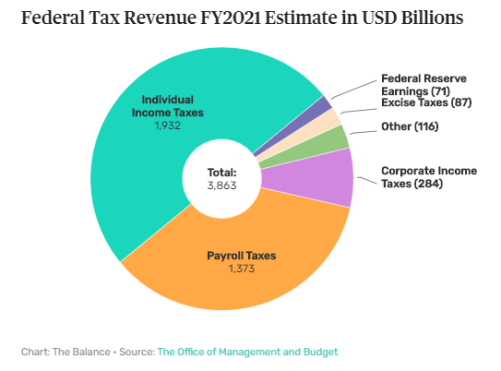
The federal government has three primary sources of income: Individual Income Tax (47%), Corporate Income Tax (11%), and FICA (33%).

But, because the federal government can create dollars at will, and never can run short of dollars, it neither needs nor uses income

Even if all of the above-mentioned taxes were eliminated, the federal government could continue spending forever.

This image has an empty alt attribute; its file name is federal-tax-revenue-2021.png

In 2021, $3.86 trillion will be taken from the economy and destroyed

Alan Greenspan: “A government cannot become insolvent with respect to obligations in its own currency.”

Ben Bernanke: “The U.S. government has a technology, called a printing press (or, today, its electronic equivalent), that allows it to produce as many U.S. dollars as it wishes at essentially no cost.”

St. Louis Federal Reserve: “As the sole manufacturer of dollars, whose debt is denominated in dollars, the U.S. government can never become insolvent, i.e.,unable to pay its bills. In this sense, the government is not dependent on credit markets to remain operational.”

The most common measure of the economy as a whole is Gross Domestic Product (GDP). The formula is GDP = Federal Spending + Non-federal Spending + Net Exports.

Federal taxes remove dollars from the economy, while federal spending adds dollars to the economy. When federal spending exceeds federal taxing, i.e adds net dollars to the economy, this misleadingly is termed a “deficit.”

When federal taxing exceeds federal spending, this is termed a “surplus.”

A federal surplus is the economy’s deficit, and a federal deficit provides the economy with a surplus.

Thus, contrary to popular intuition, federal surpluses are recessionary and federal deficits lead to GDP growth.

The above graph shows annual percentage changes in federal deficit spending (red line) and recessions (gray bars).

Recessions tend to be preceded by periods of reduced deficit growth; recessions then are cured by increased federal deficit growth. Federal deficit spending stimulates economic growth.

A regressive tax adversely affects the poorer more than the richer. FICA not only is a large tax — well over a trillion dollars taken from the economy each year — but it is our single most regressive federal tax, because it is collected only on salaries below approximately $100K.

All other incomes –interest, capital gains, salaries above $100K, etc. — which are more important for the rich, are not subject to FICA. (Sales taxes are our largest federal and non-federal regressive taxes).

In 2017, the federal government collected about $3.7 trillion in taxes, of which $1.7 trillion came from FICA. If the federal government were to have eliminated FICA, while continuing to pay exactly the same amounts in Social Security and Medicare benefits, $1.7 trillion would have been added to the economy.

That addition of $1.7 trillion would offer the greatest benefit to the payors of FICA, the lower income, salaried people. (FICA is a deduction from salaries. Even the portion that ostensibly is paid by corporations actually functions as a salary deduction.)

Simply ending FICA (Step #1) would grow the economy,
improve health care, and narrow the Gap
between the rich and the rest.

Since ending FICA is easy to execute — simply stop collecting from paychecks — why hasn’t it been done? Actually, it has, or at least a mini version has:

Headline: Payroll Tax Cut Temporarily Extended into 2012
IR-2011-124, Dec. 23, 2011

WASHINGTON — Nearly 160 million workers will benefit from the extension of the reduced payroll tax rate that has been in effect for 2011.

The Temporary Payroll Tax Cut Continuation Act of 2011 temporarily extends the two percentage point payroll tax cut for employees, continuing the reduction of their Social Security tax withholding rate from 6.2 percent to 4.2 percent of wages paid through Feb. 29, 2012.

This reduced Social Security withholding will have no effect on employees’ future Social Security benefits. 

Due to massive federal deficit spending, the “Great Recession” ended, and in 2010, Gross Domestic Product grew 3.78%. However, in 2011, the growth rate fell to 3.70%, and the government feared we might slip back into recession.

So, the federal government instituted what it called, a payroll tax “holiday.” The government temporarily (for two years) made a small cut (2%) in Social Security collections, and even this temporary, small cut made a difference. In 2012 GDP growth rose to  4.11%.

If a temporary, mini FICA cut could have a positive effect on the economy, and did not reduce Social Security benefits, the question remains, why hasn’t FICA been cut further or eliminated?

Three reasons:

  1. The “Big Lie,” which simply stated is: Federal taxes fund federal spending.  Even a cursory examination reveals the truth. Since the federal government, being Monetarily Sovereign, has the unlimited ability to create dollars, clearly it does not need taxes to fund its spending. It could (and does) fund spending by creating dollars, ad hoc.
  2. The inflation myth:  There is no historical data, either domestic or foreign, demonstrating that deficit spending causes inflation. (Hyperinflations in Zimbabwe, Weimar Republic, Argentina, et al, were caused by shortages, not by money “printing.”) All inflations are caused by shortages of vital goods or services, usually by shortages of food or energy
  3. The Gaps are the differences between the richer/more powerful and those below them on the economic scales. It is the Gaps that make the rich richer and more powerful, so they want to widen those Gaps.  But cutting FICA would narrow the Gaps, so the higher economic groups, having more power, are able to convince Congress to keep, and even increase FICA.

FICA collections have another, more insidious effect. By providing the illusion that FICA funds Social Security and Medicare, FICA forces limits on those benefits — benefits that are far more important to the lower income groups. A double penalty for the less affluent.

But it gets worse. Medicare payments are unnecessarily low (because of the Big Lie), so some of our best doctors now opt to refuse Medicare or to become “boutique” doctors.

(Boutique doctors collect a fixed annual or semi-annual sum from their patients in addition to what they receive from Medicare or other insurance. In return, the doctors accept fewer patients and so are more readily available to their patients.)

These doctors are not financially available to the lower-income groups, who then receive on average, lesser health care (not only from the standpoint of skill but because of the number of patients each doctor must serve).

And it gets worse, yet: America has a severe shortage of doctors and nurses. But limiting the size of benefits has the unintended consequence of discouraging our best and our brightest from entering medicine.

And then the final insult. Though the dollars you use to pay FICA are taxed (corporate dollars are tax deductible), the benefits you receive from Social Security also are taxed — a double tax against the less affluent.

Summary: FICA is unnecessary; it’s a drag on the economy;  it reduces the number of, and availability of, health care providers: and it punishes the less affluent, widening the Gap between the richer and the rest.

Eliminating FICA should be the first and would be the simplest Step the government could take. It involves almost no work and would have an immediate, positive effect on the economy and on narrowing the Gap between the rich and the rest.

FICA should be eliminated.

Rodger Malcolm Mitchell
Monetary Sovereignty

………………………………………………………………………………………………………………………………………………………………………………………………………………………………………………………………………………………………………………………………………..

The single most important problems in economics involve the excessive income/wealth/power Gaps between the have-mores and the have-less.

Wide Gaps negatively affect poverty, health and longevity, education, housing, law and crime, war, leadership, ownership, bigotry, supply and demand, taxation, GDP, international relations, scientific advancement, the environment, human motivation and well-being, and virtually every other issue in economics.

Implementation of The Ten Steps To Prosperity can narrow the Gaps:

Ten Steps To Prosperity:
1. ELIMINATE FICA (Ten Reasons to Eliminate FICA )
Although the article lists 10 reasons to eliminate FICA, there are two fundamental reasons:
*FICA is the most regressive tax in American history, widening the Gap by punishing the low and middle-income groups, while leaving the rich untouched, and
*The federal government, being Monetarily Sovereign, neither needs nor uses FICA to support Social Security and Medicare.
2. FEDERALLY FUNDED MEDICARE — PARTS A, B & D, PLUS LONG TERM CARE — FOR EVERYONE (H.R. 676, Medicare for All )
This article addresses the questions:
*Does the economy benefit when the rich can afford better health care than can the rest of Americans?
*Aside from improved health care, what are the other economic effects of “Medicare for everyone?”
*How much would it cost taxpayers?
*Who opposes it?”
3. PROVIDE AN ANNUAL ECONOMIC BONUS TO EVERY MAN, WOMAN AND CHILD IN AMERICA, AND/OR EVERY STATE, A PER CAPITA ECONOMIC BONUS (Social Security for All) (The JG (Jobs Guarantee) vs the GI (Guaranteed Income) vs the EB (Guaranteed Income)) Or institute a reverse income tax.
This article is the fifth in a series about direct financial assistance to Americans:

Why Modern Monetary Theory’s Employer of Last Resort is a bad idea. Sunday, Jan 1 2012
MMT’s Job Guarantee (JG) — “Another crazy, rightwing, Austrian nutjob?” Thursday, Jan 12 2012
Why Modern Monetary Theory’s Jobs Guarantee is like the EU’s euro: A beloved solution to the wrong problem. Tuesday, May 29 2012
“You can’t fire me. I’m on JG” Saturday, Jun 2 2012

Economic growth should include the “bottom” 99.9%, not just the .1%, the only question being, how best to accomplish that. Modern Monetary Theory (MMT) favors giving everyone a job. Monetary Sovereignty (MS) favors giving everyone money. The five articles describe the pros and cons of each approach.
4. FREE EDUCATION (INCLUDING POST-GRAD) FOR EVERYONEFive reasons why we should eliminate school loans
Monetarily non-sovereign State and local governments, despite their limited finances, support grades K-12. That level of education may have been sufficient for a largely agrarian economy, but not for our currently more technical economy that demands greater numbers of highly educated workers.
Because state and local funding is so limited, grades K-12 receive short shrift, especially those schools whose populations come from the lowest economic groups. And college is too costly for most families.
An educated populace benefits a nation, and benefitting the nation is the purpose of the federal government, which has the unlimited ability to pay for K-16 and beyond.
5. SALARY FOR ATTENDING SCHOOL
Even were schooling to be completely free, many young people cannot attend, because they and their families cannot afford to support non-workers. In a foundering boat, everyone needs to bail, and no one can take time off for study.
If a young person’s “job” is to learn and be productive, he/she should be paid to do that job, especially since that job is one of America’s most important.
6. ELIMINATE CORPORATE TAXES
Corporations themselves exist only as legalities. They don’t pay taxes or pay for anything else. They are dollar-transferring machines. They transfer dollars from customers to employees, suppliers, shareholders and the government (the later having no use for those dollars).
Any tax on corporations reduces the amount going to employees, suppliers and shareholders, which diminishes the economy. Ultimately, all corporate taxes come around and reappear as deductions from your personal income.
7. INCREASE THE STANDARD INCOME TAX DEDUCTION, ANNUALLY. (Refer to this.) Federal taxes punish taxpayers and harm the economy. The federal government has no need for those punishing and harmful tax dollars. There are several ways to reduce taxes, and we should evaluate and choose the most progressive approaches.
Cutting FICA and corporate taxes would be a good early step, as both dramatically affect the 99%. Annual increases in the standard income tax deduction, and a reverse income tax also would provide benefits from the bottom up. Both would narrow the Gap.
8. TAX THE VERY RICH (THE “.1%) MORE, WITH HIGHER PROGRESSIVE TAX RATES ON ALL FORMS OF INCOME. (TROPHIC CASCADE)
There was a time when I argued against increasing anyone’s federal taxes. After all, the federal government has no need for tax dollars, and all taxes reduce Gross Domestic Product, thereby negatively affecting the entire economy, including the 99.9%.
But I have come to realize that narrowing the Gap requires trimming the top. It simply would not be possible to provide the 99.9% with enough benefits to narrow the Gap in any meaningful way. Bill Gates reportedly owns $70 billion. To get to that level, he must have been earning $10 billion a year. Pick any acceptable Gap (1000 to 1?), and the lowest paid American would have to receive $10 million a year. Unreasonable.
9. FEDERAL OWNERSHIP OF ALL BANKS (Click The end of private banking and How should America decide “who-gets-money”?)
Banks have created all the dollars that exist. Even dollars created at the direction of the federal government, actually come into being when banks increase the numbers in checking accounts. This gives the banks enormous financial power, and as we all know, power corrupts — especially when multiplied by a profit motive.
Although the federal government also is powerful and corrupted, it does not suffer from a profit motive, the world’s most corrupting influence.
10. INCREASE FEDERAL SPENDING ON THE MYRIAD INITIATIVES THAT BENEFIT AMERICA’S 99.9% (Federal agencies)Browse the agencies. See how many agencies benefit the lower- and middle-income/wealth/ power groups, by adding dollars to the economy and/or by actions more beneficial to the 99.9% than to the .1%.
Save this reference as your primer to current economics. Sadly, much of the material is not being taught in American schools, which is all the more reason for you to use it.

The Ten Steps will grow the economy, and narrow the income/wealth/power Gap between the rich and you.

MONETARY SOVEREIGNTY

The myth of the business expert

Twitter: @rodgermitchell; Search #monetarysovereignty
Facebook: Rodger Malcolm Mitchell

…………………………………………………………………………………………………………………………………………………………………………..

It takes only two things to keep people in chains: The ignorance of the oppressed and the treachery of their leaders.

…………………………………………………………………………………………………………………………………………………………………………………………………………………………………………………………………………………………………………………………..

There is an ongoing myth that America is a business and the best people to run America are business experts.

But America is not a business. Not even close. America is the opposite of business.

To begin, the American government is Monetarily Sovereign. Businesses are monetarily non-sovereign.  And that makes all the difference.

Our Monetarily Sovereign government:

Never can run short of its own sovereign currency
Creates money by the act of spending
Cannot go bankrupt
Has no need for income or for profits
Creates all the laws by which it operates
Exists to benefit the populace

By contrast, a business:

Can run short of money
Does not create money by spending
Can go bankrupt
Needs income and profits to survive long term
Operates under the laws of its governments
Exists to benefit its owners

Image result for pulling in opposite directions

In short, nothing can be more different from a government than a business. In so many ways, they are opposites.

What works for one, fails for the other.

Think about it. Being a good parent is a closer approximation to running a government than is being a good businessman. 

Yet the myth persists that government is like business, and businessmen make good politicians.

The GOP’s cult of the businessman
By James Pethokoukis

Republican skepticism of experts — especially economists, climatologists, and Ivy League professors — has its limits. Military experts get a pass. So do supposed experts in running a business.

You can see that latter point in the CEO-heavy Trump administration, which features a rather novel combination of business acumen and government amateurism.

If every Trump nominee gets congressional approval, notes Pew Research his team will have more “businesspeople with no public-sector experience than have ever served in the Cabinet at any one time.”

You see, much as GOPopulists hate elites in general, they’re very willing to tolerate (or even celebrate) multi-billionaire elites as long as they’ve cut a paycheck. Cultural elites bad. Financial elites good.

For many of today’s Trumpublicans, America’s best and brightest are found almost exclusively in the private sector, such as the Wall Street “killers” whom Trump argues are needed to negotiate better trade deals on behalf of the U.S.

The practical knowledge that big business bosses supposedly have is what’s needed to turn around America. Only they — and Trump most of all, of course — understand the deep magic that made America great in the past and surely will again soon.

In a recent op-ed, the Manhattan Institute’s Diana Furchtgott-Roth (said):

Trump has named a talented team to improve the economy. These individuals have been successful in their own fields — far more successful than the average economist. … Take Wilbur Ross, for example, who has been nominated for commerce secretary. Ross has turned around many companies, and has a net worth of about $2.5 billion to show for it.

Practically no economist is a multi-billionaire. That’s the kind of person that is needed to turn around the American economy, not someone who writes academic articles in scholarly journals.

And it is utter hogwash.

The choice is not between billionaires and economists. The choice is between people who have knowledge and experience, power, and motivation vs. people who have none.

Consider a baseball team. It may have a surface resemblance to a nation insofar as it competes with other teams (other nations) and the important foundations of its strength are the players coming up from its farm system (analogous to Gross Domestic Product) and its trade deals (player trades).

But running a baseball team is completely different from running a nation.

Knowledge and experience: Would you hire billionaire Wilbur Ross to manage the Chicago Cubs, or would you search for an experienced and successful baseball man?

Would you hire a sleepy neurosurgeon to head up your farm system? Would that be your first choice? It was Trump’s.

Would one of Trump’s many billionaire banksters be a better choice, or would the Cubs have more success with the likes of Theo Epstein,  Jed Hoyer, and Joe Maddon, all of whom have previous experience winning the World Series?

If you have done any hiring for any job in business, aren’t you looking for knowledge and experience?

Power: In most cases, an owner or CEO of a business has total control over his business. His decisions are made by fiat. CEOs are accustomed to that.

By contrast, even the President of the United States must deal with Congress and state governors. Constitutionally, a President’s power is limited, and his cabinets power is limited even more. Billionaires are not accustomed to being limited and second-guessed.

Experienced politicians continually must create alliances, and make compromises. CEOs don’t want to, or know how to, do that. It’s completely against their nature.

Motivation: A business CEO is motivated by profit: His company’s profit and particularly his own.  Billionaires have spent their entire lives trying to enrich themselves.

But an Attorney General, an Interior Secretary, a Treasury Secretary, a Secretary of State, etc. should have no personal profit motive. Their motive should be to do what is best for the populace.

The realities of government require inter- and intra-party negotiation and the ability to create, sell, and execute plans to benefit your constituency. Donald Trump has no government experience, and he has hired a group of people having even less experience.

Image result for weird direction signs

My prediction: The next four years will be chaotic, with Trump making conflicting statements, and jumping from idea to idea, day by day.

His people, having no discernable direction, will make equally conflicting decisions.

Eventually, Congress will spend all its time trying to justify confusion, while also justifying what passes for party philosophy (which seems to be more guns, more religion, and especially more benefits for the rich, and fewer benefits for the non-rich).

It won’t be right-wing. It won’t be left-wing. It will be mixed-up-wing.

And pitiful Kellyanne Conway will try to BS her way through the mess by increasingly offering today’s latest “alternative facts” that contradict yesterday’s “alternative facts,” until even she won’t  remember what she said previously.

And America, especially the middle-classes and the poor, will suffer.

Bottom line: Government experience is of almost no value when trying to run a business, and business experience is of almost no value when trying to run a government.

The moral of the story: If you want an important job done, hire someone who has proven he knows how to do the job.

Don’t hire a pediatrician to do your plumbing.

Simple?

Rodger Malcolm Mitchell
Monetary Sovereignty

………………………………………………………………………………………………………………………………………………………………………………………………………………………………………………………………………………………………………………………………………..

ECONOMICS LAWS

•Those, who do not understand the differences between Monetary Sovereignty and monetary non-sovereignty, do not understand economics.

•Any monetarily NON-sovereign government — be it city, county, state or nation — that runs an ongoing trade deficit, eventually will run out of money.

•The more federal budgets are cut and taxes increased, the weaker an economy becomes.

•No nation can tax itself into prosperity, nor grow without money growth.

•Cutting federal deficits to grow the economy is like applying leeches to cure anemia.

•A growing economy requires a growing supply of money (GDP = Federal Spending + Non-federal Spending + Net Exports)

•Deficit spending grows the supply of money

•The limit to federal deficit spending is an inflation that cannot be cured with interest rate control. The limit to non-federal deficit spending is the ability to borrow.

•Until the 99% understand the need for federal deficits, the upper 1% will rule.

•Progressives think the purpose of government is to protect the poor and powerless from the rich and powerful. Conservatives think the purpose of government is to protect the rich and powerful from the poor and powerless.

•The single most important problem in economics is the Gap between the rich and the rest.

•Austerity is the government’s method for widening   the Gap between the rich and the rest.

•Until the 99% understand the need for federal deficits, the upper 1% will rule.

•Everything in economics devolves to motive, and the motive is the Gap between the rich and the rest.

MONETARY SOVEREIGNTY