–When “redistribution” is a dirty word, and when it is not.

Twitter: @rodgermitchell; Search #monetarysovereignty
Facebook: Rodger Malcolm Mitchell

Mitchell’s laws:
●The more federal budgets are cut and taxes increased, the weaker an economy becomes.
●Austerity is the government’s method for widening the gap between rich and poor,
which ultimately leads to civil disorder.
●Until the 99% understand the need for federal deficits, the upper 1% will rule.
To survive long term, a monetarily non-sovereign government must have a positive balance of payments.
●Those, who do not understand the differences between Monetary Sovereignty and monetary non-sovereignty, do not understand economics.
●The penalty for ignorance is slavery.
●Everything in economics devolves to motive.

======================================================================================================================================================================================

Politicians of a certain political stripe tend to brand any federal spending as “socialism” and “redistribution.”

Social Security, Medicare, Medicaid and Food stamps all are “Socialism and redistribution.” Any other aid to the poor and middle classes is Socialism and redistribution.

Those two words, “socialism” and “redistribution” have become the epithets du jour.

As to socialism, there are many kinds, but those who use the word seldom know any of them. For all kinds of socialism, the word does not simply mean government spending.

If it did, every government in history could be called “socialist,” since all spend money.

Rather “socialism” means government ownership and management of production. So the next time someone tells you a certain government project is socialism, ask him for the definition of “socialism,” then watch him stumble.

So called “socialized medicine” is not socialized medicine. Truly “socialized” medicine would be a system in which the government owned all the hospitals and employed all the doctors, nurses and other health-care providers.

I doubt many in America advocate socialized medicine.

The term ignorantly is used to describe “single payer” programs. Medicare is an example. Medicare is not socialized medicine any more than the Supreme Court is “socialized” law, though the government pays the justice’s salaries. Nor is Congress “socialized” legislation. Nor have we had a “socialized” military, or a “socialized” White House.

Government spending is not socialism. (It also is not communism, fascism or any other “ism.” It simply is spending.)

Now, having stepped on the obtuseness of the “socialism” epithet, let’s examine “redistribution”.

Every time you, your city, county or state spends a dollar, there is some measure of “redistribution.” You had a dollar; you spend it; now the store has your dollar. That dollar has been redistributed.

State, county and local taxes are redistributed via state, county and local spending.

Ironically, when the federal government spends a dollar, no redistribution occurs. The federal government creates new dollars by spending. So although federal spending causes “distribution,” it is not an example of RE-distribution.

(Some may object that federal taxing AND spending together comprise redistribution, but that would not strictly be correct. There is no relationship between federal taxing and federal spending. Federal taxing destroys dollars; federal spending creates new dollars. Different dollars.)

Semantic arguments aside, the right-wing objects to any program from which the gap between the rich and the rest is narrowed. They sneer at narrowing of the gap as “redistribution.”

To prevent the poor and middle class from coming closer to the rich, right-wingers define redistribution as a process whereby indolent slobs, who rather than becoming educated or working for a living, prefer to commit crimes in a drug-induced stupor, while collecting easy money from the government.

Never mind that the vast majority of Americans are poor or middle class, and by portraying these folks in negative terms, the right wing essentially portrays America in those same terms.

Such is right-wing patriotism.

New York Times
WHITE HOUSE MEMO
Don’t Dare Call the Health Law ‘Redistribution’
By John Harwood
Published: November 23, 2013

Rebecca M. Blank was a top candidate in 2011 to lead President Obama’s Council of Economic Advisers, but then the White House turned up something politically dangerous.

“A commitment to economic justice necessarily implies a commitment to the redistribution of economic resources, so that the poor and the dispossessed are more fully included in the economic system,” Ms. Blank, a noted poverty researcher, wrote in 1992. With advisers wary of airing those views in a nomination fight, Mr. Obama passed over Ms. Blank.

“Redistribution is a loaded word that conjures up all sorts of unfairness in people’s minds,” said William M. Daley, who was Mr. Obama’s chief of staff at the time. Republicans wield it “as a hammer” against Democrats, he said, adding, “It’s a word that, in the political world, you just don’t use.”

Despite the fact that, compared with the rich, the average poor and middle class labor harder and longer, and lead more difficult, less healthy lives, and have less bright futures, this is not thought to be “unfair.”

To the right wing, “unfairness” means closing that income/wealth gap. Even the poor and middle class have been brainwashed to believe such nonsense.

These days the word (“redistribution”) has been hidden away to make the Affordable Care Act more palatable to the public and less a target for Republicans, who have long accused Democrats of seeking “socialized medicine.”

The right wing, by controlling the media, the politicians and the mainstream economists, has been so effective in using “redistribution” as a pejorative, one cannot even utter the word without adverse consequences.

But the redistribution of wealth has always been a central feature of the law and lies at the heart of the insurance market disruptions driving political attacks this fall.

“Americans want a fair and fixed insurance market,” said Jonathan Gruber, a health economist at the Massachusetts Institute of Technology who advised Mr. Obama’s team as it designed the law. “You cannot have that without some redistribution away from a small number of people.”

And therein lies the problem, for even Mr. Gruber buys into the Big Lie, the belief that taxes pay for federal spending, which if true, would mean that the rich are paying for the poor. But in a Monetarily Sovereign government, taxes do not pay for spending.

Mr. Obama’s advisers set out to pass the law in 2009 fully aware that fears among middle-class voters sank President Bill Clinton’s health initiative 16 years earlier. So they designed the legislation to minimize the number of people likely to be hurt.

That was a perfect example of the brainwashing. To “minimize the number of people likely to be hurt,” the federal government should institute a fully paid, comprehensive Medicare for every man, woman and child in America.

Instead of a sweeping change to a government-run “single-payer” system favored by Democratic liberals, members of the administration sought to preserve the existing system of employer-provided health insurance while covering the uninsured through the expansion of Medicaid and changes to the individual insurance market.

Sadly, there seem to be no “Democratic liberals.” Obama is a right winger, who may seem liberal only by comparison with the extreme right wingers of the Republican party.

When Mr. Obama ran for president in 2008, Republicans tried to wound him by accusing him of waging “class warfare” to achieve wealth redistribution. That fall, the Republican presidential nominee, Senator John McCain, derided Mr. Obama as the “redistributor in chief.”

“Class warfare” and “redistributor in chief” meant Obama wished to reduce the GINI ratio, which unfortunately, he seems not to.

Mr. Obama survived that episode and other instances when Republicans deployed old recordings of him using the word “redistribution” as evidence that he was a closet socialist.

Again, misuse and stigmatizing of the word “socialist.”

The president promised stability: “If you like your current insurance, you will keep your current insurance.”

Hiding in plain sight behind that pledge — visible to health policy experts but not the general public — was the redistribution required to extend health coverage to those who had been either locked out or priced out of the market.”

Again, fundamental misunderstanding on two levels:

1. Since taxes do not pay for federal spending, there should be no redistribution in the ACA.
2. Redistribution, if it occurred, would narrow the GINI ratio, and therefore benefit America.

The law, for example, banned rate discrimination against women, which insurance companies called “gender rating” to account for their higher health costs. But that raised the relative burden borne by men. The law also limited how much more insurers can charge older Americans, who use more health care over all. But that raised the relative burden on younger people.

And the law required insurers to offer coverage to Americans with pre-existing conditions, which eased costs for less healthy people but raised prices for others who had been charged lower rates because of their good health.

The “redistribution” is not between rich and poor, but rather among select demographic groups — which would be unnecessary in a “Medicare for All” program. The government simply would pay for health care, regardless of age of prior condition.

Ironically, that private insurance redistribution is made necessary by the right-wing’s focus on the reduction of deficit spending, making fully funded Medicare for All impossible.

David Axelrod, the president’s longtime strategist said, “we’ve created a sense that everyone can expect to win — nobody has to sacrifice.

Which would be true in a federally funded, “Medicare for All” scenario.

Mr. Axelrod argued that widening income inequality has, to some Americans at least, changed the meaning of redistribution. “The whole redistribution argument has shifted in the country because there’s a sense that a lot of redistribution has been to the top and not the bottom.”

Bingo! That is exactly what has happened. The rich, who argue most against redistribution, have been, in fact the beneficiaries of tax laws and a bribed Congress and President, who have legislated the huge increase in income/wealth redistribution to the top.

“Understand this is not a redistribution argument,” the president told his audience [18 months ago]. “This is not about taking from rich people to give to poor people. This is about us together making investments in our country so everybody’s got a fair shot.”

Rather than “redistribution,” our Monetarily Sovereign government can make it “fair distribution,” where nothing is taken from the rich, but more is given to the middle and the poor.

Closing the gap is the course of action, fairest and most beneficial to America — but that would be mis-termed, “socialism” and “redistribution.”

Rodger Malcolm Mitchell
Monetary Sovereignty

====================================================================================================================================================
Nine Steps to Prosperity:
1. Eliminate FICA (Click here)
2. Medicare — parts A, B & D plus long term nursing care — for everyone (Click here)
3. Send every American citizen an annual check for $5,000 or give every state $5,000 per capita (Click here)
4. Free education (including post-grad) for everyone. Click here
5. Salary for attending school (Click here)
6. Eliminate corporate taxes (Click here)
7. Increase the standard income tax deduction annually
8. Increase federal spending on the myriad initiatives that benefit America’s 99% (Click here)
9. Federal ownership of all banks (Click here)

—–

10 Steps to Economic Misery: (Click here:)
1. Maintain or increase the FICA tax..
2. Spread the myth Social Security, Medicare and the U.S. government are insolvent.
3. Cut federal employment in the military, post office, other federal agencies.
4. Broaden the income tax base so more lower income people will pay.
5. Cut financial assistance to the states.
6. Spread the myth federal taxes pay for federal spending.
7. Allow banks to trade for their own accounts; save them when their investments go sour.
8. Never prosecute any banker for criminal activity.
9. Nominate arch conservatives to the Supreme Court.
10. Reduce the federal deficit and debt

No nation can tax itself into prosperity, nor grow without money growth. Monetary Sovereignty: Cutting federal deficits to grow the economy is like applying leeches to cure anemia.
Two key equations in economics:
1. Federal Deficits – Net Imports = Net Private Savings
2. Gross Domestic Product = Federal Spending + Private Investment and Consumption – Net Imports

THE RECESSION CLOCK
Monetary Sovereignty Monetary Sovereignty

As the federal deficit growth lines drop, we approach recession, which will be cured only when the lines rise.

#MONETARY SOVEREIGNTY

–The real reason for the QEs.

Twitter: @rodgermitchell; Search #monetarysovereignty
Facebook: Rodger Malcolm Mitchell

Mitchell’s laws:
●The more federal budgets are cut and taxes increased, the weaker an economy becomes.
●Austerity is the government’s method for widening the gap between rich and poor,
which ultimately leads to civil disorder.
●Until the 99% understand the need for federal deficits, the upper 1% will rule.
To survive long term, a monetarily non-sovereign government must have a positive balance of payments.
●Those, who do not understand the differences between Monetary Sovereignty and monetary non-sovereignty, do not understand economics.
●The penalty for ignorance is slavery.
●Everything in economics devolves to motive,
and the motive is the gap.
===================================================================================

Here is why the Fed continues with Quantitative Easing (QE) — and it’s not what Chairman Bernanke tells you.

Background: What is the single biggest problem facing the American economy? No, it’s not the federal deficit or the debt, not inflation, deflation, recession or depression, not reduced employment or unemployment, not health care or Social Security.

No, the single biggest problem facing the American economy is the growing gap between the few very rich and the rest of us.

monetary sovereignty

THE GINI RATIO — A MEASURE OF INCOME INEQUALITY — CONTINUES TO WORSEN

(“0” means everyone receives the same; 1.00 means one person gets it all. The rising line means rising inequality.)

When a large percentage of a nation’s citizens suffer from poor housing, inadequate access to medical care, less affordable and less nutritious food and less affordable, quality education, poor prospects and opportunities for success — and when that large percentage is growing — the nation and its leaders have failed.

President Kennedy was wrong when he said, “Ask not what your country can do for you – ask what you can do for your country.” For what, after all, is the fundamental purpose of a nation, if not to care for its citizens?

The Situation: The Fed, under Chairman Bernanke, claims QE (Quantitative Easing) stimulates the economy. His theory goes like this:

Under QE, the Fed buys $85 billion dollars worth (currently) of T-bonds from the private sector every month. Bernanke would have you believe that each month this pumps $85 billion into the American economy.

Utter nonsense.

When the private sector purchases T-bonds, dollars are transferred from private sector checking accounts at various banks, to T-bond accounts at the Federal Reserve Bank. (Think of transferring dollars from your bank checking account to your bank savings account.)

Then, when the Fed buys those T-bonds from the private sector, dollars are transferred back from T-bond accounts to private checking accounts. No new dollars are added to the economy.

What does happen however, is that the Fed’s bond purchases increase the demand for T-bonds, which increases the price of T-bonds, which in turn, decreases the interest rate paid by T-bonds. In short, QE simply is a gigantic long-term-interest-rate-reduction device. Nothing more.

Because the Fed controls short-term interest rates (via the Fed Funds rate), QE closes the circle, by lowering longer-term interest rates. So the question becomes, “Why does the Fed want low interest rates?”

The usual claim is that low rates make borrowing more attractive, which supposedly is economically stimulative. But, while low rates make borrowing more attractive, those same low rates make lending less attractive.

As a result, there is no historical relationship between low rates and GDP growth. See: Low interest rates do not help the economy.”

If QE merely keeps interest rates low, and low rates don’t stimulate the economy, why QE?

The Fed is a creature of the rich, and the rich want low interest rates. Low rates reduce federal bond interest payments, so when rates are low, the government pumps less money into the economy. And, low rates make borrowing less costly for businesses, thereby adding to business profits.

Thus, QE causes two complementary effects: Less money coming into the economy plus higher profits for business: The perfect combination for taking money from the poor and giving it to the rich.

Here is how that works:

Spiegel

Near Zero: ECB Interest Rate Cuts Hit Savings Hard

By SPIEGEL staff

As the European Central Bank pushes interest rates to a new low, Germans are growing increasingly concerned about their savings. The money in their accounts is losing value and life insurance policies are yielding lower returns.

Only a few years ago, Germans were convinced that they could offset the cuts lawmakers had made to government-mandated pensions by saving more money on their own. Because Germans tend to be risk-averse, they invest most of their money in savings deposits, life insurance and fixed-income products.

But savings can only grow in real terms if the interest rate is higher than the rate of inflation.

“In Germany today, people can no longer provide for their retirement by saving,” says Walter Krämer, a statistics professor in the western city of Dortmund.

The percentage of young people in the population is shrinking, and yet they must generate greater economic output to reduce the debts they are inheriting from the current generation.

Because this is unsustainable, a redistribution from creditors to borrowers, or from savers to the state, is now occurring. The government makes money when interest rates on government bonds are lower than inflation. Its debt burden is decreased, while savers are left to foot the bill, with their assets losing value in real terms.

The consequence is a massive redistribution. McKinsey, the consulting firm, has calculated that the governments of the United States, Great Britain and the euro zone already saved $1.6 trillion between 2007 and 2012 as a result of low interest rates. This is offset by a loss to private households of $630 billion. Older citizens are losing more than younger people, because the latter tend to have more debt and fewer savings.

As much as savers are being fleeced, there are also those who profit from low interest rates. People who own real estate have benefited from increases in value in recent years, while stock owners have seen Germany’s DAX share index climb from one record high to the next. But this primarily benefits those who are not worried about having enough retirement income.

In this way, the low-interest-rate policy doesn’t just lead to a transfer of assets from citizens to the state, but also from the poor to the rich</strong>. Affluent households are in a better position to shift their focus to stocks, real estate and other investments than those with average incomes.

Bottom line: The Bernanke purpose of QE is to reduce interest rates while convincing the public this is beneficial. It is beneficial, but only to those who invest in stocks and real estate. Low rates are detrimental to the vast majority of Americans who try to save via bank accounts, insurance accounts and other “safe,” interest-paying investments — i.e. the middle class and the poor.

QE, deficit reduction, debt reduction and interest rate reduction all have been sold to the American public as economically stimulative and beneficial to the poor and middle classes. But, in fact, they widen the gap between the rich and the rest.

That is why Bernanke and the rich bankers love QE. It is the gap that makes the rich rich. If there were no gap, no one would be rich, and the wider the gap, the richer the rich are.

Bernanke, the politicians, the media and the mainstream economists have been paid by the rich to widen the gap. That is the purpose of QE.

So far, it’s working.

Rodger Malcolm Mitchell
Monetary Sovereignty

===================================================================================
Ten Steps to Prosperity:
1. Eliminate FICA (Click here)
2. Federally funded Medicare — parts A, B & D plus long term nursing care — for everyone (Click here)
3. Provide an Economic Bonus to every man, woman and child in America, and/or every state a per capita Economic Bonus. (Click here) Or institute a reverse income tax.
4. Free education (including post-grad) for everyone. Click here
5. Salary for attending school (Click here)
6. Eliminate corporate taxes (Click here)
7. Increase the standard income tax deduction annually
8. Tax the very rich (.1%) more, with higher, progressive tax rates on all forms of income. (Click here)

9. Federal ownership of all banks (Click here)

10. Increase federal spending on the myriad initiatives that benefit America’s 99% (Click here)

—–

10 Steps to Economic Misery: (Click here:)
1. Maintain or increase the FICA tax..
2. Spread the myth Social Security, Medicare and the U.S. government are insolvent.
3. Cut federal employment in the military, post office, other federal agencies.
4. Broaden the income tax base so more lower income people will pay.
5. Cut financial assistance to the states.
6. Spread the myth federal taxes pay for federal spending.
7. Allow banks to trade for their own accounts; save them when their investments go sour.
8. Never prosecute any banker for criminal activity.
9. Nominate arch conservatives to the Supreme Court.
10. Reduce the federal deficit and debt

No nation can tax itself into prosperity, nor grow without money growth. Monetary Sovereignty: Cutting federal deficits to grow the economy is like applying leeches to cure anemia.
Two key equations in economics:
1. Federal Deficits – Net Imports = Net Private Savings
2. Gross Domestic Product = Federal Spending + Private Investment and Consumption – Net Imports

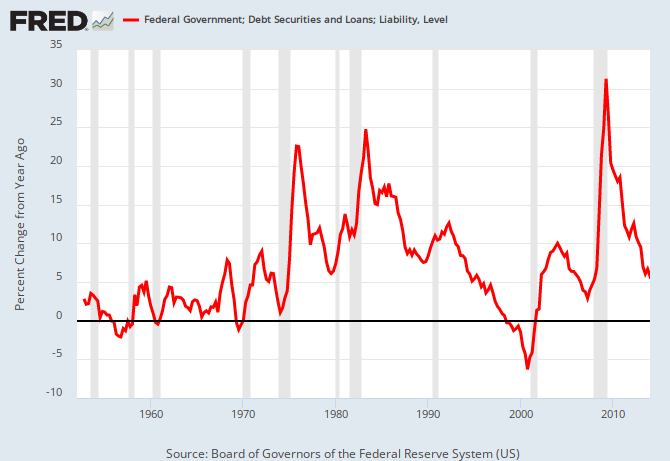
THE RECESSION CLOCK
Monetary Sovereignty

Monetary Sovereignty

Vertical gray bars mark recessions.

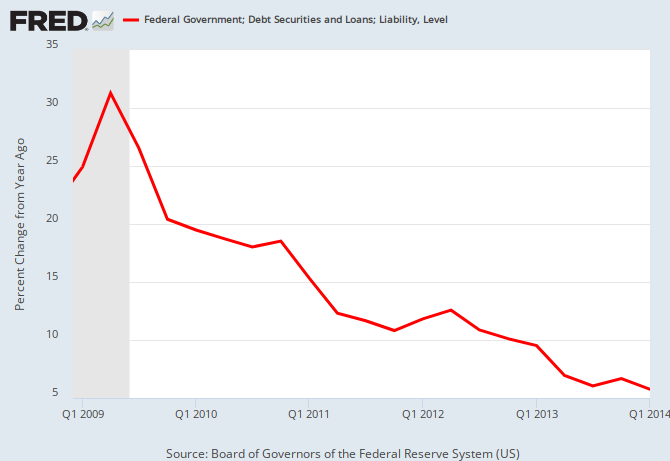
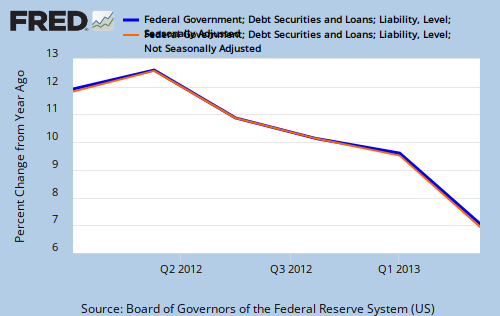
As the federal deficit growth lines drop, we approach recession, which will be cured only when the growth lines rise. Increasing federal deficit growth (aka “stimulus”) is necessary for long-term economic growth.

#MONETARYSOVEREIGNTY

–What is missing from this article about the Senate’s “nuclear option”

Twitter: @rodgermitchell; Search #monetarysovereignty
Facebook: Rodger Malcolm Mitchell

Mitchell’s laws:
●The more federal budgets are cut and taxes increased, the weaker an economy becomes.
●Austerity is the government’s method for widening the gap between rich and poor,
which ultimately leads to civil disorder.
●Until the 99% understand the need for federal deficits, the upper 1% will rule.
To survive long term, a monetarily non-sovereign government must have a positive balance of payments.
●Those, who do not understand the differences between Monetary Sovereignty and monetary non-sovereignty, do not understand economics.
●The penalty for ignorance is slavery.
●Everything in economics devolves to motive.

======================================================================================================================================================================================

The U.S. Congress, as a political system, is broken. It does not and cannot work.

The House of Representatives is broken because of Gerrymandering. Supposedly illegal, Gerrymandering never is challenged.

So, Representatives no longer worry about the needs or desires of the nation. They need only to please their tiny, local constituency, no matter how wrong-headed, bigoted or harmful those narrow beliefs might be.

The Senate is broken by the filibuster, which allows any one Senator to block all action by Congress. The filibustering Senator no longer needs even to stand and talk. He just notifies the Senate that he’s filibustering — then takes a nap, while the nation waits.

Yesterday, the Senate’s Democratic majority voted to modify the Republican’s use of the filibuster to block some Presidential nominations.

Sides have been taken and threats delivered. But what is missing from the discussion? Here are excerpts from an article in the 1/22/13 Chicago Tribune:

Democrats made a historic change to Senate rules Thursday, ending the minority party’s ability to use filibusters to block most presidential nominations and, in the process, virtually guaranteeing that the rest of President Obama’s term will be dominated by executive actions and court battles rather than legislation.

What else is new? Up ’til now, Congress has been engaged in anything but legislation.

The Senate Republican minority, which will see its power dramatically curtailed, threatened reprisals.

What “reprisals”? Lack of cooperation? End of bipartisanship? When your entire agenda has been obstructionism, what possible “reprisals” are left?

The decision by Senate Majority Leader Harry Reid (D-Nev.) to deploy the so-called nuclear option means Senate confirmations of presidential appointments — except for Supreme Court justices — will proceed by a simple majority vote. Previously, a 60-vote threshold had become the norm to avoid a filibuster by the minority party. The change does not affect filibusters on legislation.

So legislation still can and will be filibustered, thereby assuring no meaningful legislation will come out of Congress.

“You may regret it a lot sooner than you think,” said Senate Minority Leader Mitch McConnell (R-Ky.). “It only reinforces the narrative of a party that is willing to do and say just about anything to get its way.”

Not sure to which party he refers. The Republicans have taken great pride in being obstructionists. Back in 2011, when Republicans were so obstructionist they were accused of being the “party of No,” Sarah Palin said, “We’re the party of ‘hell no,'” such was her pride in making nothing happen.

The vote reflected the view of many Democrats that the chance of any major legislation passing the divided Congress over the next year already had dwindled to almost nothing. As a result, Reid and his allies felt they had little to lose.

“We’d much prefer the risk of up-or-down votes and majority rule than the risk of continued total obstruction,” said Sen. Charles E. Schumer (D-N.Y.). “That’s the bottom line no matter who’s in power.”

“I’d rather fight over policy,” said Sen. Mark Begich (D-Alaska), who is running for reelection for the first time in the conservative state. “It’s not a Republican or Democratic issue. It’s that the American people are asking us to fix this system.”

“I recognize that I could be back in the minority again, but that’s OK if that happens,” said Sen. Dianne Feinstein (D-Calif.), who just began a fifth term and who recently decided to support changing the rules. “I want, in the remainder of my five-plus years, to get something done, to be able to get nominees approved, to be able to get bills moved.”

Excuse me Senators, but your “nuclear option” does not include policy. It applies only to appointments. So Congress will continue to do nothing — and to be paid for it.

The move to end filibusters was probably only a matter of time, reflecting the long-term shift in American politics toward ever-greater polarization, particularly over the last two decades.

Even during the Bush Jr. terms, there was compromise. All bipartisanship ended with the Obama Presidency, probably related to his skin color. The red states hate blacks and browns. Making a black Presidency fail follows up very nicely with the old Nixon “Southern Strategy.”

Congress has moved toward a parliamentary system characterized by near-lock-step party voting and deep, consistent ideological differences between the two parties.

Bipartisan coalitions have dwindled, and so have incentives on other side of the aisle to bend the majority party’s agenda. For both parties, winning a majority now comes with heavy pressure from constituents to actually adopt the majority’s program.

And from Yahoo News:

Most recently, Republicans blocked three straight nominees to the powerful U.S. District Court of Appeals, not because of any qualms with the candidates’ credentials, but merely because they didn’t want Obama filling vacancies on an influential court that tilts conservative.

Translation: “The candidates are fine, but we don’t want them because Obama appointed them. We don’t want anything Obama.

Outraged Republicans vowed retribution, saying they would use the process to stack future courts in their favor once they’re back in control.

What? If the Republicans gain power, they threaten to stack the courts with right wing extremists? Hard to believe. And I was so sure they would appoint bleeding-heart liberals — like Thomas, Scalia and Alito, for instance.

Anyway, what is missing from all this? You are. There is no mention of what is good for you as Americans. The only concern is beating the other party, and saying “No” to anything the other party wants.

The filibuster has become a system for doing nothing. We didn’t send representatives to Congress just to obstruct and do nothing. They don’t receive generous salaries, expenses and perks just to sit on their hands.

The filibuster supposedly prevented one of the great disadvantages of a democratic system — the majority exercising dictatorial powers over the minority. But, in recent use, the filibuster has created the opposite problem: The minority exercising dictatorial power over the majority.

The filibuster has become an anachronism in a nation where winning is everything, and to hell with the American people (except for the rich, who always get their way).

Unfortunately, the filibuster remains for legislation, so look forward to continuing obstructionism.

Congress is broken. The system has been “gamed” by those whose sole concern is power. The result will be a continued widening of the gap between the rich and the rest.

And as for you, nobody even thinks about you. You are like a bag of popcorn at a football game. Both coaches care only about winning.

Neither coach — and neither party — cares about you.

Rodger Malcolm Mitchell
Monetary Sovereignty

====================================================================================================================================================
Nine Steps to Prosperity:
1. Eliminate FICA (Click here)
2. Medicare — parts A, B & D plus long term nursing care — for everyone (Click here)
3. Send every American citizen an annual check for $5,000 or give every state $5,000 per capita (Click here)
4. Free education (including post-grad) for everyone. Click here
5. Salary for attending school (Click here)
6. Eliminate corporate taxes (Click here)
7. Increase the standard income tax deduction annually
8. Increase federal spending on the myriad initiatives that benefit America’s 99% (Click here)
9. Federal ownership of all banks (Click here)

—–

10 Steps to Economic Misery: (Click here:)
1. Maintain or increase the FICA tax..
2. Spread the myth Social Security, Medicare and the U.S. government are insolvent.
3. Cut federal employment in the military, post office, other federal agencies.
4. Broaden the income tax base so more lower income people will pay.
5. Cut financial assistance to the states.
6. Spread the myth federal taxes pay for federal spending.
7. Allow banks to trade for their own accounts; save them when their investments go sour.
8. Never prosecute any banker for criminal activity.
9. Nominate arch conservatives to the Supreme Court.
10. Reduce the federal deficit and debt

No nation can tax itself into prosperity, nor grow without money growth. Monetary Sovereignty: Cutting federal deficits to grow the economy is like applying leeches to cure anemia.
Two key equations in economics:
1. Federal Deficits – Net Imports = Net Private Savings
2. Gross Domestic Product = Federal Spending + Private Investment and Consumption – Net Imports

THE RECESSION CLOCK
Monetary Sovereignty Monetary Sovereignty

As the federal deficit growth lines drop, we approach recession, which will be cured only when the lines rise.

#MONETARY SOVEREIGNTY

The suicide bombers of American Society

Twitter: @rodgermitchell; Search #monetarysovereignty
Facebook: Rodger Malcolm Mitchell

Mitchell’s laws:
●The more federal budgets are cut and taxes increased, the weaker an economy becomes.
●Austerity is the government’s method for widening the gap between rich and poor,
which ultimately leads to civil disorder.
●Until the 99% understand the need for federal deficits, the upper 1% will rule.
To survive long term, a monetarily non-sovereign government must have a positive balance of payments.
●Those, who do not understand the differences between Monetary Sovereignty and monetary non-sovereignty, do not understand economics.
●The penalty for ignorance is slavery.
●Everything in economics devolves to motive.

======================================================================================================================================================================================

Have you wondered why the so-called “religious” right has turned into a forum for mean-spirited, cold-hearted, selfish people, who are as far from religion as one could stray?

Have you wondered where all these negative generalizations about the poor, the immigrant, the black, the Jewish, the gay and virtually everyone other than a white, adult, has-a-good-job and American-born-to-American-citizens, came from?

We are not born bigots. We are not born haters. Those traits must be learned. Consider, for instance, the Cato Institute:

The Cato Institute was founded as the Charles Koch Foundation in 1974 by Ed Crane, Murray Rothbard, and Charles Koch.

Cato Policy Analysis No. 224 April 27, 1995
SSI: The Black Hole of the Welfare State
by Christopher M. Wright, Southern lawyer (Alexandria, Virginia), and publisher of The Deficit Letter and Activists Online.

Executive Summary
Congress is finally reforming the Supplemental Security Income (SSI) program. Unfortunately, the reforms currently under consideration fall far short of the dramatic overhaul that open-ended entitlement program needs.

In Cato-speak, “reform” means cutting any program that primarily benefits the lower income groups.

SSI is one of the fastest growing welfare programs in the federal budget, and its costs are projected to accelerate by another 60 percent by 2000.

Translation: “’Welfare’ is our little code word for money given to lazy, low-income people (All low-income people are lazy). SSI pumps dollars into the pockets of low income Americans and into the economy, which stimulates the economy.

“This narrows the income gap between the very rich and the rest of you – a bad thing for us very rich people.”

SSI was originally designed to provide a safety net for low-income senior citizens, but it is now experiencing spectacular growth in recently eligible population groups, including drug addicts, the mentally ill, immigrants, and children.

Government projections indicate that between 1990 and 2000 the number of immigrants on SSI will have grown fivefold and the number of drug addicts and alcoholics eightfold.

Translation: “Addicts, the mentally ill and children are at fault for their own misery. As a lesson, they should be made to starve in the streets. Or let them commit crimes to support themselves. Then, the government can support them in jail.”

Many of the House Republican proposals, such as ending SSI for immigrants, are sensible, but they are insufficient to cap SSI’s skyrocketing costs.

In Cato-speak, “sensible” (and the aforementioned “reform”), means cutting any program that benefits the lower income groups. Sure, we’re cutting benefits to immigrants, but we have to keep cutting, cutting, cutting — to drive these people into the ground.

Some of the SSI reforms recommended in this study include the following: (1) terminating automatic cost-of-living increases for SSI . . .

Translation: “Reduce real (inflation adjusted) benefits to the poor.”

(2). . . eliminating lump-sum payments to SSI recipients . . .

Translation: “The lump sums are generated because the claims process and resulting appeals drag on for months and even years, and benefits are paid retroactively to the date of application. The solution is not to speed up the claims process, but to punish the needy for government inefficiency.

(3). . . ending all childhood disability benefits . . .

Translation: “There is no need to pay childhood disability benefits. Kids don’t work, and it doesn’t cost anything to care for a disabled kid, does it?”.

, (4). . . creating an enrollment cap . . .

Translation: “We should help only a certain (diminishing) number of poor people. Any additional people can simply starve.”

(5). . . scaling back mental impairment benefits . . .

Translation: “We don’t believe the psychiatrists’ definitions of ‘mental impairment,’ and anyway, if you’re nuts, you don’t deserve to get any help. You should wander the streets, get a job, commit a crime or go to jail to feed yourself. We’ll be glad to pay for your jail time, but not for anything else.”

“Hitler was right. These people are lazy slugs, who are a drag on the economy and a blot on the gene pool.”

. . . and (6) ultimately privatizing disability insurance.

Translation. “We are the Koch brothers. We own Koch industries. Forbes called it the second largest privately held company in the United States, with an annual revenue of about $98 billion. We like rich people. Rich people are our friends.

“Some of our friends own insurance companies and other investment companies. Can you imagine how much richer we and our friends will become if SSI is privatized. Wow! We can smell the meat a’cookin.’”

Over the past several years, the Supplemental Security Income program (SSI) has been plagued by exploding costs for taxpayers.

Translation: “O.K., so SSI is paid for by our Monetarily Sovereign government. It doesn’t cost taxpayers a dime. But let’s not quibble over details.”

The combined federal expenditures of SSI and its sister program, Disability Insurance (DI), are now $55.3 billion. Disability has become the fourth largest area of federal entitlement spending after Social Security retirement, Medicare, and Medicaid.

SSI is a troubling case study in how federal entitlements continually expand beyond their original mission. Today, SSI is one of Washington’s primary fiscal black holes.

In Cato-speak, a “fiscal black hole” is a program that pays increasing amounts of money to the poor and to the economy. It is NOT a program that gives wonderful tax breaks to us rich people.

Possible reform measures include terminating the SSI program at the federal level and returning to the states the responsibility for providing assistance to low-income aged, blind, and disabled persons.

Translation: “The federal government, which has the unlimited power to pay any bill of any size, without collecting taxes (i.e. it’s Monetarily Sovereign), should not have to pay for SSI.

Instead, let the states, which already teeter on the brink of insolvency (i.e. they’re monetarily non-sovereign) should be burdened. This will assure that SSI benefits to the poor cease to exist, which is what we really want.”

If SSI continues at the federal level, enrollment should be capped and expenditures limited. And children and substance abusers should no longer receive cash assistance.

Other federal programs already address the needs of children, and substance abusers should be forced to compete for new drug treatment slots.

Translation: “The federal government is broke, but poor people are getting rich on SSI payments. Drug addicts and children are perfectly able to compete for treatment. Why should we have to care about them, anyway?”

The Senate Finance Committee report at the time of SSI’s inception declared that federal assistance would “provide a positive assurance that the Nation’s aged, blind, and disabled people would no longer have to subsist on below-poverty-level incomes.”

Despite the focus on adult assistance, disabled children were included in SSI, apparently without much discussion or examination of what the costs might be.

Translation: “O.K., so a bunch of bleeding-heart liberals wanted to help the Nation’s aged, blind and disabled. And I know it doesn’t cost me a cent, but why do we also have to help kids?”

Why SSI Keeps Growing and Growing
No one knows precisely why SSI has grown so rapidly and unexpectedly in the past six years. Many factors are probably responsible for the cascade.

Translation: “We have no idea what we are talking about, but if anything helps the aged, the poor or the disabled, and above all, if it helps disabled children, we are firmly against it.”

A sharp increase in disability claims followed the 1990 recession. Similar correlations have been observed in other nations between a poorly performing economy and spikes in the number of disability claims.

Translation: “We can’t understand why, during recessions, people actually lose their jobs and their health insurance.

“And, we can’t understand why, being in desperate straits, they claim disability, rather than simply firing a few of their maids and gardeners, like we do.

“This makes me so mad, I hardly can enjoy sailing my yacht.

Several states, including Illinois, California, and Michigan (which has terminated general assistance), have taken steps to switch disabled residents from state relief programs to SSI.

Translation: “The states (which are going broke, because they must rely on taxes) want the federal government (which never can go broke, because it does not rely on taxes) to pay for relief programs.

“This makes me so mad I hardly can enjoy flying in my private jet.”

Should their claims be denied, claimants can pursue several layers of appeal; 80 percent of appeals are now ultimately successful.

Lawyers in Pennsylvania run ads declaring, “Social Security is well known for denying meritorious claims that later are approved. . . . Don’t let a bureaucrat determine your future. Keep appealing.”

Translation: “The government denies meritorious claims, so for some reason, the greedy people appeal again. Outrageous.

“This makes me so mad, I no longer enjoy my hourly compliments from my butler.”

So that’s Cato, founded by Koch, Rothbard and Crane. Yes, we know about billionaire Koch. What about Rothbard?

To promote his economic and political ideas, Rothbard joined Llewellyn H. Rockwell, Jr. and Burton Blumert in 1982 to establish the Ludwig von Mises Institute in Alabama.

Are you conservative, libertarian, anarchist, socialist, or what? We are Misesians! The media will typically describe all non-socialists as conservatives, so we are usually lumped in among them, though the actual orientation of the Institute is libertarian.

This designation can encompass a wide range of thought from Jeffersonian classical liberalism to the modern anarcho-capitalism of Murray N. Rothbard.

The core conviction is what matters: peaceful exchange makes everyone better off; private property is the first principle of liberty; intervention destroys wealth; society and economy need no central management to achieve orderliness.

Anarcho-capitalism (also referred to as free-market anarchism, market anarchism, private-property anarchism is a political philosophy which advocates the elimination of the state in favor of individual sovereignty in a free market.

Translation: “Private property is most important, and those who have the most private property should rule. Intervention (i.e government aid to the poor) destroys the wealth (i.e. the income gap) of the rich.

“Big government is unnecessary, because it can prevent the orderliness of the rich ruling the poor.”

And finally, we come to Edward Crane:

Edward Harrison Crane is a co-founder of the Cato Institute and served as its President until October 1, 2012.

In the 1970s, he was one of the most active leaders of the Libertarian Party. In 1980, Crane served as Communications Director to the Libertarian Party presidential ticket of Clark and Vice Presidential candidate David Koch.

Crane sits on the boards of various political organizations, including Americans for Limited Government.

Translation: “I, Edward Harrison Crane, think David Koch should be Vice President of the United States of America. He may be a billionaire, who wants to cut federal aid to the poor, but really, in his heart, he loves you little people.”

Americans for Limited Government (ALG) is committed to advancing free-market reforms, private property rights and core American liberties. For these liberties to be achieved, it is essential to reduce the role of government and put citizens back in charge of their own lives.

Translation: “Free market reforms” means allow the rich to do whatever they please.

“Reduce the role of government” means cut spending on anything that benefits the middle class and the poor.

“Put citizens back in charge of their own lives” means let the poor swim or drown.

Bottom line: The Kochs and their wealthy cronies not only have bribed the politicians (via campaign contributions and promises of lucrative employment), the media (via ownership) and the university economists (via contributions to universities), but also have been very effective in brainwashing the middle class and the poor to believe what the rich want them to believe.

The notion that the poor are at fault for their own misery, is fundamental to the religious right’s “core American liberties.”

Ironically, the vast majority of the religious right is part of the very group who will be most punished by conservatism.

Brainwashed, they use the words the rich have put in their mouths.

They have dedicated themselves to destroying the lives of the poor — and they get mad as hell if anyone tries to warn them that by helping the rich, they are destroying their own lives.

Conservatives are the trained suicide bombers of American society.

Rodger Malcolm Mitchell
Monetary Sovereignty

====================================================================================================================================================
Nine Steps to Prosperity:
1. Eliminate FICA (Click here)
2. Medicare — parts A, B & D plus long term nursing care — for everyone (Click here)
3. Send every American citizen an annual check for $5,000 or give every state $5,000 per capita (Click here)
4. Free education (including post-grad) for everyone. Click here
5. Salary for attending school (Click here)
6. Eliminate corporate taxes (Click here)
7. Increase the standard income tax deduction annually
8. Increase federal spending on the myriad initiatives that benefit America’s 99% (Click here)
9. Federal ownership of all banks (Click here)

—–

10 Steps to Economic Misery: (Click here:)
1. Maintain or increase the FICA tax..
2. Spread the myth Social Security, Medicare and the U.S. government are insolvent.
3. Cut federal employment in the military, post office, other federal agencies.
4. Broaden the income tax base so more lower income people will pay.
5. Cut financial assistance to the states.
6. Spread the myth federal taxes pay for federal spending.
7. Allow banks to trade for their own accounts; save them when their investments go sour.
8. Never prosecute any banker for criminal activity.
9. Nominate arch conservatives to the Supreme Court.
10. Reduce the federal deficit and debt

No nation can tax itself into prosperity, nor grow without money growth. Monetary Sovereignty: Cutting federal deficits to grow the economy is like applying leeches to cure anemia.
Two key equations in economics:
1. Federal Deficits – Net Imports = Net Private Savings
2. Gross Domestic Product = Federal Spending + Private Investment and Consumption – Net Imports

THE RECESSION CLOCK
Monetary Sovereignty Monetary Sovereignty

As the federal deficit growth lines drop, we approach recession, which will be cured only when the lines rise.

#MONETARY SOVEREIGNTY