–16 Reasons why you have way too much money and deserve to be in the Servant Class

Twitter: @rodgermitchell; Search #monetarysovereignty
Facebook: Rodger Malcolm Mitchell

Mitchell’s laws:
•Those, who do not understand the differences between Monetary Sovereignty and monetary non-sovereignty, do not understand economics.
•Any monetarily NON-sovereign government — be it city, county, state or nation — that runs an ongoing trade deficit, eventually will run out of money.
•The more federal budgets are cut and taxes increased, the weaker an economy becomes. .
Liberals think the purpose of government is to protect the poor and powerless from the rich and powerful. Conservatives think the purpose of government is to protect the rich and powerful from the poor and powerless.
•The single most important problem in economics is
the Gap between rich and poor.
•Austerity is the government’s method for widening
the Gap between rich and poor.
•Until the 99% understand the need for federal deficits, the upper 1% will rule.
•Everything in economics devolves to motive, and the motive is the Gap between the rich and the rest..

===================================================================================================================================================================================================================================================================================

You may know of Pete Peterson. He, along with the equally infamous Koch Brothers, is one of those several billionaires who have spent millions — perhaps billions — to prove that those in the upper .1% income/wealth/power group rightfully belong to the Master Class, while the rest of us 99.9% deserve to be in the Servant Class.

Peterson’s toadies and sycophants, otherwise known as the “Committee for a Responsible Federal Budget” and the “Campaign to Fix the Debt” published FISCAL FACTCHECKER: 16 BUDGET MYTHS TO WATCH OUT FOR IN THE 2016 CAMPAIGN

All 16 of the so-called “Budget Myths” are designed to make you believe one short nonsense idea: “Removing money from the economy enriches the economy, while adding money to the economy impoverishes the economy.”

If you can be brainwashed to believe that idea, you are perfect for the Servant Class.

Today’s post will not address all 16 “myths.” You can read them yourself. We’ll examine just the first one, because it summarizes the “thinking” in the others:

Myth #1: We Can Continue Borrowing Without Consequences

One of the most common myths about the national debt is that we can increase it without consequence. Some argue that because the United States borrows in its own currency, it can simply print money to cover its debt.

The “myth” is correct that the federal government (unlike state and local governements) has the unlimited ability to create its own sovereign currency, the dollar. That is known as Monetary Sovereignty.

But, this statement of the first “myth,” uses the misleading word “debt,” a word that can be pejorative or praising, depending on circumstance. For instance, If you were a billion dollars “in debt,” that may be a bad thing. But what if your bank is a billion dollars “in debt”? Is that also a bad thing?

What if your bank boasts that it has a billion dollars in deposits? Bank deposits are bank debts, so your bank’s boasts about deposits actually boasts about its indebtedness. And that is where the Petersonites attempt to confuse you, for federal debt is nothing more than bank deposits.

To “lend” to the federal government, you invest in a T-security — a T-bill, T-note or T-bond. The process is: You instruct your local bank to transfer dollars out of your checking account and send those dollars to be deposited in a T-security account at the Federal Reserve Bank.

A T-security account is like a bank savings account. Money sits in your account while it earns interest.

Then, when the Federal Reserve Bank pays off the “debt,” it does what any bank does to pay off deposits: It transfers existing dollars from your T-security account to your savings account. Aside from interest, the bank does not need to “print money to cover its debt,” as the Petersonites claim.

It transfers existing money. So there are no inflationary implications.

Others point to high-debt nations like Japan to show countries can bear large amounts of debt. Many others suggest that current low interest rates show that the market is not concerned about the debt.

However, none of these arguments stand up to scrutiny. Printing large sums of money might offer a quick x, but as internaonal experience shows, it can lead to hyper-inflation.

That, to put it gently, is a lie.

As we have seen, paying off federal “debt” does not require “printing large sums of money.” Aside from interest, which is relatively minuscule, no money creation is involved.

Further, despite massive deficit spending for the past 230 years, the U.S. never has experienced hyperinflation — not during the massive spending for wars, nor to cure recessions or depressions. The Petersonites issue dire warnings, based on false information about something that never has happened.

Japan is unique for a number of reasons that do not apply to the United States, and it has also faced two decades of economic stagnation along with its high debt.

All nations are unique, but nothing about Japan’s uniqueness answers why it has failed to experience hyperinflation, despite massive deficits (other than: Deficits don’t cause hyperinflation).

Nor does national debt cause economic stagnation. Remember how national debt is accumulated: The nation spends more than it taxes, that is, the nation pumps more money into the economy than it takes out.

The Petersonites would have you believe that adding money to an economy depresses the economy, while removing money from the economy stimulates it. Also, black is white and up is down. George Orwell would love such reasoning.

Low interest rates are a temporary consequence of the struggling global economy and near-term Federal Reserve actions – not a permanent fixture.

That is true, though irrelevant. The Federal Reserve lowers rates, because it believes (wrongly, in my opinion) that low rates are stimulative. This has nothing to do with the subject of the “myth,” the claimed dangers of federal debt. It’s a clever tactic: Toss in a true statement to add credibility to your false statements. (Every liar includes grains of truth.)

In reality, high levels of debt come with many risks and consequences. Over the long run, growing debt crowds out productive private investment, slows income growth, increases interest rates, reduces government flexibil-ity, and increases the risk of a fiscal crisis.

The federal debt increases when the government spends more than it taxes. To reduce the debt, the government taxes more than it spends.

No one can explain how federal spending “crowds out” productive spending. When the federal government buys goods and services, it buys them from the private sector, which then has more dollars for “productive private investment. Many thousands of businesses, employing millions of people, profit from federal purchases. By contrast, taxing, which removes dollars from the economy, “crowds out private investment” by reducing the money available for such investment.

Similarly, federal spending cannot “slow income growth,” though federal taxing does.

The Federal Reserve does increase interest rates when the economy is growing faster, as a defense against inflation. In essence, the Petersonites are preaching against economic growth!

Higher interest rates benefit lenders, and lower rates benefit borrowers. Which is better for you depends on your circumstances at any one time. If you buy a house or a car, you are a borrower who benefits from lower rates. If you own CDs, T-securities, any bank accounts, any bonds or bond funds, you are a lender, who benefits from higher rates — and you also benefit from a growing economy.

The non-partisan Congressional Budget Office (CBO) finds that large and growing debt “would have serious negative consequences for both the economy and the federal budget.” Within 25 years, they estimate rapidly rising debt will increase interest rates by a full percentage point, reduce the size of the economy by 7 percent, and reduce average annual per person income by $6,000 ompared to current baseline projecons.

“Rapidly rising debt . . . “ What is “rapidly” rising? No one knows. Does this mean that rising debt is O.K., so long as it isn’t “rapidly” rising? Again, no one knows. “Rapidly” is one of those caveats, that mean whatever one wishes it to mean — or nothing.

” . . . Increase interest rates by a full percentage point . . . “ Is one percentage point supposed to frighten America? Or is this one percentage point merely the Federal Reserve’s normal response to the economic growth, from which we all benefit?

Finally, how could raising taxes (taking dollars out of the economy) not “have serious negave consequences” for the economy,” while increased federal spending on goods and services, cause those “serious negative consequences”? Talk about backward thinking!

And that is just “myth #1.” The Petersonites present 15 more, equally wrong myths — too much to discuss in one post. I invite you to go to the site, read the myths, and then ask me about any of them.

The entire excercise is to prove to you that federal spending for you must be decreased and federal taxes on you must be increased, so that the Gap between the rich and the rest can widen.

That is how the “Master Class” creates a permanent “Servant Class.”

And where is the majority of that federal spending that “must” be decreased? Social Security. Medicare. Medicaid. Poverty aids like food stamps, public housing — in short, everything that benefits the poor and the middle-income groups — the Servant Class — must be cut.

And where should taxes be increased? In addition to increasing FICA, the ongoing push is for “broadening the tax base,” i.e.taxing the poor and middle more. This usually involves some sort of sales or “use” tax, all of which punish the lower income groups most.

Of course, the Petersonites will tell you military spending must be maintained to protect us against foreign enemies that always, always, always are growing stronger. The Master Class loves the military to protect them, in case the Servant Class tries to rebel. (All over the world, most people are enslaved by their own military, rather than by foreign enemies.)

And taxing of the rich must be reduced, because those in the Master Class are the “makers,” while you in the Servant Class are the “takers.”

In summary, the upper .1% wish to create a Master Class, but can do so only with the acquiescence of a Servant Class. So they brainwash the public with the Big Lie — the lie that federal finances are like personal finances, and that federal debt is “unsustainable” (You’ll see the word “unsustainable” often in Peterson- and Kochsponsored articles). So, your taxes must be increased and your benefits must be cut.

And if you believe this, well maybe the .1% are right. Maybe they do desrve to be the Master Class, and maybe you do deserve to be the Servant Class.

What do you think?

Rodger Malcolm Mitchell
Monetary Sovereignty

===================================================================================
Ten Steps to Prosperity:
1. Eliminate FICA (Click here)
2. Federally funded Medicare — parts A, B & D plus long term nursing care — for everyone (Click here)
3. Provide an Economic Bonus to every man, woman and child in America, and/or every state a per capita Economic Bonus. (Click here) Or institute a reverse income tax.
4. Free education (including post-grad) for everyone. Click here
5. Salary for attending school (Click here)
6. Eliminate corporate taxes (Click here)
7. Increase the standard income tax deduction annually
8. Tax the very rich (.1%) more, with higher, progressive tax rates on all forms of income. (Click here)
9. Federal ownership of all banks (Click here and here)

10. Increase federal spending on the myriad initiatives that benefit America’s 99% (Click here)

The Ten Steps will add dollars to the economy, stimulate the economy, and narrow the income/wealth/power Gap between the rich and the rest.
——————————————————————————————————————————————

10 Steps to Economic Misery: (Click here:)
1. Maintain or increase the FICA tax..
2. Spread the myth Social Security, Medicare and the U.S. government are insolvent.
3. Cut federal employment in the military, post office, other federal agencies.
4. Broaden the income tax base so more lower income people will pay.
5. Cut financial assistance to the states.
6. Spread the myth federal taxes pay for federal spending.
7. Allow banks to trade for their own accounts; save them when their investments go sour.
8. Never prosecute any banker for criminal activity.
9. Nominate arch conservatives to the Supreme Court.
10. Reduce the federal deficit and debt

No nation can tax itself into prosperity, nor grow without money growth. Monetary Sovereignty: Cutting federal deficits to grow the economy is like applying leeches to cure anemia.
1. A growing economy requires a growing supply of dollars (GDP=Federal Spending + Non-federal Spending + Net Exports)
2. All deficit spending grows the supply of dollars
3. The limit to federal deficit spending is an inflation that cannot be cured with interest rate control.
4. The limit to non-federal deficit spending is the ability to borrow.

THE RECESSION CLOCK
Monetary Sovereignty

Monetary Sovereignty

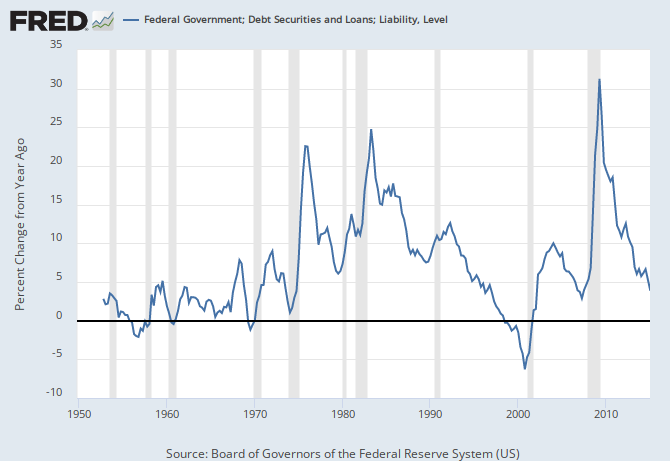
Vertical gray bars mark recessions.

As the federal deficit growth lines drop, we approach recession, which will be cured only when the growth lines rise. Increasing federal deficit growth (aka “stimulus”) is necessary for long-term economic growth.

#MONETARYSOVEREIGNTY

The fundamental flaw in U.S. democracy: No term limits

Twitter: @rodgermitchell; Search #monetarysovereignty
Facebook: Rodger Malcolm Mitchell

Mitchell’s laws:
•Those, who do not understand the differences between Monetary Sovereignty and monetary non-sovereignty, do not understand economics.
•Any monetarily NON-sovereign government — be it city, county, state or nation — that runs an ongoing trade deficit, eventually will run out of money.
•The more federal budgets are cut and taxes increased, the weaker an economy becomes. .
Liberals think the purpose of government is to protect the poor and powerless from the rich and powerful. Conservatives think the purpose of government is to protect the rich and powerful from the poor and powerless.
•The single most important problem in economics is
the Gap between rich and poor.
•Austerity is the government’s method for widening
the Gap between rich and poor.
•Until the 99% understand the need for federal deficits, the upper 1% will rule.
•Everything in economics devolves to motive, and the motive is the Gap between the rich and the rest..

===================================================================================================================================================================================================================================================================================

Recently, President Obama spoke in Ethiopia, saying, “Nobody should be president for life. Your country is better off if you have new blood and new ideas. I’m still a pretty young man, but I know that somebody with new energy and new insights will be good for my country. It will be good for yours, too, in some cases.”

What he didn’t say is that the lack of term limits practically guarantees criminality, sloth and nepotism, all of which increase with each passing year.

Consider my state, Illinois, the most corrupt state in the union. Of our last seven governors, four have gone to prison.

Illinois has the worst debt of any state, together with high taxes; our school systems are a mess; and Chicago’s racial segregation is extreme. Illinois is as poorly run as — perhaps more poorly run than — any state.

The state of Illinois does not have any term limits, though some individual cities across the state do.

Thirty seven states have placed term limits on their constitutional officers such as governor, lieutenant governor, attorney general, secretary of state, comptroller and treasurer.

Eight out of 10 of the largest cities nationwide place term limits on their mayors and/or city councils, while fifteen legislatures have term limits.

Chicago is one of those two largest cities nationwide without any term limits. Thus, we had Mayor Richard J Daley who held office for 21 years, and ruled king-like over a notoriously corrupt administration.

Later, came his even more corrupt son, Richard M. Daley, who held office for 22 years, before retiring in disgrace. (He sold valuable city property to pay for bribes to unions and others for re-election assistance.)

ILLINOIS GENERAL ASSEMBLY IGNORES CITIZENS ON TERM LIMITS

“It is a safe bet that the General Assembly will never pass a bill limiting its own members’ ability to seek re-election.” – Christopher Mooney, University of Illinois Springfield professor, term-limits expert

Overwhelmingly, Illinoisans support term limits. A recent poll showed 78.7 percent of Illinois voters support term limits.

Despite the overwhelming public support for term limits, only a few legislators have tried to use the legislative process to enact term limits. The legislature has failed to enact any meaningful term limit reforms.

Consider Illinois’s Michael Madigan:

He is the longest-serving Speaker in state history, having held the position for all but two years since 1983. He has been a member of the Illinois House since 1971.

Chicago Magazine named Madigan the fourth-most-powerful Chicagoan in 2012 and second in 2013 and 2014, calling him “the Real Governor of Illinois.”

Madigan refused to testify in the inquiry over his advocacy for more 40 applicants to the University of Illinois at Urbana-Champaign. Michael Madigan had sought to use his influence to secure patronage hiring and promotion at the Metra commuter rail agency for two of his supporters.

More than 400 current or retired state and local government employees have strong political ties to Madigan. The former Bureau of Electricity in the Streets and Sanitation Department of the City of Chicago was called “Madigan Electric” by political insiders.

Madigan admitted that he is more likely to return phone calls from campaign contributors than from non-contributors. Of all the current sitting Democratic Illinois House members, Speaker Madigan has received the highest amount of campaign contributions from labor unions.

Madigan was founder and continues as senior partner of the law firm Madigan and Getzendanner specializing in corporate real estate property tax appeals, which has been accused of profiting off of Madigan’s position and power. Getzendanner and four other staff attorneys handle the tax appeals, while Madigan brings in clients.

In 2008 Madigan and Getzendanner represented 45 of the 150 most valuable buildings in downtown Chicago, more than any other property tax appeal firm, and more than twice as many as the second highest.

Then we have the Madigan family nepotism tree:

(His wife) Shirley is the head of the Illinois Arts Council. His oldest daughter, Lisa Madigan, is the Attorney General of Illinois. Madigan’s son-in-law Jordan Matyas is the chief lobbyist for Regional Transportation Authority, a deputy chief overseeing their Government Affairs Department.

In 2002, Madigan helped his daughter Lisa garner more campaign contributions in her run for Illinois Attorney General than even the candidates for governor that year. At one point, Lisa Madigan’s $1.2 million raised was more than all the attorney general candidates in 1998 had raised, combined.

The man has been clever enough to cover his back by installing his daughter as Attorney General, who not surprisingly, never has investigated her father.

How has Madigan achieved and maintained such control?

First, he brings home the bacon to his district. He is not elected by the state voters. He is elected by just one district, and that district receives the benefits of Madigan’s power. If you lived in that district, you would elect him. So would I.

Money flows to Madigan district while state dollars tight

At a time when Republican Gov. Bruce Rauner has frozen state spending and cut the budget, a $35 million state grant got paid in full last month that helps build a 1,500-student school in the district of House Speaker Michael Madigan.

Second, the lack of term limits has given Madigan plenty of time to build alliances and to create a system that increasingly provides him with corrupting power.

For a politician, length of term is in direct proportion to breadth of corruption.

The lack of term limits, which allows criminal fiefdoms time to develop, is the fundamental flaw in American politics. It has all but destroyed Illinois and Chicago and presumably many other states, counties and cities.

The primary argument against term limits has to do with experience. A politician gains experience through time, and limiting his time, limits his experience.

However, that does not seem to have been an impediment to the most demanding and important job in America: The Presidency of the United States. The reason: Each new President surrounds himself with experienced people. All politicians can do that.

Once installed, politicians are very difficult to dislodge. They do more favors and collect more money than any opposing candidate.

The whole notion of “Ruler For Life”, whether a governor, mayor, alderman, senator, representative, etc., is an open invitation to the corruption that comes with power.

In summary, the fundamental flaw of American democracy is the lack of term limits.

Rodger Malcolm Mitchell
Monetary Sovereignty

===================================================================================
Ten Steps to Prosperity:
1. Eliminate FICA (Click here)
2. Federally funded Medicare — parts A, B & D plus long term nursing care — for everyone (Click here)
3. Provide an Economic Bonus to every man, woman and child in America, and/or every state a per capita Economic Bonus. (Click here) Or institute a reverse income tax.
4. Free education (including post-grad) for everyone. Click here
5. Salary for attending school (Click here)
6. Eliminate corporate taxes (Click here)
7. Increase the standard income tax deduction annually
8. Tax the very rich (.1%) more, with higher, progressive tax rates on all forms of income. (Click here)
9. Federal ownership of all banks (Click here and here)

10. Increase federal spending on the myriad initiatives that benefit America’s 99% (Click here)

The Ten Steps will add dollars to the economy, stimulate the economy, and narrow the income/wealth/power Gap between the rich and the rest.
——————————————————————————————————————————————

10 Steps to Economic Misery: (Click here:)
1. Maintain or increase the FICA tax..
2. Spread the myth Social Security, Medicare and the U.S. government are insolvent.
3. Cut federal employment in the military, post office, other federal agencies.
4. Broaden the income tax base so more lower income people will pay.
5. Cut financial assistance to the states.
6. Spread the myth federal taxes pay for federal spending.
7. Allow banks to trade for their own accounts; save them when their investments go sour.
8. Never prosecute any banker for criminal activity.
9. Nominate arch conservatives to the Supreme Court.
10. Reduce the federal deficit and debt

No nation can tax itself into prosperity, nor grow without money growth. Monetary Sovereignty: Cutting federal deficits to grow the economy is like applying leeches to cure anemia.
1. A growing economy requires a growing supply of dollars (GDP=Federal Spending + Non-federal Spending + Net Exports)
2. All deficit spending grows the supply of dollars
3. The limit to federal deficit spending is an inflation that cannot be cured with interest rate control.
4. The limit to non-federal deficit spending is the ability to borrow.

THE RECESSION CLOCK
Monetary Sovereignty

Monetary Sovereignty

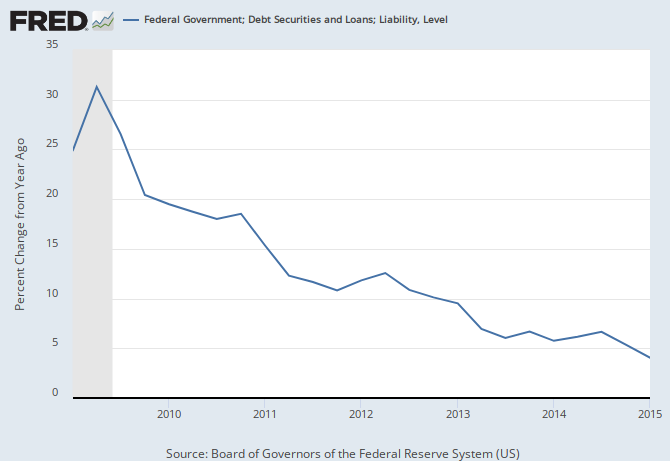
Vertical gray bars mark recessions.

As the federal deficit growth lines drop, we approach recession, which will be cured only when the growth lines rise. Increasing federal deficit growth (aka “stimulus”) is necessary for long-term economic growth.

#MONETARYSOVEREIGNTY

–The euro comes to Puerto Rico

Twitter: @rodgermitchell; Search #monetarysovereignty
Facebook: Rodger Malcolm Mitchell

Mitchell’s laws:
•Those, who do not understand the differences between Monetary Sovereignty and monetary non-sovereignty, do not understand economics.
•Any monetarily NON-sovereign government — be it city, county, state or nation — that runs an ongoing trade deficit, eventually will run out of money.
•The more federal budgets are cut and taxes increased, the weaker an economy becomes. .
Liberals think the purpose of government is to protect the poor and powerless from the rich and powerful. Conservatives think the purpose of government is to protect the rich and powerful from the poor and powerless.
•The single most important problem in economics is
the Gap between rich and poor.
•Austerity is the government’s method for widening
the Gap between rich and poor.
•Until the 99% understand the need for federal deficits, the upper 1% will rule.
•Everything in economics devolves to motive, and the motive is the Gap between the rich and the rest..

===================================================================================================================================================================================================================================================================================

The euro nations, having surrendered the single, most valuable asset any entity can have — their Monetary Sovereignty — now deal with the inevitable austerity that surrender requires.

The process always is the same:

1. A monetarily NON-sovereign government does not have the ability to create money. So, to pay its bills, it must have income. This income can come from three sources: A positive balance of trade, taxes and/or borrowing.

(As an aside, you personally are monetarily NON-sovereign. To pay your bills, you must have income. To survive long-term all monetarily NON-sovereign entities must have net income.)

2. Mathematically, not all nations can rely on a positive balance of trade. Those with a negative balance of trade must acquire money by increased taxing and/or borrowing.

3. Increased taxing impoverishes the private sector, which reduces the tax base and makes future tax increases ever more difficult — an endless whirlpool of impoverishment — so monetarily NON-sovereign nations increasingly turn to borrowing.

And here is where the divide between euro nations vs. U.S. states, counties and cities occurs.

Euro nations borrow from the troika (the European Central Bank [ECB], the European Commission [EC], and the International Monetary Fund [IMF]), a rapacious group that follows typical loan-shark protocol:

Lend to borrowers who cannot pay, then repeatedly lend more to pay the previously unpayable debt, then impose draconian punishments for non-payment — a protocol the guarantees endless debt slavery. The troika must have learned from the Mafia.

By contrast, most U.S. cities, counties and states, though also monetarily NON-sovereign, are blessed by a positive balance of trade with the Monetarily Sovereign U.S. government (which never can run short of dollars).

This brings us to Puerto Rico, financially much like a U.S. state:

Hedge funds tell Puerto Rico: lay off teachers and close schools to pay us back
Report commissioned by 34 hedge funds says government had been ‘massively overspending on education’ despite spending only 79% of US average per pupil

Billionaire hedge fund managers have called on Puerto Rico to lay off teachers and close schools so that the island can pay them back the billions it owes.

The hedge funds called for Puerto Rico to avoid financial default – and repay its debts – by collecting more taxes, selling $4bn worth of public buildings and drastically cutting public spending, particularly on education.

Perfect: The loan sharks (this time not the troika, but the equally rapacious hedge fund managers) demand that Puerto Rico further enslave and impoverish its people by squeezing them for more taxes and cutting education.

And of course, the wealthy hedge fund managers want further to rape the Puerto Rican economy by purchasing government property at bargain basement prices.

This is exactly what is happening to Greece. Loan sharks are the same, the world over.

The report, entitled For Puerto Rico, There is a Better Way, said Puerto Rico could save itself from default if it improves tax collection and drastically cuts back on public spending.

It accused the island, where 56% of children live in poverty, of spending too much on education even though the government has already closed down almost 100 schools so far this year.

Could it be any more disgusting than stealing the futures of already impoverished children?

The article goes on with ever more shocking suggestions from the loan sharks. You should read it to see how low it is possible for rich criminals to sink (the same rich criminals who complain loudly about the petty crimes committed by poor criminals).

And what is the solution? Quite simple, really.

Institute the “Ten Steps to Prosperity” (below) In the case of Puerto Rico’s education problem, see especially Step #4: Free Education, Including Post-Grad, For Everyone

That would rid PR of the loan sharks, permanently.

Rodger Malcolm Mitchell
Monetary Sovereignty

===================================================================================
Ten Steps to Prosperity:
1. Eliminate FICA (Click here)
2. Federally funded Medicare — parts A, B & D plus long term nursing care — for everyone (Click here)
3. Provide an Economic Bonus to every man, woman and child in America, and/or every state a per capita Economic Bonus. (Click here) Or institute a reverse income tax.
4. Free education (including post-grad) for everyone. Click here
5. Salary for attending school (Click here)
6. Eliminate corporate taxes (Click here)
7. Increase the standard income tax deduction annually
8. Tax the very rich (.1%) more, with higher, progressive tax rates on all forms of income. (Click here)
9. Federal ownership of all banks (Click here and here)

10. Increase federal spending on the myriad initiatives that benefit America’s 99% (Click here)

The Ten Steps will add dollars to the economy, stimulate the economy, and narrow the income/wealth/power Gap between the rich and the rest.
——————————————————————————————————————————————

10 Steps to Economic Misery: (Click here:)
1. Maintain or increase the FICA tax..
2. Spread the myth Social Security, Medicare and the U.S. government are insolvent.
3. Cut federal employment in the military, post office, other federal agencies.
4. Broaden the income tax base so more lower income people will pay.
5. Cut financial assistance to the states.
6. Spread the myth federal taxes pay for federal spending.
7. Allow banks to trade for their own accounts; save them when their investments go sour.
8. Never prosecute any banker for criminal activity.
9. Nominate arch conservatives to the Supreme Court.
10. Reduce the federal deficit and debt

No nation can tax itself into prosperity, nor grow without money growth. Monetary Sovereignty: Cutting federal deficits to grow the economy is like applying leeches to cure anemia.
1. A growing economy requires a growing supply of dollars (GDP=Federal Spending + Non-federal Spending + Net Exports)
2. All deficit spending grows the supply of dollars
3. The limit to federal deficit spending is an inflation that cannot be cured with interest rate control.
4. The limit to non-federal deficit spending is the ability to borrow.

THE RECESSION CLOCK
Monetary Sovereignty

Monetary Sovereignty

Vertical gray bars mark recessions.

As the federal deficit growth lines drop, we approach recession, which will be cured only when the growth lines rise. Increasing federal deficit growth (aka “stimulus”) is necessary for long-term economic growth.

#MONETARYSOVEREIGNTY