–Employment numbers you may not have thought about — but should.

Mitchell’s laws: The more budgets are cut and taxes inceased, the weaker an economy becomes. Until the 99% understand the need for deficits, the 1% will rule. To survive long term, a monetarily non-sovereign government must have a positive balance of payments. Austerity = poverty and leads to civil disorder. Those, who do not understand the differences between Monetary Sovereignty and monetary non-sovereignty, do not understand economics.
==========================================================================================================================================

The following graph shows employment / population ratios.

Monetary Sovereignty

While the percentage of Americans who are employed has changed very little since 1948 (red line — 57% in 1948; 58% in 2011), the change in the difference between men (blue line) and women (green line) is stunning.

Back in 1948, only 30% of women were employed. Today, more than half are employed. By contrast, 1948 saw more than 80% of men employed, compared with less than 65% today.

There are several reasons for this phenomenon, and at least one is rather sad: Lower salaries for women, make them more attractive hires.

Toward the end of the 1960’s, I worked in the advertising agency business. Back then, it was a male-dominated industry. Just ten years later, it had become female dominated, in terms of employee numbers (though not in job titles). The reason: For any given job, the agencies could hire a woman to do it as well as a man, but cheaper. Since advertising is heavy on personnel, the savings were enormous.

Ironically, the men, by keeping a lid on women’s salaries, did themselves a disservice. They created a competing class of worker, just as skilled, but costing less.
======================================================================================================================================================================================

Lest there is any doubt that a college education helps:

Monetary Sovereignty

During recessions, college graduates seem less likely to be fired, and when the recession ends, the non-graduates must start from a comparatively worse position. I suspect, our increasingly high-tech economy will exacerbate this problem for those who don’t graduate college.

I have proposed, and continue to propose, that just as elementary and high school education is government supported, so should college education be financed by the government. For America to compete and grow in the global market, our young people increasingly need a college education.

Unfortunately, college has become so expensive, only the wealthiest children or those willing to suffer years of huge college debts, can attend. It is foolish and counterproductive to place such barriers in front of our future.

======================================================================================================================================================================================

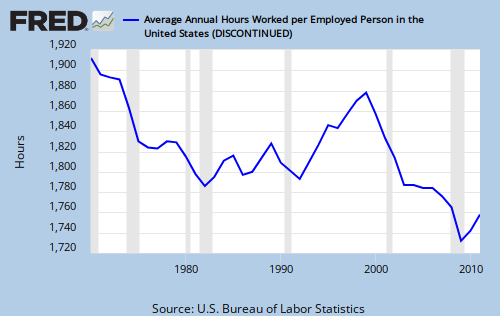
Here is a graph that has me searching for answers.
Monetary Sovereignty

I’m not sure why hours-per-employee went down dramatically from 1970 through the mid 1980’s, then rose in the 1990’s, then crashed during the 2000’s.

I suspect it has to do with the development of computers in business. In the 1970’s, word processors were becoming popular, and in the 1980’s full-fledged computers became more common, especially with the advent of spread sheet programs.

The Internet began to take off in the 1990’s, and the 2000’s saw the rise of Google, followed by the social web pages.

And to all of this, I say, “So?”

Clearly, computers and the Internet have increased productivity, which translated into fewer hours needed to accomplish the same results. But the down – up – down shape of the graph is related to additional effects.

I can speculate that the growth in average hours earlier was related to business growth, but that around the year 2000, computers started to become so efficient that productivity increased faster than business growth, and fewer hours were needed.

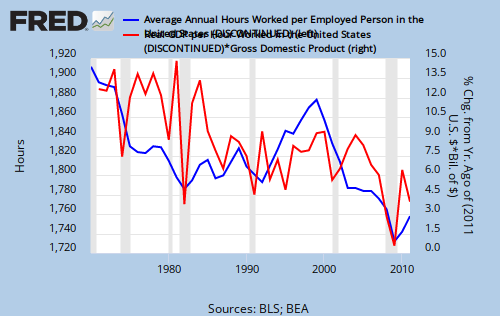
There is a bare hint of that effect in the following graph, where the red line represents GDP growth multiplied by productivity. (Faster GDP growth sends the line down; faster productivity growth sends the line up.)
Monetary Sovereignty

Obviously, any “correlation” is tenuous at best, since population growth, more women in the workforce, trade deficits, tax laws and several other factors may be involved.

Rodger Malcolm Mitchell
http://www.rodgermitchell.com


==========================================================================================================================================
No nation can tax itself into prosperity, nor grow without money growth. Monetary Sovereignty: Cutting federal deficits to grow the economy is like applying leeches to cure anemia. Two key equations in economics:
Federal Deficits – Net Imports = Net Private Savings
Gross Domestic Product = Federal Spending + Private Investment and Consumption + Net exports

#MONETARY SOVEREIGNTY

–Has Vallejo, California found the solution to city financial survival?

Mitchell’s laws: The more budgets are cut and taxes inceased, the weaker an economy becomes. Until the 99% understand the need for deficits, the 1% will rule. To survive long term, a monetarily non-sovereign government must have a positive balance of payments. Austerity = poverty and leads to civil disorder. Those, who do not understand the differences between Monetary Sovereignty and monetary non-sovereignty, do not understand economics.
==========================================================================================================================================

The federal government, being Monetarily Sovereign, has the power to pay any bill of any size. It never can go bankrupt. The states, counties and cities, being monetarily non-sovereign, do not have this power, so many are in financial difficulty.

Has Vallejo, California found a solution?

Washington Post
Vallejo, Calif., once bankrupt, is now a model for cities in an age of austerity
David Paul Morris/Bloomberg

After becoming the largest city in America to declare bankruptcy in 2008, Vallejo, Calif., began to reinvent itself.

The first couple of years were ugly. . . crime and prostitution surged as the police force was thinned by 40 percent. Firehouses were shuttered, and funding for libraries and senior centers was slashed. Foreclosures multiplied and home prices plummeted.

But then this city of 116,000 began to reinvent itself. It started using technology to fill personnel gaps, rallying residents to volunteer to provide public services and offering local voters the chance to decide how money would be spent — in return for an increase in the sales tax. For the first time in five years, the city expects to have enough money to do such things as fill potholes, clear weeds, trim trees and repair tennis courts.

Our states, counties and face a common problem. They cannot create dollars. So, for instance, if they run a balanced budget, and suddenly any expense — meaning ANY expense — increases, they must obtain dollars from the residents or from outside their borders.

But if residents work inside the city’s borders, the same dollars merely recirculate, and eventually the residents become impoverished trying to support their government. This is exactly the same problem residents of Greece and the other monetarily non-sovereign euro nations face.

A rule in economics: To survive long term, a monetarily non-sovereign entity must have money coming in from outside its borders. This money can come from a higher entity — i.e. cities can get dollars from the state — or from exports. But, of course, all states, counties and cities cannot be net exporters, so dollars much come from a higher entity — ultimately from the federal government.

The nation’s cities are weak links in the U.S. economy and, if they collapse in large numbers, it could knock the country’s recovery off course. Cuts at the federal level are being pushed down to the states, which in turn are passing the problems to their cities.

Which demonstrates, yet again, the suicidal foolishness of federal budget cuts.

At least three California cities — Stockton, Mammoth Lakes and Montebello — have declared that they are exploring the (bankruptcy) option. And at least 100 of the state’s 482 cities are on track to face a similar predicament by the end of the year, according to Barbara O’Connor, a professor at California State University at Sacramento.

Economists warn that a number of large bankruptcies of cities, concentrated over a short period of time, could have a devastating effect on the national economy.

Vallejo, about 35 miles northeast of San Francisco, became the poster child for the failures of municipal budgeting in 2008 when its cash reserves dwindled to zero and it was unable to pay its bills amid falling property tax revenue and the soaring cost of employee compensation and pensions.

For Vallejo to survive, two city council members — Marti Brown, 46, a redevelopment worker for the state, and Stephanie Gomes, 45, a legislative specialist for the U.S. Forest Service — decided that the city needed to study best practices from around the world and bring some of them to California.

The police went high-tech, investing $500,000 in cameras across the city that allow officers to monitor a larger area than they could before. The department deputized citizens to participate in law enforcement by sharing tips on Facebook and Twitter.

Gomes, whose husband is a retired police officer, focused on public safety. The couple went neighborhood to neighborhood setting up e-mail groups and social media accounts so people can, for instance, share pictures of suspicious vehicles and other information. “There have been countless cases where ordinary people have stopped crimes this way,” Gomes said.

This is a close relative of the “spy-on-your-neighbor” approach used by many totalitarian governments, and supported by the National Rifle Association. Think: George Zimmerman, neighborhood watch captain, killing Trayvon Martin — an “ordinary person” stopped a crime.

The number of neighborhood watch groups jumped from 15 to 350. Citizen volunteers came together monthly to paint over graffiti and do other cleanup work.

So in addition to paying more taxes, the citizens paid with their time.

And the city council struck an unusual deal with residents — if they agreed to a one-penny sales tax increase, projected to generate an additional $9.5 million in revenue, they could vote on how the money would be used.

In return for paying higher taxes, the citizens would be allowed to vote on how that money could be used. Of course other money could be switched over to other uses.

[In Illinois, lottery money was supposed to support education. So the crooked politicians merely switched away the money that formerly supported education. A perfect scam.]

As the 2012-13 budget season kicks off in California, Vallejo’s neighbors are looking at severe cuts, in part because of reduced support from the state. Gov. Jerry Brown (D) this month revealed that California is facing a crushing$16 billion deficit because of a shortfall in tax revenue. As a result, the state is diverting billions that had been earmarked for redevelopment or housing assistance away from cities that were already under fiscal stress.

As the old saying goes, sh*t flows downhill. The federal government cuts support to the states, so the states cut support to the counties and the cities. All this hardship falls on the people, because the debt hawks say the federal government should live within its non-existent “means.”

The state capital, Sacramento, which is expecting an $18 million deficit for fiscal 2012-13, has proposed cutting 286 full-time jobs, including police and firefighters, a move that would probably leave the city unable to respond to home burglaries and car accidents and lengthen the response time for 911 calls in all but the most dire cases.

Vallejo is in a markedly different situation. While it still faces some serious challenges — crime continues to be a problem

I guess “spy-on-your-neighbor” hasn’t worked too well.

. . . and the housing market remains depressed — the city’s finances are doing so well that a federal judge released it from bankruptcy in November.

Assistant City Manager Craig Whittom, who has worked in Vallejo since 2003, said the bankruptcy may have been the best thing to happen: “It was effective at helping us re-create ourselves and change the culture so that we could restart from a stronger financial footing.”

So all is well, right? Wrong. The fundamental problems remain:

1. Vallejo still is monetarily non-sovereign.
2. The debt-hawks in Washington still push for budget cuts.

So with no changes in #1 or #2, Vallejo again will crash against financial realities. Residents will tire of providing free services, and no amount of neighbor spying or graffiti overpainting will save the city.

Vallejo again will run out of money, thanks to the debt-hawks in Washington.

Rodger Malcolm Mitchell
http://www.rodgermitchell.com


==========================================================================================================================================
No nation can tax itself into prosperity, nor grow without money growth. Monetary Sovereignty: Cutting federal deficits to grow the economy is like applying leeches to cure anemia. Two key equations in economics:
Federal Deficits – Net Imports = Net Private Savings
Gross Domestic Product = Federal Spending + Private Investment and Consumption + Net exports

#MONETARY SOVEREIGNTY

–The Obama non-spending spree and the road to depression

Mitchell’s laws: The more budgets are cut and taxes inceased, the weaker an economy becomes. Until the 99% understand the need for deficits, the 1% will rule. To survive long term, a monetarily non-sovereign government must have a positive balance of payments. Austerity = poverty and leads to civil disorder. Those, who do not understand the differences between Monetary Sovereignty and monetary non-sovereignty, do not understand economics.
==========================================================================================================================================

TPM published an article titled, “An Obama Spending Spree? Hardly” by Sahil Kapur

As a defense against Republican charges that President Obama spent too much, the article really should be called, “With friends like these, who needs enemies.”

Some excerpts:

A dominant theme of the national political discourse has been the crushing spending spree the U.S. has ostensibly embarked on during the Obama presidency. That argument, ignited by Republicans and picked up by many elite opinion makers, has infused the national dialogue and shaped the public debate in nearly every major budget battle of the last thee years.

But the numbers tell a different story.

Obama’s policies, including the much-criticized stimulus package, have caused the slowest increase in federal spending of any president in almost 60 years, according to data compiled by the financial news service MarketWatch.

During the worst recession since the Great Depression, the Obama administration oversaw “the slowest increase in federal spending of any president in almost 60 years.” And this is supposed to be a defense of the President?? At just the time when increased spending is most needed, spending increases were smallest? Yikes!

Obama — unlike his Republican and Democratic predecessors — signed a law in February 2010 necessitating that new spending laws are paid for.

Here, Mr. Kapur parrots the popular ignorance that Monetary Sovereignty is the same a monetary non-sovereignty. Unlike state and local government spending, the spending by a Monetarily Sovereign government is not “paid for” by anything. There is no vault from which dollars are extracted and sent to creditors. The government merely instructs banks to mark up checking accounts. The government can send these instructions endlessly, regardless of tax collections.

Not understanding the difference between Monetary Sovereignty and monetary non-sovereignty is absolute proof one does not understand economics.

In addition, Obama last year signed into law over $2 trillion in debt-reduction over the next decade.

Thereby, converting the United States into Greece. Debt reduction is guaranteed to cause a depression:

1817-1821: U. S. Federal Debt reduced 29%. Depression began 1819.
1823-1836: U. S. Federal Debt reduced 99%. Depression began 1837.
1852-1857: U. S. Federal Debt reduced 59%. Depression began 1857.
1867-1873: U. S. Federal Debt reduced 27%. Depression began 1873.
1880-1893: U. S. Federal Debt reduced 57%. Depression began 1893.
1920-1930: U. S. Federal Debt reduced 36%. Depression began 1929.

. . . the President has put hundreds of billions in cuts to Medicare, Medicaid and Social Security on the table in deals that have been derailed, thanks in no small part to the GOP’s resistance to raising new tax revenues to help bridge the budget shortfall.

There’s irony for you. The Democrat wants to slash programs for the 99%, while the Republicans “derail” the deal.

You simply cannot make this stuff up. A pox on both your houses.

Rodger Malcolm Mitchell
http://www.rodgermitchell.com


==========================================================================================================================================
No nation can tax itself into prosperity, nor grow without money growth. Monetary Sovereignty: Cutting federal deficits to grow the economy is like applying leeches to cure anemia. Two key equations in economics:
Federal Deficits – Net Imports = Net Private Savings
Gross Domestic Product = Federal Spending + Private Investment and Consumption + Net exports

#MONETARY SOVEREIGNTY

–The solution to the income gap in less than 1000 words.

Mitchell’s laws: The more budgets are cut and taxes inceased, the weaker an economy becomes. To survive long term, a monetarily non-sovereign government must have a positive balance of payments. Austerity = poverty and leads to civil disorder. Those, who do not understand the differences between Monetary Sovereignty and monetary non-sovereignty, do not understand economics.
==========================================================================================================================================

So far, it’s been a great week for the public, a great week for Chicago and a great week for America. We can be proud.

The public has used its First Amendment voice, the Chicago police controlled the situation, with scant violence, while being spat on, called names and had bottles and batteries tossed at them. America demonstrated a tolerant democracy.

In reality, it’s been a terrible week, because after much sound and fury, nothing much was accomplished. At great expense and effort, NATO did little it couldn’t have done by staying home. Virtually all the work was done before they got here. And the protesters will go home to a world identical with the one they left.

As I watched the protesters in Chicago, my heart went out to them. I personally agree with most of their beliefs about big business, government and particularly the 1% tyranny over the 99%. Yet, I feel their message is confused, unfocused and devoid of solutions, and their method is self defeating. And like most people, I look upon war as a disgrace. So?

Surely, the marches didn’t change many minds. The people who agreed with the marchers’ arguments, still agree. Those who disagreed think the marchers are a bunch of naive rabble-rousers, using the NATO conference as a substitute for wild Spring Break in Florida.

The politicians ignore the protesters, because there is no bribe money on the table. And the 1% sit in their summer homes and laugh at the futility.

A peaceful protest is like a non-embryonic pregnancy – much effort with no results. A violent protest leads, often as not, to either a more violent push-back by the 1%, or by an even harsher totalitarianism.

Protests have a bad track record for long-term accomplishment.

The Chicago protests seemed to involve two desires: An end to war and an end to income inequality. The end-the-war segment had its humorous moments: the Syrian contingent asking NATO to impose a no-fly zone over Syria (to help prevent the massacres by the Syrian government), standing next to the pacifist group asking NATO to stop shooting at people. How NATO is to do both, was not explained.

The end-income-inequality group seemed somewhat misplaced, as NATO’s relationship to the income gap seems tenuous at best. In short, the protests meant little, will accomplish little, and if anything, will help the media impart a negative impression of the protesters’ causes.

Theoretically, the 99%, having the voting power, should be able to enforce their will. But, the politicians, realizing the 99% doesn’t know what their will is, continue to nominate 1% sympathizers. Voting for Romney is a disaster for the 99%. Voting for Obama is somewhat less a disaster, but a disaster nevertheless. And in America, 3rd party candidates seldom win.

So what’s to be done?

I cannot speak to the anti-war marches, because the reasons for war are so diffuse, different in every situation. But I will speak to the #Occupy complaint about the income gap between the 1% and the 99%.

The fundamental problem facing the 99% is this: They do not understand Monetary Sovereignty. They actually believe the federal government is broke, the federal deficit must be reduced, the federal debt is a burden, social services need to be cut and additional federal spending will cause inflation.

Based on these beliefs, the 99% is in perfect harmony with the 1%. They are like a woman who believes being raped is a proper punishment for being pretty. The 1% enjoys raping the 99%, and the 99% believe rape is necessary.

Since the problem is ignorance, the solution is to teach the facts. And that begins with the media. Because the media are owned by the 1%, merely contacting the media isn’t enough. It helps, and we should continue to write, Email and call, but it isn’t enough. The media have to be forced to listen, embarrassed not to listen.

The protests should not target NATO, which doesn’t care, or the government officials, who care even less. The protest marches should target the media.

A plan outline:

First, #Occupy leaders must learn Monetary Sovereignty, not just learn but be prepared to defend and to teach it. They must learn how and why:

1. The federal government became Monetarily Sovereign on August 15, 1971. Its finances are unlike those of state and local governments, business, the euro nations, you and me.

2. Monetarily Sovereign governments create money by spending. This money creation misleadingly is termed “deficits.” It should be called “economic surpluses, ” and economic surpluses are necessary to grow the economy.

3. The federal government neither needs nor uses tax dollars. Unlike state and local taxes, federal taxes do not pay for spending. Federal taxes do not pay for Social Security, Medicare, Medicaid, Congress, the Supreme Court or the White House. Federal spending does not cost taxpayers one cent.

4. The federal government’s ability to spend is limited only by inflation. But, despite huge “deficits,” federal spending never has caused inflation. And inflation can be controlled by interest rates.

Second, the #Occupy leaders must teach Monetary Sovereignty to their members. Formal and informal schooling should be arranged. Contact such educators as Randy Wray, Bill Black, Stephanie Kelton, and Matt Forstater at UMKC. Ask for advice.

Third, #Occupy must target the media. Contact the media repeatedly. Flood with Emails, snail mail, personal contacts. And march against the media. A hundred knowledgeable, sign-carrying people, standing on Chicago’s Michigan Avenue, in front of the Chicago Tribune headquarters, demanding that the Tribune print the Monetary Sovereignty facts, will do more than all that has been accomplished to date.

Force the media to educate the public, which will give the 99% the information and the voice they have been missing. And when the 99% has a voice, the politicians will listen.

The result: An informed public, a generous Social Security, Medicare for all, more support for education, research, infrastructure, ecology, a healthy, growing economy, and a smaller gap between the 1% and the 99%.

Rodger Malcolm Mitchell
http://www.rodgermitchell.com


==========================================================================================================================================
No nation can tax itself into prosperity, nor grow without money growth. Monetary Sovereignty: Cutting federal deficits to grow the economy is like applying leeches to cure anemia. Two key equations in economics:
Federal Deficits – Net Imports = Net Private Savings
Gross Domestic Product = Federal Spending + Private Investment and Consumption + Net exports

#MONETARY SOVEREIGNTY