–The BIG LIE: It’s everywhere. Repetition creates belief, which creates more repetition.

Mitchell’s laws:
●The more budgets are cut and taxes increased, the weaker an economy becomes.

●Austerity starves the economy to feed the government, and leads to civil disorder.
●Until the 99% understand the need for federal deficits, the upper 1% will rule.
●To survive long term, a monetarily non-sovereign government must have a positive balance of payments.
●Those, who do not understand the differences between Monetary Sovereignty and monetary non-sovereignty, do not understand economics.

==========================================================================================================================================

In economics we suffer the BIG LIE. It is a lie, because it is untrue. And it is big, because it adversely affects every facet of our lives. The BIG LIE, in its simplest, most basic form is this:

“A Monetarily Sovereign government unwillingly can run short of its sovereign currency.”

The U.S. became Monetarily Sovereign on August 15, 1971, when it went off a gold standard. The government creates dollars by paying bills. It pays bills by instructing banks to increase the numbers in checking accounts. It can do this endlessly, now that it no longer needs supplies of gold to collateralize dollars. In short, the BIG TRUTH is:

It is not possible for the U.S. government unwillingly to run short of dollars.

Even were all federal taxes and so-called federal “borrowing to fall to $0, the U.S. government could pay any bills of any size, forever. This includes 100% funding of Social Security, Medicare for everyone and every other federal initiative.

Not only is the BIG TRUTH factually true, but it has been proven true. Not only is the BIG LIE factually false, but it repeatedly has been proven false. Yet the BIG LIE is widely believed — so widely believed it seldom even is argued, but rather merely assumed as fact — and he BIG TRUTH is widely derided. There are two reasons.

1. The BIG LIE appeals to ignorant intuition, because though it is untrue about federal finances, it is true about personal finances. While the federal government cannot run short of dollars, we citizens can run short.

2. The BIG LIE benefits the upper 1% income group by increasing the gap between the 1% and the 99%. Most federal deficit spending benefits the 99% more than the 1%. Deficit reductions increase the gap. And most information sources – the media editors and politicians – are part of, or beholden to, the 1%.

Thus the BIG LIE, despite its factual and experiential shortcomings, is repeated everywhere in America and around the world, and seldom even debated. Here are examples of the BIG LIE in the words of the liars:

“We need to stop spending money we don’t have. President Obama has given us four years of trillion-dollar-plus deficits.” Paul Ryan

“Spending money we don’t have” applies to people, cities and businesses, all of which are monetarily non-sovereign, not to the Monetarily Sovereign federal government, which creates money by spending. The only way we can “have” money is via federal spending. No federal spending, no “having.”

“With Medicare expected to go bust by 2024 . . . “ Jan Crawford of CBS News

Medicare, as a federal agency, cannot “go bust,” unless Congress and the President decide not to fund it. Even if FICA were $0, the government could continue paying benefits, as always.

“Canada’s path of great budgetary discipline and a very heavy emphasis on growth and overcoming the crisis, not living on borrowed money, can be an example for the way in which problems on the other side of the Atlantic can be addressed. This is also the right solution for Europe.” Angela Merkel, Germany

For every nation, including Canada, Gross Domestic Product = Government Spending + Private Investment and Consumption + Net exports. So if Government Spending goes down, growing the economy requires something else to go up. That’s simple algebra. Canada’s is a net exporter, otherwise it would be in a depression.

‘Medicare is the second-biggest item in the entire federal budget and one of the fastest-growing. Over the past 30 years, its cost has doubled as a share of our gross domestic product, and over the next 30, it’s on track to double again. But the revenues that pay for it are not keeping pace.” Steve Chapman, Chicago Tribune

The president of AARP recently admitted that FICA does not pay for Medicare or Social Security.

“We need a national sales tax — a consumption tax, like the dreaded but efficient value-added tax — but Mr. Romney and Mr. Ryan don’t have the gumption to support it.” David Stockman, Ronald Reagan’s budget director

Just as federal spending adds dollars to the economy, federal taxes remove dollars from the economy, which by simple mathematics, reduces GDP growth. Taxes depress economies.

Just as a doctor would treat an illness, we must look for the cause of the ailment. In the case of the deficit, that’s government overspending. So the question clearly is, “Where do we cut?” Gretchen Hamel, executive director of Public Notice.

The need to cut federal spending merely is assumed. No evidence ever is provided. The reason: No such evidence exists.

“The issue of the debt and the deficit – and what to do about it – has paralyzed Washington lawmakers. But when it comes to measures for reducing the deficit on which they might reach common ground, they will get little help in building support for an agreement by turning to public opinion.” Andrew Kohut, President, Pew Research Center

While public opinion is nearly unanimous that the federal deficit should be reduced, there can be no agreement about how. The reason: Every plan for reducing the deficit discloses the BIG TRUTH that deficit reduction hurts the economy.

“Was the budget deficit increase in 2008, Rob Portman’s fault?” Published: Saturday, August 11, 2012, By Stephen Koff, The Cleveland Plain Dealer

The headline uses the world “fault” to describe a deficit increase. The correct word would have been “accomplishment.”

“Since 2010, Social Security has been paying out more in benefits than it collects in taxes, adding to the urgency for Congress to address the program’s long-term finances.” Aug. 12, 2012, Associated Press writer Andres Gonzalez contributed to this report.

FICA does not pay for Social Security benefits. The best way to “address the program’s long-term finances” would be to eliminate FICA and support SS out of the general fund.

“You must have a balanced plan that reforms the tax code in a progressive, pro-growth manner and produces additional revenue if you are serious about reducing the deficit by at least $4 trillion without disrupting the country’s fragile economic recovery and hurting the disadvantaged.” August 12, 2012, By Erskine Bowles, in St. Louis Post Dispatch

He wants to increase taxes to grow the economy, a mathematical idiocy.

“The long-term entitlement crisis is seeping into the short term. Social Security slipped into the red last year. Medicare follows suit in roughly a decade. And Europe is demonstrating that creditors’ patience with political and fiscal dysfunction is not infinite.” Michael Gerson (from the Seattle Times)

Gerson does not understand the difference between Monetary Sovereignty (the U.S.) and monetary non-sovereignty (the euro nations). Or at least, he pretends he doesn’t understand. As an employee of the 1%, he is paid to disseminate the BIG LIE.

One could go on and on, with repetitions of the BIG LIE. Is it any wonder the public has come to believe and even repeat the BIG LIE? We read the BIG LIE in our newspapers. We hear the BIG LIE from politicians, on radio and TV, and even from our neighbors. We drown in the BIG LIE. Repetition creates belief, which creates more repetition.

And all these repetitions have one thing in common: They express alarm at the size of the federal deficit, but none provides any evidence the deficit harms the economy. The reason for no evidence: The deficit is absolutely necessary for economic growth.

“It’s bad because it’s big,” is the only “evidence” the liars provide, but that is exactly the same as saying, “Gross Domestic Product is bad because it’s big.”

Abraham Lincoln supposedly said, ” . . . you can not fool all of the people all of the time.” Old Abe might have been wrong about this one. The 1% has managed to fool nearly all the people about the federal deficit.

Rodger Malcolm Mitchell
Monetary Sovereignty


==========================================================================================================================================
No nation can tax itself into prosperity, nor grow without money growth. Monetary Sovereignty: Cutting federal deficits to grow the economy is like applying leeches to cure anemia. Two key equations in economics:
Federal Deficits – Net Imports = Net Private Savings
Gross Domestic Product = Federal Spending + Private Investment and Consumption + Net exports

#MONETARY SOVEREIGNTY
–AARP President Rob Romasco admits FICA does not support Social Security

Mitchell’s laws:
●The more budgets are cut and taxes increased, the weaker an economy becomes.

●Austerity starves the economy to feed the government, and leads to civil disorder.
●Until the 99% understand the need for federal deficits, the upper 1% will rule.
●To survive long term, a monetarily non-sovereign government must have a positive balance of payments.
●Those, who do not understand the differences between Monetary Sovereignty and monetary non-sovereignty, do not understand economics.

==========================================================================================================================================

In economics, the BIG LIE is the idea that somehow a Monetarily Sovereign government unwillingly can run short of its own sovereign money. The purpose of the BIG LIE is to make the populace believe the federal government cannot afford social spending.

And the purpose of that is to increase the gap between the upper 1% income group and the lower 99% (The lower 99% receives a greater percentage of its income from federal social spending than does the upper 1%.) Increasing the gap is the primary goal of the 1%.

Republican Representative John Boehner, famously repeated the BIG LIE when he declared “America is broke.” Main Street Americans, not understanding the difference between federal finances and personal finances, accept the BIG LIE without question.

In an August 14th online discussion, AARP President Rob Romasco answered questions about Social Security funding, and essentially admitted the BIG LIE, though he didn’t realize it at the time:

Comment From Guest: “I hear conflicting statements in the media about Social Security running out of money. What is the real story: Is it expected to run out of money?”

Rob: “Social Security receives money from 3 main sources: the payroll tax, interest earned from bonds that are held in the Trust Funds, and the taxation of benefits.”

Comment From Guest: “Is the FICA tax holiday hurting Social Security?”

Rob: “This is a very good question… The FICA tax holiday is in no way hurting the Social Security program. Even though the payroll tax was decreased by 2 percent, money is transferred from the ‘General Fund’ to make up for the lost payroll tax.”

So there you have it. To pay for the “lost payroll tax,” money is transferred from the General Fund. And in fact, to pay for any “lost” payroll tax, money always can be transferred from the General Fund. If there were no payroll tax at all – i.e. if FICA were $0 – money to pay Social Security benefits still could be transferred from the General Fund.

What does this all mean? The General Fund, the Social Security Trust Fund, and indeed all federal funds are accounting fictions. They do not exist in any real form. They all are nothing more than numbers on balance sheets and the numbers are wholly controlled by the U.S. government. That is what we mean when we say the government is Monetarily Sovereign.

Until August 15, 1971, the federal government limited its dollar-creation to its supplies of physical gold. If gold supplies ran low, the government would not allow itself to create the dollars to pay its bills.

This was entirely a self-limitation; dollars have no physical existence. The federal government always has had the power to change the numbers in its balance sheets, but prior to 1971, chose to tie its own hands as a presumed protection against creating “too many dollars,” i.e. inflation.

By 1971, it had become clear this artificial limitation prevents economic growth and can cause a self-created bankruptcy. So President Nixon simply removed the limitation. After that date, nothing prevents the federal government from increasing its fictional supply of dollars by any amount.

Dollars don’t come from taxes. Dollars don’t come from borrowing. Dollars don’t “come from” anywhere. They simply are numbers added to the General Fund by arbitrary credits.

In accounting, any credit requires a debit, so where do the debits come from? Some come from the “taxes received” line of the balance sheet. And the rest come from what erroneously is called “borrowing,” but actually is the total of outstanding Treasury securities.

This provides the illusion that taxes and borrowing “pay for” federal spending. But if there were no taxes and no borrowing (T-securities), the federal government still could pay its bills as always — by crediting and debiting accounts. That illusion is what makes the BIG LIE persuasive.

What would happen if not enough people wished to own T-securities? The Federal Reserve Bank simply would credit T-security accounts (which are at the FRB) by enough to make up the difference.

Remember: Though dollars may seem real and scarce to you and me, for the Monetarily Sovereign federal government, dollars are an accounting fiction. They are nothing more than numbers the government can manipulate at will.

Need a trillion dollars to pay for Social Security? No problem. Credit the General Fund by $1 trillion, and debit the T-security account. Need another trillion to pay for Medicare? Still no problem. Credit the General Fund, and debit the T-security fund, by another trillion.

Need more dollars in the T-security account? No problem. Credit the T-security account and debit other accounts at the Federal Reserve Bank. This is especially convenient since all T-security accounts are kept at the FRB.

You and I are not Monetarily Sovereign. Neither are Illinois, Cook County, Chicago or General Electric. None of us has the legal authority to change the numbers in bank accounts at will. The federal government has this legal authority.

It can instruct your bank to increase the numbers in your checking account (i.e. pay your Social Security benefit). Your bank will obey, and forward these instructions to the Federal Reserve bank, which will clear the transaction (i.e. credit your bank’s account), because the instructions came from the government.

Bottom line: Dollars do not exist in any physical sense. They are an accounting fiction, wholly controlled by our Monetarily Sovereign government, which can create an infinite number of them, simply by crediting accounts. The government can credit Medicare, Medicaid and Social Security accounts endlessly, just as it can credit all federal agency accounts, endlessly.

The only way Social Security could run short of dollars is if the government fails to credit its accounts. The same is true for Medicare (which is why the much-despised individual mandate is unnecessary). The same is true for all federal spending.

Sadly, Rob Romasco ended his response to the Social Security question, with this comment:

Rob: “Nevertheless, AARP believes the temporary payroll tax holiday should not be extended beyond the current year.”

Thus, despite admitting benefits can be (and are being) paid by debiting the General Fund, AARP continues to promulgate the BIG LIE that the federal government can run short of dollars.

After all, AARP is a private organization, owned and directed by the 1%.

Rodger Malcolm Mitchell
Monetary Sovereignty


==========================================================================================================================================
No nation can tax itself into prosperity, nor grow without money growth. Monetary Sovereignty: Cutting federal deficits to grow the economy is like applying leeches to cure anemia. Two key equations in economics:
Federal Deficits – Net Imports = Net Private Savings
Gross Domestic Product = Federal Spending + Private Investment and Consumption + Net exports

#MONETARY SOVEREIGNTY

–Mathematical proof that deficits should be increased. Send it to your favorite debt-hawk

Mitchell’s laws:
●The more budgets are cut and taxes increased, the weaker an economy becomes.

●Austerity starves the economy to feed the government, and leads to civil disorder.
●Until the 99% understand the need for federal deficits, the upper 1% will rule.
●To survive long term, a monetarily non-sovereign government must have a positive balance of payments.
●Those, who do not understand the differences between Monetary Sovereignty and monetary non-sovereignty, do not understand economics.

==========================================================================================================================================

One of the most important and timely equations in economics is:

Federal Deficits = Net Private Savings + Net Imports

This neither is theory or even hypothesis. It is an accounting description of U.S. dollar flow. No economist disputes this equation.

The equation shows that federal deficits are the ultimate source of all dollars, and despite economically suicidal efforts to reduce deficits, if there were no deficits there would be no dollars. Without federal deficits, your net savings — even Bill Gates net savings — would be zero.

“Deficit” and “debt” fool most people, because these words sound negative. But think about it this way:

A federal “deficit” occurs when the federal government creates and spends more dollars than it receives in taxes. Similarly, when the government runs a surplus, the government takes more dollars out of the economy than it sends into the economy. A government surplus is the economy’s deficit.

The added dollars from federal deficit spending go to one of two places:

1. Into the U.S. economy, where they become Net Savings, or
2. To foreign economies to pay for Net Imports

Thus, the equation: Federal Deficits = Net Private Savings + Net Imports

Banks create dollars by lending, but those are not net dollars. For every dollar created by a bank, a loan obligation also is created –- the new dollars are offset by new obligations, so they net to zero. Only the federal government creates net savings dollars.

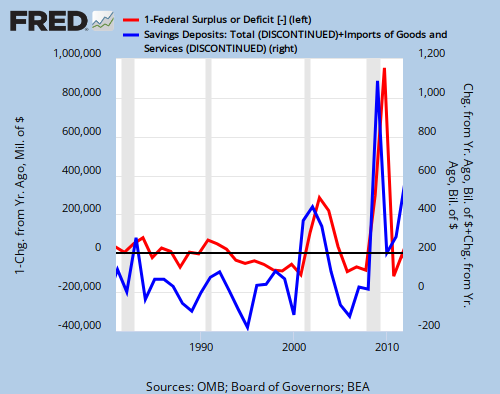
Lately, the blogosphere has been crackling with graphs illustrating this simple concept. First, I received an Email from several economists, containing an illustrative graph from Warren Mosler’s site. Then, I sent them back the following graph which shows Federal Deficits (red line) and Total Savings Deposits at all Depository Institutions plus Imports of Goods and Services (BOPMGSA)

Monetary Sovereignty
(The lines would be exactly coincident but for slight measurement differences. Also, “Total Savings Deposits at all Depository Institutions” is not identical with Net Private Savings, and Imports of Goods and Services is not Net Imports.)

The graph makes this point clear: The more deficits rise, the more net savings rise.

The misnamed “deficit” is the source of all net dollars, i.e. all net private savings. Cutting deficits cuts private savings, which depresses the economy. Cutting deficits is a prescription for depression.

The Tea Party, Romney/Ryan, the Chicago Tribune, AARP and the Wall Street Journal editors all act on behalf of the upper 1% income group. They tell you the myth that federal deficit and debt are “unsustainable” and should be reduced. They never explain why a Monetarily Sovereign nation cannot “sustain” its deficits.

The 1% wants you to believe the myth, because that belief leads to your acceptance of cuts to social benefits and a large and growing income gap between the 1% and the 99%.

Reducing the deficit takes dollars out of the economy. When the government deficit spends, dollars flow into your pockets. When the government taxes, dollars flow out of your pockets. It’s that simple.

Because the government is Monetarily Sovereign it can create endless dollars. It does not need taxes. It does not need to borrow the dollars it creates. It can support endless Medicare, endless Medicaid and endless Social Security and never bounce a check.

Federal social programs will be in financial trouble only if the government cuts federal spending. It’s a self-fulfilling action. The more deficit cutting, the more financial trouble, which (according to the 1%) “requires” more deficit cutting, and on and on, until the lower 99% are sucked dry.

Don’t let the 1% starve you to feed a Monetarily Sovereign government that does not need to be fed. Vote against all tax increases and benefit cuts.

(By the way, if the Ryan budget doesn’t really cut Medicare, but actually “saves” Medicare, why does Ryan repeatedly assure those 55 and older, that the plan will not apply to them? Does he think we are so selfish we don’t care what happens to our kids?)

Rodger Malcolm Mitchell
Monetary Sovereignty


==========================================================================================================================================
No nation can tax itself into prosperity, nor grow without money growth. Monetary Sovereignty: Cutting federal deficits to grow the economy is like applying leeches to cure anemia. Two key equations in economics:
Federal Deficits – Net Imports = Net Private Savings
Gross Domestic Product = Federal Spending + Private Investment and Consumption + Net exports

#MONETARY SOVEREIGNTY

–Have you bribed a politician lately?

Mitchell’s laws:
●The more budgets are cut and taxes increased, the weaker an economy becomes.

●Austerity starves the economy to feed the government, and leads to civil disorder.
●Until the 99% understand the need for federal deficits, the upper 1% will rule.
●To survive long term, a monetarily non-sovereign government must have a positive balance of payments.
●Those, who do not understand the differences between Monetary Sovereignty and monetary non-sovereignty, do not understand economics.

==========================================================================================================================================

Have you bribed a politician lately?

The Washington Post published an interesting article titled, When is a campaign contribution a bribe?
By Robert Barnes, Published: August 12

A few excerpts:

Former Alabama governor Don Siegelman heads back to prison next month, contrite about and embarrassed by his bribery conviction. But when he faced resentencing earlier this month, he still was not quite ready to concede that he knowingly broke the law.

“If I had known I was coming close to the line where a campaign contribution becomes a bribe and a crime, I would have stopped,” Siegelman told U.S. District Judge Mark Fuller, who sentenced Siegelman to 6 1/2 years in prison.

Federal law makes it a crime to corruptly solicit or accept money with the intent of being rewarded or influenced in official actions.

In 1991, (the Supreme Court) ruled that a campaign contribution could be a bribe if prosecutors proved a quid pro quo — that the contribution was “made in return for an explicit promise or undertaking by the official to perform or not to perform an official act.”

In a subsequent case, Justice Anthony Kennedy said the quid pro quo need not be expressly stated. But lower courts have differed, since then, on exactly what standards apply.

In Siegelman’s case, the contribution at issue was to his pet project, a lottery referendum measure that would help education. Richard Scrushy, a health-care facility magnate who had been appointed to a state hospital facility planning board by previous Republican governors, gave $500,000 to the referendum campaign. Siegelman, a Democrat, later reappointed him to the board.

Let’s say you understand that the Romney/Ryan ticket is a shill for the upper 1% income group, and intends to slash benefits for the 99% under the guise of “fiscal responsibility.” You are part of the lower 99% who would be hurt by cuts to Medicare and Social Security, so you send in your $25 donation to re-elect Obama.

Later, Obama votes to expand Medicare and Social Security. You keep your benefits. Have you bribed the President?

Let’s say you are one of the Koch brothers who, to quote an article in The New Yorker, “believe in drastically lower personal and corporate taxes, minimal social services for the needy, and much less oversight of industry—especially environmental regulation. These views dovetail with the brothers’ corporate interests.”

So you give $100 million to the campaigns of numerous right-wing politicians, all of whom express their undying gratitude by voting to drill for oil in ecologically sensitive lands, cut taxes on the wealthy and on corporations, and reduce Medicare, Social Security, Medicaid and aid to the poor.

Have you bribed these politicians?

You may try to find an answer, but you will fail. No matter how you twist and turn the semantics of what constitutes a bribe and what merely is free speech, you will not be able to find a boundary.

For instance, you might say a bribe involves a direct quid pro quo, in which something specific is promised in return for something else specific. Does this include giving money to someone who has promised to give you money if elected? Does “direct quid pro quo” include the tax savings right wing politicians have promised to the Kochs?

I submit that everyone, who gives money to a politician, does it for the same reason: They want that politician to do something to benefit someone. There is no bright line difference between the Alabama governor who reappointed a guy to yet another term on a board, the Koch brothers who essentially bribe the entire right wing, the gal who slips a cash-filled envelope to the small town mayor to get a job for her brother. – and you, who gave $25 to the politician who promises not to cut your Medicare.

While there is no clear solution, there may be some partial solutions – some steps in the right direction. And they have to do with money, and with what I consider the false belief that giving money is a form of free speech.

The 1st Amendment says, “Congress shall make no law . . abridging the freedom of speech, or of the press . . . “ That’s it. In my innocense, I would include talking and writing as “speech.” Although money supposedly “talks,” somehow I don’t consider giving a politician money, to be a form of speech – especially when the money is so big it simply cannot be ignored by the recipient.

The Dalberg quote, “Power tends to corrupt, and absolute power corrupts absolutely,” could be refashioned. “Money corrupts, and big time money corrupts big time.” While your $25 contribution to Obama, may not elicit a quid pro quo, is there any doubt that a million dollar contribution to a politician will get that politician to do almost anything?

Sadly, the Supreme Court does not recognize the difference between $25 and $100 million – something like not recognizing the difference between a machine gun and a Nerf gun – so in removing limits from campaign contributions, the Court, in essence said, “Guns are legal, Nerf guns, machine guns, all he same to us.”

Further, while I disagree that giving money is free speech, previous Supreme Courts have held that even some speech can be proscribed. Oliver Wendell Holmes, Jr. famously said, “The most stringent protection of free speech would not protect a man falsely shouting fire in a theater and causing a panic.”

Yes, even “free speech” is not endlessly free. There are limits. Similarly, there can and should be limits on the “free speech” of political donations.

My suggestion: A limit of $10 per person to each candidate. That would level the playing field. A rich man would have no more “free speech” than would a poor man. Not enough to influence a vote, that $10 worth of “free speech” would tell the politician how you feel.

Rather than being a bribe, that $10 would be “free speech” in its purest form — not a total solution, but perhaps a start.

Rodger Malcolm Mitchell
Monetary Sovereignty


==========================================================================================================================================
No nation can tax itself into prosperity, nor grow without money growth. Monetary Sovereignty: Cutting federal deficits to grow the economy is like applying leeches to cure anemia. Two key equations in economics:
Federal Deficits – Net Imports = Net Private Savings
Gross Domestic Product = Federal Spending + Private Investment and Consumption + Net exports

#MONETARY SOVEREIGNTY