–The private sector myth busted, then, oh no, the public sector myth repeated.

Twitter: @rodgermitchell; Search #monetarysovereignty
Facebook: Rodger Malcolm Mitchell

Mitchell’s laws:
●The more federal budgets are cut and taxes increased, the weaker an economy becomes.
●Austerity is the government’s method for widening the gap between rich and poor,
which ultimately leads to civil disorder.
●Until the 99% understand the need for federal deficits, the upper 1% will rule.
To survive long term, a monetarily non-sovereign government must have a positive balance of payments.
●Those, who do not understand the differences between Monetary Sovereignty and monetary non-sovereignty, do not understand economics.
●The penalty for ignorance is slavery.
●Everything in economics devolves to motive.

======================================================================================================================================================================================

. . . . . . . . . . . . . . . . . . . . . . . . . . . . . . . . . . . . . . . . . . . . . . . . . . . . . .
Mariana Mazzucato is an economist and professor of science and technology policy at the University of Sussex, UK. Her latest book is The Entrepreneurial State: Debunking public vs. private sector myths. She tweets on @MazzucatoM The University is an exempt charity under the Charities Act 2006.
. . . . . . . . . . . . . . . . . . . . . . . . . . . . . . . . . . . . . . . . . . . . . . . . . . . . . .
Professor Mazzucato’s book was summarized in the 24 August 2013 issue of NewScientist Magazine. Her book debunks the myth that the private sector is better at creativity and innovation than is the public sector — a myth often repeated by debt hawks to support federal deficit reduction.

But alas, after her excellent research and insight, she goes off the tracks. Here are a few excerpts from the article:

State of innovation: Busting the private-sector myth
by Mariana Mazzucato

Images of tech entrepreneurs such as Mark Zuckerberg and Steve Jobs are continually thrown at us by politicians, economists and the media. The message is that innovation is best left in the hands of these individuals and the wider private sector, and that the state – bureaucratic and sluggish – should keep out.

Consider the source. What group — the upper 1% income group or the lower 99% — would be more likely to claim that the private sector has all the brains and so, should be less regulated and more supported, financially?

It is ideology, not evidence, that fuels this image. A quick look at the pioneering technologies of the past century points to the state, not the private sector, as the most decisive player in the game.

In countries such as the US, China, Singapore and Denmark the state has provided the kind of patient and long-term finance new technologies need to get off the ground. Investments of this kind have often been driven by big missions, from putting a human on the moon, to solving climate change.

In its early stages Apple received government cash support via a $500,000 small business investment company grant. And every technology that makes the iPhone, a smartphone, owes its vision and funding to the state: the internet, GPS, touchscreen displays and even the voice-activated smartphone assistant Siri all received state cash.

The US Defence Advanced Research Projects Agency (DARPA) bankrolled the internet, and the CIA and the military funded GPS.

The US National Institutes of Health spends around $30 billion every year on pharmaceutical and biotechnology research and is responsible for 75 per cent of the most innovative new drugs annually. Even the algorithm behind Google benefited from US National Science Foundation (NSF) funding.

The fundamental reason: Innovation requires money, and private money is less willing and less able to take big risks and wait long times for uncertain results.

In this era of obsession with reducing public debt – and the size of the state more generally – it is vital to dispel the myth that the public sector will be less innovative than the private sector.

At this point, one may be excused for believing professor Mazzucato understands the need for national deficit spending. Not so fast.

Stories about how progress is led by entrepreneurs and venture capitalists have aided lobbyists for the US venture capital industry in negotiating lower capital gains and corporate income taxes – hurting the ability of the state to refill its innovation fund.

And there is where one myth is replaced by another myth — the myth that a Monetarily Sovereign government like that of the UK or the U.S., needs or even uses tax dollars to support its spending.

As readers of this and several other blogs know, Monetarily Sovereign governments destroy tax dollars upon receipt. Those tax dollars you send to the national government disappear from the nation’s money supply. (Contrast this with tax dollars you send to your city government, which remain a part of the money supply.)

The fact that companies like Apple and Google pay hardly any tax – relative to their massive profits – is all the more problematic, given the significant contributions they have had from the government. Thus, the “real” economy (made up of goods and services) has experienced a shift similar to that of the “financial” economy: the risk has been increasingly moved to the public sector while the private sector keeps the rewards.

What a shame. An economics professor writes an excellent article about government creativity, then spoils it with a demonstration that she doesn’t know the difference between Monetary Sovereignty and monetary non-sovereignty.

Indeed, one of the most perverse trends in recent years is that while the state has increased its funding of R&D and innovation, the private sector is apparently de-committing itself.

In the name of “open innovation” big pharma is closing down its R&D labs, relying more on small biotech companies and public funds to do the hard stuff. Is this a symbiotic public-private partnership or a parasitic one?

Someone please contact the good Professor and tell her the national government is supposed to support the private sector, as a parent supports a child. (Or does she consider her children, if she has any, to be parasites?)

It is time for the state to get something back for its investments. How? First, this requires an admission that the state does more than just fix market failures – the usual way economists justify state spending. The state has shaped and created markets and, in doing so, took on great risks.

Yes, the state does much more than “just fix market failures.” It creates market successes, which in of themselves, strengthen the state. The only “risk” the state takes, is to risk the money it creates freely, at will and in unlimited amounts — in short, no risk at all.

Second, we must ask where the reward is for such risk-taking and admit that it is no longer coming from the tax systems.

Taxes do not reward the government, which destroys tax money on receipt. The reward national government receives for its investment, is economic growth.

And here is where we go from merely bad to downright awful:

Third, we must think creatively about how that reward can come back.

There are many ways for this to happen. The repayment of some loans for students depends on income, so why not do this for companies? When Google’s future owners received a grant from the NSF, the contract should have said: if/when the beneficiaries of the grant make $X billion, a contribution will be made back to the NSF.

Other ways include giving the state bank or agency that invested a stake in the company. A good example is Finland, where the government-backed innovation fund SITRA retained equity when it invested in Nokia.

There is also the possibility of keeping a share of the intellectual property rights, which are almost totally given away in the current system.

OMG, as the kids would say. She doesn’t understand that Finland has no sovereign currency. Because it uses the euro, Finland is monetarily non-sovereign, so is on a par with you and me. It cannot create money at will as the UK and US governments can.

Recognising the state as a lead risk-taker, and enabling it to reap a reward, will not only make the innovation system stronger, it will also spread the profits of growth more fairly.

To Professor Mazzucato, it isn’t “fair” that the private economy reaps profits. One wonders whether she also thinks it’s “fair” that the national government has the exclusive and unlimited ability to create money — unlimited amounts of money — whenever and however it wishes.

And now for the biggest laugh of all:

This will ensure that education, health and transport can benefit from state investments in innovation, instead of just the small number of people who see themselves as wealth creators, while relying increasingly on the courageous, entrepreneurial state.

Oh, that courageous government, sacrificing exactly nothing to build the economy. What daring! What heroism!

My opinion: I do not think Professor Mazzucato really is ignorant of Monetary Sovereignty. I suspect, that as a salaried employee of an exempt charity, she is beholden to the wishes of wealthy contributors, whose primary goal is to widen the gap between the rich and the rest.

This requires deficit limitation, i.e. less support for the 99%.

She is a paid part of the economics establishment, which is responsible for such idiocy in America as deficit reduction, the sequester the federal debt limit and those truly ridiculous “debt clocks.”

But she is right about the myth of the private sector having exclusivity in innovation and creativity.

Rodger Malcolm Mitchell
Monetary Sovereignty

====================================================================================================================================================
Nine Steps to Prosperity:
1. Eliminate FICA (Click here)
2. Medicare — parts A, B & D plus long term nursing care — for everyone (Click here)
3. Send every American citizen an annual check for $5,000 or give every state $5,000 per capita (Click here)
4. Free education (including post-grad) for everyone. Click here
5. Salary for attending school (Click here)
6. Eliminate corporate taxes (Click here)
7. Increase the standard income tax deduction annually
8. Increase federal spending on the myriad initiatives that benefit America’s 99% (Click here)
9. Federal ownership of all banks (Click here)

10 Steps to Economic Misery: (Click here:)
1. Maintain or increase the FICA tax..
2. Spread the myth Social Security, Medicare and the U.S. government are insolvent.
3. Cut federal employment in the military, post office, other federal agencies.
4. Broaden the income tax base so more lower income people will pay.
5. Cut financial assistance to the states.
6. Spread the myth federal taxes pay for federal spending.
7. Allow banks to trade for their own accounts; save them when their investments go sour.
8. Never prosecute any banker for criminal activity.
9. Nominate arch conservatives to the Supreme Court.
10. Reduce the federal deficit and debt

No nation can tax itself into prosperity, nor grow without money growth. Monetary Sovereignty: Cutting federal deficits to grow the economy is like applying leeches to cure anemia.
Two key equations in economics:
1. Federal Deficits – Net Imports = Net Private Savings
2. Gross Domestic Product = Federal Spending + Private Investment and Consumption – Net Imports

THE RECESSION CLOCK
Monetary Sovereignty Monetary Sovereignty

As the lines drop, we approach recession, which will be cured only when the lines rise.

#MONETARY SOVEREIGNTY

–The real purpose of federal taxes

Twitter: @rodgermitchell; Search #monetarysovereignty
Facebook: Rodger Malcolm Mitchell

Mitchell’s laws:
●The more federal budgets are cut and taxes increased, the weaker an economy becomes.
●Austerity is the government’s method for widening the gap between rich and poor,
which ultimately leads to civil disorder.
●Until the 99% understand the need for federal deficits, the upper 1% will rule.
To survive long term, a monetarily non-sovereign government must have a positive balance of payments.
●Those, who do not understand the differences between Monetary Sovereignty and monetary non-sovereignty, do not understand economics.
●The penalty for ignorance is slavery.
●Everything in economics devolves to motive.

======================================================================================================================================================================================

Many posts on this blog discuss the fact that the U.S. federal government, unlike you and me, and unlike the cities, counties, states, companies and the euro nations, is Monetarily Sovereign, and so, does not need income. It creates all the dollars it needs for spending by the very act of spending dollars.

When the government pays a bill, it simply sends instructions to the creditor’s bank, telling the bank to increase the balance in the creditor’s checking account. These instructions are in the form of a check or a wire, and when the bank follows the instructions, dollars are created.

Unlike we monetarily non-sovereign entities, the U.S. federal government can send such instructions endlessly. For more background on this, you might wish to read: “I just thought you should know.”

We are left with the obvious question, “Why does a government, that does not need income, levy taxes?” Considering that the U.S. federal tax code is perhaps the most complex, convoluted, inefficient, ever-changing, incomprehensible, economically damaging set of laws ever created in the history of the world, this question is important.

Why indeed, does the government force us to spend millions of unproductive and unpleasant hours calculating taxes, then take dollars from our pockets to pay those taxes, then spend more dollars to investigate, prosecute and even jail those who don’t pay taxes, properly?

One cannot imagine another exercise that costs so much in time and money, causes so much grief, and has so little value (none) as the U.S. federal tax system.

So, again, why do we do this to ourselves?

WHY TAX?

Economic Control Federal taxes are used to control certain details of the economy. By adjusting tax rates among long-term, short-term, real estate, interest, salary and various enterprises (oil drilling, farming, energy saving, etc.) the government encourages and discourages certain activities.

However, the government could accomplish the same things without taxes, by rewarding (paying dollars) rather than by punishing (taxing dollars).

Provide Demand: Years ago, I had this discussion with proponents of Modern Monetary Theory (MMT) a kissin’ cousin to Monetary Sovereignty (MS). It was (and I believe remains) their belief that federal taxes are necessary to provide demand for the dollar. By requiring people to pay their taxes in dollars, the federal government assures that people will want and use dollars.

I suggest this is partly true, but mostly false. The “true” part is that requiring taxes to be paid in dollars does indeed create demand for the dollar.

But, because there are plenty of state, county, city, village, park district, water district, etc., etc. taxes to provide demand for the dollar, federal taxes are not necessary to provide dollar demand.

Control Inflation: A second belief is, the purpose of federal taxes is to control inflation. If dollars were not removed from the economy by federal taxation, there would be too many dollars in the economy, and this would cause inflation.

This is like saying a pail must have holes in the bottom, otherwise it will overfill. Clearly, the solution to overfilling is to pour less water into the pail. To prevent having too many dollars in the economy, the federal government simply could spend (create) fewer dollars.

Further, since 1971, when the U.S. went off the last vestiges of a gold standard, there has been no relationship between federal deficit spending and inflation. In the past 40+ years, inflation has been associated with oil prices, not with federal money creation.

More importantly, our Monetarily Sovereign federal government not only has the unlimited ability to create dollars, but it also has the unlimited ability to set the value of those dollars. It could, if it chose, devalue the dollar relative to other currencies, revalue (upward) the dollar or renominate (introduce a wholly new currency.)

The U.S. federal government being the inventor of the dollar, and having arbitrarily created all the laws that make the existence of the dollar possible, is in effect, the “God of the dollar.” It has unlimited power over all aspects of the dollar.

The Federal Reserve, a government agency, controls inflation to its target rate of 2% – 3%. That target is based on the idea that a small amount of inflation stimulates the economy, by creating the incentive to buy goods and services today, rather than waiting until tomorrow, when prices will be higher.

Redistribute Wealth: A third belief is, federal taxes are necessary to redistribute wealth and to prevent some people and some families from being so rich they, in effect, become sovereign dictators. In theory, it is a protection for the “not-rich.”

But, the United States is loaded with billionaires, and these people have enormous power, verging on dictatorial power. So clearly, federal taxation has not worked to prevent concentration of wealth, and the reason it has not worked is the tax code is a product of the wealthy.

Rather than protecting the middle- and lower-income groups, the tax code, as constructed by the rich, is a far lesser burden on the rich than on the rest.

While the rich pay more in total tax, they still are left with a massive surplus, while the poor and middle-classes struggle to pay their taxes and still save anything for the future.

Consider FICA, the single most regressive tax in American history, and the tax that often exceeds income taxes for many lower-end, salaried people. While it purportedly pays for Social Security and Medicare, in reality its sole purpose is to widen the gap between the rich and the rest.

Thus, federal taxes do not redistribute dollars, but in fact are a kind of “false flag” operation, designed to appear created by a benevolent Congress to benefit lower income groups while, actually having been created by the rich, to benefit the rich.

This is why Congress (having been bribed by the rich, via campaign contributions and promises of lucrative employment), the media (owned by the rich) and mainstream economists (controlled by the rich via contributions to universities and by lucrative employment) all combine to spread the “BIG LIE” that federal taxes are necessary.

“Sin” taxes: Taxes on cigarettes, liquor and other recreational drugs may be the sole appropriate use of federal taxation, though perhaps these might better be the function of state and local governments than of the federal government.

Summary on taxation: Federal taxes do not support federal spending. They are inefficient, unnecessary and having been created by agents of the rich, serve only to widen the gap between the rich and the rest.

Federal taxes can, and should be, eliminated.

Rodger Malcolm Mitchell
Monetary Sovereignty

====================================================================================================================================================
Nine Steps to Prosperity:
1. Eliminate FICA (Click here)
2. Medicare — parts A, B & D plus long term nursing care — for everyone (Click here)
3. Send every American citizen an annual check for $5,000 or give every state $5,000 per capita (Click here)
4. Free education (including post-grad) for everyone. Click here
5. Salary for attending school (Click here)
6. Eliminate corporate taxes (Click here)
7. Increase the standard income tax deduction annually
8. Increase federal spending on the myriad initiatives that benefit America’s 99% (Click here)
9. Federal ownership of all banks (Click here)

10 Steps to Economic Misery: (Click here:)
1. Maintain or increase the FICA tax..
2. Spread the myth Social Security, Medicare and the U.S. government are insolvent.
3. Cut federal employment in the military, post office, other federal agencies.
4. Broaden the income tax base so more lower income people will pay.
5. Cut financial assistance to the states.
6. Spread the myth federal taxes pay for federal spending.
7. Allow banks to trade for their own accounts; save them when their investments go sour.
8. Never prosecute any banker for criminal activity.
9. Nominate arch conservatives to the Supreme Court.
10. Reduce the federal deficit and debt

No nation can tax itself into prosperity, nor grow without money growth. Monetary Sovereignty: Cutting federal deficits to grow the economy is like applying leeches to cure anemia.
Two key equations in economics:
1. Federal Deficits – Net Imports = Net Private Savings
2. Gross Domestic Product = Federal Spending + Private Investment and Consumption – Net Imports

THE RECESSION CLOCK
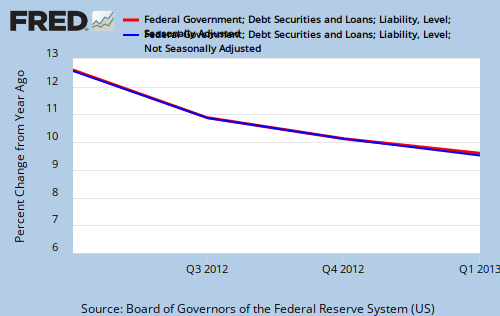
Monetary Sovereignty Monetary Sovereignty

As the lines drop, we approach recession, which will be cured only when the lines rise.

#MONETARY SOVEREIGNTY

–Right wing cuts your nose to spite Obama’s face

Twitter: @rodgermitchell; Search #monetarysovereignty
Facebook: Rodger Malcolm Mitchell

Mitchell’s laws:
●The more federal budgets are cut and taxes increased, the weaker an economy becomes.
●Austerity is the government’s method for widening the gap between rich and poor,
which ultimately leads to civil disorder.
●Until the 99% understand the need for federal deficits, the upper 1% will rule.
To survive long term, a monetarily non-sovereign government must have a positive balance of payments.
●Those, who do not understand the differences between Monetary Sovereignty and monetary non-sovereignty, do not understand economics.
●The penalty for ignorance is slavery.
●Everything in economics devolves to motive.

======================================================================================================================================================================================

This goes under the heading, Unless you’re rich, why do you plan to vote Republican in the next Presidential election?

Let’s talk health care. Rich people and Washington politicians can afford the best health care and the best health care insurance. The rest of us need help.

Most of those who live in the blue states will get that help. Most who live in the red states will not.

Here are excerpts from an article in today’s Chicago Tribune, a right wing paper.

With states at odds, health care law is uneven
Noam N. Levey, Tribune Washington Bureau

Colorado residents shopping for health insurance next year will be able to compare health plans using a star system that ranks insurance companies on quality.

In Oregon and Maryland, consumers will save as much as 30 percent on some plans after state regulators forced insurers to lower 2014 premiums.

Californians will get extra help selecting a health plan next year, from a small army of community workers paid in part by foundations and the state.

Americans in states backing the Act will receive substantial protections and assistance unavailable to residents in states still fighting the 2010 law.

Now, let’s visit some of those states whose leaders would rather fight Obama than help their own residents:

[Many resistant states] have not set up consumer hotlines, and insurance regulators refuse to make sure health plans offer new protections required by law, such as guaranteed coverage for people who are ill.

Florida suspended its authority to review how much insurance companies charge. Missouri state workers are forbidden by law from providing any assistance to the new health insurance marketplace.

“I certainly would rather live in a state that is trying than one that is not,” said Alan Weil, executive director of the National Academy for State Health Policy.

Apparently, the right wing’s primary goal is to defeat Democrats rather than to help people. In fact, Boehner said as much:

Idaho Statesman
Boehner visits Boise; vows to succeed with entitlement reform this fall
By Dan Popkey

House Speaker John Boehner said Monday that getting the GOP-controlled House to agree to raising the U.S. debt ceiling will only come with a bipartisan deal to make cost-saving changes to Social Security, Medicaid, Medicare, farm programs and government pensions.

“We’re not going to inflict all of this pain and suffering on our kids and our grandkids.”

Translation: “Cutting Social Security, Medicare and pensions won’t inflict “pain and suffering” on HIS kids and grandkids or on rich kids.

“YOUR kids and grandkids will have the “pain and suffering” of less Social Security, less Medicare and less pension security, but who cares? I’m all right.”

Back to the Tribune:

About half of the states, most with Republican leadership, have rejected federal aid to expand their government Medicaid programs.

That means millions of the poorest residents in these states will not be able to get coverage.

Keep in mind that the federal government initally will pay the states for 100% of Medicaid’s cost, through 2016, phasing down to a permanent 90 percent matching rate by 2020.

And even at the 90% rate, the cooperating states make a huge profit. All those federal millions pumped into a state’s economy translate into increased state taxes and state wealth.

In short, the right-wing states would rather fight Obama than benefit their own citizens or increase their own state’s solvency.

In Alabama, Oklahoma, Texas and Wyoming, insurance commissioners will not review health plans being offered on the new marketplaces to endure they provide consumers with the required benefits and protections.

In Florida, the state legislature and governor stripped the insurance commissioner’s authority to block rate increases for two years. This allows insurance companies to raise premiums as much as they choose in 2014 and 2015.

In Texas, more than 6 million people lack health insurance coverage (but) Texas cut staff who could have educated state residents about the new law.

Translation: “We want our citizens to suffer. Then we can claim it’s all because of Obamacare, and that’s how we’ll win the next election.

The article goes on and on, citing benefits to citizens of cooperating states — benefits not available to citizens of right-wing, nose-cutter states.

It takes a special kind of cruelty to deny people health, just to make a political opponent’s program fail.

Yes, I agree Obama has not been much of a President. I’ve said so numerous times.

But he will be gone after 2016. So please give me your reasons why you plan to vote Republican in the next Presidential election:

1. “I am very rich and my main goal is to widen the gap between the rich and the rest, and I really don’t give a damn about the poor.”

2. [Add your own 2nd reason.]

Rodger Malcolm Mitchell
Monetary Sovereignty

====================================================================================================================================================
Nine Steps to Prosperity:
1. Eliminate FICA (Click here)
2. Medicare — parts A, B & D plus long term nursing care — for everyone (Click here)
3. Send every American citizen an annual check for $5,000 or give every state $5,000 per capita (Click here)
4. Free education (including post-grad) for everyone. Click here
5. Salary for attending school (Click here)
6. Eliminate corporate taxes (Click here)
7. Increase the standard income tax deduction annually
8. Increase federal spending on the myriad initiatives that benefit America’s 99% (Click here)
9. Federal ownership of all banks (Click here)

10 Steps to Economic Misery: (Click here:)
1. Maintain or increase the FICA tax..
2. Spread the myth Social Security, Medicare and the U.S. government are insolvent.
3. Cut federal employment in the military, post office, other federal agencies.
4. Broaden the income tax base so more lower income people will pay.
5. Cut financial assistance to the states.
6. Spread the myth federal taxes pay for federal spending.
7. Allow banks to trade for their own accounts; save them when their investments go sour.
8. Never prosecute any banker for criminal activity.
9. Nominate arch conservatives to the Supreme Court.
10. Reduce the federal deficit and debt

No nation can tax itself into prosperity, nor grow without money growth. Monetary Sovereignty: Cutting federal deficits to grow the economy is like applying leeches to cure anemia.
Two key equations in economics:
1. Federal Deficits – Net Imports = Net Private Savings
2. Gross Domestic Product = Federal Spending + Private Investment and Consumption – Net Imports

THE RECESSION CLOCK
Monetary Sovereignty Monetary Sovereignty

As the lines drop, we approach recession, which will be cured only when the lines rise.

#MONETARY SOVEREIGNTY

–Time to do a little war-war.

Twitter: @rodgermitchell; Search #monetarysovereignty
Facebook: Rodger Malcolm Mitchell

Mitchell’s laws:
●The more federal budgets are cut and taxes increased, the weaker an economy becomes.
●Austerity is the government’s method for widening the gap between rich and poor,
which ultimately leads to civil disorder.
●Until the 99% understand the need for federal deficits, the upper 1% will rule.
To survive long term, a monetarily non-sovereign government must have a positive balance of payments.
●Those, who do not understand the differences between Monetary Sovereignty and monetary non-sovereignty, do not understand economics.
●The penalty for ignorance is slavery.
●Everything in economics devolves to motive.

======================================================================================================================================================================================

As everyone knows, Saddam Hussein was in league with al qaeda, stockpiling weapons of mass destruction — atomic bombs, poison gas, smallpox bombs — that kind of bad stuff — all of which threatened the security of the United States.

And, as everyone knows, Iraq (population 30 million) was preparing to unleash its mighty army on the United States (population 300 million, and 1/2 way across the world).

Except, of course, he wasn’t and it wasn’t. It all turned out to be a lie, which allowed President Bush Jr. to do his very own conflict, and show his daddy, Bush Sr., how things really should be done, by a rough, tough Yale/Harvard Texan, who was brave enough to sneak out of military duty.

So, to demonstrate his personal courage, President Bush Jr. managed to get 4000+ young Americans killed, not to mention many more Iraqis killed, and today, life in Iraq is much worse than it was when we liberated it, particularly when the wind blows west and you can smell the corpses.

Yet, doesn’t it make for nice funeral services in America, where politician can give stirring, patriotic speeches amid flags unfurled in the breeze, and families can shed tears for their lost children, and reporters can feign sympathy?

Today, we have moved on, and all is forgotten and forgiven. Bush Jr. has remained mercifully quiet, except for passing on the phony legacy of rough, tough, gun-toting Texans. When your only tool is a gun, every problem requires killing someone.

Mission Accomplished.

Now, little Obama is our new President, and what a wus he is. The guy hasn’t begun any new wars, and even has wound down some wars he inherited. Concerned about his legacy as a bank crime aider and abetter, he needs a bloody fight of his very own, to demonstrate his Chicago morality.

It’s time, my friends, to do a little war-war.

Today, Syria is ruled by a tyrant — as is every Arab, every Muslim, and virtually every African nation. And this tyrant is killing his own people, which is what tyrants do.

Perfect.

The excuse about Syria being a threat to U.S. security won’t work. We used that one up with Iraq. But how about humanitarianism?

That Bashar Hafez al-Assad (His name sounds sort of like al qaeda, doesn’t it?), not only is murdering his own people, but he is murdering them with poison gas (which makes those innocent people much deader than if they had been murdered with bullets, bombs, knives, nooses or reading the comments of Antonin Gregory Scalia).

So to prevent the wrong kind of murder, we good Americans (everyone knows Americans have a monopoly on good) must commit the right kind of murder, which requires killing lots of young Syrians without killing too many young Americans.

Our President, who never does anything without a great deal of agonizing thought, after which he compromises on a Grand Bargain, now agonizes about the best way to kill lots of Syrians without killing too may Americans (a couple hundred might be the acceptable max.)

But Obama has a problem. No one wants to play with him. Oh, except for the French — you remember, the brave guys who surrendered to Hitler before he even asked.

Obama called his other playmates and said, “Hey, want to come out and do a little war-war?” And they all said, “Why?” And Obama said, “Syria broke the law by using poison gas to kill a thousand — or was it two thousand — people.”

And they said, “Your banks broke the law and killed a hundred million people, and not one banker has gone to jail.”

And he said, “There’s a big difference. A huge difference. My rich donors don’t want me to do anything about the banks, but they do want me to do a little war-war, because that is good for business.”

And they said, “Won’t the same thing happens that always happens? We remove one blood-thirsty regime that hates us, and replace it with another blood-thirsty regime that hates us even more?

And Obama said, “Yes, that always happens, but it’s a good thing. The more they hate us, the more excuses we have to increase NSA, CIA, FBI spying on innocent American citizens.

First we do war-war to create the danger. Then we spend billions to prevent the danger by taking away more and more liberties and giving these liberties to the rich, who will pay us. And because we spend more to prevent danger, we must spend less on social programs, so we widen the gap between the rich and the rest. Then we do more war-war to create even more danger. We never stop doing war-war. It’s a perfect, endless circle.”

And they said, “Barack, you are nobody’s fool. That’s damn clever. Maybe we will go along with you after all, drop a few bombs, kill and maim a few foreigners, look tough, merciful and cruel, all at the same time.”

And Obama said, “And there’s one more thing. Can you name a single American President who was considered great, and did not do his very own war-war?

And a-bombing we shall go.

Rodger Malcolm Mitchell
Monetary Sovereignty

====================================================================================================================================================
Nine Steps to Prosperity:
1. Eliminate FICA (Click here)
2. Medicare — parts A, B & D plus long term nursing care — for everyone (Click here)
3. Send every American citizen an annual check for $5,000 or give every state $5,000 per capita (Click here)
4. Free education (including post-grad) for everyone. Click here
5. Salary for attending school (Click here)
6. Eliminate corporate taxes (Click here)
7. Increase the standard income tax deduction annually
8. Increase federal spending on the myriad initiatives that benefit America’s 99% (Click here)
9. Federal ownership of all banks (Click here)

10 Steps to Economic Misery: (Click here:)
1. Maintain or increase the FICA tax..
2. Spread the myth Social Security, Medicare and the U.S. government are insolvent.
3. Cut federal employment in the military, post office, other federal agencies.
4. Broaden the income tax base so more lower income people will pay.
5. Cut financial assistance to the states.
6. Spread the myth federal taxes pay for federal spending.
7. Allow banks to trade for their own accounts; save them when their investments go sour.
8. Never prosecute any banker for criminal activity.
9. Nominate arch conservatives to the Supreme Court.
10. Reduce the federal deficit and debt

No nation can tax itself into prosperity, nor grow without money growth. Monetary Sovereignty: Cutting federal deficits to grow the economy is like applying leeches to cure anemia.
Two key equations in economics:
1. Federal Deficits – Net Imports = Net Private Savings
2. Gross Domestic Product = Federal Spending + Private Investment and Consumption – Net Imports

THE RECESSION CLOCK
Monetary Sovereignty Monetary Sovereignty

As the lines drop, we approach recession, which will be cured only when the lines rise.

#MONETARY SOVEREIGNTY