A shameful graph

Education is important to America.

Of the many investments the federal government could make, few would have a greater positive impact on the American economy than education.

When you visualize the things that make America special compared to other large nations, like China and India, advanced education is one of the first things that comes to mind.

So it is sad that Americans believe making advanced education difficult to afford, somehow is normal or acceptable.

Steps #4 and #5 of the Ten Steps to Prosperity (below) tell why the federal government can and should fund college educations for all those who want them.

Instead, we have the following shameful graph.
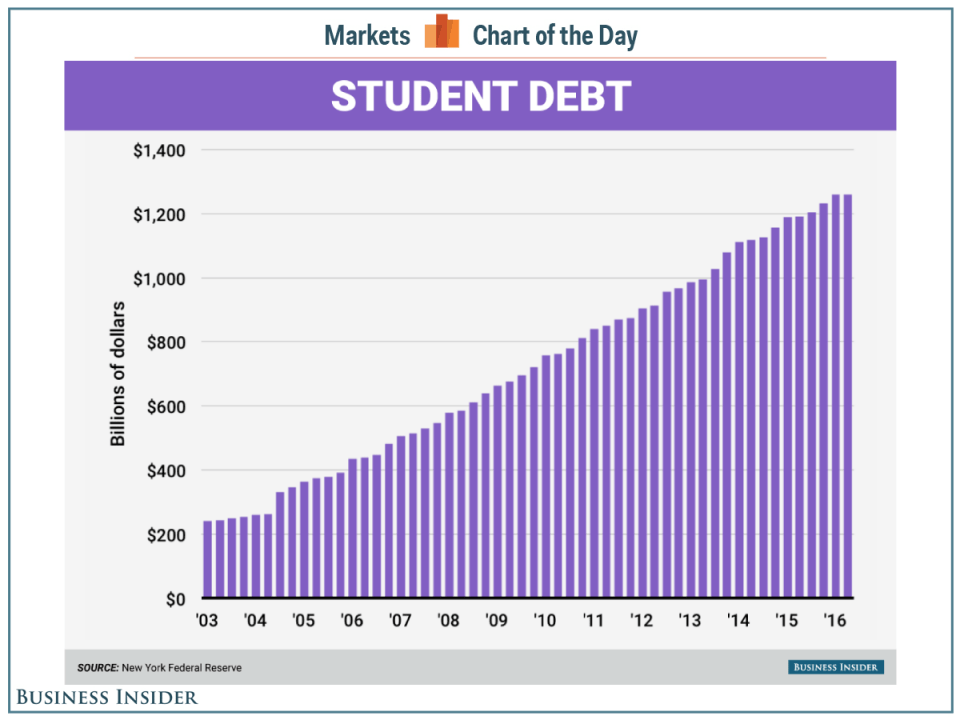
STUDENT DEBT

In case you wonder why we intentionally put our students into debt, the answer is quite simple: Student loans widen the Gap between the rich and the rest.

Gap widening, rather than mere income, is the primary motivation of the rich. It is the Gap, not just their own incomes, that makes them rich (Without the Gap, no one would be rich; we all would be the same). The wider the Gap, the richer they are.

Thus, keeping the non-wealthy down is just as important to the rich as lifting their own incomes up. Either way, the Gap is widened.

Every wealth stratum wants the Gap between them and those lower, to be widened. That is why so many lower-to-middle-income people resent aid to the poor. Such aid narrows the Gap, bringing the poor uncomfortably closer to those in the middle.

When the federal government lends to students, interest payments remove stimulus dollars from the economy,  and all loan repayments punish borrowers, who primarily are middle-income (The rich don’t use student loans).

The federal government, being Monetarily Sovereign, neither needs nor uses any form of income. To pay its bills, the government creates dollars ad hoc. There is no economic purpose for student loan payments to a government that has no use for the money.

When the lender is a private bank, the bank is enriched by a loan that is difficult to discharge in bankruptcy.  It is a “forever” loan, passed down through the generations — perfect for Gap widening:

Business Insider: America’s crushing surge of student debt, now at $1.2 trillion, has bred a disturbing new phenomenon: School loans that span multiple generations within families.

Weighed down by their own loans, many parents lack the means to fund their children’s educations without sinking even deeper into debt.

  • School loans increasingly belong to Americans over 40. This group accounts for 35 percent of education debt, up from 25 percent in 2004
  • Student loan balances average $20,000 for Generation X adults — those from 35 to 50 years old.
  • Gen-X parents who carry student debt and have teenage children have struggled to save for their children’s educations. Many of their children will need to borrow heavily for college, thereby perpetuating a cycle of family debt.
  • Student debt is surpassing groceries as a primary expense, with the gap widening most for younger families.

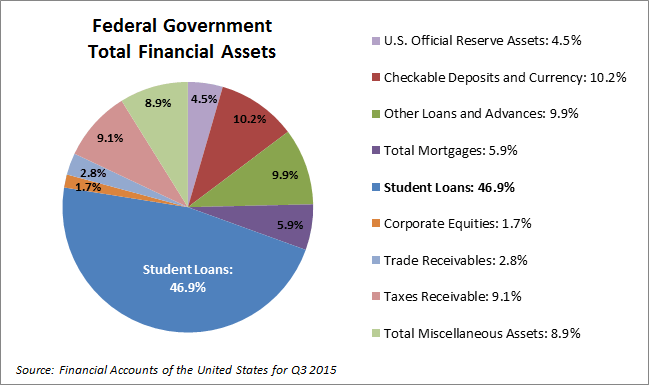
And if the above weren’t shameful enough, consider this graph, also supplied by Business Insider:
w704

Student loans are listed on the government’s books as its largest financial asset. Millions of American families are in debt to the federal government for educating children.

In reality, this is all just record-keeping. The federal government has no need for financial assets, because as mentioned earlier, it creates all the dollars it needs, ad hoc, when it pays its bills.

Thus, the government has discovered yet another, powerful Gap-widening device, designed to keep millions of families in financial bondage for many years, even for generations.

(Among such Gap-widening devices are federal sales taxes, FICA, and high-end income taxes on 401k mandatory distributions.) 

State and local governments are monetarily non-sovereign. They need income in order to pay for K-12 education.

The federal government is Monetarily Sovereign. It needs no taxes or loan repayments to fund a college education for every American who wanted one.

All those additional educated minds would greatly benefit America. No one knows how many potential Nobel winners America has lost lack for of the finances to attend college.

Even the time away from work is too expensive for many people. The federal government should pay for that, too.(Step #5)

But the rich don’t want federal funding for college; it would narrow the Gap. Despite what Presidential and Congressional campaigning may indicate, the rich, not the politicians, run America.

College debt is another destgructive result of The Big Lie, the lie that federal taxes fund federal spending.

Rodger Malcolm Mitchell
===================================================================================
Ten Steps to Prosperity:
1. ELIMINATE FICA (Ten Reasons to Eliminate FICA )
Although the article lists 10 reasons to eliminate FICA, there are two fundamental reasons:
*FICA is the most regressive tax in American history, widening the Gap by punishing the low and middle-income groups, while leaving the rich untouched, and
*The federal government, being Monetarily Sovereign, neither needs nor uses FICA to support Social Security and Medicare.
2. FEDERALLY FUNDED MEDICARE — PARTS A, B & D, PLUS LONG TERM CARE — FOR EVERYONE (H.R. 676, Medicare for All )
This article addresses the questions:
*Does the economy benefit when the rich afford better health care than the rest of Americans?
*Aside from improved health care, what are the other economic effects of “Medicare for everyone?”
*How much would it cost taxpayers?
*Who opposes it?”
3. PROVIDE AN ECONOMIC BONUS TO EVERY MAN, WOMAN AND CHILD IN AMERICA, AND/OR EVERY STATE, A PER CAPITA ECONOMIC BONUS (The JG (Jobs Guarantee) vs the GI (Guaranteed Income) vs the EB) Or institute a reverse income tax.
This article is the fifth in a series about direct financial assistance to Americans:

Why Modern Monetary Theory’s Employer of Last Resort is a bad idea. Sunday, Jan 1 2012
MMT’s Job Guarantee (JG) — “Another crazy, rightwing, Austrian nutjob?” Thursday, Jan 12 2012
Why Modern Monetary Theory’s Jobs Guarantee is like the EU’s euro: A beloved solution to the wrong problem. Tuesday, May 29 2012
“You can’t fire me. I’m on JG” Saturday, Jun 2 2012

Economic growth should include the “bottom” 99.9%, not just the .1%, the only question being, how best to accomplish that. Modern Monetary Theory (MMT) favors giving everyone a job. Monetary Sovereignty (MS) favors giving everyone money. The five articles describe the pros and cons of each approach.
4. FREE EDUCATION (INCLUDING POST-GRAD) FOR EVERYONEFive reasons why we should eliminate school loans
Monetarily non-sovereign State and local governments, despite their limited finances, support grades K-12. That level of education may have been sufficient for a largely agrarian economy, but not for our currently more technical economy that demands greater numbers of highly educated workers.
Because state and local funding is so limited, grades K-12 receive short shrift, especially those schools whose populations come from the lowest economic groups. And college is too costly for most families.
An educated populace benefits a nation, and benefiting the nation is the purpose of the federal government, which has the unlimited ability to pay for K-16 and beyond.
5. SALARY FOR ATTENDING SCHOOL
Even were schooling to be completely free, many young people cannot attend, because they and their families cannot afford to support non-workers. In a foundering boat, everyone needs to bail, and no one can take time off for study.
If a young person’s “job” is to learn and be productive, he/she should be paid to do that job, especially since that job is one of America’s most important.
6. ELIMINATE CORPORATE TAXES
Corporations themselves exist only as legalities. They don’t pay taxes or pay for anything else. They are dollar-tranferring machines. They transfer dollars from customers to employees, suppliers, shareholders and the government (the later having no use for those dollars).
Any tax on corporations reduces the amount going to employees, suppliers and shareholders, which diminishes the economy. Ultimately, all corporate taxes come around and reappear as deductions from your personal income.
7. INCREASE THE STANDARD INCOME TAX DEDUCTION, ANNUALLY. (Refer to this.) Federal taxes punish taxpayers and harm the economy. The federal government has no need for those punishing and harmful tax dollars. There are several ways to reduce taxes, and we should evaluate and choose the most progressive approaches.
Cutting FICA and corporate taxes would be an good early step, as both dramatically affect the 99%. Annual increases in the standard income tax deduction, and a reverse income tax also would provide benefits from the bottom up. Both would narrow the Gap.
8. TAX THE VERY RICH (THE “.1%) MORE, WITH HIGHER PROGRESSIVE TAX RATES ON ALL FORMS OF INCOME. (TROPHIC CASCADE)
There was a time when I argued against increasing anyone’s federal taxes. After all, the federal government has no need for tax dollars, and all taxes reduce Gross Domestic Product, thereby negatively affecting the entire economy, including the 99.9%.
But I have come to realize that narrowing the Gap requires trimming the top. It simply would not be possible to provide the 99.9% with enough benefits to narrow the Gap in any meaningful way. Bill Gates reportedly owns $70 billion. To get to that level, he must have been earning $10 billion a year. Pick any acceptable Gap (1000 to 1?), and the lowest paid American would have to receive $10 million a year. Unreasonable.
9. FEDERAL OWNERSHIP OF ALL BANKS (Click The end of private banking and How should America decide “who-gets-money”?)
Banks have created all the dollars that exist. Even dollars created at the direction of the federal government, actually come into being when banks increase the numbers in checking accounts. This gives the banks enormous financial power, and as we all know, power corrupts — especially when multiplied by a profit motive.
Although the federal government also is powerful and corrupted, it does not suffer from a profit motive, the world’s most corrupting influence.
10. INCREASE FEDERAL SPENDING ON THE MYRIAD INITIATIVES THAT BENEFIT AMERICA’S 99.9% (Federal agencies)Browse the agencies. See how many agencies benefit the lower- and middle-income/wealth/ power groups, by adding dollars to the economy and/or by actions more beneficial to the 99.9% than to the .1%.
Save this reference as your primer to current economics. Sadly, much of the material is not being taught in American schools, which is all the more reason for you to use it.

The Ten Steps will grow the economy, and narrow the income/wealth/power Gap between the rich and you.

MONETARY SOVEREIGNTY

Trump smarter than mainstream economists? Maybe.

Donald Trump may have, as he claims, “a very good brain,” but way too many of his comments originate in his gut.

He is all over the place, a former Democrat, now a Republican, but at odds with the Republican Party.  He is so unfocused he needs a Vice Presidential candidate to “explain what Trump really meant.”

That said, like the proverbial stopped clock, which is right twice a day, he may have some good ideas that mainstream economists would be well to examine.

Chicago Tribune:  Trump’s economic proposals were split between traditional GOP policies, like rolling back taxes and easing federal regulations, scrapping trade pacts and pouring new money into railways, highways and other infrastructure.

Trump’s plans left many economicst skeptical, as did the absence of detail on how he would pay for his proposals.

Rolling back federal taxes is a good idea if it is done from the bottom up, to narrow the Gap between the rich and the rest. Unfortunately, it’s unlikely to work that way, as his previous proposals aided the rich more than the non-rich.

Easing federal regulations is a terrible idea that caused the Great Recession of 2008. It allows the money barons to set the rules — the sharks in charge of the bathing beach.

Scrapping trade plans is a bad idea — and overly simple solution, made to appeal to simpletons. We can’t leave American trade rules in the hands of the big corporations, but trade plans are needed. They should be designed to ease trade while benefitting the lower income groups.

Deficit spending on infrastructure is more than a great idea; it is an absolute necessity. Those arguing against this spending are arguing for the rusting and destruction of America.

But the key problem comes with the phrase, “how he would pay for his proposals.” It is a version of the “Big Lie” (the lie that federal taxes are needed to fund federal spending.)

The federal government, being Monetarily Sovereign, can pay for anything, and do it without collecting taxes. That is what being Monetarily Sovereign means.

All decent economists are well aware that asking how the federal government would pay for spending, is almost like asking how the Pacific Ocean will supply salt water (except that our Monetarily Sovereign federal government has a greater ability to supply dollars than the Ocean’s ability to supply salt water).

Trump also promised a major buldup of the military at an unspecified price, and he has vowed to resist pressure by fellow Republicans to curb Social Security and Medicare, a pledge he did not mention Monday.

Building the military not only protects our interests but stimulates the economy. Complaining about terrorists, while cutting defense  spending, is like complaining about mosquitos while cutting holes in the screens.

The right-wing desire to “curb” Social Security and Medicare is a disgrace. It would impoverish millions of Americans for no reason at all. Neither Social Security nor Medicare could run short of dollars, unless Congress and the President wished it.

“It can’t add up is the bottom line,” said Roberton Williams, a senior fellow at the Urban-Brookings Tax Policy Center, and nonpartisan think tank.

Translation: “Nonpartisan” always means: Being neither Republican nor Democrat, but doing exactly what the rich want done, and saying exactly what the rich want said. 

And “add up” means: “We hope you’ll believe the Big Lie that federal spending is funded by federal taxing. In that way, we can give you phony excuses to prevent the government from helping close the Gap between you and the uber-rich.”

He initially proposed simplifying individual income tax rates with three brackets — 25 percent, 20 percent and 10 percent.  Trump increased those Monday to align with House Republican plan that calls for rates of 33 percent, 25 percent and 12 percent.

Prior to those changes, a Moody’s Analytics report concluded that Trump’s economic agenda would thrust Americans into a lengthy recesslion, create “very large deficits” and burden the country with “a much higher debt load.”

Trump is far more liberal than the Republican leaders, who want the 99% less wealthy / less powerful Americans to pay as much tax as possible.

The 33% tax rate on the rich is fake; no rich person pays the highest rate. That’s what tax shelters, tax havens, and tax dodges are for.

The biggest tax shelter for the “not-rich” is the 401K plan, which is taxed at the highest form of income rate, as soon as money is taken out. (Even if your 401K investments have long-term capital gains, which normally are taxed at a low rate [for the rich] you will be taxed at the higher rate when you take the money.)

And then we come to Moody’s, one of the three credit rating agencies that rated worthless securities AAA, which helped cause the Great Recession of 2008. Thank you Moody’s. Why anyone believes anything they say, is a mystery.

“Very large deficits” are the method by which the federal government grows the economy. “A much higher debt load” means much higher investments in T-security accounts at the world’s safest bank.

Neither federal deficits nor federal debt are a burden on the government, on taxpayers or on anyone else. The government cannot run short of its own sovereign currency.

In summary, Moody’s comments are as diametrically wrong as it is humanly possible;  Trump, as wrong as he is, is much closer to being correct.

Bottom line: Trump has no coherent economic plan, and what little plans he offers are riddled with inconsistencies and false assumptions.

Nevertheless, Trump’s inconsistent and false plans are closer to reality than the gigantic, humongous lies of the Republican Party, the Urban-Brookings Tax Policy Center, and Moody’s.

When you’re farther from reality than Donald Trump, wow, that is saying something.

Rodger Malcolm Mitchell
Monetary Sovereignty

===================================================================================
Ten Steps to Prosperity:
1. ELIMINATE FICA (Ten Reasons to Eliminate FICA )
Although the article lists 10 reasons to eliminate FICA, there are two fundamental reasons:
*FICA is the most regressive tax in American history, widening the Gap by punishing the low and middle-income groups, while leaving the rich untouched, and
*The federal government, being Monetarily Sovereign, neither needs nor uses FICA to support Social Security and Medicare.
2. FEDERALLY FUNDED MEDICARE — PARTS A, B & D, PLUS LONG TERM CARE — FOR EVERYONE (H.R. 676, Medicare for All )
This article addresses the questions:
*Does the economy benefit when the rich afford better health care than the rest of Americans?
*Aside from improved health care, what are the other economic effects of “Medicare for everyone?”
*How much would it cost taxpayers?
*Who opposes it?”
3. PROVIDE AN ECONOMIC BONUS TO EVERY MAN, WOMAN AND CHILD IN AMERICA, AND/OR EVERY STATE, A PER CAPITA ECONOMIC BONUS (The JG (Jobs Guarantee) vs the GI (Guaranteed Income) vs the EB) Or institute a reverse income tax.
This article is the fifth in a series about direct financial assistance to Americans:

Why Modern Monetary Theory’s Employer of Last Resort is a bad idea. Sunday, Jan 1 2012
MMT’s Job Guarantee (JG) — “Another crazy, rightwing, Austrian nutjob?” Thursday, Jan 12 2012
Why Modern Monetary Theory’s Jobs Guarantee is like the EU’s euro: A beloved solution to the wrong problem. Tuesday, May 29 2012
“You can’t fire me. I’m on JG” Saturday, Jun 2 2012

Economic growth should include the “bottom” 99.9%, not just the .1%, the only question being, how best to accomplish that. Modern Monetary Theory (MMT) favors giving everyone a job. Monetary Sovereignty (MS) favors giving everyone money. The five articles describe the pros and cons of each approach.
4. FREE EDUCATION (INCLUDING POST-GRAD) FOR EVERYONEFive reasons why we should eliminate school loans
Monetarily non-sovereign State and local governments, despite their limited finances, support grades K-12. That level of education may have been sufficient for a largely agrarian economy, but not for our currently more technical economy that demands greater numbers of highly educated workers.
Because state and local funding is so limited, grades K-12 receive short shrift, especially those schools whose populations come from the lowest economic groups. And college is too costly for most families.
An educated populace benefits a nation, and benefiting the nation is the purpose of the federal government, which has the unlimited ability to pay for K-16 and beyond.
5. SALARY FOR ATTENDING SCHOOL
Even were schooling to be completely free, many young people cannot attend, because they and their families cannot afford to support non-workers. In a foundering boat, everyone needs to bail, and no one can take time off for study.
If a young person’s “job” is to learn and be productive, he/she should be paid to do that job, especially since that job is one of America’s most important.
6. ELIMINATE CORPORATE TAXES
Corporations themselves exist only as legalities. They don’t pay taxes or pay for anything else. They are dollar-tranferring machines. They transfer dollars from customers to employees, suppliers, shareholders and the government (the later having no use for those dollars).
Any tax on corporations reduces the amount going to employees, suppliers and shareholders, which diminishes the economy. Ultimately, all corporate taxes come around and reappear as deductions from your personal income.
7. INCREASE THE STANDARD INCOME TAX DEDUCTION, ANNUALLY. (Refer to this.) Federal taxes punish taxpayers and harm the economy. The federal government has no need for those punishing and harmful tax dollars. There are several ways to reduce taxes, and we should evaluate and choose the most progressive approaches.
Cutting FICA and corporate taxes would be an good early step, as both dramatically affect the 99%. Annual increases in the standard income tax deduction, and a reverse income tax also would provide benefits from the bottom up. Both would narrow the Gap.
8. TAX THE VERY RICH (THE “.1%) MORE, WITH HIGHER PROGRESSIVE TAX RATES ON ALL FORMS OF INCOME. (TROPHIC CASCADE)
There was a time when I argued against increasing anyone’s federal taxes. After all, the federal government has no need for tax dollars, and all taxes reduce Gross Domestic Product, thereby negatively affecting the entire economy, including the 99.9%.
But I have come to realize that narrowing the Gap requires trimming the top. It simply would not be possible to provide the 99.9% with enough benefits to narrow the Gap in any meaningful way. Bill Gates reportedly owns $70 billion. To get to that level, he must have been earning $10 billion a year. Pick any acceptable Gap (1000 to 1?), and the lowest paid American would have to receive $10 million a year. Unreasonable.
9. FEDERAL OWNERSHIP OF ALL BANKS (Click The end of private banking and How should America decide “who-gets-money”?)
Banks have created all the dollars that exist. Even dollars created at the direction of the federal government, actually come into being when banks increase the numbers in checking accounts. This gives the banks enormous financial power, and as we all know, power corrupts — especially when multiplied by a profit motive.
Although the federal government also is powerful and corrupted, it does not suffer from a profit motive, the world’s most corrupting influence.
10. INCREASE FEDERAL SPENDING ON THE MYRIAD INITIATIVES THAT BENEFIT AMERICA’S 99.9% (Federal agencies)Browse the agencies. See how many agencies benefit the lower- and middle-income/wealth/ power groups, by adding dollars to the economy and/or by actions more beneficial to the 99.9% than to the .1%.
Save this reference as your primer to current economics. Sadly, much of the material is not being taught in American schools, which is all the more reason for you to use it.

The Ten Steps will grow the economy, and narrow the income/wealth/power Gap between the rich and you.

MONETARY SOVEREIGNTY

Three things to remember as you watch Trump, Clinton speeches

Soon you will hire someone for the difficult job of being President of the U.S. As with any talent hunt, you’ll want to take into consideration certain key factors, while eliminating extraneous factors.

For example, the ability to be a good President does not rely on who cheated on a spouse, or who stole money. Personal morality never has been a good measure of Presidential effectiveness.

(Lyndon Johnson, for instance, may have been one of our least moral, but most effective, Presidents.)

Though the “job interview” speeches may seem complex, with both candidates offering excessive solutions to non-problems and bashing the other candidate for trivial offenses.

But it’s quite simple, really. There are three, and only three, issues:

1. The single biggest problem facing the U.S. economy and the world’s economy is: The Gap between the rich/powerful, and the rest, is too wide and continues to widen. (See: This is the single biggest problem facing America)

The Gap is responsible for our most serious ills:

  • Poverty: “Poor” is a relative term. The rich/powerful always have sucked the best out of the economy, leaving only the dregs for the rest.
  • Street crime: Have you noticed that most street (as opposed to white collar) crime occurs in poor neighborhoods and/or by poor people? Having little wealth and power, and with no hope of obtaining more, the poor resort to physical crime.
  • Gun violence: Street crime not only includes gun violence, but fear of street crime breeds the need for guns, which breeds more gun violence.
  • Poor health and early death: Unaffordable health care and bad (but cheap) food, shorten lives.
  • Lack of education: No one knows how many millions of children are born with native intelligence, but are unable to use that intelligence because they cannot afford a good education. The cost to America’s growth, well-being, power and prosperity is immeasurable.

By enabling poverty, street crime, gun violence, poor health, early death, and lack of education, the Gap adversely affects everyone — the entire nation — even including the rich.

When you listen to each of the candidates’ proposals, ask yourself this: Will this proposal help narrow the Gap between the rich/powerful, and the rest?

2. The single biggest Lie about our economy is: “Federal taxes fund federal spending.” (See: Monetary Sovereignty and Free Lunch)

This “Big Lie leads to:

  • Unnecessary, regressive taxes: The FICA tax, which purportedly funds Medicare and Social Security, in reality, funds neither. Even if FICA were eliminated, Medicare and Social Security could continue paying benefits, forever. The only thing FICA (and sales taxes, and income taxes on the non-rich accomplish is to widen the Gap)
  • Unnecessary reductions in Social Security, Medicare, Medicaid and other social programs. The false belief that the federal government “can’t afford” these programs, leads to ongoing attempts to reduce benefits.
  • Lack of federal spending to support infrastructure, research & development, scientific progress, and education.

When you listen to each of the candidates’ proposals, ask yourself this: Will this proposal reduce FICA, sales taxes and/or income taxes on the non-rich? Will it increase funding for social programs and science?

3. The single biggest consideration about the candidates is: What are their qualifications?

  • Will they do what they say they will do? What is their history? Whether in business or in government service, have they done what they promised to do?
  • What is their experience? When hiring for any job, past experience is one of the most important attributes a candidate can have.
  • Are their proposals truly feasible? One can promise to bring everlasting peace, and defeat all our enemies, but is this reality?
  • What is the nature of their lies? All politicians lie. The real question is not whether they lie, or even how much they lie, but how will their lies affect you? A lie about a personal indiscretion is much less important than a lie about one’s experience.

When you listen to each of the candidates’ proposals, as yourself this: Considering the nature of the candidate, is this proposal possible or even likely to occur?

In summary, ask yourself three simple questions:

  1. Will this proposal help narrow the Gap between the rich/powerful, and the rest?
  2. Will this proposal reduce FICA, sales taxes and/or income taxes on the non-rich? Will it increase funding for social programs and science?
  3. Considering the nature of the candidate, is this proposal possible or even likely to occur?

Those questions will help you wade through the clutter, the obfuscations, the personal insults and the moral digressions, and decide who should be President of the United States.

Rodger Malcolm Mitchell
Monetary Sovereignty

===================================================================================
Ten Steps to Prosperity:
1. ELIMINATE FICA (Ten Reasons to Eliminate FICA )
Although the article lists 10 reasons to eliminate FICA, there are two fundamental reasons:
*FICA is the most regressive tax in American history, widening the Gap by punishing the low and middle-income groups, while leaving the rich untouched, and
*The federal government, being Monetarily Sovereign, neither needs nor uses FICA to support Social Security and Medicare.
2. FEDERALLY FUNDED MEDICARE — PARTS A, B & D, PLUS LONG TERM CARE — FOR EVERYONE (H.R. 676, Medicare for All )
This article addresses the questions:
*Does the economy benefit when the rich afford better health care than the rest of Americans?
*Aside from improved health care, what are the other economic effects of “Medicare for everyone?”
*How much would it cost taxpayers?
*Who opposes it?”
3. PROVIDE AN ECONOMIC BONUS TO EVERY MAN, WOMAN AND CHILD IN AMERICA, AND/OR EVERY STATE, A PER CAPITA ECONOMIC BONUS (The JG (Jobs Guarantee) vs the GI (Guaranteed Income) vs the EB) Or institute a reverse income tax.
This article is the fifth in a series about direct financial assistance to Americans:

Why Modern Monetary Theory’s Employer of Last Resort is a bad idea. Sunday, Jan 1 2012
MMT’s Job Guarantee (JG) — “Another crazy, rightwing, Austrian nutjob?” Thursday, Jan 12 2012
Why Modern Monetary Theory’s Jobs Guarantee is like the EU’s euro: A beloved solution to the wrong problem. Tuesday, May 29 2012
“You can’t fire me. I’m on JG” Saturday, Jun 2 2012

Economic growth should include the “bottom” 99.9%, not just the .1%, the only question being, how best to accomplish that. Modern Monetary Theory (MMT) favors giving everyone a job. Monetary Sovereignty (MS) favors giving everyone money. The five articles describe the pros and cons of each approach.
4. FREE EDUCATION (INCLUDING POST-GRAD) FOR EVERYONEFive reasons why we should eliminate school loans
Monetarily non-sovereign State and local governments, despite their limited finances, support grades K-12. That level of education may have been sufficient for a largely agrarian economy, but not for our currently more technical economy that demands greater numbers of highly educated workers.
Because state and local funding is so limited, grades K-12 receive short shrift, especially those schools whose populations come from the lowest economic groups. And college is too costly for most families.
An educated populace benefits a nation, and benefiting the nation is the purpose of the federal government, which has the unlimited ability to pay for K-16 and beyond.
5. SALARY FOR ATTENDING SCHOOL
Even were schooling to be completely free, many young people cannot attend, because they and their families cannot afford to support non-workers. In a foundering boat, everyone needs to bail, and no one can take time off for study.
If a young person’s “job” is to learn and be productive, he/she should be paid to do that job, especially since that job is one of America’s most important.
6. ELIMINATE CORPORATE TAXES
Corporations themselves exist only as legalities. They don’t pay taxes or pay for anything else. They are dollar-tranferring machines. They transfer dollars from customers to employees, suppliers, shareholders and the government (the later having no use for those dollars).
Any tax on corporations reduces the amount going to employees, suppliers and shareholders, which diminishes the economy. Ultimately, all corporate taxes come around and reappear as deductions from your personal income.
7. INCREASE THE STANDARD INCOME TAX DEDUCTION, ANNUALLY. (Refer to this.) Federal taxes punish taxpayers and harm the economy. The federal government has no need for those punishing and harmful tax dollars. There are several ways to reduce taxes, and we should evaluate and choose the most progressive approaches.
Cutting FICA and corporate taxes would be an good early step, as both dramatically affect the 99%. Annual increases in the standard income tax deduction, and a reverse income tax also would provide benefits from the bottom up. Both would narrow the Gap.
8. TAX THE VERY RICH (THE “.1%) MORE, WITH HIGHER PROGRESSIVE TAX RATES ON ALL FORMS OF INCOME. (TROPHIC CASCADE)
There was a time when I argued against increasing anyone’s federal taxes. After all, the federal government has no need for tax dollars, and all taxes reduce Gross Domestic Product, thereby negatively affecting the entire economy, including the 99.9%.
But I have come to realize that narrowing the Gap requires trimming the top. It simply would not be possible to provide the 99.9% with enough benefits to narrow the Gap in any meaningful way. Bill Gates reportedly owns $70 billion. To get to that level, he must have been earning $10 billion a year. Pick any acceptable Gap (1000 to 1?), and the lowest paid American would have to receive $10 million a year. Unreasonable.
9. FEDERAL OWNERSHIP OF ALL BANKS (Click The end of private banking and How should America decide “who-gets-money”?)
Banks have created all the dollars that exist. Even dollars created at the direction of the federal government, actually come into being when banks increase the numbers in checking accounts. This gives the banks enormous financial power, and as we all know, power corrupts — especially when multiplied by a profit motive.
Although the federal government also is powerful and corrupted, it does not suffer from a profit motive, the world’s most corrupting influence.
10. INCREASE FEDERAL SPENDING ON THE MYRIAD INITIATIVES THAT BENEFIT AMERICA’S 99.9% (Federal agencies)Browse the agencies. See how many agencies benefit the lower- and middle-income/wealth/ power groups, by adding dollars to the economy and/or by actions more beneficial to the 99.9% than to the .1%.
Save this reference as your primer to current economics. Sadly, much of the material is not being taught in American schools, which is all the more reason for you to use it.

The Ten Steps will grow the economy, and narrow the income/wealth/power Gap between the rich and you.

MONETARY SOVEREIGNTY

How not to run a Brexit

Some facts:

1. The Value of a currency is based on the Supply and Demand for the currency vs. the Supply and Demand for goods and services.
2. The Demand for a currency is based on Risk and Reward.
3. The Reward for owning a currency is interest.

That is why, to fight U.S. inflation (i.e. increase the value of the dollar) the Fed increases the Reward for owning dollars (i.e. increases interest rates), which increases the Demand for dollars.

4. A growing economy requires a growing supply of money.

That is why, to stimulate the economy, Congress and the President increase deficit spending, which pumps more dollars into the economy.

Carefully balancing the creation of dollars with interest rates stimulates the economy without inflation.

Keep those 4 points in mind as you read the following excerpts from an article in CNN Money:

Brexit rescue: Bank of England slashes interest rates
by Mark Thompson

The Bank of England has cut interest rates for the first time in seven years, and will revive a broader economic stimulus program to try to limit the damage from June’s Brexit vote.

Rates were cut to a record low of 0.25%, which should reduce mortgage rates for some homeowners and make it cheaper for companies to borrow.

Savers, pension funds and banks, on the other hand, are likely to suffer.

“Following the United Kingdom’s vote to leave the European Union, the exchange rate has fallen and the outlook for growth in the short to medium term has weakened markedly,” the bank said Thursday. “

The Bank’s concern is: The exchange rate has fallen. So what does the Bank do? It reduces the reward for owning pounds, thereby guaranteeing a further decline in the exchange rate. Counter-productive and non-sensical.

The bank also said it would pump £70 billion ($92 billion) into the economy by printing money to buy bonds issued by the British government and companies.

The bank’s program of quantitative easing — already worth £375 billion — has been on hold since July 2012.

Bonds issued by the British government were purchased by the public. The money used to purchase those bonds did not disappear.  It was deposited in bond accounts owned by the public.

These bond accounts are very much like bank savings accounts. Just as money continues to exist when it’s deposited in a savings account, money also continues to exist when it’s deposited in a government bond account.

When the bank of England buys those bonds from the public, it merely transfers existing pounds from the public’s bond accounts back to the public’s checking accounts. No new money is “printed.”

By purchasing those bonds from the public, the government reduces the amount of interest money it would have pumped into the economy.

Contrary to what the Bank of England (and the Fed) claim, “Quantitative Easing” is anti-stimulus. It moves money around without adding any, and in fact, reduces the stimulus that government interest payments provide.

Recent surveys of business activity, confidence and optimism suggest that the United Kingdom is likely to see little growth in GDP in the second half of this year.”

There’s a 50% chance of a recession over the next 18 months, according to the National Institute for Social and Economic Research.

Based solely on the BOE’s efforts, there is a 100% chance of recession, and it may come sooner than 18 months.

Rather than uselessly buying its own bonds, and adding nothing to the economy, the government should cut taxes and increase spending, according to some version of the Ten Steps to Prosperity (below).

The Monetarily Sovereign British never can run short of its own sovereign currency, the pound. In theory, this should provide a huge advantage over the euro nations, which are monetarily non-sovereign, and cannot control their money supplies.

Sadly though, the British government promotes the false notion that its debt is unsustainable, and austerity (deficit reduction) is the path to economic growth.

Taking money from an economy, in an effort to grow that economy, is like applying leeches to cure anemia.

One only can pity the British people, who are forced to live under such misguided rule. Of course, we Americans are exposed to the same Big Lie from our leaders.

Pity us.

Rodger Malcolm Mitchell
Monetary Sovereignty

===================================================================================
Ten Steps to Prosperity:
1. ELIMINATE FICA (Ten Reasons to Eliminate FICA )
Although the article lists 10 reasons to eliminate FICA, there are two fundamental reasons:
*FICA is the most regressive tax in American history, widening the Gap by punishing the low and middle-income groups, while leaving the rich untouched, and
*The federal government, being Monetarily Sovereign, neither needs nor uses FICA to support Social Security and Medicare.
2. FEDERALLY FUNDED MEDICARE — PARTS A, B & D, PLUS LONG TERM CARE — FOR EVERYONE (H.R. 676, Medicare for All )
This article addresses the questions:
*Does the economy benefit when the rich afford better health care than the rest of Americans?
*Aside from improved health care, what are the other economic effects of “Medicare for everyone?”
*How much would it cost taxpayers?
*Who opposes it?”
3. PROVIDE AN ECONOMIC BONUS TO EVERY MAN, WOMAN AND CHILD IN AMERICA, AND/OR EVERY STATE, A PER CAPITA ECONOMIC BONUS (The JG (Jobs Guarantee) vs the GI (Guaranteed Income) vs the EB) Or institute a reverse income tax.
This article is the fifth in a series about direct financial assistance to Americans:

Why Modern Monetary Theory’s Employer of Last Resort is a bad idea. Sunday, Jan 1 2012
MMT’s Job Guarantee (JG) — “Another crazy, rightwing, Austrian nutjob?” Thursday, Jan 12 2012
Why Modern Monetary Theory’s Jobs Guarantee is like the EU’s euro: A beloved solution to the wrong problem. Tuesday, May 29 2012
“You can’t fire me. I’m on JG” Saturday, Jun 2 2012

Economic growth should include the “bottom” 99.9%, not just the .1%, the only question being, how best to accomplish that. Modern Monetary Theory (MMT) favors giving everyone a job. Monetary Sovereignty (MS) favors giving everyone money. The five articles describe the pros and cons of each approach.
4. FREE EDUCATION (INCLUDING POST-GRAD) FOR EVERYONEFive reasons why we should eliminate school loans
Monetarily non-sovereign State and local governments, despite their limited finances, support grades K-12. That level of education may have been sufficient for a largely agrarian economy, but not for our currently more technical economy that demands greater numbers of highly educated workers.
Because state and local funding is so limited, grades K-12 receive short shrift, especially those schools whose populations come from the lowest economic groups. And college is too costly for most families.
An educated populace benefits a nation, and benefiting the nation is the purpose of the federal government, which has the unlimited ability to pay for K-16 and beyond.
5. SALARY FOR ATTENDING SCHOOL
Even were schooling to be completely free, many young people cannot attend, because they and their families cannot afford to support non-workers. In a foundering boat, everyone needs to bail, and no one can take time off for study.
If a young person’s “job” is to learn and be productive, he/she should be paid to do that job, especially since that job is one of America’s most important.
6. ELIMINATE CORPORATE TAXES
Corporations themselves exist only as legalities. They don’t pay taxes or pay for anything else. They are dollar-tranferring machines. They transfer dollars from customers to employees, suppliers, shareholders and the government (the later having no use for those dollars).
Any tax on corporations reduces the amount going to employees, suppliers and shareholders, which diminishes the economy. Ultimately, all corporate taxes come around and reappear as deductions from your personal income.
7. INCREASE THE STANDARD INCOME TAX DEDUCTION, ANNUALLY. (Refer to this.) Federal taxes punish taxpayers and harm the economy. The federal government has no need for those punishing and harmful tax dollars. There are several ways to reduce taxes, and we should evaluate and choose the most progressive approaches.
Cutting FICA and corporate taxes would be an good early step, as both dramatically affect the 99%. Annual increases in the standard income tax deduction, and a reverse income tax also would provide benefits from the bottom up. Both would narrow the Gap.
8. TAX THE VERY RICH (THE “.1%) MORE, WITH HIGHER PROGRESSIVE TAX RATES ON ALL FORMS OF INCOME. (TROPHIC CASCADE)
There was a time when I argued against increasing anyone’s federal taxes. After all, the federal government has no need for tax dollars, and all taxes reduce Gross Domestic Product, thereby negatively affecting the entire economy, including the 99.9%.
But I have come to realize that narrowing the Gap requires trimming the top. It simply would not be possible to provide the 99.9% with enough benefits to narrow the Gap in any meaningful way. Bill Gates reportedly owns $70 billion. To get to that level, he must have been earning $10 billion a year. Pick any acceptable Gap (1000 to 1?), and the lowest paid American would have to receive $10 million a year. Unreasonable.
9. FEDERAL OWNERSHIP OF ALL BANKS (Click The end of private banking and How should America decide “who-gets-money”?)
Banks have created all the dollars that exist. Even dollars created at the direction of the federal government, actually come into being when banks increase the numbers in checking accounts. This gives the banks enormous financial power, and as we all know, power corrupts — especially when multiplied by a profit motive.
Although the federal government also is powerful and corrupted, it does not suffer from a profit motive, the world’s most corrupting influence.
10. INCREASE FEDERAL SPENDING ON THE MYRIAD INITIATIVES THAT BENEFIT AMERICA’S 99.9% (Federal agencies)Browse the agencies. See how many agencies benefit the lower- and middle-income/wealth/ power groups, by adding dollars to the economy and/or by actions more beneficial to the 99.9% than to the .1%.
Save this reference as your primer to current economics. Sadly, much of the material is not being taught in American schools, which is all the more reason for you to use it.

The Ten Steps will grow the economy, and narrow the income/wealth/power Gap between the rich and you.

MONETARY SOVEREIGNTY