–When will we suffer the Tea/Republican/Obama riots in the streets?

Economic austerity causes civil disorder. Reduced money growth cannot increase economic growth. Those, who do not understand the differences between Monetary Sovereignty and monetary non-sovereignty, do not understand economics.
====================================================================================================================================================================================================

How soon will we suffer the Tea/Republican/Obama riots in the streets?

An interesting article ran on Washington’s Blog. I’ll quote from parts of it, but I can’t do it justice here. I urge you to go there to read the entire article.

The essence is that austerity combined with a large gap between the wealthy few and the rest of the population, an inevitable result of “cut-deficit” preaching by the Tea/Republicans and President Obama, will lead to riots in the streets, sabotage and other forms of serious civil unrest.

Guest Post: Austerity and Runaway Inequality Lead to Violence And Instability
By Washington’s Blog

A study this month by economists Hans-Joachim Voth and Jacopo Ponticelli shows that – from 1919 to the present – austerity has increased the risk of violence and instability:

From the end of the Weimar Republic in Germany in the 1930s to anti-government demonstrations in Greece in 2010-11, austerity has tended to go hand in hand with politically motivated violence and social instability. In this paper, we assemble cross-country evidence for the period 1919 to the present, and examine the extent to which societies become unstable after budget cuts. The results show a clear positive correlation between fiscal retrenchment and instability.
[…]
Studying instances of austerity and unrest in Europe between 1919 to 2009, Ponticelli and Voth conclude that there is a “clear link between the magnitude of expenditure cutbacks and increases in social unrest. With every additional percentage point of GDP in spending cuts, the risk of unrest increases.”

“Expenditure cuts carry a significant risk of increasing the frequency of riots, anti-government demonstrations, general strikes, political assassinations, and attempts at revolutionary overthrow of the established order. While these are low probability events in normal years, they become much more common as austerity measures are implemented.”
[…]
The relation between austerity and riots is so clear that former IMF chief economist and Noble prize winning economist Joseph Stiglitz coined a phrase to describe what happens after the International Monetary Fund demands austerity in return for loans to indebted countries: “The IMF Riot”.
[…]
The military must be prepared . . . for a “violent, strategic dislocation inside the United States,” which could be provoked by “unforeseen economic collapse,” “purposeful domestic resistance,” “pervasive public health emergencies” or “loss of functioning political and legal order.” . . . “widespread civil violence,” the document said, “would force the defense establishment to reorient priorities in extremis to defend basic domestic order and human security.”

As I suggested, read the entire post, the essence of which can be summarized: Civil unrest occurs when:

1. The government cuts spending
and
2. The gap between rich an poor grows.

As we have said throughout this blog, the drive to reduce the federal deficit is a combination of ignorance about Monetary Sovereignty and madness, supported by zero data, and based on faulty, obsolete assumptions about economics. Congress and the President have not created a deficit reduction committee. They have created a Riot Production and America Destruction Committee.

Sadly, the politicians’ response will be to call out the military, and ruthlessly suppress the population even further, rather than to solve the fundamental problem by federal deficit spending to stimulate the economy, create jobs and lift the lives of the underclasses.

Thus, do all great nations fall at the hands of their leaders. America is no exception.

Rodger Malcolm Mitchell
http://www.rodgermitchell.com


==========================================================================================================================================
No nation can tax itself into prosperity, nor grow without money growth. Monetary Sovereignty: Cutting federal deficits to grow the economy is like applying leeches to cure anemia. The key equation in economics: Federal Deficits – Net Imports = Net Private Savings

MONETARY SOVEREIGNTY

–A quick lesson: How Economists Lie, Using Graphs

Economic austerity causes civil disorder. Reduced money growth cannot increase economic growth. Those, who do not understand the differences between Monetary Sovereignty and monetary non-sovereignty, do not understand economics.
====================================================================================================================================================================================================

I use graphs to make my points. Graphs allow readers to visualize the data, but graphs can be misleading. While I try very hard not to mislead, I always am aware I inadvertently could be making a nonexistent point. The old line, “Figures don’t lie, but liars figure,” was never more true than with graphs.

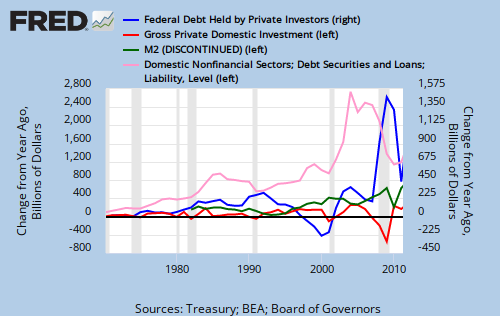
Look at this graph. It’s one of the most common — and deceptive — types of graph. You will see it every day in magazines, newspapers and blogs

1

It shows four lines, all rising, three of which essentially are parallel. All four use the same scale, “Billions of Dollars” on the left. Looking at this graph, one could “prove” that Federal Debt Held by Private Investors, M2 and Gross Private Domestic Investment move together, while Total Domestic Nonfinancial Sectors moves up more rapidly.

The problem with this graph is the fact that it uses the same scale for all four variables, and the scale blurs out the real differences. America has grown over the years. So most of its measurements have grown.

But here is exactly the same graph, with one variable removed.

5

Those three variables that seemed to move together, look a lot less together.

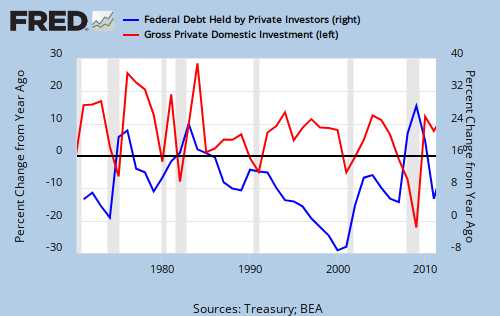
Then there is the following graph. One more variable is removed, and the scale now is % Change From Year Ago. Remember, the basic data are the same. Suddenly, there is no relationship between the two remaining variables. They don’t move together at all.

6

Now look at the following graph, which uses exactly the same data as the first graph, above. Rather than “Billions of Dollars,” the scale now is % Change From Year Ago, and Federal Debt Held by Private Investors is scaled on the right.

2

Then there is this graph, which again, uses the same data, except it now shows Change from Year Ago in billions of dollars. Again, the same data as above:

3

And the following graph, again the same basic data, just moving one variable to the right hand scale:

4

I could go on and on, but you get the idea. Demonstrating a point with graphs is a great way to educate, but it can be tricky. The most well-intentioned graph can make a misleading point, even when the data are completely accurate. All of the above graphs use the same basic data, yet all look substantially different. Different conclusions could be drawn from each of them.

Graphs are analogies. They are not reality. They only purport to represent reality. So the next time you see a graph (even mine), ask yourself, “Are the data shown in a way that fairly makes the point?”

Rodger Malcolm Mitchell
http://www.rodgermitchell.com


==========================================================================================================================================
No nation can tax itself into prosperity, nor grow without money growth. Monetary Sovereignty: Cutting federal deficits to grow the economy is like applying leeches to cure anemia. The key equation in economics: Federal Deficits – Net Imports = Net Private Savings

MONETARY SOVEREIGNTY

–Watch America, our once great nation, decline – as we cut pieces from ourselves, snip by snip by snip.

Reduced money growth cannot increase economic growth. Those, who do not understand the differences between Monetary Sovereignty and monetary non-sovereignty, do not understand economics.
==================================================================================================================================================================================

Nations die from within, their governments, either from ignorance or corruption, slowly cutting away the factors and institutions that made their nations great.

On August 15, 1971, the United States of America went off the gold standard to become “Monetarily Sovereign.” In that fateful instant, our federal government acquired the unlimited ability to create dollars. It no longer could be forced into bankruptcy, except by Congress. America had gained the ability to pay any bill of any size, instantly. No debt was unsustainable.

There are more than 1,000 federal government agencies. Because they are agencies of the government, they too cannot be forced into bankruptcy. Congress, the White House, the Supreme Court, the branches of the military – all are federal agencies. None can go bankrupt. They have the full support of the U.S. government and its unlimited money-creation power.

For reasons clouded in political history, a tiny handful of the 1,000+ U.S. agencies cannot count on unlimited support from the federal government. Among these are Social Security, Medicare and the United States Post Office.

Ostensibly, the first two are supported by the FICA tax, while the USPO is supported by stamp sales. In economic fact though, the budgets of Social Security and Medicare are limited, not supported, by the FICA tax, and the budget of the USPO is limited, not supported, by stamp sales. In a Monetarily Sovereign nation, no form of income, whether taxes or fees, supports government spending.

The measure of a nation is the well-being of its citizens. All three of the above-named agencies are vital to the health and welfare of the United States. The USPO is so important, it specifically is authorized in the Constitution. Notwithstanding the Internet, fax machines and cell phones, America requires postal service, and any lessening of this service lessens America.

The benefits of Social Security, Medicare and the Post Office all are necessary to America’s greatness. Any reduction in the services provided by these three agencies represents a step backward for America.

Today, a Congress and President, ignoring factual economics, debate how once again, they will snip pieces from Medicare and Social Security, diminishing us. And then there was this article from the 8/12/11 Washington Post:

The Postal Service has reduced its workforce by 212,000 positions in the past 10 years and recently announced it is considering the closing of 3,700 post offices. It also has asked Congress to allow it to deliver mail five days a week instead of six and to change a requirement that it pre-fund retiree health benefits.

The USPS said it needs to reduce its workforce by 120,000 career positions by 2015, from a total of about 563,400, on top of the 100,000 it expects by attrition. Some of the 120,000 could come through buyouts and other programs, but a significant number would probably result from layoffs if Congress allows the agency to circumvent union contracts.

At a time when unemployment is one of our most serious problems, the USPO will lose 212,000 jobs in just the next three years. Even more telling are the phrases,” . . .closing of 3,700 post offices. . . “ and “ . . . deliver mail five days a week instead of six . . .”

In what seems now the distant past, mail was delivered twice a day, six days a week. Later, this service was reduced to once a day (snip) and soon just five days a week (snip). And the availability of local post offices will be reduced by another 3,700 (snip). And all too often, in what essentially is a tax increase, the price of postage rises, becoming less and less affordable (snip).

Today, we have a Congressional committee deciding how to cut Medicare benefits once again (snip) and how to reduce Social Security benefits once again (snip).

Slowly America is being cut away, our greatness being gutted by leaders who have neither the wits to understand what they are doing, nor the patriotism to care.

Is Congress like the apocryphal carpenter who shakes his head in puzzlement, “The more I cut the shorter it gets”? Or perhaps more like populist François Duvalier, who destroyed Haiti with the Tonton Macoutes militia and voodoo?

Whatever the analogy, there is no question America is diminishing at the hands of Congress and the President. That will be their legacy. And it all is so unnecessary. In a great nation, Medicare should be enlarged, not cut. In a great nation, Social Security should be expanded, not reduced. In a great nation, the Post Office should provide more services, not fewer.

Our federal government can and should enable the growth of America, not its dissolution. Instead it forms a committee to reduce our money supply, like using leeches to cure anemia. Right before our eyes, our beloved nation is dying the death of a thousand cuts, disappearing at the hands of those elected to protect us. And we are dying with it.

Snip.

Snip.

Snip.

Snip


Rodger Malcolm Mitchell
http://www.rodgermitchell.com


==========================================================================================================================================
No nation can tax itself into prosperity, nor grow without money growth. Monetary Sovereignty: Cutting federal deficits to grow the economy is like applying leeches to cure anemia. The key equation in economics: Federal Deficits – Net Imports = Net Private Savings

MONETARY SOVEREIGNTY
–Which is better for the U.S.: Increased exports or increased federal deficit spending?

Economic austerity causes civil disorder. Reduced money growth cannot increase economic growth. Those, who do not understand the differences between Monetary Sovereignty and monetary non-sovereignty, do not understand economics.
==========================================================================================================================================================================================

Which is better for the U.S.: Increased exports or increased federal deficit spending? Answer first, then please read the following article, which appeared in the online version of Time:

Time: Can China Help Prevent a U.S. Tailspin?
Posted by Roya Wolverson Wednesday, August 10, 2011

China’s $31 billion trade surplus in July is an irksome reminder to U.S. officials of the advantages China reaps from its undervalued currency. China has repeatedly dismissed U.S. demands that it let the yuan appreciate faster, which would help boost the U.S. recovery by making its exports cheaper.

Many economists think that, for the U.S. economy to get back on track, exports have to grow faster. Although only 10% of U.S. GDP comes from exports now, export growth has driven more than a third of the increase in U.S. GDP over the past year. Those gains are partially due to a falling dollar, fueled by fears about the U.S. economy’s future and the Fed’s bond-buying sprees. A faster appreciation of the yuan would only help a U.S. export bender.

According to Ms. Wolverson, an increase in U.S. exports would be stimulative. And she is right. But why would sending our goods and overseas benefit the U.S. in any way? Why, for instance, does it help America for farmers to work and sweat, growing and harvesting corn, and then to send this corn to a foreign land? Where is the economic benefit in that?

The obvious answer: Exporting goods and services is just another word for importing dollars. It’s not the goods and services leaving America that benefit us. It’s the dollars coming in, that stimulate our economy.

A growing economy requires a growing supply of money, and exports (i.e. the import of dollars) is one way to increase the money supply. That is the sole benefit of exporting.

There is another way to increase the money supply: Federal deficit spending. When the U.S. government buys goods and services domestically, it credits the bank accounts of the domestic sellers. This creates dollars, adding them to the economy. The U.S. government is America’s biggest customer, bigger than China, bigger than Canada, bigger than any other nation.

The financial effect of federal deficit spending is identical with the financial effect of exporting. Both increase the dollar supply; both stimulate the economy. Yet inexplicably, most old-line economists favor exporting while simultaneously disfavoring federal deficit spending. As with so many economic beliefs by old-line economists, this makes no sense.

Fact is, federal spending could be viewed as a better stimulative than exporting, because federal deficit spending does not require us to send valuable goods and services overseas. We can keep them right here, enriching America.

Summary: Financially, federal deficit spending is identical with exporting. Both add stimulative dollars to our economy. And deficit spending has the advantage of not requiring us to send our valuable goods and services overseas.

So the next time someone tells you we need to export more, ask him or her, “Should the federal government increase deficit spending?” If he says, “No,” grab him by the throat and as sweetly as possible, scream, “You idiot.” Then show him this post.

Rodger Malcolm Mitchell
http://www.rodgermitchell.com


==========================================================================================================================================
No nation can tax itself into prosperity, nor grow without money growth. Monetary Sovereignty: Cutting federal deficits to grow the economy is like applying leeches to cure anemia. The key equation in economics: Federal Deficits – Net Imports = Net Private Savings

MONETARY SOVEREIGNTY