–Here is an example of an “Obama compromise”

Mitchell’s laws: To survive, a monetarily non-sovereign government must have a positive balance of payments. Economic austerity causes civil disorder. Reduced money growth cannot increase economic growth. Those, who do not understand the differences between Monetary Sovereignty and monetary non-sovereignty, do not understand economics.
==========================================================================================================================================================================

An “Obama compromise” is when you give the other person everything he demands, but pretend it either is meaningless or is something you always wanted. Here’s a classic example:

Washington Post:
—————————————-
News Alert: Obama to address joint session of Congress on Sept. 8
August 31, 2011 9:36:20 PM
—————————————-

President Obama will address a joint session of Congress on Sept. 8 to lay out his plan for jobs and the economy, the White House announced Wednesday night. The date is one day later than the president requested earlier Wednesday, but that date conflicted with a scheduled debate of Republican presidential candidates, drawing objections from GOP lawmakers. House Speaker John A. Boehner responded by suggesting that Obama come to Capitol Hill on Thursday night, a date that now puts the president up against the first game of the NFL season.

Good luck, Mr. President, getting a huge, national audience vs. the NFL opener. But at least the Tea/Republicans have what they demanded. So that’s nice.

Rodger Malcolm Mitchell
http://www.rodgermitchell.com


==========================================================================================================================================
No nation can tax itself into prosperity, nor grow without money growth. Monetary Sovereignty: Cutting federal deficits to grow the economy is like applying leeches to cure anemia. The key equation in economics: Federal Deficits – Net Imports = Net Private Savings

MONETARY SOVEREIGNTY

–Uh oh. The Debt/GDP police soon will be on the prowl.

Mitchell’s laws: To survive, a monetarily non-sovereign government must have a positive balance of payments. Economic austerity causes civil disorder. Reduced money growth cannot increase economic growth. Those, who do not understand the differences between Monetary Sovereignty and monetary non-sovereignty, do not understand economics.
==========================================================================================================================================================================

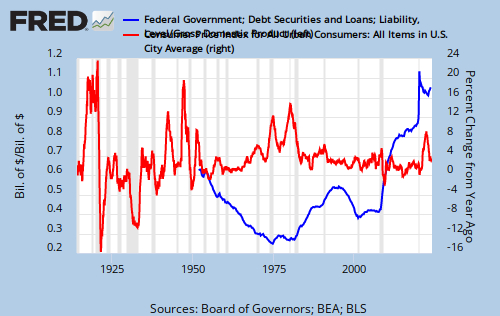
Lately federal debt as a percentage of GDP has been rising. So very soon, the Debt/GDP police will tell you that if the ratio goes above 100% or 150% or whatever number is chic these days, some terrible things will happen. What are these terrible things? No one knows, but we can assume they have to do with economic growth and/or with inflation.

Previously, I have showed how Debt/GDP is a meaningless fraction. The numerator is a life-of-nation measure, and the denominator is a one-year measure. Further, federal debt is nothing more than Treasury securities outstanding, which the federal government could eliminate tomorrow, merely by instructing banks to credit holders’ T-security accounts and debit their checking accounts.

Nevertheless, it might be instructive to see whether there is any historical relationship between Debt/GDP and inflation or economic growth. Here is what GDP/Debt (blue line) looks like when compared with inflation:

Debt/GDP vs inflation

Do you see any relationship between GDP/Debt and inflation? I don’t. Not surprisingly, this meaningless fraction has had no effect on inflation.

What about Debt/GDP as compared with economic growth. Here’s what that graph looks like:

Debt/GDP vs GDP

It would be difficult to conclude that a high Debt/GDP ratio affects economic growth, negatively. In fact, one could make the case that for the past 25 years, increases in Debt/GDP have had positives effect on economic growth. Notice also, that Debt/GDP does not seem to be related to the beginning of recessions (gray bars). If fact, as befits a meaningless ratio, Debt/GDP does not seem related to any economic function.

So the next time you read a sky-is-falling article saying the Debt/GDP ratio is too high, unsustainable, will cause inflation or will reduce economic growth, send him/her this article.

Rodger Malcolm Mitchell
http://www.rodgermitchell.com


==========================================================================================================================================
No nation can tax itself into prosperity, nor grow without money growth. Monetary Sovereignty: Cutting federal deficits to grow the economy is like applying leeches to cure anemia. The key equation in economics: Federal Deficits – Net Imports = Net Private Savings

MONETARY SOVEREIGNTY

–What a dilemma: Republican Senator demands federal spending — for his state.

Mitchell’s laws: To survive, a monetarily non-sovereign government must have a positive balance of payments. Economic austerity causes civil disorder. Reduced money growth cannot increase economic growth. Those, who do not understand the differences between Monetary Sovereignty and monetary non-sovereignty, do not understand economics.
==========================================================================================================================================================================

Pulaski County Daily News: Blunt urges continued FEMA disaster recovery funding for Joplin tornado

By: Press Office of U.S. Sen. Roy Blunt, Posted: Monday, August 29, 2011 11:43 pm
WASHINGTON, D.C. (Aug. 29, 2011) — U.S. Senator Roy Blunt (Republican) released the following statement regarding the reallocation of Federal Emergency Management Agency (FEMA) funding in the wake of Hurricane Irene recovery efforts:

“My staff and I are regularly communicating with Joplin officials to make sure that they’re getting the immediate help they need. The federal government has committed resources to help Missouri communities recover from crippling flood and tornado damage, and I expect that commitment to be fulfilled expeditiously. Recovery from hurricane damage on the East Coast must not come at the expense of Missouri’s rebuilding efforts. If FEMA can’t fulfill its promise to our state because we have other disasters, that’s unacceptable, and we need to take a serious look at how our disaster response policies are funded and implemented.”

U.S. Sen. Roy Blunt serves as a member of the Senate Committee on Appropriations as well as the Senate Committee on Commerce, Science, and Transportation. He currently serves as Ranking Member of the Appropriations Subcommittee on Agriculture, Rural Development, Food and Drug Administration, and Related Agencies and Ranking Member of the Commerce Subcommittee on Competitiveness, Innovation, and Export Promotion.

Well, this is something of a conundrum. Republican Senator Blunt rightly wants money for his Joplin people. And he rightly recognizes that the East Coast disaster will require billions in federal aid. And he rightly does not want money taken from Joplin and sent to the East Coast.

But he wrongly subscribes to the Tea/Republican myth that the federal debt and deficit are too high. So what’s a loyal Republican to do? Ah, troubles, troubles.

It will be interesting to see how the Tea/Republicans — the group that has hurt more Americans than al Qaeda — will solve this problem of their own making. Ultimately, bad plans lead to bad results, and in this case, Americans will continue to pay the price.

Rodger Malcolm Mitchell
http://www.rodgermitchell.com


==========================================================================================================================================
No nation can tax itself into prosperity, nor grow without money growth. Monetary Sovereignty: Cutting federal deficits to grow the economy is like applying leeches to cure anemia. The key equation in economics: Federal Deficits – Net Imports = Net Private Savings

MONETARY SOVEREIGNTY

–Obama appoints yet another debt-hawk to lead us to recession and depression

Mitchell’s laws: To survive, a monetarily non-sovereign government must have a positive balance of payments. Economic austerity causes civil disorder. Reduced money growth cannot increase economic growth. Those, who do not understand the differences between Monetary Sovereignty and monetary non-sovereignty, do not understand economics.
========================================================================================================================================================================================

The one truth about ignorance. It usually appoints more ignorance that agrees with it. Consider President Obama’s proposed new chairman of the Council of Economic Advisers, Alan Krueger:.

Shot at a Sane Budget
Washington Post, By ALAN B. KRUEGER, Published: April 16, 2011

PRESIDENT OBAMA has been criticized as too slow to engage in major debates and too timid to make difficult decisions.
[…]
In one important respect, however, Mr. Obama’s deficit speech disproves the caricature, and contains a bold, serious and timely proposal.

I’m not talking about the president’s plan to curb the growth rate of Medicare expenditures beyond what is already included in health care reform, or his renewed pledge to allow the Bush tax cuts on top income earners to expire — both of which will be difficult to achieve.

Krueger wants to cut Medicare and to increase taxes, and that will be “difficult to achieve.” What a shame.

An earlier version of the Medicare proposal was projected by the Congressional Budget Office to produce only modest savings, and we all know what happened the last time the top tax rates were held hostage to middle-class tax cuts.

“Only modest savings.” Another shame. Just what the people of America need: Big cuts in their Medicare. And yet another shame: . . . top tax rates “held hostage” to middle-class tax cuts. No reason to cut taxes for the working people, is there?

What I have in mind is his endorsement of a trigger that would automatically kick in to reduce spending and tax expenditures if Congress and the administration fail to bring the debt under control.

Mr. Obama described what he called a “debt fail-safe”: “If, by 2014, our debt is not projected to fall as a share of the economy — if we haven’t hit our targets, if Congress has failed to act — then my plan will require us to come together and make up the additional savings with more spending cuts and more spending reductions in the tax code.

In essence, Mr. Obama proposed a rule that will enable us to get ahead of the long-run budget problem, and provide predictability and certainty to the federal budget.

To Krueger, “getting ahead of the problem” is to cut the federal budget, thereby providing “predictability and certainty” that we will have a recession if we are “lucky” and a depression if we are not.

The so-called pay-go rule in the Budget Enforcement Act of 1990 — which required increases in spending or decreases in revenue to be offset by other spending cuts or revenue increases — helped lead to the surpluses that arose in the late 1990s.

Er, ah, excuse me, Mr. Krueger, but didn’t those surpluses lead to the recession of 2000?

We’ve also run the experiment in reverse: After the pay-go rules expired in 2002, increased spending on programs like Medicare prescription drugs and two rounds of tax cuts caused the deficit to soar.

Er, ah, excuse me again, Mr. Krueger, but didn’t that increased deficit end the 2000 recession and lead to eight recession free years, GDP growth slowing only when the deficit began to decline and the real estate bubble burst? Details, details.

While pay-go rules are helpful in the current environment, they are not sufficient given the burden the approaching retirement of the baby boom generation and rising health care costs will place on the debt. We need a supercharged pay-go rule, and that is what the president proposed. Because politicians prefer discretion, it took courage to propose an automatic trigger.

Yes, a supercharged spending cut to create a supercharged recession. Who could argue with that?

The proposal goes beyond the trigger proposed in December by Mr. Obama’s fiscal commission, which affected only tax revenue and kicked in only if tax reform was not enacted. Mr. Obama’s plan would automatically reduce direct spending and spending through the tax code.

Of course, the devil in any trigger is in the details. A key issue involves exceptions: What categories of spending or taxing would be exempted from the trigger, and how large a majority would be required to override the trigger?

Another important issue concerns the ratio of spending cuts to tax revenue. The president proposed a ratio of $2 of direct spending cuts (excluding interest on the debt) to every additional dollar of tax revenue in his speech. The House speaker, John A. Boehner, and many other Republicans have objected to raising additional tax revenue. But the two sides may be closer to some type of agreement than is commonly believed; they seem to agree that around $4 trillion needs to be trimmed from the budget over the next 10 to 12 years, but not on how to do it.

Again those nasty details. Cutting the budget is a swell idea, except for the detail that this causes recessions and the other detail that it causes human hardship for whomever depends on federal spending – like poor people, sick people, unemployed people, and every other citizen of America – except the wealthiest of us.

Discretion is hard for politicians to give up — and briefly satisfying, as dieters know when they dig out those hidden chocolate bars. What will help over time to lessen our appetite for more debt is to remove the temptation, and expectation, that when it comes to the budget we can always spend more than we have.

“. . . more than we have.”??? Pray tell, Mr. Krueger, exactly how much does the federal government “have”? Lord save us. This man does not understand the very foundation of modern economics — the differences between Monetary Sovereignty and monetary non-sovereignty — and he will be Obama’s chief economics advisor!

Alan B. Krueger, served as Chief Economist at the United States Department of Labor, received his Bachelors degree from Cornell University’s School of Industrial Labor Relations, and in 1987 he received his Ph.D. in Economics from Harvard University. .

All that economics education and so little economics understanding.

Rodger Malcolm Mitchell
http://www.rodgermitchell.com


==========================================================================================================================================
No nation can tax itself into prosperity, nor grow without money growth. Monetary Sovereignty: Cutting federal deficits to grow the economy is like applying leeches to cure anemia. The key equation in economics: Federal Deficits – Net Imports = Net Private Savings

MONETARY SOVEREIGNTY