–John Mauldin, one of the best paid gardeners, outdoes himself.

Mitchell’s laws: The more budgets are cut and taxes inceased, the weaker an economy becomes. To survive long term, a monetarily non-sovereign government must have a positive balance of payments. Austerity = poverty and leads to civil disorder. Those, who do not understand the differences between Monetary Sovereignty and monetary non-sovereignty, do not understand economics.
==========================================================================================================================================

John Mauldin is a famous blogger, who publishes “Thoughts from the Front Line,” and books he promotes. He may be one of the best paid gardeners in the world. He never seems to understand Monetary Sovereignty, but today he may have outdone himself.

Here are a few excerpts from his blog:

Let me shock a few of my fellow Republicans and say that I think the deficit is such a deadly disease that it would be better for the country for the Democrats to be in power and forced to deal with the situation than to do nothing. I would not like their solution, and I think it would be harmful, but not as harmful as a second Depression, brought on by not dealing with the deficits and entitlement problems.

John, depending on how you define “Depression,” there have been at least six of them, not two, and all six have been brought on, not by deficits, but by surpluses:

1817-1821: U. S. Federal Debt reduced 29%. Depression began 1819.
1823-1836: U. S. Federal Debt reduced 99%. Depression began 1837.
1852-1857: U. S. Federal Debt reduced 59%. Depression began 1857.
1867-1873: U. S. Federal Debt reduced 27%. Depression began 1873.
1880-1893: U. S. Federal Debt reduced 57%. Depression began 1893.
1920-1930: U. S. Federal Debt reduced 36%. Depression began 1929.

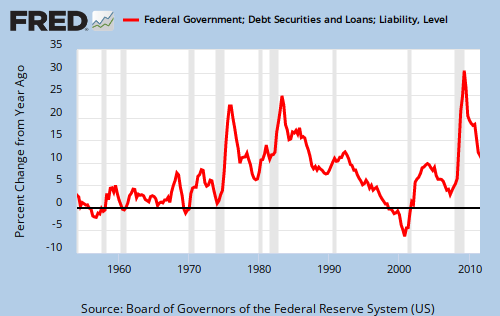
The most recent recession, and virtually every recession, has come on the heels of reduced deficit growth and has been cured with increased deficit growth.
Monetary Sovereignty

But why bother investigating facts when repeating popular wisdom is so much easier. After all, everyone is saying it, so it must be true.

Think what happens when any country has hit that debt limit. Greece is not having fun. And either Italy is going to be unhappy with the longer-term recession it will have, or Germany is going to be unhappy with the ECB backing Italian debt at below-market rates for a long time, which means printing money and a much lower euro.

Pardon me, John, but those countries are monetarily non-sovereign. The U.S. is Monetarily Sovereign. Really, after all these years, don’t you understand the difference? And “printing money and a much lower euro” translated means “deficits cause inflation.” But hasn’t the U.S. been running huge deficits for years? So where is the inflation?

The growing debt and the deficit is a deadly cancer on the economy. It will deliver a mortal blow to the economy if not dealt with. . . . Putting off treatment will not make the cancer go away by itself, and the cancer of our debt is clearly growing and malignant.

Allow me to translate, again. What John says is: The growing money supply is a deadly cancer on the economy. It will deliver a mortal blow to the economy if not dealt with. . . . Putting off treatment will not make the cancer go away by itself, and the money supply is clearly growing and malignant.

Yes, according to John, the economy has too much money, and GDP will grow better and faster if we reduce the supply of money. How that works, I’m not sure. I’ve asked him, but get no answer.

Then he goes on with the usual blah, blah, blah about how austerity now is better than austerity later, and we should increase taxes and/or reduce spending in order to achieve that austerity as soon as possible.

Yes, John, austerity is great. Ask those nations that have experienced it.

John Mauldin has outdone himself this time. He may be one of the best paid gardeners in the world. Think of how much makes spreading manure.

Rodger Malcolm Mitchell
http://www.rodgermitchell.com


==========================================================================================================================================
No nation can tax itself into prosperity, nor grow without money growth. Monetary Sovereignty: Cutting federal deficits to grow the economy is like applying leeches to cure anemia. Two key equations in economics:
Federal Deficits – Net Imports = Net Private Savings
Gross Domestic Product = Federal Spending + Private Investment and Consumption + Net exports

#MONETARY SOVEREIGNTY

–With friends like these: How AARP’s misunderstanding of the facts hurts their members.

Mitchell’s laws: The more budgets are cut and taxes inceased, the weaker an economy becomes. To survive long term, a monetarily non-sovereign government must have a positive balance of payments. Austerity = poverty and leads to civil disorder. Those, who do not understand the differences between Monetary Sovereignty and monetary non-sovereignty, do not understand economics.
==========================================================================================================================================

AARP’s writers don’t understand Monetary Sovereignty. They think Social Security is supported by FICA. This popular misconception hurts AARP members, because it supports three false notions about sustaining Social Security for future generations:

1. Social Security benefits must be reduced.
2. Social Security benefits should be taxed.
3. FICA must be increased.

Wrong, wrong and wrong. Those who understand Monetary Sovereignty know that in a Monetarily Sovereign nation, taxes do not pay for federal spending, and Social Security benefits could be expanded, even if FICA were zero ( which it should be ). Thus, AARP finds itself going along with popular myths, and opting for damaging “fixes,” instead of properly asking Congress to eliminate FICA, increase benefits and eliminate the tax on benefits.

AARP Home; Social Security: Fears vs. Facts
What Social Security critics keep getting wrong

by: Liz Weston | from: AARP The Magazine | July/August 2011 issue

I’ve been writing about Social Security for nearly two decades. But even I still have trouble wrapping my brain around some of the system’s complexities — from how benefits are calculated to how the trust fund works. So it’s not surprising that myths about Social Security persist, often fed by the program’s critics. With the debate about Social Security’s future once again heating up, these three myths need to be put to rest — so we can focus on the real issues.

Myth #1: By the time I retire, Social Security will be broke.

It’s true that Social Security’s finances need work, because over the long term there will not be enough money to fully cover promised benefits.

Absolutely, 100% false. The federal government, not FICA, pays for Social Security; the federal government never will run out of money. No tax supports federal spending in a Monetarily Sovereign nation (This is not true of the states, counties, cities and euro nations, all of which are monetarily non-sovereign, and do use taxes to support spending. It is vital to understand the difference.)

But radical changes aren’t needed. In 2010 a number of different proposals were put forward that, taken in combination, would put the program back on firm financial ground for the future, including changes such as raising the amount of wages subject to the payroll tax (now capped at $106,800) and benefit changes based on longer life expectancy.

Here was a perfect example of AARP acceding to Congress’s proposals, based on economic ignorance, that would harm AARP members. And this from a person who claims to have been writing about Social Security for “two decades.” Yikes!

Myth #2: The Social Security trust fund assets are worthless.

Any surplus payroll taxes not used for current benefits are used to purchase special-issue, interest-paying Treasury bonds. In other words, the surplus in the Social Security trust fund has been loaned to the federal government for its general use — the reserve of $2.6 trillion is not a heap of cash sitting in a vault.

These bonds are backed by the full faith and credit of the federal government, just as they are for other Treasury bondholders. However, Treasury will soon need to pay back these bonds. This will put pressure on the federal budget, according to Social Security’s board of trustees. Even without any changes, Social Security can continue paying full benefits through 2037. After that, the revenue from payroll taxes will still cover about 75 percent of promised benefits.

A mishmosh of partly true, almost true, once-but-no-longer-true statements. While government accounting seems to move money around, this is illusory. There may be pressure on the federal budget, but the budget is an artificial construct of pre-1971 accounting. There is no pressure on the federal government’s ability to pay.

The government has the power to credit and debit accounts at will, and none of this debiting and crediting affects one underlying truth: Payroll taxes do not pay for Social Security benefits. The government pays by instructing banks to mark up checking accounts, which it can do, endlessly.

The federal government never can run short of dollars. It never can be unable to pay its bills. It was monetarily non-sovereign when Social Security was invented, and the processes, though appropriate at the time, no longer are appropriate for a Monetarily Sovereign nation.

Myth #3: I could invest better on my own.

Maybe you could, and maybe you couldn’t. But the point of Social Security isn’t to maximize the return on the payroll taxes you’ve contributed. Social Security is designed to be the one guaranteed part of your retirement income that can’t be outlived or lost in the stock market. It’s a secure base of income throughout your working life and retirement. And for many, it’s a lifeline.

That one is correct. So two out of three isn’t bad.

As AARP The Magazine’s personal finance columnist, Liz Weston offers advice on everything from car loans to home sales.

Monetary Sovereignty is the basis for economics. Monetary Sovereignty is to economics as arithmetic is to mathematics.

AARP has a powerful voice. By going along with the popular (false) beliefs about Social Security, AARP does great damage to America. If AARP would take the minimal effort needed to understand Monetary Sovereignty, they could be an effective force for saving the American economy, and Social Security along with it.

I award AARP three dunce caps for not understanding the fundamentals of a subject about which they should be expert.

This, by the way, puts no pressure on my ability to create more dunce caps.

Rodger Malcolm Mitchell
http://www.rodgermitchell.com


==========================================================================================================================================
No nation can tax itself into prosperity, nor grow without money growth. Monetary Sovereignty: Cutting federal deficits to grow the economy is like applying leeches to cure anemia. Two key equations in economics:
Federal Deficits – Net Imports = Net Private Savings
Gross Domestic Product = Federal Spending + Private Investment and Consumption + Net exports

#MONETARY SOVEREIGNTY

Who says Mitt has no sense of humor. This is as funny as it gets.

Mitchell’s laws: The more budgets are cut and taxes inceased, the weaker an economy becomes. To survive long term, a monetarily non-sovereign government must have a positive balance of payments. Austerity = poverty and leads to civil disorder. Those, who do not understand the differences between Monetary Sovereignty and monetary non-sovereignty, do not understand economics.
==========================================================================================================================================

Washington Post, Feb. 17 (Bloomberg):

Romney bashes union bosses as he attempts to win Michigan primary

Romney, the son of an auto company executive-turned- Michigan governor, has bashed labor bosses at almost every campaign stop in the state this week, vowing to pass laws making it harder for workers to organize — particularly the powerful United Auto Workers union.

Union membership in the state is on the rise, bucking the national trend. Last year, 18.3 percent of the Michigan workforce was represented by a union, up from 17.3 percent in 2010. More than a quarter of Michigan Republican primary participants in 2008 were from households that included a union member.

Romney also has been citing unions as a major reason for his opposition to the federal bailouts of General Motors Co. and Chrysler Group LLC.

Romney, 64, is also trying to rebrand himself as a committed fiscal conservative and refute criticism that he changes positions for political gain.

Bashes unions in a powerful union state. Opposes the successful saving of the auto companies, where Republican voters work. Tries to show he doesn’t change positions for political gain. What next to appease the pious right — an anti-gambling tirade in Nevada?

Folks, you simply cannot make this stuff up.

I award Mitt one clown symbol, plus a great big thank you for adding humor to an otherwise grim campaign:

Clown
——-Romney——-

Rodger Malcolm Mitchell
http://www.rodgermitchell.com


==========================================================================================================================================
No nation can tax itself into prosperity, nor grow without money growth. Monetary Sovereignty: Cutting federal deficits to grow the economy is like applying leeches to cure anemia. Two key equations in economics:
Federal Deficits – Net Imports = Net Private Savings
Gross Domestic Product = Federal Spending + Private Investment and Consumption + Net exports

#MONETARY SOVEREIGNTY

–The Japanese crisis. What is it and could it happen here?

Mitchell’s laws: The more budgets are cut and taxes inceased, the weaker an economy becomes. To survive long term, a monetarily non-sovereign government must have a positive balance of payments. Austerity = poverty and leads to civil disorder. Those, who do not understand the differences between Monetary Sovereignty and monetary non-sovereignty, do not understand economics.
==========================================================================================================================================

Just to show that ignorance of Monetary Sovereignty is not restricted to Americans and the European Union, here comes Japan:

Yahoo: Finance
Insight: Japan slowly wakes up to doomsday debt risk

By Tetsushi Kajimoto, Leika Kihara and Tomasz Janowski

TOKYO (Reuters) – Capital flight, soaring borrowing costs, tanking currency and stocks and a central bank forced to pump vast amounts of cash into local banks — that is what Japan may have to contend with if it fails to tackle its snowballing debt.

Not long ago such doomsday scenarios would be dismissed in Tokyo as fantasies of ill-informed foreigners sitting on loss-making bets “shorting Japan.” Today this is what is on bureaucrats’ minds in Japan’s centre of political and economic power.

Japan is Monetarily Sovereign, so even if borrowing costs “soared,” and currency “tanked,” the central bank would have no difficulty whatsoever pumping vast amounts of cash into local banks or anywhere else.

“Shorting Japan” is a fools play — unless they do something stupid, like raising taxes.

“It’s scary when you think what could happen if there’s triple-selling of bonds, stocks and the yen. The chance of this happening is bigger than markets think,” says a senior official.

These officials would be the ones pulling the levers in the command center if Japan were to be hit by a debt crisis.

Japan cannot have a “debt crisis.” Remember, it’s Monetarily Sovereign.

The government borrows more than it raises in taxes, and its debt pile amounts to two years’ worth of Japan’s economic output, the highest debt-to-GDP ratio in the world. It costs Japan half of the country’s tax income just to service its debt.

Being Monetarily Sovereign, Japan does not need or use taxes to pay its debts. It merely creates yen.

Technocrats who might have once dismissed worst-case scenarios are now beginning to take them seriously as doubts grow over whether Japan is ready to act and as Greece’s budget meltdown stokes the euro zone’s debt crisis.

Greece is monetarily non-sovereign. No comparison with Japan.

Conventional wisdom is that Japan is safe as long as it keeps covering about 95 percent of its borrowing needs at home.

As usual, conventional wisdom about Monetarily Sovereign governments is wrong.

But to some economists who have followed Japan for years, the frustration is that the country has yet to solve its underlying problems of slow economic growth and stubborn deflation.

So all that money “printing” to pay all that debt has not caused inflation?? It must make debt-hawks crazy not to be able to use their Weimar Republic scare example.

As long as those conditions persist, it will be difficult to crawl out from under the debt burden.

Why would slow growth and deflation make it difficult for a Monetarily Sovereign nation to pay its bills?

“If you wind the clock back five or 10 years, they’d have been saying all the same things and probably with a very similar time horizon of three to five years,” said Richard Jerram, chief economist at Bank of Singapore.

Yes, the same as in the U.S. Since 1940 or earlier, our debt-hawks have been saying our federal debt is unsustainable. Failure to be right never deters them.

While officials stress it is too early for a definite contingency plan, there seems to be an agreement that financial institutions will be the hardest hit because of their big government bond holdings, and that the Bank of Japan will play a key role in shoring up the sector.

Why hit at all? Japan will continue to service its bonds, just as always.

In an event of a surge in yields, the Bank of Japan could flood money markets with cash the way it did after the March 11 earthquake and act as a market-maker for the bond market, matching bids and offers if they fail to meet, officials say.

The finance ministry could also be forced to redeem bonds ahead of maturity to calm investors, says Yoichi Miyazawa, former vice finance minister and upper house lawmaker for the opposition Liberal Democratic Party.

Right. No problem. Easily done. That’s the beauty of Monetary Sovereignty (Hello Greece, are you listening?)

Miyazawa, who led work on the party’s crisis plan, says the worst case scenario could involve bank bailouts and Greek-style austerity if debt servicing costs soared, threatening to eat up a big portions of revenues. “The government should show a concrete roadmap for rebuilding public finances, including the kind of reforms adopted by Greece, which involve painful belt-tightening, slashing welfare spending and boosting sales and other tax rates,” he said.

He’s nuts. It’s guys like him who would doom Japan.

Finance Ministry . . . simulations show adding 1 percentage point to borrowing costs would add 1 trillion yen to about 22 trillion in borrowing costs over the course of one year, rather than double them as some commentators warn, because the spike would only affect newly issued and rolled over debt.

Yawn. Another 1 trillion yen would be needed. So? That would require one push of a computer key.

What sets Japan apart from Europe’s crisis-hit nations is that it borrows almost exclusively at home and with domestic savings of some 1,500 trillion yen ($19 trillion) it can do it paying less than 1 percent for 10-year bonds.

And herein lies the ignorance. What sets Japan apart is that it is Monetarily Sovereign, while the euro nations are monetarily non-sovereign. Those who do not understand the difference, do not understand economics.

Deflation and the yen’s long bull run foster a “patriotic” home bias among households and institutions, turning private savings into quasi public money, always there and easily accessible. That explains how a nation with one of the lowest tax burdens in the OECD and a stagnant economy never seemed to have trouble rolling out hefty stimulus packages or subsidizing social security.

Gee, what a mystery. A Monetarily Sovereign nation has low taxes, high debt, and never has trouble spending money. And no inflation! Debt-hawks, how could this be?

It’s sad to see Japan undergoing the same death-by-ignorance that the U.S. suffers at the hands of the economically unknowing. Here is a perfect example for Americans — a nation with twice the debt/GDP ratio as ours, yet having no difficulty paying its bills and no inflation. Yet our leaders do not learn from what is right in front of their eyes.

I hope Japan doesn’t panic and begin needlessly to raise taxes, as our Congress and President wish to do. That would make them as foolish as we are.

Regarding the headline of this post, the Japanese “crisis” is economic ignorance, and yes, it already has happened here.

Rodger Malcolm Mitchell
http://www.rodgermitchell.com


==========================================================================================================================================
No nation can tax itself into prosperity, nor grow without money growth. Monetary Sovereignty: Cutting federal deficits to grow the economy is like applying leeches to cure anemia. Two key equations in economics:
Federal Deficits – Net Imports = Net Private Savings
Gross Domestic Product = Federal Spending + Private Investment and Consumption + Net exports

#MONETARY SOVEREIGNTY