Now that you have voted, here is what you voted for

You may have thought you were voting for people — Trump, Clinton or someone else, but in fact you were voting for programs that will affect your life. So now that voting is over, you might as well learn what you voted for.

Those of you on the “ABC” (Anyone But Clinton) team must feel great to have dispatched the evil witch, and now you have a chance to “Make America Great Again.”

The following post tells you where your jump from the frying pan has taken you.

Here are some excerpts from an article in today’s Chicago Tribune,  a right-wing newspaper that opposed Trump (as did almost every newspaper in America):

President-elect Donald Trump’s stunning victory Tuesday has delivered to GOP congressional leaders the gift they dreamed of, even if they never quite believed it was within reach: a Republican president to sign Republican bills passed by a uniformly Republican Congress.

House Speaker Paul D. Ryan (R-Wis.), who rose to prominence based on his plans to dramatically scale back federal spending, said Wednesday that Trump “earned a mandate” in his victory to enact years of conservative promises and that Republican lawmakers stood ready to help.

These days, every political victory, no matter how narrow, is termed a “mandate” by the winning party.

Trump’s “mandate” is pretty much the same “mandate” Bush had over Al Gore, when Gore received more votes and Bush won the electoral college. Last I heard, Clinton actually received more votes than Trump.

“This is the kind of unified Republican government that we set out to deliver,” Ryan told reporters. “I think we are going to hit the ground running.”

Senate Majority Leader Mitch McConnell (R-Ky.) also called the election a rejection of Obama’s policies and said Republicans would work with Trump to overturn them — and to fill the Supreme Court vacancy they have kept open for eight months.

Once again we will have a conservative Supreme Court, which may please those who agree with the “Citizens United” (money is speech) decision that allows the rich to spend unlimited dollars to elect candidates favoring the rich, and with the “Hobby Lobby” (corporations are people) decision saying a corporation has religious rights that supersede the religious rights of its employees.

If you have noticed a certain bent in conservative Court rulings it’s this: The rich should have more rights than the not-rich.

Among the first priorities next year is likely to be an effort to repeal and replace the Affordable Care Act, aka Obamacare. McConnell said that would be “pretty high on our agenda” and that he “would be shocked if we didn’t move forward and keep our commitment to the American people.”

Obamacare (originally Romneycare) was created as a result of the Big Lie, the lie that federal taxes fund federal spending. They don’t.

Unlike state and local taxes, which do fund state and local government spending, federal taxes are not in any way related to federal spending. That is the fundamental difference between a monetarily non-sovereign (state and local) government and a Monetarily Sovereign (federal) government.

The public’s ignorance of the Big Lie has done more damage to the American economy than all the wars in U.S. history.

Yes, Obamacare should be replaced, but not with another jury-rigged, anti-middle-class, Rube Goldbergian program based on the Big Lie.  It should be replaced with a federally funded, single-payer, comprehensive Medicare for every man, woman, and child in America.

The more money the federal government spends on Medicare, the more stimulus dollars will enter the economy and the faster the economy will grow.

(By the way, don’t let the oft-used “inflation” excuse confuse you. Being Monetarily Sovereign, the government has total control over both the supply and the demand for [i.e. the value of] the U.S. dollar.) The government can cause or stop inflation any time it wishes.

Ryan told reporters that he also expects to work with Trump to scale back regulations for coal mining, ranching and other industries.

If there is one thing conservatives hate it’s those pesky regulations that prevent the rich from polluting the air, exacerbating global warming, cheating food and drug buyers, and taking America’s land for themselves.

And puh-leeze let’s not regulate those downtrodden banksters, who created the Great Recession. Those poor $100 million a year folks would be able to make $200 million if only you and the government would let them do whatever they want.

Wicker predicted Republicans would get to work immediately on replacing the health-care law, swiftly confirm Trump’s first pick for the Supreme Court and work toward a bipartisan infrastructure package.

In reality, “bipartisan” means, “We have the votes, so shut up. (Does infastructure include a wall on the American/Mexican border? Just wondering.)

Conservatives are expected to push anew to slash domestic programs and to reduce the size of entitlement programs such as Social Security and Medicare.

Is that what you thought you were voting for? Read it again: The Trump Republicans want to reduce entitlement programs such as Social Security and Medicare.

Fortunately, you and your children won’t need either Social Security or Medicare.  Right?

The problem is not that money is lacking. There is plenty of money — an infinite amount, really.  The problem is that your life is not harsh enough, and the ultra-rich are not happy about that. You, the servant class, don’t deserve all that “free stuff.” Only the rich deserve free stuff in the form of tax loopholes.

The overriding goal of the rich is not to make more money, but to widen the Gap between them and you. That is accomplished by giving the rich more and/or by giving you less.

The Gap is what makes the rich, rich.  Without the Gap, no one would be rich (We all would be the same). And the wider the Gap, the richer they are. A man making $100 is rich if everyone else makes $10.

That widening Gap is the single, most important problem facing the American Economy.

When you and your children receive less Social Security and a more restrictive Medicare (both programs having been invented by liberals) don’t be surprised. It’s what you voted for. Didn’t anyone tell you?

Last year, Trump said that he would eventually insist on a balanced budget but did not elaborate.

“Right now, we’re so under, we’re so far under that you can’t go too quickly,” Trump said in an interview with Fox News. “But I would absolutely insist on it relatively soon.”

If you believe that a balanced budget (i.e increased taxes and reduced spending) will grow the economy, then you also must believe that your anemia can be cured by applying leeches or by draining your blood into a pail.

While your personal lifestyle depends on many factors, money always is the lifeblood of an economy.  The federal government not only has the unlimited ability to create U.S. dollars, but also has the unlimited ability to control the value of the U.S. dollar (i.e. inflation).

There is absolutely no reason to run a balanced budget, and in fact, a balanced budget would lead to recession or depression.
…………………………………………………………………………………………………………………..
THE RECESSION CLOCK

Monetary Sovereignty
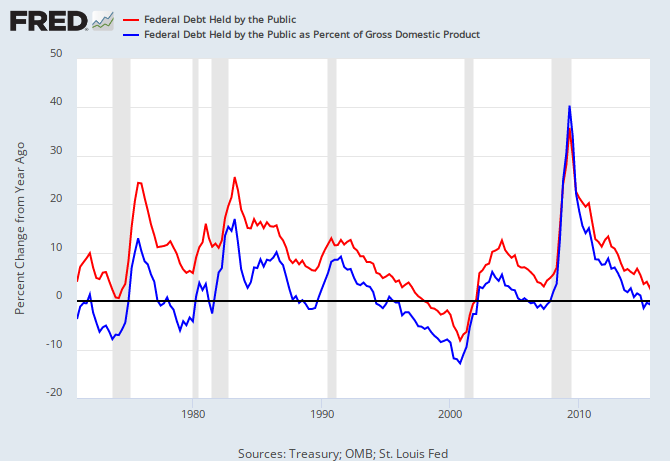
Vertical gray bars mark recessions.

Deficit reduction puts less money into the economy, thereby recessing the economy. Recessions begin an average of a year after the red line (Federal Debt Held By The Public) slides to its bottom. 

As the federal deficit growth lines drop, we approach recessions, which have been cured only when the growth lines have risen.

Increasing federal deficit growth (aka “stimulus”) is necessary for long-term economic growth.

And if deficit reductions are bad, surpluses are even worse, because they actually remove dollars from the economyU.S. depressions tend to come on the heels of federal surpluses.

1817-1821: U. S. Federal Debt reduced 29%. Depression began 1819.
1823-1836: U. S. Federal Debt reduced 99%. Depression began 1837.
1852-1857: U. S. Federal Debt reduced 59%. Depression began 1857.
1867-1873: U. S. Federal Debt reduced 27%. Depression began 1873.
1880-1893: U. S. Federal Debt reduced 57%. Depression began 1893.
1920-1930: U. S. Federal Debt reduced 36%. Depression began 1929.

Bill Clinton ran America’s last surplus, immediately after which we were fortunate to have “only” a recession — in 2001 — rather than a depression.

“On Tuesday, America demanded disruption,” said Sen. Ben Sasse (R-Neb.), a Trump critic who nonetheless said Wednesday he would “do everything in my power” to hold Trump to his pledges to overturn the Affordable Care Act, pursue congressional term limits and nominate conservative judges.

Congressional term limits are wise for the same reason Presidential term limits are wise. The longer Congresspersons hold their jobs, the less responsive they are to the public good. 

But, can you imagine Congress voting for term limits? Trump’s wisest proposal has the least chance of passing.

Another Trump critic, Sen. Lindsey O. Graham (said) “We have wars to win, threats to be dealt with, and a stagnant economy which must be revived. I believe there is consensus to be had on keeping trade free but fairer, rebuilding our military, restoring our standing in the world, reforming our tax code, repealing and replacing Obamacare with an alternative that empowers patients while reining in costs, and confirming conservative justices to the Supreme Court.”

“Empowers patients,” is political doubletalk meaning reducing patients’ benefits and increasing their costs. Implied in all this are two fundamental, conservative beliefs:

  1. More money must be spent on the military.
  2. This money must come from the working class.

Tax “reform” always seems to mean increasing a regressive tax on the working class, like a sales tax, a flat tax or more FICA, while taking care of the very rich idle class.

The working class voted Republican, but the Republicans will disappoint the working class. Sadly, while the Democrats lean (ever so slightly) more to the left, they too have disappointed the working class, because they have become right-wing.

The Democrats too, espouse the Big Lie as a reason to limit social programs. For both parties, it has become a matter of faith that social programs promote laziness, and the only way to eliminate poverty is to punish the impoverished — i.e. to whip the slaves until they are willing to work.

The myth is that cutting social programs is the best way to prod the working class into greater effort.

Until at least one politician has the knowledge, the courage and the power to publicly demonstrate the fallacy of the Big Lie, America will forever be plagued with booms and busts, and after each cycle, the working class will be worse off than before.

Historically, the Republican’ bases are the rich and the Christian fundamentalists. Hillary Clinton lost because the Democrats forgot their own historical base, the working class.

All those thousands of people attending Trump speeches were actually Democrats. They just didn’t know it, because the Democratic party ignored them in its drive for dollars.

Clinton was not a Democrat. Obama was not a Democrat. The last real Democrat was Lyndon Johnson, who did many great things before enmeshing himself in the Vietnam war.

  • Civil Rights Acts of 1964 and 1968
  • Appointed Thurgood Marshall (first black Supreme Court justice)
  • Voting Rights Act of 1965
  • $11 billion tax cut
  • Elementary and Secondary Education Act
  • Public broadcasting
  • Higher Education Act
  • Established the National Endowment for the Arts and Humanities
  • Outlawing most racial segregation
  • Medicare
  • Medicaid
  • Aid to education
  • Head Start
  • Food stamps
  • Work study
  • Environmental protection
  • Reduced poverty from roughly 23 percent to 12 percent

Those were liberal initiatives.  If you feel they are worthwhile, don’t allow anyone to use the world “liberal” as a pejorative.

Bottom line: The election was based on ignorance.

The Democratic Party was, and has been, ignorant for using the Big Lie as an excuse to ignore their base: The working class.

The Democrats also have been ignorant in allowing the Republicans to characterize liberalism as socialism and communism.  Liberalism is what Jack Kennedy and Lyndon Johnson did.  Socialism and communism are what Mao and Castro did.

If the working class understood the realities of  liberalism and of the Big Lie, they would vote liberal every time. The Democrats ignorantly allowed the Republicans to steal the Democrats’ “natural” base.

The working class voters were ignorant about what Trump and the right wing plans to do to them. They voted for change, without considering the fact that change can be bad.

And in fact, if the Republicans accomplish their goals, the change will be horrible for the working class and for the entire country, except for the rich, who will prosper.

To win back the Presidency and the Congress, Democrats must re-embrace Roosevelt/Kennedy/Johnson liberalism while teaching the public the facts about Monetary Sovereignty, the Ten Steps to Prosperity (below), and the Big Lie.

Rodger Malcolm Mitchell
Monetary Sovereignty

P.S. Within a year, no one will remember voting for Trump — but we will remind you.

……………………………………………………………………………………………………………………………………………………………………………………………………….

The single most important problems in economics involve the excessive income/wealth/power Gaps between the rich and the rest.

Wide Gaps negatively affect poverty, health and longevity, education, housing, law and crime, war, leadership, ownership, bigotry, supply and demand, taxation, GDP, international relations, scientific advancement, the environment, human motivation and well-being, and virtually every other issue in economics.

Implementation of The Ten Steps To Prosperity can narrow the Gaps:

Ten Steps To Prosperity:
1. ELIMINATE FICA (Ten Reasons to Eliminate FICA )
Although the article lists 10 reasons to eliminate FICA, there are two fundamental reasons:
*FICA is the most regressive tax in American history, widening the Gap by punishing the low and middle-income groups, while leaving the rich untouched, and
*The federal government, being Monetarily Sovereign, neither needs nor uses FICA to support Social Security and Medicare.
2. FEDERALLY FUNDED MEDICARE — PARTS A, B & D, PLUS LONG TERM CARE — FOR EVERYONE (H.R. 676, Medicare for All )
This article addresses the questions:
*Does the economy benefit when the rich can afford better health care than can the rest of Americans?
*Aside from improved health care, what are the other economic effects of “Medicare for everyone?”
*How much would it cost taxpayers?
*Who opposes it?”
3. PROVIDE AN ANNUAL ECONOMIC BONUS TO EVERY MAN, WOMAN AND CHILD IN AMERICA, AND/OR EVERY STATE, A PER CAPITA ECONOMIC BONUS (The JG (Jobs Guarantee) vs the GI (Guaranteed Income) vs the EB) Or institute a reverse income tax.
This article is the fifth in a series about direct financial assistance to Americans:

Why Modern Monetary Theory’s Employer of Last Resort is a bad idea. Sunday, Jan 1 2012
MMT’s Job Guarantee (JG) — “Another crazy, rightwing, Austrian nutjob?” Thursday, Jan 12 2012
Why Modern Monetary Theory’s Jobs Guarantee is like the EU’s euro: A beloved solution to the wrong problem. Tuesday, May 29 2012
“You can’t fire me. I’m on JG” Saturday, Jun 2 2012

Economic growth should include the “bottom” 99.9%, not just the .1%, the only question being, how best to accomplish that. Modern Monetary Theory (MMT) favors giving everyone a job. Monetary Sovereignty (MS) favors giving everyone money. The five articles describe the pros and cons of each approach.
4. FREE EDUCATION (INCLUDING POST-GRAD) FOR EVERYONEFive reasons why we should eliminate school loans
Monetarily non-sovereign State and local governments, despite their limited finances, support grades K-12. That level of education may have been sufficient for a largely agrarian economy, but not for our currently more technical economy that demands greater numbers of highly educated workers.
Because state and local funding is so limited, grades K-12 receive short shrift, especially those schools whose populations come from the lowest economic groups. And college is too costly for most families.
An educated populace benefits a nation, and benefiting the nation is the purpose of the federal government, which has the unlimited ability to pay for K-16 and beyond.
5. SALARY FOR ATTENDING SCHOOL
Even were schooling to be completely free, many young people cannot attend, because they and their families cannot afford to support non-workers. In a foundering boat, everyone needs to bail, and no one can take time off for study.
If a young person’s “job” is to learn and be productive, he/she should be paid to do that job, especially since that job is one of America’s most important.
6. ELIMINATE CORPORATE TAXES
Corporations themselves exist only as legalities. They don’t pay taxes or pay for anything else. They are dollar-transferring machines. They transfer dollars from customers to employees, suppliers, shareholders and the government (the later having no use for those dollars).
Any tax on corporations reduces the amount going to employees, suppliers and shareholders, which diminishes the economy. Ultimately, all corporate taxes come around and reappear as deductions from your personal income.
7. INCREASE THE STANDARD INCOME TAX DEDUCTION, ANNUALLY. (Refer to this.) Federal taxes punish taxpayers and harm the economy. The federal government has no need for those punishing and harmful tax dollars. There are several ways to reduce taxes, and we should evaluate and choose the most progressive approaches.
Cutting FICA and corporate taxes would be a good early step, as both dramatically affect the 99%. Annual increases in the standard income tax deduction, and a reverse income tax also would provide benefits from the bottom up. Both would narrow the Gap.
8. TAX THE VERY RICH (THE “.1%) MORE, WITH HIGHER PROGRESSIVE TAX RATES ON ALL FORMS OF INCOME. (TROPHIC CASCADE)
There was a time when I argued against increasing anyone’s federal taxes. After all, the federal government has no need for tax dollars, and all taxes reduce Gross Domestic Product, thereby negatively affecting the entire economy, including the 99.9%.
But I have come to realize that narrowing the Gap requires trimming the top. It simply would not be possible to provide the 99.9% with enough benefits to narrow the Gap in any meaningful way. Bill Gates reportedly owns $70 billion. To get to that level, he must have been earning $10 billion a year. Pick any acceptable Gap (1000 to 1?), and the lowest paid American would have to receive $10 million a year. Unreasonable.
9. FEDERAL OWNERSHIP OF ALL BANKS (Click The end of private banking and How should America decide “who-gets-money”?)
Banks have created all the dollars that exist. Even dollars created at the direction of the federal government, actually come into being when banks increase the numbers in checking accounts. This gives the banks enormous financial power, and as we all know, power corrupts — especially when multiplied by a profit motive.
Although the federal government also is powerful and corrupted, it does not suffer from a profit motive, the world’s most corrupting influence.
10. INCREASE FEDERAL SPENDING ON THE MYRIAD INITIATIVES THAT BENEFIT AMERICA’S 99.9% (Federal agencies)Browse the agencies. See how many agencies benefit the lower- and middle-income/wealth/ power groups, by adding dollars to the economy and/or by actions more beneficial to the 99.9% than to the .1%.
Save this reference as your primer to current economics. Sadly, much of the material is not being taught in American schools, which is all the more reason for you to use it.

The Ten Steps will grow the economy, and narrow the income/wealth/power Gap between the rich and you.
If you don’t like Medicare for All, read this:

Twitter: @rodgermitchell; Search #monetarysovereignty
Facebook: Rodger Malcolm Mitchell

……………………………………………………………………………………..

Step #2 of the Ten Steps For Prosperity reads:

FEDERALLY FUNDED MEDICARE — PARTS A, B & D, PLUS LONG TERM CARE — FOR EVERYONE (H.R. 676, Medicare for All )
This article addresses the questions:
*Does the economy benefit when the rich can afford better health care than can the rest of Americans?
*Aside from improved health care, what are the other economic effects of “Medicare for everyone?”
*How much would it cost taxpayers?
*Who opposes it?”

Click the link, read the article, then read this:

National Public Radio: Cuts In Texas Medicaid Hit Rural Kids With Disabilities Especially Hard

Last year, the Texas legislature approved a $350 million cut in Medicaid reimbursement rates to early childhood intervention therapists and providers.

The cuts, made to help balance a billion dollars in property tax relief, affect the most vulnerable Texas children — those born extremely prematurely or with Down syndrome or other genetic conditions that put them at risk for developmental delay.

Medicare for All, funded by the federal government, would pay for everything Texas Medicaid — i.e. the citizens of Texas — now pay. No federal taxes would be needed, and Texas’s citizens could save hundreds of millions in taxes.

The problem is the Libertarian belief that federal government should be small. Why should a huge, wealthy nation have a small government? No real reason. 

Presumably, they believe a small government is preferable to children’s health.

For months, providers of in-home physical, speech and occupational therapies have continued to serve children who have disabilities, despite mounting financial losses.

Now some have had to shut their doors, curtail services or halt their home-visit programs, leaving many children without treatments their parents feel are crucial to the kids’ well-being.

That’s what’s happened to 2-year-old Haylee Crouse, who lives with her three brothers and sisters in the small town of Whitehouse, in East Texas.

When she was just 8 days old, Haylee contracted newborn meningitis. It left her with some mental and physical deficits, and she started having periodic seizures.

But at the age of 9 months, Haylee started getting home visits and treatments from physical, occupational and speech therapists, several days a week.

“They were a lifesaver to her and to our family,” Amanda Crouse, Haylee’s mother said. “They worked her hard. For example, she was not rolling over. They taught her how to roll over. They then taught her how to crawl, pull up on the couch and then, finally, she learned how to walk.”

The state’s cuts to its Texas Medicaid Acute Care Therapy Programs have meant that the one provider of early childhood intervention treatment in Tyler can no longer do so.

And so, that’s it.

On the 2-year-old’s last day of therapy, Crouse said, “her therapist actually cried. Gave her a hug, said goodbye.

Parents and grandparents of children who have disabilities flocked to Austin in March to implore the state Senate not to do this.

Mothers wept in frustration as they testified before the Texas Senate Finance Committee about the vital these early interventions play in their children’s quality of life.

Mrs. Crouse, please tell little Haylee this: Texans can’t afford to help sick Texas children, and the federal government can’t help because it’s too big.

I’m sure Haylee will understand.

Republican Sen. Jane Nelson, who heads the Texas Senate’s finance committee, tried to reassure anguished parents that the state would make sure there would be no interruption of services, whatsoever.

“Every eligible child for these services will continue to receive them. And we’re going to monitor it and we’re going to make sure that happens.”

But that’s been a promise the state has not been able to keep, and it’s in the rural parts of Texas where collapse of service has already begun.

This is how they “Make America Great, Again”: Ignore sick children.

“Sometimes you need to talk to some of the parents before you just decide to cut a program,” said Waymon Stewart, the executive director of the Andrews Center in Tyler.

Stewart predicts that children with profound disabilities will suffer most from the closure of his program and others like it, especially in rural regions.

It’s not uncommon for early childhood intervention therapists to have to drive an hour each way to get to far-flung patients. For children who are prone to seizures, or who have to be connected to machines for daily living, long trips in the car several days a week for treatment in other clinics are simply not going to happen, he says.

The cuts made in the state capital took a $312,000 bite out of his center’s budget, forcing him to terminate 20 employees.

“It really hit us hard,” Stewart said. So we were really digging into reserves to try to make this program last, and we did for a year.”

But after that, he said, “we just decided to give our notice. We couldn’t continue to do it unless the rates were changed.”

In Wichita Falls, 235 miles away, the same thing has transpired at the North Texas Rehabilitation Center, which serves 10 North Texas counties.

Mike Castles, the center’s president, said they hung on for a year, but it cost them more than $200,000 in losses. So, after 30 years of service to thousands of North Texas families, that’s it for them too.

“It’s all about money,” he said. “There’s just so much money to make this all work. We tried to for a year; it got worse instead of better with even more bad news coming for this fiscal year.”

The mark of a great nation is not how many atomic bombs it has, or how many billionaires. The mark of a great nation is how it cares for its most vulnerable.

Medicare for all would cost you taxpayers nothing. But the rich, the Tea Partyers, the Libertarians, and especially the health insurance companies, don’t want you to understand that.

They want “small government” so that only the wealthy and powerful can live the American dream.  The rest of you: Just keep struggling.

And don’t worry about sick kids.  They’re just “takers,” aren’t they?

Rodger Malcolm Mitchell
Monetary Sovereignty

……………………………………………………………………………………………………………………………………………………………………………………………………………………………………….

The single most important problems in economics involve the excessive income/wealth/power Gaps between the rich and the rest.

Wide Gaps negatively affect poverty, health and longevity, education, housing, law and crime, war, leadership, ownership, bigotry, supply and demand, taxation, GDP, international relations, scientific advancement, the environment, human motivation and well-being, and virtually every other issue in economics.

Implementation of The Ten Steps To Prosperity can narrow the Gaps:

Ten Steps To Prosperity:
1. ELIMINATE FICA (Ten Reasons to Eliminate FICA )
Although the article lists 10 reasons to eliminate FICA, there are two fundamental reasons:
*FICA is the most regressive tax in American history, widening the Gap by punishing the low and middle-income groups, while leaving the rich untouched, and
*The federal government, being Monetarily Sovereign, neither needs nor uses FICA to support Social Security and Medicare.
2. FEDERALLY FUNDED MEDICARE — PARTS A, B & D, PLUS LONG TERM CARE — FOR EVERYONE (H.R. 676, Medicare for All )
This article addresses the questions:
*Does the economy benefit when the rich can afford better health care than can the rest of Americans?
*Aside from improved health care, what are the other economic effects of “Medicare for everyone?”
*How much would it cost taxpayers?
*Who opposes it?”
3. PROVIDE AN ANNUAL ECONOMIC BONUS TO EVERY MAN, WOMAN AND CHILD IN AMERICA, AND/OR EVERY STATE, A PER CAPITA ECONOMIC BONUS (The JG (Jobs Guarantee) vs the GI (Guaranteed Income) vs the EB) Or institute a reverse income tax.
This article is the fifth in a series about direct financial assistance to Americans:

Why Modern Monetary Theory’s Employer of Last Resort is a bad idea. Sunday, Jan 1 2012
MMT’s Job Guarantee (JG) — “Another crazy, rightwing, Austrian nutjob?” Thursday, Jan 12 2012
Why Modern Monetary Theory’s Jobs Guarantee is like the EU’s euro: A beloved solution to the wrong problem. Tuesday, May 29 2012
“You can’t fire me. I’m on JG” Saturday, Jun 2 2012

Economic growth should include the “bottom” 99.9%, not just the .1%, the only question being, how best to accomplish that. Modern Monetary Theory (MMT) favors giving everyone a job. Monetary Sovereignty (MS) favors giving everyone money. The five articles describe the pros and cons of each approach.
4. FREE EDUCATION (INCLUDING POST-GRAD) FOR EVERYONEFive reasons why we should eliminate school loans
Monetarily non-sovereign State and local governments, despite their limited finances, support grades K-12. That level of education may have been sufficient for a largely agrarian economy, but not for our currently more technical economy that demands greater numbers of highly educated workers.
Because state and local funding is so limited, grades K-12 receive short shrift, especially those schools whose populations come from the lowest economic groups. And college is too costly for most families.
An educated populace benefits a nation, and benefiting the nation is the purpose of the federal government, which has the unlimited ability to pay for K-16 and beyond.
5. SALARY FOR ATTENDING SCHOOL
Even were schooling to be completely free, many young people cannot attend, because they and their families cannot afford to support non-workers. In a foundering boat, everyone needs to bail, and no one can take time off for study.
If a young person’s “job” is to learn and be productive, he/she should be paid to do that job, especially since that job is one of America’s most important.
6. ELIMINATE CORPORATE TAXES
Corporations themselves exist only as legalities. They don’t pay taxes or pay for anything else. They are dollar-transferring machines. They transfer dollars from customers to employees, suppliers, shareholders and the government (the later having no use for those dollars).
Any tax on corporations reduces the amount going to employees, suppliers and shareholders, which diminishes the economy. Ultimately, all corporate taxes come around and reappear as deductions from your personal income.
7. INCREASE THE STANDARD INCOME TAX DEDUCTION, ANNUALLY. (Refer to this.) Federal taxes punish taxpayers and harm the economy. The federal government has no need for those punishing and harmful tax dollars. There are several ways to reduce taxes, and we should evaluate and choose the most progressive approaches.
Cutting FICA and corporate taxes would be a good early step, as both dramatically affect the 99%. Annual increases in the standard income tax deduction, and a reverse income tax also would provide benefits from the bottom up. Both would narrow the Gap.
8. TAX THE VERY RICH (THE “.1%) MORE, WITH HIGHER PROGRESSIVE TAX RATES ON ALL FORMS OF INCOME. (TROPHIC CASCADE)
There was a time when I argued against increasing anyone’s federal taxes. After all, the federal government has no need for tax dollars, and all taxes reduce Gross Domestic Product, thereby negatively affecting the entire economy, including the 99.9%.
But I have come to realize that narrowing the Gap requires trimming the top. It simply would not be possible to provide the 99.9% with enough benefits to narrow the Gap in any meaningful way. Bill Gates reportedly owns $70 billion. To get to that level, he must have been earning $10 billion a year. Pick any acceptable Gap (1000 to 1?), and the lowest paid American would have to receive $10 million a year. Unreasonable.
9. FEDERAL OWNERSHIP OF ALL BANKS (Click The end of private banking and How should America decide “who-gets-money”?)
Banks have created all the dollars that exist. Even dollars created at the direction of the federal government, actually come into being when banks increase the numbers in checking accounts. This gives the banks enormous financial power, and as we all know, power corrupts — especially when multiplied by a profit motive.
Although the federal government also is powerful and corrupted, it does not suffer from a profit motive, the world’s most corrupting influence.
10. INCREASE FEDERAL SPENDING ON THE MYRIAD INITIATIVES THAT BENEFIT AMERICA’S 99.9% (Federal agencies)Browse the agencies. See how many agencies benefit the lower- and middle-income/wealth/ power groups, by adding dollars to the economy and/or by actions more beneficial to the 99.9% than to the .1%.
Save this reference as your primer to current economics. Sadly, much of the material is not being taught in American schools, which is all the more reason for you to use it.

The Ten Steps will grow the economy, and narrow the income/wealth/power Gap between the rich and you.

MONETARY SOVEREIGNTY

Which is worse: You lack money or the federal government lacks money?

Twitter: @rodgermitchell; Search #monetarysovereignty
Facebook: Rodger Malcolm Mitchell

…………………………………………………………………………………………………………………………………………
Which is worse: Your lack of money or the federal government’s lack of money?

Answer: The federal government, being Monetarily Sovereign, cannot lack its own sovereign currency, the dollar.

It is absolutely, positively, 100% impossible for the U.S. federal government to run short of dollars, unless Congress and the President wish it.

Even if federal taxes fell to $0, even if federal spending tripled, no matter how large the federal deficits, it is impossible for the federal government to lack dollars.

And that is why the FICA (Federal Insurance Contributions Act) tax is unnecessary and harmful, and Medicare is unnecessarily inadequate.

Because the federal government never can run short of dollars, no purpose is served by your making “insurance contributions” to FICA. You might as well make a water contribution to the Pacific ocean.

In the same vein, Medicare is unnecessarily inadequate because it doesn’t cover some of the most common health problems facing America: Dental, hearing, vision, and long-term care.

Why?

Scientific American Magazine: Why won’t Medicare cover dental, hearing or vision expenses?

Phil Moeller: The failure of Medicare to cover most dental, hearing, and vision expenses is perhaps its greatest failing.

Other critics might point to the fact that it does not cover long-term care expenses either.

And my favorite personal rant is reserved for its failure to cover nearly all medical expenses incurred outside the United States.

Huge and growing numbers of seniors face substantial dental, hearing and vision expenses. Failure to receive adequate care in any of these areas will have a big impact on overall health care and thus on health claims that Medicare does cover.

Unfortunately, nearly all of the talk in Washington these days is about how to restrain Medicare expenses, not add to them.

Why restrain Medicare expenses? After all, the federal government cannot run short of money. So why restrain medical care for Americans?

Because the rich don’t need Medicare. They can pay for all of the best medical care.

By keeping medical care from the middle and the lower-income groups, the rich widen the Gap between them and the rest — and widening the Gap is the primary goal of the rich.

The Gap makes them rich. Without the Gap, no one would be rich (We all would be the same) and the wider the Gap the richer they are. The rich widen the Gap by increasing their income or by reducing yours. Either will do.

Medicare pays for doctors and hospital care. Is dental care all that important?

Scientific American: Oral Health Goes Modern

We are amidst a global oral disease epidemic, and the statistics are startling: nearly 100 percent of adults have had cavities.

About one-fifth of middle-aged adults have gum disease so severe that they could lose their teeth—and about a third of the world’s elderly citizens no longer have any of their original teeth.

Periodontitis—the swelling, bleeding, receding gums caused by some species of bacteria in our mouths—may raise the risk of a number of serious health conditions.

That list includes stroke, respiratory illness, and cardiovascular disease, adult-onset (type 2) diabetes, and premature birth.

Mouth pain from cavities is among the leading reasons that children are absent from school. Bacterial invaders in gum tissue can slip into the bloodstream, settling into the arteries around the heart, or may be inhaled into the lungs, causing pneumonia.

In answer to the question, “Is dental care all that important?” we only can ask, “Are stroke, respiratory illness, heart disease, diabetes, pneumonia, pain, and school absences all that important?”

Scientific American Magazine: The Case for Oral Health

Former Surgeon General David Satcher: “Children who live in poverty in this country and around the world don’t get good oral health care.

“80 percent of oral health problems affect about 20 percent of the population—the poor and minorities in this country.

“We still have the only health system [among developed countries] that doesn’t provide universal access to care.

“I’m supportive of the Affordable Care Act but critical of the fact that while…it improves oral health care access for children, it does not for adults.

“Our health system has to incorporate easy access to oral health care.”

Think of it. The great United States of America has the only health system [among developed countries] that doesn’t provide universal access to care.

In effect, you have been made a second-class citizen of a second-class country.

Why? Because you have been told the government can’t afford comprehensive Medicare, an outright lie, promulgated by the rich.

And it’s not just young people who receive inadequate dental health care:

Scientific American Magazine: Attention on Prevention

In the U.S., about 10,000 baby boomers turn 65 each day—and many who have dental insurance lose it when they retire.

One-fifth of people over 75 haven’t seen a dentist in five years.

The nonprofit Center for Oral Health is currently assessing dental problems among California’s elderly. Preliminary results show that 38 percent of people in the state’s long-term care facilities have lost all of their original teeth; nearly half have at least one untreated cavity; and about one in seven need urgent care.

In the U.S. alone, nearly 30 percent of 15,000 adults surveyed said life is “very often” or “occasionally” less satisfying because of the condition of their mouth or teeth.

The authors urged policymakers to re-evaluate the separation of the mouth from the rest of the body in healthcare policy—and to consider the growing data linking oral health to physical, social and economic well-being.

Bottom line: We lead worse lives because of a lie: The Big Lie that very simply says federal taxes are needed to fund federal spending, so the federal government is running short of dollars.

The big truth: The federal government never can run short of dollars, with or without taxes. The government can pay for anything, including comprehensive Medicare for every man, woman, and child in America.

The rich want you to believe otherwise, because they want to widen the Gap between them and the rest.

Don’t fall for the con-job. Contact your Senator or Representative. Tell them you know the secret, and will not be fooled. Demand a fully paid, comprehensive Medicare for all.

Who needs money more: The federal government or you?

Contact your Senator or Representative. Tell them you know the secret, and no longer will be fooled. Demand a fully paid, comprehensive Medicare for all.

Demand fully paid, comprehensive Medicare for all. America deserves nothing less. You deserve nothing less.

Rodger Malcolm Mitchell
Monetary Sovereignty

…………………………………………………………………………………………………………………………………….

The single most important problems in economics involve the excessive income/wealth/power Gaps between the rich and the rest.

Wide Gaps negatively affect poverty, health and longevity, education, housing, law and crime, war, leadership, ownership, bigotry, supply and demand, taxation, GDP, international relations, scientific advancement, the environment, human motivation and well-being, and virtually every other issue in economics.

Implementation of The Ten Steps To Prosperity can narrow the Gaps:

Ten Steps To Prosperity:
1. ELIMINATE FICA (Ten Reasons to Eliminate FICA )
Although the article lists 10 reasons to eliminate FICA, there are two fundamental reasons:
*FICA is the most regressive tax in American history, widening the Gap by punishing the low and middle-income groups, while leaving the rich untouched, and
*The federal government, being Monetarily Sovereign, neither needs nor uses FICA to support Social Security and Medicare.
2. FEDERALLY FUNDED MEDICARE — PARTS A, B & D, PLUS LONG TERM CARE — FOR EVERYONE (H.R. 676, Medicare for All )
This article addresses the questions:
*Does the economy benefit when the rich afford better health care than the rest of Americans?
*Aside from improved health care, what are the other economic effects of “Medicare for everyone?”
*How much would it cost taxpayers?
*Who opposes it?”
3. PROVIDE AN ANNUAL ECONOMIC BONUS TO EVERY MAN, WOMAN AND CHILD IN AMERICA, AND/OR EVERY STATE, A PER CAPITA ECONOMIC BONUS (The JG (Jobs Guarantee) vs the GI (Guaranteed Income) vs the EB) Or institute a reverse income tax.
This article is the fifth in a series about direct financial assistance to Americans:

Why Modern Monetary Theory’s Employer of Last Resort is a bad idea. Sunday, Jan 1 2012
MMT’s Job Guarantee (JG) — “Another crazy, rightwing, Austrian nutjob?” Thursday, Jan 12 2012
Why Modern Monetary Theory’s Jobs Guarantee is like the EU’s euro: A beloved solution to the wrong problem. Tuesday, May 29 2012
“You can’t fire me. I’m on JG” Saturday, Jun 2 2012

Economic growth should include the “bottom” 99.9%, not just the .1%, the only question being, how best to accomplish that. Modern Monetary Theory (MMT) favors giving everyone a job. Monetary Sovereignty (MS) favors giving everyone money. The five articles describe the pros and cons of each approach.
4. FREE EDUCATION (INCLUDING POST-GRAD) FOR EVERYONEFive reasons why we should eliminate school loans
Monetarily non-sovereign State and local governments, despite their limited finances, support grades K-12. That level of education may have been sufficient for a largely agrarian economy, but not for our currently more technical economy that demands greater numbers of highly educated workers.
Because state and local funding is so limited, grades K-12 receive short shrift, especially those schools whose populations come from the lowest economic groups. And college is too costly for most families.
An educated populace benefits a nation, and benefiting the nation is the purpose of the federal government, which has the unlimited ability to pay for K-16 and beyond.
5. SALARY FOR ATTENDING SCHOOL
Even were schooling to be completely free, many young people cannot attend, because they and their families cannot afford to support non-workers. In a foundering boat, everyone needs to bail, and no one can take time off for study.
If a young person’s “job” is to learn and be productive, he/she should be paid to do that job, especially since that job is one of America’s most important.
6. ELIMINATE CORPORATE TAXES
Corporations themselves exist only as legalities. They don’t pay taxes or pay for anything else. They are dollar-transferring machines. They transfer dollars from customers to employees, suppliers, shareholders and the government (the later having no use for those dollars).
Any tax on corporations reduces the amount going to employees, suppliers and shareholders, which diminishes the economy. Ultimately, all corporate taxes come around and reappear as deductions from your personal income.
7. INCREASE THE STANDARD INCOME TAX DEDUCTION, ANNUALLY. (Refer to this.) Federal taxes punish taxpayers and harm the economy. The federal government has no need for those punishing and harmful tax dollars. There are several ways to reduce taxes, and we should evaluate and choose the most progressive approaches.
Cutting FICA and corporate taxes would be a good early step, as both dramatically affect the 99%. Annual increases in the standard income tax deduction, and a reverse income tax also would provide benefits from the bottom up. Both would narrow the Gap.
8. TAX THE VERY RICH (THE “.1%) MORE, WITH HIGHER PROGRESSIVE TAX RATES ON ALL FORMS OF INCOME. (TROPHIC CASCADE)
There was a time when I argued against increasing anyone’s federal taxes. After all, the federal government has no need for tax dollars, and all taxes reduce Gross Domestic Product, thereby negatively affecting the entire economy, including the 99.9%.
But I have come to realize that narrowing the Gap requires trimming the top. It simply would not be possible to provide the 99.9% with enough benefits to narrow the Gap in any meaningful way. Bill Gates reportedly owns $70 billion. To get to that level, he must have been earning $10 billion a year. Pick any acceptable Gap (1000 to 1?), and the lowest paid American would have to receive $10 million a year. Unreasonable.
9. FEDERAL OWNERSHIP OF ALL BANKS (Click The end of private banking and How should America decide “who-gets-money”?)
Banks have created all the dollars that exist. Even dollars created at the direction of the federal government, actually come into being when banks increase the numbers in checking accounts. This gives the banks enormous financial power, and as we all know, power corrupts — especially when multiplied by a profit motive.
Although the federal government also is powerful and corrupted, it does not suffer from a profit motive, the world’s most corrupting influence.
10. INCREASE FEDERAL SPENDING ON THE MYRIAD INITIATIVES THAT BENEFIT AMERICA’S 99.9% (Federal agencies)Browse the agencies. See how many agencies benefit the lower- and middle-income/wealth/ power groups, by adding dollars to the economy and/or by actions more beneficial to the 99.9% than to the .1%.
Save this reference as your primer to current economics. Sadly, much of the material is not being taught in American schools, which is all the more reason for you to use it.

The Ten Steps will grow the economy, and narrow the income/wealth/power Gap between the rich and you.

MONETARY SOVEREIGNTY

Single payer: Too good to be true. Is that the problem?

Twitter: @rodgermitchell; Search #monetarysovereignty
Facebook: Rodger Malcolm Mitchell

Back in 2013, we discussed H.R. 676, Medicare for All.

Its stated purpose: “To provide for comprehensive health insurance coverage for all United States residents, improved health care delivery, and for other purposes. No deductibles, copayments, coinsurance, or other cost-sharing shall be imposed with respect to covered benefits.”

All your medical bills — your doctors, your hospital, your drugs, inpatient, outpatient, even long-term care — all would be paid. You wouldn’t have to worry about Medicare supplement insurance, Medicaid coverage, shopping for and paying for any sort of health insurance.

No parents would have to pay for sick children. No children would have to pay for sick parents. No one would be uninsured.

Is it too good to be true, one gigantic worry, one gigantic burden, off your back? Who could possibly not love that?

Well, as it turns out, lots of people.

First, there is the health insurance industry. You know them, the hard to reach folks you have to beg to cover your hospital stay, your expensive drugs, your outpatient nursing care.

These are the people who charge you and your boss excessive premiums, offer confusing arrays of plans — gold, silver, bronze, cardboard — with deductibles and exceptions and non-coverages, and whose profits depend on them denying, denying, denying.

Quick now, tell me exactly what your expensive health insurance covers and doesn’t cover. You don’t know? Not everything? Why not?

And don’t even get me started on those uber-expensive long-term care plans, with their complex, convoluted requirements that you absolutely, positively do not understand, and the limits that kick in just when you need help most.

Second, there are the very rich, those people who don’t need health insurance because, let’s face it, when you have a few hundred million dollars, you can pay for any medical problem. You don’t need insurance.

The rich don’t want you to have good health care because that would narrow the Gap between them and you.

If there were no Gap, no one would be rich and no one would be poor, and the wider the Gap, the richer are the rich and the poorer are the poor.

Third, there are the politicians, media and university economists, who are paid by the rich to tell you why your receiving of free medical care is bad for you and bad for the country.

Bernie Sanders’ Health Care Plan Proves That U.S. Single-Payer is an Expensive Fantasy
It’s too disruptive and too expensive. Peter Suderman |Jan. 19, 2016 1:13 pm

On Sunday night, shortly before the Democratic primary debate, Sanders released his plan, dubbing it, Medicare for All: Leaving No One Behind.

The Sanders plan would require $1.38 trillion—trillion! with a T!—in additional federal spending every single year.

The tax hikes required to pay for this much new spending would be enormous, and while the Sanders plan does its best to place most of the burden on high earners through a slew of income tax hikes, he also adds new taxes on employers and an additional 2.2 percent flat tax on virtually all income beyond the standard deduction.

The author of the article is Peter Suderman. We’ve spoken of him before. He’s a reliable mouthpiece for the rich. He greets any proposed benefits for the middle class with contempt (He calls them “welfare state,” and “entitlement state”).

Suderman is completely clueless (or pretends to be clueless) about Monetary Sovereignty.

To Suderman, federal spending is unaffordable and unsustainable and just plain bad, while personal spending is fine, because in Suderman-world, the federal government is broke while you and I can afford anything.

Here is what Bernie Sanders says about the costs of Medicare for All:

“The United States currently spends $3 trillion on health care each year—nearly $10,000 per person. Reforming our health care system, simplifying our payment structure and incentivizing new ways to make sure patients are actually getting better health care will generate massive savings.

“This plan has been estimated to save the American people and businesses over $6 trillion over the next decade.

“Bernie’s plan will cost over $6 trillion less than the current health care system over the next ten years. The United States currently spends $3 trillion on health care each year—nearly $10,000 per person.

“Reforming our health care system, simplifying our payment structure and incentivizing new ways to make sure patients are actually getting better health care will generate massive savings.

“This plan has been estimated to save the American people and businesses over $6 trillion over the next decade. The typical middle class family would save over $5,000 under this plan”

The real problem is that the American public has been so brainwashed with the false notion that federal deficits are unaffordable, unsustainable and downright awful, that no politician can tell the truth and expect to be elected.

Sanders has given us a hint about what he will do after being elected, however. He has hired Stephanie Kelton to be his chief economist.

Kelton is extremely knowledgeable about Monetary Sovereignty. She knows the federal government cannot run short of dollars; she knows federal deficits are necessary for economic growth.

Bernie wouldn’t have hired Stephanie unless he plans to educate the public about the facts.

Getting back to Suderman’s article:

Sanders’ defense also reveals another problem beyond his savings: The way he would get rid of private health insurance premiums would be to get rid of private health insurance.

The problem is that most people like their current health plans and doctors. Disruption is the essential element of a single-payer overhaul.

This “Sudermanism” either is extremely stupid or a cunning lie. Saying that most people like paying for their current health care plans is like saying that most people like paying off their three-year-old car — and so would not like to receive abigger, better newer, model, absolutely free.

And notice that little insert of the words “and doctors.” There is nothing in ‘Medicare for All” that says you will give up your doctors. In fact, the opposite is true.

But the well-paid Suderman’s of the world, try to disseminate the Big Lie that you will lose your doctors. Medicare pays doctors. “Medicare for All” would pay doctors. No one would give up anything.

But the issue goes well beyond dollars. Most importantly, it’s a human issue:

CEO of $200 million/Year Biz: Single Payer is Good For Business

Richard Master CEO of MCS Industries, Inc.: I was out of the country. My son was introducing us to future in-laws in Chile. He developed an allergic reaction he bought an inhalator for $15 that would cost $150 in the US. At the same time, my company was going through negotiations regarding insurance increases.

Question: What were the most shocking, surprising things you learned?

Master: In almost every rock you turn over in this investigation is another outrage. We do not negotiate for pharmaceutical drugs in this country. As a result, we pay 40-50% more in this country than any other country in the world. Healthcare is eating the economy alive. It is 10-15% of local school district budget.

Question: MCS pays $1.5 million for health insurance. How would that change under single payer? Would it save your company money?

Master: Yes, about 20%.

Actually, Medicare for All, fully funded by the federal government, would save his company 100%.

Question: Are there other ways that single payer help your company.

Master: It’s also an argument for prevention. When people have to pay a “deductible” most families don’t have two or four five thousand dollars for deductible. So, from a preventative care, this would be transformative.

It’s against the law to discriminate against older employees. But employers and HR professionals looking to moderate their costs are inclined to prefer younger employees, because insurance companies even under the affordable care act can charge three times as much for older employees than younger ones.

Question: How would single payer help American companies in terms of international competition?

Master: If you look at the total medical bill in terms of gross domestic product it’s at 18%. That’s about twice the foreign companies. We’re not competitive as a society.

We have a Canadian company CEO– a conservative– who said it is a non-starter to open in the United states. I can’t do it because it would cost me an additional million dollars.

Question: So there are whole industries that can’t do business in the US because they can’t compete with foreign companies that do not have to worry about health care costs?

Chuck Pennacchio, Associate Professor of History and Politics, University of the Arts in Philadelphia, Executive Director of Healthcare for All Pennsylvania, Associate Producer of “Fix It: Healthcare at the Tipping Point”:

We did a study in PA that found that it would generate 300-400,000 new jobs. It will raise wages for employees and give companies ability to compete worldwide

Master: It would also transform how doctors work. There probably would be additional care that would be given, particularly to the 29 million people who don’t have insurance coverage right now. You would also be eliminating the classism– the stigma of medicaid.

Question: Misconceptions and lies about single payer. The biggest one is that that it costs more. So, we’re going to save $500 billion a year and cover everyone and get rid of co-pay.

Chuck: Dental and mental health, eye care, transport– it’s comprehensive health care. They’re all covered. Folks have a floor under their feet. Chuck– choice of provider. Under single payer you’ll have far greater choice. Insurance companies preclude confine and limit who yu can see. You’ll have choice of access to hospitals, providers.

One of the canards of single payer is that it rations healthcare. Administrative costs in other countries. are 2-4% and it’s 20-25% in the US.

Question: The claim is that there are long waiting lists that lead to people dying. Is that true? single payer reduces quality– people wait and die?

Richard: Large out of pocket and deductible expenses– people see self-rationing (in the US) at the beginning of the year elective surgeries are reduced.

Chuck: we are living under the terms of the ACA and we are seeing utilization of healthcare at a 30 year low. The problem in the US is not just the 29 million without insurance. It’s the 100 million who are underinsured.

Chuck: People have a piece of paper that says they have insurance. There are four tiers of insurance. Platinum, gold, silver, then bronze. At the top level people are paying a lot more in premiums and they have lower co-pays and deductibles.

When you get to the bronze level, people have huge deductibles and co-pays, so folks don’t have the wherewithal when they need it. Look at a single mom makes $35,000 a year, with two kids. A low end plan requires her to come up with $3500 deductible. Where does she come up with it. So they stay away from the doctors.

Chuck: A third of the population are underinsured.

Question: Are there statistics on how under the underinsured function differently regarding healthcare.

Master: They cut their pills in half because they can’t afford them. 25% OF PEOPLE who get a prescription don’t fill their prescription, or go to the pharmacist instead of the doctor.

We’re 19 out of 19 industrialized countries in terms of death by preventable disease because there are economic barriers to care. Depending on the year there 1-1.5 million personal bankruptcies in the US. About 60% of those bankruptcies are medical bill related. This is really a burden on people in the US and the anxiety that people feel.

If they lose their job. What a terrible thing for a breadwinner to lose his or her job and to ultimately have the family not have health care.

People are dying from illnesses they can’t afford to have treated. And all the while, the rich and the right-wing tell us the federal government “can’t afford” to save American lives, and the federal deficit is “unsustainable.”

All lies.

There is much more to this disgraceful story. See FIXIT.com.

When Donald Trump says he wants to “make America great again,” he should begin with making us a first-world nation in healthcare, rather than worrying about how many people are allowed to carry guns in public, or how many Mexicans and Muslims are here.

The greatest crisis in America today is the lack of a Medicare for All program. Medicare for All would add stimulus dollars to the economy while saving lives.

Is it too good to be true?

Rodger Malcolm Mitchell
Monetary Sovereignty

===================================================================================
Ten Steps to Prosperity:
1. Eliminate FICA (Click here)
2. Federally funded Medicare — parts A, B & D plus long term nursing care — for everyone (Click here)
3. Provide an Economic Bonus to every man, woman and child in America, and/or every state a per capita Economic Bonus. (Click here) Or institute a reverse income tax.
4. Free education (including post-grad) for everyone. Click here
5. Salary for attending school (Click here)
6. Eliminate corporate taxes (Click here)
7. Increase the standard income tax deduction annually Click here
8. Tax the very rich (.1%) more, with higher, progressive tax rates on all forms of income. (Click here)
9. Federal ownership of all banks (Click here and here)

10. Increase federal spending on the myriad initiatives that benefit America’s 99% (Click here)

The Ten Steps will grow the economy, and narrow the income/wealth/power Gap between the rich and you.
——————————————————————————————————————————————

THE RECESSION CLOCK

Recessions begin an average of 2 years after the blue line first dips below zero. There was a dip below zero in 2015. Recessions are cured by a rising red line.

Monetary Sovereignty

Vertical gray bars mark recessions.

As the federal deficit growth lines drop, we approach recession, which will be cured only when the growth lines rise. Increasing federal deficit growth (aka “stimulus”) is necessary for long-term economic growth.

#MONETARYSOVEREIGNTY