Here is a scam that even those who understand Monetary Sovereignty will fall for:
News article: President Donald Trump says the government might start cutting checks again, but this time, not for COVID-19 relief or tax refunds. Instead, the money could come straight from the tariffs his administration has slapped on foreign imports.
In his words, “We have so much money coming in, we’re thinking about a little rebate.”
And by “little,” he means from a pool of more than $100 billion in tariff revenue already collected this year.
Sounds good, right? Some of the dollars those tariffs are taking out of your pocket will come back in the form of rebates. What could be wrong with that?
This illustration actually exaggerates the impact of tariffs on the federal government’s ability to spend. The ocean doesn’t contain an infinite amount of water, but the government can create an infinite number of dollars.
It’s 100% misleading.
There is no “pool of tariff revenue.” The federal government has infinite dollars.
Every dollar that comes to the government disappears into an infinite pool of funds.
Fed Chairman Alan Greenspan: “A government cannot become insolvent with respect to obligations in its own currency. There is nothing to prevent the federal government from creating as much money as it wants and paying it to somebody. The United States can pay any debt it has because we can always print the money to do that.”
Fed Chairman Ben Bernanke: “The U.S. government has a technology, called a printing press (or, today, its electronic equivalent), that allows it to produce as many U.S. dollars as it wishes at essentially no cost. It’s not tax money… We simply use the computer to mark up the size of the account.
Fed Chairman Jerome Powell stated, “As a central bank, we have the ability to create money digitally.
The St. Louis Fed: “As the sole manufacturer of dollars, whose debt is denominated in dollars, the U.S. government can never become insolvent, i.e., unable to pay its bills. In this sense, the government is not dependent on credit markets to remain operational.”
If Trump wanted to send a “rebate” to Americans, he could do it tomorrow, simply by having his acquiescent Congress vote for it.
There, quite literally. is no limit to how much the federal government can send to anyone and everyone, today, tomorrow, or any time.
Then there is this nonsense:
The US government is raising record-high revenue from tariffs, thanks to President Donald Trump’s embrace of new import levies. The White House may exaggerate the potential, but independent budget analysts agree the new tariffs may bring trillions of additional dollars into government coffers over a decade.
The United States government has the potential to collect US$2trn or more in tariff revenue for its coffers in the next decade from President Donald Trump’s new import levies, according to economic and budget researchers.
Since his second presidential term began in January, Trump has ordered a series of new import tariffs on a global, per-country and per-item basis. Among the president’s stated goals is to raise enough money to offset, or even eliminate, federal income taxes.
The independent analyses do not envision any possibility that tariffs, even under the highest plausible outcome, can replace the income tax. The US collects approximately US$2trn in income taxes annually.
There are no “coffers.”
This situation is similar to the ocean boasting about a tiny thimbleful of water being added to it.
However, that analogy isn’t quite accurate because even the ocean doesn’t have an infinite supply of water, while the U.S. government has an unlimited capacity to create dollars.
The government has the power to create a trillion, trillion, trillion dollars today, if it chooses to, simply by pressing a computer key.
Therefore, the government does not need to “raise” money to eliminate federal income taxes; it could eliminate those taxes immediately.
And this:
Howard Lutnick: “The tariff revenues are amazing — $700 BILLION a year. That’s just net new money the government never had before. You take that for ten years, that’s $7 TRILLION.”
An abject lie. The federal government has infinite money. The mythical $7 TRILLION would be taken from the private sector and disappear.
The purpose of federal income taxes is not to supply the federal government with money. Instead, the purposes of federal taxes are:
To control the economy by taxing what the government wishes to discourage (Examples: “Sin taxes on cigarettes, liquor, etc.) and by giving tax breaks to what the government wishes to reward (Examples: Tax breaks for charitable contributions, and tax loopholes for the rich.)
To assure demand for the U.S. dollar by requiring dollars to be used for tax payments.
Unlike state and local governments, which rely on tax dollars, the federal government does not need or use tax revenue.
Rather than taking tariff dollars from the public, the federal government should simply vote to eliminate poverty by funding comprehensive, no-deductible health care insurance and generous Social Security benefits for every man, woman, and child in America.
No, this wouldn’t cause inflation any more than Trump’s so-called “rebates” would. Inflation is caused by a shortage of essential goods and services, and it can be alleviated through federal spending to address those shortages.
At long last, when will the media, the politicians, and the economists acknowledge the federal government’s infinite supply of dollars?
This post is dedicated to those who believe the U.S. government can run short of its sovereign currency, the dollar.
The Continental Congress met in New York in 1785, and on 6 July, the dollar was established as the official currency of the new United States of America.
Congress decided on a decimal system, i.e., 100 cents to a dollar. However, disagreements among the members of Congress meant that a mint wasn’t established in America until 1792.
It was another 70 years—1862, in the middle of the Civil War—before the US Treasury was able to print dollar bills—black on the front, green on the back, so colored because of the chemicals used to prevent counterfeiting.
And so the dollar (or greenback) as we know it today came into being.
Keep in mind that all of this was accomplished simply by passing laws, which are created from thin air. So long as the U.S. government has the infinite power to pass laws, it has the endless power to create U.S. dollars.
Former Federal Reserve Chairman Alan Greenspan: “A government cannot become insolvent with respect to obligations in its own currency. There is nothing to prevent the federal government from creating as much money as it wants and paying it to somebody. The United States can pay any debt it has because we can always print the money to do that.”
Former Federal Reserve Chairman Ben Bernanke: “The U.S. government has a technology, called a printing press (or, today, its electronic equivalent), that allows it to produce as many U.S. dollars as it wishes at essentially no cost. It’s not tax money… We simply use the computer to mark up the size of the account.”
Fed Chairman Jerome Powell: “As a central bank, we have the ability to create money digitally.”
Statement from the St. Louis Federal Reserve Bank: “As the sole manufacturer of dollars, whose debt is denominated in dollars, the U.S. government can never become insolvent, i.e., unable to pay its bills. In this sense, the government is not dependent on credit markets to remain operational.”
All of the above statements rely on the fact that the U.S. government is Monetarily Sovereign; it is sovereign over the U.S. dollar.
The statements are true for all Monetary Sovereigns. For example, the European Union is sovereign over the euro. So long as the EU can pass laws, it can create euros.
Mario Draghi, President of the European Central Bank: “We cannot run out of money.”
As you read this post, keep in mind the U.S. government’s infinite ability to create dollars out of thin air.
The subhead was: “Medicare and Social Security are projected to run out of money by 2036. Mike Townsend discusses possible solutions to the shortfalls and the likelihood of each.”
The clock is ticking on two pillars of retirement planning.
Barring major overhauls, projections indicate that Medicare’s Hospital Insurance trust fund, which covers hospital benefits, will be unable to pay full benefits after 2036, and the Social Security trust fund, which covers retirees and their survivors, will be unable to pay full benefits after 2033.
We’ll pause here to remind you that Medicare’s Hospital Insurance trust fund and the Social Security trust fund are not real trust funds.
They are just bookkeeping line items 100% controlled by Congress and the President.
If Congress and the President decide to add a trillion dollars to each of the so-called “trust funds,” they will vote, and each “trust fund” line item instantly will be a trillion higher.
Strangely, Mike Townsend, the managing director of legislative and regulatory affairs at Schwab, doesn’t seem to understand Monetary Sovereignty and the federal government’s unique and infinite ability to create U.S. dollars.
Seemingly, Townsend equates the federal government with monetarily non-sovereign state and local governments, which do not have this infinite power.
We talked with Mike Townsend about the most likely solutions, whom they’ll affect, and when.
Q: Let’s start with Social Security. What potential fixes are on the table?
Mike: There’s a universe of possibilities, including extending the full retirement age, raising the payroll tax rate, and increasing the amount of income subject to the payroll tax.
But no one in elected office is enthusiastic about promoting any solutions that might prove politically unpopular.
Townsend doesn’t mention the real solution: Eliminate the fake trust funds and simply pay for Social Security and Medicare the same way we pay for Congress, the White House, the Supreme Court, all the branches of the military, and almost every other federal agency and federal project: by creating dollars ad hoc.
Q: What might raising the full retirement age look like?
Mike: During the last major Social Security overhaul, in 1983, the age at which you could collect full benefits was gradually increased, from 65 to 67. (You can collect reduced benefits as early as age 62.)
We’re seeing similar proposals now, with one pushing for a full retirement age of 70 for those born after 1977—the rationale being that people are generally living longer and therefore also working longer.
This is at or near the top of the list of proposals, and it’s likely that the full retirement age will go up at some point—though I expect it will include a long and slow phase-in when it does happen.
This solution, called the “work ’til you drop” idea, and other “solutions” Townsend mentions, involve taking dollars from the poor and middle classes, the very people for whom Social Security and Medicare were invented.
The rich receive most of their income from sources not subject to the FICA tax.
It truly is a disgrace the people who are paid to know better pretend the federal government needs to take dollars from those who rely on them most.
Q: Have there also been proposals to change the payroll tax that funds Social Security?
Mike: Currently, the payroll tax that funds retiree benefits is 12.4% of workers’ earnings, split evenly between employer and employee. There are many proposals to increase that amount, such as by a fraction of a percentage point annually over several years to lessen the impact on the average worker.
Townsend fails to tell you that in reality, all of the money comes from salaried employees.
Every business treats the payroll tax as a cost associated with employees’ pay. This cost is one of the considerations when determining how much to pay salaried employees.
That is why so many businesses prefer to classify workers as independent contractors rather than as employees. FICA is in reality, a head tax on businesses, paid for by salaried employees.
Q: How else could the payroll tax structure change to increase revenue?
Mike: For 2024, only the first $168,600 of income is subject to the Social Security payroll tax. One proposal suggests starting to collect the tax again for income over $400,000, while another suggests collecting above $250,000.
On the political left, that’s probably the most popular proposal, because it impacts higher earners; but on the right, it’s among the least popular proposals because conservatives generally oppose tax increases of any kind.
Q: Any other ideas floating around?
Mike: There’s a bipartisan group in the Senate trying to come up with alternatives. For example, Social Security funds are now 100% invested in U.S. Treasury bonds, which are very safe but offer a relatively low rate of return.
One idea is to put some portion of Social Security taxes into a newly created sovereign wealth fund that would invest in stocks and have the potential to earn a higher rate of return.
The above is an example of the federal government pretending it isn’t Monetarily Sovereign and is helpless to increase the balance in the “trust funds” or, better yet, to do away with them and simply pay for the costs.
Q: Let’s turn to Medicare. What can be done to sustain the Hospital Insurance trust fund?
Mike: The Medicare payroll tax of 2.9%, which is split equally between employers and workers, finances this fund. For wages above $200,000, there’s an additional Medicare tax of 0.9%. Raising the tax is one way to help shore up Medicare, so it’s definitely in the mix. But again, in a divided Congress the more conservative members are unlikely to vote for a tax increase.
Q: How does the Net Investment Income Tax factor into the equation?
Mike: Currently that tax is 3.8% on investment income for those making a total of more than $200,000 ($250,000 for married couples filing jointly).
Right now, that money goes into the general coffers rather than Medicare.
However, President Biden has proposed not only an expansion of the tax—to 5% above $400,000 in income ($450,000 for couples filing jointly)—but also to apply the money to the Hospital Insurance trust fund. That proposal is also going nowhere in a divided Congress, but it’s nevertheless on the table.
It’s all ridiculous hocus-pocus. There are no “general coffers.” The federal government creates all its payment funds ad hoc. It sends instructions to each creditor’s bank, instructing the bank to increase the balance in the creditor’s checking account.
What the bank does as instructed, new dollars are created and added to the M2 money supply measure.
Further, a tax increase is entirely useless. The federal government neither needs nor uses tax dollars. When you pay your taxes, you take M2 dollars from your bank account and send them to the U.S. Treasury.
When your dollars reach the Treasury, they cease to be part of any money supply measure because the Treasury has access to infinite dollars.
Mike: The closer the government gets to the insolvency deadlines, the less time it has to raise the necessary funds.
Congress can continue to kick the can down the road, but the math is only going to get more difficult. That said, there continues to be a lack of urgency on Capitol Hill, and it may be a few years before momentum for action builds.
The Monetarily Sovereign federal government doesn’t “raise” funds. It creates all the funds it needs and destroys all dollars coming in.
Congress can continue to kick the can down the road, but the math is only going to get more difficult. That said, there continues to be a lack of urgency on Capitol Hill, and it may be a few years before momentum for action builds.
From a beneficiary’s perspective, any proposed solution likely would be phased in over many years—and people approaching or already in retirement would almost certainly be exempt.
After all, many Americans have been planning their retirement with certain assumptions around Social Security in mind, and it would be unfair to upend those assumptions without adequate time to adjust.
Townsend does not seem to understand the fundamental differences between Monetary Sovereignty (i.e., the U.S. government) and monetary non-sovereignty (i.e., you, me, state/local governments, and businesses).
The astounding lack of factual information promulgated by one of America’s largest brokerages truly is sad.
The sole purpose of government is to improve and protect the people’s lives.
Why else would we, the people, turn over control of our lives to a government?
Why else would we. the people, give our precious money and limited power to a small group that tells them what they are allowed to do and not allowed to do?
But the International Monetary Fund (IMF) has different purposes, according to their site:
1. Furthering international monetary cooperation for consultation and collaboration on international monetary problems. 2. Facilitating the expansion and balanced growth of international trade, and to contributing thereby to the promotion and maintenance of high levels of employment, real income and productive resources. 3. Promoting orderly exchangearrangements among members, and to avoiding competitive exchange depreciation. 4. The elimination of foreign exchangerestrictions which hamper the growth of world trade. 5. Making the resources of the Fund temporarily available to members to correct maladjustments in their balance of payments without measures destructive of prosperity. 6. Shortening the duration and lessening the degree of disequilibrium in the international balances of payments of memberss
Nowhere are improving and protecting the people’s lives mentioned. It’s all about the governments and their money.
That is why the IMF never met an austerity it didn’t love.
It almost always recommends some form of austerity as a cure for what it deems “excessive” government debt.
Here’s what austerity means:
Reducing Expenditure: Governments may cut spending on public services, welfare benefits, and salariesfor public sector workers. This can include limiting the terms of unemployment benefits, reducing government employees’ wages,or cutting programs for the poor.
Increasing Revenue: This can be achieved by raising taxes, targeting tax fraud and evasion, or privatizing government-owned businesses to raise capital.
Economic Impact: Austerity measures act like contractionary fiscal policy, which can slow economic growth. This is because they reduce the amount of money circulating in the economy, which can lead to lower consumer spending and investment.
Debt Management: The primary goal of austerity is to reduce the risk of default on government debt. High levels of debt can lead to creditors demanding higher interest rates, making it more expensive for a country to borrow money.
Cut benefits, increase taxes, slow growth, and ensure the government pays its obligations to other governments. That is about as pro-government and “non-people” as you can get.
It can be said sweetly and nobly as President John Kennedy with his “Ask not what your country can do for you — ask what you can do for your country” speech.
Ah, those lofty words that sound so patriotic and easy on the ear, but are a prescription for an impoverished nation living under a dictatorship.
I prefer to ask politicians, “What will you do for us in return for your salary, lifestyle, and the prestige we have given you?”
Alan Greenspan: “A government cannot become insolvent with respect to obligations in its own currency.”
The IMF functions as an employee of governments and not of the people.
Based on history and its own statements, the IMF may have a different maxim: The sole purpose of people is to improve and protect their government.
That is true in America. Here, the federal government has infinite money but still demands taxes from the people.
Here, politicians decry federal deficits, though the government can pay any invoice merely by pressing computer keys.
Here, our government pretends to struggle with funding benefits for the poor, though it has no trouble funding tax breaks for the rich.
“Improving and protecting the people’s lives” seems to be the last thing the IFM and U.S. politicians worry about.
U.S. government budget deficits and an escalating debt load pose “a growing risk” to the global economy, marring an otherwise stellar economic performance, the International Monetary Fund said on Thursday.
Translation: The federal government is putting more dollars into people’s pockets than it is taking out, and as a result, the economy is doing great.
The “growing risk” is that somehow the poor will discover the government’s infinite ability to fund benefits, and demand more and better.
The United States over the next several years faces “a pressing need” to reduce its debt burden, which could require broad-based income tax increases and cuts in popular entitlement programs, the fund said at the conclusion of its annual review of the U.S. economy.
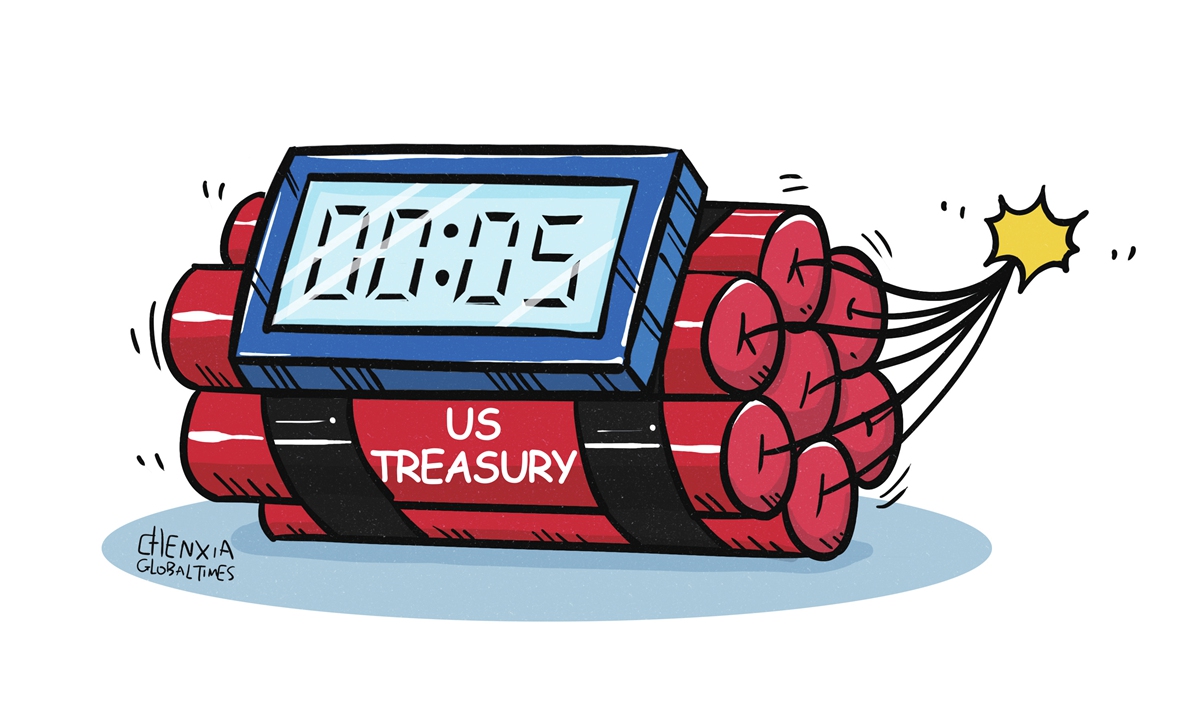
Translation: This “pressing need” often has been described as a “ticking time bomb,” which has been “ticking” for eighty-four years without exploding.
Our Monetarily Sovereign (MS) government has infinite dollars.
Why then does the IMF want, the government unnecessarily to take more money from the people and cut benefits to those who need them.
The required fiscal adjustment will mean “difficult political decisions over the course of multiple years,” the fund said, warning that an unchecked rise in debt could eventually sap U.S. growth and snowball into global financial distress.
Translation: “Difficult political decisions” are those that screw the people while sounding like the IMF is helping them.
For instance, raising Medicare, Social Security, and unemployment taxes with the false explanation that these taxes are needed to “save” the benefits.
These decisions are difficult, but we politicans, being heroic, are ready to sacrifice your lives to make the rich richer.
The rise in debt stimulated U.S. growth and “snowballed” into the people’s financial success. So, cut the debt.
“Now is a good time,” said Kristalina Georgieva, the fund’s managing director. “The U.S. economy is very strong, and it is in good times where you can do more to prepare yourself for risks in the future.”
Translation: The U.S. economy is very strong because the government has increased spending.
Therefore, now is a good time to weaken it by taking money out of the economy. GDP=Federal and Non-federal Spending + Net Exports.
You can be sure that if the economy was suffering, Ms. Georgieva would offer the same prescription: Austerity. It’s what they always recommend, regardless of the circumstances.
President Biden has ruled out at least one of the fund’s suggested remedies: Higher taxes on people making less than $400,000 a year.
Translation: The IMF wants to take dollars out of the pockets of the poorer people.
Apparently, these people should ask not what the country can do for them but what they can do for the rich people.
But debt aside, the IMF statement praised the U.S. economy for “a remarkable performance” in recent years.
Inflation has largely been brought under control without the sharp increase in unemployment that many economists had expected.
Gross domestic product (GDP) growth remains above expectations and is expected to continue.
Translation: We, the IMF, are completely clueless about how high levels of federal deficit spending can cause these remarkable outcomes, but whatever the reason, we want it stopped.
“The U.S. is the only G-20 economy whose GDP level now exceeds the pre-pandemic level. This is good for the U.S. and it is good for the global economy,” Georgieva told reporters.
Translation: The federal debt (that isn’t federal and isn’t debt — See: National Debt ) is up, and all this good stuff is happening. We of the IMF don’t understand why, and we want it stopped.
Despite the U.S. debt bulge, financial markets remain untroubled. The return that the government must offer to entice investors to purchase 10-year treasury securities hovers around 4.2 percent, below rates that were typical before the Great Recession.
Translation: The IMF is shocked that financial markets are untroubled by sales and profit growth.
Jerome Powell: “Look how well I’m driving.”
The U.S. government doesn’t really don’t care how many treasury securities are purchased.
Those dollars mean nothing to a government that has infinite dollars.
The government sets the interest rate at any level the Fed chooses.
It’s what the Fed does to make people think it is driving the car when, in fact, it is just going along for the ride.
The U.S. economy also is attracting an increasing share of global capital, according to Georgieva.
Before the pandemic, 18 percent of funds invested outside national borders was placed in the United States.
Today, the U.S. share of mobile finance is 33 percent, she said.
Translation: The so-called “federal debt” that bothers the IMF doesn’t seem to bother knowledgeable investors.
Debts and deficits will be an early challenge for the next president. In early 2025, Congress must lift the statutory debt ceiling or see the United States default on its debt.
Lawmakers also must decide by the end of 2025 to extend Trump’s 2017 tax cuts or allow them to expire, thus increasing taxes on most Americans.
Translation: Debts and deficits will grow the economy, but politicians, economists, the media and IMF will argue that the debt and deficits should be reduced. It’s what the very rich want us to say.
In April, as part of a separate review, IMF officials chided the United States for government deficits that stimulated the economy, saying they effectively made it more difficult for the Federal Reserve to cut interest rates.
Translation: Deficits grew the economy and enriched the private sector, but how is the Fed going to justify its existence if it can’t manipulate interest rates?
The IMF’s slogan should be: The sole purpose of people is to protect and improve their government and the rich people.
On Thursday, citing potential upside risks to inflation, the IMF said the Fed should wait to cut interest rates until “at least late 2024.”
Translation: Otherwise, it will be too easy for those who aren’t rich to buy cars, houses, refrigerators, furniture, and every other product whose price is increased by high interest rates (i.e., all products).
Thursday’s IMF statement is just the latest warning on the U.S. debt picture.
On Tuesday, the Organization for Economic Co-Operation and Development said that adding debt at a time of higher interest rateswill limit the ability of the United States to meet other needs, including defense, an aging population, and future economic shocks.
Translation: We have no idea what this means. The U.S. government has proved it has infinite moneyto meet all needs, including defense, an aging population, and future economic shocks. But, the IMF felt compelled to make a statement, however wrong.
Years of repeated tax cuts have narrowed the government’s revenue base at a time when it faces escalating spending commitments for programs such as Social Security and Medicare, as well as rising interest charges, the OECD said.
Translation: Federal taxes do not fund federal spending. Even if it collected zero taxes, it could continue spending forever.
But then, it couldn’t take dollars from the poor for social benefits or just limit those benefits altogether.
That is not what our real patrons, the rich, want.
As a share of the economy, corporate income tax payments are now less than half what they were in 1967, according to the Congressional Budget Office.
Interest expenses on the national debt over the same period have doubled to 2.4 percent of gross domestic product.
Translation: The government is taking comparatively less money from corporations, and adding more money to the economy in interest. This is working spectacularly, so it must be stopped???
The OECD, a group of more than three dozen advanced economies, called for a “sustained but steady multiyear” budget effort to curb debt.
Only Italy, Greece and Japan have higher gross debt-to-GDP ratios, the OECD said in its annual assessment of the U.S. economy.
Translation: Because the IMF is are clueless about the fundamental differences between a Monetarily Sovereign (MS) government and a monetarily non-sovereign government, it lumps Italy, Greece, and Japan into our comparison.
Italy and Greece, not being MS, must rely on the (EU) European Union to provide them with money. Japan, being MS, doesn’t need any help.
Government debt held by the public, which excludes Treasury securities in the Social Security Trust Fund, is equal to 99 percent of total U.S. output and is expected to hit 122 percent in 2034, according to the CBO.
Translation: The useless Debt/GDP ratio is the phony number of last resort for those who don’t understand MS; therefore, the IMF tries to fool you with it.
Many economists say the government’s growing debt burden must be addressed with a mix of spending cuts and tax increases.
Stabilizing the debt relative to the size of the economy is “a really important goal,” Jared Bernstein, the chairman of the White House Council of Economic Advisers, said at the Brookings Institution this week.
Someone please tell Mr. Bernstein that federal debt is two things, neither of which has any meaning relative to the size of our economy (which is GDP).
The two meanings of federal debt are:
The historical net total of federal deficits— the difference between federal spending and federal taxes. Simply add all the spending the government has ever done and subtract all the income the federal government has ever received. That’s the debt.
The current total of all outstanding Treasury Securities (T-bills, T-notes, T-bonds, etc.)
With regard to #1, the “debt” would have some meaning if the federal government was monetarily non-sovereign: it doesn’t use a currency it issues. This resembles city, county, and state governments, as well as businesses, you, and me.
It’s relevant because we monetarily non-sovereign types might have difficulty paying all those outstanding bills. The Monetarily Sovereign U.S. government has no such difficulty because it has the infinite ability to create dollars.
Regarding #2, Treasury Securities are accounts wholly owned by the depositors. The government doesn’t owe the contents of those accounts because it never takes ownership of the money. It just holds the dollars for safekeeping.
This resembles bank safe deposit boxes. The contents are not part of bank debt because the bank never owns them.
By contrast, city, county, and state notes and bonds are in accounts owed by the respective cities, counties, and states, which rely on income to pay them off.
Inflation is not an increase in one commodity’s price. It is a general increase in prices. Inflations tend to begin quickly and end slowly.
Fiscal policy is enacted by the legislative branch of government and deals with tax policy and government spending.
Monetary policy is enacted by a government’s central bank and deals with changes in the money supply by adjusting interest rates, reserve requirements, and open market operations.
Monetary policy involves changing interest rates and influencing the money supply.
Fiscal policy involves changing tax rates and levels of government spending to influence aggregate demand in the economy.
Congress and the President have given the Federal Reserve a mandate for maximum employment and price stability.
Given the Fed’s limited control over consumer and business pricing, this is akin to giving the shortstop a mandate for the team to win the World Series.
Any single business will raise its prices based on several factors, which include:
Increased costs
Reduced competition
Product improvements
New markets open up
Fed Chair Jerome Powell
The Federal Reserve, being a monetary organization, views inflation as being a monetary problem. So, it attempts to fight inflation with a monetary solution: Increased interest rates.
The Fed’s hypothesis is that increasing interest rates will discourage buyers, thus reducing demand. The demand reduction supposedly forces businesses to reduce prices to capture the remaining customers.
This, in turn, forces a reduction in business profits available to spend on employment, marketing, production, and research/development.
The formula for Gross Domestic Product (GDP), one of the most important measures of our economy is:
GDP = Federal Spending + Non-federal Spending – Net Imports
The United States is a huge consumer of goods and services so it tends to import more than it exports.
Thus, for real (inflation-adjusted) GDP to grow, either Federal Spending or Non-federal Spending must grow enough to overcome inflation and Net Imports.
However, if the Fed’s interest rate increases are successful in reducing demand, two things will happen:
Non-federal Spending will decline and
Business costs will rise
The first will cause a recession unless Federal Spending increases enough to overcome inflation and the dollar losses from Net Imports.
The second will exacerbate inflation.
However, the consensus among economic pundits — including the Fed — is that increased Federal Spending causes inflation.
No matter what the Fed’s interest rate hikes do — raise business costs or cut consumer spending — the result will be inflation and/or recession.
Only if the Fed’s rate cuts don’t work will we be spared inflation and/or recession — unless Congress and the President keep pumping growth dollars into the economy.
To cure inflation, without recession, the economy needs more growth dollars that address the true cause of inflation: Shortages of critical goods and services.The Fed’s website says, “The Federal Reserve The Federal Open Market Committee (FOMC) judges that an annual increase in inflation of 2 percent in the price index for personal consumption expenditures (PCE), produced by the Department of Commerce, is most consistent over the longer run with the Federal Reserve’s mandate.”
Two inflation measures, the Consumer Price Index (CPE-red), and Personal Consumption Expenditures (PCE-blue) track similarly. It’s not clear why the blue line is more “consistent with the Federal Reserve’s mandate.”
Another strange comment from the Fed: “Although food and energy make up an important part of the budget for most households–and policymakers ultimately seek to stabilize overall consumer prices–core inflation measures that leave out items with volatile prices can be useful in assessing inflation trends.”
Really? Look at this graph and see if you can see why so-called “core inflation” is useful.
The red line is Personal Consumption Expenditures. The blue line is “Core” Personal Consumption Expenditures.
Does anyone believe the Fed’s predictions are so precise that the blue line is more “useful in assessing inflation trends”? I mention this only to demonstrate how the Fed’s historical beliefs sometimes ignore facts.
No matter which measure the Fed leans toward, one thing is clear: To succeed, the Fed must fail.
Its interest rate increases must fail to increase business costs (or prices will increase).
Its interest rate increases must fail to reduce Non-federal Spending (or GDP will decrease).
Its cajoling of Congress to reduce Federal Spending must fail to cause a recessionary reduction in GDP
In short, the Fed must fail in everything it does, and if it fails, and the recession ends despite what the Fed does, Chairman Powell will boast that he took the economy to a “soft landing.”
Powell is the player who after he strikes out, the catcher drops the ball, and the winning run scores. So he brags about his winning the game.
The facts:
The best way to cure a problem is to cure the cause of the problem.
The cure for shortages is Federal Spending to encourage the production of, and/or access to, the scarcities that cause inflation.
Federal deficit Spending adds growth dollars to GDP, thereby curing inflation while preventing recession.
Oil shortages are the most common cause of inflation. Oil supply changes quickly. OPEC can affect supply in a day, Oil demand changes slowly. Oil prices (green) parallel inflation (purple), which generally comes on quickly, but can leave slowly if oil shortages are not cured. Oil prices affect the prices of nearly every other product.
No “soft landing” was necessary. No “landing” at all was needed. Congress and the President control the fiscal policy that controls supply.
The economy does not need or want increased interest rates. The federal government should:
Increase Federal Spending to support oil drilling and refining. and increase support for research, development, production, and distribution of such renewables as wind, solar, geothermal, tidal, and nuclear fusion (not fission).
Increase Federal support for businesses raising wages by making hiring cheaper. Federal funding of all health care insurance by instituting comprehensive, no-deductible Medicare for every adult and child in America. This would relieve businesses of the payroll cost and reduce the expense of illness-related absences.
Reduce payroll costs by eliminating FICA and funding more generous Social Security benefits for every American. This also would reduce the payroll cost of employer-funded retirement plans.
Stop fobbing off the responsibility for inflation on the Fed. Instead, take responsibility for preventing/curing the shortages that cause inflation.
Stop pretending that the federal government “can’t afford” to pay for benefits or that the federal deficits and debt are dangers to our Monetarily Sovereign economy.
Federal deficit spending is necessary to prevent/cure inflations and for economic growth. The Fed’s interest rate increases must fail to succeed.
Rodger Malcolm Mitchell
Monetary SovereigntyTwitter: @rodgermitchellSearch #monetarysovereigntyFacebook: Rodger Malcolm Mitchell;MUCK RACK: https://muckrack.com/rodger-malcolm-mitchell
……………………………………………………………………..
The Sole Purpose of Government Is to Improve and Protect the Lives of the People.


:max_bytes(150000):strip_icc()/GettyImages-671519300-e1ecfe47b0734333a9ac17eb46f6f398.jpg)



 Another strange comment from the Fed: “Although food and energy make up an important part of the budget for most households–and policymakers ultimately seek to stabilize overall consumer prices–core inflation measures that leave out items with volatile prices can be useful in assessing inflation trends.”
Really? Look at this graph and see if you can see why so-called “core inflation” is useful.
Another strange comment from the Fed: “Although food and energy make up an important part of the budget for most households–and policymakers ultimately seek to stabilize overall consumer prices–core inflation measures that leave out items with volatile prices can be useful in assessing inflation trends.”
Really? Look at this graph and see if you can see why so-called “core inflation” is useful.


 #Monetary Sovereignty - Mitchell