–Initial results from the survey

The debt hawks are to economics as the creationists are to biology. Those, who do not understand monetary sovereignty, do not understand economics. Cutting the federal deficit is the most ignorant and damaging step the federal government could take. It ranks ahead of the Hawley-Smoot Tariff.
========================================================================================================================
Here are a few results from a survey I ran, recently. The results demonstrate the confusion even educated people have about our economy:

All respondents agreed “the U.S. government has the power to print all the money it wants to” and half thought the federal deficit was too low. But, only half thought high taxes were a big problem. There was a logical disconnect between the government’s unlimited ability to spend money and the need for taxes.

Nearly everyone thought a “continuation or resumption of the recession” was a big problem, and only a handful thought the federal deficit was a big problem.

The majority wanted more spending on Retirement, Medical care, Education, Infrastructure, The environment and Unemployment. I was surprised that the majority wanted less spending on The military and Homeland security.

Perhaps the most interesting parts of the survey were the answers to “If I were President of the United States, this is what I would do to improve the economy.”
One person wanted to “cut the budget by 1% across all departments each year for 3 years and eliminate earmarks.” But that same person wanted more spending on medical care, education and the environment, with no change in spending on retirement, housing, business, infrastructure and unemployment.

One person wanted to end all federal taxing and borrowing, and to cut the size of the federal government to 20% of the size it is today. That person wanted less spending in all listed categories, while feeling the following problems were big: recession, state deficits, unemployment, mortgages, medical costs.

Several people wanted to end FICA along with other taxes, but some felt the federal deficit was too high.

Obviously, the results are skewed by the fact that most respondents read this blog. I was encouraged by the unanimous knowledge that the federal government has the unlimited ability to create money. So I was surprised by the common belief that taxes are necessary, especially since very few people felt inflation was a problem. (If the government can create money, and inflation is no problem, why the need for taxes?)

As I read through the comments, I was struck by one theme: Even those, who generally understand federal financing, tend to have some elements of anthropomorphic economics disease – the intuition that the federal government is like you and me. There was some“Tea Partyism” – wanting more federal spending on most projects, while wanting less government.

The debt hawks have a simple, highly intuitive model: Our own personal experience. Those who understand monetary sovereignty haven’t found such a model. So even among readers of this blog, whom one might expect to understand monetary sovereignty, the intuitive pull of personal experience is quite strong.

You can see it best while watching Congress try to stimulate the economy while limiting the only thing that can stimulate the economy: money creation.
========================================================================================================================
Response Summary

Chart1. I believe the federal deficit is:

Too low 57.7%
Too high 15.4%
About right 26.9%

Chart2. My belief about the size of the federal deficit is based on: (Indicate all that apply)

My own research 66.7%
What I learned in school 11.1%
What I hear and read in the media 33.3%
What the experts say 37.0%
What my friends say 7.4%
Other 14.8%

Chart3. Do you believe the U.S. government has the power to print all the money it wants to?

Yes, it has that power 100.0%

Chart4. How big are these problems facing the American economy.
Extremely big—–Fairly big—–Moderate or Not sure—–Not very big—–Not at all big

Continuation or resumption of the recession
63.0% 29.6% 7.4%

Federal deficit too high
7.4% 7.4% 14.8% 14.8% 51.9%

State deficits too high
37.0% 37.0% 18.5% 0.0% 7.4%

Unemployment
85.2% 14.8%

The economy has too little money
30.8% 26.9% 34.6%

Federal taxes are too high
26.9% 26.9% 15.4% 3.8% 26.9%

Too little support for the poor
38.5% 30.8% 23.1% 3.8% 3.8%

The gap between rich and poor
63.0% 14.8% 11.1% 7.4% 3.7%

Mortgages
26.9% 53.8% 15.4% 3.8%

Bank lending
15.4% 30.8% 42.3% 11.5%

Medical costs
51.9% 29.6% 11.1% 7.4%

Inflation
0.0% 7.7% 19.2% 11.5% 61.5%

Chart5. The federal government should spend on:

More than it currently spends—–About what it currently spends—– Less than it currently spends

The military
7.7% 26.9% 65.4%

Homeland security
15.4% 34.6% 50.0%

Retirement
63.0% 29.6% 7.4%

Medical care
53.8% 26.9% 19.2%

Housing
38.5% 46.2% 15.4%

Business support
30.8% 42.3% 26.9%

Education
74.1% 22.2% 3.7%

Infrastructure
85.2% 11.1% 3.7%

The environment
53.8% 30.8% 15.4%

Unemployment
74.1% 18.5% 7.4%

========================================================================================================================
If I were President of the United States, this is what I would do to improve the economy. [Selected responses]

1. suspend FICA collection
2. put people to work on infrastructure projects.
bring our troops home from all over the world.
build an network of wind-power projects, and feed them into a much upgraded national electrical grid.
facilitate a truly high-speed internet.
build a very high-speed maglev train network.
enable a national network of college-level courses that anyone could take over the internet.
3. Hugely increase spending in job creation, infrastructure, education, health care, energy R&D, heath care R&D, health and safety regulations and environmental clean up and protection.
4. First, I would institute a full payroll tax holiday, a per capita disbursement to the states, and an ELR program. Then hopefully we can begin to turn our economy around and start to reap the benifits of our real terms of trade.
5. Cut the budget by 1% across all departments each year for 3 years. Eliminate earmarks.
6. remove/eliminate payroll/FICA/medicare taxes & fund them from the general fund like everything else (great idea you have)… spend/hire billions more on DARPA, National Insitutte of Health, Medical Corps, QUADRUPLE medical schools/nursing schools/PA schools, etc to increase supply of medical personnel for increased medical demand of baby boomers & lower prices by increasing supply of medical services
and $1 TRILLION (like China is doing) on 250mph bullet trains between L.A. & Vegas, Chicago & Detroit, DC & NY, etc
7. Eliminate the payroll tax.
8. FICA holiday forever, Per capital state support, Work program.
9. End the Income Tax, Social Security Tax, and Medicare Tax. Stop borrowing our own currency. And cut the size of government to 20% of the size it is today.
10. Not too sure. Support green jobs and green infrastructure – this reduces unemployment, strengthens our infrastructure, and increases national security (moreso than a war in the Middle East would anyway). I would reduce some of the corporate welfare and unnecessary defense projects (and probably pay our soldiers more). Spend more overall, however, until the private sector picks back up.
11. Cut taxes for everyone. Fix health care, dump the current law
12. go back to the barter system.
13. Eliminate the payroll taxes
14. No taxes (including FICA) on 1st 100K of income (all sources), graduated marginal rates going up to 90% on all else. Guarantee job to anyone wanting one. Raise social security payouts by 50%. Really regulate financial sector and introduce transaction taxes
15. Cut military spending, eliminate tax cuts for rich, and dedicate more resources to meaningful stimulus packages.
16. cut taxes, increase the stimulus packages because I believe that the current stimulus is barely helping people pay off their debt and willing not increase their spending. I would seek reform of the IRS tax code(So it is not so complicated and the average American can do their own taxes), Audit and Tax the federal reserve on their income. Eliminate congressional spending to what they bring in only.
17. I would aim to catch up and overtake the Chinese in infrastructure and education. The US has to spend and tax the rich whatever it takes to achieve this. I would tell the American people that the US is in an economic war with China and is currently losing and is going to lose unless it changes course.
18. Dismantle the Tax code, make it a simple structure, a % of earnings at 4 or 5 stages (say 0% for under 30,000; 8% over 30K and under 50K; 15% over 50K and 150K; 25% over 150K and 250K & 32% over 250K. No loopholes, no deductions, no credits on anything.
19. Learn about how the govt’s role in providing money to the economy. They dont’ know how things work.
20. Tax all offshore tax haven corporate sales in USA at a higher rate than sales from US based corps and corps based in countries we have trade agreements with.
– Bring taxes on top 3% into line with Reagan or Clinton rates.
– Pass a War Tax which would go into effect automatically whenever US troops enter a foreign country for military engagement. Progressive tax, no exceptions. Exempt special ops from this tax.
– Pass a 1 trillion dollar stimulus bill.
– Disengage as quickly as possible from Afghanistan.
– Withdraw as many troops as possible from Muslim countries.
– Emphasize special ops in any future engagement, avoid ground troops. Retire most generals. keep number of generals to a smaller number.
– Increase veteran benefits, cut back on military budget by 30%.
– Fully support Head Start programs.
– Encourage savings by giving 10-20 year US bonds to all families below a certain income, add 50% on every dollar in savings accounts first year for low income people, 20% afterwards, 10% after 5 years.
– Create a federally funded, independent bond and equities rating agency. Prosecute executives and CEOs at any financial company who provides this agency with deceptive information.
21. Direct hiring program, single-payer health-care, increased taxes on rich.
========================================================================================================================
Rodger Malcolm Mitchell
http://www.rodgermitchell.com

No nation can tax itself into prosperity. Those who say the stimulus “didn’t work” remind me of the guy whose house is on fire. A neighbor runs with a garden hose and starts spraying, but the fire continues. The neighbor wants to call the fire department, which would bring the big hoses, but the guy says, “Don’t call. As you can see, water doesn’t put out fires.”
–How to fight inflation and how not to.

The debt hawks are to economics as the creationists are to biology. Those, who do not understand monetary sovereignty, do not understand economics. Cutting the federal deficit is the most ignorant and damaging step the federal government could take. It ranks ahead of the Hawley-Smoot Tariff.
==================================================================================================================================
I know this is a strange time to talk about fighting inflation. Recently we struggled up from a minus inflation (aka “deflation”) and now are at a puny 1% level. But too often, when I say that federal deficit spending should increase, a debt-hysteric concern expressed to me, is not just inflation, but the typical debt-hawk exaggeration: hyperinflation!

The debt-hawks seem to be the kind of folks who, upon seeing a starving child, would not feed that child for fear the food would cause obesity. Today, our economy is starved for money, but the debt hawks fear monetary obesity (aka “inflation”) and they warn us of wheelbarrows full of money. They give silly speeches about what they term “fiscal prudence” and what I term, “starving the baby.”

So as long as we must face debt hysteria, and the hysteria has to do with a non-existent though dreaded inflation, we might as well talk about preventing and curing inflation. Inflation is the loss in value of money compared to the value of goods and services.

So, there are two fundamental methods for curing inflation: Reduce the supply of money or increase the demand for money. Both methods increase the value of money vs the value of goods and services. (In theory, increasing the supply of goods and services or decreasing the demand for goods and services also would work, but there is no known method for accomplishing this without changing the money supply.)

Ideally, any anti-inflationary activity should be effective, quick to activate, quick to take effect, incremental, easy to rescind and not damaging to the economy. But while tax increases remove money from the economy, and so can be effective, they fail all the other tests. They are highly political; They are slow to pass through Congress. They take effect slowly, because taxes are collected slowly. They cannot be passed and implemented incrementally. They are difficult to undo. And they damage the economy. The require answers to difficult questions: Exactly which taxes should be increased? By how much? Should we have a tax increase during a stagflation? How do we calibrate an incremental tax increase?

Compare this approach with another approach: Interest rate increases. Interestingly, interest rate increases have both pro-inflation and anti-inflation effects. Pro inflation: Increase in business costs and increase in the money supply due to increased federal interest payments. Anti-inflation: Increase in the demand for money vs the demand for non-money.

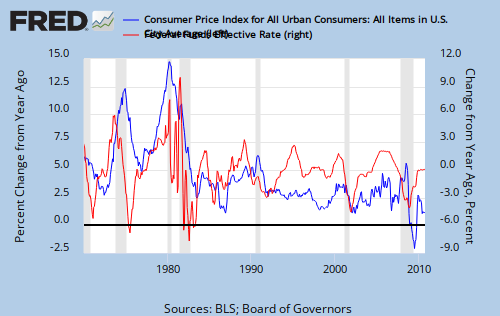
On balance, the anti-inflation effects are stronger. One hint is this graph: graph 1that seems to indicate interest rate increases are followed about one year later by inflation decreases.
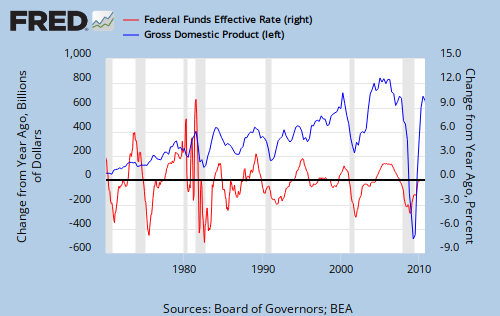
The other hint is the Fed’s ongoing success in controlling inflation despite massive increases in the money supply. Interest rate increases actually work.

Interest rate increases can be done quickly and in small or large increments — just what is needed for inflation control. And contrary to popular faith, high interest rates do not negatively affect GDP growth. See: Interest

In summary:
–We are nowhere near inflation
–We can control inflation by raising interest rates
–High interest rates do not negatively affect GDP growth

We can and should feed the starving economy without letting unfounded worries about our ability to prevent or cure the economy’s obesity, prevent us from saving the child.

Rodger Malcolm Mitchell
http://www.rodgermitchell.com

No nation can tax itself into prosperity. Those who say the stimulus “didn’t work” remind me of the guy whose house is on fire. A neighbor runs with a garden hose and starts spraying, but the fire continues. The neighbor wants to call the fire department, which would bring the big hoses, but the guy says, “Don’t call. As you can see, water doesn’t put out fires.”

–Reducing the federal deficit and other forms of national suicide

The debt hawks are to economics as the creationists are to biology. Those, who do not understand monetary sovereignty, do not understand economics. Cutting the federal deficit is the most ignorant and damaging step the federal government could take. It ranks ahead of the Hawley-Smoot Tariff.
======================================================================================================================================================

Here is what my local newspaper, the Chicago Tribune, says about the federal debt and deficit:

“First pay attention to Ireland, the latest nation to discover that when no one will take your IOUs, terrible things happen. In exchange for a bailout, Ireland has committed to huge spending cuts and brutal tax hikes that will inflict sever economic pain across the Emerald Isle for years.”

Right you are, Tribune. Tax hikes and spending cuts always cause severe damage to a nation and its people..

“Second, pay attention to Erskine Bowles and Alan Simpson. The dogged co-chairmen of the president’s deficit commission are telling you how difficult it already will be to save the U.S. from reaching the day when no onee will take our IOUs.”

If that’s what Messrs. Bowles and Simpson are saying they are more dog-brained than dogged. The U.S., as a monetarily sovereign nation, does not need anyone to accept our IOUs, for this simple reason: A monetarily sovereign nation never needs to borrow the sovereign money it already has the unlimited ability to create. In fact, when the U.S. “borrows,” it simply exchanges T-securities it creates out of thin air for dollars it already has created, also out of thin air. Monetarily non-sovereign nations do need to borrow, because they do not have the unlimited ability to create money.

“The lesson from Ireland, the lesson from Bowles and Simpson, the lesson that official Washington still doesn’t want to hear: If we don’t make painful choices on spending and taxes right now, we’re going to invite chaos.”

Ireland is monetarily non-sovereign; the U.S. is monetarily sovereign. The Tribune doesn’t understand the difference. And because the Tribune and Messrs. Bowles and Simpson, and indeed the entire political establishment thinks U.S. finances are similar to monetary non-sovereign finances, we most certainly will have chaos. What these people imagine as a problem (deficits) actually is a benefit (money), and they try to cure this supposed problem with solutions that will damage us for decades. It’s like trying to “cure” good height by cutting off a person’s legs.

“(Bowles’ and Simpson’s) plan would raise the retirement age for Social Security [Keep paying FICA, but work ’til you drop], put federal health care programs on a strict budget [i.e. cut Medicare and Medicaid to improve health care], slash defense spending [for a stronger America] . . . It targets everything from federal payments to states reclaiming abandoned coal mines [Goodby environment] to restrictions that stop the Postal Service from shifting to five-day-a-week delivery [What next? Once-a-week delivery?]. Everybody gets gored one way or another.”

Yes, we all will get gored. But aside from worse health care, poorer retirement, more poverty, less national defense, worse education, worse environment and a thousand other reductions in the American life style, not only for us but for our children and our grandchildren, why worry? There is only one small detail. I almost hate to mention it, but: Where is the economic evidence that our federal deficit is too large? Nowhere.

Where do we see that the federal government can’t pay its bills? Nowhere. Where do we find that inflation threatens us? Nowhere. Where do we find that deficits cause recessions, depressions, stagflations, unemployment, poverty or any other form of economic miserey? Nowhere. According to the Tribune et al, the debt is big, ergo bad. Don’t ask for evidence. There is none. Just take your bitter pill on our say so.

Bowles and Simpson will make Osama bin Laden happy. Between them, they propose more damage to America than the Taliban and al-Qaeda together would be able to effect in a century. And all because of brutal ignorance.

“All together, the 16-nation eurozone has less debt and a much lower deficit in relation to its size than the United States has.”

The ignorance just grows and grows. The 16-nation eurozone is composed of both monetarily sovereign nations (which can service any size debt), and monetarily non-sovereign nations, which have limited debt-serving ability. The Tribune treats them as one. This respected paper sees no differences among the U.S., our states, counties, cities, businesses you and me. To the Tribune, whatever applies to one, applies to all.

“We’re not heading into trouble. We’re there.”

With thinkers like Bowles, Simpson, our political leaders and the Tribune editors, we are in desperate trouble, indeed.

But dammit, if they expect us to endure all this misery, and if they expect us to agree to harm our children and our grandchildren, and if they, in their own words, want to “inflict sever economic pain for years,” shouldn’t they at least be required to provide evidence all this is necessary?

Rodger Malcolm Mitchell
http://www.rodgermitchell.com

No nation can tax itself into prosperity. Those who say the stimulus “didn’t work” remind me of the guy whose house is on fire. A neighbor runs with a garden hose and starts spraying, but the fire continues. The neighbor wants to call the fire department, which would bring the big hoses, but the guy says, “Don’t call. As you can see, water doesn’t put out fires.”

–How the Ignorant Murder the Innocent: Debt-Hysteria Continues to Destroy America

The debt hawks are to economics as the creationists are to biology. Those, who do not understand monetary sovereignty, do not understand economics. Cutting the federal deficit is the most ignorant and damaging step the federal government could take. It ranks ahead of the Hawley-Smoot Tariff.
======================================================================================================================================================

How the Ignorant Murder the Innocent: Debt-Hysteria Continues to Destroy America

“NBC, msnbc.com and news services 12/1/10

“Extended unemployment benefits for nearly 2 million Americans begin to run out Wednesday, cutting off a steady stream of income and guaranteeing a dismal holiday season for people already struggling with bills they cannot pay.

“Unless Congress changes its mind, benefits that had been extended up to 99 weeks will end this month.

“Congress has let jobless benefits lapse twice already this year as Republicans insist the cost — $160 billion in the last fiscal year — be offset by cuts elsewhere to prevent the nation’s $13.8 trillion debt from growing further.

“Congressional opponents of extending the benefits beyond this month say fiscal responsibility should come first. Republicans in the House and Senate, along with a handful of conservative Democrats, say they’re open to extending benefits, but not if it means adding to the $13.8 trillion national debt.”

Ah, yes. “Fiscal responsibility.” Please someone remind me again; why did we go off the gold standard and become monetarily sovereign? What was the purpose of having the unlimited ability to create money? What exactly does “fiscal responsibility” mean? And what about human responsibility?

“‘I am not searching for a job, I am begging for one,’ said Felicia Robbins, 30, as she prepared to move out of a homeless shelter in Pensacola, Fla., where she and her five children have been living. She is using the last of her cash reserves, about $500, to move into a small, unfurnished rental home.”

The debt-hawks will tell you that unemployment benefits merely extend the time for lazy people to sit home, collecting checks. Of course, the Senators and Representatives collect their generous paychecks on time, so why worry about the “little” people?

If you are concerned about the gap between the rich and the poor, I remind you that this unnecessary, cruel action takes money from the poorest of us, increasing the gap.

As always, I urge you to contact your Congressperson, and try to educate him/her, before America reenters recession.

Rodger Malcolm Mitchell
http://www.rodgermitchell.com

No nation can tax itself into prosperity. Those who say the stimulus “didn’t work” remind me of the guy whose house is on fire. A neighbor runs with a garden hose and starts spraying, but the fire continues. The neighbor wants to call the fire department, which would bring the big hoses, but the guy says, “Don’t call. As you can see, water doesn’t put out fires.”