–More of the same — unfortunately

Twitter: @rodgermitchell; Search #monetarysovereignty
Facebook: Rodger Malcolm Mitchell

Mitchell’s laws:
●The more federal budgets are cut and taxes increased, the weaker an economy becomes.
●Austerity is the government’s method for widening the gap between rich and poor,
which ultimately leads to civil disorder.
●Until the 99% understand the need for federal deficits, the upper 1% will rule.
To survive long term, a monetarily non-sovereign government must have a positive balance of payments.
●Those, who do not understand the differences between Monetary Sovereignty and monetary non-sovereignty, do not understand economics.
●The penalty for ignorance is slavery.
●Everything in economics devolves to motive.

======================================================================================================================================================================================

The Chicago Tribune, my favorite owned-by-the-rich, to-hell-with-the-rest newspaper, published today an editorial ironically titled, “More of the same — unfortunately.”

For the Tribune, it really was more of the same — unfortunately.

The editorial decried the slow pace of job creation.

The weak recovery is failing to gain momentum. Many Americans are being left behind — sidelined, underemployed or otherwise underutilized — while their skills atrophy.

The (unemployment) rate dropped 0.1 percent in August almost entirely because 312,000 Americans exited the workforce. So even though 115,000 fewer people held jobs in August, the rate went down because many Americans no longer are trying to find work.

The trend reflects an aging population that is retiring, as expected. But the numbers also were up for “discouraged workers,” those who have given up looking for jobs because they don’t think they’ll ever find one.

The Affordable Care Act gives some employers and workers an additional incentive to go part time, so as Obamacare kicks in over the next year, don’t be surprised to see part-timing spike.

It’s a right-wing hint, hint: Getting rid of Obamacare somehow will grow the job market — perhaps by dooming millions more people to the abject poverty associated with ill health.

Never mind that employers hire the number of workers needed to accomplish tasks, and never mind that employers pay what the market forces them to pay. When employers try to employ part timers, they need to hire more part timers to do the same work.

And this doesn’t even consider reduced efficiency, job skills, commitment and loyalty. Having owned several businesses, I can assure you, part timers are no bargain.

Job creation is proceeding at far too slow a pace to make up for what was lost.

Washington, regrettably, has more talking points than good answers. The most aggressive response has come from the U.S. Federal Reserve, which is pumping $85 billion into a bond-buying program designed to stimulate growth.

The so-called “bond buying” program adds nothing to the money supply. It’s sole effects are to reduce long-term interest rates and to reduce the money supply!

Why, reduce? Because with low interest rates and with fewer T-securities outstanding, the federal government pays less interest into the economy. That is not stimulative; it is recessive.

The Fed’s latest program, nicknamed QE3, simply isn’t delivering enough economic growth — enough jobs. It’s past time for the Fed to give it up.

Right. QE3 delivers zero jobs, so yes, give it up. And stop pretending it is stimulative.

And now, here are the Tribune’s big ideas, their “more of the same — unfortunately” grand plan:

To give business confidence and truly get the economy moving again, Washington needs to make progress on three big issues:

First, reform entitlement programs so employers won’t fear future tax hikes to rescue them.

In Tribune, right-wing-speak, “reform” is a euphemism for “slash.” What they really mean, but don’t have the honesty to say is, “Slash the programs that benefit the poor and middle-income groups.

“Slash Social Security. Slash Medicare. Slash Medicaid. Slash food stamps. Slash job creating initiatives like road and bridge building, education, crime prevention and pharmaceutical research. Slash food regulation, drug regulation, stock and commodity market regulation and above all, slash bank regulation.

“Finally, increase FICA, the most regressive tax in U.S. history.”

Second, revamp (and simplify) a federal tax code that, because it chooses winners and losers, discourages muscular hiring and investment.

All taxes “choose winners and losers,” but the real point is: “Revamp (and simplify)” are euphemisms for tax the lower income groups more, and reduce taxes on the rich (the self-proclaimed “job creators.”)

Every tax “simplification” plan ever proposed by the right-wing, increases the tax burden on the middle class.

Third, stop amassing an unaffordable national debt — almost $17 trillion and rising. Repaying that obligation threatens to devour too much of future workers’ incomes.

The usual, right-wing bullsh*t. The national debt is nothing more than the total of privately owned T-security accounts at the Federal Reserve Bank. T-security accounts essentially are bank savings accounts.

The so-called “debt” could be eliminated tomorrow, at a cost of $0 to current or to future workers, simply by transferring the balances in holders’ T-security accounts to their checking accounts.

It would be the same as transferring dollars from your savings account to your checking account. No cost to anyone.

The Tribune has learned that “more of the same — unfortunately” continues to fool the populace and to benefit the Tribune’s rich owners. So why not continue the charade?

If the people keep buying snake oil, keep selling it. If it works, keep doing it. So they do.

When I played “fetch” with my dog, I sometimes would fake a throw. He would run to find the non-existent stick. After I did this a few times, he learned I was faking, and quit being fooled.

The American populace, having not yet learned the media and politicians are faking when claiming the debt is “unaffordable,” still continue to be fooled. In that sense, they are not as smart as my dog.

Unfortunately.

Rodger Malcolm Mitchell
Monetary Sovereignty

====================================================================================================================================================
Nine Steps to Prosperity:
1. Eliminate FICA (Click here)
2. Medicare — parts A, B & D plus long term nursing care — for everyone (Click here)
3. Send every American citizen an annual check for $5,000 or give every state $5,000 per capita (Click here)
4. Free education (including post-grad) for everyone. Click here
5. Salary for attending school (Click here)
6. Eliminate corporate taxes (Click here)
7. Increase the standard income tax deduction annually
8. Increase federal spending on the myriad initiatives that benefit America’s 99% (Click here)
9. Federal ownership of all banks (Click here)

10 Steps to Economic Misery: (Click here:)
1. Maintain or increase the FICA tax..
2. Spread the myth Social Security, Medicare and the U.S. government are insolvent.
3. Cut federal employment in the military, post office, other federal agencies.
4. Broaden the income tax base so more lower income people will pay.
5. Cut financial assistance to the states.
6. Spread the myth federal taxes pay for federal spending.
7. Allow banks to trade for their own accounts; save them when their investments go sour.
8. Never prosecute any banker for criminal activity.
9. Nominate arch conservatives to the Supreme Court.
10. Reduce the federal deficit and debt

No nation can tax itself into prosperity, nor grow without money growth. Monetary Sovereignty: Cutting federal deficits to grow the economy is like applying leeches to cure anemia.
Two key equations in economics:
1. Federal Deficits – Net Imports = Net Private Savings
2. Gross Domestic Product = Federal Spending + Private Investment and Consumption – Net Imports

THE RECESSION CLOCK
Monetary Sovereignty Monetary Sovereignty

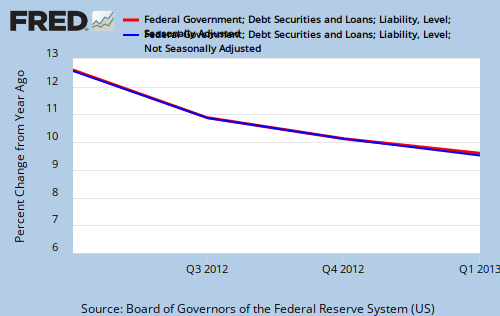
As the lines drop, we approach recession, which will be cured only when the lines rise.

#MONETARY SOVEREIGNTY

–The dark, cold heart of the “religious” right.

Twitter: @rodgermitchell; Search #monetarysovereignty
Facebook: Rodger Malcolm Mitchell

Mitchell’s laws:
●The more federal budgets are cut and taxes increased, the weaker an economy becomes.
●Austerity is the government’s method for widening the gap between rich and poor,
which ultimately leads to civil disorder.
●Until the 99% understand the need for federal deficits, the upper 1% will rule.
To survive long term, a monetarily non-sovereign government must have a positive balance of payments.
●Those, who do not understand the differences between Monetary Sovereignty and monetary non-sovereignty, do not understand economics.
●The penalty for ignorance is slavery.
●Everything in economics devolves to motive.

======================================================================================================================================================================================

The dark, cold heart of the “religious” right.

The right wing often calls its brand of morality, “Christian.” That is meant to be a synonym for “compassionate,” for “brotherly love,” and for “caring about the less fortunate.”

“Come, you that are blessed by my Father, inherit the kingdom prepared for you from the foundation of the world; for I was hungry and you gave me food, I was thirsty and you gave me something to drink, I was a stranger and you welcomed me, I was naked and you gave me clothing, I was sick and you took care of me.”

That is what Christ supposedly said. Compare it with what the “religious” right says:

On the Edge of Poverty, at the Center of a Debate on Food Stamps
By Sheryl Gay Stolberg, Published: September 4, 2013

When Congress officially returns to Washington next week, the diets of (poor) families will be caught up in a debate over deficit reduction. Republicans, alarmed by a rise in food stamp enrollment, are pushing to revamp and scale down the program.

No matter what Congress decides, benefits will be reduced in November, when a provision in the 2009 stimulus bill expires.

(Republican) Representative Stephen Fincher, who was elected in 2010 on a Tea Party wave and collected nearly $3.5 million in farm subsidies from the government from 1999 to 2012, recently voted for a farm bill that omitted food stamps.

“The role of citizens, of Christianity, of humanity, is to take care of each other, not for Washington to steal from those in the country and give to others in the country,” Mr. Fincher, said after his vote in May.

Apparently, for the religious right-wing Mr. Fincher, collecting $3.5 million in federal subsidies is not stealing, while taking food stamps to survive – that is stealing.

“I tell you the truth, whatever you did not do for one of the least among you, you did not do for me.”

The religious right offers its own biblical excuses for cruelty to the poor:

In response to a Democrat who invoked the Bible during the food stamp debate in Congress, Mr. Fincher cited his own biblical phrase. “The one who is unwilling to work shall not eat,” he said.

“People have a lot of misimpressions about hunger in America,” said Maura Daly, a spokeswoman for Feeding America, the nation’s largest network of food banks. “People think it’s associated with homelessness when, in fact, it is working poor families, it’s kids, it’s the disabled.

The “religious” right despises the poor, the sick, the hungry, the disabled.

“You shall love your neighbor as yourself.”

Robert Rector, a scholar at the conservative Heritage Foundation, argues that the food stamp program should be overhauled so that benefits are tied to work. He advocates mandatory drug testing for food stamp recipients.

If you don’t live the pure and perfect life, according to the standards set for you by the “religious” right wing, you deserve to starve.

In Dyersburg (TN), hundreds of people, many of them food stamp recipients, lined up for boxes of free food. More than 700 families get help each month from the charitable program, Feed the Need.

“We couldn’t absorb the work force back into our community,” said Mr. Oakes, the chairman of the local Salvation Army, “and people were hungry.”

Kathy Baucom, 61, a former welder disabled by lupus, lives alone in a trailer. Her food stamp benefits of $125 a month were recently reduced to $117. “I don’t buy milk because it’s so expensive,” she said. “I don’t buy cheese.”

Representative Stephen Fincher and the rest of the “religious” right, do not give a damn about you and your lupus, Ms. Baucom.

Tarnisha Adams, who left her job skinning hogs at a slaughterhouse when she became ill with cancer, gets $352 a month in food stamps for herself and three college-age sons.

She buys discount meat and canned vegetables, cheaper than fresh (meat). Like Mr. Rigsby, she eats once a day — “if I eat,” she said. “We don’t splurge,” Ms. Adams said, “and it doesn’t last.” One recent evening, she baked a tray of mostaccioli, an Italian pasta, hoping it would last for two meals, she had none herself.

“You hate to tell your child, ‘You can’t eat this, you have to save it for another day,’ ” she said.

Representative Stephen Fincher and the rest of the “religious” right, do not give a damn about you and your cancer and your children, Mrs. Adams.

For the Rigsbys, both 20, the priority is three meals a day for their son, Drake, who is 1. Some months they run out of milk. Mr. Rigsby, who is out of work with a knee injury, recently sold his truck for cash; his wife, Christina, works part time as a clerk at J. C. Penney.

On the refrigerator is a calendar marked with the date — the 6th. “FOOD!” it declares. But when benefits drop in November, the Rigsbys, who say they receive about $350 a month, can expect $29 less.

“When we got married, we told each other that we want to be able to sit down at the table and eat as a family,” Mrs. Rigsby said. “But we don’t really get to do that.”

Representative Stephen Fincher and the rest of the “religious” right, do not give a damn about you and your knee injury and your starving child, Mr. & Mrs. Rigsby.

There are millions of such stories in America – some even more touching – but apparently not touching the cold, selfish heart of the “religious” right:

In Washington, House Republicans propose cutting $40 billion more in food stamps over the next 10 years by imposing work requirements and eliminating waivers for some able-bodied adults. The cuts would push four million to six million low-income people, including millions of “very low-income unemployed parents” who want to work but cannot find jobs, off the rolls.

Here in Tennessee, Mr. Fincher [the guy who received $3.5 million from the government] said, “We have to remember there is not a big printing press in Washington that continually prints money over and over.”

Well, actually there is. The U.S. government, being Monetarily Sovereign, cannot run short of dollars. But the rich-owned Congress, the rich-owned media and the rich-owned economists have brainwashed the public into believing otherwise.

The U.S. government could lift everyone from poverty, and it not would cost taxpayers one cent. But the rich don’t want the poor to be lifted from poverty, even at no cost. The rich want the poor to be poor, for poverty exalts the rich.

The rich wish to widen the gap between them and the poor, because it is the gap that makes them rich. If there were no gap, no one would be rich, and the wider the gap, the richer and more powerful they are.

Mr. Rigsby said his family would find a way to make do. “The way I was raised,” he said, “it’s, ‘Be thankful for what you’ve got.’ We’re not the worst case out there. But somebody else? How is this going to affect them?”

And so it is the poor who have compassion for those poorer, while the “religious” right has compassion for no one.

Conservatism has become a cold, cruel, heartless disease, infecting America with its selfish immorality, cloaked in religious and patriotic phrases. It is a disease that is destroying everything for which America once stood.

We no longer are the America that opens our arms to the tired, poor, huddled masses yearning to breathe free, the wretched refuse of a teeming shore, the homeless and tempest-tost.

These latest, greed-infected generations have given our once-blessed nation the dark, cold heart of the “religious” right.

Rodger Malcolm Mitchell
Monetary Sovereignty

====================================================================================================================================================
Nine Steps to Prosperity:
1. Eliminate FICA (Click here)
2. Medicare — parts A, B & D plus long term nursing care — for everyone (Click here)
3. Send every American citizen an annual check for $5,000 or give every state $5,000 per capita (Click here)
4. Free education (including post-grad) for everyone. Click here
5. Salary for attending school (Click here)
6. Eliminate corporate taxes (Click here)
7. Increase the standard income tax deduction annually
8. Increase federal spending on the myriad initiatives that benefit America’s 99% (Click here)
9. Federal ownership of all banks (Click here)

10 Steps to Economic Misery: (Click here:)
1. Maintain or increase the FICA tax..
2. Spread the myth Social Security, Medicare and the U.S. government are insolvent.
3. Cut federal employment in the military, post office, other federal agencies.
4. Broaden the income tax base so more lower income people will pay.
5. Cut financial assistance to the states.
6. Spread the myth federal taxes pay for federal spending.
7. Allow banks to trade for their own accounts; save them when their investments go sour.
8. Never prosecute any banker for criminal activity.
9. Nominate arch conservatives to the Supreme Court.
10. Reduce the federal deficit and debt

No nation can tax itself into prosperity, nor grow without money growth. Monetary Sovereignty: Cutting federal deficits to grow the economy is like applying leeches to cure anemia.
Two key equations in economics:
1. Federal Deficits – Net Imports = Net Private Savings
2. Gross Domestic Product = Federal Spending + Private Investment and Consumption – Net Imports

THE RECESSION CLOCK
Monetary Sovereignty Monetary Sovereignty

As the lines drop, we approach recession, which will be cured only when the lines rise.

#MONETARY SOVEREIGNTY

–Do You Believe in Magic? Spain does.

Twitter: @rodgermitchell; Search #monetarysovereignty
Facebook: Rodger Malcolm Mitchell

Mitchell’s laws:
●The more federal budgets are cut and taxes increased, the weaker an economy becomes.
●Austerity is the government’s method for widening the gap between rich and poor,
which ultimately leads to civil disorder.
●Until the 99% understand the need for federal deficits, the upper 1% will rule.
To survive long term, a monetarily non-sovereign government must have a positive balance of payments.
●Those, who do not understand the differences between Monetary Sovereignty and monetary non-sovereignty, do not understand economics.
●The penalty for ignorance is slavery.
●Everything in economics devolves to motive.

======================================================================================================================================================================================

Do You Believe in Magic? Spain does.

If you believe in magic, come along with me
We’ll dance until morning ’til there’s just you and me

By the Lovin’ Spoonful

Everything is wonderful in Spain. Tax increases and government spending reductions, which never in the history of human existence, have stimulated an economy, now have, by euro magic, cured Spain’s recession.

Your feet start tapping and you can’t seem to find
How you got there, so just blow your mind

Spain has no idea how it got where it is, and no idea how it will get where it wants to go. Their minds have been blown by euro-nonsense.

Financial Times
Spain reaps benefit of austerity measures, says economy minister
By Tobias Buck in Madrid

Spain’s nascent recovery shows that the eurozone’s austerity measures have worked after all, the economy minister has said, offering a riposte to the backlash against the continent’s response to the crisis.

“We are much more confident than we were six months ago,” Luis de Guindos told the Financial Times, adding that he expected the Spanish economy to emerge from recession in the current quarter.

“It has been tough for the population. But we implemented difficult tax measures and expenditure cuts. We have implemented some reforms that were not popular. Now, we expect to reap the fruits of these policies. And we are starting to see the light at the end of the tunnel.”

Yes, it has been tough for the population to pay more taxes and receive less in benefits, to go hungry, jobless and homeless, unlike the politicians, who are doing just fine, thank you.

But what is the magic that takes more money from the pockets of the populace, while putting less money into their pockets, yet somehow stimulates the economy?

Spain has been “reaping the fruits” of these policies for many years: Recession, depression, starvation. What’s changed, now?

Mr de Guindos said Madrid was already expecting the end-of-year unemployment figure to be better than previously announced, with the jobless rate predicted to fall below 27 per cent.

Wow, now that’s a recovery. After years of austerity, the jobless rate will fall below 27 percent. 27 percent!! Yikes.

But really, what is the reason for this wonderful “recovery”?

According to Mr. de Guindos, the economy will be shown to have grown by as much as 0.2 per cent in the three months to the end of September, fueled by a sharp rise in exports from newly-competitive sectors such as the car industry.

And there it is. Exports.

To grow, any nation, Monetarily Sovereign or monetarily non-sovereign, needs a growing supply of money. A monetarily non-sovereign nation, as all euro nations are, cannot create its sovereign currency. It has no sovereign currency.

So how can a euro nation increase its money supply? How can it grow?

Answer: To grow long term, a monetarily non-sovereign government must have net money coming in from outside its borders. The U.S. states, also monetarily non-sovereign, survive by having a positive balance of payments with the Monetarily Sovereign U.S. federal government. Federal deficit spending grows state economies.

But the euro nations do not have a federal government willing to give them (not lend them) euros. They must rely on exports. In the eurozone, those nations having net exports prosper. Those nations having net imports shrink.

“The automobile industry is transferring a lot of production not only from Europe but also from Asia to Spanish factories. This is an indication that you have the correct cost of labour and that you have much more flexibility here in Spain than in other areas,” he said.

Apparently, for Spain to grow it must replace China, India, Viet Nam and other nations having low standards of living.

“In real terms, our exports of merchandise are growing at a rate of 8 per cent; we are second to none in the eurozone.” Mr de Guindos said. Spain’s current account, he added, was expected to show a surplus of about 2 per cent of GDP this year – another record.

Mr de Guindos insisted that Spain would start creating jobs on a sustained basis in the second or third quarter next year. “Our projection is that the labour market reform has clearly reduced the threshold at which we start to create jobs.”

Sadly, for Spain to take business from its euro neighbors and from Asia, those jobs will have to be low-pay, just like China’s have been. One wonders, will Spain recruit its children to work in Nike factories making tennis shoes?

Mr de Guindos’s economic outlook contrasts sharply with the more bleak prediction made by the International Monetary Fund, which has warned that Spain may be saddled with unemployment of about 25 per cent until 2018.

When even the IMF thinks your austerity isn’t going to work, you know you have problems. Spain will continue to struggle. The Spanish leaders believe in the magic of applying leeches to cure anemia (as do the American leaders, just less so.)

Here is one way in which Monetarily Sovereign nations (U.S., UK, Canada, Australia, Japan, et al) and monetarily non-sovereign nations (euro nations) all can grow their economies:

1. The monetarily non-sovereign nations maintain a positive balance of trade with the Monetarily Sovereign nations.
2. The Monetarily Sovereign nations run national deficits greater than their negative balances of trade.

That way, every nation’s money supply will grow and their economies will grow.

But, of course, it won’t happen. Spain is doomed by economic ignorance.

We all are.

Rodger Malcolm Mitchell
Monetary Sovereignty

====================================================================================================================================================
Nine Steps to Prosperity:
1. Eliminate FICA (Click here)
2. Medicare — parts A, B & D plus long term nursing care — for everyone (Click here)
3. Send every American citizen an annual check for $5,000 or give every state $5,000 per capita (Click here)
4. Free education (including post-grad) for everyone. Click here
5. Salary for attending school (Click here)
6. Eliminate corporate taxes (Click here)
7. Increase the standard income tax deduction annually
8. Increase federal spending on the myriad initiatives that benefit America’s 99% (Click here)
9. Federal ownership of all banks (Click here)

10 Steps to Economic Misery: (Click here:)
1. Maintain or increase the FICA tax..
2. Spread the myth Social Security, Medicare and the U.S. government are insolvent.
3. Cut federal employment in the military, post office, other federal agencies.
4. Broaden the income tax base so more lower income people will pay.
5. Cut financial assistance to the states.
6. Spread the myth federal taxes pay for federal spending.
7. Allow banks to trade for their own accounts; save them when their investments go sour.
8. Never prosecute any banker for criminal activity.
9. Nominate arch conservatives to the Supreme Court.
10. Reduce the federal deficit and debt

No nation can tax itself into prosperity, nor grow without money growth. Monetary Sovereignty: Cutting federal deficits to grow the economy is like applying leeches to cure anemia.
Two key equations in economics:
1. Federal Deficits – Net Imports = Net Private Savings
2. Gross Domestic Product = Federal Spending + Private Investment and Consumption – Net Imports

THE RECESSION CLOCK
Monetary Sovereignty Monetary Sovereignty

As the lines drop, we approach recession, which will be cured only when the lines rise.

#MONETARY SOVEREIGNTY

–The private sector myth busted, then, oh no, the public sector myth repeated.

Twitter: @rodgermitchell; Search #monetarysovereignty
Facebook: Rodger Malcolm Mitchell

Mitchell’s laws:
●The more federal budgets are cut and taxes increased, the weaker an economy becomes.
●Austerity is the government’s method for widening the gap between rich and poor,
which ultimately leads to civil disorder.
●Until the 99% understand the need for federal deficits, the upper 1% will rule.
To survive long term, a monetarily non-sovereign government must have a positive balance of payments.
●Those, who do not understand the differences between Monetary Sovereignty and monetary non-sovereignty, do not understand economics.
●The penalty for ignorance is slavery.
●Everything in economics devolves to motive.

======================================================================================================================================================================================

. . . . . . . . . . . . . . . . . . . . . . . . . . . . . . . . . . . . . . . . . . . . . . . . . . . . . .
Mariana Mazzucato is an economist and professor of science and technology policy at the University of Sussex, UK. Her latest book is The Entrepreneurial State: Debunking public vs. private sector myths. She tweets on @MazzucatoM The University is an exempt charity under the Charities Act 2006.
. . . . . . . . . . . . . . . . . . . . . . . . . . . . . . . . . . . . . . . . . . . . . . . . . . . . . .
Professor Mazzucato’s book was summarized in the 24 August 2013 issue of NewScientist Magazine. Her book debunks the myth that the private sector is better at creativity and innovation than is the public sector — a myth often repeated by debt hawks to support federal deficit reduction.

But alas, after her excellent research and insight, she goes off the tracks. Here are a few excerpts from the article:

State of innovation: Busting the private-sector myth
by Mariana Mazzucato

Images of tech entrepreneurs such as Mark Zuckerberg and Steve Jobs are continually thrown at us by politicians, economists and the media. The message is that innovation is best left in the hands of these individuals and the wider private sector, and that the state – bureaucratic and sluggish – should keep out.

Consider the source. What group — the upper 1% income group or the lower 99% — would be more likely to claim that the private sector has all the brains and so, should be less regulated and more supported, financially?

It is ideology, not evidence, that fuels this image. A quick look at the pioneering technologies of the past century points to the state, not the private sector, as the most decisive player in the game.

In countries such as the US, China, Singapore and Denmark the state has provided the kind of patient and long-term finance new technologies need to get off the ground. Investments of this kind have often been driven by big missions, from putting a human on the moon, to solving climate change.

In its early stages Apple received government cash support via a $500,000 small business investment company grant. And every technology that makes the iPhone, a smartphone, owes its vision and funding to the state: the internet, GPS, touchscreen displays and even the voice-activated smartphone assistant Siri all received state cash.

The US Defence Advanced Research Projects Agency (DARPA) bankrolled the internet, and the CIA and the military funded GPS.

The US National Institutes of Health spends around $30 billion every year on pharmaceutical and biotechnology research and is responsible for 75 per cent of the most innovative new drugs annually. Even the algorithm behind Google benefited from US National Science Foundation (NSF) funding.

The fundamental reason: Innovation requires money, and private money is less willing and less able to take big risks and wait long times for uncertain results.

In this era of obsession with reducing public debt – and the size of the state more generally – it is vital to dispel the myth that the public sector will be less innovative than the private sector.

At this point, one may be excused for believing professor Mazzucato understands the need for national deficit spending. Not so fast.

Stories about how progress is led by entrepreneurs and venture capitalists have aided lobbyists for the US venture capital industry in negotiating lower capital gains and corporate income taxes – hurting the ability of the state to refill its innovation fund.

And there is where one myth is replaced by another myth — the myth that a Monetarily Sovereign government like that of the UK or the U.S., needs or even uses tax dollars to support its spending.

As readers of this and several other blogs know, Monetarily Sovereign governments destroy tax dollars upon receipt. Those tax dollars you send to the national government disappear from the nation’s money supply. (Contrast this with tax dollars you send to your city government, which remain a part of the money supply.)

The fact that companies like Apple and Google pay hardly any tax – relative to their massive profits – is all the more problematic, given the significant contributions they have had from the government. Thus, the “real” economy (made up of goods and services) has experienced a shift similar to that of the “financial” economy: the risk has been increasingly moved to the public sector while the private sector keeps the rewards.

What a shame. An economics professor writes an excellent article about government creativity, then spoils it with a demonstration that she doesn’t know the difference between Monetary Sovereignty and monetary non-sovereignty.

Indeed, one of the most perverse trends in recent years is that while the state has increased its funding of R&D and innovation, the private sector is apparently de-committing itself.

In the name of “open innovation” big pharma is closing down its R&D labs, relying more on small biotech companies and public funds to do the hard stuff. Is this a symbiotic public-private partnership or a parasitic one?

Someone please contact the good Professor and tell her the national government is supposed to support the private sector, as a parent supports a child. (Or does she consider her children, if she has any, to be parasites?)

It is time for the state to get something back for its investments. How? First, this requires an admission that the state does more than just fix market failures – the usual way economists justify state spending. The state has shaped and created markets and, in doing so, took on great risks.

Yes, the state does much more than “just fix market failures.” It creates market successes, which in of themselves, strengthen the state. The only “risk” the state takes, is to risk the money it creates freely, at will and in unlimited amounts — in short, no risk at all.

Second, we must ask where the reward is for such risk-taking and admit that it is no longer coming from the tax systems.

Taxes do not reward the government, which destroys tax money on receipt. The reward national government receives for its investment, is economic growth.

And here is where we go from merely bad to downright awful:

Third, we must think creatively about how that reward can come back.

There are many ways for this to happen. The repayment of some loans for students depends on income, so why not do this for companies? When Google’s future owners received a grant from the NSF, the contract should have said: if/when the beneficiaries of the grant make $X billion, a contribution will be made back to the NSF.

Other ways include giving the state bank or agency that invested a stake in the company. A good example is Finland, where the government-backed innovation fund SITRA retained equity when it invested in Nokia.

There is also the possibility of keeping a share of the intellectual property rights, which are almost totally given away in the current system.

OMG, as the kids would say. She doesn’t understand that Finland has no sovereign currency. Because it uses the euro, Finland is monetarily non-sovereign, so is on a par with you and me. It cannot create money at will as the UK and US governments can.

Recognising the state as a lead risk-taker, and enabling it to reap a reward, will not only make the innovation system stronger, it will also spread the profits of growth more fairly.

To Professor Mazzucato, it isn’t “fair” that the private economy reaps profits. One wonders whether she also thinks it’s “fair” that the national government has the exclusive and unlimited ability to create money — unlimited amounts of money — whenever and however it wishes.

And now for the biggest laugh of all:

This will ensure that education, health and transport can benefit from state investments in innovation, instead of just the small number of people who see themselves as wealth creators, while relying increasingly on the courageous, entrepreneurial state.

Oh, that courageous government, sacrificing exactly nothing to build the economy. What daring! What heroism!

My opinion: I do not think Professor Mazzucato really is ignorant of Monetary Sovereignty. I suspect, that as a salaried employee of an exempt charity, she is beholden to the wishes of wealthy contributors, whose primary goal is to widen the gap between the rich and the rest.

This requires deficit limitation, i.e. less support for the 99%.

She is a paid part of the economics establishment, which is responsible for such idiocy in America as deficit reduction, the sequester the federal debt limit and those truly ridiculous “debt clocks.”

But she is right about the myth of the private sector having exclusivity in innovation and creativity.

Rodger Malcolm Mitchell
Monetary Sovereignty

====================================================================================================================================================
Nine Steps to Prosperity:
1. Eliminate FICA (Click here)
2. Medicare — parts A, B & D plus long term nursing care — for everyone (Click here)
3. Send every American citizen an annual check for $5,000 or give every state $5,000 per capita (Click here)
4. Free education (including post-grad) for everyone. Click here
5. Salary for attending school (Click here)
6. Eliminate corporate taxes (Click here)
7. Increase the standard income tax deduction annually
8. Increase federal spending on the myriad initiatives that benefit America’s 99% (Click here)
9. Federal ownership of all banks (Click here)

10 Steps to Economic Misery: (Click here:)
1. Maintain or increase the FICA tax..
2. Spread the myth Social Security, Medicare and the U.S. government are insolvent.
3. Cut federal employment in the military, post office, other federal agencies.
4. Broaden the income tax base so more lower income people will pay.
5. Cut financial assistance to the states.
6. Spread the myth federal taxes pay for federal spending.
7. Allow banks to trade for their own accounts; save them when their investments go sour.
8. Never prosecute any banker for criminal activity.
9. Nominate arch conservatives to the Supreme Court.
10. Reduce the federal deficit and debt

No nation can tax itself into prosperity, nor grow without money growth. Monetary Sovereignty: Cutting federal deficits to grow the economy is like applying leeches to cure anemia.
Two key equations in economics:
1. Federal Deficits – Net Imports = Net Private Savings
2. Gross Domestic Product = Federal Spending + Private Investment and Consumption – Net Imports

THE RECESSION CLOCK
Monetary Sovereignty Monetary Sovereignty

As the lines drop, we approach recession, which will be cured only when the lines rise.

#MONETARY SOVEREIGNTY