–Finding the American dream on welfare and minimum wage

Twitter: @rodgermitchell; Search #monetarysovereignty
Facebook: Rodger Malcolm Mitchell

Mitchell’s laws:
●The more federal budgets are cut and taxes increased, the weaker an economy becomes.
●Austerity is the government’s method for widening the gap between rich and poor,
which ultimately leads to civil disorder.
●Until the 99% understand the need for federal deficits, the upper 1% will rule.
To survive long term, a monetarily non-sovereign government must have a positive balance of payments.
●Those, who do not understand the differences between Monetary Sovereignty and monetary non-sovereignty, do not understand economics.
●The penalty for ignorance is slavery.
●Everything in economics devolves to motive.

======================================================================================================================================================================================

The so-called “religious” right, the Tea/Republican Party and all the politicians and media owned by the rich, have done a wonderful job of convincing the illiterati that poor people are lazy slugs.

The idea of federal support for the poor is repugnant to the rich and their sycophants, because as “everyone knows,” when you give money to the poor, you encourage sloth.

And if there is anything worse than a poor person, it’s a union member. As “everyone also knows,” unions not only are unnecessary but downright harmful to hard working Americans.

Why? Because business can be depended upon to pay workers a living wage and to provide a humane working environment.

I’m talking about such generous organizations as Wal-Mart, Macdonalds and all the other minimum-wage-or-less slavers who compounded their cruelty by making their underpaid employees work on Thanksgiving day, rather than be home with their families.

One solution to the starvation-level minimum wage would be to raise it. But no. That would allow people to feed their children, and worse yet, narrow the gap between the rich and the rest.

The right wing has a better solution. Cut welfare.

Here is what the billionaire Koch Brothers’ Cato Institute says:

Study: Welfare pays more than minimum wage in most states

[A new study by the libertarian think tank, Cato Institute, says]: Welfare benefits continue to outpace the income that most recipients can expect to earn from an entry-level job. And the balance between welfare and work may actually have grown worse in recent years.

To a right-winger, “worse” doesn’t mean pay is too low. No, “worse” means welfare benefits are too high, and should be cut.

If Congress and state legislatures are serious about reducing welfare dependence and rewarding work, they should consider reducing benefit levels and tightening eligibility requirements.

Can’t have those people getting rich on welfare, when they could starve working at Wal-Mart.

See, according to the Kochs’ Cato, if people are stuck in mid-ocean, clinging to a government inner tube, the tube should be taken away, so to make the people swim and, if necessary, drown, rather than create a dependence on that tube.

The Washington-based Center on Budget and Policy Priorities argues the study has several flaws, including that it “lumps together” a set of safety-net programs, including Medicaid, housing assistance and food stamps, and that “all poor families in which the parents aren’t working receive all of these benefits.”

In short, Cato created a study in cruelty and bias, sponsored by billionaires, who lounging comfortably on their yachts, can’t bear the thought of struggling people earning a living wage.

So they fund the propaganda that raising the minimum wage is inflationary or will cause unemployment — both lies — and brainwash the middle and lower classes to despise poor.

The single, biggest economic problem facing America today is the growing gap between the rich and the rest. Ironically, many of the middle and lower classes actually buy into what the right wing, Tea/Republicans (and even the Democrats) tell them.

CBS Moneywatch
Minimum wage a bad idea? Ask execs who pay even more

The biggest employers of minimum-wage workers are not predominantly small businesses that might struggle under an increased minimum wage, but rather some of the nation’s biggest employers: Companies such as Wal-Mart (WMT); Yum Brands (YUM), the owner of Taco Bell and Kentucky Fried Chicken, among others; McDonald’s (MCD); and Target (TGT).

Many of those employers are among the corporations with high executive compensation packages.

[Meanwhile,] Joel Benoliel, senior vice president and chief legal officer at Costco, said in a recent interview. “There’s a fundamental misunderstanding among many employers who focus on how little they can pay.

Our philosophy is that we actually pay less for labor per hour when we look at productivity and sales per hour.”

“We’d all be better off in our country if the lowest-paying jobs paid enough for people not to be on food stamps and not to be on welfare,” he added.

(Costco Wholesale Company typically pays its employees 8% above market. Similar employers pay their employees 4% below market. Similar companies include: Wal-Mart Stores, Inc, The Home Depot Inc.)

Check out this Walmart video, and see if saving a few cents on cotton is worth endorsing slavery.

Lincoln didn’t think so. Nor should you.

Rodger Malcolm Mitchell
Monetary Sovereignty

====================================================================================================================================================
Nine Steps to Prosperity:
1. Eliminate FICA (Click here)
2. Medicare — parts A, B & D plus long term nursing care — for everyone (Click here)
3. Send every American citizen an annual check for $5,000 or give every state $5,000 per capita (Click here)
4. Free education (including post-grad) for everyone. Click here
5. Salary for attending school (Click here)
6. Eliminate corporate taxes (Click here)
7. Increase the standard income tax deduction annually
8. Increase federal spending on the myriad initiatives that benefit America’s 99% (Click here)
9. Federal ownership of all banks (Click here)

—–

10 Steps to Economic Misery: (Click here:)
1. Maintain or increase the FICA tax..
2. Spread the myth Social Security, Medicare and the U.S. government are insolvent.
3. Cut federal employment in the military, post office, other federal agencies.
4. Broaden the income tax base so more lower income people will pay.
5. Cut financial assistance to the states.
6. Spread the myth federal taxes pay for federal spending.
7. Allow banks to trade for their own accounts; save them when their investments go sour.
8. Never prosecute any banker for criminal activity.
9. Nominate arch conservatives to the Supreme Court.
10. Reduce the federal deficit and debt

No nation can tax itself into prosperity, nor grow without money growth. Monetary Sovereignty: Cutting federal deficits to grow the economy is like applying leeches to cure anemia.
Two key equations in economics:
1. Federal Deficits – Net Imports = Net Private Savings
2. Gross Domestic Product = Federal Spending + Private Investment and Consumption – Net Imports

THE RECESSION CLOCK
Monetary Sovereignty Monetary Sovereignty

As the federal deficit growth lines drop, we approach recession, which will be cured only when the lines rise.

#MONETARY SOVEREIGNTY

Corporations are people, but is a corporation a person?

Twitter: @rodgermitchell; Search #monetarysovereignty
Facebook: Rodger Malcolm Mitchell

Mitchell’s laws:
●The more federal budgets are cut and taxes increased, the weaker an economy becomes.
●Austerity is the government’s method for widening the gap between rich and poor,
which ultimately leads to civil disorder.
●Until the 99% understand the need for federal deficits, the upper 1% will rule.
To survive long term, a monetarily non-sovereign government must have a positive balance of payments.
●Those, who do not understand the differences between Monetary Sovereignty and monetary non-sovereignty, do not understand economics.
●The penalty for ignorance is slavery.
●Everything in economics devolves to motive.

======================================================================================================================================================================================

The Supreme Court often has decided corporations are people, or rather, groups of people, and have the same rights as people. But is any individual corporation a person, with the same rights as a person?

As part of the Republican’s apparently never-ending effort to destroy the Affordable Care Act (a program supported by the right-wing Heritage Foundation and instituted by Republican Mitt Romney — See: Heritage), a new case soon will come before the Supreme Court:

Washington Times
Supreme Court to decide Obamacare birth control mandate
By Tom Howell Jr.

The Supreme Court set up another showdown over President Obama’s health care law on Tuesday by taking on a pair of cases that challenges an administrative rule requiring many for-profit companies to insure birth control.

Hobby Lobby stores and Conestoga Wood Specialties are among dozens of large firms with religious devout owners who say the “contraception mandate” tied to the Affordable Care Act infringes on their right to religious freedom.

“This legal challenge has always remained about one thing and one thing only: the right of our family businesses to live out our sincere and deeply held religious convictions as guaranteed by the law and the Constitution,” said David Green, founder and CEO of Hobby Lobby. “Business owners should not have to choose between violating their faith and violating the law.”

Some questions are:

1. Should a family business be treated as a person or as a corporation? If, as a person, should a family-owned corporation continue to receive all those legal, tax and liability benefits of corporations, while also receiving the benefits of individual citizenship?

2. Does a family-owned corporation have the same religious, voting and personal rights as an American citizen? Can such a corporation assert a personal right to religious freedoms that contradict federal and local law?

3. Even if a corporation is not a person, does it still have the same religious rights as a person? Can one violate a corporation’s religious rights? What about all the other rights in the Bill of Rights? Do they apply to a corporation?

Should a corporation be represented in the House of Representatives? Does a corporation not only have religious rights, but freedom of speech rights? (The right-wing Supreme Court says “yes” to the later).

Does a corporation have a right to remain silent in criminal cases? Can a corporation be arrested and jailed?

In short, is the owner of a family-owned corporation identical with the corporation itself?

What if your religion mandates that pregnant women cannot work, or claims that women are witches. Should your family-owned business be allowed to fire any women who become pregnant or for being witches?

What if, according to your religion, black people are infidels. Could your business legitimately pay black people lower wages or simply fire them?

What if your religion outlaws paying taxes. Should you and your corporation be immune from paying taxes?

What if your religion mandates that the punishment for stealing is to have a hand amputated. Should your company be allowed to amputate hands in the case of theft from the company?

What if your religion mandates that infant boys be circumcised. Could your company require all employee’s infant boys to be circumcised?

What if your religion mandates that infant girls be circumcised. Could your company require all employee’s infant girls to be circumcised?

What if your religion mandates that women must cover their faces at all times in public. Could your company mandate that all your women employees must cover their faces when in public?

What if your religion required not eating pork. Could your company fire anyone who ate pork?

What if your religion says that abortion is murder. Can your business compel any woman not to have an abortion or face punishment? Can that business refuse to provide health insurance that covers abortion?

What if your religion allows polygamy. Could state or federal laws against polygamy be voided for employees of your business? Could your business reward employees for committing polygamy?

What if your religion allows or even requires the use of peyote and other mind-altering drugs. Should your employees be allowed to buy, sell and use peyote and other mind-altering drugs? Can your business supply employees with peyote and other mind-altering drugs?

What if your fundamentalist, faith-healing religion rejects all medical treatment in favor of prayer? Can the ACA force your family business to pay for health insurance that pays for medical treatment?

Should a corporation be able to apply for citizenship and have the right to vote? Does a corporation, as a person, have religious freedom rights, separate from — or identical to — individual religious freedom rights?

The Supreme Court, most recently with its Citizens United v. Federal Election Commission, and many earlier decisions revolving around the 14th Amendment, repeatedly has addressed related questions, and now again it must address them.

With each previous answer, it has made exception upon exception, more often favoring moneyed interests.

Oh, what a tangled web we weave when first we practice to be an activist Supreme Court, catering to the right.

Rodger Malcolm Mitchell
Monetary Sovereignty

====================================================================================================================================================
Nine Steps to Prosperity:
1. Eliminate FICA (Click here)
2. Medicare — parts A, B & D plus long term nursing care — for everyone (Click here)
3. Send every American citizen an annual check for $5,000 or give every state $5,000 per capita (Click here)
4. Free education (including post-grad) for everyone. Click here
5. Salary for attending school (Click here)
6. Eliminate corporate taxes (Click here)
7. Increase the standard income tax deduction annually
8. Increase federal spending on the myriad initiatives that benefit America’s 99% (Click here)
9. Federal ownership of all banks (Click here)

—–

10 Steps to Economic Misery: (Click here:)
1. Maintain or increase the FICA tax..
2. Spread the myth Social Security, Medicare and the U.S. government are insolvent.
3. Cut federal employment in the military, post office, other federal agencies.
4. Broaden the income tax base so more lower income people will pay.
5. Cut financial assistance to the states.
6. Spread the myth federal taxes pay for federal spending.
7. Allow banks to trade for their own accounts; save them when their investments go sour.
8. Never prosecute any banker for criminal activity.
9. Nominate arch conservatives to the Supreme Court.
10. Reduce the federal deficit and debt

No nation can tax itself into prosperity, nor grow without money growth. Monetary Sovereignty: Cutting federal deficits to grow the economy is like applying leeches to cure anemia.
Two key equations in economics:
1. Federal Deficits – Net Imports = Net Private Savings
2. Gross Domestic Product = Federal Spending + Private Investment and Consumption – Net Imports

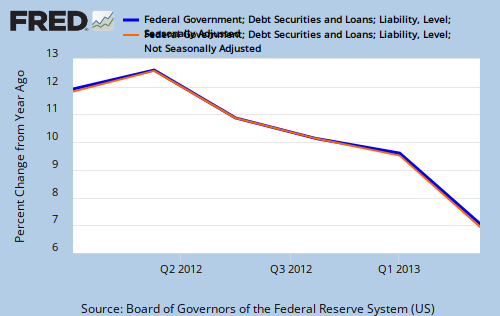
THE RECESSION CLOCK
Monetary Sovereignty Monetary Sovereignty

As the federal deficit growth lines drop, we approach recession, which will be cured only when the lines rise.

#MONETARY SOVEREIGNTY

–When “redistribution” is a dirty word, and when it is not.

Twitter: @rodgermitchell; Search #monetarysovereignty
Facebook: Rodger Malcolm Mitchell

Mitchell’s laws:
●The more federal budgets are cut and taxes increased, the weaker an economy becomes.
●Austerity is the government’s method for widening the gap between rich and poor,
which ultimately leads to civil disorder.
●Until the 99% understand the need for federal deficits, the upper 1% will rule.
To survive long term, a monetarily non-sovereign government must have a positive balance of payments.
●Those, who do not understand the differences between Monetary Sovereignty and monetary non-sovereignty, do not understand economics.
●The penalty for ignorance is slavery.
●Everything in economics devolves to motive.

======================================================================================================================================================================================

Politicians of a certain political stripe tend to brand any federal spending as “socialism” and “redistribution.”

Social Security, Medicare, Medicaid and Food stamps all are “Socialism and redistribution.” Any other aid to the poor and middle classes is Socialism and redistribution.

Those two words, “socialism” and “redistribution” have become the epithets du jour.

As to socialism, there are many kinds, but those who use the word seldom know any of them. For all kinds of socialism, the word does not simply mean government spending.

If it did, every government in history could be called “socialist,” since all spend money.

Rather “socialism” means government ownership and management of production. So the next time someone tells you a certain government project is socialism, ask him for the definition of “socialism,” then watch him stumble.

So called “socialized medicine” is not socialized medicine. Truly “socialized” medicine would be a system in which the government owned all the hospitals and employed all the doctors, nurses and other health-care providers.

I doubt many in America advocate socialized medicine.

The term ignorantly is used to describe “single payer” programs. Medicare is an example. Medicare is not socialized medicine any more than the Supreme Court is “socialized” law, though the government pays the justice’s salaries. Nor is Congress “socialized” legislation. Nor have we had a “socialized” military, or a “socialized” White House.

Government spending is not socialism. (It also is not communism, fascism or any other “ism.” It simply is spending.)

Now, having stepped on the obtuseness of the “socialism” epithet, let’s examine “redistribution”.

Every time you, your city, county or state spends a dollar, there is some measure of “redistribution.” You had a dollar; you spend it; now the store has your dollar. That dollar has been redistributed.

State, county and local taxes are redistributed via state, county and local spending.

Ironically, when the federal government spends a dollar, no redistribution occurs. The federal government creates new dollars by spending. So although federal spending causes “distribution,” it is not an example of RE-distribution.

(Some may object that federal taxing AND spending together comprise redistribution, but that would not strictly be correct. There is no relationship between federal taxing and federal spending. Federal taxing destroys dollars; federal spending creates new dollars. Different dollars.)

Semantic arguments aside, the right-wing objects to any program from which the gap between the rich and the rest is narrowed. They sneer at narrowing of the gap as “redistribution.”

To prevent the poor and middle class from coming closer to the rich, right-wingers define redistribution as a process whereby indolent slobs, who rather than becoming educated or working for a living, prefer to commit crimes in a drug-induced stupor, while collecting easy money from the government.

Never mind that the vast majority of Americans are poor or middle class, and by portraying these folks in negative terms, the right wing essentially portrays America in those same terms.

Such is right-wing patriotism.

New York Times
WHITE HOUSE MEMO
Don’t Dare Call the Health Law ‘Redistribution’
By John Harwood
Published: November 23, 2013

Rebecca M. Blank was a top candidate in 2011 to lead President Obama’s Council of Economic Advisers, but then the White House turned up something politically dangerous.

“A commitment to economic justice necessarily implies a commitment to the redistribution of economic resources, so that the poor and the dispossessed are more fully included in the economic system,” Ms. Blank, a noted poverty researcher, wrote in 1992. With advisers wary of airing those views in a nomination fight, Mr. Obama passed over Ms. Blank.

“Redistribution is a loaded word that conjures up all sorts of unfairness in people’s minds,” said William M. Daley, who was Mr. Obama’s chief of staff at the time. Republicans wield it “as a hammer” against Democrats, he said, adding, “It’s a word that, in the political world, you just don’t use.”

Despite the fact that, compared with the rich, the average poor and middle class labor harder and longer, and lead more difficult, less healthy lives, and have less bright futures, this is not thought to be “unfair.”

To the right wing, “unfairness” means closing that income/wealth gap. Even the poor and middle class have been brainwashed to believe such nonsense.

These days the word (“redistribution”) has been hidden away to make the Affordable Care Act more palatable to the public and less a target for Republicans, who have long accused Democrats of seeking “socialized medicine.”

The right wing, by controlling the media, the politicians and the mainstream economists, has been so effective in using “redistribution” as a pejorative, one cannot even utter the word without adverse consequences.

But the redistribution of wealth has always been a central feature of the law and lies at the heart of the insurance market disruptions driving political attacks this fall.

“Americans want a fair and fixed insurance market,” said Jonathan Gruber, a health economist at the Massachusetts Institute of Technology who advised Mr. Obama’s team as it designed the law. “You cannot have that without some redistribution away from a small number of people.”

And therein lies the problem, for even Mr. Gruber buys into the Big Lie, the belief that taxes pay for federal spending, which if true, would mean that the rich are paying for the poor. But in a Monetarily Sovereign government, taxes do not pay for spending.

Mr. Obama’s advisers set out to pass the law in 2009 fully aware that fears among middle-class voters sank President Bill Clinton’s health initiative 16 years earlier. So they designed the legislation to minimize the number of people likely to be hurt.

That was a perfect example of the brainwashing. To “minimize the number of people likely to be hurt,” the federal government should institute a fully paid, comprehensive Medicare for every man, woman and child in America.

Instead of a sweeping change to a government-run “single-payer” system favored by Democratic liberals, members of the administration sought to preserve the existing system of employer-provided health insurance while covering the uninsured through the expansion of Medicaid and changes to the individual insurance market.

Sadly, there seem to be no “Democratic liberals.” Obama is a right winger, who may seem liberal only by comparison with the extreme right wingers of the Republican party.

When Mr. Obama ran for president in 2008, Republicans tried to wound him by accusing him of waging “class warfare” to achieve wealth redistribution. That fall, the Republican presidential nominee, Senator John McCain, derided Mr. Obama as the “redistributor in chief.”

“Class warfare” and “redistributor in chief” meant Obama wished to reduce the GINI ratio, which unfortunately, he seems not to.

Mr. Obama survived that episode and other instances when Republicans deployed old recordings of him using the word “redistribution” as evidence that he was a closet socialist.

Again, misuse and stigmatizing of the word “socialist.”

The president promised stability: “If you like your current insurance, you will keep your current insurance.”

Hiding in plain sight behind that pledge — visible to health policy experts but not the general public — was the redistribution required to extend health coverage to those who had been either locked out or priced out of the market.”

Again, fundamental misunderstanding on two levels:

1. Since taxes do not pay for federal spending, there should be no redistribution in the ACA.
2. Redistribution, if it occurred, would narrow the GINI ratio, and therefore benefit America.

The law, for example, banned rate discrimination against women, which insurance companies called “gender rating” to account for their higher health costs. But that raised the relative burden borne by men. The law also limited how much more insurers can charge older Americans, who use more health care over all. But that raised the relative burden on younger people.

And the law required insurers to offer coverage to Americans with pre-existing conditions, which eased costs for less healthy people but raised prices for others who had been charged lower rates because of their good health.

The “redistribution” is not between rich and poor, but rather among select demographic groups — which would be unnecessary in a “Medicare for All” program. The government simply would pay for health care, regardless of age of prior condition.

Ironically, that private insurance redistribution is made necessary by the right-wing’s focus on the reduction of deficit spending, making fully funded Medicare for All impossible.

David Axelrod, the president’s longtime strategist said, “we’ve created a sense that everyone can expect to win — nobody has to sacrifice.

Which would be true in a federally funded, “Medicare for All” scenario.

Mr. Axelrod argued that widening income inequality has, to some Americans at least, changed the meaning of redistribution. “The whole redistribution argument has shifted in the country because there’s a sense that a lot of redistribution has been to the top and not the bottom.”

Bingo! That is exactly what has happened. The rich, who argue most against redistribution, have been, in fact the beneficiaries of tax laws and a bribed Congress and President, who have legislated the huge increase in income/wealth redistribution to the top.

“Understand this is not a redistribution argument,” the president told his audience [18 months ago]. “This is not about taking from rich people to give to poor people. This is about us together making investments in our country so everybody’s got a fair shot.”

Rather than “redistribution,” our Monetarily Sovereign government can make it “fair distribution,” where nothing is taken from the rich, but more is given to the middle and the poor.

Closing the gap is the course of action, fairest and most beneficial to America — but that would be mis-termed, “socialism” and “redistribution.”

Rodger Malcolm Mitchell
Monetary Sovereignty

====================================================================================================================================================
Nine Steps to Prosperity:
1. Eliminate FICA (Click here)
2. Medicare — parts A, B & D plus long term nursing care — for everyone (Click here)
3. Send every American citizen an annual check for $5,000 or give every state $5,000 per capita (Click here)
4. Free education (including post-grad) for everyone. Click here
5. Salary for attending school (Click here)
6. Eliminate corporate taxes (Click here)
7. Increase the standard income tax deduction annually
8. Increase federal spending on the myriad initiatives that benefit America’s 99% (Click here)
9. Federal ownership of all banks (Click here)

—–

10 Steps to Economic Misery: (Click here:)
1. Maintain or increase the FICA tax..
2. Spread the myth Social Security, Medicare and the U.S. government are insolvent.
3. Cut federal employment in the military, post office, other federal agencies.
4. Broaden the income tax base so more lower income people will pay.
5. Cut financial assistance to the states.
6. Spread the myth federal taxes pay for federal spending.
7. Allow banks to trade for their own accounts; save them when their investments go sour.
8. Never prosecute any banker for criminal activity.
9. Nominate arch conservatives to the Supreme Court.
10. Reduce the federal deficit and debt

No nation can tax itself into prosperity, nor grow without money growth. Monetary Sovereignty: Cutting federal deficits to grow the economy is like applying leeches to cure anemia.
Two key equations in economics:
1. Federal Deficits – Net Imports = Net Private Savings
2. Gross Domestic Product = Federal Spending + Private Investment and Consumption – Net Imports

THE RECESSION CLOCK
Monetary Sovereignty Monetary Sovereignty

As the federal deficit growth lines drop, we approach recession, which will be cured only when the lines rise.

#MONETARY SOVEREIGNTY
–The real reason for the QEs.

Twitter: @rodgermitchell; Search #monetarysovereignty
Facebook: Rodger Malcolm Mitchell

Mitchell’s laws:
●The more federal budgets are cut and taxes increased, the weaker an economy becomes.
●Austerity is the government’s method for widening the gap between rich and poor,
which ultimately leads to civil disorder.
●Until the 99% understand the need for federal deficits, the upper 1% will rule.
To survive long term, a monetarily non-sovereign government must have a positive balance of payments.
●Those, who do not understand the differences between Monetary Sovereignty and monetary non-sovereignty, do not understand economics.
●The penalty for ignorance is slavery.
●Everything in economics devolves to motive,
and the motive is the gap.
===================================================================================

Here is why the Fed continues with Quantitative Easing (QE) — and it’s not what Chairman Bernanke tells you.

Background: What is the single biggest problem facing the American economy? No, it’s not the federal deficit or the debt, not inflation, deflation, recession or depression, not reduced employment or unemployment, not health care or Social Security.

No, the single biggest problem facing the American economy is the growing gap between the few very rich and the rest of us.

monetary sovereignty

THE GINI RATIO — A MEASURE OF INCOME INEQUALITY — CONTINUES TO WORSEN

(“0” means everyone receives the same; 1.00 means one person gets it all. The rising line means rising inequality.)

When a large percentage of a nation’s citizens suffer from poor housing, inadequate access to medical care, less affordable and less nutritious food and less affordable, quality education, poor prospects and opportunities for success — and when that large percentage is growing — the nation and its leaders have failed.

President Kennedy was wrong when he said, “Ask not what your country can do for you – ask what you can do for your country.” For what, after all, is the fundamental purpose of a nation, if not to care for its citizens?

The Situation: The Fed, under Chairman Bernanke, claims QE (Quantitative Easing) stimulates the economy. His theory goes like this:

Under QE, the Fed buys $85 billion dollars worth (currently) of T-bonds from the private sector every month. Bernanke would have you believe that each month this pumps $85 billion into the American economy.

Utter nonsense.

When the private sector purchases T-bonds, dollars are transferred from private sector checking accounts at various banks, to T-bond accounts at the Federal Reserve Bank. (Think of transferring dollars from your bank checking account to your bank savings account.)

Then, when the Fed buys those T-bonds from the private sector, dollars are transferred back from T-bond accounts to private checking accounts. No new dollars are added to the economy.

What does happen however, is that the Fed’s bond purchases increase the demand for T-bonds, which increases the price of T-bonds, which in turn, decreases the interest rate paid by T-bonds. In short, QE simply is a gigantic long-term-interest-rate-reduction device. Nothing more.

Because the Fed controls short-term interest rates (via the Fed Funds rate), QE closes the circle, by lowering longer-term interest rates. So the question becomes, “Why does the Fed want low interest rates?”

The usual claim is that low rates make borrowing more attractive, which supposedly is economically stimulative. But, while low rates make borrowing more attractive, those same low rates make lending less attractive.

As a result, there is no historical relationship between low rates and GDP growth. See: Low interest rates do not help the economy.”

If QE merely keeps interest rates low, and low rates don’t stimulate the economy, why QE?

The Fed is a creature of the rich, and the rich want low interest rates. Low rates reduce federal bond interest payments, so when rates are low, the government pumps less money into the economy. And, low rates make borrowing less costly for businesses, thereby adding to business profits.

Thus, QE causes two complementary effects: Less money coming into the economy plus higher profits for business: The perfect combination for taking money from the poor and giving it to the rich.

Here is how that works:

Spiegel

Near Zero: ECB Interest Rate Cuts Hit Savings Hard

By SPIEGEL staff

As the European Central Bank pushes interest rates to a new low, Germans are growing increasingly concerned about their savings. The money in their accounts is losing value and life insurance policies are yielding lower returns.

Only a few years ago, Germans were convinced that they could offset the cuts lawmakers had made to government-mandated pensions by saving more money on their own. Because Germans tend to be risk-averse, they invest most of their money in savings deposits, life insurance and fixed-income products.

But savings can only grow in real terms if the interest rate is higher than the rate of inflation.

“In Germany today, people can no longer provide for their retirement by saving,” says Walter Krämer, a statistics professor in the western city of Dortmund.

The percentage of young people in the population is shrinking, and yet they must generate greater economic output to reduce the debts they are inheriting from the current generation.

Because this is unsustainable, a redistribution from creditors to borrowers, or from savers to the state, is now occurring. The government makes money when interest rates on government bonds are lower than inflation. Its debt burden is decreased, while savers are left to foot the bill, with their assets losing value in real terms.

The consequence is a massive redistribution. McKinsey, the consulting firm, has calculated that the governments of the United States, Great Britain and the euro zone already saved $1.6 trillion between 2007 and 2012 as a result of low interest rates. This is offset by a loss to private households of $630 billion. Older citizens are losing more than younger people, because the latter tend to have more debt and fewer savings.

As much as savers are being fleeced, there are also those who profit from low interest rates. People who own real estate have benefited from increases in value in recent years, while stock owners have seen Germany’s DAX share index climb from one record high to the next. But this primarily benefits those who are not worried about having enough retirement income.

In this way, the low-interest-rate policy doesn’t just lead to a transfer of assets from citizens to the state, but also from the poor to the rich</strong>. Affluent households are in a better position to shift their focus to stocks, real estate and other investments than those with average incomes.

Bottom line: The Bernanke purpose of QE is to reduce interest rates while convincing the public this is beneficial. It is beneficial, but only to those who invest in stocks and real estate. Low rates are detrimental to the vast majority of Americans who try to save via bank accounts, insurance accounts and other “safe,” interest-paying investments — i.e. the middle class and the poor.

QE, deficit reduction, debt reduction and interest rate reduction all have been sold to the American public as economically stimulative and beneficial to the poor and middle classes. But, in fact, they widen the gap between the rich and the rest.

That is why Bernanke and the rich bankers love QE. It is the gap that makes the rich rich. If there were no gap, no one would be rich, and the wider the gap, the richer the rich are.

Bernanke, the politicians, the media and the mainstream economists have been paid by the rich to widen the gap. That is the purpose of QE.

So far, it’s working.

Rodger Malcolm Mitchell
Monetary Sovereignty

===================================================================================
Ten Steps to Prosperity:
1. Eliminate FICA (Click here)
2. Federally funded Medicare — parts A, B & D plus long term nursing care — for everyone (Click here)
3. Provide an Economic Bonus to every man, woman and child in America, and/or every state a per capita Economic Bonus. (Click here) Or institute a reverse income tax.
4. Free education (including post-grad) for everyone. Click here
5. Salary for attending school (Click here)
6. Eliminate corporate taxes (Click here)
7. Increase the standard income tax deduction annually
8. Tax the very rich (.1%) more, with higher, progressive tax rates on all forms of income. (Click here)

9. Federal ownership of all banks (Click here)

10. Increase federal spending on the myriad initiatives that benefit America’s 99% (Click here)

—–

10 Steps to Economic Misery: (Click here:)
1. Maintain or increase the FICA tax..
2. Spread the myth Social Security, Medicare and the U.S. government are insolvent.
3. Cut federal employment in the military, post office, other federal agencies.
4. Broaden the income tax base so more lower income people will pay.
5. Cut financial assistance to the states.
6. Spread the myth federal taxes pay for federal spending.
7. Allow banks to trade for their own accounts; save them when their investments go sour.
8. Never prosecute any banker for criminal activity.
9. Nominate arch conservatives to the Supreme Court.
10. Reduce the federal deficit and debt

No nation can tax itself into prosperity, nor grow without money growth. Monetary Sovereignty: Cutting federal deficits to grow the economy is like applying leeches to cure anemia.
Two key equations in economics:
1. Federal Deficits – Net Imports = Net Private Savings
2. Gross Domestic Product = Federal Spending + Private Investment and Consumption – Net Imports

THE RECESSION CLOCK
Monetary Sovereignty

Monetary Sovereignty

Vertical gray bars mark recessions.

As the federal deficit growth lines drop, we approach recession, which will be cured only when the growth lines rise. Increasing federal deficit growth (aka “stimulus”) is necessary for long-term economic growth.

#MONETARYSOVEREIGNTY