Every politician wants to be known as “tough on crime.” No one wants to be seen as “soft on crime.”
The Republicans especially like to rage at crime, especially when the criminals are immigrants, poor, black and not Christian — not so much when the criminals are white, Christian, and Republican.
We’ll interrupt here to explain that for the typical American voter, “crime” means “violent street crime.
The “Central Park 5” are the faces Americans see in their imagination when demanding politicians be “tough on crime.” These young boys were convicted, though innocent, and only later, exonerated.
It does not seem to include white-color crime of the sort Donald Trump has been accused, convicted, and even paid fines for. Daft-dodging, Trump U., Trump Foundation, tax cheating, assaulting women, and all the assorted low-life cons and lies that don’t involve extreme physical violence or the threat thereof are not included in the “crime” we should be “tough” on.
The average American visualizes “crime” as something that involves a black or brown teenage boy pointing a gun. Being “tough on crime.” means locking up said teenager for long stretches of his life.
You don’t hear the same Fox News outrage when it comes to Trumpers Rep. Matt Gaetz, Rudy Giuliani, Sidney Powell, Steve Bannon, and all the other traitors who defended and/or attempted what previously was unthinkable in America –a coup — so inconceivable, that many people still refuse to believe the crime they have seen actually occurred.
Even a respected judge is not immune to “soft-on-crime” criticism. Here are excerpts from a Fox News article written by none other than Sen. Josh Hawley, who, as a coup encourager and thus a traitor to the U.S., is not the best one to complain about criminals.
“While serving on the Sentencing Commission, she (Judge Jackson) supported eliminating the existing child pornography mandatory-minimum sentence.)
(She opposes all mandatory minimums as being blind to circumstances and substituting generalizations for specifics.)
“Those views carried over to Judge Jackson’s time on the bench. Over and over again, she handed down sentences well below the congressionally endorsed Sentencing Guidelines recommendations.)
(Not to mention the many times all judges do that — it’s the purpose of using human judges rather than robots — and she often handed down sentences above those guidelines, but why quibble about facts when you are a typical mean-spirited Trumper writing for Fox News?)
“Unfortunately, Jackson is not the first judge to do that.”
Right, judges normally impose a range of punishments.
“But she stands out because she also consistently sentenced child pornography offenders below even what liberal prosecutors in Washington, D.C., were seeking.”
(It wasn’t consistent, and prosecutors always ask for the maximum. In most cases, judges look at circumstances and don’t grant the maximum the prosecutors seek. All of Hawley’s shrieking is about normal judicial procedure. The notion that Judge Jackson encouraged child pornography stretches credulity.)
Hawley knows all this, but he is a renowned liar who writes for Fox,, a proven-to-be-lying network. They are Trumpers, and we expect nothing less from them.
But even the most softhearted, squishy Democrats have no idea what “tough on crime” really means:
The Washington PostThe 5-Minute FixBy Amber Phillips with Caroline Anders
Crime is looking like it’s going to be a big issue in November’s midterm elections — and that has Democrats on the defensive.
“We must invest in our police departments,“ said Rep. Val Demings (D-Fla.), a former police chief who is running for Senate in Florida.
Ask virtually anyone, winged right or left, about being “tough on crime,” and you will hear such suggestions as:
More police
More money spent on policing
More laws
Tougher judges
Longer jail sentences
Harsher jail conditions
Everything has to do with increasing the punishment for committing crimes and nothing for reducing the cause of crimes.
Republicans especially are interested in punishment, especially of the aforementioned poor immigrant, brown, non-Christian, blacks:
It (crime) has been fed and fueled in multiple ways by the Democratic Party’s far-left turn,” Senate Minority Leader Mitch McConnell (R-Ky.) has said of the country’s recent crime wave.
Strange, how Mitch suddenly seems unconcerned about a mob of people attacking the nation’s capital, attempting to overthrow the United States government, and even causing death and injuries. And for certain, he is not worried about gun crime.
To Mitch, criminals are street, not white-collar, criminals, who are born bad and born black.
From 2019 to 2020, the homicide rate in the United States jumped nearly 30 percent, according to FBI data, marking the largest increase since we started keeping track of those stats.
Third Way, a Democratic think tank, found that cities (run by Democrats) in red states were hit harder by the 2020 murder surge than blue states were.
Democrats who have been recently elected as mayors in liberal cities such as New York and Seattle have campaigned on being tough on crime.
“There is little doubt that the sheer stress and strain of the pandemic, not to mention the economic dislocation, helped to push up homicide rates,” criminologist Richard Rosenfeld told Witte.
Democrats are nervous about getting tagged as anti-police — again. This time, they’re already campaigning on more funding for police departments.
And none of this “tough on crime” blustering addresses the root cause of most street crime: Poverty.
Poverty is the mother of crime.
Yes, crime has many parents — that “stress, strain, and economic dislocation” to name three. But walk through any wealthy area, and you will fear street crime far less than in an impoverished area.
Republicans are adamant in their desire to apprehend and punish street criminals. However, while apprehending and punishing after the fact may be their focus, Republicans have no desire to address cause and prevention.
They are adamant in their opposition to gun control, to keep guns out of the hands of potential criminals, and to reduce the lethality of the guns being sold, which would have a significant impact.
Similarly, Republicans vote against anti-poverty benefits, i.e., Social Security for All, Medicare for All, School lunch programs, housing aid, food aid, college for all, and the myriad other easily affordable (by the federal government) programs that would reduce poverty and crime in America.
Punishment, punishment, punishment; that is all the right-wing knows. One reasonably might think putting blacks, browns, and immigrants in jail is the real motive, and crime is just the convenient excuse.
The right dismisses them all with one word, “socialism,” then blindly continues to chatter about the need for tougher police and harsher sentences.
(White-color crime and political crime are OK, except if found on a Hunter Biden laptop)
Even the Democrats have been dragged into the false rhetoric:
“Fund the police,” Biden roared at his State of the Union address this spring, to bipartisan applause.
Yes, fund the police. We do need well-trained, well-paid police.
But, digging recruits from the bottom of the barrel, and then without training, setting them loose on the public, is no way to be tough on crime.
Fund the police, but also fund the people.
Our Monetarily Sovereignfederal government, having the infinite ability to spend dollars, can reduce poverty in America — and thus reduce crime — without levying one cent in taxes or causing inflation.
There is a reason why poor areas of the country endure more street crime than wealthy areas. It’s not that poor people are innately more dishonest. They simply have less money and less of what money can buy.
They have the same desires the rich have but fewer means of satisfying them. So they steal. It has been the same for time immemorial.
We can curse the darkness by arresting a hungry kid for stealing food from a grocery store and locking him up forever, or we can light a candle by giving him food, shelter, and reasonable hope for his future.
For some reason, we have lately shown a greater desire to beat down than to lift up, and that truly is wrong. It is wrong morally and wrong an effective solution.
Beating down may satisfy the mob’s bloodlust, but it will not reduce crime, and it will turn on the innocent.
I was reminded of the 2022 article (above) when I read this yesterday:
Voters want solutions to crime, not fighting from Trump, HarrisAna Zamora, Chicago TribuneAmericans aren’t interested in overheated rhetoric or petty name-calling. What people want are real solutions to make our communities safer and more just.
Last year, Gallup showed that when you ask Americans whether the criminal justice system is “too tough” or “not tough enough,” most say it should be tougher.
But then the pollsters went a level deeper and asked people what should actually be done.
The top answer wasn’t to hire more police. It was to address the social and economic problems that drive crime in the first place — by a margin of 2 to 1.
Typically, such social efforts as enhanced Medicare and more generous Social Security, unemployment compensation, free school lunch, free housing, and other anti-poverty measures are not considered “toughon crime,” and that is the problem.
Efforts to reduce poverty and its associated hopelessness, lack of education, and lack of stable home life are the best ways to be “tough on crime.” Still, too many Americans, especially those on the right, consider such benefits to be unaffordable, socialist, and soft-hearted rewards for indolence.
The reform movement has notched remarkable wins, beginning with the fact that 3 in 4 Americans— Democrats and Republicans — now believe in its aims, according to a report from the bipartisan group FWD.us.
Many of its solutions enjoy broad political appeal — among voters and legislators alike. States have passed laws to give police the resources they need while improving oversight and accountability.
They’ve also pushed ahead on other fronts — strengthening the public defense system, ending mandatory minimum sentencing and juvenile life without parole, creating deflection and diversion programs, funding education and workforce development in prisons, expanding access to parole, sealing criminal records and making sure people who leave the prison system have the support they need to reenter society successfully.
The above all are worthwhile, but most don’t address the fundamental cause of street crime: Poverty.
Now the prison population is shrinking in many places, and crime rates are plummeting. We have to protect those precious gains. And we can’t let the overheated rhetoric of a presidential election keep us from making more.
The bright-red state of Oklahoma just passed a law to help survivors of domestic abuse who were imprisoned because they committed a criminal act while defending themselves.
Their sentences will now be reduced, thanks to a politically diverse group of advocates, legislators, funders and community members who spent two years working to right an obvious wrong.
Stories like this remind us that “tough on crime” policies aren’t the only option. Even in an era of profound political division — and a moment when the presidential election will pry us even further apart — we are still capable of crossing party lines to make change.
It’s only when we lose sight of that fact that we end up with laws such as the Safer Kentucky Act, which promises to sweep even more people into the state’s bulging prison system, some for life, while doing nothing to prevent crime.
Give voters a choice between senseless punishment and pragmatic solutions that deliver safety, accountability and justice, they’ll pick the better option.
(Ana Zamora is founder and CEO of The Just Trust, which advocates for bipartisan criminal}
SUMMARYAmericans and their politicians continue to eschew crime prevention in favor of punishment.
It’s as though we believed the way to prevent and cure illness was to pack sick people into miserable quarantine camps rather than to give them medical care and healthful diets and surroundings.
Ironically, punishment feeds recidivism whereby those coming out of prison are more, not less, likely to recommit crimes.
They have lost the crucial education and orientation years and, upon release, are thrust unprepared into a world that does not offer them reasonable possibilities for honest lives.
Rather than preventing or curing crime, being “tough on crime” begets more crime, and not just by the criminals but by their friends, parents, spouses, and children in an unending cycle of failure.
Rodger Malcolm Mitchell
Monetary SovereigntyTwitter: @rodgermitchellSearch #monetarysovereigntyFacebook: Rodger Malcolm Mitchell;MUCK RACK: https://muckrack.com/rodger-malcolm-mitchell; https://www.academia.edu/
……………………………………………………………………..
The Sole Purpose of Government Is to Improve and Protect the Lives of the People.
I would call this a “Can’t happen to me” story.
People own guns for several reasons. Some people are collectors. Some are hunters. Some are target shooters.
But one big reason is personal safety. Many people are convinced that their easy access to, and liberal carry of, guns makes them safer.
They feel that if they have a gun in their home or can carry it in the street, they will be able to protect themselves.
In this, they are correct. A gun is a potent, self-protection device.
However, they don’t seem to understand, or they do understand but deny two things:
1. If they have easy access to guns, then everyone else has easy access to guns, and having everyone else own and carry guns is a danger their own gun ownership doesn’t solve.
In a way, it’s like driving. We post speed limits, and we arrest people for exceeding those limits.
There are many roads posted for 60 mph that I would love to drive at 85 mph. I feel I’m a good enough driver to do it safely.
But I don’t because I don’t want to get stopped by a cop. And I don’t object to the posting because I don’t want every damn fool driver to zoom past me going 85 mph on that road.
Yes, there are plenty of damn fool drivers who break the law. Sometimes I do it myself. Still don’t object to the speed limit because I am convinced that, despite all the law-breakers, speed limits save lives.
2. And this is the second thing gun owners deny, the “It can’t happen to me” part:
— Clinicians need to start conversations about gun access, researcher urgesby Kristen Monaco, Senior Staff Writer, MedPage Today, May 22, 2023
I have good kids. I teach them gun safety, so they won’t have accidents or commit suicide. Right?
SAN FRANCISCO — Many teens who died by firearm suicide grew up in gun-owning families, according to a small psychological autopsy study.
Interviews with family members of nine teens who died by firearm suicide showed that 89% of decedents had prior family engagement with firearms or the family considered itself to be engaged in firearm culture, said Paul Nestadt, MD, co-director of the Johns Hopkins Anxiety Disorders Clinic in Baltimore.
Keep in mind this was an exceedingly small study, so statistics related to this study have little meaning.
“Interventions must acknowledge culturally embedded routes of identity formation while re-scripting firearms from expressions of family cohesion to instruments that may undermine that cohesion — and might cost the life of their child,” Nestadt said during a press conference at the American Psychiatric Association annual meeting.
Suicide death rates have been steadily climbing since 2000, Nestadt explained, and now account for the second most common cause of death among youth.
“It’s a big problem,” Nestadt said. “And when we’re talking about suicide, it’s hard not to talk about firearm suicide.”
“One of the reasons so many suicides are by firearm … is that firearm attempts are much more lethal,” he added.
According to CDC data, firearms are the most common method used in suicide; they were used in 55% of suicides in 2021.
Of suicide attempts that involved a firearm, 90% resulted in a fatality.
For reference, Nestadt said only about 8% of all suicide attempts result in death. “That’s why having a firearm is such an important risk factor for completed suicide,” he said. In addition, most firearm deaths in the U.S. are suicides.
Three distinct themes emerged from the qualitative interviews. The first was firearm culture’s prevalence among families of youth who died by firearm suicide.
“[He] used to love shooting with his dad. That was something that they did together. It was a big connection point for them,” one person said during the interview.
Firearm culture tended to play an integral role in how these families identified themselves and were part of family traditions, Nestadt explained.
The second theme that emerged — and the most clinically relevant, according to Nestadt — was the perspective on firearm risk. Many family members tended to be unaware of the potential danger that access to firearms posed for youth at risk for suicide, and few locked up household guns.
Most families said they would have removed guns from the house if it had been suggested.
“If [the hospital] had recommended it, we would’ve agreed and removed the gun from the house. But I wasn’t worried, though — it wasn’t even a thought,” said one family member.
“I know these are politically valent topics of the time, but as healthcare providers, we ask about their sex life, rashes, all kinds of sensitive things, religion,” he said. “It’s important that we’re able to really do that.”
“I will point out for any healthcare provider that it’s never illegal to ask about gun access. It’s medically relevant to saving your patient’s life,” Nestadt added.
“Pediatricians: remember, this is the second leading cause of death,” he said. “It’s important to screen for all these things that can hurt your kid, but the most likely thing that will result in your child patient dying will be suicide. The number one is accidental death.”
This theme was closely entangled with the third theme that emerged from interviews, which involved risk mitigation strategies.
Calling this “truly a courageous study,” session moderator Howard Liu, MD, MBA, of the University of Nebraska Medical Center in Omaha, praised the research for bringing up such an “important, timely public health discussion.”
“Of course, we’re all facing this challenge of how do we reduce suicide in all ages … and I think this is a really vital discussion and such an important clue about access, and just trying to reduce accessin the moment of impulsivity and a moment of grief.“
Those last few words are important. Young people tend to be impulsive. Children look for a way to end their pain when things go badly or even seem to go badly.
Fear, embarrassment, rejection, and failure, all are magnified in the young mind, and if there is a gun in the house, death might seem like a preference or a solution rather than a danger.
If you gun owners learn that your child has been driving too fast and has received tickets, you might take his car keys away. But kids generally don’t try to commit suicide by driving, and if they do make an attempt, they likely will survive it.
Bullets are much less survivable.
The bottom line is, easy access to guns might make you feel safer, but that safety is an illusion. And yes, laws cannot 100% prevent criminals from accessing guns, just as laws cannot 100% prevent speeding, dealing drugs, or committing burglaries.
But we have laws for a reason. Laws help prevent bad acts and bad outcomes.
When we had laws restricting gun ownership, we had fewer gun deaths. Laws work. We should try them again.
Of course, a gun accident or suicide can’t happen in your house, can it?
Rodger Malcolm Mitchell
Monetary SovereigntyTwitter: @rodgermitchellSearch #monetarysovereigntyFacebook: Rodger Malcolm Mitchell
……………………………………………………………………..
The Sole Purpose of Government Is to Improve and Protect the Lives of the People.
Another mass murder with a gun. It’s starting to become ho-hum. The 5-stage process goes like this:
Just another day in America
Someone shoots a lot of people.
In the ensuing outrage, demands are made that “something must be done.“
Gun control laws are suggested
The NRA, America’s paid proxies for the gun manufacturers, says that no law will prevent mass shootings.
The bribed politicians pretend to argue; columnists speculate; then all agree that mass shootings cannot be prevented, so nothing is done.
Soon after, begin again from #1.
It’s happening more frequently now, and ironically, the more often it happens, the more inured we become to tragedy.
NRA tells you, there is no gun problem, but the solution to the problem is more guns.
The NRA then says there are no acceptable solutions, because we cannot prevent all gun killings in America. For every proposed solution, someone will claim, “That solution wouldn’t have stopped this [named] crime.
In truth, there are no total solutions to any crime. Still, we have laws.
Laws against speeding do not prevent all speeding. Laws against fraud do not prevent all fraud. Laws against burglary do not prevent all burglary.
All laws are only partial solutions.
Because no law will eliminate all gun killings, we must be willing to accept laws that at least will reduce gun killings.
We must be willing to search for and to accept partial solutions.
In evaluating proposed laws, we must ask:
Will this law have a net positive effect? That is, will it do more good than harm?
Is it feasible? That is, can the law be enforced by the police and the courts?
Is it fair? That is, does it apply regardless of income, age, or ethnic background?
Last year we published the post titled, “Five partial solutions to gun violence.” Because we now are entering stage #5 (above), perhaps we should review those partial solutions, which are listed at the end of this post.
We have a choice. We can take the actions described below, which will not completely eliminate shootings. But they will save thousands of American lives, while reducing the urge to buy guns for “self-defense.”
Or, we can take no action, and know full well that the gun killings will continue and probably increase, as more people buy more guns to defend themselves against their fellow Americans.
But, yes, we can institute certain partial solutions, greatly diminishing the deaths and woundings that occur every day.
1. Interpret the Constitution properly. Our founders placed the words, “A well-regulated militia being necessary to the security of a free state . . . ” at the beginning of the 2nd Amendment for a reason. Clearly, they understood that allowing everyone to have all kinds of “arms,” without limitation, was dangerous to the public.
We are a nation of laws. Regulation always has been and always will be, the key to public safety.
Even gun enthusiasts would be first to admit that the public should be prevented, by regulation from “keeping and bearing” certain “arms”: 50 caliber machine guns or bazookas or cannons or poison gas, or surface-to-air missiles, or atomic arms, etc.
So the question is not one of regulation vs. no regulation, but merely what kind of regulation?
And the Constitution tells us the answer to that question: “A well-regulated militia.” That is the kind of regulation needed. Guns should be under the control of well-regulated militias. They can be federal militias or even state militias, for those states more addicted to guns, but guns are too important not to be regulated.
2. Federalize gun manufacture and importation The misrepresentation of the Constitution, the bribing of Congress by the gun manufacturers and the gun importers and the NRA, the propaganda telling us that guns make us safer, despite daily evidence they don’t — these all are funded by one motive: The profit motive. Eliminate the gun manufacturer’s and importer’s profit motive, and the elements that put too many guns into the hands of too many people disappear.
3. Apply the RICO (Racketeer Influenced and Corrupt Organizations)laws to gangs. A great many gun killings are committed by street gang members. Entire neighborhoods, even towns, are held hostage by the fear of turf wars, drive-by shootings, revenge shootings, and robberies. Street gangs are criminal enterprises under RICO.
Under RICO, a person who has committed “at least two acts of racketeering activity” drawn from a list of 35 crimes—27 federal crimes and 8 state crimes—within a 10-year period can be charged with racketeering if such acts are related in one of four specified ways to an “enterprise”.
Those found guilty of racketeering can be fined up to $25,000 and sentenced to 20 years in prison per racketeering count.
In addition, the racketeer must forfeit all ill-gotten gains and interest in any business gained through a pattern of “racketeering activity.
Despite its harsh provisions, a RICO-related charge is considered easy to prove in court, as it focuses on patterns of behavior as opposed to criminal acts.
Some patterns of activity include:
It shall be unlawful for any person who has received any income derived, directly or indirectly, from a pattern of racketeering activity or through collection of an unlawful debt. (Bottom line: Every gang member does this, so merely belonging to a gang is considered a crime.)
. . . to acquire or maintain, directly or indirectly, any interest in or control of any enterprise which is engaged in, or the activities of which affect, interstate or foreign commerce. (For example, if your gang deals in drugs, guns or women, you, as a member of the gang, are liable.)
. . . to conspire to violate any of the provisions [of the law]. (Even talking about breaking the law with your fellow gang members is a felony.)
Your police know who the gang-bangers are. They have lists. The police could round up many of them, tomorrow.
But rather than arresting gang-bangers, again and again, only to see them let them soon back on the streets to shoot someone, we can break up the gangs and take the gangsters off the streets permanently.
4. Additional penalties for gun carry during a felony Enact a law that essentially says: If you carry a gun while committing a felony, twenty years automatically will be added to the term of the felony itself.
5. Tax gun ownership. Governments tax personal property, and the amount of tax is determined by the type of property.Place a heavy, annual tax on guns. Make gun ownership expensive.The ostensible purpose of the tax would be to pay for the widespread death, injury and damage to this nation and to its citizens, caused by guns.Anyone caught with a gun, for which no tax has been paid, would be subject to jail, and have the gun confiscated and destroyed.
Denying that guns are a danger to innocent people, while claiming that guns protect “good guys,” as the greedy gun manufacturers tell us, simply hasn’t worked, cannot work and never will work.
The quote, often misattributed to Albert Einstein applies here: “Insanity is doing the same thing over and over again, but expecting different results.”
Rather than foolishly continuing to repeat failure, common sense must prevail.
There is no way to identify in advance, the so-called “good guys” who should have guns. A “good guy” can become a “bad guy” in an instant, given some minor provocation or no provocation at all.
Even many mass killers have been seeming “good guys,” by any of the myriad definitions.
The only solution is over time to make guns harder and harder to get and use, by a five-pronged offensive:
Interpret the Constitution properly
Remove the profit motive from gun manufacture and sales
Eliminate gangs via the RICO statutes
More jail time for gun-carry during felonies. Get them off the street.
Make gun ownership expensive
Anyone, sincerely hoping to reduce gun violence will renounce the insatiable gun manufacturer’s profit-motivated propaganda, and recognize that for a safer society we must begin to reduce the number of guns in the hands of the populace.
There are many things we are not allowed, yet we agree to the prohibitions, because we understand we must give up something to gain something. That is what being in a society means.
We must give up the unquestioned attachment to guns to achieve a safer society. Other nations have done it. We Americans can do it, too.
Mitchell’s laws:
•Those, who do not understand the differences between Monetary Sovereignty and monetary non-sovereignty, do not understand economics.
•Any monetarily NON-sovereign government — be it city, county, state or nation — that runs an ongoing trade deficit, eventually will run out of money.
•The more federal budgets are cut and taxes increased, the weaker an economy becomes..
•Liberals think the purpose of government is to protect the poor and powerless from the rich and powerful. Conservatives think the purpose of government is to protect the rich and powerful from the poor and powerless.
•The single most important problem in economics is the Gap between rich and the rest..
•Austerity is the government’s method for widening the Gap between rich and poor.
•Until the 99% understand the need for federal deficits, the upper 1% will rule.
•Everything in economics devolves to motive, and the motive is the Gap between the rich and the rest..
============================================================================================================================================================================================================================================================
Because the NRA has been so successful with its propaganda, you may not realize that:
For almost 200 years after it was adopted, the Second Amendment was interpreted to protect the right for militias to bear arms, but not individuals.
In 1939, the Supreme Court ruled in United States v. Miller that restricting access to shotguns or machine guns by citizens outside the military was permissible.
“The right to bear arms was thought to ensure well-regulated state militias,” Harvard constitutional law professor Richard J. Fallon told Mic. “Regulation of firearms was permissible as long as it did not interfere with state militias.”
Historically, conservatives actually tended to support gun control, seeing it as a way to stop crime.
That changed in the 1970s, when conservatives began to make the argument that the Second Amendments protects individuals, rather than just the military.
The current, right-wing interpretation of the 2nd Amendment, with the belief that the “militia” phrase has no meaning whatsoever, is a recent phenomenon.
The most important recent Supreme Court decision dealing with gun regulation came in 2008, when the court ruled in the case District of Columbia v. Heller.
At issue was the constitutionality of the District’s ban on handguns, which at the time was one of the most restrictive in the country.
In a 5-4 decision, the court struck down the ban, claiming it infringed on an individual right, namely “the right of the people to keep and bear arms.”
However, the court also explicitly stated that while owning handguns is protected as an individual right, possession of “dangerous and unusual weapons” is not.
Get it? Even the right wing court ruled that banning guns is constitutional, with the only question being, “Which guns can be banned.?”
Two weeks ago, 49 Republican senators voted against a failed bill that would have expanded background checks and closed the so-called gun show loophole, with Florida Sen. Marco Rubio stating that such an expansion “would impede the Second Amendment right of a large number of Americans.”
What these politicians get wrong: Those absolutist positions were never supported by the Supreme Court’s Heller ruling, which was intentionally narrow.
By broadcasting the same lie repeatedly, the politicians, well-paid by the NRA and gun manufacturers, have implanted the notion that any restrictions on gun ownership are unconstitutional.
Absolutely false. That wasn’t true when the 2nd Amendment was written, and it never has been true, since.
“Heller set out sort of a bare-bones holding that there is a constitutionally protected right to bear arms, but most of the hard questions have not yet been considered by the Supreme Court,” Fallon told Mic. “Although the Supreme Court has recognized a Second Amendment right to bear arms, it has not recognized an absolute right of everybody to bear arms, of all kinds, at all places, in all circumstances.”
Other constitutional lawyers go even further, saying that although conservatives may not want to admit it, Heller actually paved the way for more gun control restrictions.
“I believe ‘assault weapons’ are indeed what the court had in mind when it wrote in Heller about ‘dangerous and unusual weapons,” Harvard Law professor and renowned legal scholar Laurence Tribe told Mic. “I believe military-style assault weapons will never be protected by the court in the name of the Second Amendment.”
The only question is whether a bribed and cowardly Congress will pass more restrictive laws, and/or whether local and state governments have the will to challenge restrictions to a right-wing Supreme Court, known for ignoring the “militia” rule.
Tribe told Mic. “The Second Amendment and the Constitution as a whole are abused by those who treat them as a sick suicide pact.”
And now, I await the informative comments from those who have more guns than teeth, and fewer brains than either.
=================================================================================== Ten Steps to Prosperity:
1. Eliminate FICA (Click here)
2. Federally funded Medicare — parts A, B & D plus long term nursing care — for everyone (Click here)
3. Provide an Economic Bonus to every man, woman and child in America, and/or every state a per capita Economic Bonus. (Click here) Or institute a reverse income tax.
4. Free education (including post-grad) for everyone. Click here
5. Salary for attending school (Click here)
6. Eliminate corporate taxes (Click here)
7. Increase the standard income tax deduction annually Click here
8. Tax the very rich (.1%) more, with higher, progressive tax rates on all forms of income. (Click here)
9. Federal ownership of all banks (Click here and here)
10. Increase federal spending on the myriad initiatives that benefit America’s 99% (Click here)
The Ten Steps will add dollars to the economy, stimulate the economy, and narrow the income/wealth/power Gap between the rich and the rest.
——————————————————————————————————————————————
10 Steps to Economic Misery: (Click here:)
1. Maintain or increase the FICA tax..
2. Spread the myth Social Security, Medicare and the U.S. government are insolvent.
3. Cut federal employment in the military, post office, other federal agencies.
4. Broaden the income tax base so more lower income people will pay.
5. Cut financial assistance to the states.
6. Spread the myth federal taxes pay for federal spending.
7. Allow banks to trade for their own accounts; save them when their investments go sour.
8. Never prosecute any banker for criminal activity.
9. Nominate arch conservatives to the Supreme Court.
10. Reduce the federal deficit and debt
No nation can tax itself into prosperity, nor grow without money growth. Monetary Sovereignty: Cutting federal deficits to grow the economy is like applying leeches to cure anemia.
1. A growing economy requires a growing supply of dollars (GDP=Federal Spending + Non-federal Spending + Net Exports)
2. All deficit spending grows the supply of dollars
3. The limit to federal deficit spending is an inflation that cannot be cured with interest rate control.
4. The limit to non-federal deficit spending is the ability to borrow.
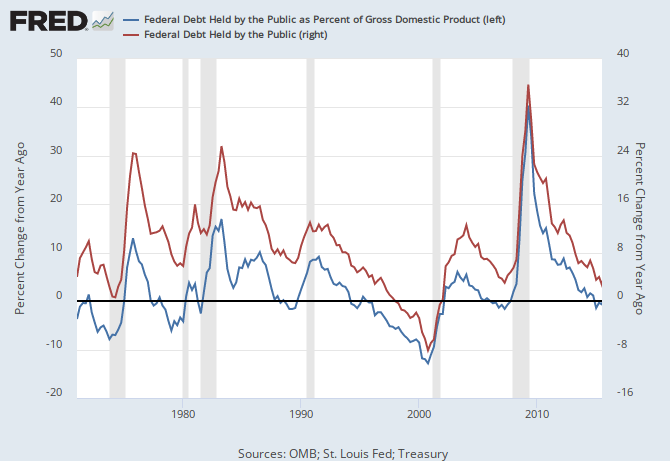
THE RECESSION CLOCK
Recessions come only after the blue line drops below zero.
Vertical gray bars mark recessions.
As the federal deficit growth lines drop, we approach recession, which will be cured only when the growth lines rise. Increasing federal deficit growth (aka “stimulus”) is necessary for long-term economic growth.


 #Monetary Sovereignty - Mitchell