–“How to Slash the State: 14 ways to dismantle a monstrous government, one program at a time”

The debt hawks are to economics as the creationists are to biology.

The November 2010 issue of reason.com contains an article titled, “How to Slash the State: 14 ways to dismantle a monstrous government, one program at a time”

It’s a thoughtful article, but only if you believe the federal government should be smaller, the federal deficit should be lower and taxpayers pay for federal spending. Unfortunately, there is no evidence to support any of these three beliefs. In fact, all the evidence points to the need for ever increasing federal deficit spending, i.e. money creation. (A growing economy requires a growing supply of money.) Also, in a monetarily sovereign nation, taxes do not pay for federal spending (though taxes do pay for state and local spending, as the states, counties and cities are not monetarily sovereign).

Further, some of the “dismantling” they suggest is more like shifting, because some of the suggestions merely push expenses from the federal government (which has unlimited money) to state and local governments (which are having great difficulty paying their bills) – a terrible idea.

Nevertheless, here are the ideas, with my comments.

1. Overhaul Medicaid
“stop the matching grant funding process, in which states receive federal money for each Medicaid dollar they spend” or “scrap the program entirely in favor of a temporary assistance program that doesn’t create long-term dependency.”

The first part of the suggestion shifts more burden to the struggling states, which are not monetarily sovereign, and so cannot create unlimited money. The second part of the suggestion goes under the heading, “These Medicaid recipients aren’t really poor; they are lazy. If we stop giving them help, they’ll go to work.” That simply is nuts.

2. Bring the Troops Home
“. . . a swift and total deoccupation . . . probably would save “$50 billion to $70 billion in fiscal 2011 and perhaps $80 billion to $100 billion a year in 2012 and beyond.”

I’d like to see the troops come home, but not for financial reasons. I have no idea why we’re in Afghanistan, but saving money is a foolish way to manage a war. It kills soldiers.

3. Erase Federal Education Spending
“. . . the federal education budget is full of cuttable programs. If eliminating the entire Department of Education is politically impossible, then the programs with the most tenuous relationships to raising student achievement need to be the first to go.”

This falls under the “make government more efficient” heading. Sure, who can argue with that, but again, it’s not a money thing. It’s an effectiveness thing.

4. Slash State Budgets
“ . . . lawmakers have been living way beyond their means for far too long.”

Not sure what this has to do with the federal government, but I love it. Any specific ideas?

5. End Defined-Benefit Pensions
“ . . . public servants of the future should be put into 401(k) plans like the rest of us, with responsibility to contribute to and manage their own retirement nest eggs.”

This would mean federal employees would receive less money, which would be anti-growth. I agree however, for state and local government employees, as the state and local governments spend taxpayer money.

6. Declare Defeat in the Drug War
“To enforce drug prohibition, state and federal agencies spend more than $40 billion and make 1.7 million arrests every year. This effort wastes resources that could be used to fight predatory crime. . . While imprisoned (as half a million of them currently are), drug offenders cannot earn money or care for their families, which boosts child welfare costs.”

I agree, but again not for money reasons. Prohibition didn’t work in the 1920’s. I can’t imagine why the public and the politicians think it will work, today. Prohibition caused crime in the 1920’s. It causes crime, today. The war on drugs is a perfect example of how the government and the public are incapable of learning from experience.

7. Cancel the Federal Communications Commission
“. . . just about everything the FCC does is either onerous, constitutionally dubious, ineffective, or all three.. . . its role as broadcast censor . . . The best alternative is a world in which spectrum is freely tradable private property rather than a government-managed resource, interference is treated as a tort, and no one worries about whether their next on-air word will result in a seven-figure fine—in other words, a world with no FCC at all.”

The FCC’s role as public scold is useless – actually harmful. The Internet has eliminated the prohibition against swear words, as today one easily can find the most pornographic videos. Fining CBS for Janet Jackson’s 1 second breast reveal, while every sexual act imaginable is available on the Internet, is just plain silly. But, the limited public bandwidth has to be managed to prevent monopolies.

8. Uproot Agriculture Subsidies
“They distort markets and spark trade wars. They make food staples artificially expensive, while making high-fructose corn syrup—the bogeyman of crunchy parents, foodies, and obesity activists everywhere—artificially cheap. They give farmers incentives to tamper with land that would otherwise be forest or grassland. They encourage inefficient alternative energy programs by artificially lowering the price of corn ethanol compared to solar, wind, and other biomass options. School lunches are jammed full of agricultural surplus goods, interfering with efforts to improve the nutritional value (and simple appeal) of the meals devoured by the nation’s chubby public schoolers.”

I agree. Any time the federal government subsidizes an industry, it controls that industry. So you have bureaucrats determining what food is best. While those agriculture subsidies are stimulative, in that they add money to the economy, they distort the market.

9. Unplug the Department of Energy
“. . . more than half of the department’s $26 billion budget ($16 billion) was devoted to managing . . . facilities that make and dispose of materials used for nuclear weapons. . . If Congress and the White House must pursue the development of alternative energy via social engineering, a far more effective alternative to allowing DOE bureaucrats to pick technology “winners” would be a tax on conventional energy. The boost in energy prices would at least encourage inventors and entrepreneurs to get to work.”

All taxes hurt the economy. Taxing energy would tax us all, as we all use energy. The federal gasoline tax has accomplished nothing but take money out of the economy. It certainly has not reduced the consumption of gasoline. It has been an economic cost. This falls under the heading: “If something is harmful, do it again, only more so.” Once again, a failure to learn from experience.

10. Dismantle Davis-Bacon
“. . . which requires all workers on federal projects costing more than $2,000 to be paid the “prevailing wage,” which typically means the hourly rate set by local unions. . . . born as a racist reaction to the presence of Southern black construction workers on a Long Island, New York, veterans hospital project.”

I agree. See #8. It’s another example of the federal government distorting the market, this time the labor market.

11. Repeal the Stimulus
“. . . as of early September, 18 months after the stimulus was passed, an estimated $301 billion remained unspent. That money should be banked, not wasted . . . deficit spending has crowded out private investment.”

A demonstration of financial ignorance. There is no way federal money can be “banked.” And there is no way deficit spending can “crowd out” anything. This is a myth. Without deficit spending, we would be in the deepest depression one could imagine. Of all 14 suggestions, this is the most ignorant.

12. Spend Highway Funds on Highways
“ . . . just to maintain the Interstate Highway System at a decent level is $10 billion to $20 billion per year. . . . lesser highways should all be the states’ problem.”

In other words, transfer the cost from the federal government, which can afford it, to the state governments, which can’t. And how does this help the taxpayer?

13. Privatize Public Lands
“Letting the states manage this land instead would take up to $5 billion a year off the federal books. . .One Forest Service contractor in Arizona recently offered to take over six state parks targeted for closure amid budget cuts. The concessionaire would collect the same visitor fees the state charges today while taking the operations and maintenance costs off the state’s books entirely. Further, the company would pay the state an annual “rent” based on a percentage of the fees collected, turning parks into a revenue generator instead of a money eater.”

In the very few cases where a private company could do this, profitably and under federal supervision, it could be a good idea. Now let’s talk about the other 99% of the public lands. Get real.

14. End (or at Least Audit) the Fed

It’s not explained how auditing would cut federal spending. Bernanke warned that opening the Fed’s books would diminish the central bank’s political independence. I believe him. Imagine relying on Congress to make quick economic decisions. These people can’t decide to go to the bathroom without the threat of filibuster. Let’s face it. The most dysfunctional of all federal agencies is Congress.

In summary, most of these suggestions simply are foolish or would not save taxpayers anything. A couple have some value, not because they “save” money, but because they are good governing policy. All are based an the false assumption that federal spending should be reduced.

Think of the economy as a child and money is its food. Today, the child is starving. To make the child healthy, we must feed it. As the child grows, it will need an increasing amount of food. Yes, if you overfeed the child, it will become fat (inflate), but we are a long way from that. The debt hawks want to starve the child, and then always are surprised when it becomes ill.

Rodger Malcolm Mitchell
http://www.rodgermitchell.com

No nation can tax itself into prosperity
–The “impossible” cure for stagflation

The debt hawks are to economics as the creationists are to biology.

Stagflation is economic stagnation or high unemployment combined with high inflation. Here is what a Wikipedia author said. “It is a difficult economic condition for a country, as both inflation and economic stagnation occur simultaneously and no macroeconomic policy can address both of these problems at the same time

This is one statement with which, both mainstream economists and Modern Monetary Theorists (MMT) seem to agree. I disagree with both.

Economic stagnation, high unemployment and recession all indicate the same fundamental problem: The economy is starved for money. Inflation (wrongly) is felt to be caused by too much money, which is why we experience the universal belief that “no macroeconomic policy can address both of these problems at the same time.”

Stagflation is most likely to occur when oil prices spike. A rapid increase in oil prices causes inflation. It also has a negative effect on production and economic growth. U.S. stagflation could occur, even in the near future, were any major oil producing states, for economic or political reasons, decide to reduce production dramatically.

Debt hawks (aka mainstream economists) would address stagflation with increased federal spending, while simultaneously increasing taxes to “pay for” the spending. The benefits of the increased spending would be offset by the damages of increased taxation. The former adds money to the economy; the later removes money from the economy — equal and opposite effects.

Even today, as we try to recover from the worst recession in decades, debt hawks continue to demand increased taxes to “pay for” spending, not realizing that in a monetarily sovereign nation, taxes do not pay for spending. Simultaneously, the Fed, wrongly believing interest rate cuts stimulate the economy, would lower rates, thereby exacerbating the inflation.

The Fed believes this, because raising interest rates does cure inflation, and for reasons known only to the Fed, they believe inflation is the opposite of recession, so for recessions, they do the opposite. Unfortunately for Fed theorists and for us citizens, the opposite of inflation is deflation, not recession, so doing the opposite doesn’t work.

MMT followers also would increase spending (good) and increase taxes (bad), because they believe taxes control inflation.

In short, MMT and debt hawk economists would follow the same path, an irony lost on both groups, each of which correctly claims the other does not understand current economics.

To cure stagflation, one must deal with two distinct problems – recession and inflation – using two distinct solutions. The solution for recession is federal deficit spending. Money is the lifeblood of an economy. During a recession, an economy suffers from “anemia,” a shortage of money. The treatment for anemia is to increase the blood supply. The government’s deficit spending adds money to the economy, curing the stagnation. Deficit spending can be accomplished by cutting taxes, increasing spending or both.

Then, to cure the inflationary part of stagflation, the government must raise interest rates, thereby increasing the reward for owning money, i.e increasing the value of money.

Increase deficit spending while increasing interest rates: The simple solution for taxation. Why will the government not take these easily administered steps? Because the mainstream economists wrongly belief deficit spending causes inflation, while MMT wrongly believes tax increases control inflation, and the Fed wrongly believes raising interest rates slows the economy.

Until these three groups understand economic realities, please pray we don’t encounter a stagflation, because the government will find it incurable.

Summary of how each group would attempt to defeat stagflation:

Mainstream economics (debt hawks):
Reduce taxes to stimulate economy
Reduce federal spending to cut federal debt
Increase interest rates to fight inflation
(Result: Reduction in federal spending nullifies tax reduction and exacerbates recession)

Modern Monetary Theory:
Increase taxes to fight inflation
Increase spending to stimulate economy
Reduce interest rates to fight inflation
(Result: Tax increase nullifies spending increase and exacerbates recession. Reduced interest rates exacerbate inflation)

Mitchell:
Reduce taxes to stimulate economy
Increase spending to stimulate economy
Increase interest rates to fight inflation
(Result: Tax reduction & spending increase cure recession; interest rate increase cures inflation)

Rodger Malcolm Mitchell
http://www.rodgermitchell.com

No nation can tax itself into prosperity

–Four lessons about Congress and our economy

The debt hawks are to economics as the creationists are to biology.

What lessons does the following article provide?

7/31/10: (AP) “WASHINGTON (AP) – Tucked into the new health care law is a requirement that could become a paperwork nightmare for nearly 40 million businesses. They must file tax forms for every vendor that sells them more than $600 in goods.

“Business groups say it will swamp their members in paperwork. “This foolish policy hammers our business community when we should be supporting their job growth,” Sen. Mike Johanns of Nebraska said. The requirement would hit about 38 million businesses, charities and tax-exempt organizations, many of them small businesses already swamped by government paperwork . It would also create an avalanche of paperwork that could strain the IRS.

“Republicans want to repeal the filing requirement and pay for it by changing other parts of the new health care law. Democrats want to repeal the filing requirement and pay for it by raising taxes on international corporations and limiting taxpayers’ ability to use special trusts to avoid gifts taxes.”

Four lessons:

#1. Federal taxes represent the single most damaging factor in our economy – far more damaging than bankers’ greed or speculators’ law-breaking. Taxes not only remove massive amounts of money from our economy, but they waste millions of hours for preparation, and enforcement.

#2. Congress does not understand the fundamentals of government finance. Federal taxes do not pay for federal spending, and tax reductions do not need to be “paid for” by increases in other taxes.

#3. Taxing business, while simultaneously trying to stimulate employment, makes no sense. Every tax on business hurts the economy, while increasing unemployment.

#4. Senators and Representatives are far worse than the “greedy” businessmen Congress loves to criticize. Congress’s greed is both for money and for votes. Members of Congress have one concern, and it is not the best interests of America. It is re-election. In that sense, Congresspersons are the least patriotic people in America, often taking actions they know will hurt the country, merely to assure themselves of ongoing personal power. Each day, Congress does more damage to America than have Al Qaeda, the Taliban and oil spills combined.

Rodger Malcolm Mitchell
http://www.rodgermitchell.com

No nation can tax itself into prosperity

–Is Federal money better than other money??

Mitchell’s laws:
●The more budgets are cut and taxes increased, the weaker an economy becomes.

●Until the 99% understand the need for federal deficits, the upper 1% will rule.
●To survive long term, a monetarily non-sovereign government must have a positive balance of payments.
●Austerity = poverty and leads to civil disorder.
●Those, who do not understand the differences between Monetary Sovereignty and monetary non-sovereignty, do not understand economics.

==========================================================================================================================================

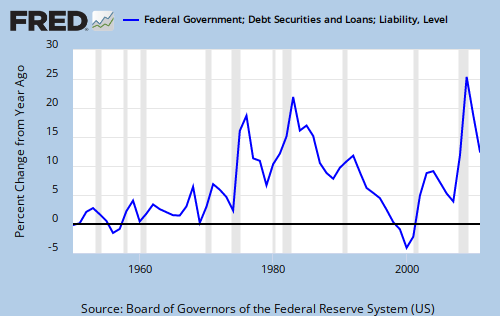
In other posts on this blog, we have discussed how reductions in federal debt growth, as shown by the following graph, “Federal Government Debt-Domestic Nonfinancial Sectors,” immediately precede recessions. This comes as no surprise, since a growing economy requires a growing supply of money, and deficit spending is the federal government’s method for adding money to the economy.

Federal debt
FEDERAL GOVERNMENT DEBT- PERCENTAGE CHANGE FROM YEAR AGO

Clearly, federal debt/money growth is essential to keep us out of recessions. Yet, when we look at “Debt Outstanding Domestic Nonfinancial Sectors” which includes not only Federal debt, but also outstanding credit market debt of state and local governments, and private nonfinancial sectors we do not see the same pattern.

Total Nonfinancial Debt
TOTAL DOMESTIC NONFINANCIAL DEBT — PERCENTAGE CHANGE FROM YEAR AGO

In fact, when we subtract federal debt from total debt, leaving only state, local and private debt, we see the opposite pattern. Recessions more often seem to follow increases in state, local and private debt.


STATE, LOCAL AND PRIVATE DEBT, PERCENT CHANGE FROM YEAR AGO

Now in one sense, money is money. Your buying on your credit card creates debt/money, just as federal deficit spending creates debt/money. Presumably, both should have the same stimulative effect on the economy. They do, but not long term. Why?

Because, unlike the federal government, you, your business and local governments cannot create new money endlessly to service your debts. Your debts can pile up to the point where you must liquidate them by paying them off or by going bankrupt. When non-federal debts become too large, a growing number of people, states, cities and businesses must pull back and stop further borrowing, i.e. stop creating money, or even destroy money by paying off loans. When that happens, we have a recession.

(As an aside, this is one reason the early stimulus efforts had so little effect. People used the stimulus money to pay off loans, so while the federal deficit spending created money, the loan pay-downs destroyed it. Debt reduction destroys debt/money.)

During the recession, and for a short time after, we tend to cut back on our personal borrowing and liquidate debt/money. Then we begin to resume borrowing, more and more, until again, we hit our personal limits and cut back, causing yet another recession. The sole prevention of this cycle, which averages about 5 years in length, is to make sure that federal deficit spending grows sufficiently to offset periodic money destruction by the private sector.

In summary, federal deficit spending is good for the economy, always good, endlessly good (up to the point of inflation). Private and local government spending/borrowing also is good, but not endlessly. Unlike the federal government, the private and local-government sectors eventually reach a point where debt is unaffordable and unsustainable.

To prevent recessions, the government continuously must provide stimulus spending, then provide added stimulus spending to offset the periodic reduction of money creation by the private sector.

Rodger Malcolm Mitchell
Monetary Sovereignty


==========================================================================================================================================
No nation can tax itself into prosperity, nor grow without money growth. Monetary Sovereignty: Cutting federal deficits to grow the economy is like applying leeches to cure anemia. Two key equations in economics:
Federal Deficits – Net Imports = Net Private Savings
Gross Domestic Product = Federal Spending + Private Investment and Consumption + Net exports

#MONETARY SOVEREIGNTY